Pedersen Device · Volume 5
The Mark I Rifle, and Telling Them Apart
The Army's own list of seven changes to the M1903, what each one does, why the port stayed when the sear and cut-off went, and how to tell a standard M1903 from an original Mark I, a converted Mark I and a rifle with a port cut later, plus the markings on a genuine device
5.1 The Army’s list of changes
The manual’s Plate 5 is the primary list. Its title reads “(Springfield) Model of 1903 Rifle Modified To Caliber .30 Model of 1918 Pistol. Changes made on Rifle to take pistol”, and it lists seven:
Table 1 — The manual's Plate 5 is the primary list. Its title reads "(Springfield) Model of 1903 Rifle Modified To Caliber .30 Model of 1918 Pistol. Changes made on Rifle to take pistol", and it lists seven
| Change, in the manual’s words | Shown | |
|---|---|---|
| a | Cut in stock of rifle – left hand side | (A) |
| b | Cut in receiver left side for ejection | (B) |
| c | Cut in Cut-Off | (C) |
| d | Cut to lengthen sear slot – sear altered | (D) |
| e | New design cut-off spindle added | (E) |
| f | New design trigger lever | not shown |
| g | Cut on trigger | not shown |
Source: the manual, Plate 5.1
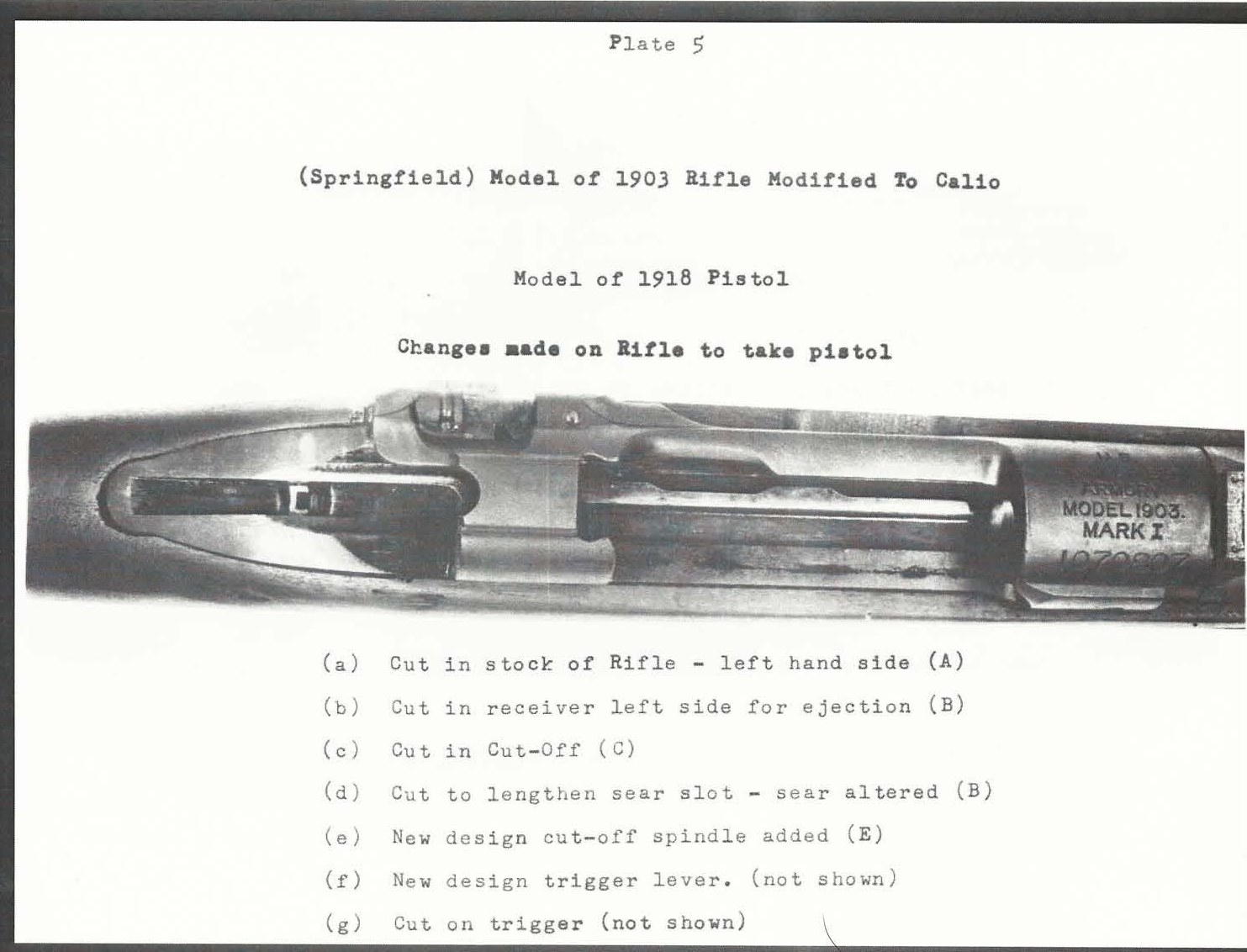
Three of the seven are cuts in parts every M1903 has (stock, receiver, trigger). Two are altered parts (the cut-off with its cut, and the sear with a lengthened slot). Two are new parts (a new cut-off spindle and the trigger lever). Hatcher’s shorter list is the same in substance: the rifle needs “the ejection port in the receiver”, “two grooves in the magazine cut-off, and a little kicker in the sear”.2 Canfield: “a left-side ejection port, a modified sear, trigger, and magazine cut-off, and a ‘Mark I’ receiver marking”.3 The marking is the eighth difference, and not on the Army’s list because it changes nothing mechanical.
5.2 What each change does
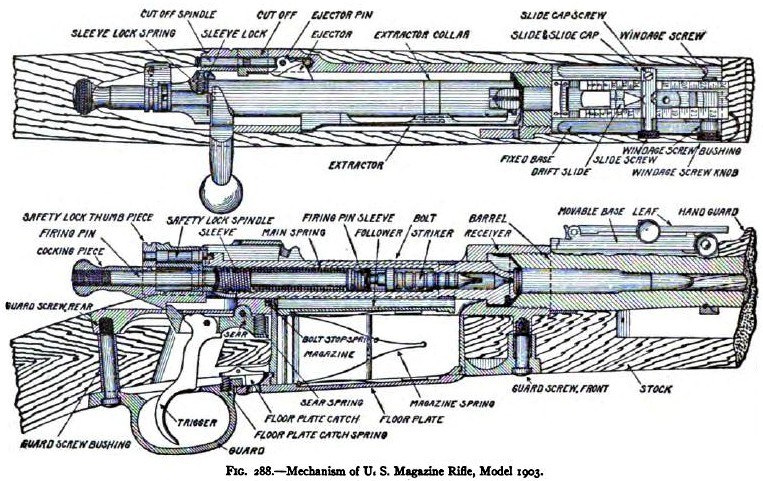
The receiver port (b) is the only exit for the empty case. The device ejects to the left through a port in its own frame, and “a corresponding port must be cut in the receiver of the rifle”.2 It is a long oval slot through the left wall of the receiver, ahead of the cut-off.
The stock cut (a) gives the cases room to clear the wood below the port. Rock Island Auction describes it on two original rifles as “the indentation below the oval receiver ejection port”; another Rock Island lot calls it a “clearance cut below the left of the receiver”.45
The cut-off cut (c) and new spindle (e) make the magazine cut-off into the lock that holds the device in the receiver. On a standard M1903 the cut-off turned down (“OFF”) stops cartridges rising from the magazine, so the rifle can be loaded singly, and it is also the bolt stop. On the Mark I, turned down with the device in place, it “holds the frame of the pistol from moving rearward”.1 Hatcher describes the result as a cut-off with “two grooves” in it.2 Rock Island Auction describes an original as a “special first variation two-lug magazine cut-off”, citing page 155 of William Brophy’s The Springfield 1903 Rifles,6 which implies at least one later variation. Brophy was not available for this dive, so the variations cannot be described here.
The sear slot (d), the trigger lever (f) and the trigger cut (g) make the rifle’s trigger work the device. The Mark I’s sear carries a small pivoted lever. When the rifle’s trigger is pulled, the top of that lever moves forward against a shoulder under the device and releases the device’s own sear (Volume 4). Hatcher: “A little pivoted lever in the sear of the rifle fits in the notch in the bottom of the device”.2 Culver calls the assembly a “tripper sear” and says it “would function with either the M1903 utilizing the standard bolt or with the Pedersen Device in place”.7 A Poulin Auctions description calls it “a new trigger with a double sear”.8
5.3 What the changes did not do
Hatcher: “These modifications do not injure the rifle in any way for regular shooting with the full-powered cartridge, and the Mark I rifle is just as good for all other purposes as any other rifle.”2 The manual assumes as much: if the device fails in action, “the soldier may restore the hand bolt to his rifle and proceed with magazine fire using the regular (Model ‘06) cartridges”.1
On strength, Culver says the port, “far from weakening the receiver was judged to provide additional gas relief in the event of an overload or pierced primer”, and that “All Mark I receivers were of the double heat treated variety, thus assuming correct headspace, the Mark I Springfield is an extremely safe rifle to shoot.”7 Culver does not define “double heat treated”; the National Park Service’s serial table records that Springfield Armory’s improved heat treatment began at receiver serial 800,000, and every Mark I is well above that number.9 Culver gives no source for the gas-relief judgement, and it is reported here as his. A Mark I is a century-old rifle, and the Headspace dive and the M1 Garand dive’s volume on maintenance and gauging, which covers the same cartridge, apply to it as to any .30-06 service rifle.
5.4 Original and converted Mark Is
From 1937, the Army recalled the Mark Is to Springfield Armory and put them back to standard: Hatcher says “by the removal of the special sear and the cut-off with grooves in it to hold the device in place. The ejection port on the rifle remained, together with the wording Mark I”.23 So two kinds of Mark I exist:
- Converted. Port, stock cut and “MARK I” marking; standard M1903 sear, trigger and cut-off. Most surviving Mark Is are of this kind (Volume 3). A converted Mark I will not take a device: there is nothing to lock it in and nothing to fire it.
- Original configuration. Port, stock cut and marking, plus the Pedersen sear with its trigger lever, the cut trigger, and the grooved cut-off and new spindle. These are the rifles auction houses describe as having the “correct Pedersen magazine cut-off” and “correct Pedersen trigger sear”.4 Some are original from 1919; some will be converted rifles later refitted with original or reproduction parts. Rock Island Auction describes one Mark I as “arsenal refurbished” yet still with “the Pedersen device type sear and cut-off lever”, which shows the categories blur.5
5.5 Telling them apart

Table 2 — Telling them apart
| Feature | Standard M1903 | Mark I, converted | Mark I, original configuration | Where to look |
|---|---|---|---|---|
| Oval slot in left receiver wall | No | Yes | Yes | Left side, ahead of the cut-off |
| Relief cut in stock below the slot | No | Usually, if the stock is original to the rifle | Yes | Left side of the stock below the port |
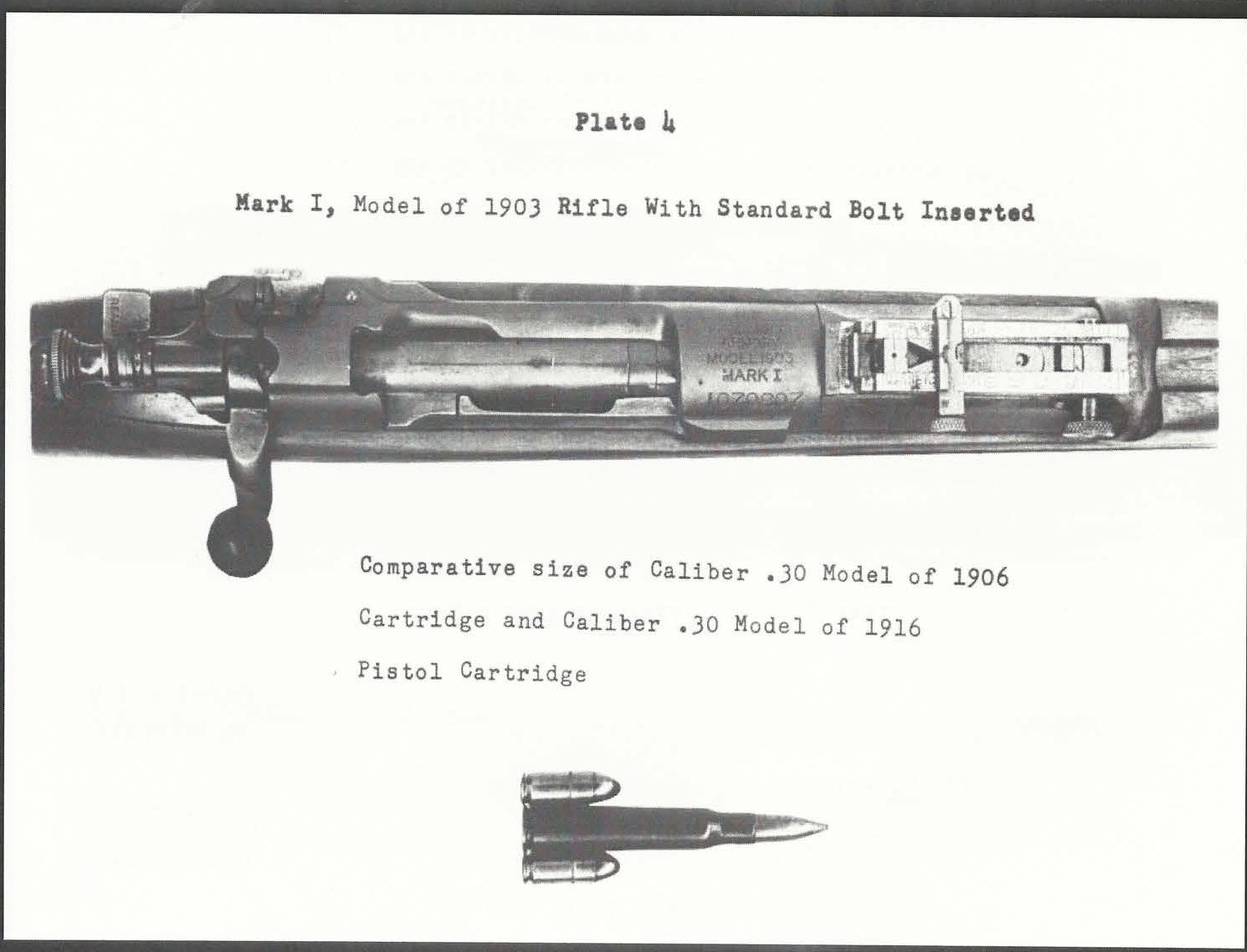
| ”MARK I” in the receiver ring marking | No | Yes | Yes | Top of the receiver ring, under “MODEL 1903.” |
| Sear with a pivoted trigger lever | No | No | Yes | Remove the stock; the sear under the receiver |
| Trigger with an extra cut | No | No, if the trigger was replaced | Yes | Trigger, in the guard |
| Cut-off with grooves, new spindle | No | No | Yes | Left rear of the receiver; turn it to the middle and look |
| Takes and fires the device | No | No | Yes | Only with an original or correctly made device |
Sources: the manual’s Plate 5, Hatcher, Canfield, Rock Island Auction.1236
A stock is the least reliable of the indicators. Stocks were swapped at every overhaul, so a Mark I may wear a plain stock and a standard rifle may wear a Mark I stock. The receiver port and marking cannot be swapped.
5.6 The device itself
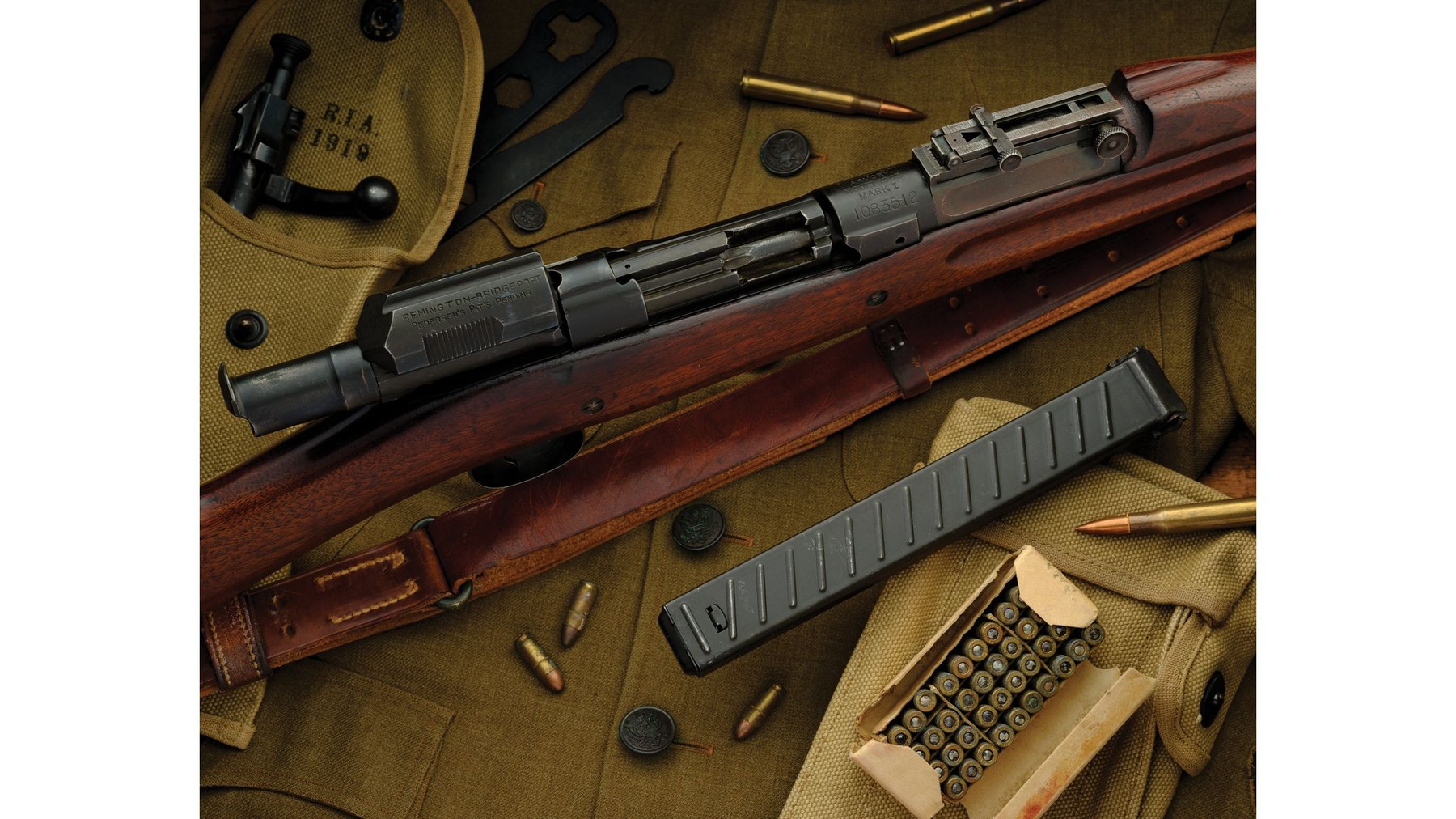
A genuine device carries markings that, on every example described in the sources found, follow one pattern. Rock Island Auction: on the left, “U.S.A. 1918-MARK I” over the serial number in two lines; on the right, “REMINGTON-BRIDGEPORT / PEDERSEN’S PAT’S. PENDING”.64 Poulin Auctions puts the same two markings on the top right and top left of the slide.8 The visible features:
- The slide handle: a raised, ribbed block on top of the device, the “lump” Hatcher saw run back and forth (Volume 4).
- The barrel nut at the front of the frame and the barrel projecting from it, shaped to fill a .30-06 chamber.
- The frame cap at the rear, round, with the frame cap lock.
- The magazine: a long tube with stamped diagonal ribs and a row of holes and numerals on its rear edge, the “register index”. Poulin describes “cartridge-counting holes on the back edge”.8
- The scabbard: sheet steel, ribbed, with a hinged cap and a belt hook (Volume 2).
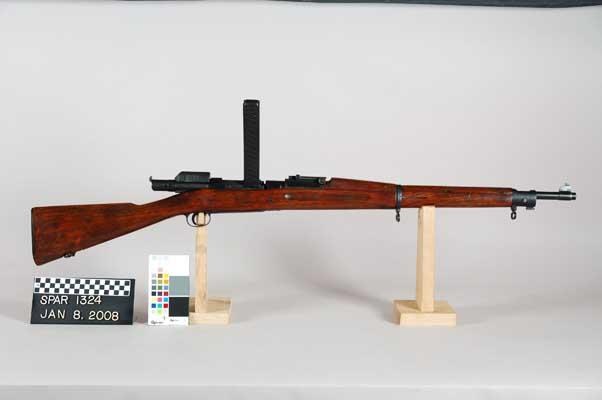
No reproduction device was found on sale in a search on 19 October 2026, and none of the sources found describes one. Any device offered should be checked against these markings and against the manual’s plates part by part (Volume 6 reproduces the plates). Fire scale on a device or magazine is consistent with the 1931 burning (Volume 3), not evidence against originality.
The Mark II for the M1917 Enfield and the Mosin-Nagant prototype were made only as tool-room models (Volume 2); no example was found described in a sale.
5.7 What a port alone does not prove
An oval slot is easy to mill. A standard M1903 receiver with a port cut later is not a Mark I, and the receiver-ring marking is the test, since Springfield rolled “MARK I” into the ring at manufacture. The port, the stock cut and the marking should agree. If they do not, the rifle is something else.
5.8 What could not be established
- The cut-off variations Brophy describes on page 155 of The Springfield 1903 Rifles. The book was not available.
- Whether every Mark I receiver carries “MARK I” in the same position and form. Every example seen here does.
- The exact form of the Pedersen sear and trigger lever, in a photograph. The manual’s Plate 5 says they are “not shown”, and no clear photograph of the parts out of the rifle was found.
- Whether the stock cut was made on every Mark I stock, or only on stocks fitted at Springfield in 1918–1920.
References
Footnotes
-
Notes on Caliber .30 Model of 1918 Pistol, CONFIDENTIAL, Small Arms Division, Ord. Dept., Machine Gun Section; S. G. Green, Captain. Undated. Chapters III and VIII; plates IV and V. Internet Archive, https://archive.org/details/pedersen-device-manual (accessed 2026-10-19). ↩ ↩2 ↩3 ↩4
-
Julian S. Hatcher, Hatcher’s Notebook, chapter XV, “The Pedersen Device”, https://archive.org/details/Hatchers_Notebook (accessed 2026-10-19). ↩ ↩2 ↩3 ↩4 ↩5 ↩6 ↩7
-
Bruce N. Canfield, “The Pedersen Device: A Secret Weapon of WWI”, American Rifleman, 17 July 2020 (print June 2003), https://www.americanrifleman.org/content/the-pedersen-device-a-secret-weapon-of-wwi/ (accessed 2026-10-19). ↩ ↩2 ↩3
-
Rock Island Auction Company, 26 August 2023, lot 1336, https://www.rockislandauction.com/detail/89/1336/us-springfield-1903-rifle-with-pedersen-device-and-accessories (accessed 2026-10-19). ↩ ↩2 ↩3
-
Rock Island Auction Company, sale 5029, lot 663, “U.S. Springfield Model 1903 Mark I Bolt Action Rifle”, https://www.rockislandauction.com/detail/5029/663/us-springfield-model-1903-mark-i-bolt-action-rifle (accessed 2026-10-19). ↩ ↩2
-
Rock Island Auction Company, 27 August 2022, lot 1458, https://www.rockislandauction.com/detail/86/1458/us-springfield-1903-rifle-with-pedersen-device-and-accessories (accessed 2026-10-19). ↩ ↩2 ↩3
-
Dick Culver, “The Pipsqueak Pistol That Never Was”, Civilian Marksmanship Program, Internet Archive copy of 27 March 2012, https://web.archive.org/web/20120327162014/http://www.odcmp.co/Services/Rifles/pipsqueak_pistol.htm (accessed 2026-10-19). ↩ ↩2
-
Poulin Auctions, Summer 2026 Premier Firearms & Militaria Auction, lot 26-29, https://www.poulinauctions.com/2026/06/14/highly-sought-after-u-s-wwi-era-remington-semi-auto-pedersen-device/ (accessed 2026-10-19). ↩ ↩2 ↩3
-
Springfield Armory National Historic Site, “U.S. Springfield Model 1903 Production”, https://www.nps.gov/spar/learn/historyculture/u-s-springfield-model-1903-production.htm (accessed 2026-10-19). ↩
Comments (0)