Hyper-Burst Mechanisms · Volume 7
Why It Did Not Spread, and Who Can Own One
Cost, complexity, maintenance and the field record of the G11 and the AN-94, each claim attributed; what survives and where; and the legal position in the United States and Michigan, where every one of these rifles is a post-1986 machine gun
7.1 The question
Two rifles reached the point of issue: the G11, approved for introduction by the Bundeswehr in 1992 and never bought in quantity, and the AN-94, adopted by Russia in the 1990s and bought in small numbers. No army anywhere now fields a hyper-burst rifle as its standard weapon. This volume collects the reasons the sources give, attributes each, and keeps the documented reasons apart from the inferred ones.
7.2 Reason one: the measured case collapsed
The strongest reason is the one in Volume 6. The case for every salvo weapon rested on a large soldier’s aiming error that a pattern of shots could cover. When the US Army measured aiming error directly in 1990, it was smaller than assumed, the bursts were larger than designed, and no salvo rifle hit more often than the M16A2. The Army concluded that “It is unlikely that sufficiently small burst sizes could be obtained and controlled to effectively improve performance with the aiming errors now known to exist.”1
That conclusion was published in a limited-distribution report, but its result was known to the governments involved. In May 1990 the German government told the Bundestag it had no ACR comparison results yet;2 by the following January the G11 was off the Bundeswehr’s procurement list.3 No document found links the two decisions, and the German government’s stated reasons were not found. The sequence is recorded here without a causal claim.
The Soviet and Russian record contains no equivalent measured test that has been published. The AN-94 won its competition on trials that, by every account, favoured it for short bursts from unstable positions; Volume 6 sets out why those claims cannot be compared with the American data.
7.3 Reason two: cost
Table 1 — Reason two: cost
| Item | Figure | Source |
|---|---|---|
| G11 development from the federal budget, 1974 to 1989 | 84.1 million marks | Der Spiegel, January 19913 |
| G11 development, pre-series and series preparation | Over 140 million marks, as claimed by the Greens; the government answered “Nein” only to the question whether it was the most expensive rifle ever | Drucksachen 11/6920 and 11/705542 |
| Start of G11 series production | 30 million marks in the 1990 budget; 30 million more planned for 1991 | Drucksache 11/70552 |
| Replacing the G3 with the G11 | ”weit über eine Milliarde Mark”, well over a billion marks | Der Spiegel, 1987, quoting the defence ministry5 |
| G11 and ACR ammunition | ”This round is, and will continue to be expensive to produce”; its HMX propellant came in the US from a single plant | US Army ACR report1 |
| AN-94 relative to the AK-74M | ”some sources said that AN-94 was about 3 times more expensive” | Popenker, unnamed sources6 |
| AN-94 | ”дорогим в производстве и конструктивно сложным изделием”, expensive to produce and structurally complex | RT, attributing the view to experts7 |
The G11 cost problem was not the rifle alone. Its ammunition was a new industrial product. The US Army explained that the propellant’s basic constituent was “a polymorph of HMX not normally considered to be an end product here in the United States”, obtainable only from the Holston Army Ammunition Plant’s modified Bachmann process, whose capacity was committed to other products, and that other constituents were “extremely hazardous to synthesize”. The bullet itself had to be made to close tolerances because of how it entered the bore.1 A NATO army adopting the G11 would have been adopting a new cartridge industry, outside the 5.56 mm standard its allies used.
The AN-94’s cost problem was different. It used the existing 5.45 mm cartridge, so the expense was in the rifle: the moving firing unit, the housing it slides in, the two-stage feed with its cable, pulley and rammer, and the dual-rate fire control. The “three times” figure is Popenker’s report of unnamed sources and should not be repeated as a fact.
7.4 Reason three: complexity, maintenance and training
The sources are consistent that both rifles were harder to keep running than the rifles they were meant to replace.
The G11. The US Army’s words: “As the mechanism is so very complex, H&K has decided that the soldier will not normally open the plastic housing of the weapon except for cleaning.” The rotating chamber needed a cam plate and levers that were “the basic source of the weapon’s complication”, a dud-clearing system that worked reliably but was “very complex”, and a sealed housing that had to be redesigned “to withstand … recurring initiations” of propellant gas.1 The rifle had no iron sights in its ACR form, and its cook-off limit restricted it to 135 rounds before cooling in the 1990 trials (Volume 4).1 Against that, the Army found it “highly reliable” in the field, with most stoppages caused by ammunition.1
The AN-94. Popenker lists unusual ergonomics, disassembly and maintenance “more complicated than AK-74”, small controls, a folding stock that fouled the trigger, and a rear sight whose small apertures clogged with mud or snow.6 RT quotes a reserve officer and firearms instructor, Vladimir Kurta: “для солдата срочной службы такой автомат однозначно не подойдёт. Например, ему будет очень тяжело запомнить схему сборки и разборки АН-94. Это сложное оружие”, for a conscript such a rifle is clearly unsuitable; he would find it very hard to remember how to strip and reassemble it.7 Forgotten Weapons calls the rifle “very complex and quite expensive”.8
Both rifles also demanded something new of the soldier. The G11’s whole argument was that its pattern did not depend on training; the Bundeswehr’s own placard lists “vereinfachte Schützenausbildung”, simplified training, as an achievement.9 The AN-94, by contrast, rewards a particular technique: RT quotes a Kalashnikov test shooter that it must be fired relaxed, without resisting the recoil, unlike an AK.7 A rifle that needs a different technique from the one an army already teaches has a training cost too.
7.5 Reason four: the end of the Cold War
Both programmes reached the point of procurement just as the money disappeared.
- Germany. The government’s answer of May 1990 had procurement starting in the 1990 budget and planned around replacing the G3 up to 2002.2 By January 1991 Der Spiegel described Oberndorf as “eines der ersten Opfer der Ost-West-Entspannung”, one of the first victims of East-West détente, with H&K facing ruin since the G11 was struck from the list.3 The same article describes a defence ministry that no longer wanted much to do with the firm.
- Russia. Popenker’s account of the AN-94 is that “due to bad economical and political shape of the Russia … available funds for military were rather short, and relatively few rifles were purchased”, and that Nikonov’s death in 2003 ended its further development.6 Profil says that the 1990s gave the new rifle no time for the kind of refinement the AK had had.10
Neither government’s official reasons were found in a primary document. Secondary sources commonly add NATO standardisation as a reason for the G11’s cancellation; the German government’s 1990 reply says only that it “fördert aus grundsätzlichen Erwägungen Bemühungen um Standardisierung im Bündnis”, supports efforts at standardisation within the alliance on principle.2 That is consistent with the explanation but does not state it.
7.6 Reason five: better sights did the job more cheaply
Profil’s 2019 article ends with a judgement about both sides of the Cold War: “По обе стороны океана пришли к выводу, что не надо пытаться создать «вундерваффе» … А эффективность огня из того же АК можно повысить за счет улучшения эргономики и размещения современных прицельных приспособлений”, that on both sides of the ocean the conclusion was not to try to build a wonder weapon, and that the effectiveness of fire from the same AK could be raised by better ergonomics and modern sights.10
The American record supports the first half. The ACR report found the M16A2’s baseline “better than anticipated”, replaced the Army’s estimates of rifle hit capability with its new data, and noted that the M16A3 under development would carry an optic as its primary fire control.1 In its own field experiment, though, optics showed no advantage over iron sights at intermediate range for most systems,1 so the report itself does not prove the second half of Profil’s judgement.
7.7 The field record
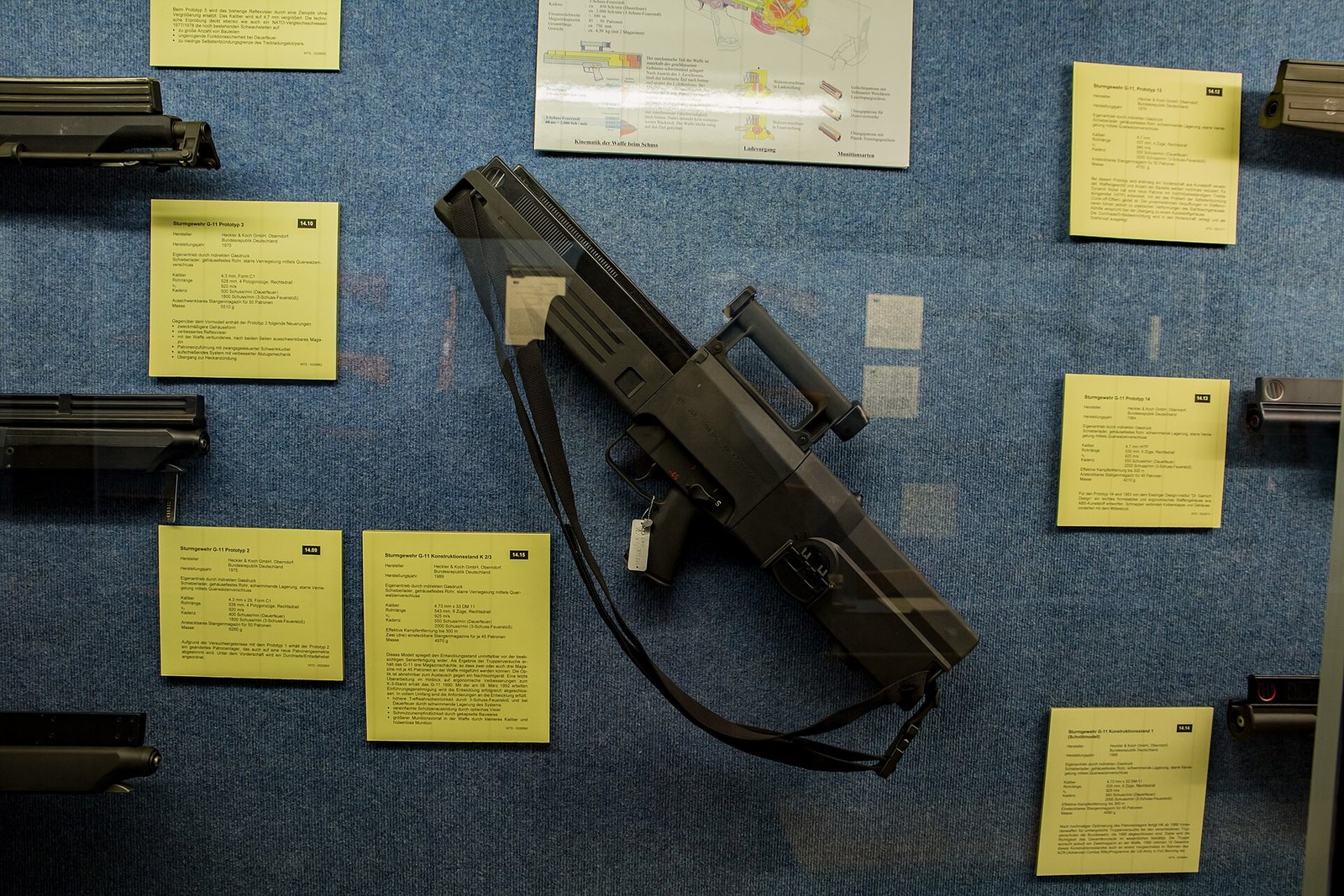
The G11 was never issued outside trials. The Koblenz placard records pre-series rifles in troop trials at the Bundeswehr’s branch schools from 1988 to 1990, and fifteen K1 rifles in the American ACR experiment in 1990.9 No combat use is recorded in any source found. When SPD deputies asked in 1993 how many G11s existed and where, the government answered only in a classified letter.1112 No reliable total of rifles built has been published.
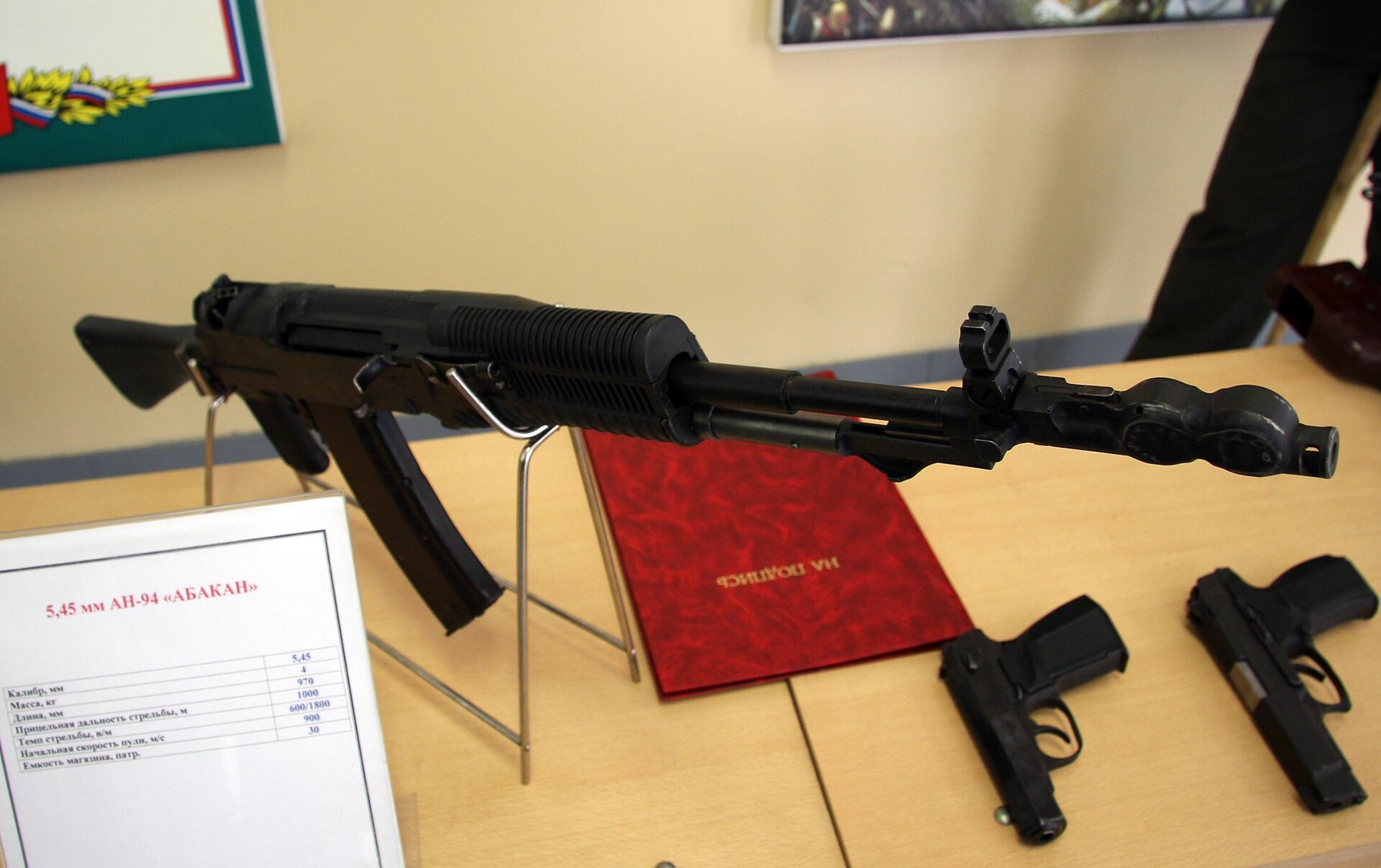
The AN-94 was issued, but narrowly. Forgotten Weapons says that it “has not seen extensive service” and is not being widely issued.8 RT says that “из открытых источников следует, что сейчас детищем Никонова вооружены некоторые спецподразделения и отдельные армейские части”, open sources indicate that some special units and individual army units carry it, and quotes an unnamed account that the army was at first unenthusiastic and the FSB and Interior Ministry special units took it first.7 Russian Wikipedia lists the Vityaz detachment, the DON division, Izhevsk SOBR, Alpha and the prison service’s special units as users, with citations of uneven quality;13 those are not confirmed here. Popenker’s estimate of 10,000 to 20,000 bought and his report of exports to Kyrgyzstan and Belarus are given without sources and are not confirmed.6 Photographs such as the one at the head of this volume, from a motor rifle brigade’s display in 2009, show that some regular army units held the rifle. By 2018, Popenker notes, the Russian Army had adopted two new conventional 5.45 mm rifles, the AK-12 and the A-545, and the AN-94 was “entirely out of favor”.6
7.8 What survives, and where
The surviving G11s and AN-94s are institutional objects. The museum collections documented in freely licensed photographs are:
- Wehrtechnische Studiensammlung, Koblenz (the Bundeswehr’s study collection): a run of G11 prototypes from 1974 to the K 2/3 standard, including a sectioned rifle, displayed with placards (Volumes 3 and 4).9
- M. T. Kalashnikov Museum and Exhibition Complex, Izhevsk: Nikonov’s NA-4, the AS of 1983 and 1984 and the ASM, in a case devoted to the Abakan competition, beside a case of balanced-automatics prototypes.14
- National Infantry Museum, Fort Benning (now Fort Moore), Georgia: Commons holds photographs captioned as an AAI ACR at the museum and a museum case of ACR test rifles; their resolution is too low to reproduce here, and the case’s contents were not confirmed.
- Springfield Armory National Historic Site and the NRA National Firearms Museum hold SPIW prototypes (Volume 2).
7.9 Who can own one in the United States
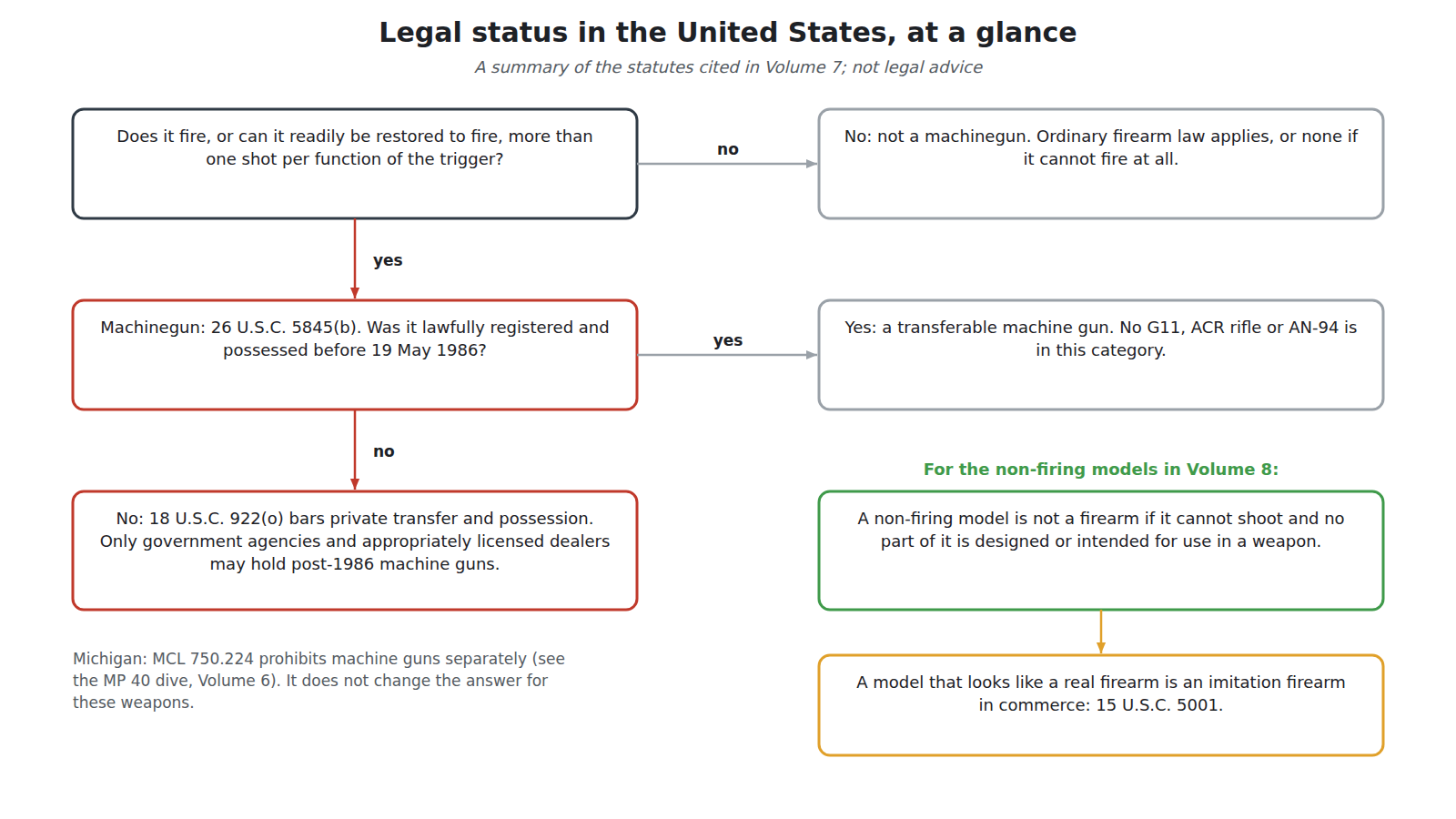
None of these weapons can be owned by a private citizen in the United States. The reasoning is short, and the hub’s MP 40 dive, Volume 6, sets out the law in full; it is not restated here beyond what applies specifically.
- They are machine guns. Federal law defines a machinegun as “any weapon which shoots, is designed to shoot, or can be readily restored to shoot, automatically more than one shot, without manual reloading, by a single function of the trigger”, including its frame or receiver and “any part designed and intended solely and exclusively, or combination of parts designed and intended, for use in converting a weapon into a machinegun”.15 A three-round burst, a two-round burst and automatic fire each fire more than one shot per function of the trigger.
- The production rifles were all made after 19 May 1986. Under 18 U.S.C. § 922(o), private possession and transfer of machine guns is limited to those lawfully possessed before that date. The G11 K1 and ACR rifles date from 1988 to 1990 and the AN-94 from the 1990s, so none can be in the transferable pool. The earlier prototypes, from the 1970s and early 1980s, are documented only as museum pieces in Germany and Russia; no record was found of any having been registered in the United States.
- Post-1986 examples, if any exist in the US, belong to the licensed or government holder. As the MP 40 dive explains, a post-1986 dealer sample belongs to the licensed business “and never becomes available to a private citizen”. Whether any G11 or AN-94 is held under that status in the United States could not be established; no public register lists machine guns by model.
- The ACR rifles were government test property. The US Army bought fifteen of each ACR candidate for the experiment.1 What became of them could not be established beyond the museum photographs noted above.
No semi-automatic civilian version of either rifle was found. The G11’s mechanism, with its floating system and three-round burst, and the AN-94’s, with its dual-rate fire control, are their reason for existing; neither maker offered a sporting derivative in any source found.
7.10 Michigan
Michigan prohibits machine guns separately, at MCL 750.224, with an exemption framed around federal licensing. The MP 40 dive quotes the statute and discusses its unresolved application to private registered owners; none of that matters for these weapons, since no private person can lawfully hold one federally. See MP 40, Volume 6, section 6.6.
7.11 Replicas and airsoft
No airsoft replica or non-firing replica of the G11 or the AN-94 was found on any maker’s own product page during the research for this dive. Searches for “G11 airsoft” return unrelated products from several makers that share the name “G11” but are not replicas of the Heckler & Koch rifle; they are not named here because their makers’ pages were not read. Toy and game models exist in quantity because the G11 appears in films and video games, but none was confirmed as a dimensionally faithful replica.
The practical alternative for someone who wants to understand these mechanisms is the one Volume 8 covers: a non-firing kinematic demonstrator, built to show how the motion works and incapable of firing. Any replica that looks like a real firearm is an “imitation firearm” under federal law (15 U.S.C. § 5001) with marking rules for commerce, as the MP 40 dive notes; a mechanism model that does not resemble a firearm is not.
7.12 The burden, compared
Table 2 — The burden, compared
| G11 / H&K ACR | AN-94 | M16A2 / AK-74 (for scale) | |
|---|---|---|---|
| Ammunition | New caseless round from a new propellant industry | Existing 5.45 × 39 | Existing standard rounds |
| Field cleaning | Major sub-assemblies only; housing not opened by the soldier | Field strip more complicated than the AK-74 (Popenker) | Routine field strip |
| Depot repair | Manufacturer only, in the 1989 manual | No manual found | Established |
| Firing limit | 135 rounds before cooling in the 1990 trials | None found | None comparable |
| Iron sights | None on the ACR rifle | Yes | Yes |
| Training | Claimed to need less marksmanship training | Needs a relaxed technique unlike the AK | Established |
| Measured hit benefit | None in the 1990 US experiment | No published measured trial | Baseline |
Sources: ACR Final Report; H&K ACR armourer’s manual; Popenker; RT.11667
References
Footnotes
-
Vernon E. Shisler and Stephen M. Mango, Advanced Combat Rifle (ACR) Program, Volume I, ACR Program Summary, ARCCD-TR-92001, US Army ARDEC, Picatinny Arsenal, February 1992 (DTIC AD-B162 942). Public digitised copy, https://municion.org/wp-content/uploads/2022/11/06-047-BGC-011-1.pdf, consulted 2026-10-18. ↩ ↩2 ↩3 ↩4 ↩5 ↩6 ↩7 ↩8 ↩9 ↩10
-
Deutscher Bundestag, Drucksache 11/7055, 3 May 1990, https://dserver.bundestag.de/btd/11/070/1107055.pdf, consulted 2026-10-18. ↩ ↩2 ↩3 ↩4 ↩5
-
“Weg ist weg”, Der Spiegel 3/1991, 13 January 1991, https://www.spiegel.de/spiegel/print/d-13488184.html, consulted 2026-10-18. ↩ ↩2 ↩3
-
Deutscher Bundestag, Drucksache 11/6920, 11 April 1990, https://dserver.bundestag.de/btd/11/069/1106920.pdf, consulted 2026-10-18. ↩
-
“Pulver im Turm”, Der Spiegel 31/1987, 26 July 1987, https://www.spiegel.de/spiegel/print/d-13525602.html, consulted 2026-10-18. ↩
-
Maxim Popenker, “Nikonov AN-94 Abakan assault rifle (Russia)”, Modern Firearms, https://modernfirearms.net/en/assault-rifles/russia-assault-rifles/an-94-abakan-eng/, consulted 2026-10-18. ↩ ↩2 ↩3 ↩4 ↩5 ↩6
-
Aleksei Zakvasin and Elizaveta Komarova, “«Выдающееся стрелковое изделие»: как создавался российский автомат сверхбыстрой стрельбы АН-94”, RT (Russian state broadcaster), 11 August 2020, https://russian.rt.com/russia/article/772592-an-94-abakan-nikonov, consulted 2026-10-18. ↩ ↩2 ↩3 ↩4 ↩5
-
Ian McCollum, “Rocket Surgery: Inside the Russian Nikonov AN94 (Video)”, Forgotten Weapons, 11 April 2017, https://www.forgottenweapons.com/rocket-surgery-inside-the-russian-nikonov-an94-video/, consulted 2026-10-18. ↩ ↩2
-
Wehrtechnische Studiensammlung, Koblenz, G11 display placards, read from Wikimedia Commons photographs by Clemens Vasters (2017, CC BY 2.0) and Bojoe (2009, CC BY 3.0), consulted 2026-10-18. ↩ ↩2 ↩3
-
Vladislav Grinkevich, “Что помешало советским конструкторам создать автомат будущего”, Profil, 10 September 2019, https://profile.ru/military/chto-pomeshalo-sovetskim-konstruktoram-sozdat-avtomat-budushhego-170553/, consulted 2026-10-18. ↩ ↩2
-
Deutscher Bundestag, Drucksache 12/4956, 13 May 1993, https://dserver.bundestag.de/btd/12/049/1204956.pdf, consulted 2026-10-18. ↩
-
Deutscher Bundestag, Drucksache 12/5240, 22 June 1993, https://dserver.bundestag.de/btd/12/052/1205240.pdf, consulted 2026-10-18. ↩
-
“АН-94”, Russian Wikipedia, revision 154133310, consulted 2026-10-18 (lead only). ↩
-
M. T. Kalashnikov Museum and Exhibition Complex, Izhevsk, display placards and case headings, read from Wikimedia Commons photographs by Vyacheslav Bukharov (2022, CC BY-SA 4.0), consulted 2026-10-18. ↩
-
26 U.S.C. § 5845(b), “Machinegun”, quoted from the statutory text at the Legal Information Institute, https://www.law.cornell.edu/uscode/text/26/5845, consulted 2026-10-18. ↩
-
Heckler & Koch, Armorers Manual for Maintenance and Repair of Rifle 4,92 mm, ACR, TD 2237, first draft, March 1989. Internet Archive, https://archive.org/details/1557677285551-2, consulted 2026-10-18. ↩
Comments (0)