Hyper-Burst Mechanisms · Volume 2
SPIW: Flechettes, Trounds and the First 2,000-Round Bursts
The US Army's Special Purpose Individual Weapon of the 1960s, read from the Ballistic Research Laboratories' own test reports: four prototypes, a three-barrelled rifle declared hopeless, a floating barrel that made no difference, and a controlled burst that beat the trigger finger by 30 percent
2.1 What SPIW was for
The Special Purpose Individual Weapon (SPIW) was the US Army’s attempt, through the 1960s, to put the SALVO findings of Volume 1 into one infantry weapon. It was meant to do two jobs from one stock: fire small, fast, low-recoil projectiles at point targets, and fire explosive “area” rounds at targets behind cover. The point-fire half is the part that matters here. It was built around the conclusion that a soldier could not be trained to hit reliably under stress, so the rifle should fire several projectiles for each trigger pull in a pattern sized to his aiming error.
The documentary record used in this volume is the Ballistic Research Laboratories’ (BRL) technical reports from Aberdeen Proving Ground, which are now public. They are a better source for the programme’s engineering than most published histories, because they record measured rates of fire, malfunctions and test methods, and because BRL was not shy about saying when a prototype did not work.
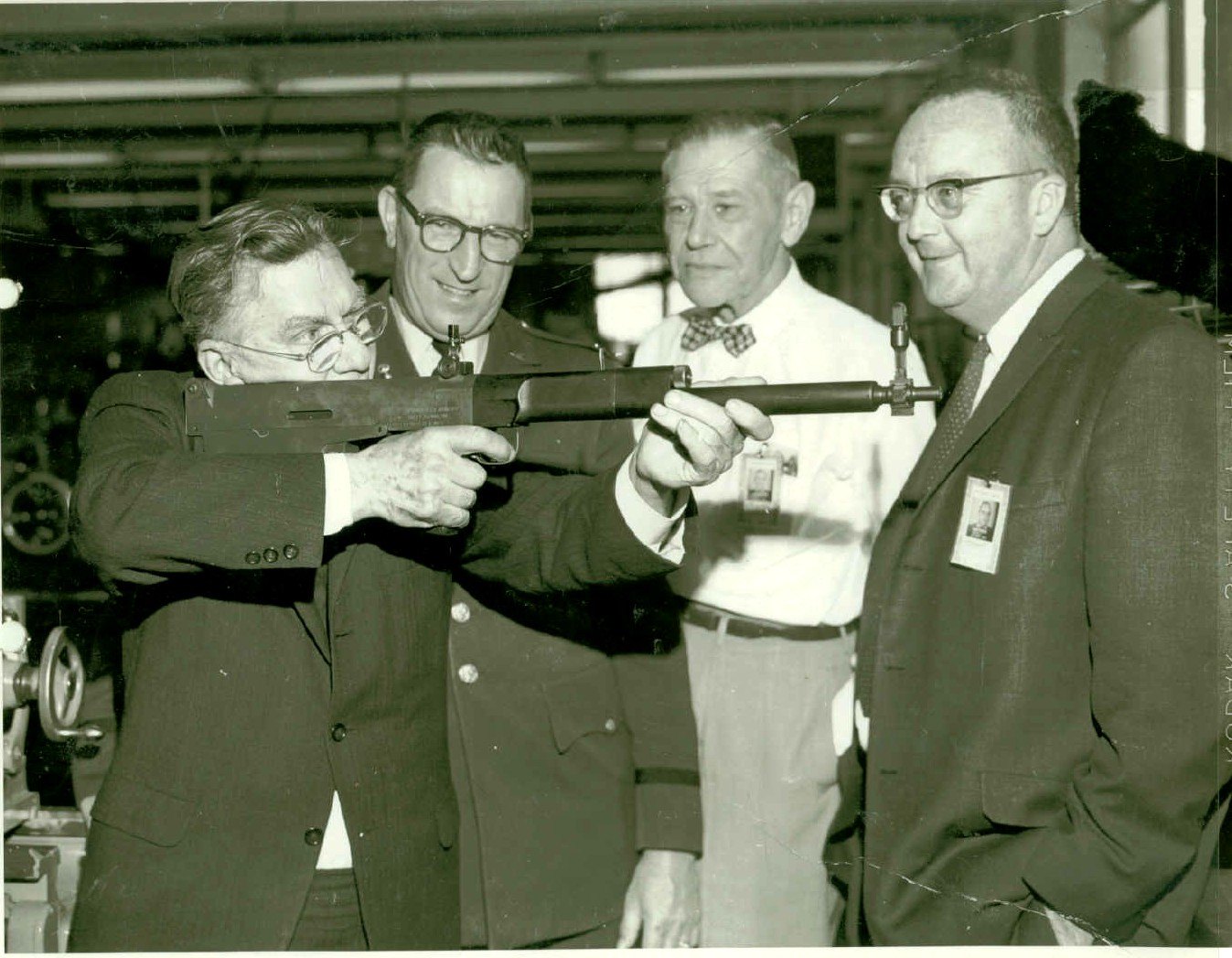
The hub’s M1 Garand dive, Volume 2 covers John Garand’s own involvement at Springfield Armory, including the photograph of him in April 1962 with the Springfield SPIW Concept #1 prototype, and that material is linked rather than repeated.
2.2 Why flechettes
A flechette is a small fin-stabilised steel dart, fired inside a sabot that falls away after the muzzle. For SPIW its attraction was low recoil impulse at very high velocity. The H&R proposal described its .217 sabot-flechette at 4,700 to 4,900 feet a second;1 the AAI flechette that descended from SPIW into the 1980s weighed 10.2 grains and left the muzzle at 4,600 feet a second.2 A projectile that light gives very little recoil per shot, and low recoil per shot is the precondition for keeping a burst together.
Volume 1 showed that SALVO’s own flechette weapon, a 32-flechette shotgun load, produced the largest paper gain in 1956 and then proved of “such poor technical quality” in 1957 that no useful data were collected.3 SPIW’s flechettes were different: one dart per cartridge, fired in a burst, rather than many darts in one shell.
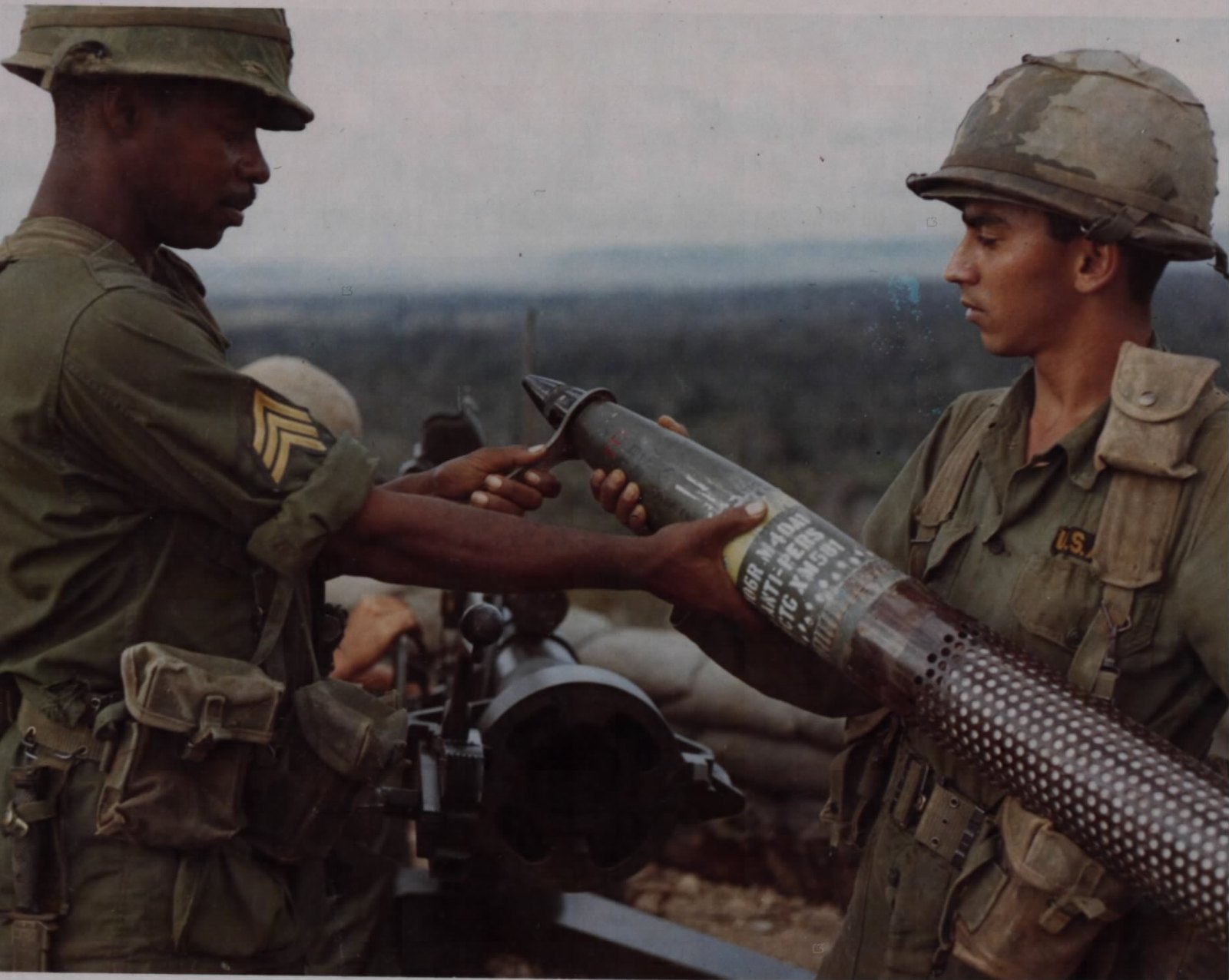
Flechettes were already in service in other forms. Artillery and recoilless-rifle “Beehive” rounds packed with thousands of flechettes were used in Vietnam; the US Army photograph below shows soldiers of the 1st Cavalry Division setting the fuze on one in 1967.
Their drawbacks also carried over, and Volume 6 shows them still unsolved in 1990: flechettes dispersed more widely from round to round than bullets, the sabot pieces were a hazard to friendly troops in front of the muzzle, and no satisfactory tracer existed.2
2.3 The competition, as BRL recorded it
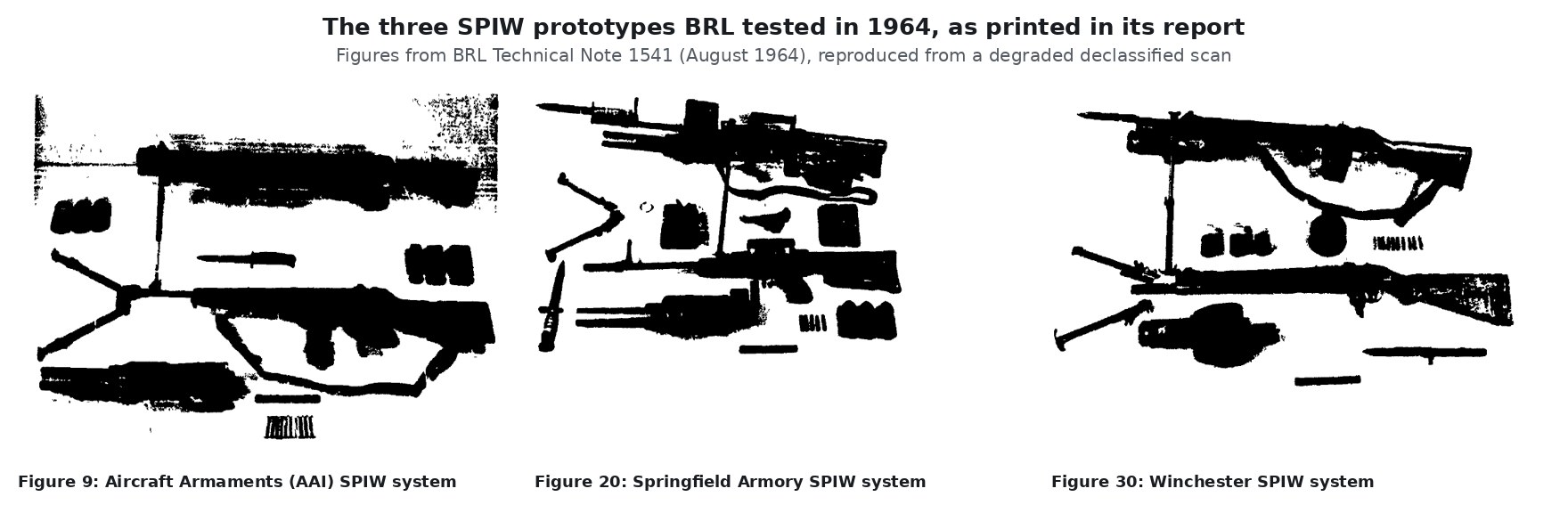
BRL’s August 1964 Kinematic Evaluation of the Special Purpose Individual Weapon Prototypes, by Richard P. Cronin, Stanley S. Lentz and Wallace M. Werner of the Interior Ballistics Laboratory, gives the selection history in its introduction:4
- In December 1962 the Army Weapons Command sent proposals from ten manufacturers to BRL for evaluation. BRL’s Interior Ballistics Laboratory recommended prototypes from Aircraft Armaments Incorporated (AAI) and from Winchester (Olin), and further research on a three-barrelled open-chamber weapon firing three cartridges simultaneously.
- An eleventh proposal later came from Springfield Armory.
- The Selection Committee chose AAI, Harrington & Richardson (H&R), Springfield Armory and Winchester “to each produce ten prototype weapons as presented in their proposals”.
- In early March 1964, three prototypes from each contractor were delivered to BRL for kinematic analysis.
- The M14 rifle and the “Cal. 0.223 automatic rifle M16” were fired as controls.
The kinematic study measured weights, impulses, cyclic rates and the overturning moments that make a rifle climb, and logged every malfunction. Its findings on each weapon follow.
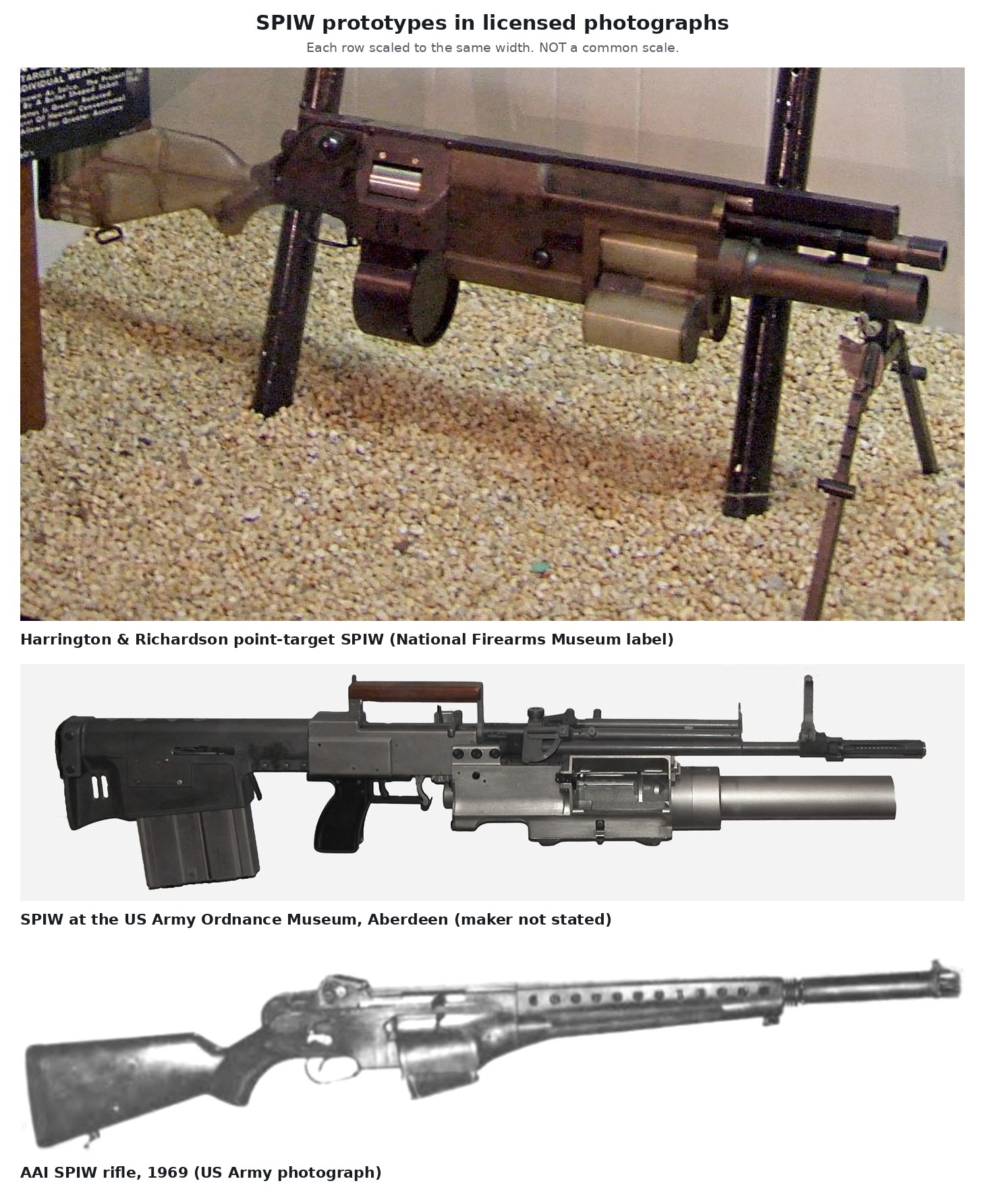
2.4 Harrington and Richardson: the tround salvo
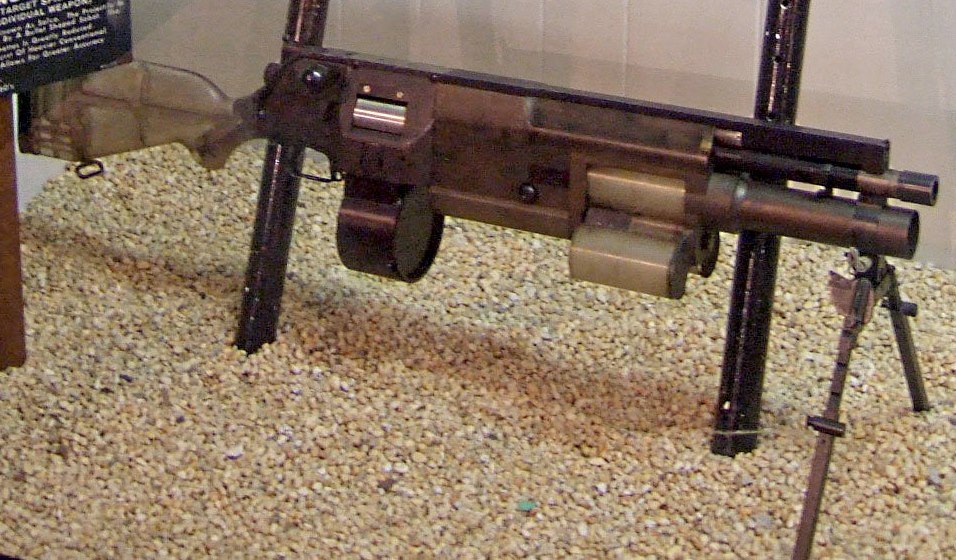
H&R’s entry was the purest simultaneous salvo of the programme. Its Phase I report of 17 May 1963 describes a rifle that fired “a salvo of three projectiles simultaneously out of a single plastic cartridge case containing a single primer and propellant charge”. The cartridge was triangular, a “Tround”, so that it indexed itself in a rotating open-chamber cylinder in front of a cluster of three light barrels: “the user aims once, fires once and three projectiles are on the way. This gives a much higher hit probability than a three (3) shot burst, as the three projectiles form essentially a circular pattern with a 3 to 5 mil spread.”1
The open-chamber principle meant there was no reciprocating bolt: the cylinder turned through 120 degrees to bring each tround in line with the barrels and to eject the empty case. Trounds were belted together with heat-sealed tape. In full automatic the rifle was to fire 300 to 500 trounds a minute, which H&R counted as “900 to 1500 projectiles per minute”. H&R gave its loaded weight, with 75 projectiles and three 40 mm grenades, as 10.05 pounds, and reported test firing of a plastic tround to 70,000 psi with no case damage.1
BRL’s verdict a year later was one word: “hopeless”. Its reasons were three:
“first, because of its excessive weight; second, because the mechanism could not be made to function; and third, because the three projectile round produced extreme variations in velocity and excessive dispersion in the target patterns. As a result, the Harrington and Richardson system was withdrawn from the program and given no further consideration.”4
The H&R rifle is the clearest example in this dive of the simultaneous branch’s problem. A cartridge that launches three projectiles at once has to launch them all at the same velocity and in a controlled pattern, and the tround did neither.
2.5 AAI: a piston in the cartridge
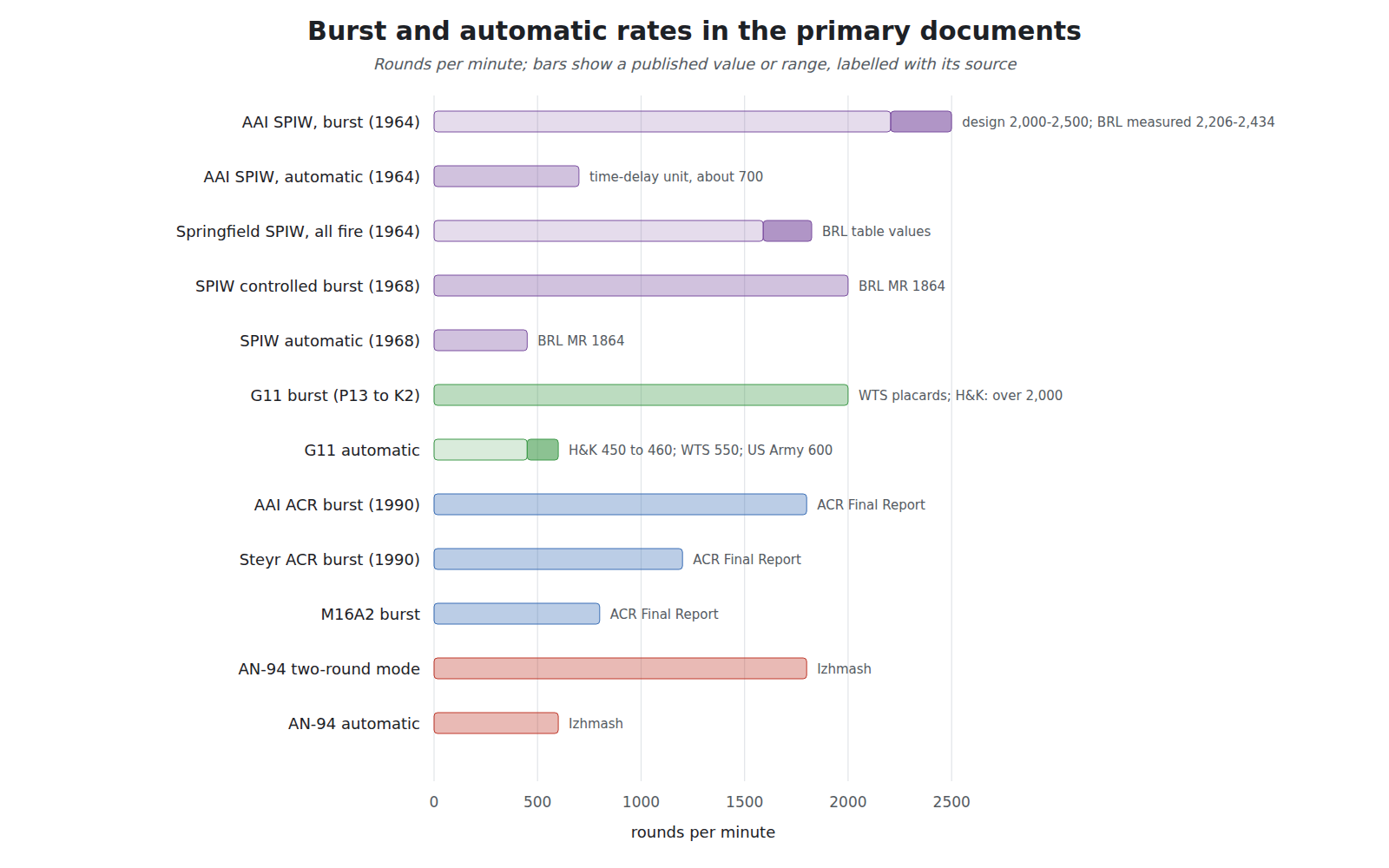
AAI’s point-fire weapon was the most radical of the serial designs and the one with the highest rate. BRL described it as “essentially gas operated, obtaining its energy for operation from the set back of a piston which is incorporated in the cartridge”: the firing pin struck a piston in the cartridge base, which set off the primer, and the gas pressure then drove the piston and firing pin rearward to unlock the bolt “with sufficient energy to cycle the mechanism at a rate of fire from 2000 to 2500 shots per minute in controlled three-round bursts”.4
BRL’s own measurements of three-round bursts from a machine rest bear this out. One table row records a maximum of 2,434, an average of 2,320 and a minimum of 2,206 shots per minute.4 For full-automatic fire, AAI fitted a time-delay mechanism, an inertia wheel and clock spring, that reduced the rate from over 2,000 to about 700 shots a minute (the description page gives 600 to 750). BRL did not expect it to last: “Based on past performance of the time-delay units of other weapons, its functioning is expected to be erratic and its life limited.” It had already failed on occasion, “particularly when hard extraction produces short bolt travel.”4
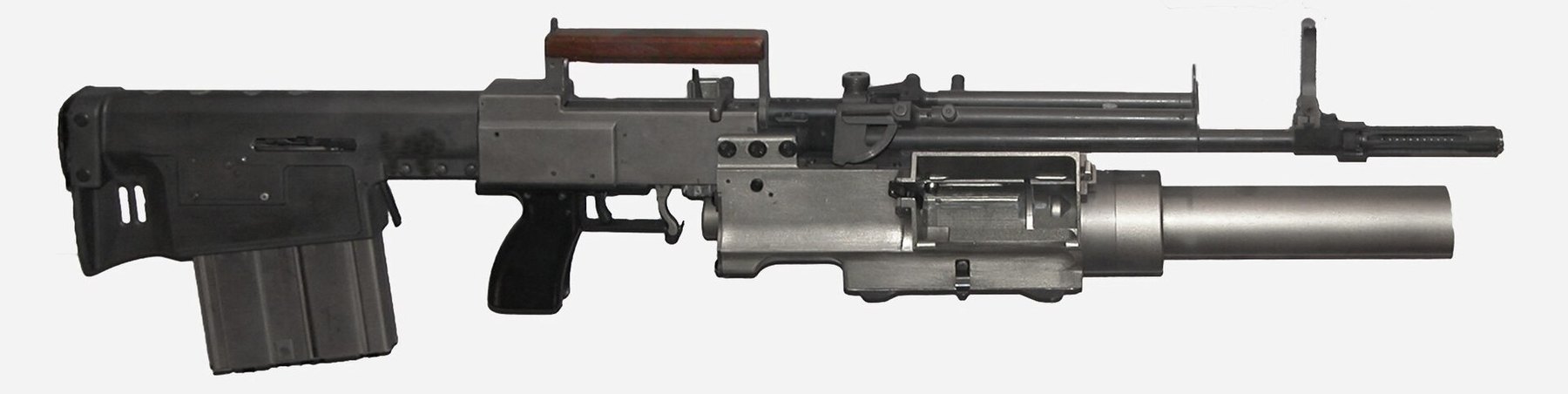
The AAI rifle fed from a 60-round plastic drum ahead of the trigger guard and carried a lever-action launcher for three 40 mm area rounds under the barrel.4 BRL’s list of its problems is a preview of every later high-rate design: ammunition that had to be lubricated and a chamber cleaned often to prevent case separations, lubricant that sludged the mechanism and magazine, a three-round selector likely to fail in dust and sand “because of its complexity”, and an extractor that broke. Among the desirable features, BRL judged that AAI’s selector and burst control “performs all functions but is complicated and has relatively short endurance capabilities”.4
2.6 Springfield Armory: one rate for everything
Springfield Armory’s weapon was conventional by comparison: a gas-operated rifle firing a conventionally primed cartridge, with a selector for semi-automatic, controlled three-round bursts and full automatic. It had no rate reducer, so bursts and automatic fire ran at the same cyclic rate, and a muzzle brake-compensator to reduce climb. Its 60-round box magazine sat behind the pistol grip, in a bullpup-like arrangement, and its area launcher, mounted rigidly under the barrel, was blowback-operated from a three-round box.4
BRL gives its rate as 1,500 to 1,750 shots a minute (read from the page image; the OCR text garbles it), and the report’s tables record Springfield bursts at roughly 1,600 to 1,800, with averages around 1,630 to 1,710.4 BRL thought Springfield’s cam-operated selector the most durable of the three, although it lacked automatic re-indexing and a low-rate feature, and that its sights were placed so high that “aiming is awkward unless the butt plate rests high on the shoulder”.4
2.7 Winchester: the floating barrel that did nothing
Winchester’s rifle is the reason this volume exists in a dive about hyper-burst. It was the first design in the documentary record built on the principle that the G11 and the AN-94 later made work: letting the firing parts recoil inside the stock so that the stock, and the shooter, feel the recoil later.
BRL described it as a gas-operated weapon that “employs a floating barrel-receiver system, which has erroneously been called a soft recoil system”. The barrel and receiver moved together relative to a stationary feed from a 60-round drum; a driving spring served as the bolt’s return spring, as the barrel-and-receiver recoil spring during unlocking, and as a booster for the firing pin; and a ratchet-spring friction device between the stock and barrel limited the barrel’s travel.4
BRL then explained, in 1964, exactly what such a system is supposed to achieve:
“The advantage of a floating barrel consists of having the momentum developed during the period the bolt is locked, not delivered directly to the stock but, delivered through the recoil springs to the stock along with the remainder of the momentum developed. This delays the attainment of the usual levels of velocity of the stock and thus results in less displacement in a given period of time.”4
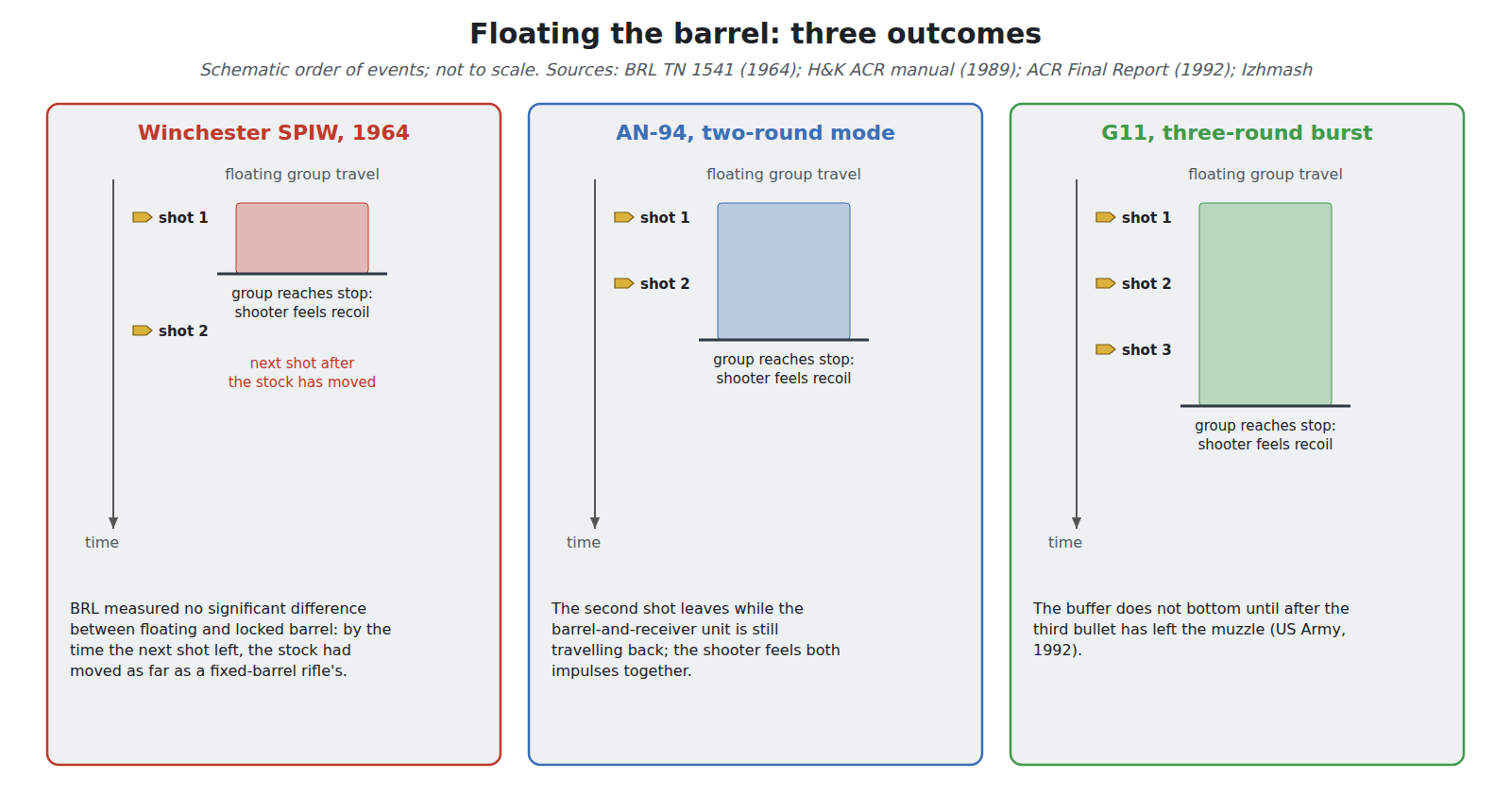
That is the hyper-burst argument stated by a government laboratory twenty years before the G11 was fielded in trials. And BRL tested it. The Winchester rifle was hung from parallel pairs of strings for a free-recoil study, a drum camera recorded the motion of the operating rod and the stock through three-round bursts, and the trigger was pulled by a solenoid so the experimenter did not disturb the gun. It was fired with the barrel floating and with the barrel locked to the stock, with loose and tight holds. The result:
“In both the loose and tight stances there is no significant difference between having the Winchester barrel locked or floating.”4
The floating barrel also caused most of Winchester’s malfunctions: failures to feed, to eject and to fire the first round, a firing mechanism that “lacks sufficient energy to fire the first round consistently”, and a three-round control that was “weak and poorly designed”. BRL’s recommendation was to “abandon the floating barrel-receiver design and attach the mechanism rigidly to the stock and incorporate a muzzle brake-flash hider-compensator attachment.”4
2.8 Why the floating barrel failed
BRL’s explanation of the failure is the most useful paragraph in the SPIW record for understanding why the later designs succeeded. The trouble was not the principle but the timing of the return stroke:
“However, if upon bolt return-to-battery of the bolt, the barrel is not attached to the stock, the full advantage of the forward impact is lost. This forward impact imparts a quantity of forward momentum equal to about half of that imparted through the recoil spring to the stock by the bolt. The displacement reached by the stock, at the time the next projectile leaves the muzzle, could be as great as that of a weapon with a fixed barrel.”4
In plainer terms: in a conventional rifle, the bolt slamming forward into battery gives the gun a forward kick that partly cancels the recoil before the next shot. In Winchester’s design that forward kick went into the floating barrel rather than the stock, so the stock had moved just as far by the time the next shot left as it would have with a fixed barrel. Floating the barrel delayed the recoil, but the burst was not fast enough, and the design did not keep the moving group free long enough, for the delay to matter.
Seen from the G11 and AN-94, the lesson is that a floating system alone is not enough. It has to be combined with a burst short and fast enough that every shot leaves before the floating group reaches the end of its travel, and with a buffer that holds the recoil until then. H&K’s floating system travelled roughly twice as far in a three-round burst as in single shots, according to its own armourer’s manual, and the US Army’s ACR report states that the buffer “does not reach its rearmost point of travel until after the third projectile has exited the muzzle” (Volume 4).52 Nikonov’s rifle fires only two rounds in its fast mode for the same reason (Volume 5).
2.9 What the kinematic study concluded
BRL’s 1964 study ended with a list of “desirable features” that, it said, none of the three working prototypes could incorporate “without extensive redesign”. Several of them describe the G11 and the AN-94 closely:
- The line of thrust should run as near the centre of the butt plate as possible, “to avoid an overturning couple which tends to raise the muzzle”; this is best done by placing the barrel and receiver low in the stock with much of the mechanism above the barrel. The G11 put its magazine above the barrel and its barrel low in a straight housing.
- The burst control should be “simple, positive and rugged”, with a low rate for full automatic and automatic re-indexing for three-round bursts. Both later designs combine a high burst rate with a lower automatic rate.
- The barrel should be stiffened, because BRL found that “natural frequency of barrel and cyclic rate of the gun have a phase relationship which can increase the amplitude of the barrel vibration to the detriment of accuracy.”4
That last point is a reminder that a fast burst is not automatically a tight one. At 2,000 rounds a minute the shots are about 30 milliseconds apart, and a barrel still ringing from the previous shot is part of the problem the designer has to manage.
2.10 Modes of fire: the 1968 study
The SPIW record’s best evidence on the value of a controlled burst is BRL Memorandum Report 1864, SPIW Modes of Fire, by F. W. Hall Jr, W. W. Sheldon, W. M. Werner and E. M. Wineholt, published in February 1968. By then the SPIW rifle being developed fired single-flechette cartridges with about 0.5 pound-seconds of recoil impulse, in three modes:6
- a controlled burst of three rounds “fired at an approximate rate of 2000 shots per minute”, the number limited by the mechanism;
- a trigger-manipulated burst of two to five rounds, and
- an extended full-automatic burst of more than five rounds, both at “an approximate rate of 450 shots per minute”.
Riflemen fired about 23,000 rounds at point and sweep targets on Fort Benning’s ranges. The central finding was a measured, not modelled, advantage for the controlled burst:
“The results of the present report indicate an approximate 30 percent increase in hit capability, against a series of point targets, with the three-round controlled burst compared to a two to five round trigger-manipulated burst of low-rate, full automatic fire.”6
The report did not stop there, and its caveats are as important as its result. With a rifle of such low impulse, it found, low-rate automatic fire “can be fired effectively from the shoulder of a standing rifleman”, and an extended burst distributed projectiles over a hidden area target better than repeated controlled bursts. It then raised the problem that every later programme met:
“the mechanical stresses which are placed on a rifle mechanism by having a very high rate of fire and the complexity added by including mechanism to radically reduce the rate of fire may produce unacceptable levels of malfunction.”6
BRL suggested instead studying a single cyclic rate for both short and extended bursts, observed that the controlled burst’s 30 percent advantage would matter less if short bursts were needed only “about 10 percent of the time in combat”, and listed the costs to be weighed: “the initial cost of the more complex rifle, cost of repair parts, and maintenance costs.”6 Volume 7 returns to those costs, because they are what ended the subject in the 1990s.
2.11 From XM19 to the ACR
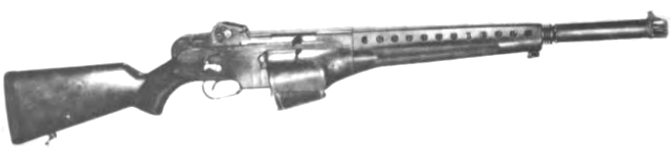
SPIW narrowed to AAI’s flechette rifle, designated XM19. In 1972 the Army’s Armaments Command at Rock Island contracted AAI to simplify it; the resulting weapon was the XM70, an open-bolt rifle with semi-automatic, three-round burst and an area-fire mode, delivered as two prototypes under a programme reported in May 1974. Its requirements set an empty weight of no more than 7.8 pounds with a 50-round magazine and a cyclic rate “comparable to XM19 Rifle”.7
The line did not end there. AAI’s ACR entry of the late 1980s was, in the Army’s words, “a modification to the previously developed serial bullet rifle”, firing a 10.2-grain flechette in a standard M855 brass case in single shots or three-round bursts at 1,800 shots a minute.2 The 1992 ACR report cites the “SPIW (XM19) Day Defense Test, and the CDEC XM19 test” among the field studies concluding that “low momentum systems firing multiple projectiles per trigger pull could compensate for the high aiming errors and increase hit probabilities”.2 Volume 6 shows what happened when that conclusion was finally tested against a properly measured baseline.
2.12 What SPIW settled, and what it did not
SPIW settled three things that the hyper-burst designs took as given.
- A mechanically limited burst at about 2,000 rounds a minute could be built. AAI’s rifle did it in 1964, and BRL measured it.
- A controlled burst hits more often than a trigger-limited one. The 1968 study measured about 30 percent more hit capability against point targets.
- Floating the barrel is not enough on its own. BRL measured no benefit from Winchester’s design and explained why.
It left two things open. The first was the projectile: flechettes gave low impulse but dispersed too widely, and BRL’s 1968 report already noted that a multiple-flechette round would raise impulse per shot and undo the controllability it was supposed to provide.6 The second was reliability: every SPIW high-rate mechanism had failures that BRL traced to the burst control, the rate reducer or the floating parts.
Heckler & Koch’s answer to both was to keep a bullet rather than a flechette and to accept its recoil, but to build a mechanism that held that recoil back until the burst was over. That is the G11, and it is the subject of the next two volumes.
References
Footnotes
-
Harrington & Richardson, Inc., Special Purpose Individual Weapon, Phase I report, 17 May 1963. DTIC ADA052844, https://archive.org/details/DTIC_ADA052844, consulted 2026-10-18. ↩ ↩2 ↩3
-
Vernon E. Shisler and Stephen M. Mango, Advanced Combat Rifle (ACR) Program, Volume I, ACR Program Summary, ARCCD-TR-92001, US Army ARDEC, Picatinny Arsenal, February 1992 (DTIC AD-B162 942). Public digitised copy, https://municion.org/wp-content/uploads/2022/11/06-047-BGC-011-1.pdf, consulted 2026-10-18. ↩ ↩2 ↩3 ↩4 ↩5
-
Leon Feldman and others, SALVO II Rifle Field Experiment, ORO-T-397, Operations Research Office, published May 1961. DTIC AD0325385, https://archive.org/details/DTIC_AD0325385, consulted 2026-10-18. ↩
-
Richard P. Cronin, Stanley S. Lentz and Wallace M. Werner, Kinematic Evaluation of the Special Purpose Individual Weapon Prototypes, Ballistic Research Laboratories Technical Note No. 1541, Interior Ballistics Laboratory, Aberdeen Proving Ground, August 1964 (declassified). DTIC AD0353233, read from https://archive.org/details/DTIC_AD0353233, consulted 2026-10-18. Some numerals in the scanned text are illegible; rates quoted are from the legible table rows. ↩ ↩2 ↩3 ↩4 ↩5 ↩6 ↩7 ↩8 ↩9 ↩10 ↩11 ↩12 ↩13 ↩14 ↩15 ↩16
-
Heckler & Koch, Armorers Manual for Maintenance and Repair of Rifle 4,92 mm, ACR, TD 2237, first draft, March 1989, “Principle of Operation: Counter Recoil Mechanism”. Copy in the Internet Archive item “G11 Manual and references”, https://archive.org/details/1557677285551-2, consulted 2026-10-18. ↩
-
F. W. Hall Jr, W. W. Sheldon, W. M. Werner and E. M. Wineholt, SPIW Modes of Fire, Ballistic Research Laboratories Memorandum Report No. 1864, February 1968 (declassified). DTIC AD0388522, https://archive.org/details/DTIC_AD0388522, consulted 2026-10-18. ↩ ↩2 ↩3 ↩4 ↩5
-
AAI Corporation, Design and Develop a Simplified Serial Flechette Rifle, final report under contract DAAF03-72-C-0172 with the US Army Armaments Command, Rock Island, May 1974. DTIC ADA017721, https://archive.org/details/DTIC_ADA017721, consulted 2026-10-18. ↩
Comments (0)