Hyper-Burst Mechanisms · Volume 3
The G11: A Programme History, 1974 to 1993
Heckler & Koch's caseless rifle from its 1974 test-fixture prototype to an introduction approval granted after it had already been struck from the procurement list: the prototypes as the Bundeswehr's own collection labels them, the American money, the Bundestag record and the corrections it forces
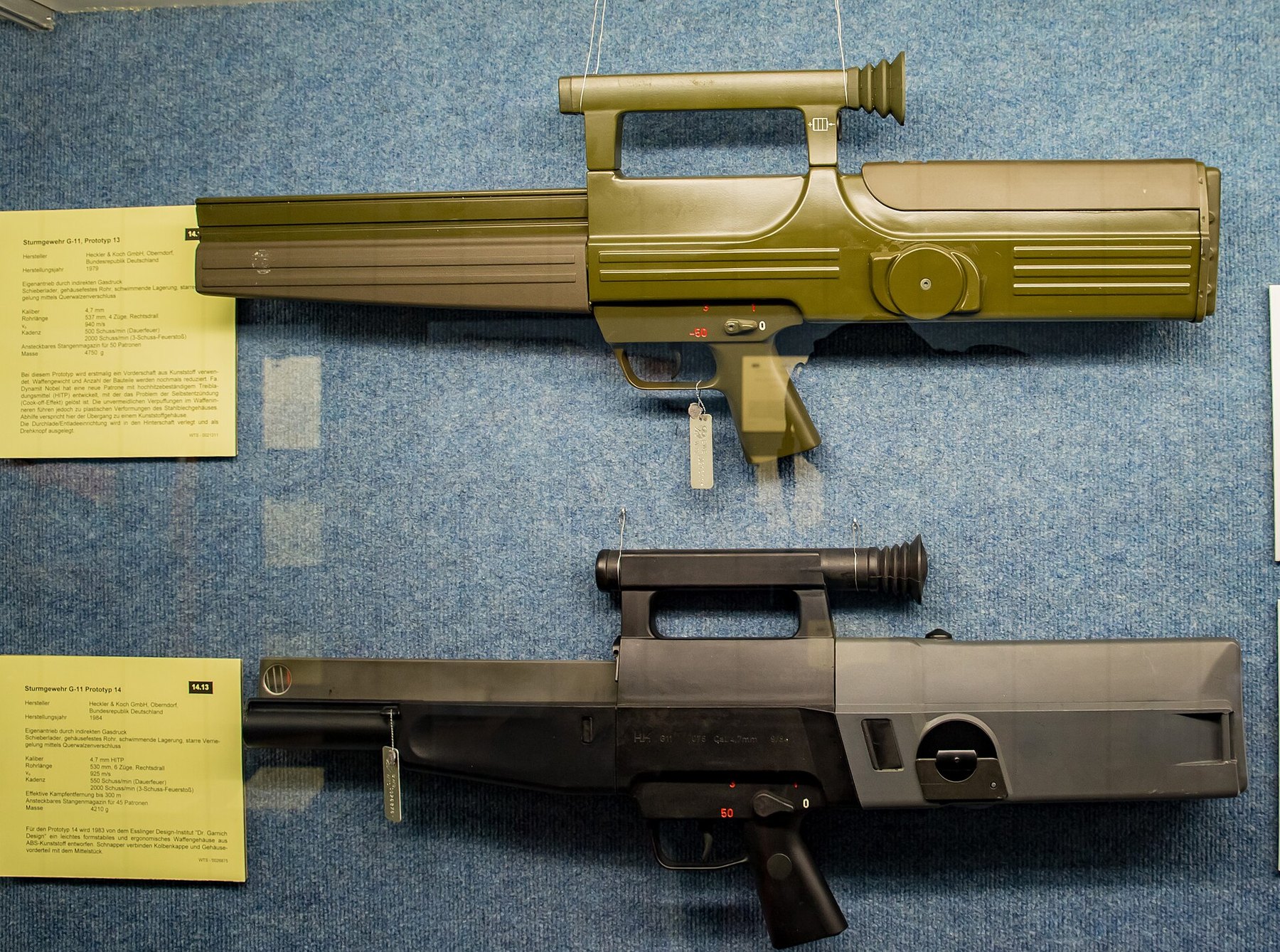
3.1 Where this volume sits
The G11 is two things at once: the most developed caseless rifle ever built and the most developed hyper-burst rifle. The hub’s Daisy dive, Volume 15, covers caseless ammunition as a whole, from Walter Hunt’s Rocket Ball through the Volcanic and the Daisy V/L to the G11 and the Voere VEC-91, together with the four jobs a brass case does that every caseless design has to replace. That material is not repeated here. This volume covers the G11’s history as a programme; Volume 4 covers how it works.
3.2 Sources, and why the placards matter
The G11’s history is usually told from secondary sources, and the most-cited account online carries many uncited dates. Four kinds of primary or near-primary evidence were used instead:
- The Bundestag record. A Greens’ minor interpellation of April 1990 and the government’s reply of May 1990, and an SPD interpellation of May 1993 with the government’s reply of June 1993, are public on the Bundestag’s document server.1234
- Contemporary reporting in Der Spiegel, 1982, 1987 and January 1991, read from the magazine’s own archive.567
- The US Army’s ACR Final Report of 1992, which records the American contract with H&K and its problems.8
- The placards of the Wehrtechnische Studiensammlung (WTS) in Koblenz, the Bundeswehr’s own study collection, which holds a run of G11 prototypes from 1974 to 1989. Several freely licensed photographs on Wikimedia Commons show the placards beside the rifles at a resolution good enough to read. They give each prototype’s year, calibre, barrel length, rates of fire, magazine and weight, with a short note on what changed. They are the collection’s statements, not an independent measurement, but they are the most specific dated record of the prototype series available.
Where these sources disagree, both are given.
3.3 The contract Heckler and Koch won
Der Spiegel’s 1982 report records how H&K came to build the rifle. The Bundeswehr put a development contract worth 20 million marks up for competition, and Heckler & Koch beat two strong rivals. Mauser, the old Oberndorf firm, proposed “eine Waffe mit drei Läufen … die alle drei gleichzeitig feuern sollten”, a weapon with three barrels all firing simultaneously. Diehl, of Röthenbach, proposed a rifle that fed projectiles and propellant charges from separate magazines.5 Mauser’s entry belongs to the simultaneous-salvo branch of Volume 1; H&K’s belonged to the serial branch.
The magazine named the G11’s development chief as Thilo Möller, born 1937, who led some 160 engineers and who described himself as “weder Waffennarr, noch Jäger oder Waffenscheininhaber”, neither a gun enthusiast, a hunter nor a licence holder.5 H&K’s US patents spell his name Tilo Möller; this dive uses the patents’ spelling except when quoting Der Spiegel.910
Several widely repeated details of the earliest phase, including a NATO initiative of 1967, feasibility contracts to Diehl, IWKA Mauser and H&K in 1968 to 1969, and a contract dated 23 December 1974, appear in secondary sources without citations that could be checked. They are not used here.
3.4 The 1974 to 1976 patents
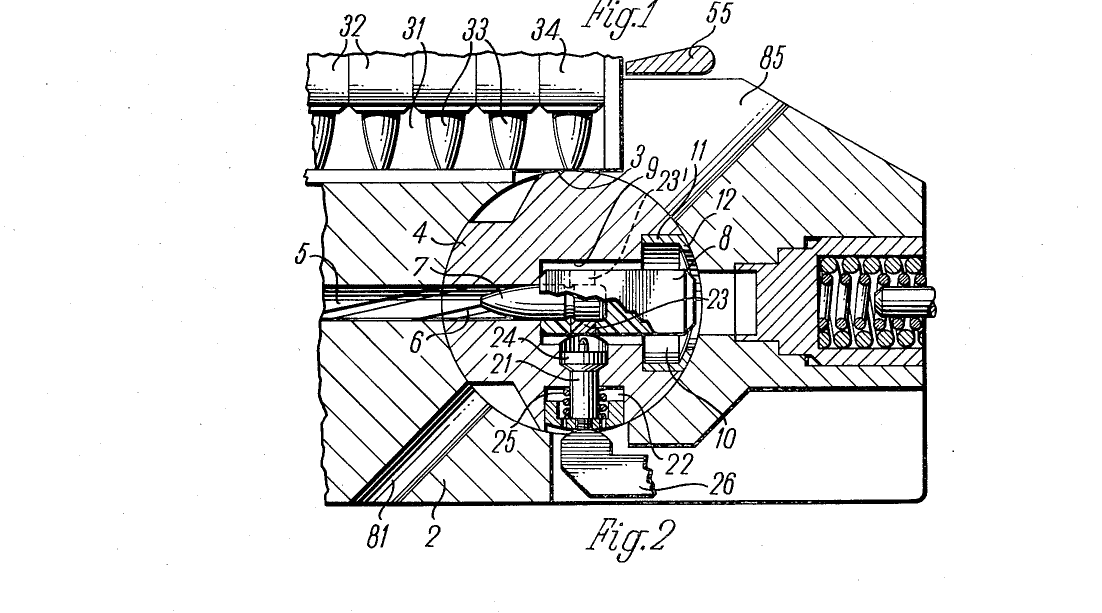
Two US patents assigned to Heckler & Koch GmbH mark the concept’s arrival in the documentary record. Both drawings are US government publications and are reproduced here.
US 3,997,994, “Shoulder Arm with Swivel Breech Member”, names Günter Kästner, Dieter Ketterer, Tilo Möller and Ernst Wössner. It claims German priority from 21 March 1974, was filed in the US on 11 March 1975 and issued on 21 December 1976.9 Its central idea is a breech member “designed as a roller which can be swivelled about its longitudinal axis”, sitting in a cylindrical hole in a part fixed to the barrel, so that “there is only one single moving part, i.e. the breech member itself”. The chamber is bored through the roller; in the firing position it lines up with the barrel, and the roller swivels “at least almost 90°” to a loading position where a magazine supplies the next round. The patent states that the arrangement is “especially well suited for firing caseless cartridges”, and it already anticipates cook-off: the breech can be caught in the loading position after every shot “to prevent a cartridge from being introduced into the hot barrel after a burst and being ignited there unintentionally as a result of the high temperature.”9
US 4,078,327, “Automatic or Semi-Automatic Small Arm”, names Tilo Möller and Dieter Ketterer, with German priority of 8 October 1975, filed on 6 October 1976 and issued on 14 March 1978.10 Its own subject is a curious safety device, covered in Volume 4. Its background section is the more important text here, because it describes an earlier H&K application, Offenlegungsschrift 23 26 525, in which “the entire, fully operational weapon system is shiftably mounted in a receiver designed as a stock. The slidability of the entire system provides accuracy advantages by eliminating or reducing recoil to a minimum during a limited number of shots or during a burst.”10 The two ingredients of the G11, a swivelling chamber and a floating system, are both in H&K’s patent record by 1976.
3.5 The prototypes, as Koblenz labels them
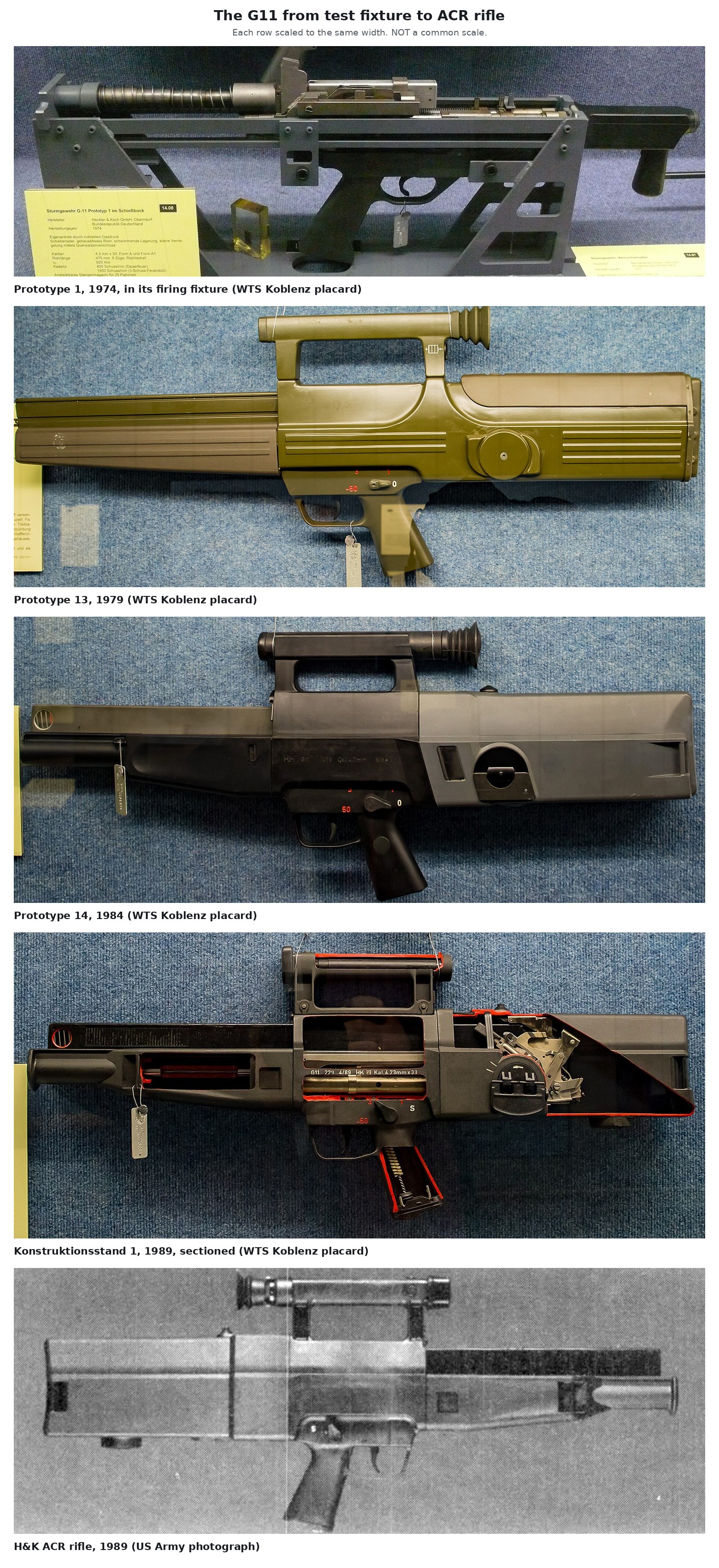
The WTS placards describe every rifle in the series the same way: “Eigenantrieb durch indirekten Gasdruck. Schieberlader, gehäusefestes Rohr, schwimmende Lagerung, starre Verriegelung mittels Querwalzenverschluss”: gas-operated, barrel fixed to its housing, floating mounting, and rigid locking by a transverse roller breech.11 The phrase schwimmende Lagerung, floating mounting, appears from the first prototype on. The placard for Prototype 1 says so explicitly: “Beim Funktionsbeschuss wird auch das Verhalten der schwimmenden Lagerung überprüft”, the function firing also tested how the floating mounting behaved.11
Table 1 — The prototypes, as Koblenz labels them
| Prototype (WTS label) | Year | Cartridge | Barrel | Rates of fire, sustained / 3-shot burst | Magazine | Weight | What the placard says changed |
|---|---|---|---|---|---|---|---|
| Prototype 1, in a firing fixture | 1974 | 4.3 × 29, forms A and A1 | 475 mm, 6 grooves | 400 / 1,800 rpm | 25 | Not given | First gas-operated roller-breech prototype, for a caseless round with side ignition; floating mounting tested |
| Prototype 2 | 1975 | 4.3 × 29, form C1 | 538 mm, 4 polygonal grooves | 400 / 1,800 rpm | 50 (partly legible) | Not legible | Not legible in the photograph |
| Prototype 3 | Not legible | Not legible | Not legible | Not legible | Not legible | Not legible | Positively controlled swivelling feed crank; improved reflex sight; move to rear ignition |
| Prototype 13 | 1979 | 4.7 mm | 537 mm, 4 grooves | 500 / 2,000 rpm | 50 | 4,750 g | First plastic forend; Dynamit Nobel’s new high-ignition-temperature propellant (HITP) “solved” cook-off; deflagrations inside the weapon deformed the sheet-steel housing |
| Prototype 14 | 1984 | 4.7 mm HITP | 530 mm, 6 grooves | 550 / 2,000 rpm | 45 | 4,210 g | Light ABS housing designed in 1983 by the Esslingen design institute “Dr. Garnich Design” |
| Konstruktionsstand 1 (sectioned) | 1989 | 4.73 × 33 DM 11 | 535 mm, 6 grooves | 550 / 2,000 rpm | 45 | 4,090 g | Pre-series rifles from 1988 for troop trials completed in 1990; 15 rifles of this standard went to the US ACR test |
| Konstruktionsstand K 2/3 | 1989 | 4.73 × 33 DM 11 | 543 mm, 6 grooves | 550 / 2,000 rpm | Two or three of 45 | 4,970 g | Three magazine slots, so two or three magazines ride on the rifle; removable optic for a night sight; ergonomic K 3 revision in 1990 |
All values as printed on the WTS placards, read from photographs on Wikimedia Commons; “not legible” means the photograph does not show it clearly enough to read, not that the placard omits it. Muzzle velocities on the placards range from 920 to 940 m/s.11
Two things in the table deserve comment. The burst rate rose from 1,800 to 2,000 rounds a minute between the first prototypes and Prototype 13, and stayed there. And the sustained rate on the placards, 500 to 550 rounds a minute, is not the figure H&K’s brochure gives (about 450) or the US Army’s ACR report gives (600). Volume 4 sets those side by side.
3.6 The ammunition problem and HITP
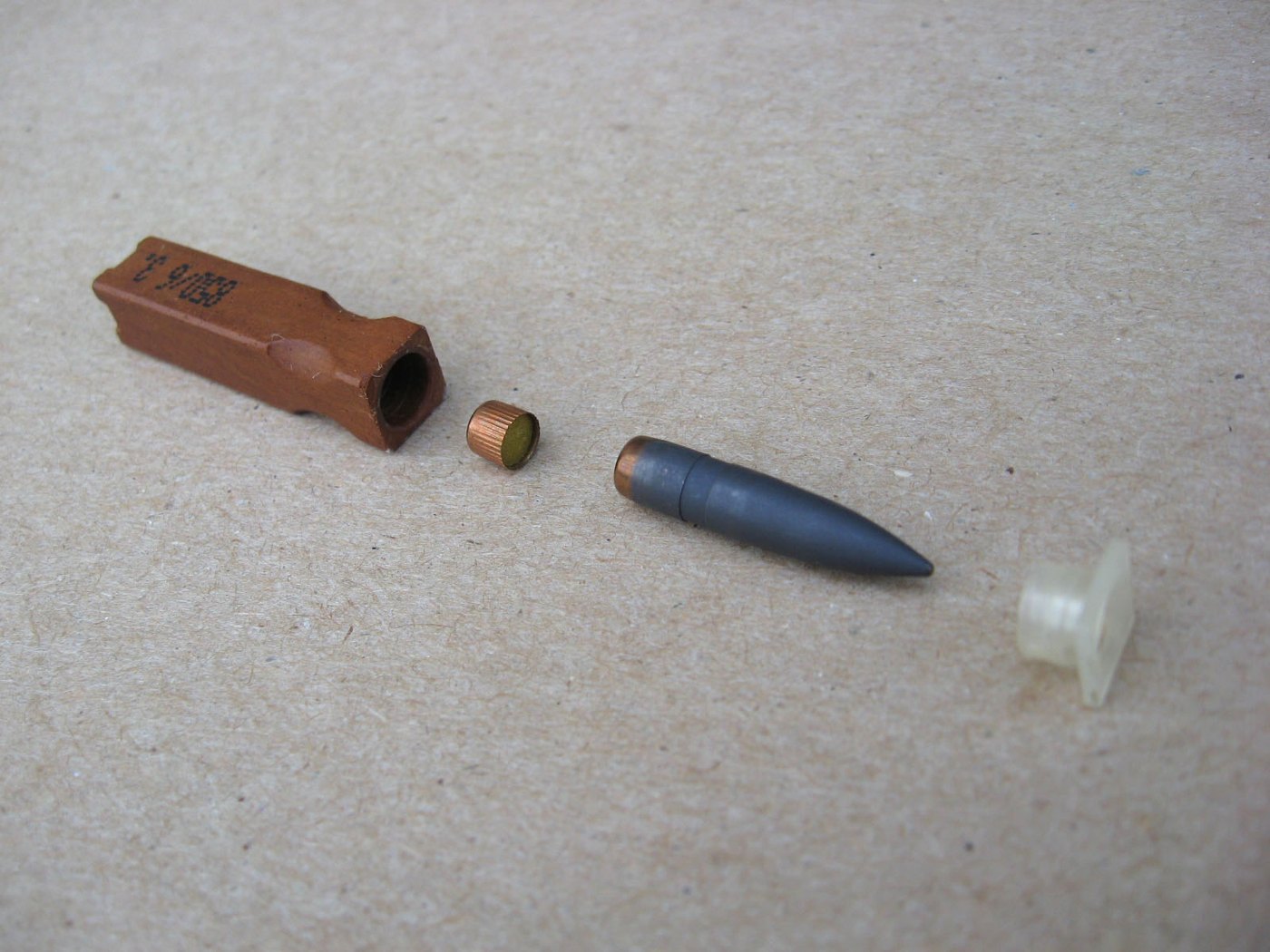
The G11 was never only a rifle. Its round was developed by Dynamit Nobel AG, and the two firms set up a joint company, the Gesellschaft für hülsenlose Gewehrsysteme (GHGS), owned in equal shares, to manage the programme.68 The difficulty that consumed the 1970s was cook-off: with no brass case to carry heat out of the chamber, a round left in a hot chamber could ignite on its own. The 1975 patent was already designing around it.9
According to the Prototype 13 placard, Dynamit Nobel’s answer was a new propellant with a high ignition temperature (HITP), “mit der das Problem der Selbstentzündung (Cook-off-Effekt) gelöst ist”.11 The US Army’s description of the final round in 1992 is consistent: a propellant body of “a true high ignition temperature propellant”, based on the nitramine HMX with an energetic binder, a little fibre for strength, and induced porosity.8 The same Prototype 13 placard records the price of solving one problem: “Die unvermeidlichen Verpuffungen im Waffeninneren führen jedoch zu plastischen Verformungen des Stahlblechgehäuses”, the unavoidable deflagrations inside the weapon deformed the sheet-steel housing.11 Volume 4 explains where those deflagrations came from and what H&K did about them.
3.7 The public debut, 1982
The G11 became public in the early 1980s with extraordinary press. Der Spiegel in May 1982 quoted the London Times, “Die Deutschen haben das Wundergewehr erfunden”, and Jane’s Infantry Weapons, which called it the most significant development in small arms since the first breech-loader.5 The article reported the claims that matter for this dive in H&K’s own words:
- a “automatisch begrenzten” three-shot burst “mit definierter Streuung”, with defined dispersion, so that “zumindest ein Geschoß des abgefeuerten Feuerstoßes sein Ziel erreicht”, at least one bullet of the burst reaches its target;
- a roller breech that moved “mit nur 30 Millisekunden pro Schuß”, only 30 milliseconds a shot, so fast “daß der Schütze keinen Rückstoß an der Schulter spürt”, that the shooter feels no recoil at the shoulder (Möller);
- and a claim of “praktisch rückstoßlos” shooting even in sustained fire, against which a tester from the journal Wehrtechnik reported feeling, in sustained fire, “ein gedämpftes Pressen”, a damped push.5
H&K kept the means secret: “Wie dieses sanfte, sichere Schießen technisch erreicht wird, hält die Firma einstweilen geheim.”5 Thirty milliseconds a shot is the arithmetic of 2,000 rounds a minute, and it matches the WTS placards.
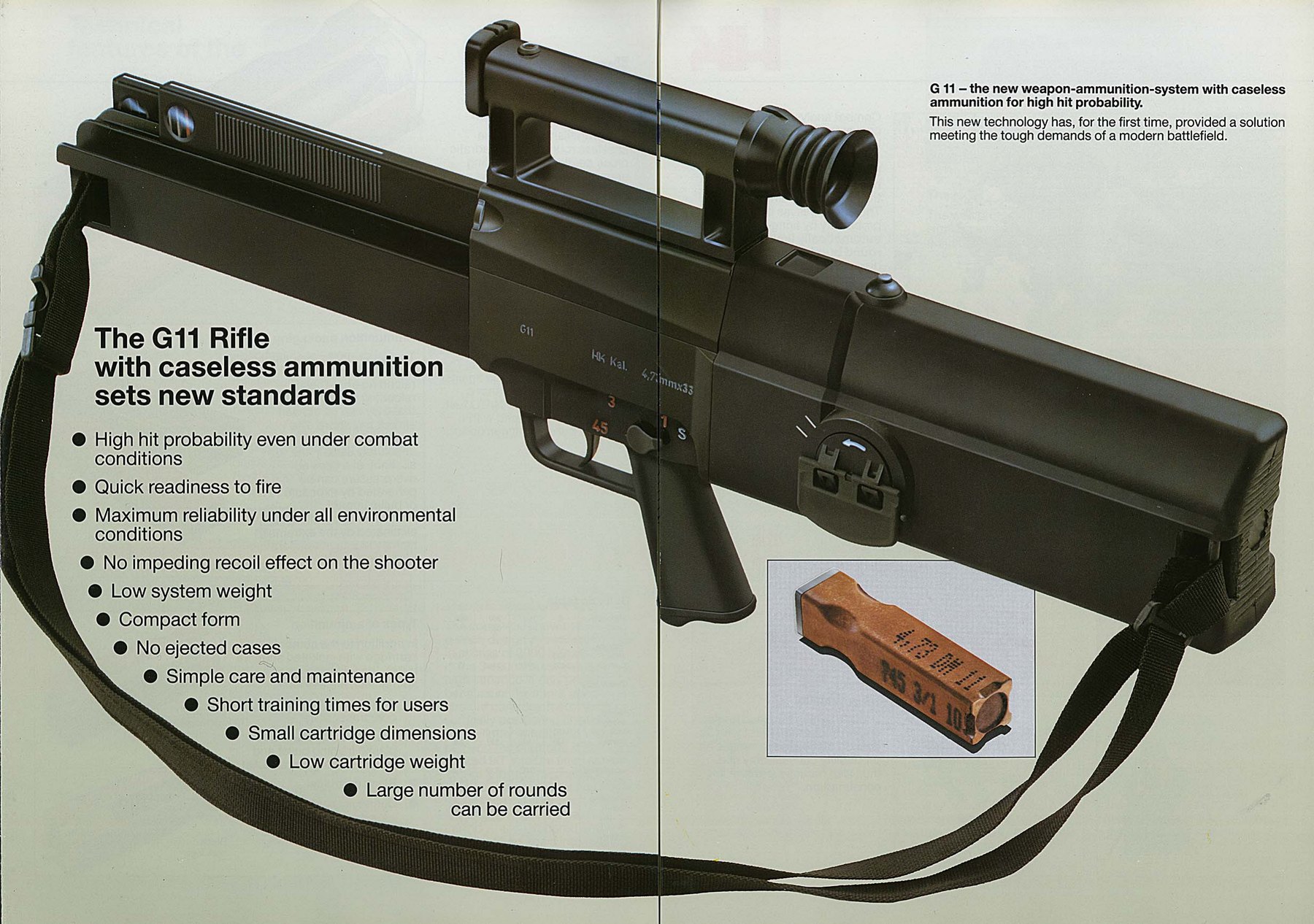
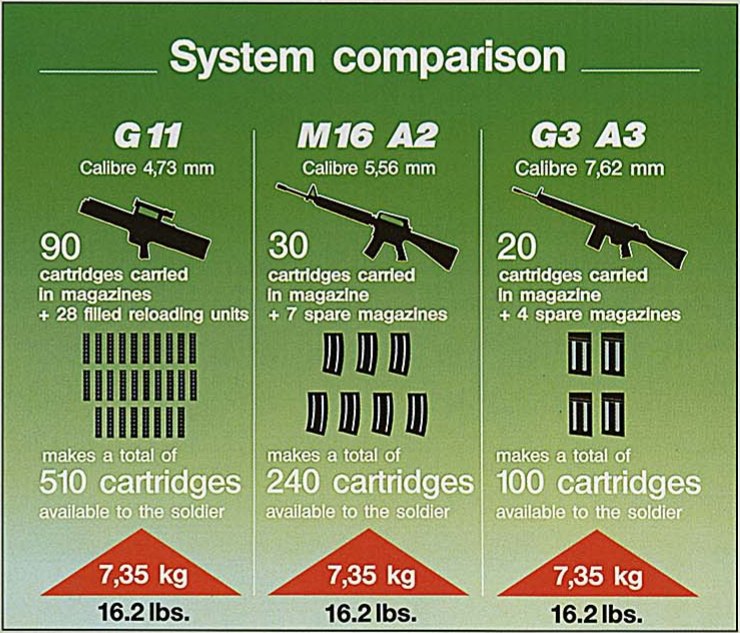
The same article gives a figure that should not be reused: the claim that in Korea and Vietnam it took 60,000 rounds to put one enemy out of action. It is unsourced in the article and appears in many forms elsewhere; it is not a measured hit probability and is not used in this dive.5
3.8 The American connection
The G11 was partly an American programme, and the ACR Final Report is frank about how awkward that was. In September 1982 the US Army awarded two caseless-rifle contracts, one to AAI and one, DAAK10-82-C-0332, to Heckler & Koch, Inc., H&K’s wholly owned subsidiary in Sterling, Virginia. The aim was demonstrator hardware combining caseless ammunition, an optic sight and the salvo concept, and a solution to the two historical barriers of caseless guns, “cook-off and round vulnerability to an incoming projectile.”8
AAI’s effort was terminated “because of AAI’s inability to fabricate a round of ammunition which would withstand gun feeding forces.” H&K and Dynamit Nobel had solved that problem, but the solution “could not be divulged to AAI because it was protected under license agreement.”8 The German government’s 1990 answer to the Bundestag confirms the licence from the other side: by an agreement of June 1984 between GHGS and the US Department of Defense, “Die USA haben … die Rechte an der Technologie hülsenloser Munition erworben. Auf dieser Basis haben sie ihre Advanced Combat Rifle-Version des Gewehres G 11 mit entwickeln lassen.” The questioners cited a value of $3.8 million from the journal Wehrtechnik; the government did not confirm the figure.2 Der Spiegel in 1987 gave the same $3.8 million for an American variant ordered from GHGS.6
The US report describes the contract as “extremely difficult to manage and control”. Germany was “totally committed” to replacing its worn-out G3 rifles with the G11, the same technology was being funded by both nations, and “From a technical viewpoint, it was virtually impossible to separate what work was being funded by which nation.” The Army listed four contract errors of its own: not writing a new contract when the requirements changed, accepting “an unwieldy, multi-layered contractor management organization”, accepting a wholly owned subsidiary as the prime contractor, and not stationing a government technical manager at the contractor’s facility in Germany.8
3.9 Troop trials and the production standard
The sources disagree slightly on when the Bundeswehr’s troop trials began. Der Spiegel reported in July 1987 that Bundeswehr specialists had “vor kurzem begonnen”, recently begun, testing the G11 as a new standard rifle, with a verdict due by 1989 and introduction to all services from 1990 if it passed.6 The WTS placard for the Konstruktionsstand 1 rifle says that H&K made pre-series rifles from 1988 for extensive troop trials at the Bundeswehr’s various branch schools, completed in 1990, and that the trials “die Richtigkeit des Gesamtkonzepts im wesentlichen bestätigt”, essentially confirmed the overall concept, but that the troops wanted a second magazine on the weapon.11
That request produced the final standard. The K 2/3 placard records three magazine slots so that two or three 45-round magazines ride on the rifle, a removable optic that could be exchanged for a night sight, and a last ergonomic revision to the K 3 standard in 1990.11 Its list of what the development achieved is the Bundeswehr collection’s statement of the G11’s claims: higher hit probability through the three-shot burst and, in sustained fire, through the floating mounting; simplified training through the optical sight; resistance to dirt through the sealed construction; and more ammunition carried, thanks to the small calibre and the caseless round.11
Fifteen rifles of the K1 standard, the placard adds, took part in 1990 in a comparative test in the US Army’s ACR programme at Fort Benning.11 The ACR Final Report confirms that fifteen test weapons of each candidate were provided.8 Volume 6 gives the result.
3.10 The Bundestag record, 1990
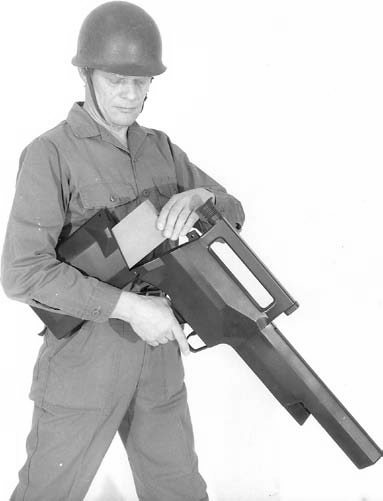
On 11 April 1990 the Greens’ deputy Frau Vennegerts and her parliamentary group tabled a long minor interpellation on the G11, built largely from quotations of H&K’s brochures and the press. The government answered on 3 May 1990 (Drucksache 11/7055), and several answers are primary evidence for the programme’s state that spring:12
- Procurement had started. “Die Einleitung der Beschaffung des G 11 mit zugehöriger Munition ist im Haushalt 1990 EPL 14 veranschlagt.” For starting series production, 30 million marks were approved in the 1990 budget, with a further 30 million in the financial plan for 1991.
- No total was fixed. The total requirement depended on the Bundeswehr’s strength; procurement planning had been geared to the number of G3 rifles that would be retired each year for economic reasons up to 2002. Replacing the G3 would run “bis in das nächste Jahrtausend hinein”. The first units would be the combat troops.
- No hit-probability figure was offered. Asked for exact figures on the hit probability achieved against people with the G11, the government answered only that the G11, through simpler handling and low weight, “erhöht … die Treffwahrscheinlichkeit unter Einsatzbedingungen und damit die Verteidigungsfähigkeit.”
- The government distanced itself from H&K’s marketing. Many of the questions, it said, rested on press releases and industry brochures, which were “nicht unbedingt neutral”. It disowned the Times’s “most precise killing machine in the world” as “nicht durch Fakten belegbar” and the development chief’s 1983 remark that a wounded enemy ties up more of the other side’s forces than a dead one: “Die Bundesregierung teilt diese Bewertung nicht.” It stated that the bullet met the international conventions on wounding, as tested in gelatine, and that no animal tests were carried out.
- No ACR results yet. Asked about the comparative results of the H&K, AAI, Colt and Steyr rifles in the American ACR programme, it had none.
- A light machine gun was being studied. “Es wird untersucht, innerhalb welcher Parameter ein leichtes Maschinengewehr auf der Basis hülsenloser Munition realisierbar ist.” The government could not confirm a fielding date.
- Cost. The questioners put development, pre-series and series preparation at over 140 million marks; asked whether the G11 was the most expensive rifle ever, the government answered “Nein.”
3.11 The end, in two documents that disagree
Seven months later the G11 was gone from the procurement plan. Der Spiegel reported on 13 January 1991 that the Oberndorf region faced ruin “seit Bundesverteidigungsminister Gerhard Stoltenberg (CDU) das neue Supergewehr G 11 von der Beschaffungsliste gestrichen hat”, since Defence Minister Gerhard Stoltenberg had struck the new super-rifle from the procurement list. H&K had been counting, “bis zum Herbst letzten Jahres”, until the autumn of 1990, on a billion-mark order.7 The article gives the development cost precisely: “Von 1974 bis 1989 flossen insgesamt 84,1 Millionen Mark aus dem Bundeshaushalt für die G-11-Entwicklung nach Oberndorf.” A ministry spokesman’s comment on the abandoned project was “Was weg ist, ist weg”: what is gone is gone. H&K, with more than 2,000 employees, carried debts of 180 million marks against domestic turnover of 300 million, and only the entry of the British group Royal Ordnance, the magazine wrote, might avert bankruptcy.7
The decision therefore fell between the autumn of 1990 and 13 January 1991. The exact date and the minister’s stated reasons were not found in a primary document.
The WTS placard for the final standard tells a different story. It records that the G11 was given its introduction approval, its Einführungsgenehmigung, on 8 March 1992, “Mit der am 08. März 1992 erteilten Einführungsgenehmigung wird die Entwicklung erfolgreich abgeschlossen”: with the introduction approval granted on 8 March 1992, development was successfully completed.11
Both statements can be true. An introduction approval certifies that a design is fit for service; a procurement list says what will be bought. The G11 appears to have been qualified for service more than a year after the decision not to buy it. It was never bought in quantity.
The last parliamentary trace is from May 1993, when SPD deputies asked how many G11s, or derived caseless weapons, were held by H&K, by Royal Ordnance, by the Bundeswehr, by the British Army and by other states; whether series production was still planned; and whether it would take place in Oberndorf or at Enfield.3 The government’s answer of 22 June 1993 was that the questions could not be answered openly “aus Geheimschutzgründen”, for reasons of secrecy, and that a classified reply had gone to the SPD’s security spokesman.4 No official count of G11s built or held has been published in the documents found for this dive.
3.12 Corrections to the common account
The widely read online account of the G11 differs from the primary record on several points. Each correction below rests on the document cited.
Table 2 — Corrections to the common account
| Common statement | What the primary record shows | Source |
|---|---|---|
| In January 1992 the defence minister removed the G11 from the procurement list | It had already been struck from the list by 13 January 1991; the source usually cited for 1992 is Der Spiegel 3/1991, mis-dated | Der Spiegel 3/19917 |
| ”Export licenses were granted for 80 countries, with manufacturing licenses for 15” (of the G11) | Those figures are Der Spiegel’s, and they refer to the G3, not the G11 | Same7 |
| The G11 was approved for production on 8 March 1992 | The 8 March 1992 approval was an Einführungsgenehmigung, approval for introduction, marking the end of development; it came after the procurement decision had gone the other way | WTS placard11; Der Spiegel 3/19917 |
| About 1,000 were produced | No published primary document found gives a total; the government declined to answer openly in 1993 | Drucksache 12/52404 |
| Troop trials achieved about double the G3’s hit probability | No published primary figure found; the government gave none when asked in 1990 | Drucksache 11/70552 |
| The development chief was Tilo Möller / Thilo Möller | Both spellings are in primary sources: the patents print Tilo, Der Spiegel Thilo | US 3,997,994; Der Spiegel 19/198295 |
3.13 Telling the G11s apart
The rifles look alike in photographs, and captions online often call any of them “the G11”. The features below are those the WTS placards and the US Army’s descriptions give; Volume 4 has the mechanism behind them.
Table 3 — Telling the G11s apart
| Feature | Early prototypes (1974 to 1975) | Prototype 13 (1979) | Prototype 14 (1984) | K1 / ACR (1988 to 1990) | K 2/3 (1989 to 1990) |
|---|---|---|---|---|---|
| Housing | Bare mechanism, or in a test fixture | Olive, with the first plastic forend | Black ABS housing by an outside designer | Black housing; ACR rifles marked for the US programme | Black housing with three magazine slots |
| Cartridge | 4.3 × 29 | 4.7 mm | 4.7 mm HITP | 4.73 × 33 DM 11; called 4.92 mm in US documents | 4.73 × 33 DM 11 |
| Magazine on the rifle | 25 or 50 | 50 | 45 | One of 45 (the ACR’s own manual says 50) | Two or three of 45 |
| Optic | Reflex sight on early models | Integral optic in carrying handle | Integral optic | Integral 1× / 3.5× optic by Swarovski in the ACR | Removable optic, exchangeable for a night sight |
| Burst rate | 1,800 rpm | 2,000 rpm | 2,000 rpm | Over 2,000 rpm | 2,000 rpm |
Where to look: the colour and material of the housing, the number of magazine slots on top, whether the optic is a fixed carrying handle, and the placard. The calibre naming is a common trap: the US Army’s documents call the ACR rifle “Rifle, 4.92 mm, ACR” and its round “4.92 mm caseless”, while H&K and the Bundeswehr call the same round 4.73 × 33.128
References
Footnotes
-
Deutscher Bundestag, Drucksache 11/6920, Kleine Anfrage der Abgeordneten Frau Vennegerts und der Fraktion DIE GRÜNEN, “Entwicklung und Einsatz neuartiger Gewehrsysteme und hülsenloser Munition (G 11)”, 11 April 1990, https://dserver.bundestag.de/btd/11/069/1106920.pdf, consulted 2026-10-18. ↩ ↩2
-
Deutscher Bundestag, Drucksache 11/7055, Antwort der Bundesregierung, 3 May 1990 (letter of the Parliamentary State Secretary of 2 May 1990), https://dserver.bundestag.de/btd/11/070/1107055.pdf, consulted 2026-10-18. ↩ ↩2 ↩3 ↩4
-
Deutscher Bundestag, Drucksache 12/4956, Kleine Anfrage der Abgeordneten Gernot Erler, Walter Kolbow and others and der Fraktion der SPD, “Beschaffungsmaßnahmen für die Bundeswehr im Handfeuerwaffen- und Ausrüstungsbereich”, 13 May 1993, https://dserver.bundestag.de/btd/12/049/1204956.pdf, consulted 2026-10-18. ↩ ↩2
-
Deutscher Bundestag, Drucksache 12/5240, Antwort der Bundesregierung, 22 June 1993, https://dserver.bundestag.de/btd/12/052/1205240.pdf, consulted 2026-10-18. ↩ ↩2 ↩3
-
“Gedämpftes Pressen”, Der Spiegel 19/1982, 9 May 1982, https://www.spiegel.de/spiegel/print/d-14350537.html, consulted 2026-10-18. ↩ ↩2 ↩3 ↩4 ↩5 ↩6 ↩7 ↩8
-
“Pulver im Turm”, Der Spiegel 31/1987, 26 July 1987, https://www.spiegel.de/spiegel/print/d-13525602.html, consulted 2026-10-18. ↩ ↩2 ↩3 ↩4
-
“Weg ist weg”, Der Spiegel 3/1991, 13 January 1991, https://www.spiegel.de/spiegel/print/d-13488184.html, consulted 2026-10-18. ↩ ↩2 ↩3 ↩4 ↩5 ↩6
-
Vernon E. Shisler and Stephen M. Mango, Advanced Combat Rifle (ACR) Program, Volume I, ACR Program Summary, ARCCD-TR-92001, US Army ARDEC, Picatinny Arsenal, February 1992, including Appendix B, “ACR Contractor Activity Synopsis” (DTIC AD-B162 942). Public digitised copy, https://municion.org/wp-content/uploads/2022/11/06-047-BGC-011-1.pdf, consulted 2026-10-18. ↩ ↩2 ↩3 ↩4 ↩5 ↩6 ↩7 ↩8
-
US Patent 3,997,994, Günter Kästner, Dieter Ketterer, Tilo Möller and Ernst Wössner, assignors to Heckler & Koch GmbH, “Shoulder Arm with Swivel Breech Member”, filed 11 March 1975, German priority 21 March 1974 (P 24 13 615), issued 21 December 1976. https://patentimages.storage.googleapis.com/pdfs/US3997994.pdf, consulted 2026-10-18. ↩ ↩2 ↩3 ↩4 ↩5
-
US Patent 4,078,327, Tilo Möller and Dieter Ketterer, assignors to Heckler & Koch GmbH, “Automatic or Semi-Automatic Small Arm”, filed 6 October 1976, German priority 8 October 1975 (P 25 44 995), issued 14 March 1978. https://patentimages.storage.googleapis.com/pdfs/US4078327.pdf, consulted 2026-10-18. ↩ ↩2 ↩3
-
Wehrtechnische Studiensammlung (WTS), Koblenz, display placards for “Sturmgewehr G-11 Prototyp 1 im Schießbock” (14.08), “Prototyp 2” (14.09), “Prototyp 3”, “Prototyp 13”, “Prototyp 14” (14.13), “Konstruktionsstand 1 (Schnittmodell)” and “Konstruktionsstand K 2/3” (14.15). Read from photographs on Wikimedia Commons: File:Wehrtechnische Sammlung der Bundeswehr (24769575197).jpg, (24769579637).jpg and (24769583927).jpg by Clemens Vasters, 5 December 2017, CC BY 2.0; File:G11 Prototyp 1.jpg by Bojoe, 26 August 2009, CC BY 3.0. Consulted 2026-10-18. ↩ ↩2 ↩3 ↩4 ↩5 ↩6 ↩7 ↩8 ↩9 ↩10 ↩11
-
Heckler & Koch, Armorers Manual for Maintenance and Repair of Rifle 4,92 mm, ACR, TD 2237, first draft, March 1989. Copy in the Internet Archive item “G11 Manual and references”, https://archive.org/details/1557677285551-2, consulted 2026-10-18. ↩
Comments (0)