Hyper-Burst Mechanisms · Volume 5
The AN-94: Abakan, Nikonov and the Shifted Recoil Impulse
The Soviet competition to beat the AK-74 off-hand, Gennadiy Nikonov's line of prototypes from bullpup to the ASM as the Kalashnikov Museum labels them, and the pulley, cable and rammer that let a 5.45 mm rifle fire two shots at 1,800 rounds a minute before the stock moves
5.1 Scope, and the limits of the sources
This volume covers the AN-94’s history and its cycle at mechanism level, under the boundary stated in Volume 1: no dimensions, no tolerances, no trigger or fire-control geometry, no assembly or disassembly procedures.
The documentary record for the AN-94 is thinner than for the G11, and the reader should know exactly how thin.
- No patent was located. Searches for a Soviet author’s certificate or Russian patent by Gennadiy Nikonov covering the mechanism found nothing that could be read. The Russian patent office’s records were not searchable by the tools available for this dive.
- No Russian technical manual was examined. The official Technical description and operating instructions is cited in Russian secondary sources but was not found.
- The maker’s own page survives. Izhmash’s product page for the AN-94, captured by the Internet Archive in October 2014, gives the maker’s description and specification.1
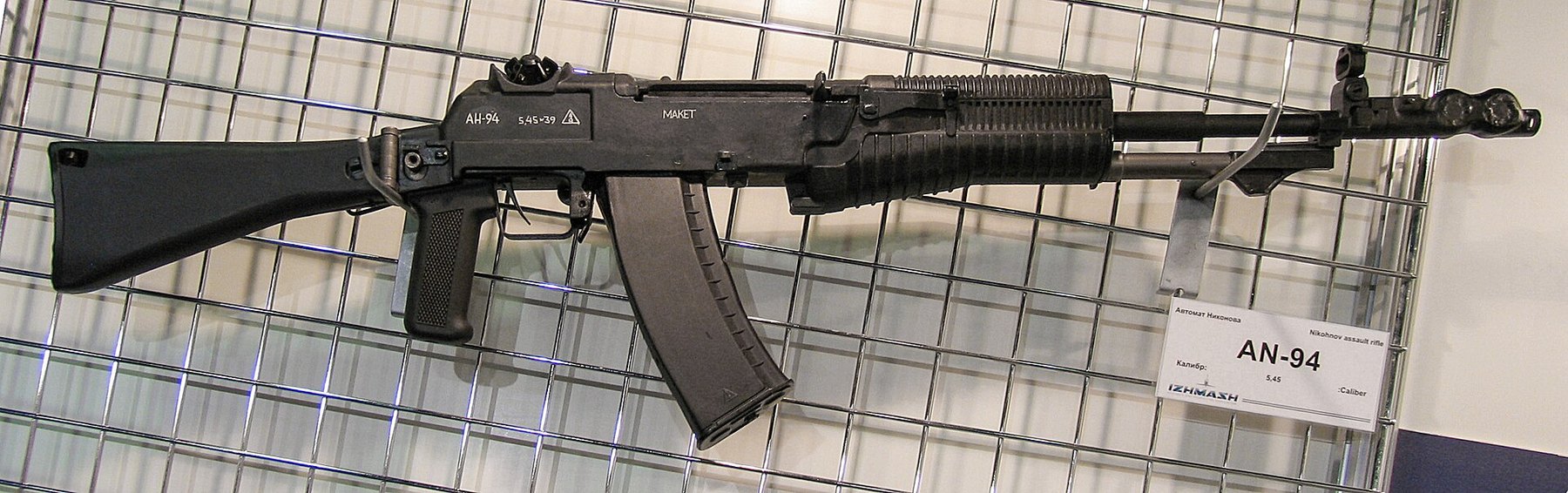
- The Kalashnikov Museum in Izhevsk labels its prototypes. Freely licensed photographs on Wikimedia Commons show the museum’s placards for Nikonov’s prototypes clearly enough to read.2
- The rest is secondary: Maxim Popenker’s Modern Firearms, the most detailed description of the cycle in English;3 Ian McCollum’s 2017 Forgotten Weapons examination with Armament Research Services;4 a 2019 article in the Russian business weekly Profil;5 and a 2020 article by RT, the Russian state broadcaster, which is used only with attribution.6 Russian Wikipedia’s article is used only as a lead and flagged wherever it is the sole source.
5.2 The requirement
The sources agree on the purpose and disagree on the dates.
- Profil (2019) says the Soviet Ministry of Defence announced the Abakan competition in 1978, that it ran for about ten years, and that its aim was a new weapon that would beat the AK-74 for grouping and accuracy “в 1,5-2 раза”, by one and a half to two times. Crucially, the military fixed the ammunition: the new rifle “должен использовать хорошо освоенный патрон 5,45х39 мм”, had to use the well-established 5.45 × 39 cartridge. Profil contrasts this with the American ACR programme, running at the same time and with the same goal, which allowed caseless ammunition and flechettes.5
- Popenker says the research programme codenamed Abakan began in 1979, and gives the key requirement as “50-100% increase in hit probability when shooting off-hands”, that is, from unsupported positions. He notes that the initial research reached findings “similar to those of US SALVO program”: a small, controlled pattern of several projectiles to absorb aiming error.3
- RT quotes Nikonov himself, without giving the source, recalling that the designers’ task was “превзойти штатный автомат по эффективности в 1,5—2 раза”, to exceed the issued rifle’s effectiveness by one and a half to two times.6
- Russian Wikipedia gives a Ministry of Defence competition of 1978 and the formal announcement of the “Abakan” competition in 1981, with twelve designs.7 The figure of twelve was not confirmed elsewhere.
The 5.45 × 39 constraint is the key to the AN-94’s design. Unlike the G11, it could not get its low recoil impulse or its fast feed from a new cartridge. Everything had to come from the mechanism. The cartridge and the AK-74 it was meant to replace are covered in the hub’s AK-47 dive, Volume 8.
5.3 The competition and its rival schemes
Profil describes two “leitmotifs” of the Abakan entries, and the Kalashnikov Museum’s own displays use the same two headings.52
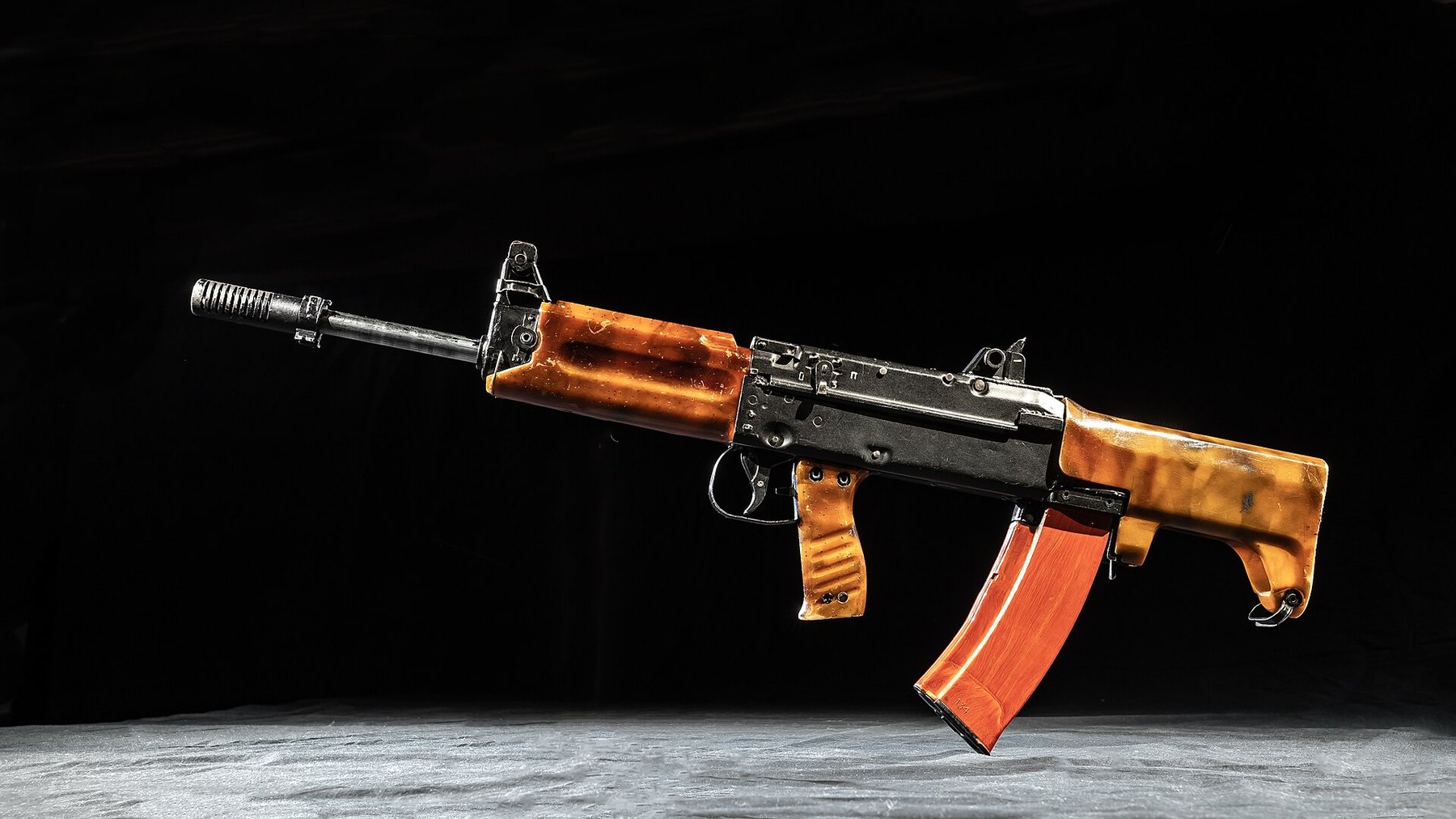
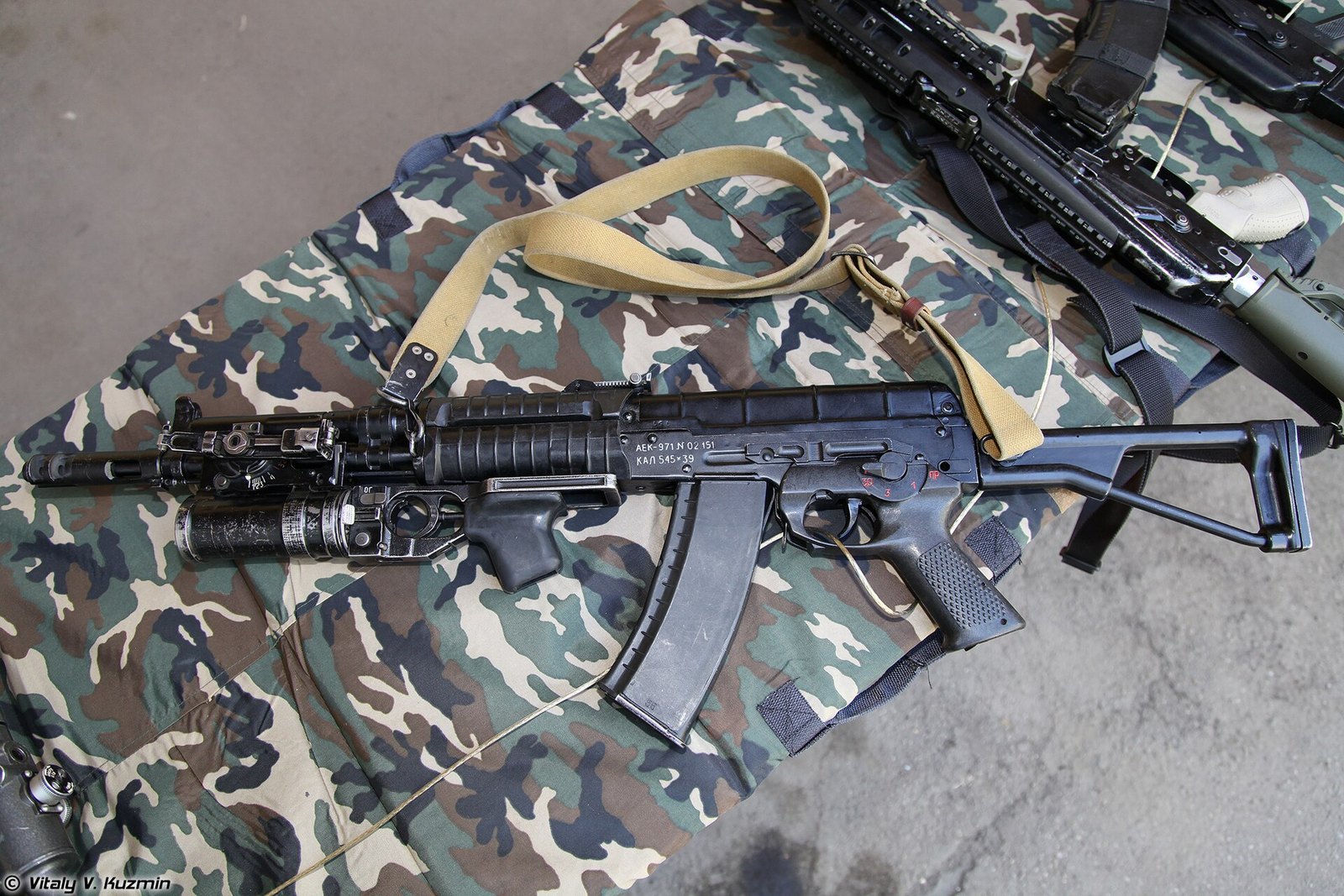
Balanced automatics (сбалансированная автоматика). A counter-mass, geared to the bolt group and equal to it in mass, moves in the opposite direction, so that the impacts of the bolt group at the ends of its travel are cancelled and the rifle jumps less. Profil says the scheme was worked on at Izhevsk in 1969 to 1971 in the experimental AL-7, and that it was used in Kovrov’s AEK-971, which “участвовал в «Абакане»”, took part in Abakan, and later in Izhevsk’s AK-107.5 The Kalashnikov Museum has a separate case headed “1980-е гг. Ижмаш. Конкурс «Абакан». Работы по созданию автоматов со сбалансированной автоматикой под руководством В.М. Калашникова”: the 1980s, Izhmash, the Abakan competition, work on rifles with balanced automatics under the direction of V. M. Kalashnikov.2 Profil’s judgement is that balanced automatics add weight and complexity and give a noticeable benefit only with low-impulse cartridges.5
The “carriage” scheme (лафетная схема), the name Profil gives to the shifted-impulse approach: the barrel, bolt and receiver form a unit that recoils inside a housing after each shot, and before the unit reaches its rearmost position and the shooter feels the recoil, a second round is fed and fired. The principle, Profil notes, is borrowed from artillery, where the barrel recoils on its carriage.5 Profil names two Abakan entries of this kind: Igor Stechkin’s TKB-0146, a bullpup, and Nikonov’s design.5 RT also names Stechkin’s TKB-0146, adds German Korobov’s TKB-0111, both from the Tula Central Design and Research Bureau of Sporting and Hunting Arms, as Nikonov’s rivals, and says nothing more about either.6
Other entrants are named in secondary sources but were not confirmed in two independent sources for this dive and are not listed here.
5.4 Nikonov’s prototypes
Gennadiy Nikonov was born in Izhevsk on 11 August 1950, according to RT, and joined the Izhevsk Machine-Building Plant (Izhmash) in 1969, where his early work included sporting rifles.6 Popenker records that he died in 2003 at the age of 55.3 The Kalashnikov Museum’s case for Nikonov’s work is headed “1980-1990 гг. Ижмаш. Конкурс «Абакан». Работы по созданию автоматов со смещенным импульсом отдачи”: Izhmash, the Abakan competition, work on rifles with a shifted recoil impulse.2
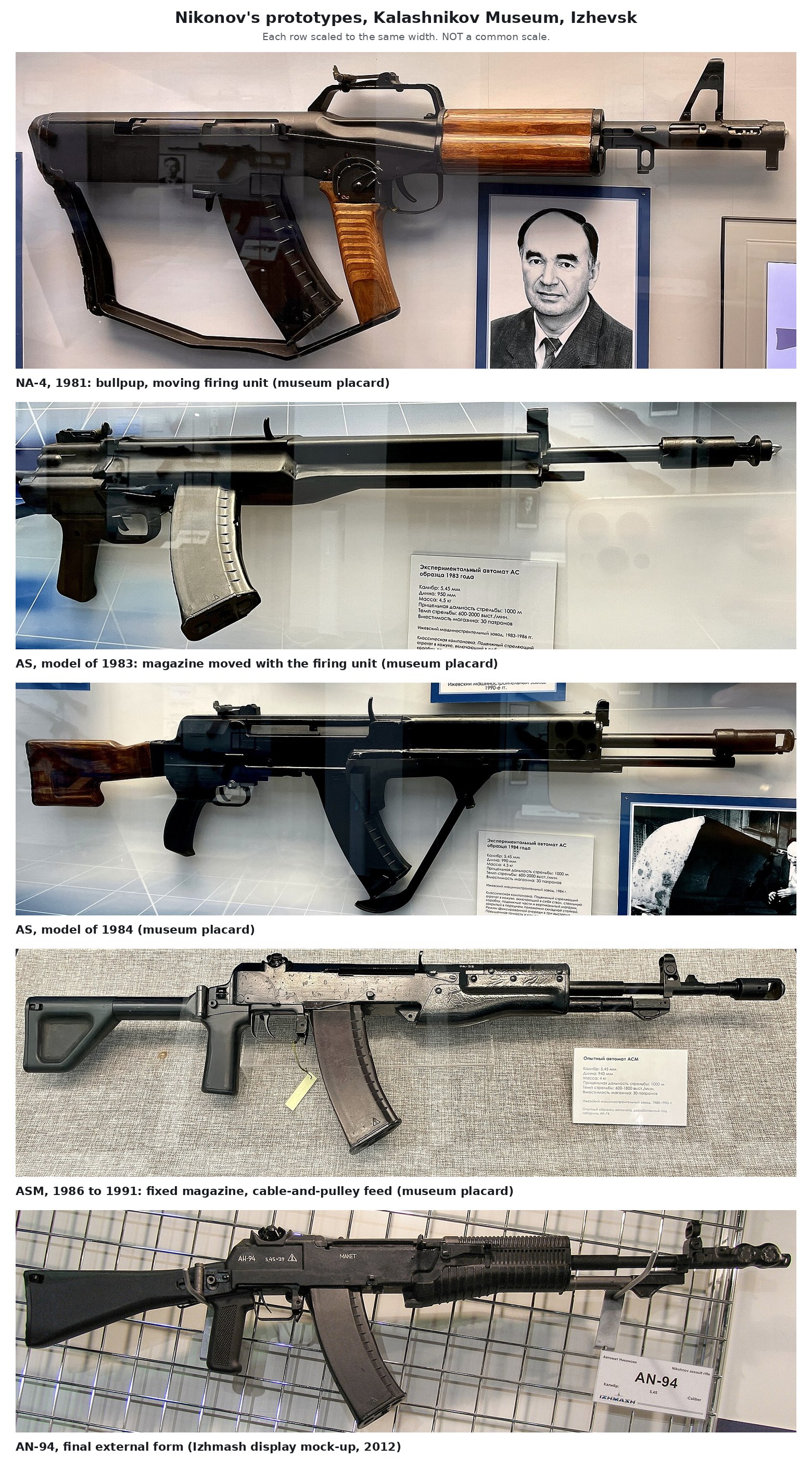
The museum’s placards, read from photographs, give the clearest dated sequence available:
Table 1 — The museum's placards, read from photographs, give the clearest dated sequence available
| Prototype (museum label) | Date | Length | Weight | Rate, as labelled | What the placard says |
|---|---|---|---|---|---|
| NA-4, “конструкции Г.Н. Никонова и А.И. Нестерова” | 1981 | 740 mm | 3.8 kg | 600 to 1,800 rpm | Bullpup layout; moving firing unit in a housing; fixed-burst mode |
| AS, model of 1983 | 1983 to 1986 | 950 mm | 4.5 kg | 600 to 2,000 rpm | Conventional layout; the moving unit in the housing included the barrel, receiver, moving parts and the magazine, mounted at the side; “Открытое положение магазина могло привести к задержкам, поломкам и травмам стрелка” |
| AS, model of 1984 | 1984 | Not legible | Not legible | Not legible | Heading only legible |
| ASM (two examples) | 1986 to 1991 | 1,010 mm and 940 mm | 4.3 kg and 4 kg | 600 to 1,800 rpm | Prototype of the rifle adopted as the AN-94 |
Source: placards of the M. T. Kalashnikov Museum and Exhibition Complex, Izhevsk, read from photographs by Vyacheslav Bukharov (September 2022) on Wikimedia Commons.2
The AS of 1983 placard explains why the design changed. The magazine moved with the recoiling unit and stood exposed at the side, which “could lead to stoppages, breakages and injuries to the shooter”. Popenker gives the same story: Nikonov’s early prototypes, which he calls NA-1 to NA-4, were bullpups with magazines that “reciprocated back and forth under recoil, along with receiver and barrel”; the AS of 1986 was conventional but still had the sliding magazine; the military asked for it to go, and by 1987 the ASM had a stationary magazine and “two-stage feeding system with separate rammer, operated by bolt via cable and pulley system, and an intermediate loading tray between magazine and barrel”.3 RT adds a 1979 test platform, the NA-2, a bullpup of about 3.9 kg, and Profil says the NA-2 and NA-4 fired fixed bursts of three rounds.65 The final rifle fires two.
The pre-series rifle before adoption is identified in Russian sources as the LI-291; Vitaly Kuzmin photographed one at the Tank Biathlon event of 2014, captioned “Prototype of AN-94 assault rifle, also known as LI-291”.8
5.5 Trials and adoption
Popenker’s account of the trials gives the result that won the competition: tested against the AK-74, the ASM was “more or less similar” in single shots, but in two-round bursts from unsupported positions “its linear dispersion was about 3 times smaller, and target hit probability was about 2 times better”. He gives a specific example: for experienced soldiers firing unsupported at 100 m, “average hit probability for short bursts was 0.30 for AK-74 and 0.63 for ASM”. In 1991, he writes, the ASM was recommended for further improvement and field trials.3 He does not name the source of the figures, and no Russian trial report was found for this dive; they are given here as Popenker’s.
The adoption date is a recurring confusion. The rifle’s formal name is the 5.45 mm Nikonov automatic rifle, model of 1994, AN-94, with the GRAU index 6P33.37 Popenker says it was formally adopted in 1997;3 Profil says “В 1994 году он был формально принят на вооружение”, formally adopted in 1994.5 Russian Wikipedia cites a government decree of 14 May 1997 on adopting the Nikonov rifle and creating production capacity for it.7 The decree was not seen for this dive. The simplest reading consistent with all three is a 1994 model designation and a 1997 adoption decree.
Production was at Izhmash, in small numbers. Profil’s phrase is “Автомат закупался гомеопатическими партиями”, the rifle was bought in homeopathic batches.5 Popenker estimates “about 10 to 20 thousands” purchased and says Izhmash stopped making it “some time in early 2000s”.3 Neither figure was confirmed in a primary source. Volume 7 covers why it was not adopted more widely.
5.6 The rifle in numbers
Table 2 — The rifle in numbers
| Item | Izhmash (maker’s page, 2014 capture) | Other sources |
|---|---|---|
| Cartridge | 5.45 × 39 | Same |
| Weight | 3.85 kg without loading and magazine | 3.82 kg empty; 4.4 kg with loaded magazine and optical sight (Russian MoD site, as quoted by RT) |
| Length | 943 mm; 728 mm with stock folded | Same (Popenker) |
| Barrel | Not given | 405 mm (Popenker) |
| Modes | Single shots; fixed two-round bursts at 1,800 rounds/min; continuous fire “с автоматически изменяющимся темпом (дискретно с 1800 на 600 выстр./мин)“ | Single, 2-round, automatic (Popenker) |
| Muzzle velocity | 900 m/s | Same |
| Sighting range, open sight | 700 m | 800 m (Russian MoD, as quoted by RT) |
| Point-blank range | 440 m against a chest figure; 625 m against a running figure | Not given |
| Magazines | Not given | AK-74 30-round and RPK-74 45-round magazines, and a 60-round four-row magazine (Popenker) |
Sources: Izhmash; RT quoting the Russian Ministry of Defence; Popenker.163
5.7 The major groups
Popenker’s description is the most complete in the sources, and it agrees with Izhmash’s and the photographs.31
- The housing. A fibreglass-reinforced polymer shell, integral with the handguards, which is also the stock mounting. The stock folds to the right.
- The firing unit. The barrel, with its gas block above, is fixed to the receiver; inside the receiver run a long-stroke gas-piston bolt carrier and a short rotating bolt, with a hammer. The whole unit slides inside the housing. The rod under the barrel, which looks like a gas tube, “is, in fact, a forward guide for the recoiling barrel / receiver assembly”; it also carries the grenade-launcher mount.
- The unit’s recoil spring lies under the receiver at the bottom of the housing, offset to the left, “and because of this the magazine is offset and inclined from vertical to the right.”
- The two-stage feed. The magazine is fixed to the housing; the cartridge has to get from there into a receiver that is moving. A rammer pushes each cartridge from the magazine into a feedway built into the bottom of the recoiling receiver. The rammer is linked to the bolt carrier “via the thin steel cable and a large pulley”, so that when the carrier moves back, the rammer moves forward.
- Controls. A cross-bolt safety at the front of the trigger guard and a separate selector above the pistol grip on the left, with positions for single shots, two-round bursts and automatic fire.
Russian Wikipedia gives the same picture in Russian terms: the rifle works “за счёт свободного отката подвижного стреляющего агрегата с приводом от газового двигателя затворной рамы”, by the free recoil of a moving firing unit, with the bolt carrier driven by a gas engine.7 That is why the common English label “blowback shifted pulse” misleads: the AN-94 is gas-operated with a locked rotating bolt, and the “free recoil” is the recoil of the whole barrel-and-receiver unit inside the housing, not a blowback action.
5.8 The cycle: the two-round burst
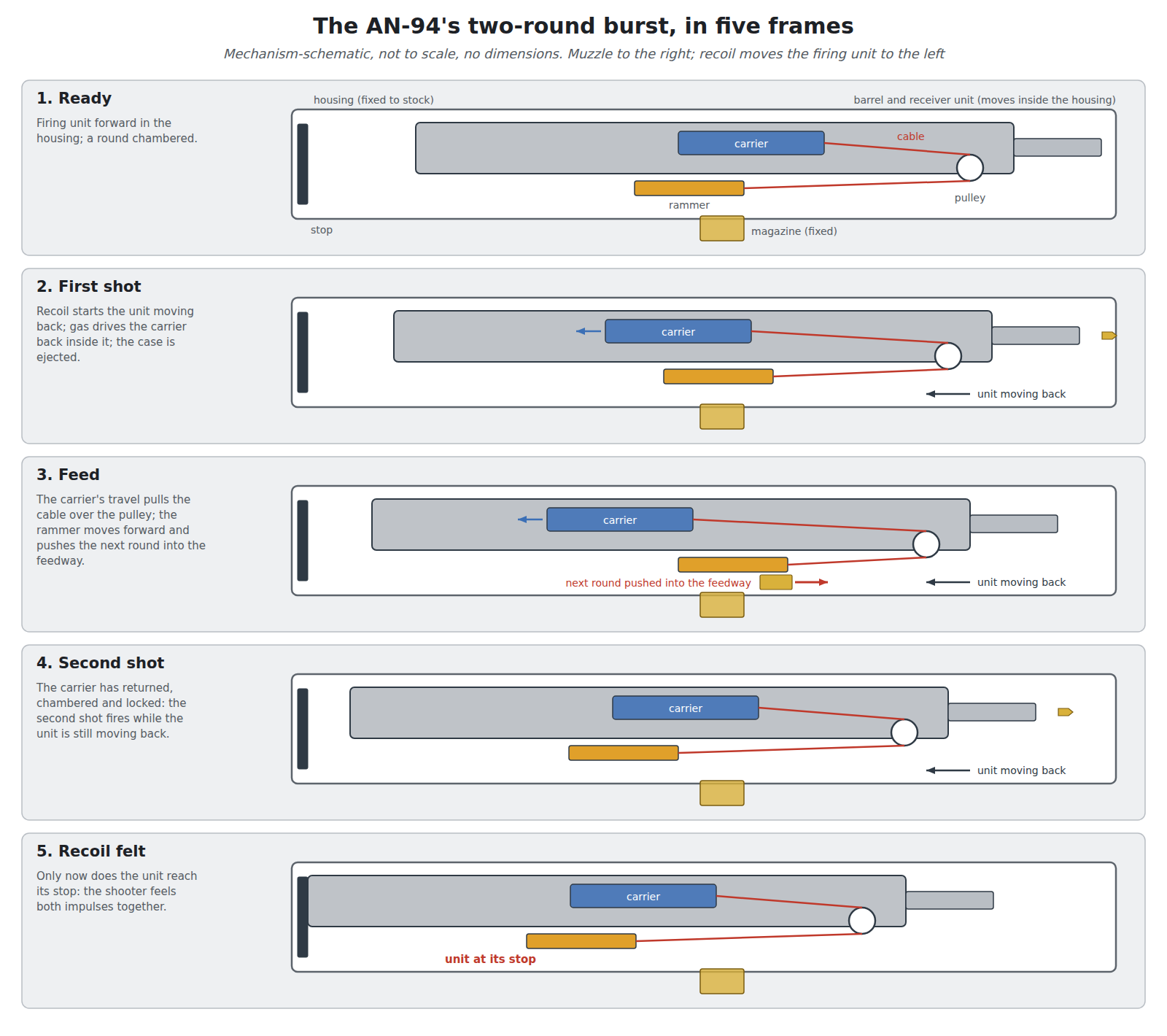
This is the sequence that defines the rifle, given here at mechanism level from Popenker, Izhmash, Russian Wikipedia and Forgotten Weapons.3174
- Ready. The firing unit is at the front of the housing. A round is chambered and locked; the hammer is cocked.
- First shot. The trigger is pulled; the hammer falls; the first bullet travels up the barrel.
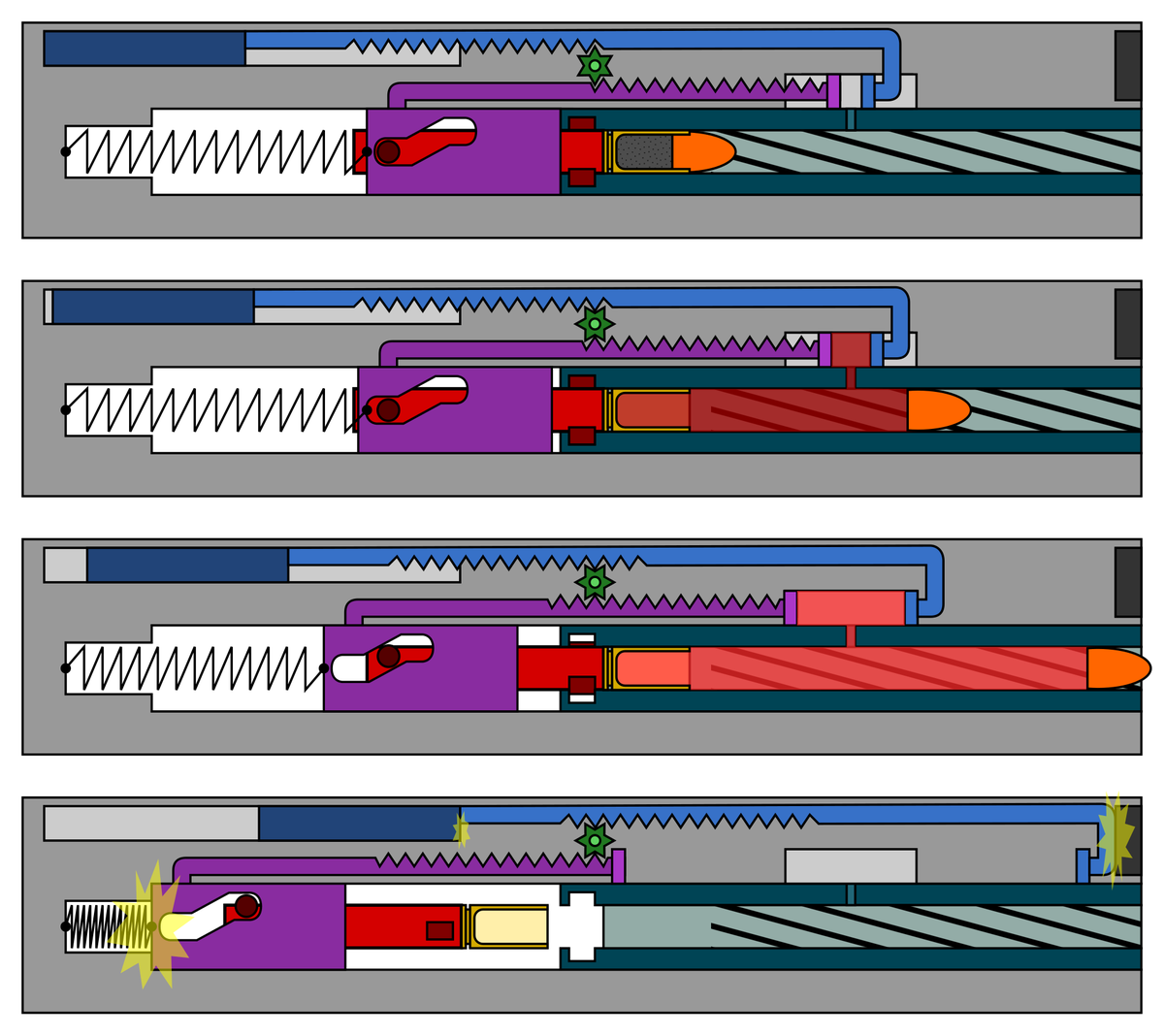
- Two motions begin at once. Recoil starts to drive the whole firing unit rearward inside the housing, compressing the unit’s own recoil spring. At the same time, once the bullet passes the gas port, gas drives the bolt carrier rearward relative to the receiver; the bolt unlocks, and the spent case is extracted and ejected.
- The cable and pulley feed the second round. As the carrier runs back, the cable over the pulley draws the rammer forward. The rammer strips the next cartridge from the fixed magazine and pushes it into the feedway in the bottom of the moving receiver.
- Second shot, while the unit is still moving. The carrier returns under its spring, chambers the cartridge from the feedway and locks the bolt, and the hammer is released automatically. Popenker: “the second shot is fired with the theoretical rate of fire of 1800 rounds per minute. At this moment the receiver is still recoiling inside the housing, and its recoil is accumulated in the spring and not yet affects the shooter and the position of the gun.”
- The shooter feels both shots at once. After the second bullet leaves, the firing unit reaches the end of its rearward travel and its stop. “At this moment the shooter feels the accumulated recoil impulse of two fired rounds, ‘shifted in time’.”3
- Reset. The mechanism continues to cycle, but the hammer is held until the firing unit has returned to the front. In the two-round mode it stays held until the trigger is released and pulled again.3
The sources differ in one detail. Popenker says the second shot fires while the receiver “is still recoiling”; Forgotten Weapons says it fires “as the receiver reaches full travel”.34 Russian Wikipedia says that by the time the firing unit reaches its rearmost position “и стрелок ощущает отдачу, первые две пули уже успевают покинуть ствол”, the first two bullets have already left the barrel.7 All three agree on the point that matters: both bullets leave before the unit strikes the rear of the housing and the recoil reaches the shooter.
5.9 The cycle: single shots and automatic fire
In single shots the rifle fires once per trigger pull, and the hammer is held until the firing unit has returned forward. In automatic fire, Izhmash’s description is that the rate changes automatically, “дискретно с 1800 на 600”, in a step from 1,800 to 600 rounds a minute.1 Popenker’s explanation is that after the first fast pair, the hammer “will switch itself automatically to the low rate of fire, and will release itself only once per complete recoil cycle”.3 Russian Wikipedia’s version is that in automatic fire the first two shots are fast and the mechanism then works on a “one shot per cycle” pattern: the firing unit returns under its spring, chambers and fires, and recoils through a full cycle without a second shot, so that it no longer strikes the rear of the housing.7 The consequence, all three agree, is that only the first two shots of a long burst are fired before the sight line moves.
A Russian Wikipedia footnote adds that, according to the rifle’s technical manual, in the low-rate mode the firing unit does not reach its rearmost position and does not strike the stock, and the shot is fired as the unit arrives at its forward position.7 The manual was not seen for this dive, and the claim is given only as Russian Wikipedia’s reading of it.
5.10 Why two rounds, not three
The G11 fires three rounds before its floating assembly bottoms; the AN-94 fires two. Profil says Nikonov’s earlier NA-2 and NA-4 fired fixed bursts of three, so the change was a choice.5 No source found for this dive gives Nikonov’s reason.
Two constraints visible in the sources point the same way, and are offered here as inference, not as a documented explanation. First, the AN-94 fires a conventional 5.45 mm cartridge, with more recoil impulse per shot than the G11’s small caseless round; the US Army’s ACR report notes that H&K’s design “did not use low impulse ammunition, but relied on a unique mechanism for controlling its recoil”, and the same problem is sharper with a heavier conventional round.9 Second, the AN-94 must feed each round from a fixed magazine into a moving receiver and extract and eject a case each time, which the G11, with no case and a magazine that moves with its mechanism, did not have to do. Each additional shot before the stop needs more travel inside the housing, and more travel means a longer, heavier rifle.
5.11 Two myths about the pulley
The pulley and cable are the AN-94’s most famous feature and the most misdescribed.
- The pulley does not balance recoil. Forgotten Weapons states it explicitly: the pulley does not balance recoil forces.4 It is part of the feed. Its job is to convert the carrier’s rearward motion into the rammer’s forward motion, so that a cartridge is moved from the fixed magazine towards the chamber in the time available. The rifle’s recoil is managed by the firing unit’s travel in the housing, not by the pulley.
- It is not a balanced-automatics rifle. Balanced automatics, as in the AEK-971, use a counter-mass moving opposite the bolt carrier to cancel its impacts. The AN-94 has no counter-mass in that sense; it delays recoil by letting the whole firing unit move. The two schemes were rivals in the same competition.
5.12 What the maker and others claimed for accuracy
Table 3 — What the maker and others claimed for accuracy
| Claim | Who makes it | Conditions | Status |
|---|---|---|---|
| ”превосходящим известные образцы по боевой эффективности в 1,5 раза”, one and a half times the combat effectiveness of known designs, through better grouping of automatic fire from unstable positions | Izhmash, maker’s page | Not stated | Advertised |
| Linear dispersion about a third of the AK-74’s and hit probability about twice, in two-round bursts off-hand | Popenker | Trials of the ASM against the AK-74, not further identified | Reported, source not named |
| Hit probability 0.63 against 0.30 for the AK-74 | Popenker | Experienced soldiers, unsupported, 100 m, short bursts | Reported, source not named |
| Two bullets about 10 to 20 cm apart at 50 m, hand-held | Profil, describing Kalashnikov Media’s videos | Video demonstrations | Observation of a video |
| Long bursts no better than the AK-74 | Russian Wikipedia, citing a Kalashnikov Media video of 2020 | Video comparison | Not confirmed |
Sources: Izhmash; Popenker; Profil; Russian Wikipedia.1357
No measured figure from a published Russian trial report was found. The figures above should be read as advertised or reported, not measured under stated conditions, which is the opposite of the G11 case, where the US Army’s own field experiment exists (Volume 6). The pattern in Profil’s video description is a useful corrective to the folklore that both bullets land “bullet in bullet”: a two-round pattern 10 to 20 cm across at 50 m is a spread of a few mils, which is a pattern, not a single hole.5
5.13 Telling an AN-94 from an AK-74
The AN-94 is often mistaken for an AK-74 or an AK-12 in photographs, and vice versa. The features below are visible from outside and are described in the sources above.
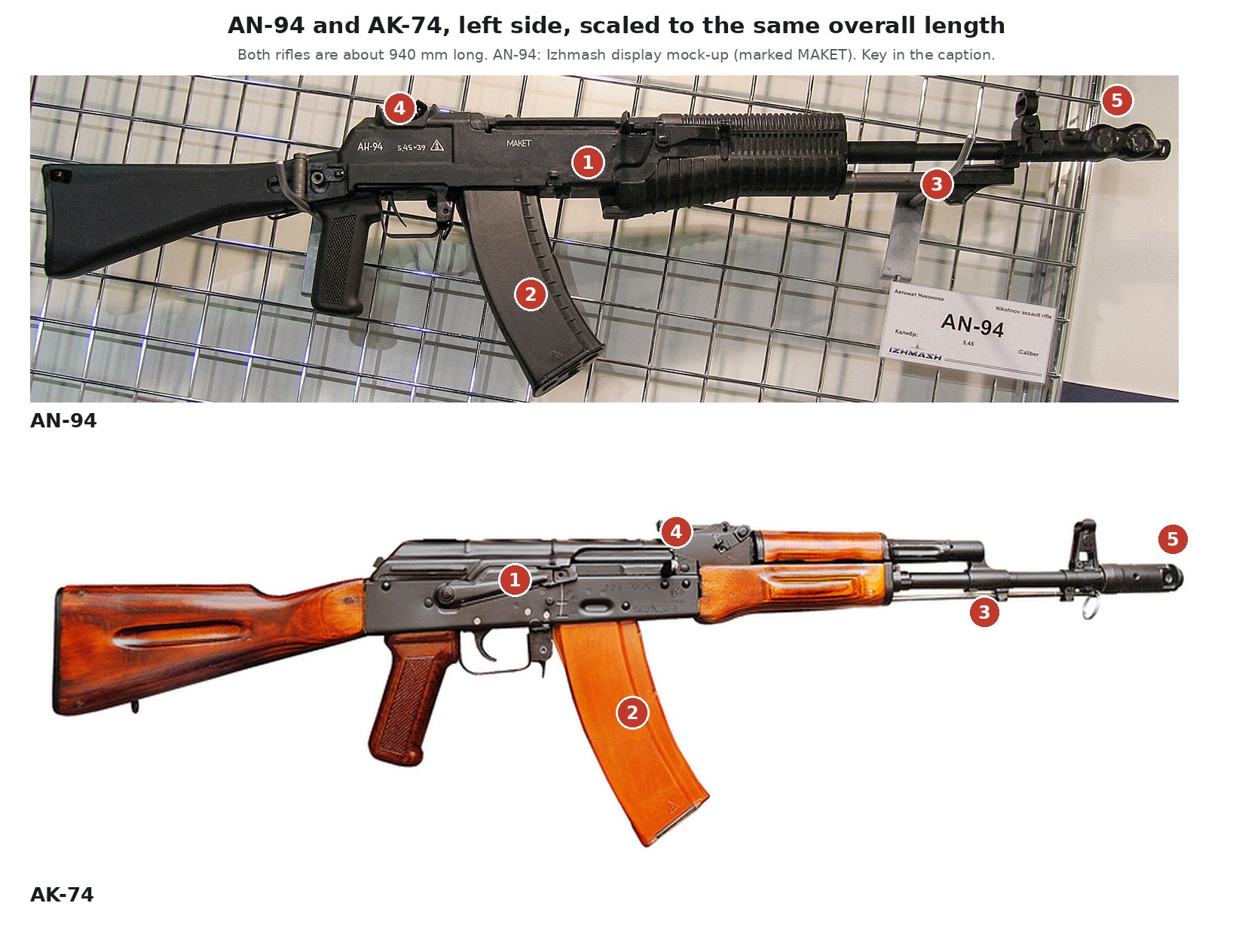
Table 4 — Telling an AN-94 from an AK-74
| Feature | AN-94 | AK-74 | Where to look |
|---|---|---|---|
| Receiver | Hidden inside a polymer housing that runs from the stock to the forend | Exposed stamped steel receiver | The side of the rifle above the trigger |
| Magazine | Canted to the right, because the firing unit’s recoil spring sits low on the left | Vertical | Look from the front or below |
| Under the barrel | A rod, the forward guide for the recoiling unit | Nothing; the gas tube is above | Below the barrel, in front of the forend |
| Rear sight | Rotating aperture on top of the housing at the rear | Tangent leaf in front of the receiver cover | Top of the rifle |
| Controls | Cross-bolt safety in the trigger guard; small selector above the grip on the left | Large lever on the right side combining safety and selector | Both sides above the trigger |
| Muzzle | A loop-shaped device described as a self-cleaning brake | The AK-74’s cylindrical two-port brake | Muzzle |
| Bayonet | Mounts on the right of the muzzle, blade horizontal | Mounts below the barrel | Front sight base |
Sources: Popenker; Russian Wikipedia; photographs in this volume.37
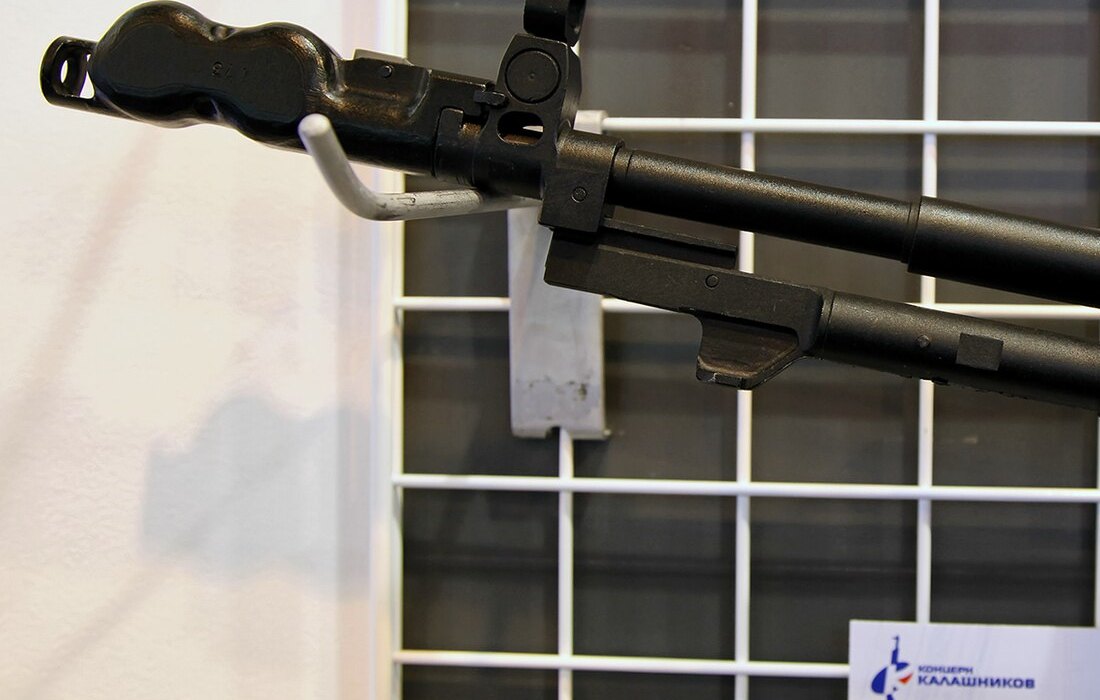
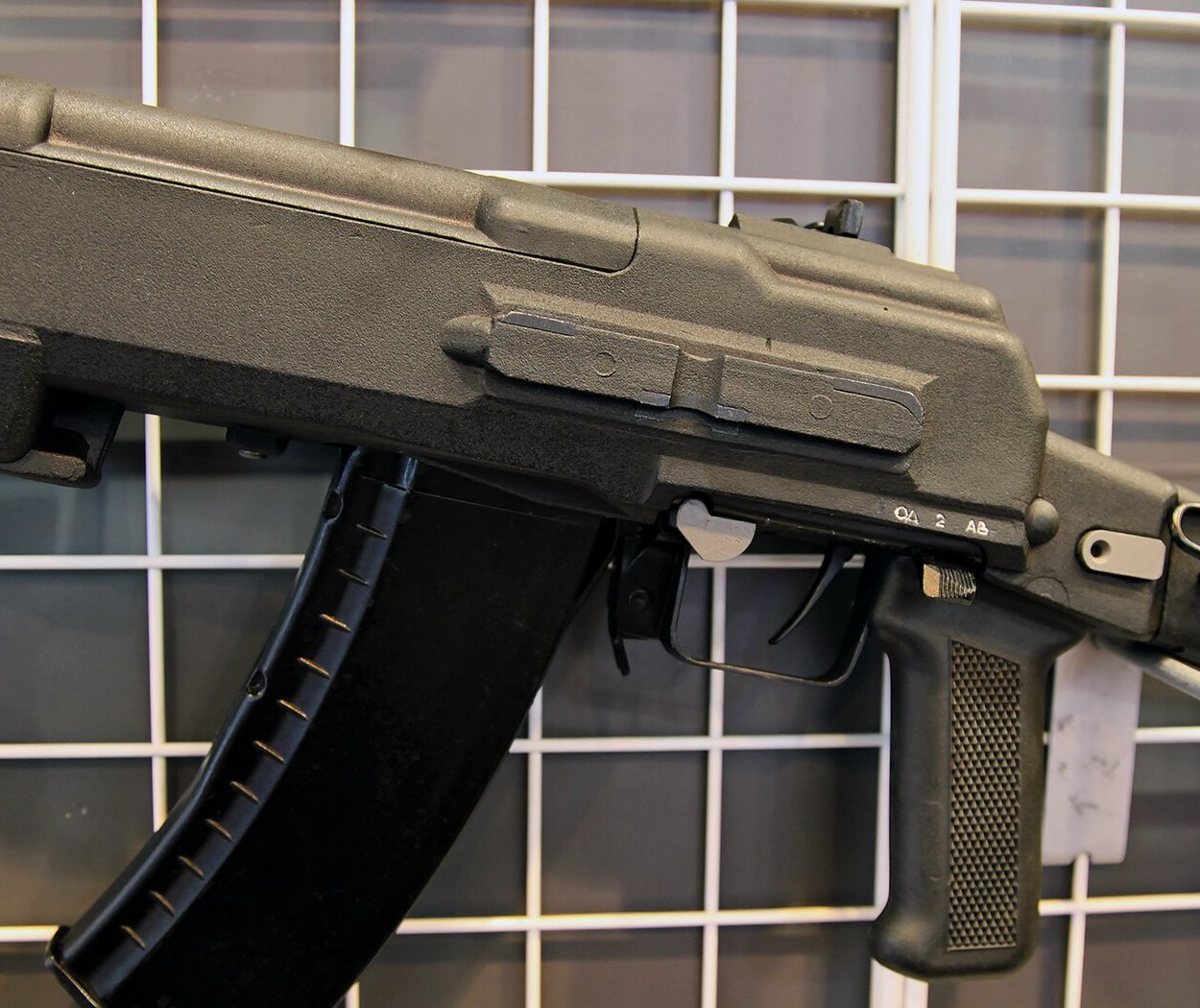
Exhibition rifles are a further trap. One of Kuzmin’s photographs of 2008 shows an AN-94 labelled “ММГ-АН-94”, a массогабаритный макет, a weight-and-dimension mock-up, not a working rifle.8 Mock-ups of this kind are common at Russian arms exhibitions, and photographs of them should not be used to identify a working rifle’s details.
5.14 Maintenance and repair, as documented
No Russian operator’s or armourer’s manual was examined, so this section can only record what secondary sources say.
- Complexity. Popenker: “disassembly and maintenance more complicated than AK-74, firing controls were small and folded stock interfered with the trigger”; users also complained that the rear sight “had rough edges and small apertures which were easily clogged by the mud or snow”.3 Russian Wikipedia says the rifle field-strips into thirteen parts, including two springs, the cable and the roller, and that it “сильно страдает от задержек”, suffers badly from stoppages, citing Kalashnikov magazine in 2001; it also cites a contrary view that its reliability met the commission’s requirements.7 Neither claim was confirmed in a primary source.
- The muzzle device is described in Russian Wikipedia as effective but “чистить его крайне неудобно”, extremely awkward to clean.7
- Handling. RT quotes a Kalashnikov test shooter, Aleksandr Krasnoperov, that the rifle should be fired relaxed, without fighting the recoil, which differs from AK technique.6
- Parts and repair. The AN-94 has been out of production since the 2000s by every account found, and no parts or service are sold to the public anywhere found. Volume 7 covers its legal status in the United States.
Step-by-step field-stripping and detail-stripping procedures are outside this dive’s scope even where they exist.
References
Footnotes
-
Izhmash (OAO Izhevsk Machine-Building Plant), product page “Автомат Никонова АН-94”, Wayback Machine capture of 18 October 2014, https://web.archive.org/web/20141018133511/http://izhmash.ru/rus/product/nikon.shtml, consulted 2026-10-18 (page encoded in Windows-1251). ↩ ↩2 ↩3 ↩4 ↩5 ↩6
-
M. T. Kalashnikov Museum and Exhibition Complex of Small Arms, Izhevsk, display placards for the NA-4, the AS of 1983, the AS of 1984 and the ASM, and case headings for the Abakan competition. Read from Wikimedia Commons photographs “Kalashnikov Museum (September 2022) - 26” to ”- 32” and “Автомат АСМ” by Vyacheslav Bukharov, CC BY-SA 4.0, and “NA-4 assault rifle - Kalashnikov museum” by Лапоть, CC0. Consulted 2026-10-18. ↩ ↩2 ↩3 ↩4 ↩5
-
Maxim Popenker, “Nikonov AN-94 Abakan assault rifle (Russia)”, Modern Firearms, https://modernfirearms.net/en/assault-rifles/russia-assault-rifles/an-94-abakan-eng/, consulted 2026-10-18. ↩ ↩2 ↩3 ↩4 ↩5 ↩6 ↩7 ↩8 ↩9 ↩10 ↩11 ↩12 ↩13 ↩14 ↩15 ↩16 ↩17 ↩18
-
Ian McCollum, “Rocket Surgery: Inside the Russian Nikonov AN94 (Video)”, Forgotten Weapons, 11 April 2017, https://www.forgottenweapons.com/rocket-surgery-inside-the-russian-nikonov-an94-video/, consulted 2026-10-18 (the written post; the video was not reviewed). ↩ ↩2 ↩3 ↩4
-
Vladislav Grinkevich, “Что помешало советским конструкторам создать автомат будущего”, Profil, 10 September 2019, https://profile.ru/military/chto-pomeshalo-sovetskim-konstruktoram-sozdat-avtomat-budushhego-170553/, consulted 2026-10-18. ↩ ↩2 ↩3 ↩4 ↩5 ↩6 ↩7 ↩8 ↩9 ↩10 ↩11 ↩12 ↩13
-
Aleksei Zakvasin and Elizaveta Komarova, “«Выдающееся стрелковое изделие»: как создавался российский автомат сверхбыстрой стрельбы АН-94”, RT (Russian state broadcaster), 11 August 2020, https://russian.rt.com/russia/article/772592-an-94-abakan-nikonov, consulted 2026-10-18. Used only for attributed statements. ↩ ↩2 ↩3 ↩4 ↩5 ↩6 ↩7
-
“АН-94”, Russian Wikipedia, revision 154133310, consulted 2026-10-18. Used as a lead; claims that rest on it alone are marked as unconfirmed in the text. ↩ ↩2 ↩3 ↩4 ↩5 ↩6 ↩7 ↩8 ↩9 ↩10 ↩11 ↩12
-
Vitaly V. Kuzmin, photographs “Опытный образец автомата АН-94, в источниках упоминается как ЛИ-291 - Танковому Биатлону-2014” (2014) and “ARMS & Hunting 2008 exhibition (112-09)” (2008), CC BY-SA 4.0, Wikimedia Commons, consulted 2026-10-18. ↩ ↩2
-
Vernon E. Shisler and Stephen M. Mango, Advanced Combat Rifle (ACR) Program, Volume I, ACR Program Summary, ARCCD-TR-92001, US Army ARDEC, February 1992. Public digitised copy, https://municion.org/wp-content/uploads/2022/11/06-047-BGC-011-1.pdf, consulted 2026-10-18. ↩
Comments (0)