Hyper-Burst Mechanisms · Volume 6
The Advanced Combat Rifle Trials, 1990: What Was Measured
The US Army's own final report on its four salvo rifles: how the programme was set up, the two entrants that never reached the field, the instrumented range at Fort Benning, and the result that ended the case for burst fire, with the advertised claims for the G11 and the AN-94 set beside it
6.1 Why this volume matters
Volume 1 traced the argument for burst fire from 1952; Volumes 3 to 5 described the two mechanisms that made a true hyper-burst work. This volume is about the only large, instrumented, published test of a hyper-burst rifle against a conventional one under simulated combat conditions. It was run by the US Army at Fort Benning in 1990, it included fifteen G11-standard rifles from Heckler & Koch, and its result was that no salvo rifle hit more often than the standard M16A2.
6.2 The source
The account is taken from the US Army’s own summary: Vernon E. Shisler and Stephen M. Mango, Advanced Combat Rifle (ACR) Program, Volume I, ACR Program Summary, Technical Report ARCCD-TR-92001, published by the Close Combat Armaments Center at Picatinny Arsenal in February 1992.1 It was a limited-distribution document at issue, marked for US government agencies only, and a digitised copy now circulates publicly. Its statistical results are taken from the Army Materiel Systems Analysis Activity’s (AMSAA) evaluation report of August 1991, which was classified, and from the Infantry Board’s test report of November 1990; neither of those was seen for this dive. Where the summary gives a conclusion, this volume quotes it; where it gives only a chart, this volume describes the chart’s statistical statements rather than inventing numbers to read off it.
6.3 How the ACR began
In April 1980 the House Armed Services Committee asked the Joint Service Small Arms Program (JSSAP) office to study the Army’s rifle. The study concluded that the M16A1 met the services’ needs, recommended near-term improvements, which became the M16A2 and M16A3, and recommended a technology base for a revolutionary improvement in the long term. The Under Secretary of the Army, James Ambrose, then pressed for something sooner. “Through his encouragement and direction, the Advanced Combat Rifle (ACR) program was established.” The Operational and Organizational Plan was approved in January 1985 and the programme in February.1
The goal was explicit. The ACR “must offer enhancement in hit probability of at least 100 percent at combat ranges over the baseline performance of the M16A2 rifle when measured under realistic battlefield conditions”, with a still larger improvement at extended ranges, against an enemy soldier wearing body armour at up to 600 metres.1
6.4 The theory the Army planned on
The report sets out the reasoning in the terms of Volume 1. A rifle in a fixed mount, or a soldier on a qualification range, shoots far better than a soldier in combat; the Army needed a figure for the latter. AMSAA reviewed a large body of earlier tests with moving and briefly exposed targets and “used the worst third of the data to represent the expected soldier’s performance in a stressed environment”, noting that “This does not represent actual combat stress, but was used as the basis for the ACR program.”1
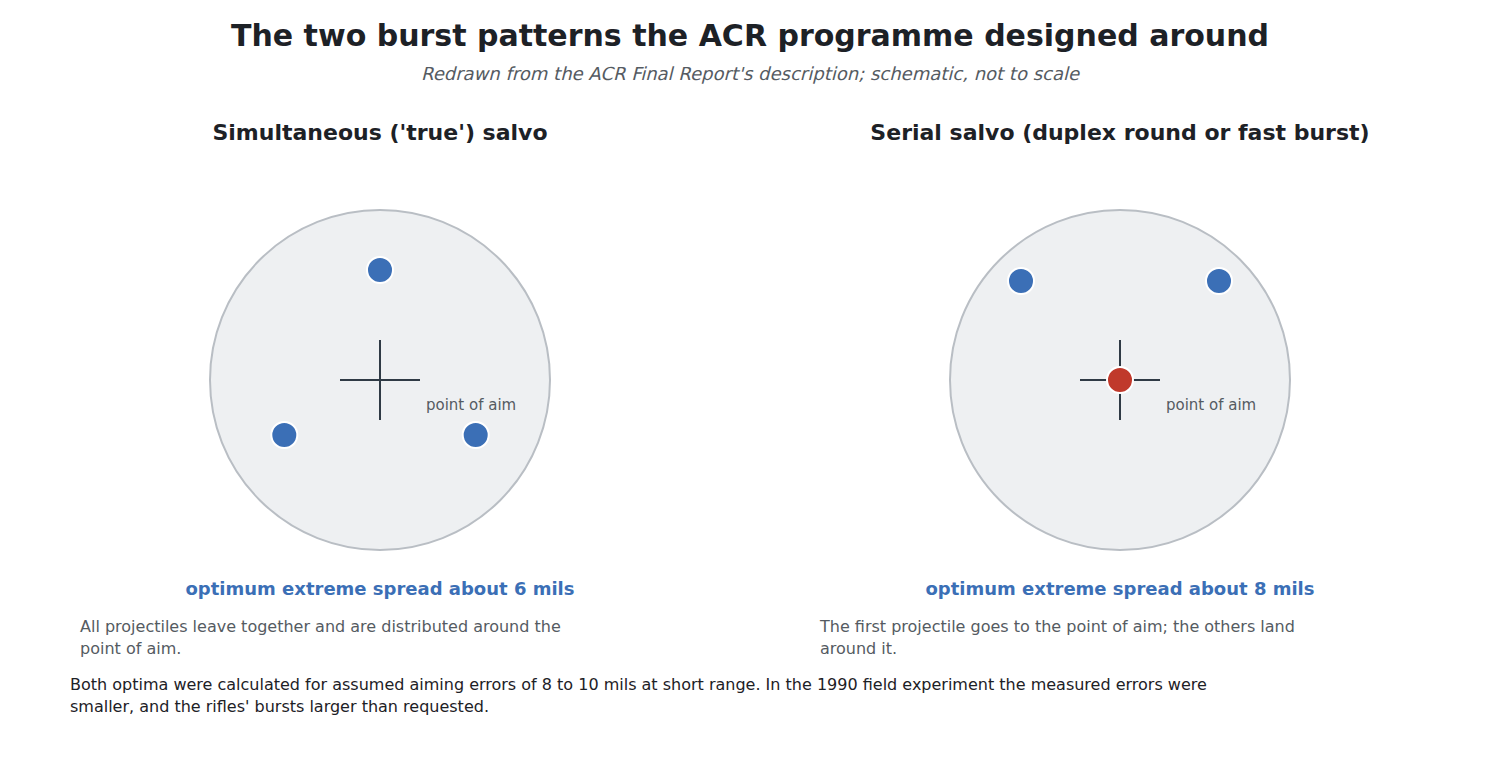
From that, the Army assumed aiming errors of 8 to 10 mils at 0 to 100 metres, about 3 mils at 300 to 400 metres, and 1 to 2 mils at 500 to 600 metres. For those errors, theory said that a salvo of three projectiles could raise the chance of at least one hit by around 100 percent, with an optimum 6-mil extreme spread for a simultaneous salvo and 8 mils for a serial one. Achieving that with a burst of separate rounds required “High cyclic rates within the burst … muzzle compensation and the use of low impulse ammunition, such as flechettes. The H&K system did not use low impulse ammunition, but relied on a unique mechanism for controlling its recoil.”1
Two things in that reasoning matter for what follows. The burst sizes were designed against the assumed aiming errors. And the assumed errors came from earlier tests whose instruments, as the report later admitted, could not measure aiming error directly.
6.5 The contracts, and the two that failed
The report’s chronology gives the programme’s path:1
- 1982. The Under Secretary endorsed a 10- to 12-year development approach, and in September 1982 two competitive contracts went to AAI Corporation and to Heckler & Koch, Inc. for caseless ammunition, salvo fire and optics. This “caseless ammunition rifle system” work was the ACR’s origin. AAI’s caseless effort was later terminated because AAI could not make a round that survived the feeding forces (Volume 3).
- 1984 to 1985. Industry conferences at Picatinny and Fort Benning. An AMSAA and Ballistic Research Laboratory study concluded “that the best way to improve rifle performance in near term is to fire multiple projectiles per trigger pull with a (controlled) salvo pattern of dispersion”. A solicitation went out in September 1985, written “to resemble a performance requirement” and deliberately excluding caseless concepts, because the government considered caseless “adequately represented with the ongoing H&K effort”. Eight responses arrived on time; five were at least minimally acceptable.
- 1986. “Industry alternative” contracts went to AAI (now with a conventional brass case), ARES Inc., Colt’s Manufacturing Company, McDonnell Douglas Helicopter Company and Steyr-Mannlicher, and the H&K contract was modified to run alongside them.
- 1987. The ARES and McDonnell Douglas efforts were terminated “due to hardware immaturity”. The Navy withdrew from the programme in December 1987, and the Marine Corps later; the Air Force stayed in.
- 1988 to 1990. Test planning, the instrumented range, hardware delivery, safety and engineering tests, and in 1990 the field experiment. AMSAA analysed the results in 1991.
All five industry contractors failed to deliver a demonstrator on time, and the second phase was stretched from twelve to eighteen to twenty-one months before a “red team” recommended ending the two least mature efforts.1
ARES had, before any hardware existed, “the highest rated concept proposal”. Its rifle was a bullpup with a rising chamber and plastic-cased, fully telescoped 5 mm ammunition in a 60-round drum, every round a tracer. The concept was built around a “closed loop fire control” tactic: the shooter would walk his fire onto the target by watching the tracer stream. The plastic case, too soft compared with brass, compressed under the bolt and misfired. The weapon also held a live round in its chamber block even when out of battery, a cook-off risk the Army judged “greater than negligible”.1
McDonnell Douglas proposed the only true simultaneous salvo of the industry round: a .338 calibre recoil-operated “lockless” rifle firing a flat plastic “chiclet” cartridge that launched several projectiles at once. The original duplex and triplex bullet packages had “unacceptably high” recoil, so the firm switched to three to five flechettes, losing time it did not have. The rifle was semi-automatic only, fed from a ten-round magazine, and was first built in its final form only at the end of May 1988. The Army’s comment on multiple-flechette loads goes to the heart of the simultaneous-salvo idea: “in past similar efforts, none of the flechettes go to the point of aim. This is not a problem where the aim error is high; but in the relatively low aim error in longer range engagements, this system would likely exhibit extremely poor hit probability performance.”1
6.6 The four finalists
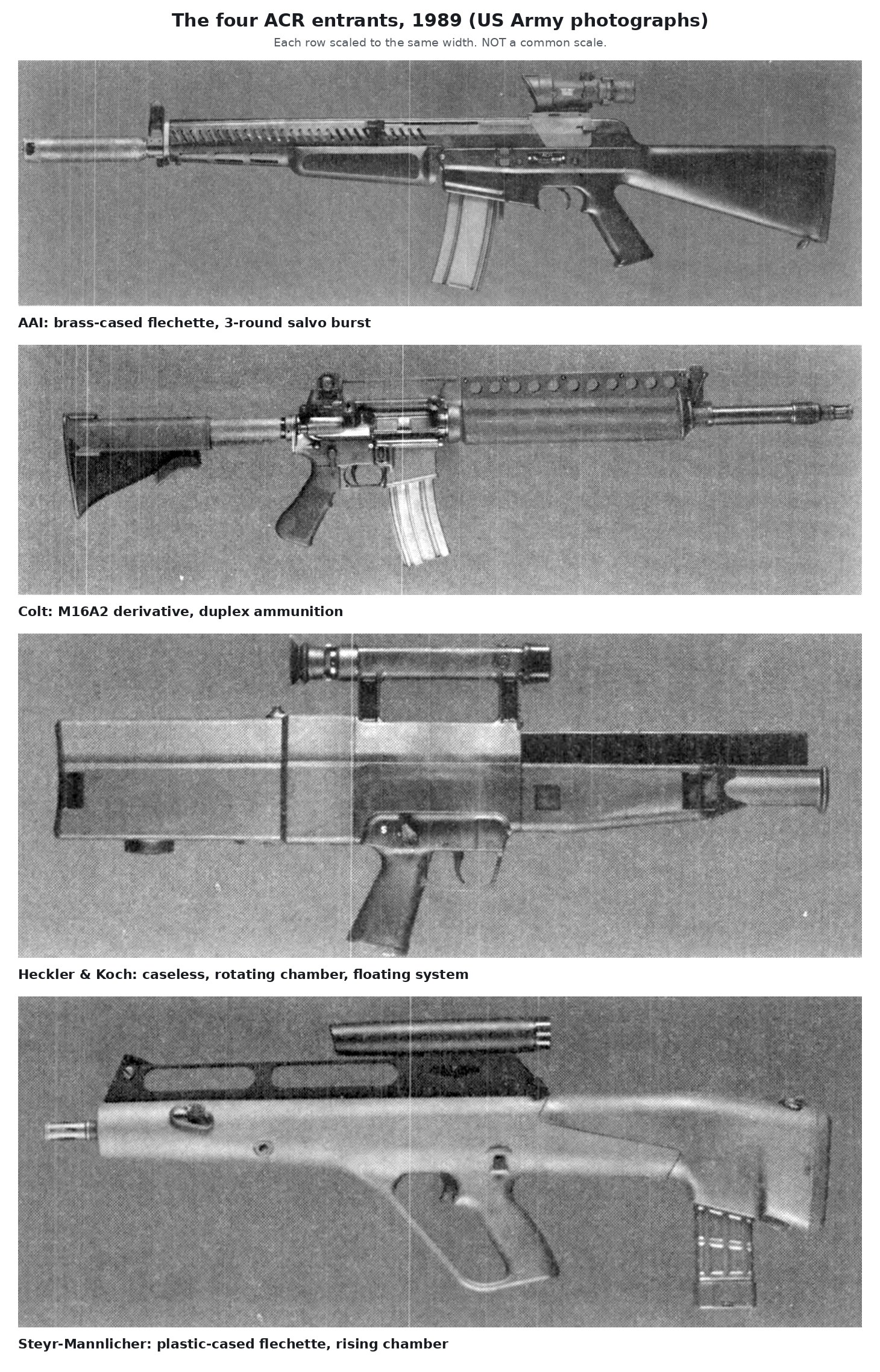
AAI, Colt, H&K and Steyr each delivered hardware for the field experiment, and the report describes each.1 All four are, in the report’s words, “serial launch salvo” rifles.
Table 1 — The four finalists
| AAI | Colt | Heckler & Koch | Steyr-Mannlicher | M16A2 (baseline) | |
|---|---|---|---|---|---|
| Mechanism | Reciprocating bolt | Reciprocating bolt | Rotating chamber | Rising chamber | Reciprocating bolt |
| Calibre and round | 5.56 mm brass-cased flechette | 5.56 mm duplex and M855 | 4.92 mm caseless ball | 5.56 mm telescoped plastic-cased flechette | 5.56 mm M855 |
| Projectile | 10.2 gr steel flechette | Two bullets, 35 and 33 gr (duplex) | 51 gr bullet | 9.85 gr steel flechette | 62 gr bullet |
| Muzzle velocity | 4,600 ft/s | 2,900 ft/s duplex; 3,110 M855 | 3,000 ft/s | 4,900 ft/s | 3,110 ft/s |
| Modes | Semi; 3-round salvo burst | Semi; automatic | Semi; automatic; 3-round salvo burst | Semi; 3-round burst | Semi; 3-round burst |
| Burst or automatic rate | 1,800 spm burst | Not given in the report | Over 2,000 burst; 600 automatic | About 1,200 spm burst | About 800 spm burst |
| Magazine | 30 | 30 | 45 | 24 | 30 |
| Length | 40.00 in | 40.625 in (36.75 in collapsed) | 29.53 in | 30.12 in | 39.63 in |
| Loaded weight with sights | 9.39 lb | 10.30 lb | 9.15 lb (optic only) | 8.53 lb | 8.80 lb |
| Twist | 1 in 85 in | 1 in 7 in | 1 in 6 in | 1 in 100 in | 1 in 7 in |
Source: ACR Final Report, Figure 3.1 and Appendix B.1 An 850-round automatic rate for the Colt circulates online but is not in the report as read and is not used here.
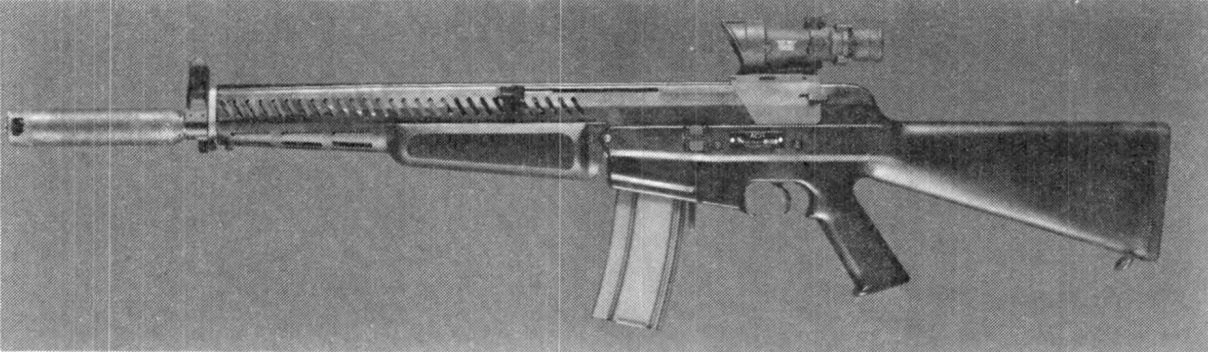
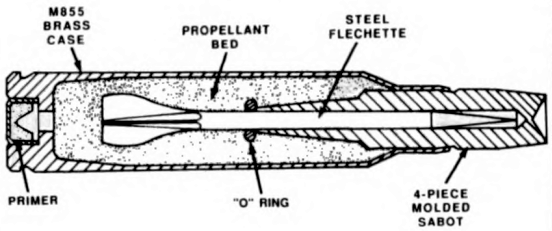
AAI offered “a modification to the previously developed serial bullet rifle”, the line that ran back through the XM70 and XM19 to SPIW (Volume 2), with an “entrapped gas” piston system meant to keep fouling out of the mechanism. It fired a 10.2-grain steel flechette in a four-segment plastic sabot inside an ordinary M855 case, single shots or three-round bursts at 1,800 shots a minute, with a muzzle compensator and a 4× optic. The Army judged it “a well-proven, mature design which performed in a reliable fashion during the FY90 Advanced Combat Rifle (ACR) field trials”. Its round weighed 143 grains against the M855’s 185, and there was no tracer flechette.1
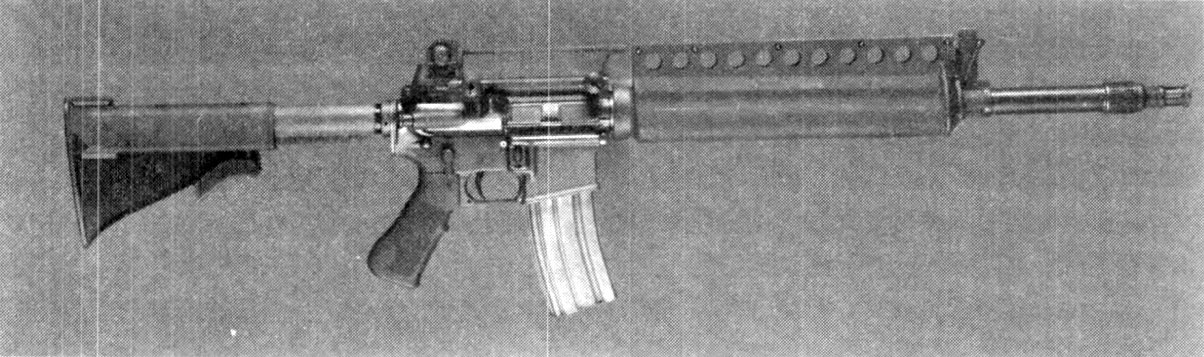
Colt offered “a human engineered derivative of the current M16A2”, with a muzzle brake compensator that Colt’s testing credited with about a 40 percent reduction in recoil, a telescoping stock, a flat-top rail, and an oil-and-spring hydraulic buffer. It fired standard M855 or a new 5.56 mm duplex round, two bullets nose to tail about 1 mil apart in dispersion. Colt proposed a two-ammunition family: duplex for short range, M855 for long. AMSAA’s projection at the end of the first phase had already shown that any improvement would come only from the duplex round. Some of Colt’s features were taken into the M16A3.1
Heckler & Koch offered the G11 in its K1 form, described in Volumes 3 and 4: a bullpup-like rifle with a rotating chamber, the “internal operating floating system”, a 45-round magazine and a Swarovski 1× or 3.5× optic with no iron sights. It was the only one of the four that relied on a recoil-delaying mechanism rather than on low-impulse ammunition to keep its burst together. It was restricted to 135 rounds before cooling during the experiment because of its cook-off limit.1
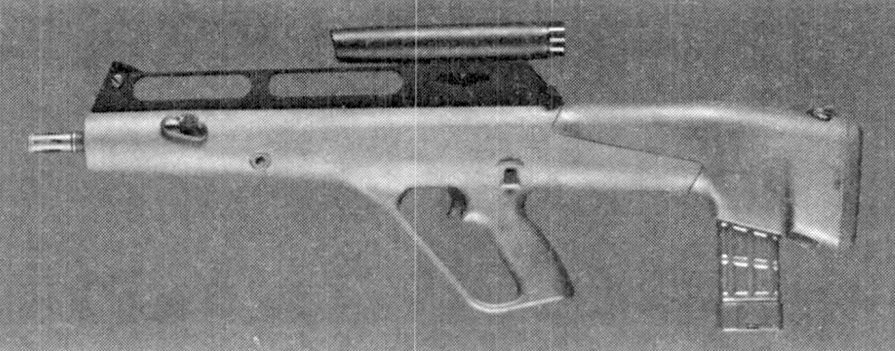
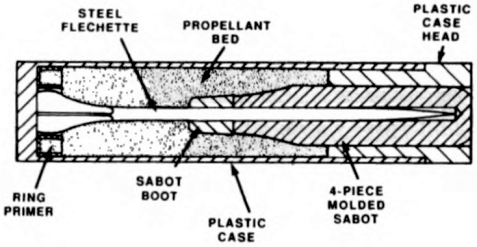
Steyr offered a bullpup “resembling” the AUG in profile, firing a 9.85-grain flechette from a fully telescoped plastic case with a ring primer struck from the side. Its rising chamber fired from an open bolt, which “greatly reduces the concern for ammunition cook-off”. The Army judged it “the simplest weapon, the simplest round, and the most cost effective approach of any of the ACR contenders”, with a projected cost of about $375 to $400, less than an M16A2, and ammunition at about 40 percent of the cost of M855. Its “greatest current deficiency is its poor round to round dispersion characteristics”: flechette dispersion “at best, twice as wide as the standard bulleted system and often wider than that”. It had the most trouble in safety certification and early testing, including obturation failures that vented gas into the buttstock, and “consideration was given to concept termination at the very late testing phase”.1 The hub’s Steyr AUG dive, Volume 3, notes that the Steyr ACR was not an AUG variant, and credits its rising-chamber action to Ulrich Zedrosser on Daniel Watters’s chronology; the ACR report does not name the designer.
6.7 The range built to measure them
The experiment’s most lasting product was the range. Buckner Range at Fort Benning was rebuilt by Unisys Corporation into “a unique highly instrumented live fire test facility”. Its two lanes had pop-up targets at 25, 50, 75, 100, 150, 225, 300, 400, 500 and 600 metres and moving targets at 75, 150 and 225 metres travelling at 6 or 12 feet per second, to simulate a walking and a running man. All targets were half-man size. A computer controlled every presentation and recorded hits, timings, the soldiers’ heart rates and, through miss-distance instruments at 14 of the 35 targets out to 300 metres, where every miss passed within 15 feet of the target. The miss-distance system sensed the shock wave of supersonic projectiles with curved rods and was sensitive enough to detect flechettes. A return-fire simulator could fire back.1
That instrumentation is the reason the result matters. For the first time, the report says, aiming error was measured “directly from the miss distance information”, rather than calculated from targets hit and engaged with “less sensitive and less reliable instrumentation”.1
6.8 How the experiment was run
- Training. The contractors trained Army and Air Force instructors and Infantry Board staff at Fort Benning from 17 to 28 July 1989, with two days of refresher training in the first week of January 1990 before the experiment began.1
- Weapons and ammunition. Fifteen test weapons of each ACR type, fifteen standard M16A2s, ten M16A2s fitted with optics, and ten M16A2s modified to fire automatic with muzzle stabilisers. Approximate ammunition: 90,000 AAI flechette rounds, 53,000 Colt duplex and 10,000 M855, 75,000 H&K caseless rounds, 90,000 Steyr flechette rounds, and 292,000 rounds for the various M16A2 conditions.1
- Design. A repeated-measures design in which every soldier fired every weapon condition, in rotations of one week’s training and two weeks’ firing, with order, carry-over, learning, stress and time of day controlled. Each weapon was fired in up to four conditions: semi-automatic or burst, each with iron or optical sights.1
- Scenarios. Short range, 25 to 75 metres, standing unsupported, targets exposed for 1.5 to 5 seconds, two or three at a time; intermediate range, 75 to 300 metres, prone unsupported, with moving targets; long range, 300 to 600 metres, from a supported foxhole.1
- Stress. Short exposures, unknown target locations, multiple targets, moving targets, physical exercise before firing, simulated return fire, and competition. The report argued that “It is unlikely that additional stressors, short of actual combat, could have been used in this test.”1
- Women firers. At the Air Force’s request, a smaller third phase tested ten women, five Army and five Air Force, at short and intermediate range from the foxhole position, with one day’s training on each weapon.1
The primary measure of effectiveness was the percentage of targets hit on the first trigger pull.1
6.9 The results
The report extracts the following from AMSAA’s classified evaluation.1
Qualification. After a week’s training on each test weapon, the soldiers fired the Army’s record-fire course again. “with the two flechette firing guns (AAI and Steyr) … almost all of the gunners failed to hit sufficient targets to be considered qualified”, because flechette round-to-round dispersion “was more than two times that of the bulleted systems”. In the women’s phase no one qualified with the flechette rifles, and 80 percent failed to qualify with the H&K rifle, which the report attributes to the short training time.
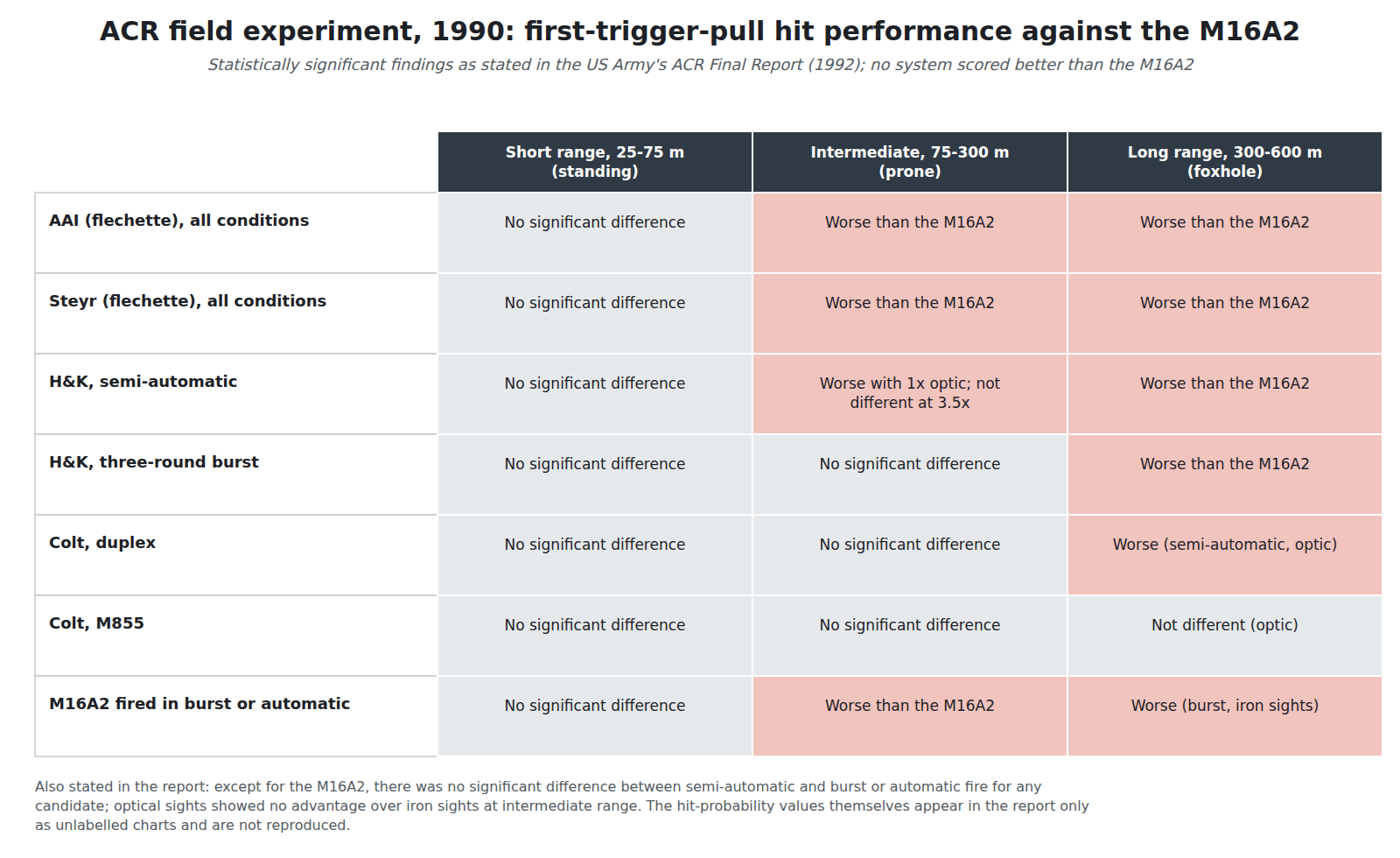
Short range (25 to 75 metres, standing). “There were no statistical differences in the hit performance of the weapons tested”. The flechette rifles in semi-automatic had lower point estimates, but not significantly so.
Intermediate range (75 to 300 metres, prone). Significant differences appeared:
- the flechette rifles were worse than the standard M16A2 in all conditions;
- the H&K firing semi-automatically with its low-power optic was worse than the standard;
- the M16A2 fired automatically was worse than the standard;
- all other systems were not significantly different from the standard;
- optical sights showed no advantage over iron sights, and the H&K’s high magnification no advantage over its low;
- “Except for the M16A2, there were no statistically significant differences between semiautomatic and automatic fire (AAI, Colt, H&K and Steyr).”
Long range (300 to 600 metres, foxhole). “The flechette weapon systems (AAI and Steyr) and the H&K were statistically worse than the standard for all firing conditions.” There was no significant difference between semi-automatic and three-round burst fire for the AAI, H&K and Steyr rifles. The Colt duplex fired semi-automatically with its optic was worse than the standard and worse than the same Colt firing M855.
The headline. “no system had a higher probability of hitting the target than the M16A2 based on the MOE of targets hit per first trigger pull.”
Incapacitation. Combining hit data with classified Ballistic Research Laboratory estimates of the probability that a hit incapacitates, the duplex rounds fired automatically from the Colt and the modified M16A2 did better than the standard at short range, and the modified M16A2 with duplex at intermediate range. The H&K, in semi-automatic and burst, was worse than the standard at intermediate range with its low-power optic and at long range with its high-power optic. Point estimates at 25 metres favoured every weapon fired in burst or automatic; out to 75 metres, all except the Steyr and the H&K. The Colt duplex’s lethality fell quickly with range because of its light bullets.
6.10 Why the salvo rifles did not win
The report’s explanation is short and is the most important paragraph in this dive.
“No rifles showed an increase in probability of hit over the M16A2 rifle under the stressed conditions of the test. This is primarily because the soldiers performed better than expected; meaning their aiming errors were smaller than anticipated. Therefore, the salvo burst sizes were too large to effectively increase the probability of at least one projectile hitting the target. Another contributing factor is that the burst size actually obtained from the weapons was somewhat greater than that originally requested.”1
It then draws the conclusion that ended the argument begun in 1952:
“Salvo rifles can be effective in increasing hit probability under conditions of large aiming errors. However, with the size of the aiming errors experienced in this test, a significantly smaller burst size would be required than those produced by the rifles in this program. It is unlikely that sufficiently small burst sizes could be obtained and controlled to effectively improve performance with the aiming errors now known to exist.”1
And it records the baseline that surprised everyone: “The baseline performance of the M16A2 rifle was better than anticipated in terms of hit probability.” The Army planned to replace its long-used rifle hit estimates with the new data base, which “will remain the basis against which all individual weapons will be assessed well into the future”.1
In other words, the theory of Volume 1 was right, and its inputs were wrong. Hitchman, SALVO and the ACR planners all sized their patterns against aiming errors inferred from imperfect data. When the error was measured directly, it was smaller than assumed; the bursts the rifles produced were also larger than designed; and a pattern wider than the error it is meant to cover throws its extra projectiles away. Volume 1’s illustrative model shows the same effect in the abstract.
The report nonetheless judged the programme “a success” as technology: “New gun mechanisms have been designed and proven, and the feasibility for reduced combat load through the use of lightweight plastic case and caseless ammunition has been demonstrated.” Flechettes, it concluded, were probably finished as rifle projectiles but remained attractive for crew-served and area weapons.1
6.11 What it means for hyper-burst
For the G11, the only true hyper-burst rifle in the test, the record is specific.
- The mechanism worked. The Army confirmed that the buffer bottomed only after the third bullet left, that recoil peaks were substantially lower than the M16’s, and that most stoppages were ammunition-related (Volume 4).
- The burst did not improve hits. There was no statistically significant difference between the H&K’s semi-automatic and burst fire at intermediate or long range.
- The rifle was not better than the M16A2 anywhere, and worse at long range in every condition, and worse at intermediate range in semi-automatic with its low-power optic.
- It was restricted to 135 rounds before cooling, and it was the only candidate without iron sights.
The fair reading is narrow. The 1990 experiment tested the G11 against the specific question the ACR asked, with soldiers who turned out to aim better than the programme assumed. It does not show that a three-round burst at 2,000 rounds a minute is useless in every circumstance; the report itself says salvo fire helps when aiming errors are large, and the incapacitation point estimates at 25 to 50 metres favoured burst fire. It does show that the G11’s burst did not produce the doubling of hit probability that both the American programme and H&K’s advertising promised, under the best simulated combat conditions the US Army could build.
6.12 Advertised and measured, side by side
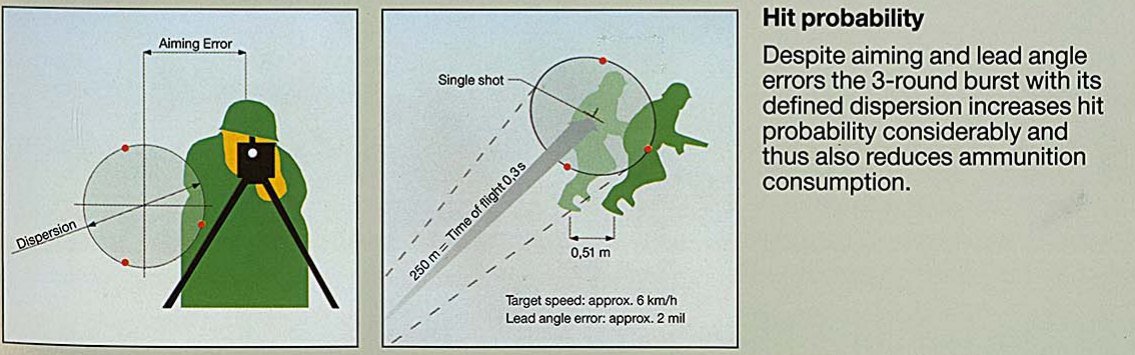
Table 2 — Advertised and measured, side by side
| Claim | Who made it | What was measured, and by whom |
|---|---|---|
| G11: “High hit probability even under combat conditions”; three-round burst “with defined dispersion” that “does not depend upon the shooter or his training level” | H&K and Dynamit Nobel brochure2 | US Army, 1990: no higher first-trigger-pull hit probability than the M16A2 in any range band; worse at long range in all conditions; no significant difference between semi and burst1 |
| G11: the burst ensures “zumindest ein Geschoß … sein Ziel erreicht”, that at least one bullet hits | H&K, quoted in Der Spiegel, 19823 | Same |
| G11: higher hit probability through the three-shot burst | Bundeswehr study collection placard (development summary)4 | Bundeswehr troop trials 1988 to 1990 “essentially confirmed” the overall concept, per the same placard; no published figure. The German government gave no figure when asked in 19905 |
| ACR goal: at least 100 percent more hits than the M16A2 | US Army O&O Plan, 19851 | Not achieved by any candidate1 |
| AN-94: 1.5 times the combat effectiveness of known designs | Izhmash6 | No published trial report found |
| AN-94 (ASM): hit probability 0.63 against 0.30 for the AK-74, off-hand at 100 m | Popenker, source not named7 | No published trial report found |
6.13 The Soviet side: no comparable record
No Soviet or Russian equivalent of the ACR report has been published or was found for this dive. The Abakan trials, by every account in Volume 5, found Nikonov’s ASM better than the AK-74 for short bursts from unstable positions, and that finding led to the AN-94’s adoption. But the published figures, Izhmash’s “1.5 times” and Popenker’s 0.30 against 0.63, come without test conditions, sample sizes or a stated measure of effectiveness, and cannot be compared with the American data. It is possible that the Soviet tests, which aimed specifically at firing from unstable positions such as on the move, without a rest and off-hand, measured a situation with larger aiming errors, which is exactly where the ACR report says salvo fire helps. That possibility is an inference; no document seen for this dive establishes it.
6.14 Figures in circulation that the report does not support
Several figures commonly attached to the ACR were not found in the report as read and are not used in this dive:
- “Approximately US$300 million” as the programme’s total cost. Not in the Volume I summary; no primary source found.
- “Between August 1989 and April 1990” as the dates of the competition. The report gives instructor training in July 1989 and the field experiment in 1990, beginning after refresher training in early January 1990, without an end date in the summary.
- “M16A2 hit probability 20 percent at 100 metres, 10 percent at 300 metres and 5 percent at 600 metres.” These appear on GlobalSecurity’s ACR page; they are not in the summary as read, and the report’s own revised M16A2 curve is published only as an unlabelled chart.
References
Footnotes
-
Vernon E. Shisler and Stephen M. Mango, Advanced Combat Rifle (ACR) Program, Volume I, ACR Program Summary, Technical Report ARCCD-TR-92001, US Army Armament Research, Development and Engineering Center, Close Combat Armaments Center, Joint Service Small Arms Program Office, Picatinny Arsenal, February 1992 (DTIC AD-B162 942; limited distribution at issue). Sections 1 to 8 and Appendices A to C. Public digitised copy credited to smallarmsoftheworld.com, https://municion.org/wp-content/uploads/2022/11/06-047-BGC-011-1.pdf, consulted 2026-10-18. The report cites as its sources for results: US Army Infantry Board, Customer Test of Advanced Combat Rifle (ACR) – Final Report, TRADOC Project No. 89-0000752, November 1990; and AMSAA, Independent Evaluation Report No. 5-91 of the Advanced Combat Rifle (CONFIDENTIAL), August 1991. Neither was seen for this dive. ↩ ↩2 ↩3 ↩4 ↩5 ↩6 ↩7 ↩8 ↩9 ↩10 ↩11 ↩12 ↩13 ↩14 ↩15 ↩16 ↩17 ↩18 ↩19 ↩20 ↩21 ↩22 ↩23 ↩24 ↩25 ↩26 ↩27 ↩28 ↩29 ↩30 ↩31 ↩32
-
Heckler & Koch and Dynamit Nobel (GHGS), Weapon-Ammunition-System G 11, English brochure, Heckler & Koch, Inc., Sterling, Virginia, undated. Internet Archive, https://archive.org/details/1557677285551-2, consulted 2026-10-18. ↩
-
“Gedämpftes Pressen”, Der Spiegel 19/1982, 9 May 1982, https://www.spiegel.de/spiegel/print/d-14350537.html, consulted 2026-10-18. ↩
-
Wehrtechnische Studiensammlung, Koblenz, placards for the G11 Konstruktionsstand 1 and K 2/3, read from Wikimedia Commons photographs by Clemens Vasters (2017, CC BY 2.0), consulted 2026-10-18. ↩
-
Deutscher Bundestag, Drucksache 11/7055, Antwort der Bundesregierung, 3 May 1990, https://dserver.bundestag.de/btd/11/070/1107055.pdf, consulted 2026-10-18. ↩
-
Izhmash, product page “Автомат Никонова АН-94”, Wayback Machine capture of 18 October 2014, https://web.archive.org/web/20141018133511/http://izhmash.ru/rus/product/nikon.shtml, consulted 2026-10-18. ↩
-
Maxim Popenker, “Nikonov AN-94 Abakan assault rifle (Russia)”, Modern Firearms, https://modernfirearms.net/en/assault-rifles/russia-assault-rifles/an-94-abakan-eng/, consulted 2026-10-18. ↩
Comments (0)