Hyper-Burst Mechanisms · Volume 1
Why Hyper-Burst: Aiming Error, Hit Probability and the SALVO Experiments
The 1952 Johns Hopkins study that called the automatic rifle 'valueless' for hitting separated targets, the Fort Benning field experiments of 1956 and 1957, and the timing argument that turned a pattern of shots into a mechanism problem
1.1 What this dive covers, and what it does not
This is a reference dive about a family of military machine guns. Every weapon in it fires more than one shot for a single pull of the trigger, which makes every one of them a machine gun in United States federal law and in Michigan law. Volume 7 sets out that position and links the hub’s existing legal material.
The scope is mechanism and history only. The dive describes how these weapons work at the level of a cycle of operation, what their designers claimed for them, what testing actually measured, and why none of them spread. It does not contain, and will not contain, any content on making, converting or modifying a firing burst or automatic device: no part dimensions, no tolerances, no fire-control geometry and no assembly or disassembly procedures that would help anyone build or alter one. Where a primary source carries that kind of detail, the dive reports that the detail exists and moves on.
Volume 8 covers the one practical project this subject supports: non-firing kinematic demonstrators that show how the motion works and could not fire, such as a printed or acrylic model of the AN-94’s pulley-and-cable feed or of the G11’s rotating breech. That volume opens with the same boundary, stated more precisely.
1.2 The idea in one paragraph
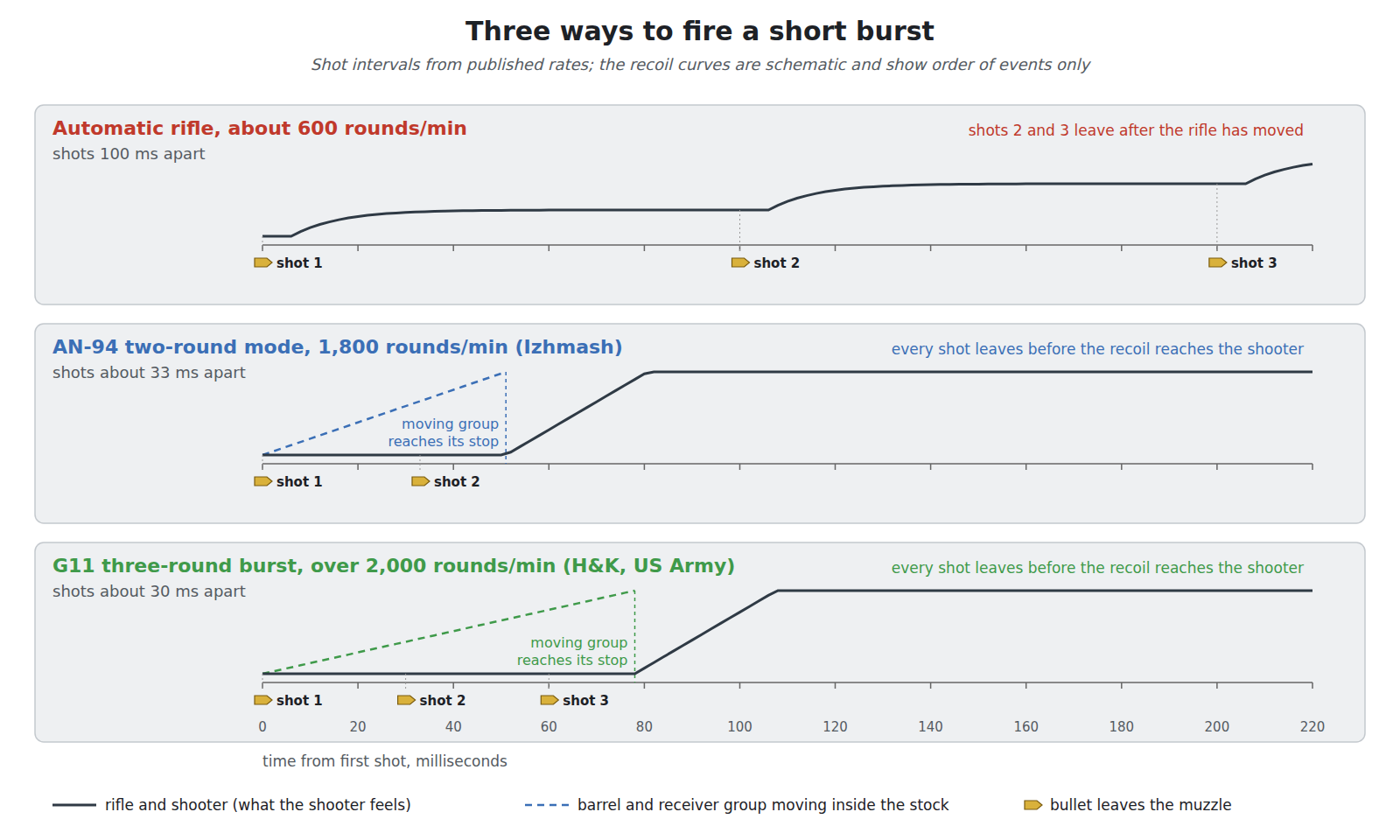
A soldier under stress aims badly, and most of the error is the soldier’s, not the rifle’s. If a rifle throws several projectiles around the point of aim in a controlled pattern, one of them may hit where a single bullet would have missed. An ordinary automatic rifle cannot do this usefully, because recoil moves the rifle between shots and the second and third bullets go wherever the recoil has pointed the barrel. There are two ways round that. One is to launch all the projectiles at once, from several barrels or from one cartridge. The other is to fire the shots in sequence so quickly that they have all left the barrel before the recoil has moved the shooter. The second approach is what this dive calls hyper-burst: a short, fixed-length burst at a very high rate, built so that the bullets leave before the recoil arrives. Two weapons carried it as far as the issue of hardware to troops: Heckler & Koch’s G11, which fired three-round bursts at a rate H&K and the US Army both put above 2,000 rounds a minute, and Gennadiy Nikonov’s AN-94, which fires two-round bursts at a rate its maker gave as 1,800 rounds a minute.12
1.3 The terms, as the sources use them
The literature is not consistent, and the words matter because they hide the distinction the whole subject turns on.
Table 1 — The terms, as the sources use them
| Term | Meaning in this dive | Where the usage comes from |
|---|---|---|
| Salvo | More than one projectile launched for one trigger pull, whether together or in rapid sequence | The 1952 ORO study used “salvo” and “volley” loosely and said so in a footnote; the ACR reports distinguish “true salvo” from serial salvo32 |
| True or simultaneous salvo | All projectiles leave together: multiple barrels, several bullets or flechettes in one cartridge | ACR Final Report, Vol. I2 |
| Serial salvo | Projectiles leave one behind the other: duplex cartridges, or a fixed burst of separate rounds | Same2 |
| Controlled burst | A burst whose length is set by the mechanism, not by the shooter’s trigger finger | SPIW reports of the 1960s (Volume 2)4 |
| Hyper-burst | A controlled burst fast enough that all its bullets leave before recoil reaches the shooter | A modern descriptive term, not a designation used in the primary reports; Russian sources speak of a “shifted recoil impulse” (смещённый импульс отдачи)1 |
| Extreme spread | The largest distance between any two impacts in a group, often given in mils | Standard; the ACR report sets its optimum burst sizes this way2 |
| Mil | One thousandth of the range: 1 mil is about 0.3 m at 300 m | Standard |
Two consequences follow. A duplex cartridge is a serial salvo but not a hyper-burst, because it is one cartridge. And an automatic rifle with a burst limiter, such as the M16A2, fires a controlled burst but not a hyper-burst: the US Army’s own ACR report puts its burst rate at about 800 rounds a minute and says that its three-round burst “has no greater hit probability than the semi-automatic mode”.2
1.4 The problem ORO found in 1952
The argument begins at the Operations Research Office (ORO), a Johns Hopkins University organisation working under contract to the US Army. Its Technical Memorandum ORO-T-160, Operational Requirements for an Infantry Hand Weapon, was received on 19 June 1952 and published that November under Project BALANCE. The author was Norman A. Hitchman, with statistical analysis by Scott E. Forbush and George J. Blakemore Jr.3 The study is often attributed to Donald L. Hall of the Ballistic Research Laboratories; Hall did separate work that Hitchman cites, but ORO-T-160 is Hitchman’s.
Hitchman combined three kinds of evidence: where wounded men had been hit and at what range, how far a soldier can actually see across real terrain, and how well riflemen shot in tests designed to resemble combat rather than the qualification range. His conclusions are worth quoting, because the rest of this subject inherits them almost unchanged:
“1. The ranges at which the rifle is used most frequently in battle and the ranges within which the greater fraction of man targets can be seen on the battlefield do not exceed 300 yd. 2. Within these important battle ranges, the marksmanship of even expert riflemen is satisfactory in meeting actual battle requirements only up to 100 yd; beyond 100 yd, marksmanship declines sharply, reaching a low order at 300 yd. 3. To improve hit effectiveness at the ranges not covered satisfactorily in this sense by men using the M-1 (100 to 300 yd), the adoption of a pattern-dispersion principle in the hand weapon could partly compensate for human aiming errors and thereby significantly increase the hits at ranges up to 300 yd.”3
He was blunt about training as the alternative. An expert rifleman at Fort Benning estimated that his own skill had taken “nine years of continuous training”, and Hitchman estimated that “less than 10 percent of the men in the normal recruit stream” could reach that level even with unlimited time. In a mobilisation, the time would not be there.3
He also made a point that later programmes rediscovered. Because the soldier’s aiming error is so much larger than the rifle’s own dispersion, he wrote, the rifle’s dispersion “could be more than doubled without materially affecting the probability of hitting the target”, and precision standards that seek near-zero dispersion are “not supported by this analysis as genuine military requirements”.3 A more accurate rifle does not help a man who cannot hold it on the target. A pattern might.
1.5 Why the automatic rifle did not help
The obvious objection in 1952 was that the Army already had a way of putting several bullets near a target: automatic fire. Hitchman tested it. At Fort Benning, expert riflemen and ordinary marksmen fired controlled five-round bursts from the automatic rifles then in service at Type E silhouettes set in front of six-foot-square screens. The result at 100 yards was stark: “Never did more than one round hit the target or screen from any of the short bursts.” To get more than one strike on the screen at all, the range had to be closed to 50 yards, and even there the silhouette was “not hit more than once from any burst”.3
From those preliminary trials ORO drew five findings, the first and last of which became the problem statement for every programme in this dive:
“1. Regardless of the skill of the rifleman, only the first round in a short, fully automatic burst can actually be directed at a point target. … 5. The full automatic feature of current infantry weapons is valueless from the standpoint of increasing the number of targets hit when aiming at separated man-size targets.”3
The mechanism of the failure is in the second finding: after the first round, the shots “fall off a man-size target in an approximately linear pattern”, the departures depending on the weapon and how it is held. A footnote adds that a rifleman can exert some compensating control, but that it “is not noticeable before 5-10 rounds have been fired”.3 In other words, recoil walks the burst away from the aim point faster than the shooter can bring it back. That observation is the seed of hyper-burst, although Hitchman did not propose it. He proposed two other cures: launch the pattern all at once, or reduce the recoil by going to a small calibre, so that a short burst would not walk so far. He thought the second might be “the most practical solution”, noting that the low recoil of a small-calibre rifle “offers the chance to employ a muzzle compensator with significant effects”.3
1.6 The pattern principle
The core of ORO-T-160 is a calculation of what a pattern would buy. Hitchman modelled a hypothetical “salvo automatic” that differed from the M1 rifle only in how it launched its projectiles, and fired it, on paper, with the aiming errors measured from real riflemen. His best practical case was a four-round salvo in a diamond with 20 inches between rounds at 300 yards; four was the fewest that would make a symmetrical pattern. Such a salvo, he found, “would more than double hit effectiveness at this distance”, and would “raise the performance of common marksmen using the salvo weapon to the level of expert riflemen using the M-1”.3
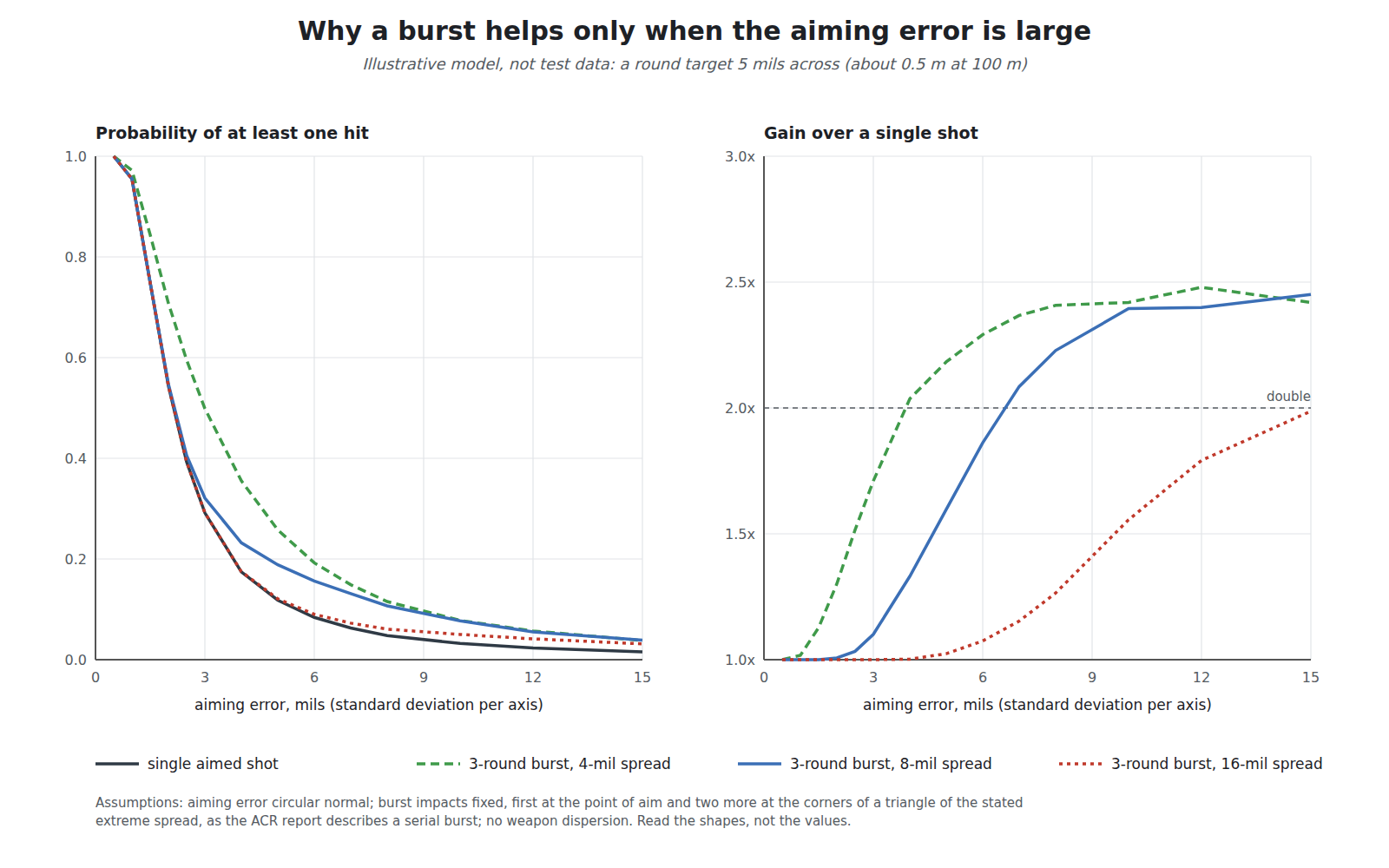
The arithmetic behind that claim is general, and later reports restate it. A pattern helps only when the shooter’s aiming error is large compared with the target. If the shooter is accurate, the first bullet hits anyway and the others are wasted; if the pattern is too wide, the extra projectiles miss on either side. The US Army’s ACR report of 1992, after thirty years more work, put it in one sentence: in burst systems “small dispersions, approximately one half the aim error, are required”.2 The pattern has to be matched to the error it is meant to cover. Volume 6 shows what happened when, for the first time, the Army measured that error directly and found it smaller than every earlier study had assumed.
Two points in Hitchman’s text are easy to miss and matter later.
First, his footnote defining the concept already contains both branches of the subject. The salvo he had in mind was “either a simultaneous, or a high cyclic rate, burst, with the number of rounds per burst automatically set rather than dependent upon trigger release”.3 A fixed-count, high-cyclic-rate burst is exactly what the G11 and the AN-94 eventually delivered. What Hitchman did not foresee was how the burst would be kept on target: he imagined “controlled nutation of the rifle muzzle” to spread the shots deliberately, not a mechanism that keeps recoil away from the shooter until the burst is over.
Second, he coupled the pattern idea to small calibre from the start. His footnotes compare an M1 cartridge with a “.21 cal missile of 60 grains”, and he cites Hall’s theoretical result that, with weapon and ammunition held to 15 pounds, a .21 calibre rifle would produce about 2.5 times the expected kills of the .30 calibre rifle.3 The salvo line and the small-calibre line, which produced the M16, grew from the same paper.
1.7 Two ways to make a pattern
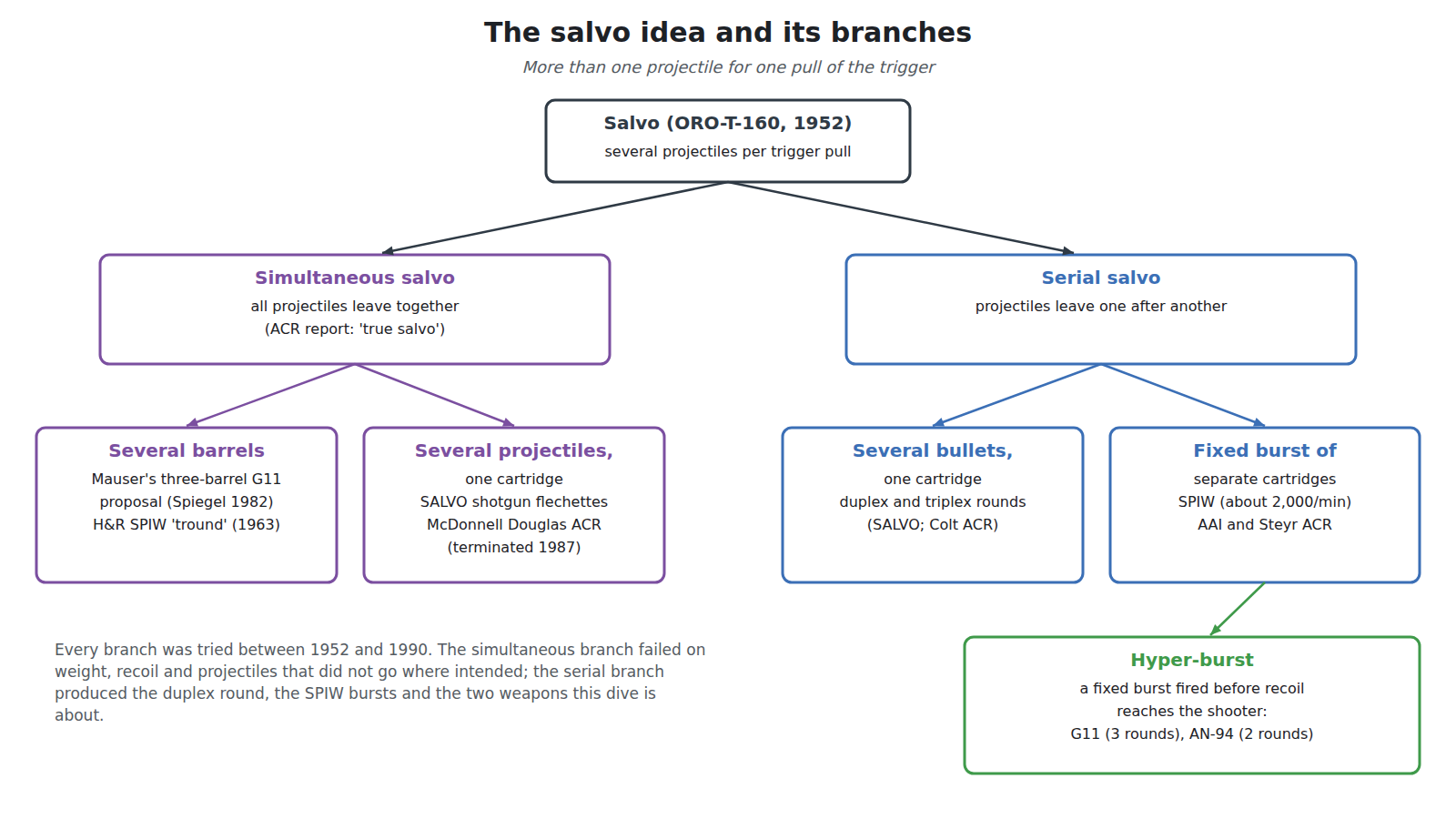
Everything in this dive is one branch or another of that tree. The simultaneous branch was tried with three-barrelled rifles, with a triangular three-projectile cartridge, and with flechette loads, and it ran into the same problems each time: weight, recoil, and projectiles that did not go where intended. Volume 2 covers the Harrington & Richardson SPIW, whose three-barrelled “tround” rifle the Ballistic Research Laboratories called “hopeless” in 1964, and Volume 6 covers McDonnell Douglas’s multiple-flechette ACR entry, terminated in 1987.52
The serial branch split again. One path put two or three bullets in tandem in one case. SALVO tested those rounds, and the duplex idea reached type classification in 7.62 mm and returned in 5.56 mm in Colt’s ACR entry.2 The other path fired separate cartridges in a mechanically limited burst. That is where the high cyclic rates came from: SPIW prototypes of the 1960s ran three-round bursts at around 2,000 rounds a minute, and the G11 and the AN-94 refined the idea by adding a way of keeping recoil off the shooter until the burst was over.
1.8 SALVO I, Fort Benning, 1956
Hitchman’s recommendation went to the Army Chief of Staff, General J. Lawton Collins, who, according to ORO’s own later account, “directed Ordnance to develop materiel to evaluate the proposed concept”; a SALVO Steering Committee was formed in response under the Chief of Ordnance.6 ORO’s second report on the programme dates the start of the salvo programme to ORO in 1951 and the Steering Committee to 1954.7 Both accounts are given here as their authors gave them.
The first large field experiment ran at Fort Benning in June and July 1956, designed by ORO and reported in June 1959 as ORO-T-378, SALVO I Rifle Field Experiment, by Leon Feldman and colleagues.6 It compared, in simulated combat on a range of 22 pop-up targets, eight types of fire:
- .30 calibre duplex and triplex rounds, two or three bullets in tandem, fired from the M1;
- standard .30 calibre armour-piercing ball as the control;
- two “minimum-climb” fully automatic .22 calibre weapons, the Gustafson carbine and a modified T48 rifle, each fired in bursts and in semi-automatic;
- a 32-flechette load from a 12-gauge semi-automatic shotgun.6
Groups of ten soldiers fired sitting and standing, by day and night, and electrical recorders logged every shot and every hit. The report’s headline table converts hits into estimated casualties per trigger pull, per unit of time and per unit of carried weight, and averages them into an overall gain over single-bullet M1 fire.6
Table 2 — SALVO I, Fort Benning, 1956
| Comparison in SALVO I | Average gain over the comparison (approximate, ORO’s Table 1) |
|---|---|
| .30 duplex vs single bullet | +60 percent (95 percent limits 53 to 67) |
| .30 triplex vs single bullet | +100 percent, ±11 |
| 32 flechettes vs single bullet | +200 percent, ±25 |
| Automatic vs semi-automatic fire, same weapons | +10 percent, ±5 |
| .22 carbine vs .30 M1 (semi-automatic) | +50 percent, ±8 |
| .22 T48 vs .30 M1 (semi-automatic) | +20 percent, ±6 |
Figures from the OCR of the declassified report; the scan is poor and the individual columns should be checked against the original before being quoted to the percentage point.
The line that matters for this dive is the fourth. Automatic fire from the two lightweight .22 weapons, built specifically to climb as little as possible, gained about 60 percent in casualties per trigger pull but lost 30 percent per unit of weight carried, and averaged out at about 10 percent. ORO concluded that “the automatic fire gain is smaller, depending on the criterion selected”, and that the duplex gain was “unequivocal”.6 It also measured how badly soldiers actually shot: “Average test accuracy is 14 percent hit probability, or an error (linear standard deviation) of 3.8 mils.”6
The report opens with a short history of the idea that is worth knowing because it reappears in later literature: an 1856 Ordnance report of two and three balls fired at once from a rifle musket; Captain E. M. Wright’s tandem three-bullet cartridge in the 1879 Ordnance report, killed by Captain J. E. Greer’s negative report; and a German Infanterie-Doppelgeschoss duplex round tested early in 1945, with a progress report of 17 March 1945 proposing it for special issue.6 Those are ORO’s statements; the original documents were not examined for this dive.
1.9 SALVO II, Fort Benning, 1957
The second experiment ran at Fort Benning in December 1957 and was reported in May 1961 as ORO-T-397.7 It repeated the comparison with .30 duplex and triplex, a new .22 duplex in a necked-down .30 case, the shotgun flechette load, and .30 and .22 single-bullet controls. Its conclusions were firmer:
- Aiming error for the SALVO II system averaged 3.1 mils, or 2.8 mils counting ricochet hits.
- .30 duplex gained 49 percent in casualties over M2 ball overall, about 60 percent on moving targets, and for the firers with the largest aiming errors, averaging 5 mils, it produced about twice the casualties of single bullets.
- .22 duplex gained 44 percent; .30 triplex 32 percent overall and 75 percent on moving targets.
- The .22 simplex and the shotgun flechette weapons “were of such poor technical quality that no useful data concerning their combat potential were collected”.7
ORO recommended that “.30-cal and/or 7.62-mm NATO duplex ammunition should be adopted as standard for combat use”, that flechette work should concentrate on achieving satisfactory salvo patterns, and that accuracy requirements for new shoulder weapons should assume an aiming error of “no less than 3 mils”.7 That last recommendation is the quiet centre of the subject: every later design was sized against an assumed aiming error, and the assumption was never measured directly until 1990.
1.10 The Aberdeen dissent
ORO’s results did not go unchallenged. In April 1958, W. C. Benjamin Jr and R. L. Simmons of the Ballistic Research Laboratories at Aberdeen Proving Ground used the SALVO I data to compare three systems at a fixed combined weight of rifle and ammunition: the M1 with armour-piercing ball, the M1 with duplex, and a proposed lightweight .22 calibre rifle firing a 50-grain bullet at about 3,500 feet a second.8
Their reading was different. They noted that the SALVO I recorders had malfunctioned often enough to make the per-shot record questionable, and used only total hits and rounds. They found that the .22 carbine had scored about as many relative hits as the duplex round, partly because it was fired faster and partly because lighter weapons seemed to be aimed better: their estimate of aiming error was 3.8 mils for the .30 calibre weapons and about 3 mils for the .22 carbine. For a fixed weight of 15 pounds, they concluded, “A light-weight caliber .22 rifle with the 50-grain projectile will result in a considerably greater effectiveness than the other weapon systems compared.”8
The dissent ran both ways. ORO’s SALVO I report argued that an earlier BRL study had used an unfair criterion, “one or more hits”, that gave a duplex round no credit for multiple hits, and had assumed an aiming error of only 1 mil where the experiment measured 3.3 mils by day.6 The disagreement is the first appearance of a pattern that recurs through the G11 and ACR years: the answer depends on the assumed aiming error and on the measure of effectiveness chosen.
BRL’s paper also contains an aside that dates it: a .22 calibre rifle firing a 55-grain bullet at about 3,300 feet a second, weighing only 5 pounds, “has been successfully demonstrated to CONARC personnel”.8 The lightweight small-calibre rifle Hitchman had recommended was already in sight, and it would overtake the salvo programme.
1.11 What SALVO left behind
SALVO did not produce a salvo rifle. It produced three things that shaped everything after it.
- A measured aiming error. The figures of about 3 to 4 mils for soldiers firing under simulated combat conditions became the planning value for two decades.
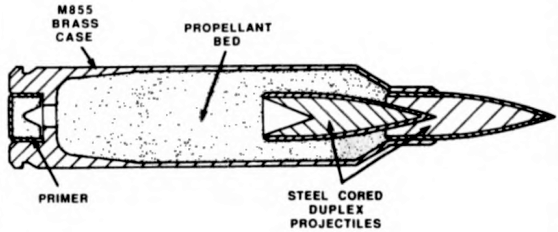
- The duplex cartridge. The 1992 ACR report records that “there is a type classified 7.62mm duplex round”, which Olin used as the basis for the 5.56 mm duplex round in Colt’s ACR entry.2 The Colt cartridge’s own drawing appears in Volume 6.
- The case for low impulse. Every later report treats low recoil impulse as a precondition for a useful burst. The ACR report states the requirement as three things: “low impulse ammunition, a high cyclic rate, and a muzzle device which compensates and attenuates recoil effects”, and notes that the M16 “has none of these features”.2 Flechettes were the extreme form of low impulse, which is why the next programme, SPIW, built its rifles around them.
1.12 The timing argument
SALVO’s two branches each had a cost. A simultaneous salvo needed several barrels or an unusual cartridge, and its projectiles did not go where intended. A burst of ordinary rounds wandered because of recoil. Hitchman’s hope was that small calibre and a muzzle compensator would keep a fast burst close enough to a designed pattern.
The third cure, the one this dive is about, is to change the timing. If the barrel and breech can move rearward inside the stock, the shooter does not feel the recoil of the first shot until that moving group reaches the end of its travel. If the next shot, or the next two, can be fired before then, they leave from very nearly the same point of aim. The shooter then feels one larger push after the burst is over.
That idea was written down within twelve years of Hitchman’s paper, in two places that rarely appear in histories of the G11 or the AN-94.
- In August 1964 the Ballistic Research Laboratories evaluated the Winchester SPIW prototype, which mounted its barrel and receiver floating in the stock. BRL explained the principle exactly: “The advantage of a floating barrel consists of having the momentum developed during the period the bolt is locked, not delivered directly to the stock but, delivered through the recoil springs to the stock … This delays the attainment of the usual levels of velocity of the stock and thus results in less displacement in a given period of time.” Then it measured it, with the rifle hung on strings and photographed on a drum camera, and found “no significant difference between having the Winchester barrel locked or floating”.5 Volume 2 explains why.
- In 1976 Heckler & Koch filed a US patent whose background section described an earlier German application, Offenlegungsschrift 23 26 525, for a weapon in which “the entire, fully operational weapon system is shiftably mounted in a receiver designed as a stock. The slidability of the entire system provides accuracy advantages by eliminating or reducing recoil to a minimum during a limited number of shots or during a burst.”9
The first is a failed test of the principle; the second is its first statement as the basis of a design. Between them lies the difference between an idea and a working mechanism. The rest of this dive is about the two designs that made it work, how well they actually worked, and why neither spread.
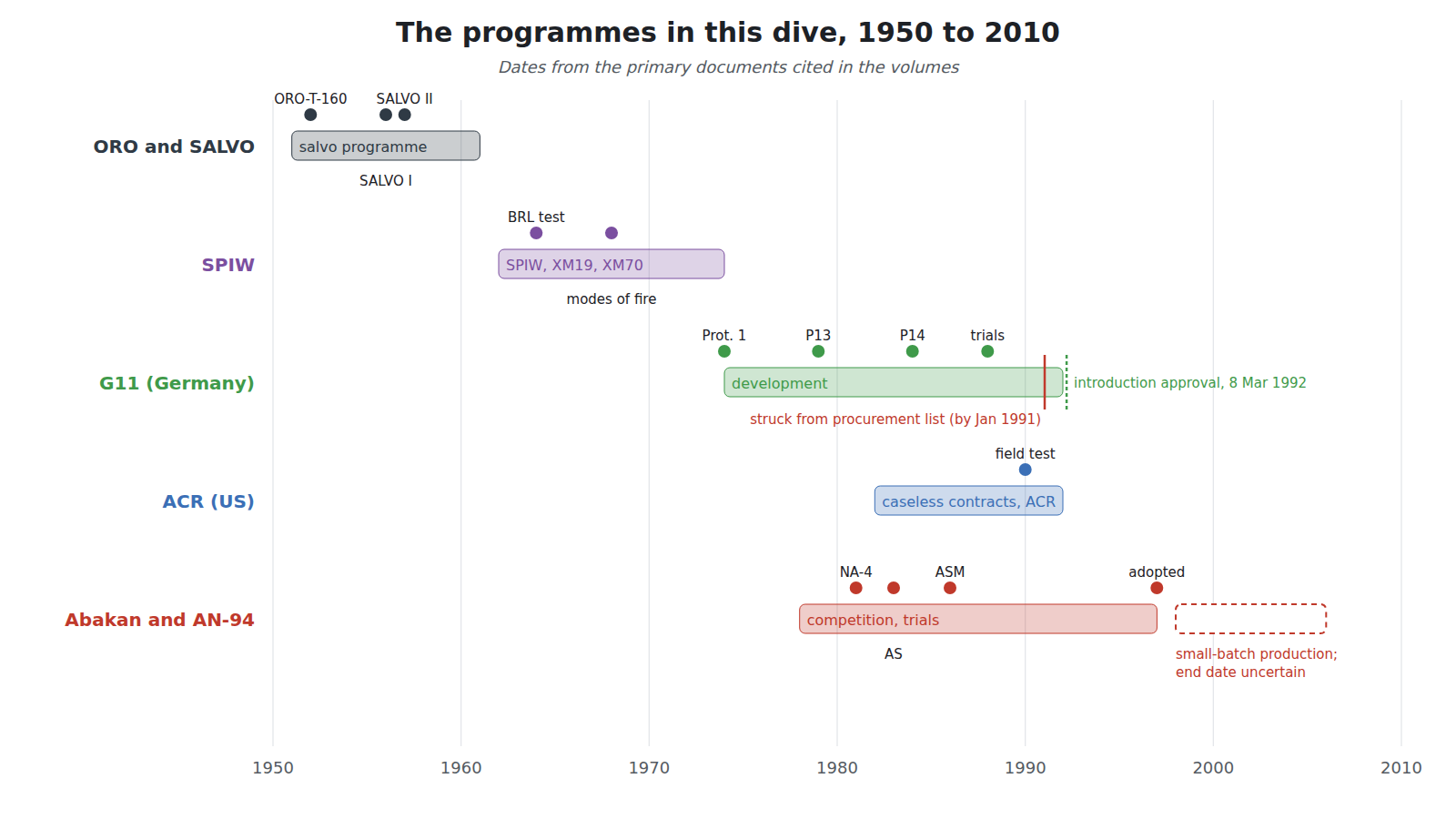
1.13 The numbers to keep straight
Figures for aiming error, burst size and hit probability circulate without their conditions. These are the ones this dive relies on, each with its source.
Table 3 — The numbers to keep straight
| Figure | Value | Conditions | Source |
|---|---|---|---|
| Best salvo pattern, Hitchman | Four rounds, 20 in apart at 300 yd | Paper study; doubles hit effectiveness at 300 yd | ORO-T-160, 19523 |
| Automatic rifle bursts, Hitchman | No more than one hit or screen strike per 5-round burst at 100 yd | Preliminary trial, Fort Benning | ORO-T-1603 |
| Aiming error, SALVO I | 3.8 mils (linear standard deviation); 3.3 mils by day | Simulated combat, 1956 | ORO-T-3786 |
| Aiming error, SALVO II | 3.1 mils; 2.8 with ricochets | December 1957 | ORO-T-3977 |
| Planning aim error for new weapons | ”no less than 3 mils” | Recommendation | ORO-T-3977 |
| Controlled burst vs trigger-limited burst | About 30 percent more hit capability against point targets | SPIW, about 23,000 rounds, 1966 to 1967 | BRL MR 1864, 19684 |
| ACR assumed aim errors | 8 to 10 mils at 0 to 100 m; about 3 mils at 300 to 400 m; 1 to 2 mils at 500 to 600 m | AMSAA’s “worst third” of past data | ACR Final Report, 19922 |
| ACR optimum burst size | 6 mils extreme spread for a true salvo; 8 mils for a serial burst | Theory, for the assumed aim errors | Same2 |
| ACR outcome | No candidate had a higher first-trigger-pull hit probability than the M16A2 | Field experiment, 1990 | Same2 |
The last line is the subject’s verdict, and it is the US Army’s own. Volume 6 sets it out in full.
1.14 How the rest of the dive is arranged
- Volume 2 covers SPIW in the 1960s: flechettes, the three-barrelled tround, 2,000-round-a-minute bursts and the floating-barrel test that failed.
- Volume 3 covers the G11’s history, from H&K’s 1974 prototype to its contradictory end in 1990 to 1992. The caseless-ammunition timeline in general belongs to the hub’s Daisy dive, Volume 15, which is linked rather than repeated.
- Volume 4 explains how the G11 works: the rotating chamber, the floating system, the caseless round and the gas that collected inside the housing.
- Volume 5 covers the AN-94: the Abakan competition, Nikonov’s prototypes, and the pulley-and-cable mechanism.
- Volume 6 covers the Advanced Combat Rifle field experiment of 1990 and the other attempts, Western and Soviet, set against what was measured.
- Volume 7 asks why none of it spread: cost, complexity, maintenance, the field record, and who can own one today.
- Volume 8 covers non-firing kinematic demonstrators that a home lab can make, under the boundary stated at the top of this volume.
References
Footnotes
-
Izhmash (Izhevsk Machine-Building Plant), product page “Автомат Никонова АН-94”, Wayback Machine capture of 18 October 2014, https://web.archive.org/web/20141018133511/http://izhmash.ru/rus/product/nikon.shtml, consulted 2026-10-18. ↩ ↩2
-
Vernon E. Shisler and Stephen M. Mango, Advanced Combat Rifle (ACR) Program, Volume I, ACR Program Summary, Technical Report ARCCD-TR-92001, US Army Armament Research, Development and Engineering Center, Close Combat Armaments Center, Picatinny Arsenal, February 1992 (DTIC AD-B162 942; distribution was limited to US government agencies at issue). Read from a public digitised copy credited to smallarmsoftheworld.com, https://municion.org/wp-content/uploads/2022/11/06-047-BGC-011-1.pdf, consulted 2026-10-18. ↩ ↩2 ↩3 ↩4 ↩5 ↩6 ↩7 ↩8 ↩9 ↩10 ↩11 ↩12 ↩13 ↩14
-
Norman A. Hitchman (statistical analysis by Scott E. Forbush and George J. Blakemore Jr), Operational Requirements for an Infantry Hand Weapon, Technical Memorandum ORO-T-160, Operations Research Office, The Johns Hopkins University, Project BALANCE; received 19 June 1952, published November 1952. DTIC AD0000346. Read from the Internet Archive’s DTIC mirror, https://archive.org/details/DTIC_AD0000346, consulted 2026-10-18 (DTIC’s own server returned a maintenance page that day). ↩ ↩2 ↩3 ↩4 ↩5 ↩6 ↩7 ↩8 ↩9 ↩10 ↩11 ↩12 ↩13 ↩14
-
F. W. Hall Jr, W. W. Sheldon, W. M. Werner and E. M. Wineholt, SPIW Modes of Fire, Ballistic Research Laboratories Memorandum Report No. 1864, February 1968. DTIC AD0388522, https://archive.org/details/DTIC_AD0388522, consulted 2026-10-18. ↩ ↩2
-
Richard P. Cronin, Stanley S. Lentz and Wallace M. Werner, Kinematic Evaluation of the Special Purpose Individual Weapon Prototypes, Ballistic Research Laboratories Technical Note No. 1541, August 1964. DTIC AD0353233, https://archive.org/details/DTIC_AD0353233, consulted 2026-10-18. ↩ ↩2
-
Leon Feldman and others, SALVO I Rifle Field Experiment, Technical Memorandum ORO-T-378, Operations Research Office, The Johns Hopkins University, published June 1959 (experiment conducted June and July 1956 at Fort Benning). DTIC AD0304321, https://archive.org/details/DTIC_AD0304321, consulted 2026-10-18. The scan is of poor quality; table values were read from the OCR text and checked against the summary prose. ↩ ↩2 ↩3 ↩4 ↩5 ↩6 ↩7 ↩8 ↩9
-
Leon Feldman, J. David Reed, Duncan Love, Richard E. Tiller, William Pettijohn, Kenneth L. Yudowitch, Paul Michelsen and William W. Walton, SALVO II Rifle Field Experiment, Technical Memorandum ORO-T-397, Operations Research Office, received 31 October 1960, published May 1961 (experiment conducted December 1957). DTIC AD0325385, https://archive.org/details/DTIC_AD0325385, consulted 2026-10-18. ↩ ↩2 ↩3 ↩4 ↩5 ↩6
-
W. C. Benjamin Jr and R. L. Simmons, A Comparison of Proposed Small Arms Weapon Systems, Ballistic Research Laboratories Memorandum Report No. 1139, Aberdeen Proving Ground, April 1958. DTIC AD0301648, https://archive.org/details/DTIC_AD0301648, consulted 2026-10-18. ↩ ↩2 ↩3
-
US Patent 4,078,327, Tilo Möller and Dieter Ketterer, assignors to Heckler & Koch GmbH, “Automatic or Semi-Automatic Small Arm”, filed 6 October 1976, German priority 8 October 1975, issued 14 March 1978. PDF from https://patentimages.storage.googleapis.com/pdfs/US4078327.pdf, consulted 2026-10-18. ↩
Comments (0)