Ruger Mark III & Mark IV · Volume 7
The Pistols Documented Here, and What the Volquartsen Parts Change
A Mark III Target decoded from Ruger's own spec sheet, a Mark IV not yet recorded, and the planned competition kit part by part — including the magazine disconnect it removes and the bolt release that does not exist for this frame
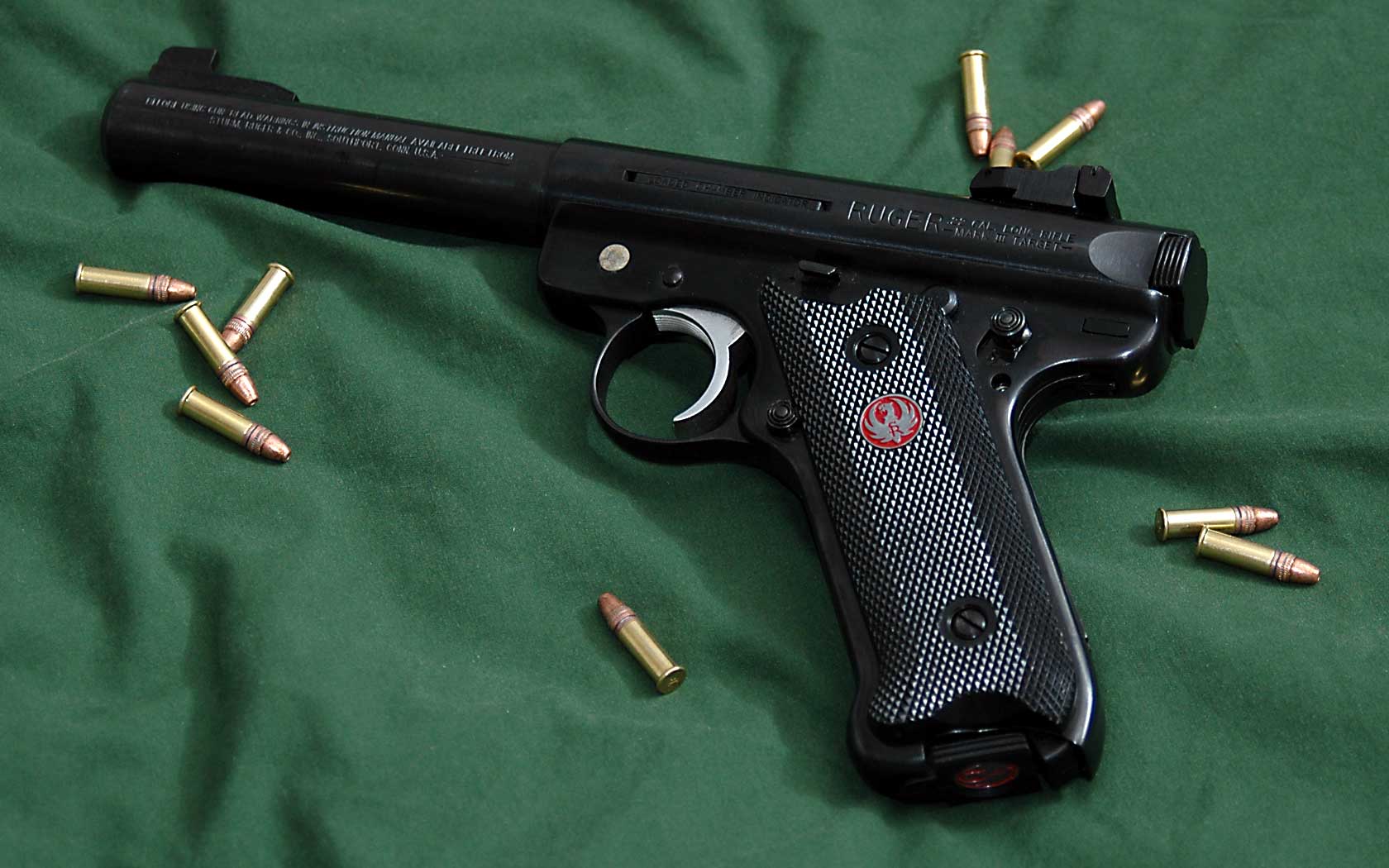
The six volumes before this one are about the pattern. This one is about two particular pistols: a Mark III Target and a Mark IV, as recorded by their owner and read on 19 September 2026. Configuration changes; the pattern does not. Everything in this volume that describes the pistols themselves is therefore dated, and planned parts are kept strictly separate from fitted ones. Serial numbers are not published, and nor are the quantities of anything owned.
7.1 As documented in September 2026
The owner’s inventory sheet, last modified 17 September 2026, records the following. Nothing on it is marked as fitted.
Table 1 — As documented in September 2026
| Mark III | Mark IV | |
|---|---|---|
| Maker / calibre | Ruger, .22 LR | Ruger, .22 LR |
| Recorded as | ”Mark III (10101)" | "Mark IV” |
| Barrel | 5.5 in | Not recorded |
| Model / configuration | Mark III Target, from the model number (§7.2) | Not recorded (§7.3) |
| Fitted modifications | None recorded | None recorded |
| Planned | Additional magazines; a Volquartsen “auto bolt release”; a Volquartsen “pistol competition kit” | None recorded |
| Optic | None recorded | None recorded |
The sheet’s word for the three Mark III items is “Pending.” In this owner’s usage that means the parts are planned and not installed — often already on hand and waiting to be fitted — and they are described here as planned upgrades, not as fitted parts and not as outstanding orders.
7.2 The Mark III: what “10101” means
The number recorded against the Mark III is Ruger’s model number. Ruger’s spec sheet, as it stood on Ruger’s website in November 2009, reads in full:1
“Ruger® Mark III™ Target Rimfire Pistol Model 10101 — Catalog Number: MKIII512 | Model Number: 10101 | Caliber: .22 LR | Material: Alloy Steel | Finish: Blued | Rear Sight: Adjustable | Front Sight: Fixed | Barrel Length: 5.50” | Barrel Style: Bull | Length: 9.75” | Height: 5.50” | Width: 1.20” | Weight: 42.00 oz. | Twist: 1:16” RH | Grooves: 6 | Capacity: 10 | Grips: Checkered | MA Approved: Yes | CA Approved: Yes | Suggested Retail: $417.00”
Ruger’s catalog number for the same pistol is MKIII512. The inventory records the right number under the other of Ruger’s two identifiers; both are given here so that either can be used with Ruger’s service department or parts catalogue.
The 2016 version of the same sheet adds the feature list Ruger printed for the model:2
- “Internal cylindrical bolt construction ensures permanent sight to barrel alignment”;
- “drilled and tapped receiver for Weaver®-style scope base adapters for easy mounting of optics (adapters included, not on fixed sight models)”;
- “Manual safety positively locks the sear when applied”;
- “an unobtrusive internal lock that locks the safety in the ‘SAFE’ position”;
- “Patented loaded chamber indicator”;
- “a conveniently located push button magazine release on the left side of the frame”;
- “Magazine disconnect prevents discharge when the magazine has been removed”;
- “Also includes: two magazines; internal lock key; hard plastic case.”
By 2016 the suggested retail had risen to $499.00, and the sheet recorded the model as approved for sale in neither California nor Massachusetts.2 Its direct successor in Ruger’s current catalogue, the Mark IV Target model 40101, has the same 5.5-inch bull barrel, 1:16 twist, six grooves, sights and dimensions, an aluminium grip frame, a weight of 35.6 ounces, and a suggested retail of $689.00 on Ruger’s site on 19 September 2026.3
What the spec sheets establish about the pistol documented here, and what they do not:
- It is a blued, steel-frame Mark III Target with a 5.5-inch bull barrel — not a 22/45. This matters for magazines (Volume 6) and for aftermarket parts (§7.7).
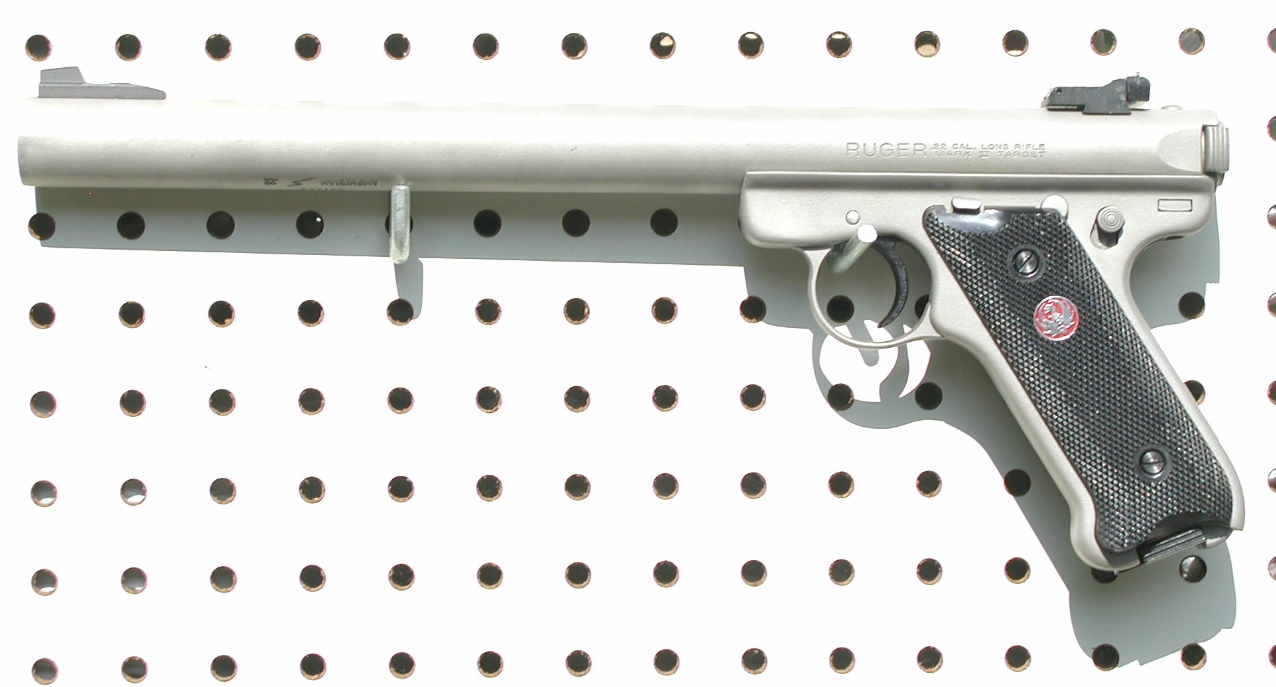
- As catalogued, the barrel is not threaded. Neither sheet mentions a threaded muzzle. The Mark III manual describes threaded barrels only on “some Ruger® 22/45 pistols.”4 Whether this particular pistol has been threaded since is not recorded (§7.8).
- It shipped with a Weaver-style scope base, which the manual says to fit with blue thread-locker and leave overnight.4 Whether the base is fitted, and whether an optic is used, is not recorded.
- It has all three Mark III additions: the loaded-chamber indicator, the magazine disconnect and the internal lock (Volumes 2 and 3).
- It is not subject to the 2017 recall, which Ruger limited to the Mark IV and its 22/45 variants (Volume 5).
7.3 The Mark IV: what is not yet recorded
The inventory records the second pistol only as “Mark IV.” Its model number, barrel length and profile, grip frame (steel, aluminium or 22/45 polymer), finish, sights, and whether it is threaded are not recorded, and none of them is inferred here. The Mark IV line spans a 4.75-inch tapered-barrel Standard, bull-barrel Targets, fluted Hunters, slab-sided Competitions, threaded Tacticals and the 22/45 family, and those differ in exactly the respects that matter to an owner (Volume 2).
Three things depend on the answer:
- Magazines. A steel- or aluminium-frame Mark IV takes the same magazine as the Mark III; a 22/45 does not (Volume 6).
- Recall status. Pistols with serial numbers beginning WBR or 401 are in the recalled range; a retrofitted one has an S on the white safety dot (Volume 5). Neither observation is recorded yet.
- Suppressor use. Some Mark IV models are threaded 1/2-28 from the factory, with the barrel nut behind the muzzle cap that Ruger’s manual says must never be removed.5
7.4 Volquartsen, and what it makes for these pistols
Volquartsen Firearms, of Carroll, Iowa, is the best-known maker of drop-in fire-control and action parts for the Ruger .22 pistols and the 10/22. Its current catalogue groups the Mark II and Mark III steel-frame and 22/45 parts under one heading, “Trigger and Action Parts for Ruger MKII, MKIII, and 22/45,” which on 19 September 2026 listed: an Accurizing Kit; a Bolt Tune-Up Kit; a CNC-Machined Disconnector; an Exact Edge Extractor; an Extended Bolt Release; a Mainspring Latch Removal Tool; the Pistol Competition Kit; a Recoil Rod and Spring Kit, with the rod and spring also sold separately; a SureStrike Firing Pin; a Target Hammer; a Target Sear; and a Target Trigger.6
Two points about that list bear on the planned parts. The Mark II and Mark III share a kit — Volquartsen sells one Accurizing Kit and one Competition Kit for both, and a separate Mark IV kit.78 And there is no automatic bolt release in the list (§7.7).
7.5 The Pistol Competition Kit, part by part
The inventory calls the planned kit a “Volquartsen Pistol Competition Kit.” Volquartsen sells exactly one product under that name for this pistol, the Pistol Competition Kit for MKII and MKIII, and it is described here on that basis. Which of its variants is on hand — they differ by trigger material and colour — is not recorded.
Volquartsen describes the kit as three of its other products combined:9
“This kit includes our Accurizing Kit for the Ruger MK II or MK III Pistol, Bolt Tune-Up Kit for MKII, MKIII, MK IV, and 22/45, and CNC-Machined Disconnector for MKII, MKIII, and MK IV. The Pistol Competition Kit is designed to produce a crisp, clean 2.25 lb. trigger pull with the Target Trigger. This kit is designed to eliminate stovepipes and failures to fire!”
Its variants and prices on Volquartsen’s site on 19 September 2026:9
Table 2 — The Pistol Competition Kit, part by part
| Volquartsen SKU | Description | Price |
|---|---|---|
| VC2PCK-B | Black target trigger and bolt release | $193 |
| VC2PCK-S | Black target trigger, silver bolt release | $193 |
| VC2PCK-S-ST | Silver, stainless target trigger | $204 |
| VC2PCK-GT | Gold target trigger | $220 |
| VC2PCK-0009 | No trigger, black bolt release | $153 |
What each component changes, in Volquartsen’s own descriptions, set against the Ruger part it replaces (Volume 3):
Table 3 — What each component changes, in Volquartsen's own descriptions, set against the Ruger part it replaces (Volume 3)
| Component (Volquartsen) | Replaces (Ruger) | What Volquartsen says it does |
|---|---|---|
| Target hammer and target sear (Accurizing Kit) | Hammer and sear | With the other kit parts, “all of the internal components needed for that crisp, clean, light trigger pull … No stoning or fitting required. Final trigger pull may vary slightly due to factory frame variances.”7 |
| Target trigger with pretravel and overtravel screws (Accurizing Kit) | Trigger | ”Adjustable pretravel and overtravel screws”; medium-strength thread-locker supplied.7 |
| Trigger return spring with polished plunger (Accurizing Kit) | Trigger spring and plunger | Part of the trigger-pull package.7 |
| Extended bolt release (Accurizing Kit) | Bolt stop thumbpiece | ”Provides the shooter with a .375” serrated face for an easier release of the bolt.” A larger manual release; not automatic.10 |
| Mark II-pattern hammer bushing (Accurizing Kit) | Mark III hammer bushing | ”Must be used when eliminating the magazine disconnect feature in the Ruger MKIII” (§7.6).7 |
| CNC-machined disconnector, 416 stainless | Disconnector | ”Added material that increases rigidity … prevent any binding or interference that can be found on the prior design and factory design”; “integral pin without the step found on the factory design.”11 |
| Exact Edge extractor and SureStrike firing pin (Bolt Tune-Up Kit) | Extractor and firing pin | ”This kit will eliminate light strikes and stovepipes.”12 |
These are the maker’s claims, and they are attributed as such. The 2.25-pound figure is Volquartsen’s statement of what the kit is “designed to produce” with its target trigger, qualified by its own note that the result “may vary slightly due to factory frame variances.” It has not been measured on the pistol documented here; the stock pull of the pistol has not been measured either, and no Ruger spec sheet consulted gives a figure for it.
What installation involves. The kit goes into the grip frame, well beyond Ruger’s field strip. Volquartsen’s installation guide lists a hammer or rubber mallet, needle-nose pliers, 3/32-inch and 1/16-inch hex keys, a 1/8-inch pin punch, blue thread-locker, and “your Ruger® factory pistol manual, for reference.” It drifts out the hammer pivot pin, the sear pivot pin and the trigger pivot pin, and it has the installer set the pretravel screw to “about 1/16” of pre-travel,” warning that “if you attempt remove too much pre-travel, the trigger will not reset,” and the overtravel screw so that it sits “just behind flush with the front face of the trigger,” warning that “if you go too far, the hammer will not be able to release.” It ends with a safety check — hammer cocked, safety off, trigger pulled, the hammer falls; hammer cocked, safety on, trigger pulled, the hammer does not move — and the advice that “if you are at all unsure about this procedure, have your frame checked by a qualified gunsmith.” Volquartsen also offers to install the kit itself.13
That is Volquartsen’s procedure, and this volume does not supplement it. Two Ruger positions sit alongside it and are recorded for completeness. Ruger’s manual warns that “this product was designed to function properly in its original condition. Alterations can make it unsafe. Do not alter any part or add or substitute parts or accessories not made by Sturm, Ruger & Co., Inc.” And it lists the Mark III’s hammer, trigger, safety and disconnector assemblies among the parts that “must be factory fitted.”4 A kit that replaces those parts is outside Ruger’s service model by definition; owners fit such kits routinely, but the manual’s position is Ruger’s and it is stated here as such.
7.6 The kit removes the magazine disconnect
This is the most important thing to know about the planned kit, and Volquartsen says it plainly. From its installation guide:13
“Please note that by installing the Volquartsen MK II Accurizing kit in a MKIII pistol, the factory magazine disconnect (parts 38 and 39 in the Ruger schematic) will be removed. This will allow the pistol to fire without having a magazine inserted. It is the customer’s responsibility to inform anyone using this pistol of this modification.”
And from the Accurizing Kit’s product page: “This kit also includes a Volquartsen MKII Hammer Bushing that must be used when eliminating the magazine disconnect feature in the Ruger MKIII. Please note the only way we recommend to remove the magazine disconnect in the Ruger MKIII is by using this kit.”7 (Volquartsen’s part numbers refer to a Ruger schematic revision; in the 2015 Mark III manual the magazine disconnector spring, magazine disconnector and disconnector assembly are keys 37, 38 and 39.4)
The consequences, set against Ruger’s own text:
- The pistol will fire with the magazine out. The Mark III manual’s statement that “you will not be able to … fire the pistol with the magazine removed” will no longer be true of this pistol.4 Its handling reverts to the Mark I and Mark II, whose manuals warn “GUN WILL FIRE WITH MAGAZINE OUT” and “Removing magazine does not unload pistol!”14
- Ruger’s unloading sequence becomes more important, not less. Magazine out first, then the bolt back and the chamber inspected — the sequence every Ruger manual prints (Volume 4).
- The Mark IV manual’s first trigger check no longer applies to a converted Mark III. “With the magazine removed … The trigger should move slightly rearward and stop. The hammer should not fall” (Volume 4 §4.8) describes the disconnect working; after conversion the hammer will fall. The safety checks remain valid.
- Takedown gets simpler. The Mark III procedure’s two magazine insertions exist only to let the trigger be pulled (Volume 4 §4.3). With the disconnect removed, the trigger can be pulled without one. Ruger’s steps are otherwise unchanged, and Ruger’s manual remains the procedure.
- Anyone else who handles the pistol must be told. Volquartsen puts that responsibility on the owner in writing.
Whether removing the disconnect has any legal consequence depends on where the pistol is and will be. Some state handgun rosters are built around specific safety features; the 10101’s California approval, recorded in 2009 and gone by 2016 on Ruger’s own sheets, is a reminder that such lists exist and change. No Michigan provision addressing magazine disconnects was identified in the research for this dive, and none is asserted.
7.7 The “automatic bolt release” that does not fit this frame
The inventory lists a planned “Volquartsen Auto Bolt Release” for the Mark III. On the evidence available, Volquartsen does not currently make an automatic bolt release for a steel-frame Mark III.
- Volquartsen’s current list of Mark II/Mark III/22/45 parts contains an Extended Bolt Release and no automatic one.6 The extended release is a larger thumbpiece — “a .375” serrated face for an easier release of the bolt” — that “fits both the Ruger MKII and MKIII” and is “not compatible with the 22/45.”10 It is still pressed by hand. It is already included in the Competition Kit (§7.5).
- Volquartsen’s product named “Automatic Bolt Release,” which “enables the shooter to simply pull the bolt back slightly to release it,” is sold on its own site under the SKUs VC10BR-B-10 and VC10BR-S-10, both labelled “10/22.”15 It is a rifle part. The owner’s two 10/22s are already documented in the .22 Rimfire dive as wearing a Volquartsen automatic bolt release.
- A Volquartsen automatic bolt release for a Mark III did exist — the “22/45 Auto Bolt Release,” SKUs VC3SPL-B and VC3SPL-S — but it appears only on retailers’ listings, not on Volquartsen’s current site, and those listings describe it as for Mark III 22/45 frames only.16 The Mark III documented here is a steel-frame Target, not a 22/45.
The mechanism these parts exploit is described in Volume 3 §3.8: the hold-open is only lightly retained, and an automatic release is shaped so that a slight rearward pull on the bolt lets it run forward without the thumbpiece. On the steel-frame Mark III, Volquartsen’s catalogue offers no such part.
What the planned item actually is therefore cannot be determined from the record. The possibilities consistent with the evidence are: the extended bolt release (which the Competition Kit already contains); a 10/22 automatic bolt release; a 22/45-frame part; or a product from a maker other than Volquartsen. None of these is assumed. The part number on the packet will settle it, and it is listed as an open question in §7.10.
7.8 A suppressor host? Not as catalogued
The Ruger .22 pistols make good suppressor hosts — the case, the physics and the law are the subject of the .22 Rimfire dive’s Volume 10, the Suppressors by Caliber dive, and Suppressor Law, which also covers Public Law 119-21’s reduction of the making and transfer tax on suppressors to $0. None of that is repeated here. What this volume can add is a fact about the pistol:
- The Mark III Target model 10101 is not threaded as catalogued (§7.2). A suppressor cannot be fitted to it without a threaded muzzle.
- Whether the pistol documented here has been threaded since is not recorded. If it has, that should be noted in the unit record with the thread and the date; if it has not, it is not a suppressor host in its current configuration.
- The two ways to make a Mark III a host are to have its barrel threaded by a gunsmith, or to fit a threaded aftermarket barrel/receiver. The second is itself a firearm. Volquartsen’s Scorpion LLV upper for the Mark II/III, which “works with any MKII or MKIII frame (either 22/45 or Target Model)” and is “not compatible with MK IV,” is sold threaded and unthreaded — $447 unthreaded and $555 in the threaded “Comp” versions on 19 September 2026 — and “must ship to an FFL dealer,” because, as Ruger’s manual says of its own, the barrel/receiver assembly “is defined as a ‘firearm’ by Federal Law.”174 Nothing in the record says either route is planned, and neither is implied.
- The Mark IV’s status depends on its model (§7.3).
7.9 Against the Model 41, and the law
The Model 41 comparison. The owner’s collection also includes a Smith & Wesson Model 41 with a 5.5-inch heavy barrel. The two are the obvious American .22 target pistols to compare — a tube-and-bolt design whose price was set by stampings and a weld (Volume 1), against a premium slide-action target pistol — and the comparison is made in the Smith & Wesson Model 41 dive, which covers that pistol’s history, mechanism and handling. It is not duplicated here.
Buying, owning and transferring in Michigan. A Ruger .22 automatic is an ordinary handgun under federal law; nothing about either pistol, as recorded, engages the National Firearms Act. Michigan’s pistol purchase licence, its exemptions, and the pistol sales record that follows every pistol transfer are set out, from the statutes, in the Remington XP-100 dive’s Volume 5, and apply to these pistols in the same way. Two points specific to the Ruger follow from facts established in this dive and are stated here without further legal conclusion: the barrel/receiver assembly is the firearm (Volume 3), so it is the part whose serial number appears on any transfer record; and an aftermarket barrel/receiver is itself a firearm that ships to a licensed dealer (§7.8). How Michigan’s pistol sales record treats the purchase of a replacement upper alone was not researched, and nothing is asserted about it.
7.10 Open questions for the record
These are the facts that would complete the record of the two pistols. They are listed here, rather than guessed at in the text above.
- Mark IV model. Ruger model or catalog number, barrel length and profile, grip frame (steel, aluminium or 22/45), finish, sights, and whether it is threaded.
- Mark IV recall status. Serial prefix only (WBR, 401, or a prefix beginning with 5), and whether an S appears on the white safety dot.
- Mark III muzzle. Threaded or not.
- The planned bolt release. Maker and part number from the packet.
- The planned Competition Kit. Which variant (trigger material and colour).
- Optics and scope base. Whether the Mark III’s supplied Weaver-style base is fitted, and whether any optic is used on either pistol. Optics move between guns in this collection; if one is fitted, the Scopes dive covers the optic itself.
References
Footnotes
-
Sturm, Ruger & Co., spec sheet, “Ruger Mark III Target Rimfire Pistol Model 10101,” as archived 25 November 2009, http://web.archive.org/web/20091125152517/http://www.ruger.com:80/products/markIIITarget/specSheets/10101.html , consulted 2026-09-19. The current ruger.com address for the sheet returns “Page Not Found.” ↩
-
Sturm, Ruger & Co., same spec sheet as archived 14 January 2016, http://web.archive.org/web/20160114101901/http://www.ruger.com:80/products/markIIITarget/specSheets/10101.html?buy=1 , consulted 2026-09-19. ↩ ↩2
-
Sturm, Ruger & Co., spec sheet, Mark IV Target model 40101, https://ruger.com/products/markIVTarget/specSheets/40101.html , consulted 2026-09-19. ↩
-
Sturm, Ruger & Co., Instruction Manual for Ruger Mark III … Autoloading Pistols, © 2015, pp. 11, 17, 32–37, https://ruger-docs.s3.amazonaws.com/_manuals/markIII.pdf , consulted 2026-09-19. ↩ ↩2 ↩3 ↩4 ↩5 ↩6
-
Sturm, Ruger & Co., Instruction Manual for Ruger Mark IV … Autoloading Pistols, code PM1179, © 2026, pp. 31–32, https://www.ruger.com/dataProcess/manual/fetch.php/ms/40160/manual_40160.pdf , consulted 2026-09-19. ↩
-
Volquartsen Firearms, “Trigger and Action Parts for Ruger MKII, MKIII, and 22/45,” https://volquartsen.com/departments/internal-parts-for-ruger-mkii-mkiii , consulted 2026-09-19. ↩ ↩2
-
Volquartsen Firearms, “Accurizing Kit for the Ruger MK II or MK III Pistol,” https://volquartsen.com/products/354-accurizing-kit-for-the-ruger-mk-ii-or-mk-iii-pistol , consulted 2026-09-19. ↩ ↩2 ↩3 ↩4 ↩5 ↩6
-
Volquartsen Firearms, “Accurizing Kit for the Ruger MK IV Pistol,” https://volquartsen.com/products/1231-accurizing-kit-for-the-ruger-mk-iv-pistol , consulted 2026-09-19 — “This kit will eliminate the magazine disconnect.” ↩
-
Volquartsen Firearms, “Pistol Competition Kit for MKII and MKIII,” https://volquartsen.com/products/1139-pistol-competition-kit-for-mkii-and-mkiii , consulted 2026-09-19; prices as displayed that day. ↩ ↩2
-
Volquartsen Firearms, “Extended Bolt Release for MKII and MKIII,” https://volquartsen.com/products/283-extended-bolt-release-for-mkii-and-mkiii , consulted 2026-09-19 (VC2BR-B / VC2BR-S, $14.25). ↩ ↩2
-
Volquartsen Firearms, “CNC-Machined Disconnector for MKII, MKIII, and MK IV,” https://volquartsen.com/products/487-cnc-machined-disconnector-for-mkii-mkiii-and-mk-iv , consulted 2026-09-19 (VF2MD for MKII/MKIII, $40). ↩
-
Volquartsen Firearms, “Bolt Tune-Up Kit for MKII, MKIII, MK IV, and 22/45,” https://volquartsen.com/products/1067-bolt-tune-up-kit-for-mkii-mkiii-mk-iv-and-22-45 , consulted 2026-09-19 (VC3FE, $43). ↩
-
Volquartsen Firearms, “Installation of the Accurizing Kit for the Ruger MKII or MKIII,” https://volquartsen.com/howto/install_mk2_accurizing_kit , consulted 2026-09-19. ↩ ↩2
-
Sturm, Ruger & Co., Instruction Manual for Ruger Mark II Autoloading Pistols, code AP & KAP 1/03 C R8, “To Load and Fire (Without Magazine),” https://ruger-docs.s3.amazonaws.com/_manuals/markII.pdf , consulted 2026-09-19. ↩
-
Volquartsen Firearms, “Automatic Bolt Release,” https://volquartsen.com/products/158-automatic-bolt-release , consulted 2026-09-19 (listed SKUs VC10BR-B-10 and VC10BR-S-10, “10/22,” $13.75). ↩
-
Midwest Gun Works, “Volquartsen Auto Bolt Release, Ruger MKIII 22/45, Black” (VC3SPL-B), https://www.midwestgunworks.com/page/mgwi/prod/vc3spl-b ; other retailer listings of VC3SPL-B and VC3SPL-S describe the part as for Mark III 22/45 frames only. Retailer descriptions, not the maker’s; the part was not found on volquartsen.com on 2026-09-19. ↩
-
Volquartsen Firearms, “Scorpion LLV Competition Pistol Upper for Ruger MKII/MKIII,” https://volquartsen.com/products/754-scorpion-llv-competition-pistol-upper-for-ruger-mkii-mkiii , consulted 2026-09-19. ↩
Comments (0)