Ruger Mark III & Mark IV · Volume 5
The Mark IV Recall, and the Safety That Could Stop Halfway
Ruger's notice of 7 June 2017 in its own words: the serial ranges, the two parts, the S on the white dot, and why only the grip frame went in the post
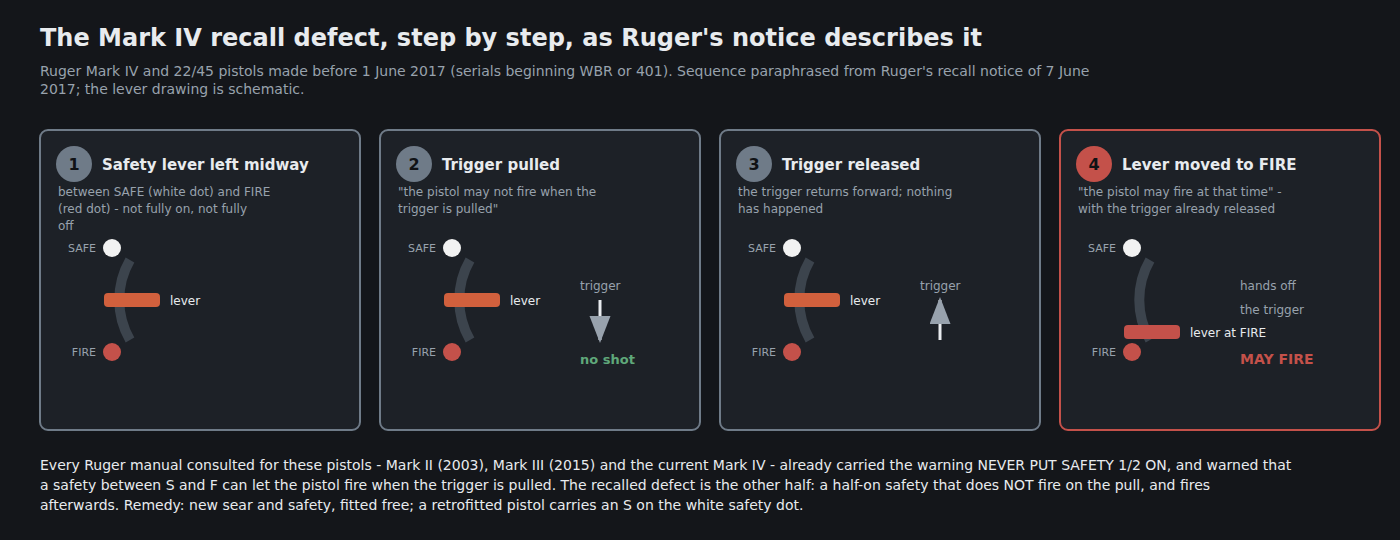
The Mark IV was announced on 22 September 2016 as the generation that fixed the Ruger .22’s oldest complaint. On 7 June 2017, eight and a half months later, Ruger recalled every Mark IV it had made. The recall was well run, cheap in the scheme of the company’s finances, and — on Ruger’s own statement — prompted before anyone was hurt. It is covered here in detail for two reasons: one of the two pistols documented in these volumes is a Mark IV whose serial range has not yet been recorded, and the recall is the clearest illustration in the pistol’s history of how its fire-control parts and its legal identity are divided between two assemblies.
Everything below is from Ruger’s own documents: the press release of 7 June 2017, the recall web page with its questions and answers, and the transcript of Ruger’s August 2017 earnings call, which the company filed with the Securities and Exchange Commission.
5.1 The notice, in Ruger’s words
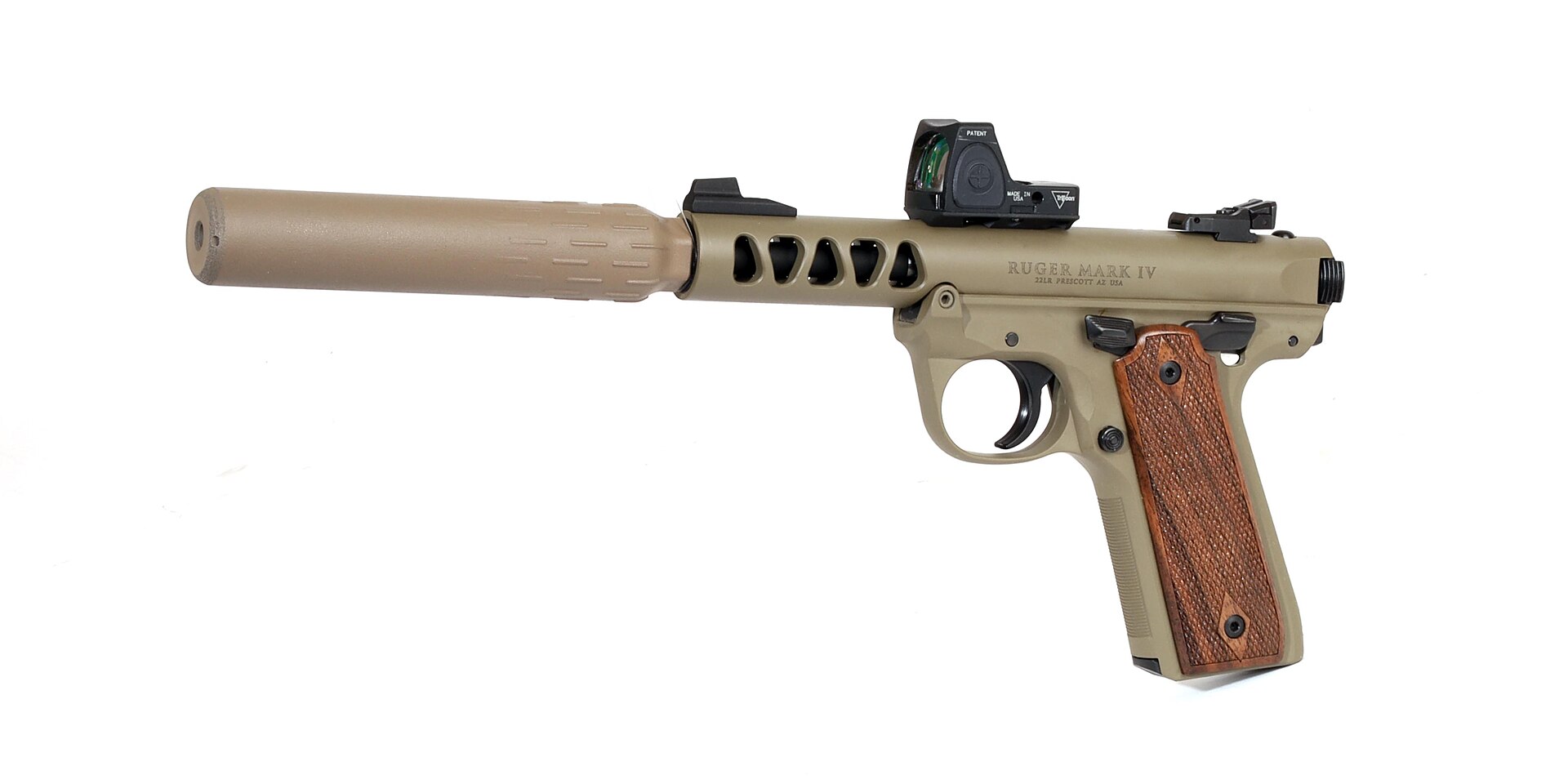
“Sturm, Ruger & Company, Inc. (NYSE-RGR) announced that it is recalling all Mark IV™ pistols (including 22/45™ models) manufactured prior to June 1, 2017. Ruger recently discovered that the pistols have the potential to discharge unintentionally if the safety is not utilized correctly. In particular, if the trigger is pulled while the safety lever is midway between the ‘safe’ and ‘fire’ positions (that is, the safety is not fully engaged or fully disengaged), the pistol may not fire when the trigger is pulled. However, if the trigger is released and the safety lever is then moved from the mid position to the ‘fire’ position, the pistol may fire at that time.”1
The notice continued: “Although only a small percentage of Mark IV pistols appear to be affected and the Company is not aware of any injuries, Ruger is firmly committed to safety and would like to retrofit all potentially affected pistols with an updated safety mechanism.” And it closed with the instruction that matters to an owner: “Ruger strongly recommends that consumers not use their Mark IV pistols until the safety retrofit has been installed.”1
The recall page’s answer to “How did you discover this issue?” is brief: “We recently received a small number of reports from the field … We have conducted additional testing and have confirmed this condition.”2
5.2 Which pistols
Ruger’s recall page is specific:2
- Models. “All Ruger® Mark IV™ pistols and 22/45™ variants produced prior to June 1, 2017 are being recalled. This includes the Mark IV™ Target, Competition, and Hunter models, as well as the 22/45™, 22/45™ Lite, and the 22/45™ Tactical.”
- Serial numbers. “Affected firearms have serial numbers beginning with ‘401’ (2017 production) or ‘WBR’ (2016 production). Mark IV™ and 22/45™ pistols outside of this serial number range are not affected. Mark IV™ or 22/45™ pistols with a serial number beginning with the number ‘5’ were produced after June 1, 2017 and are not affected.”
- Earlier generations. “Is my Mark II™ or Mark III™ affected? No. Only Mark IV™ pistols, including 22/45™ pistols, are subject to this recall.”
Ruger’s serial-number history page for the Mark IV lists WBR100001 as the first serial shipped in 2016, which is consistent with the recall’s description of WBR as the 2016 prefix.3 The recall therefore covers, in effect, the first eight months or so of Mark IV production. The Mark III documented in these volumes is not affected by any reading of the notice.
5.3 The defect, and the warning that was already in the manual
It is easy to misread the recall as the discovery that a half-applied safety is dangerous. That was not news. Every Ruger manual consulted for these pistols carries the same warning in almost the same words. The Mark II manual of 2003: “Putting the safety between ‘S’ and ‘F’ can result in the pistol firing when the trigger is pulled. Always move the safety fully to its intended position and check it … NEVER PUT SAFETY 1/2 ON.” The Mark III manual of 2015 repeats it, and the current Mark IV manual repeats it again.456 The 1981 manual for the Standard and Mark I already carried an earlier form: “Placing the safety in an ‘intermediate’ position between ‘safe’ (S) and ‘fire’ (F) can result in the gun user thinking the safety is in a safe position when it is not.”7
What the recall described is a different and worse failure. The manual warning covers a pistol that fires when the trigger is pulled with the safety half on — the shooter pulled the trigger, and the gun did what triggers do. The recalled condition is a pistol that does not fire when the trigger is pulled with the safety half on, and then fires later, when the trigger has been released and the lever is moved to FIRE. The shot comes at a moment when the shooter’s finger is not on the trigger and the shooter has every reason to believe the pistol has either failed or is safe. That is what made it a recall rather than a warning.
Ruger did not publish the mechanism. Its recall page says only that it would “install an updated sear and safety,” and that “the trigger pull will not be altered from the original factory specifications.”2 The Mark IV’s safety was new to the generation — an ambidextrous lever in place of the sliding button of the Mark I–III — and the sear it bears on had been revised along with the hammer and firing pin, according to the launch release.8 No Ruger document consulted connects the defect to either change, and none is asserted here.
5.4 The remedy: two parts and an S
- What was replaced. “We will install an updated sear and safety.”2 Ruger’s chief executive later described the fix to investors as “2 small, inexpensive parts that we need to change out. It’s a quick fix.”9
- Cost to the owner. None. Ruger sent “a prepaid USPS box with a shipping label and detailed packaging and shipping instructions” when parts were ready, on a “first-come, first-served basis,” installed the parts “free of charge,” and aimed to return each grip frame “within one week of the day it arrives at Ruger.”1
- A thank-you. “All retrofitted grip frame assemblies will be returned with a free magazine,” valued on the recall page at $29.95; owners in states that restrict magazine shipments received a ShopRuger gift certificate instead.12
- Old parts. “No. We will keep the old parts.”2
- How to recognise a retrofitted pistol. “Mark IV’s within the affected serial number range that have the upgraded safety mechanism have been marked with the letter ‘S’ located on the white safety dot that is visible when the safety is engaged.”2
The S is the only external evidence that the work has been done. A Mark IV in the WBR or 401 range whose white safety dot carries no S has, on Ruger’s own definition, not been retrofitted.
5.5 Why only the grip frame went in the post
The recall’s logistics rest on a legal fact that runs through the whole of this pistol’s history. Ruger’s recall page:
“What do I have to send back to you? We only want the grip frame assembly. It is not necessary for us to have the barrel/receiver assembly to perform the retrofit. Because the barrel/receiver assembly is the serialized component, not requiring its return simplifies the process and will enable us to more conveniently and quickly return the grip frame assembly to you.”2
Owners were told to separate the two using the instruction manual — on a Mark IV, the one-button takedown described in Volume 4 — and to keep “the barrel/receiver assembly, magazines, lock, instruction manual, and any aftermarket accessories.”2
The significance is easy to miss. Ruger’s own manuals, in the section on returning a pistol for service, tell owners that “persons who do not hold a Federal Firearms License are prohibited by Federal law from shipping a handgun by U.S. Mail,” and that a handgun must go by a private overnight carrier.56 The recall asked tens of thousands of owners to post a part in a prepaid USPS box. That was possible only because the part being posted — the grip frame, containing the trigger, sear, hammer and safety — is not the firearm. The serialized barrel/receiver, which is, stayed at home. The division of the pistol that the 1946 patent created for manufacturing economy (Volume 1) and that Ruger’s manuals define in law (Volume 3) is what let a firearm recall be run as a parcel exchange. That reading is this volume’s, drawn from Ruger’s two statements side by side; Ruger’s notice gives only the practical reason, that it “simplifies the process.”
5.6 What it cost, by Ruger’s own account
Ruger’s chief executive, Christopher Killoy, described the recall on the company’s earnings call for the second quarter of 2017, whose transcript Ruger filed with the SEC on 3 August 2017:9
“In June, the company discovered that Mark IV pistols manufactured prior to June 1, 2017, have the potential to discharge unintentionally if the safety is not utilized correctly. Although only a small percentage of Mark IV pistols appear to be affected and we are not aware of any injuries, we recalled all Mark IV pistols and recorded a $2.5 million expense in the second quarter, which is the expected total cost of the recall. While we did resume production of Mark IV pistols with the enhanced parts in the latter part of June, our second quarter results were further impaired by the significant reduction of Mark IV production, which reduced sales by approximately $5 million.”
On the same call he gave two operating figures: “We are able to retrofit approximately 1,000 pistols per day,” and, asked about the size of the affected population, “it’s approximately 80,000 units, potentially.”9 The second is a spoken estimate in answer to an analyst’s question, and it is recorded here as exactly that — the only population figure Ruger is known to have given, not an audited count.
Taken together, Ruger’s figures describe a recall of roughly eight months’ production, fixed with two inexpensive parts, at an expected cost of $2.5 million plus about $5 million of lost sales in the quarter. Production of the corrected pistol resumed within the month.
5.7 Aftermarket parts and the recall
The recall page addressed modified pistols directly, and its answers matter to anyone who has changed the internals of a Mark IV:2
- “You should remove all aftermarket accessories before returning the grip frame assembly to us. While we will attempt to return accessories to you, we cannot guarantee that is the case.”
- “To the extent the installed aftermarket parts are being replaced pursuant to the retrofit (sear and safety), these will not be returned.”
- “If you have installed any aftermarket trigger components, they will not be returned.”
- “Provided your grip frame is sent in with original factory parts, you will not notice a difference in the trigger pull.”
A Mark IV that has had an aftermarket trigger kit fitted — Volquartsen’s Mark IV kit replaces the hammer, sear, disconnector and trigger (Volume 7) — therefore raises a practical question that the recall page answers only partly. If such a pistol is in the recalled range and has not been retrofitted, the aftermarket sear would be replaced by Ruger’s updated one and not returned. Whether an aftermarket sear is itself subject to the defect is not addressed by Ruger or, in the material consulted, by Volquartsen, and no answer is offered here.
5.8 Checking a Mark IV today
Ruger’s recall page remained online when consulted on 19 September 2026, with its serial-number lookup and a Recall Call Center number, 336-949-5200, “Monday through Friday between 9:00 a.m. and 8:00 p.m. ET.” The page asks callers to “have your unloaded pistol handy … and be sure to provide us with the serial number directly from the pistol.”2 Whether the programme is still accepting pistols was not tested, and no statement is made about its current status.
For any Mark IV, the check is short:
- Read the prefix. WBR or 401: in the recalled range. A prefix beginning with 5: made after 1 June 2017 and not affected.2
- If in range, look at the white safety dot with the safety engaged. An S means the updated sear and safety are fitted. No S means Ruger’s recommendation not to use the pistol until retrofitted still applies.12
- If in doubt, use Ruger’s lookup or call the Recall Call Center with the serial number read from the pistol.
The Mark IV documented in these volumes. As recorded in September 2026, the owner’s inventory lists this pistol as “Mark IV” with no model, barrel or serial-range information in the published record. Its recall status is therefore not known, and it is not assumed either way. The two observations that settle it — the serial prefix and the presence or absence of an S on the white safety dot — are listed as open questions in this dive’s working notes and in Volume 7. The serial number itself is deliberately not published.
References
Footnotes
-
Sturm, Ruger & Co., “Sturm, Ruger & Company, Inc. Issues Safety Warning and Recall Notice of Ruger Mark IV Pistols,” 7 June 2017, https://ruger.com/news/2017-06-07.html , consulted 2026-09-19. ↩ ↩2 ↩3 ↩4 ↩5
-
Sturm, Ruger & Co., “Mark IV™ Recall” page and Frequently Asked Questions, https://ruger.com/dataProcess/markIVRecall/ , consulted 2026-09-19. ↩ ↩2 ↩3 ↩4 ↩5 ↩6 ↩7 ↩8 ↩9 ↩10 ↩11 ↩12 ↩13
-
Sturm, Ruger & Co., “Serial Number History — Mark IV Pistol,” https://ruger.com/service/productHistory/PI-MarkIV.html , consulted 2026-09-19. ↩
-
Sturm, Ruger & Co., Instruction Manual for Ruger Mark II Autoloading Pistols, code AP & KAP 1/03 C R8, “Operation of Safety,” https://ruger-docs.s3.amazonaws.com/_manuals/markII.pdf , consulted 2026-09-19. ↩
-
Sturm, Ruger & Co., Instruction Manual for Ruger Mark III … Autoloading Pistols, © 2015, pp. 13 and 34, https://ruger-docs.s3.amazonaws.com/_manuals/markIII.pdf , consulted 2026-09-19. ↩ ↩2
-
Sturm, Ruger & Co., Instruction Manual for Ruger Mark IV … Autoloading Pistols, code PM1179, © 2026, pp. 13 and 33, https://www.ruger.com/dataProcess/manual/fetch.php/ms/40160/manual_40160.pdf , consulted 2026-09-19. ↩ ↩2
-
Sturm, Ruger & Co., Instruction Manual for Ruger Mark I Target Model and Standard Model Automatic Pistols, code A-7-81, “To Load and Fire,” https://ruger-docs.s3.amazonaws.com/_manuals/markI.pdf (scanned; OCR), consulted 2026-09-19. ↩
-
Sturm, Ruger & Co., “Ruger Perfects Rimfire — Again: Introducing the One-Button Takedown Mark IV,” 22 September 2016, https://ruger.com/news/2016-09-22.html , consulted 2026-09-19. ↩
-
Sturm, Ruger & Co., Form 8-K, 3 August 2017, exhibit transcript of the second-quarter 2017 earnings call, remarks and answers of Christopher J. Killoy, President and CEO, https://ruger.com/corporate/PDF/8K-2017-08-03.pdf , consulted 2026-09-19. ↩ ↩2 ↩3
Comments (0)