Ruger Mark III & Mark IV · Volume 2
Four Generations — What Changed from the Standard to the Mark IV
Dates from Ruger's own records, where they disagree with each other, and why the Mark III is remembered for its safeties
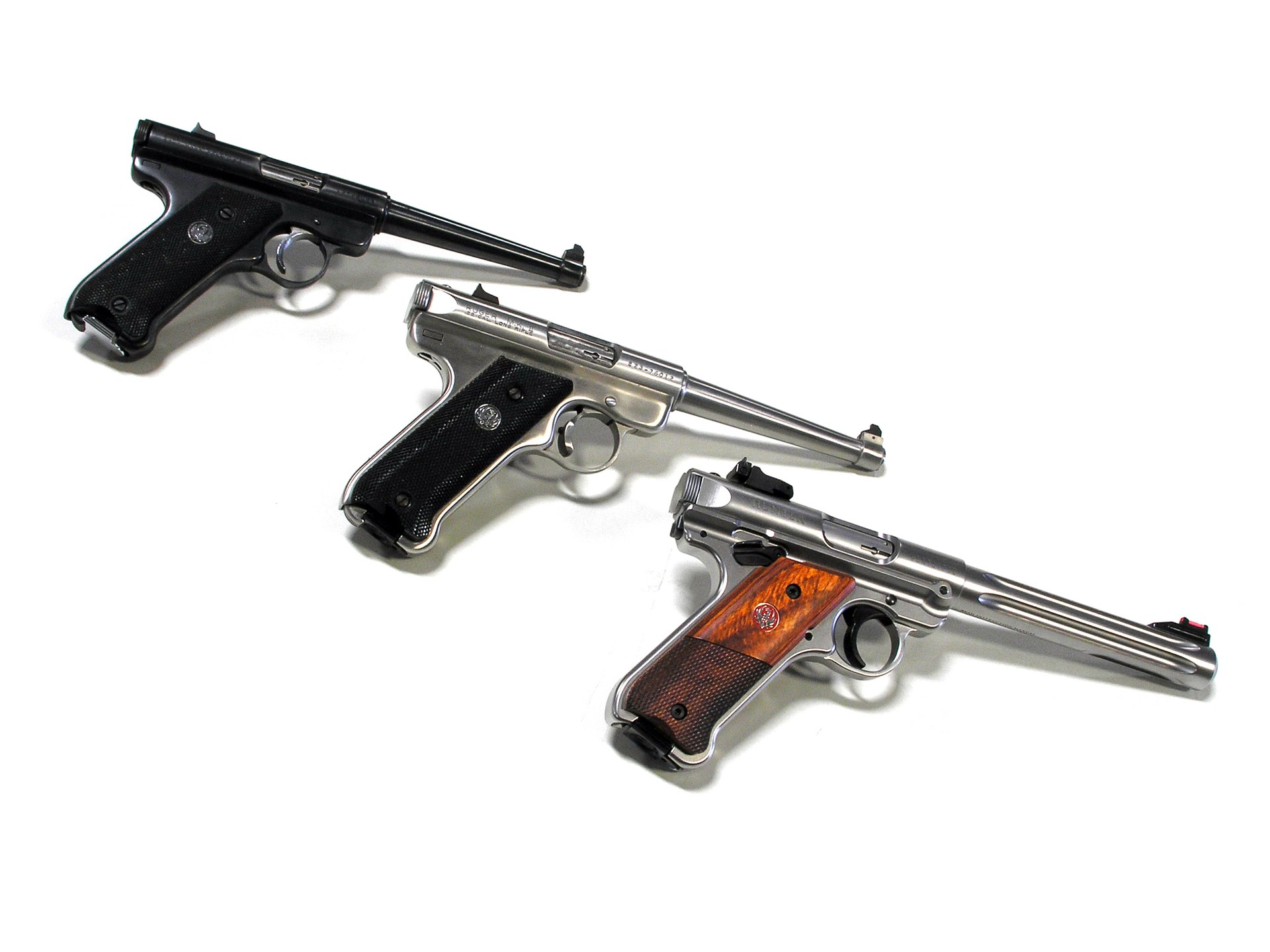
The Ruger .22 has been sold under five names — Standard, Mark I, Mark II, Mark III and Mark IV — plus the polymer-framed 22/45 branch that has run alongside the last three. The silhouette changed so little that photographs are routinely mislabelled, including on Commons, where one file captioned “Ruger MK III” turned out on inspection to be a 22/45 Mark III (the frame is the giveaway; see §2.4). This volume sets out what each generation changed, with dates from Ruger’s own serial-number histories and press releases, and records the places where those Ruger documents disagree.
Ruger publishes a serial-number history page for each generation. They give production spans as follows:1
Table 1
| Generation | Ruger’s stated span | First serial Ruger lists |
|---|---|---|
| Standard and Mark I | ”manufactured from 1949 to 1982” | 1 (1949) |
| Mark II | ”manufactured from 1982 to 2005” | 18-00001 (1982) |
| 22/45 | ”manufactured from 1992 to 2005” | 220-00001 (1992) |
| Mark III | ”manufactured from 2004 to 2016” | 227-00001 (2004) |
| Mark IV | from 2016 | WBR100001 (2016) |
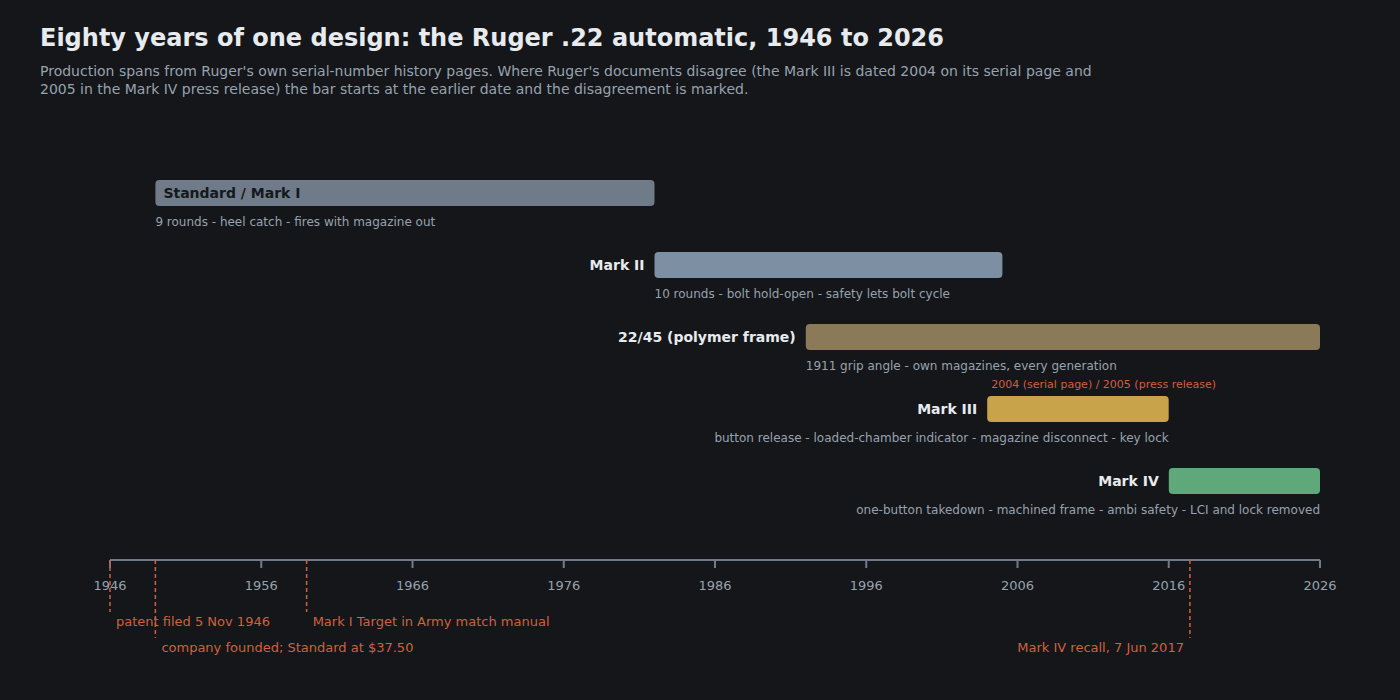
Note that the spans overlap. The Mark II and Mark III were both being shipped in 2004–2005, which is normal for a model changeover and is the first clue to the dating question in §2.5.
2.1 How to tell them apart at arm’s length
The generations can be separated by a handful of external details, and these are the tests applied to every photograph in these volumes.
Table 2 — How to tell them apart at arm's length
| Feature | Standard / Mark I | Mark II | Mark III | Mark IV |
|---|---|---|---|---|
| Magazine release | Catch at the heel of the grip | Catch at the heel | Push button on the left of the frame, behind the trigger guard | Push button on the left, behind the trigger guard |
| Rear of receiver | Plain | Scalloped cut-outs either side of the bolt ears | Scalloped; bolt ears reshaped | Scalloped |
| Bolt hold-open thumbpiece on the left of the frame | None | Yes | Yes | Yes, redesigned |
| Loaded-chamber indicator on the left of the receiver | No | No | Yes | No |
| Safety | Sliding button, left rear of frame | Sliding button | Sliding button; key-operated internal lock | Ambidextrous levers; white dot = safe, red dot = fire |
| Takedown | Mainspring housing latch at the back of the grip | Same | Same | Button at the top rear of the frame |
| Roll mark | ”Automatic Pistol” or “Mark I Target" | "Mark II" | "Mark III” / “MK III" | "Mark IV” |
A 22/45 of any generation is identified before any of these by its frame: moulded polymer, with the steeper grip angle of the Colt 1911 rather than the Ruger’s Luger-like rake.
2.2 Standard and Mark I, 1949–1982
Ruger files the two first-generation names on a single serial-number page, “Standard & Mark I Pistol,” and prints a single instruction manual for “Mark I Target Model and Standard Model Automatic Pistols,” which states that “both models have the same basic operating mechanism.”12 In Ruger’s own usage, then, “Mark I” was the name of the target model — adjustable sights, longer or heavier barrel — and “Standard” was the plain model. The collector’s habit of calling every first-generation pistol a Mark I is a retrospective convenience. Wikipedia dates the Mark I Target’s introduction to 1950, with a 5¼-inch barrel offered from 1952 to 1957 and a 5½-inch bull barrel from 1963; those dates are recorded here as that source’s and were not confirmed in a Ruger document.3
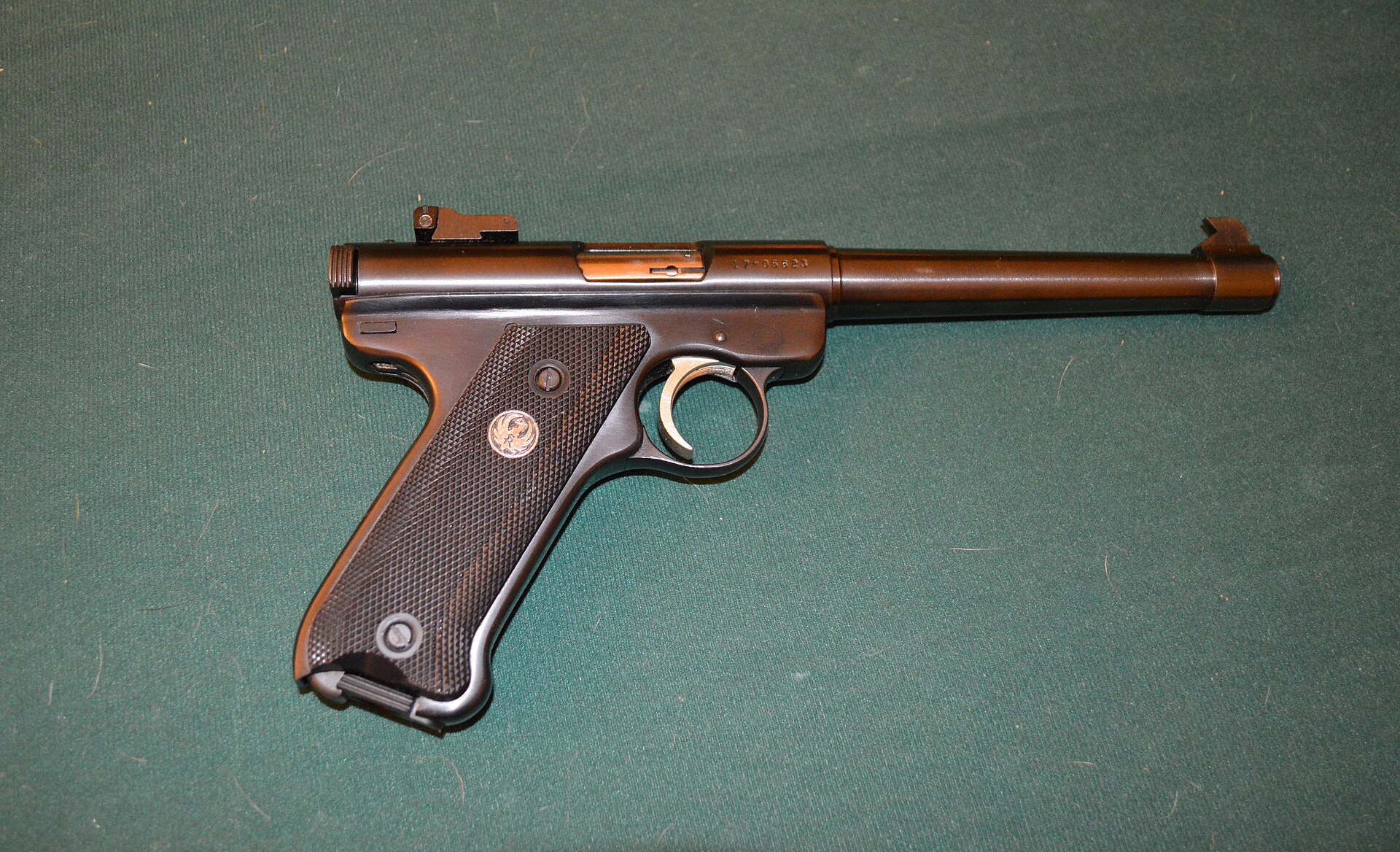
The first-generation pistol as Ruger’s manual defines it:
- Nine rounds. “The Ruger Standard Automatic and Mark I Automatic are .22 caliber rimfire, 9-shot, magazine fed, semi-automatic recoil (‘blowback’) operated pistols.”2 The Mark II manual later identifies the first-generation magazine as “the 9-shot, AMC pistol magazine (identified by its brightly plated non-removable bottom).”4
- It fires with the magazine out. “WARNING: These pistols will fire whether or not there is a magazine in the gun if there is a cartridge in the chamber.”2
- No automatic hold-open. The bolt does not stay open on an empty magazine. One owner’s note on the Commons photograph used at the head of this volume is that he rarely shoots his Mark I “because the bolt doesn’t lock back on an empty magazine.” The safety could be used to hold the bolt open manually: the Army’s 1959 manual says the safety lever “also can be used to lock the bolt in the rear.”5
- The heel catch, exactly as the 1946 patent drew it.
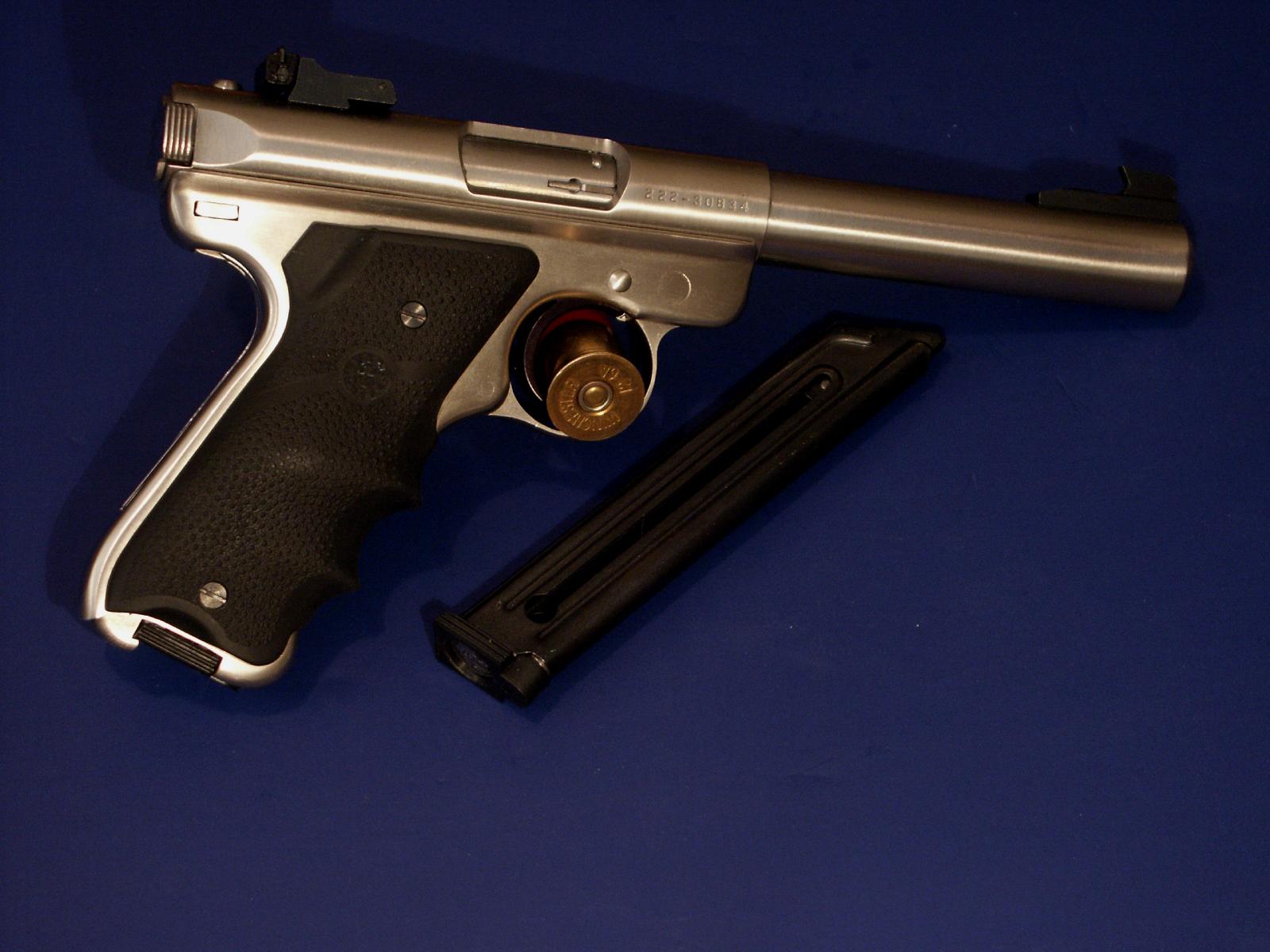
2.3 Mark II, 1982–2005
The Mark II replaced the first generation in 1982 and, in Mark Keefe’s phrase in American Rifleman, “remained the anchor for Ruger’s pistol line until 2005.” His list of changes is the most complete found:
“The Mark II had a re-designed trigger pivot retainer, a new trigger, a sear-blocking safety that allowed the bolt to be manipulated in the ‘on’ position, a new bolt hold-open device and scallops at the rear of the receiver for easier bolt manipulation. And the Mark II got a redesigned magazine, increasing capacity from nine to 10.”6
Ruger’s Mark II manual confirms the parts of that list that a user sees. The safety “locks the sear when the safety is ‘on’,” and “the bolt can be manually retracted and released when the safety is ‘on’ (S). This feature allows the pistol to be loaded or unloaded when the safety is ‘on’.”4 The bolt stop “automatically holds the bolt open” after the last shot.4 The new magazine is the M-10, “readily identified by the removable plastic bottom decorated with a silver ‘eagle’.”4 And the Mark II still fires without a magazine: its manual has a full section headed “To Load and Fire (Without Magazine),” describing single-loading for training, under the warning “GUN WILL FIRE WITH MAGAZINE OUT.”4
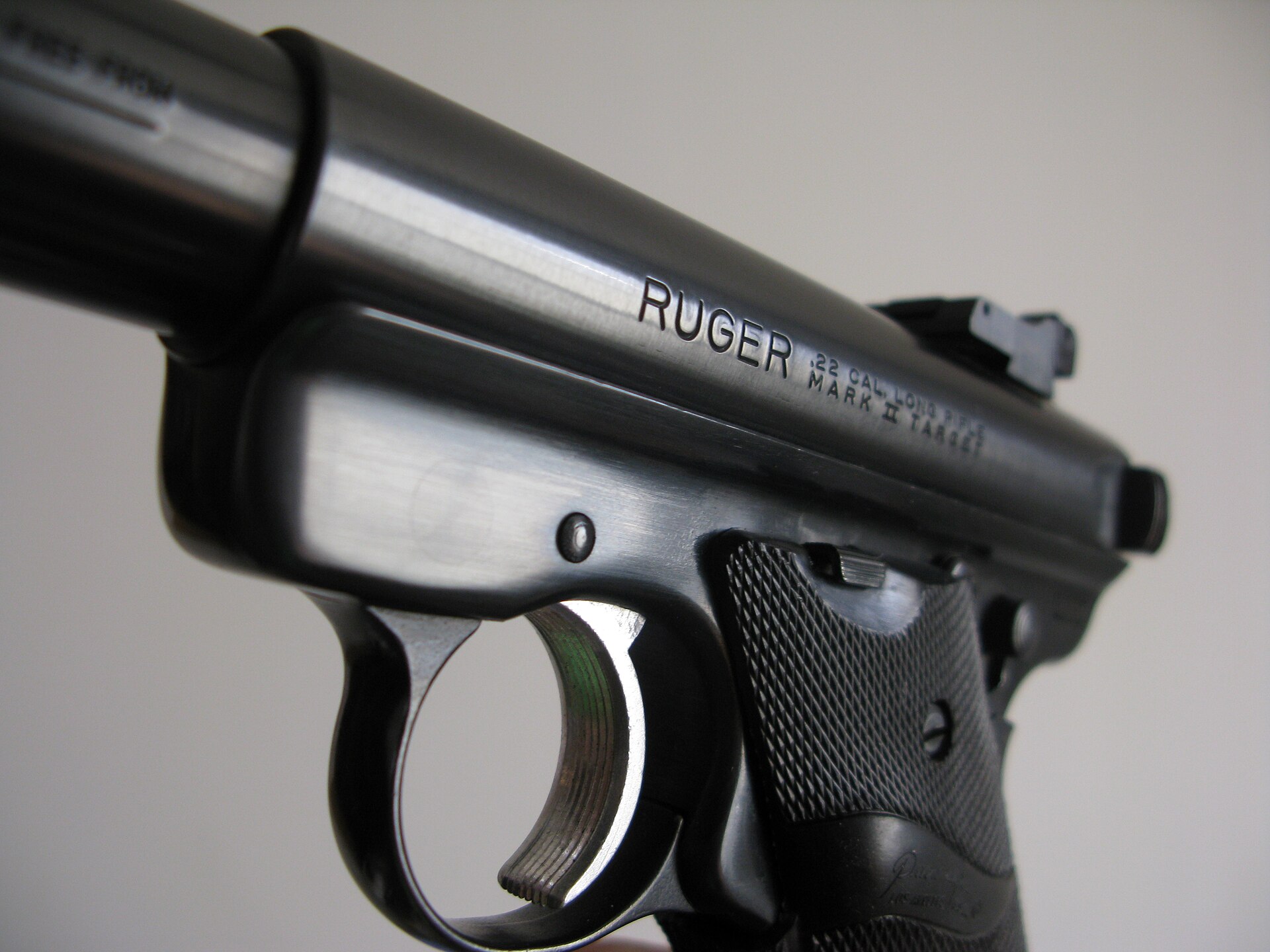
The safety change is more significant than it looks. The 1946 patent’s safety “locks the sear and also the bolt preventing the bolt from being pulled rearwardly when in the safe position.”7 The Mark II’s locks only the sear, which is why a Mark II or later can be loaded and cleared with the safety on. That is a real handling improvement, and it is also the reason the safety became a more delicate part: once it no longer blocks the bolt, its only job is to hold the sear, and Volume 5 shows what happened when a later safety failed to do that fully.
2.4 The 22/45 branch, from 1992
In 1992 Ruger added a polymer-framed variant, the 22/45, whose name states its purpose: a .22 with the grip of the .45-calibre Colt 1911. Ruger’s Mark II manual describes it as having “a grip frame assembly made of molded synthetic polymer and a magazine latch button on the left side of the frame.”4 Keefe notes that it was “introduced in 1992 with molded-in stocks, and its grip angle replicated that of the M1911,” with “the magazine catch … in the familiar M1911 position on the frame’s left, although Mark II and 22/45 magazines were not interchangeable.”6 Ruger’s 22/45 serial history agrees on 1992.1
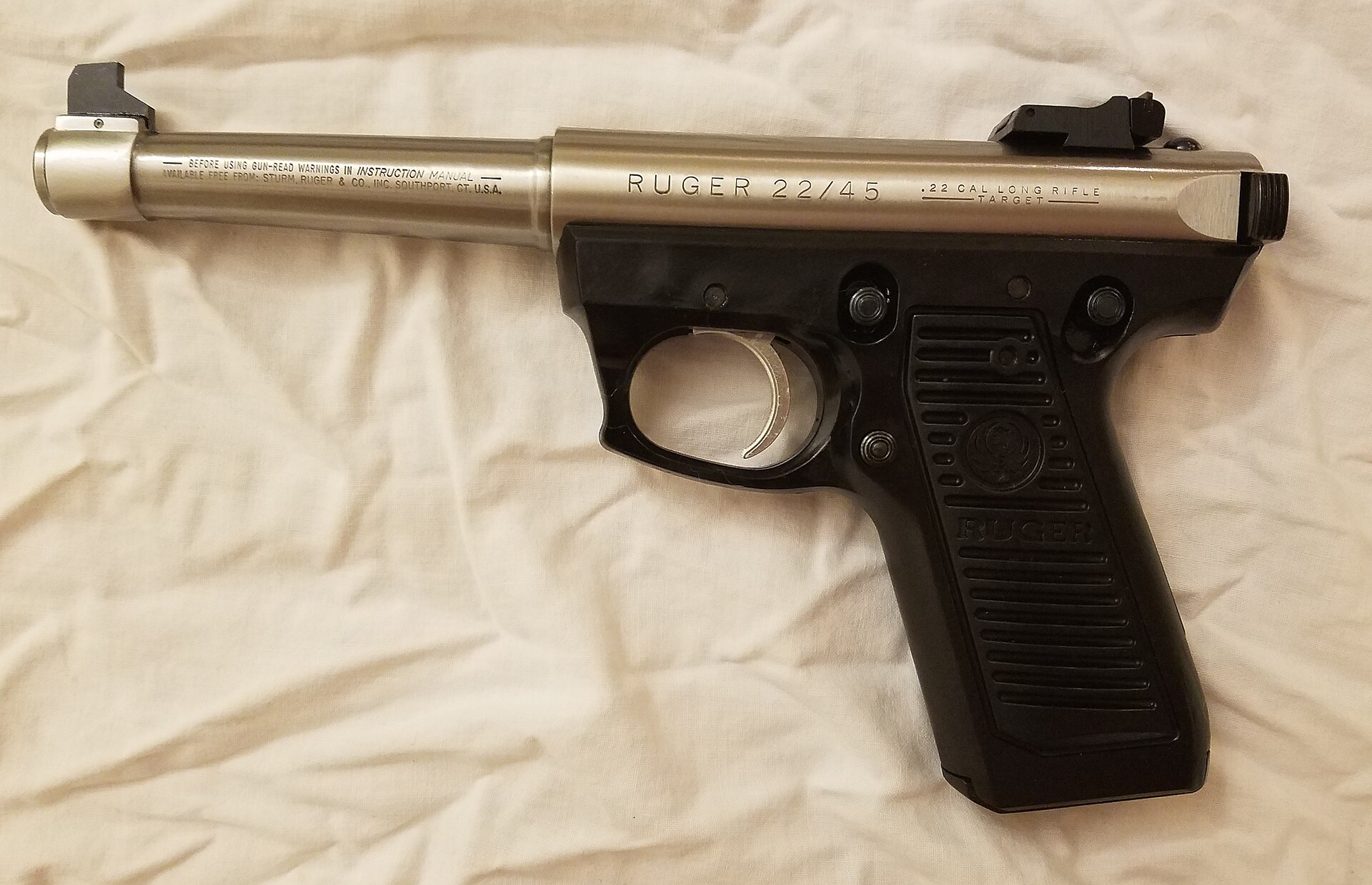
The 22/45 branch matters to these volumes for one reason: it is the source of most compatibility mistakes. Every generation of 22/45 takes its own magazine, and several aftermarket parts are made in two versions, one for the steel frame and one for the 22/45. Volume 6 sets out the magazines; Volume 7 shows that the only Volquartsen automatic bolt release ever sold for a Mark III was, on the retail evidence, a 22/45-frame part — which bears directly on one of the upgrades planned for the steel-frame Mark III documented here.
2.5 Mark III — 2004 or 2005?
Ruger’s own records give two dates for the Mark III, and they are not reconcilable as printed.
- Ruger’s serial-number history page is titled “Mark III Pistol (manufactured from 2004 to 2016)” and lists its first serial, 227-00001, against 2004.1
- Ruger’s press release introducing the Mark IV, on 22 September 2016, says the Standard “has undergone a series of enhancements with the development of the Mark I, Mark II and then the Mark III in 2005.”8
The Mark II serial page, meanwhile, continues to 2005.1 The most economical reading is that first shipments were made at the very end of 2004 and the pistol was presented as a 2005 model, and that is exactly how Keefe resolved it: “In late 2004 (let’s just call it 2005), the Mark III replaced the Mark II.”6 The NRA’s 2012 piece says the Mark III “hit the market in 2005.”9 These volumes give both dates and attribute each.
The Mark III’s end date has a similar texture. Ruger’s serial page says production ran “to 2016” and lists its last row as 2015.1 Wikipedia gives a precise end of production, 8 December 2016; that date could not be confirmed in a Ruger document and is not relied on.3
2.6 What the Mark III added, and what shooters thought of it
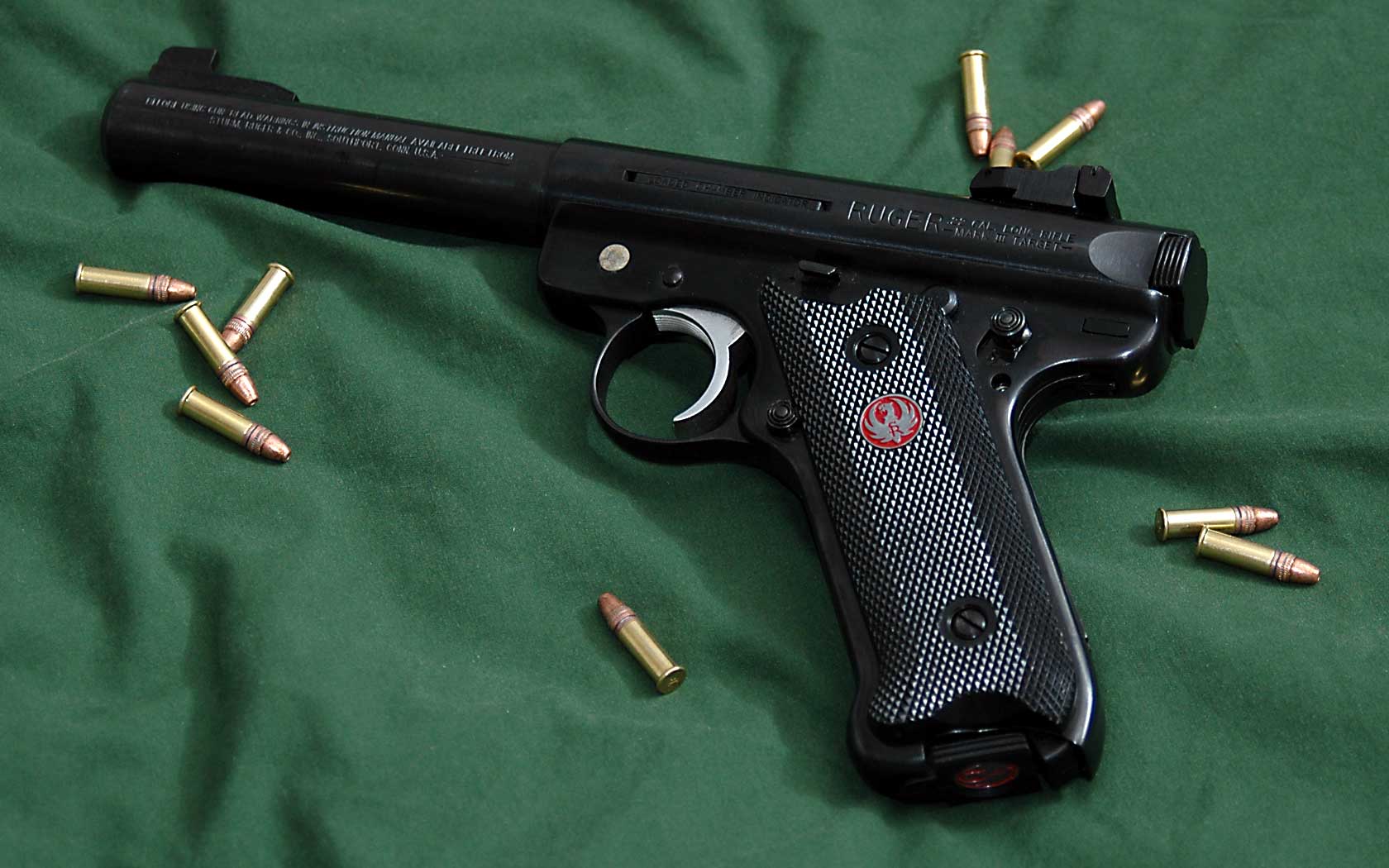
Ruger’s Mark III manual says the new pistol was “differentiated from Ruger Mark I and Mark II pistols by certain external differences in markings and exterior components (magazine latch, bolt, ejection port, sights, and grip configuration) and by the presence of certain new features for which patents are pending such as internal locks, loaded chamber indicators, and magazine disconnects.”10 That sentence divides the Mark III’s changes into two groups, and shooters divided their opinions along exactly the same line.
The changes shooters liked were the external ones. Keefe: “There were two things shooters really liked—moving the magazine release to the frame’s left behind the trigger and re-contouring and opening up of the ejection port.”6 The magazine button put the steel-frame Ruger’s release where a 1911 shooter’s thumb already was, and made the pistol quicker to reload than any heel-catch generation. The receiver was drilled and tapped for a scope base, and Ruger supplied a Weaver-style base with the Target, Hunter and Competition models.10
The three safety additions were:
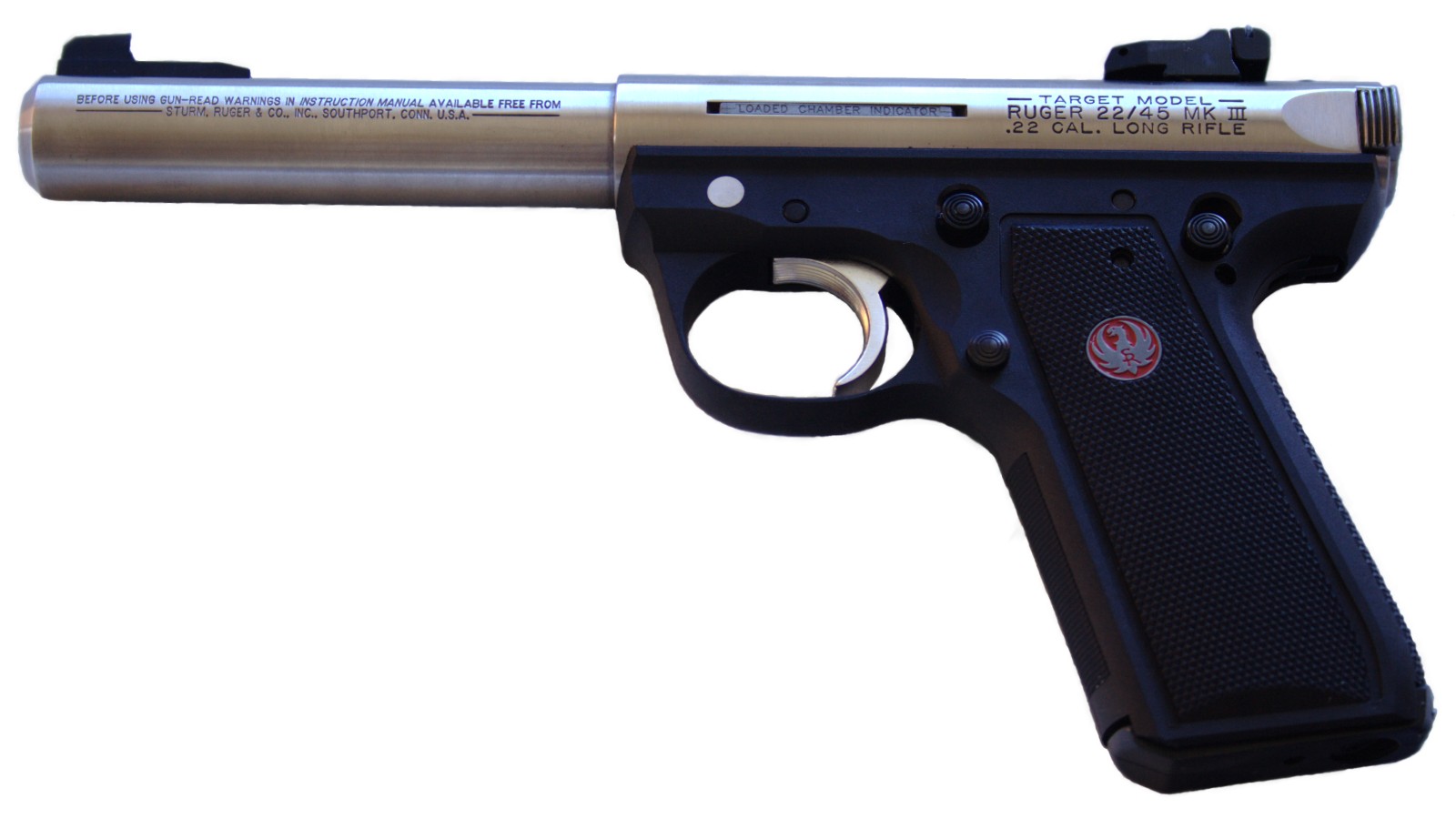
- A loaded-chamber indicator — Ruger claimed it as “the first such device on a .22 caliber pistol.” It sits on the left side of the receiver. With the chamber empty it is flush; with a round chambered, “the rearmost portion of the loaded chamber indicator should protrude from the left side of the receiver, and a red dot also should be visible on the forward top portion.”10 Ruger’s own manual puts the warning beside it in capitals: “NEVER RELY ON YOUR MEMORY OR ANY LOADED CHAMBER INDICATOR TO KNOW IF A GUN IS LOADED. ANY MECHANICAL DEVICE CAN FAIL.”
- A magazine disconnect, which “prevents the trigger from being pulled if the magazine is removed from the pistol. You will not be able to use your pistol as a single loader or to fire the pistol with the magazine removed.”10 Every earlier Ruger .22 could be fired as a single-shot; the Mark III could not.
- An internal lock in the mainspring housing: a key turned “about 1 3/4 of a rotation” locks the manual safety in the safe position.10
Of these, the loaded-chamber indicator drew the most ridicule. Keefe’s description is the one most often repeated: “a line-spoiling, loaded-chamber indicator that projected out the receiver’s left side like a compound-fractured tibia.”6 The magazine disconnect drew the practical objections — it ended single-loading, and it added a condition to disassembly (Volume 4 shows that the Mark III takedown needs an empty magazine inserted just to pull the trigger). The indicator also added a part to the reassembly: the Mark III manual tells the user to check that the loaded-chamber indicator pin “has not fallen out of the receiver” before putting the receiver back on the frame.10
The Mark III also moved Ruger’s customer base in a direction that is visible in its spec sheets. The 2009 sheet for the Mark III Target model 10101 records it as approved for sale in California and Massachusetts; the 2016 sheet for the same model records it as approved in neither.11 Neither sheet says why, and no reason is asserted here.
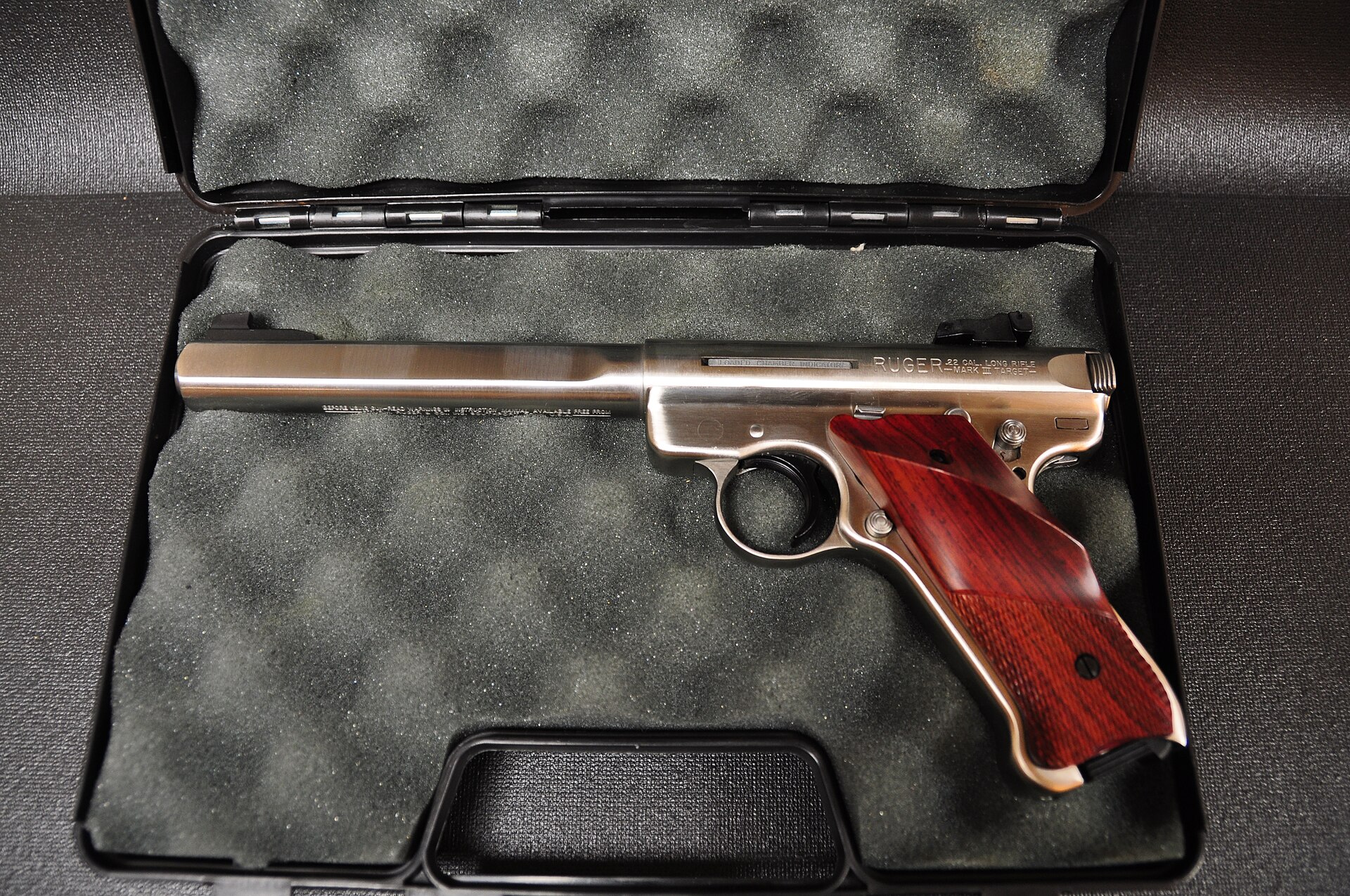
2.7 Mark IV, from 2016
Ruger announced the Mark IV on 22 September 2016, under the headline “Ruger Perfects Rimfire — Again.” The release leads with the takedown: “a simple, one-button takedown for quick and easy field-stripping. A recessed button in the back of the frame allows the upper receiver to tilt up and off of the grip frame without the use of tools.” Ruger’s president and chief operating officer, Chris Killoy, put the maker’s own name to the problem the change solved: “This one-button takedown alleviates the headache that our Mark III owners are all too familiar with.”8
The release lists the other changes:8
- “a one-piece grip frame that is precision CNC-machined from a solid piece of stainless steel or aluminum” — replacing the welded pressings that went back to the 1946 patent;
- “an ambidextrous manual safety and a redesigned bolt stop”;
- “The magazine drops free on release”;
- “a redesigned magazine disconnect safety”;
- “changes to the hammer, sear, bolt and firing pin for smoother, more reliable feeding”;
- and, unchanged, “the legendary, one-piece barreled receiver and internal cylindrical bolt construction.”
What the release does not say is what was removed. Keefe’s examination of the first Mark IVs does: “Gone is the internal lock, as is the loaded-chamber indicator, though the magazine-disconnect safety has been retained.”6 Ruger’s current Mark IV manual confirms it by omission — the Mark III manual’s sections on the internal lock and the loaded-chamber indicator have no counterpart.12 The Mark IV kept the one Mark III safety that shooters objected to in use and dropped the two that shooters objected to on sight.
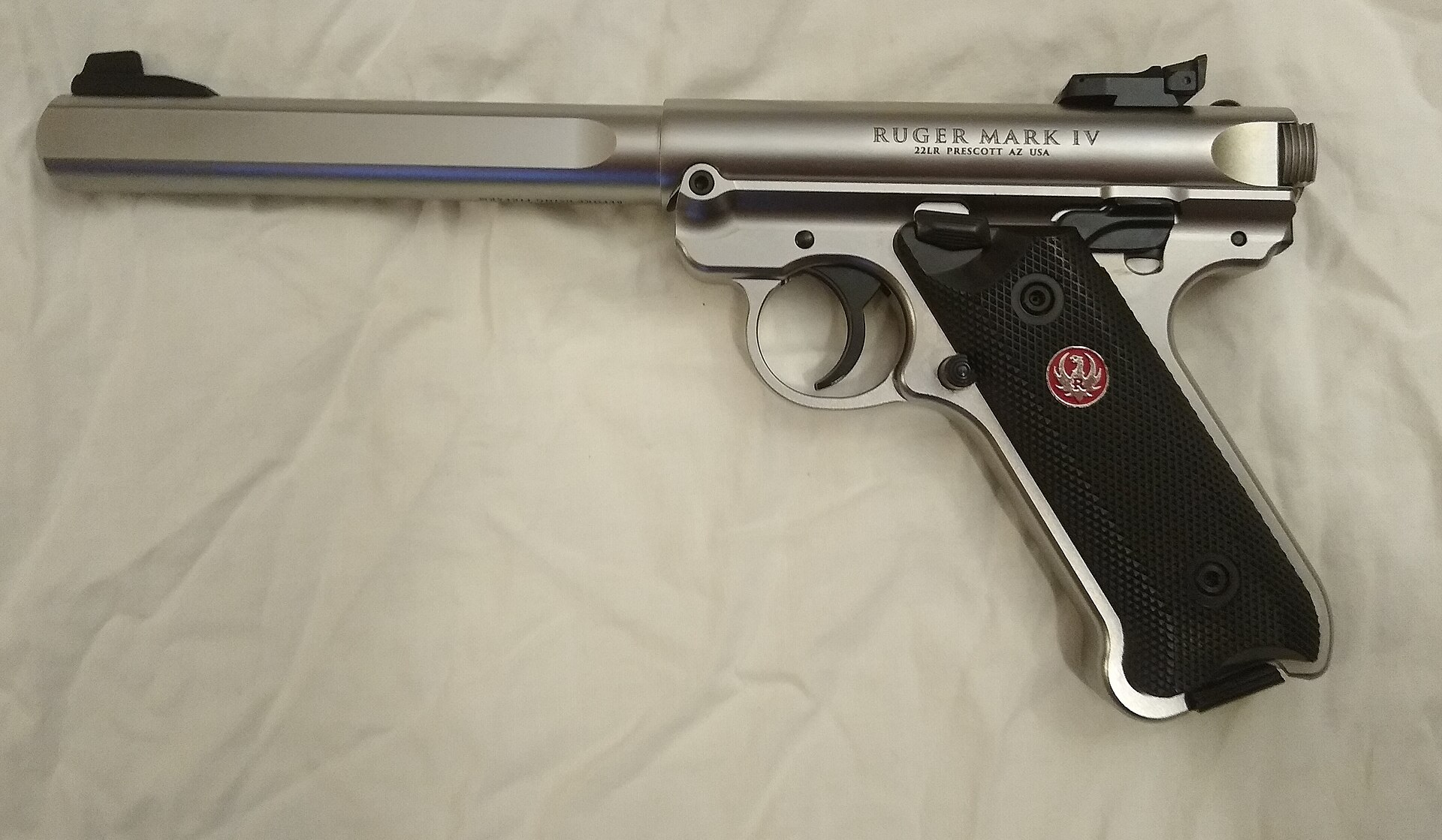
Keefe also recorded how the metal of the new frame depends on the finish: “the stainless steel guns are of, well, stainless, while the blue Target models are of aluminum.”6 Ruger’s current spec sheet for the blued Mark IV Target, model 40101, lists “Grip Frame: Aluminum” and a weight of 35.6 ounces, against 42 for the equivalent blued Mark III.13 Ruger’s release also claimed the Mark IV “is compatible with a variety of Mark III aftermarket accessories including sights, scope bases and magazines” — the last of which Volume 6 examines.8
Ruger’s current Mark IV manual names the Standard, Target, Hunter, Competition, 22/45, 22/45 Lite and 22/45 Tactical; the company’s website menu in September 2026 also lists a steel-frame Tactical.12 In 2019 Ruger issued a seventieth-anniversary Mark IV Standard with “the classic Standard styling, including the 4.75” cold hammer-forged, tapered barrel with fixed sights and angled grip,” a “70TH” serial-number prefix, and a wood case modelled on the 1949 shipping box.14
The Mark IV was recalled less than nine months after its announcement. Volume 5 is devoted to that recall.
2.8 Reading a Ruger model number
The Mark III documented in these volumes is recorded in its owner’s inventory as “Mark III (10101),” and the number is described there as a catalog number. Ruger’s own archived spec sheet settles what the number is:15
“Ruger® Mark III™ Target Rimfire Pistol Model 10101 — Catalog Number: MKIII512 | Model Number: 10101 | Caliber: .22 LR | Material: Alloy Steel | Finish: Blued | Rear Sight: Adjustable | Front Sight: Fixed | Barrel Length: 5.50” | Barrel Style: Bull | Length: 9.75” | Height: 5.50” | Width: 1.20” | Weight: 42.00 oz. | Twist: 1:16” RH | Grooves: 6 | Capacity: 10 | Grips: Checkered”
Ruger uses two identifiers. The model number is the five-digit number — 10101. The catalog number is the alphanumeric code — MKIII512. The owner’s record has the right number in the wrong field, and anyone ordering parts or looking up the pistol should know that Ruger answers to both.
Two regularities are visible in Ruger’s own pages, and they are stated only as far as those pages go:
- The stainless counterpart carries a K prefix. The same archived Ruger directory lists model 10103 under catalog number KMKIII512 — the stainless version of the same 5.5-inch bull-barrel Target.15 The stainless Mark II of the same configuration was sold as the KMK512 (the photograph in §2.3). No Ruger document consulted states the convention as a rule; it is inferred from the pairs.
- The Mark IV successor’s model number follows the Mark III’s. The blued Mark IV Target with a 5.5-inch bull barrel is model 40101.13 Its barrel length, twist, groove count, sights and dimensions are identical to the 10101’s. What Ruger means by the leading digit is not stated, and it is not decoded here.
2.9 Reading a serial number
On every generation, the serial number is on the receiver — the round upper assembly with the barrel screwed into it — not on the grip frame. Ruger states the legal consequence in every manual from the Mark II on: “Because it is a serial-numbered component, the RUGER® MARK III pistol barrel/receiver assembly is defined as a ‘firearm’ by Federal Law and is not offered for sale separately.”10 The grip frame, with the trigger, hammer, sear and safety in it, is not the firearm. Volume 5 shows Ruger using exactly that distinction to run the Mark IV recall by mail.
Ruger’s serial pages date a pistol only approximately, and each carries the same caution: the chart “shows the approximate first serial number shipped for the indicated year,” “Ruger does not necessarily produce firearms in serial number order,” blocks may be “manufactured out of sequence, sometimes years later,” and “within a model family the same serial number prefix may be used to produce a variety of different models.”1 For an exact answer Ruger’s Service Department offers a lookup and a Letter of Authenticity.1 The Mark IV’s prefixes carry one piece of information that matters more than a date — WBR and 401 identify the pistols subject to the 2017 recall — and Volume 5 explains how to read them.
References
Footnotes
-
Sturm, Ruger & Co., Serial Number History pages: Standard & Mark I (https://ruger.com/service/productHistory/PI-MarkI.html), Mark II (PI-MarkII.html), 22/45 (PI-22-45.html), Mark III (PI-MarkIII.html), Mark IV (PI-MarkIV.html), all consulted 2026-09-19. The Mark III page footnotes that from 2009 the 270- block was shared with the 22/45 Mark III Hunter. ↩ ↩2 ↩3 ↩4 ↩5 ↩6 ↩7 ↩8
-
Sturm, Ruger & Co., Instruction Manual for Ruger Mark I Target Model and Standard Model Automatic Pistols, “For Reference Only,” code A-7-81, https://ruger-docs.s3.amazonaws.com/_manuals/markI.pdf (scanned; text by OCR), consulted 2026-09-19. ↩ ↩2 ↩3
-
“Ruger Standard,” English Wikipedia, consulted 2026-09-19 — cited only for the Mark I Target barrel dates and the 8 December 2016 Mark III end date, neither confirmed in a Ruger document. ↩ ↩2
-
Sturm, Ruger & Co., Instruction Manual for Ruger Mark II Autoloading Pistols, Standard, Target, Government Target, Competition, and 22/45 Models, “For Reference Only,” code AP & KAP 1/03 C R8, https://ruger-docs.s3.amazonaws.com/_manuals/markII.pdf , consulted 2026-09-19. ↩ ↩2 ↩3 ↩4 ↩5 ↩6
-
Departments of the Army and the Air Force, TM 9-1005-226-14 / AFM 50-11, 20 July 1959, para. 3b; Wikimedia Commons File:TM-9-1005-226-14.pdf, consulted 2026-09-19. ↩
-
Mark A. Keefe IV, “Mark IV: The Ruger Evolution,” American Rifleman, 20 March 2017, https://www.americanrifleman.org/articles/2017/3/20/mark-iv-the-ruger-evolution/ , consulted 2026-09-19. ↩ ↩2 ↩3 ↩4 ↩5 ↩6 ↩7
-
W. B. Ruger, US Patent 2,655,839, “Blowback Autoloading Pistol,” filed 5 November 1946, issued 20 October 1953, https://patents.google.com/patent/US2655839A/en , consulted 2026-09-19. ↩
-
Sturm, Ruger & Co., “Ruger Perfects Rimfire — Again: Introducing the One-Button Takedown Mark IV,” 22 September 2016, https://ruger.com/news/2016-09-22.html , consulted 2026-09-19. ↩ ↩2 ↩3 ↩4
-
NRA Staff, “My Favorite Ruger,” American Rifleman, 15 July 2012, https://www.americanrifleman.org/content/my-favorite-ruger/ , consulted 2026-09-19. ↩
-
Sturm, Ruger & Co., Instruction Manual for Ruger Mark III … Autoloading Pistols, © 2015, code AP & KAP 9/15 R15, https://ruger-docs.s3.amazonaws.com/_manuals/markIII.pdf , consulted 2026-09-19, pp. 10–12, 17, 23, 35, 42. ↩ ↩2 ↩3 ↩4 ↩5 ↩6 ↩7
-
Sturm, Ruger & Co., spec sheets for model 10101 as archived 25 November 2009 (“MA Approved: Yes CA Approved: Yes”, suggested retail $417.00) and 14 January 2016 (“CA Approved No / MA Approved & Certified No”, suggested retail $499.00), consulted 2026-09-19. ↩
-
Sturm, Ruger & Co., Instruction Manual for Ruger Mark IV Standard, Target, Hunter, Competition, 22/45, 22/45 Lite, and 22/45 Tactical Autoloading Pistols, code PM1179, © 2026, https://www.ruger.com/dataProcess/manual/fetch.php/ms/40160/manual_40160.pdf , consulted 2026-09-19. This is the current revision; the 2016 original was not obtained. ↩ ↩2
-
Sturm, Ruger & Co., spec sheet, Mark IV Target model 40101, https://ruger.com/products/markIVTarget/specSheets/40101.html , consulted 2026-09-19 (suggested retail $689.00; “Limited Availability”). ↩ ↩2
-
Sturm, Ruger & Co., “Ruger Commemorates 70th Anniversary with Limited Edition Mark IV,” 26 April 2019, https://ruger.com/news/2019-04-26b.html , consulted 2026-09-19. ↩
-
Sturm, Ruger & Co., spec sheet, Mark III Target model 10101, as archived 25 November 2009, http://web.archive.org/web/20091125152517/http://www.ruger.com:80/products/markIIITarget/specSheets/10101.html ; the same archived directory lists model 10103 under catalog number KMKIII512 (order-page capture of 28 September 2011). Consulted 2026-09-19. ↩ ↩2
Comments (0)