Ruger Mark III & Mark IV · Volume 1
Origins — A Pistol Filed in 1946, a Company Founded in 1949
Bill Ruger, Alex Sturm, the $37.50 Standard, and the patent that already contained the takedown problem
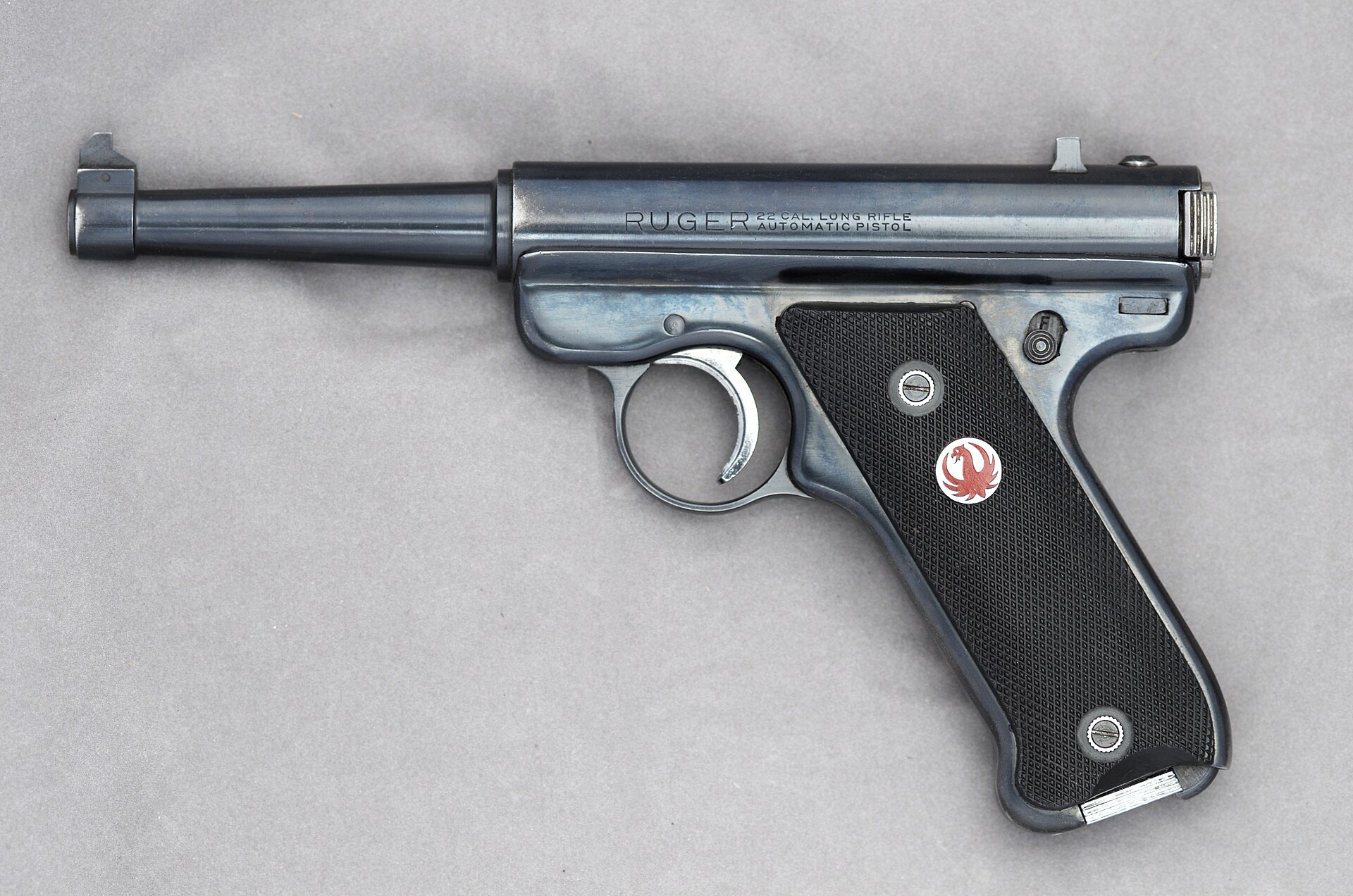
The Ruger .22 automatic is the most successful rimfire pistol ever made in the United States and one of the least examined. Everyone who has shot for more than a few years has handled one; very few have read the patent it came from, and fewer still have noticed that the feature every owner curses — the reassembly — is written into the opening pages of that patent. This volume establishes where the pistol came from: a design filed with the Patent Office in November 1946, a partnership formed in 1949 with borrowed money, a price that undercut the incumbents by more than a third, and a review in American Rifleman that turned a two-man shop into a company.
The two pistols documented in these volumes — a Mark III Target and a Mark IV of a configuration not yet recorded — are the third and fourth generations of that 1949 design. Volume 7 documents them. Volumes 2 to 6 and Volume 8 are about the pattern, because the pattern explains the pistols.
1.1 The argument of these volumes
Three claims run through the series, and each rests on Ruger’s own documents rather than on the received version.
The Ruger .22 has not been redesigned four times; it has been revised four times around one idea. That idea is a round receiver tube with a round bolt inside it, and a single cross-pin that does two jobs at once: it stops the bolt at the end of its travel and it locks the receiver to the frame. The 1946 patent describes that pin in so many words. Every generation from the Standard to the Mark III kept it, and the Mark IV still has a part that Ruger calls the bolt stop pin. Volume 3 works through the mechanism; Volume 4 shows why that one pin is the reason the pistol was hard to put back together for sixty-seven years.
The Mark III’s reputation and the Mark IV’s recall are two halves of one story about safeties. The Mark III added a loaded-chamber indicator, a magazine disconnect and an internal key lock, and shooters disliked at least two of them. The Mark IV removed the indicator and the lock, kept the disconnect, redesigned the safety as an ambidextrous lever — and was recalled within nine months because that safety could stop halfway. Every Ruger manual from the Mark I onward had already warned against a half-applied safety. Volume 5 sets the recall out from Ruger’s own notice.
Much of what is said about these pistols is almost right, and the gap matters. The Mark III’s introduction is dated 2004 on one Ruger page and 2005 on another. The number “10101” that identifies the Mark III documented here is Ruger’s model number; Ruger’s catalog number for the same pistol is a different code, MKIII512. A Volquartsen part widely described as fitting “the Mark III” fits only one of the Mark III’s two frames. Where Ruger’s own records disagree with each other, both are printed and attributed.
1.2 The pistol in one table
Figures for the first and the most recent generations, from Ruger’s documents. The Mark I Target column is from the 1959 US Army technical manual that adopted it; the Mark III and Mark IV columns are Ruger’s spec sheets for the two 5.5-inch bull-barrel Target models, which are the closest like-for-like pair in the line.
Table 1 — The pistol in one table
| Standard (1949) | Mark I Target (1959 Army data) | Mark III Target, model 10101 | Mark IV Target, model 40101 | |
|---|---|---|---|---|
| Cartridge | .22 Long Rifle | .22 Long Rifle | .22 Long Rifle | .22 Long Rifle |
| Operation | Blowback, hammer-fired | Blowback, hammer-fired | Blowback, hammer-fired | Blowback, hammer-fired |
| Magazine | 9 rounds | 9 rounds | 10 rounds | 10 rounds (same magazine as the Mark III) |
| Magazine catch | Heel of the grip | Heel of the grip | Push button, left side of frame | Push button, left side of frame; drops free |
| Barrel | 4¾ in tapered | 6⅞ in | 5.5 in bull | 5.5 in bull |
| Twist | — | 1 in 14 in, 6 grooves | 1 in 16 in RH, 6 grooves | 1 in 16 in RH, 6 grooves |
| Weight | — | 42 oz | 42 oz | 35.6 oz |
| Grip frame | Two steel stampings welded | Two steel stampings welded | Steel; two halves welded | One-piece CNC-machined aluminium |
| Fires with magazine out | Yes | Yes | No — magazine disconnect | No — magazine disconnect |
| Price at introduction | $37.50 | — | $417 suggested retail (2009 sheet) | $689 suggested retail (Ruger site, September 2026) |
Two rows deserve an immediate note. The twist is not a misprint: the Army manual gives one turn in 14 inches for the 6⅞-inch Mark I Target, and Ruger’s spec sheets give one in 16 for the 5.5-inch Mark III and Mark IV Targets. No source consulted explains the change, and none is asserted here. And the Mark IV is 6.4 ounces lighter than the Mark III on the same barrel; the only construction difference the two spec sheets record is the grip frame, which on the blued Mark IV Target is machined from aluminium.
1.3 Bill Ruger before the company
William Batterman Ruger was born in Brooklyn on 21 June 1916 and died in Prescott, Arizona, on 6 July 2002.1 He was a designer before he was a manufacturer, and a published one before he was either. The earliest known Ruger firearm is a Savage Model 99 lever-action rifle that he converted to semi-automatic operation; he described the conversion in an article titled “Semi-Automatic .250-3000” in the December 1943 issue of American Rifleman, written, in the NRA Museums’ description, by “a 27-year-old William Batterman Ruger of Brooklyn, NY.” The rifle survives in the NRA’s National Firearms Museum, in the gallery that bears his name.2
During the war he worked at Springfield Armory and at Auto-Ordnance.2 His light machine gun design — the experimental T10/T23E1 — was liked well enough by Army Ordnance that it hired him as a designer at Springfield;1 it also arrived, as the NRA account puts it, just as the war and the ordnance orders for new weapons were winding down.2 The machine gun did not go into production. What Ruger took out of the war was not a contract but a working knowledge of how service weapons were made, and a sharp awareness of what that manufacture cost.
1.4 The 1946 patent — the design came first
The single most useful document for understanding the Ruger .22 is United States Patent 2,655,839, “Blowback Autoloading Pistol,” by William B. Ruger. Its drawings are marked “Filed Nov. 5, 1946”; it issued on 20 October 1953; the application was serial number 707,773.3
The filing date is the first correction this series makes. The pistol is routinely described as the product of a company founded in 1949. It is more accurate to say that the company was founded to make a pistol whose design had been on file with the Patent Office for more than two years. The patent database now lists Sturm, Ruger & Co. as the assignee; that reflects the later assignment of the patent, not who filed it, because no such company existed in 1946.
The patent states its object plainly:
“In its more general aspects my invention provides a new construction and arrangement of elements by means of which I am able to produce a pistol from readily available stock materials at comparatively low costs. I am able to produce an autoloading pistol with a minimum of the expensive broaching and milling now required in fashioning the grip and receiver.”3
Everything characteristic of the pistol follows from that sentence.
- The grip frame is “two complementary mating half parts which are welded together to form a unitary structure,” formed “from sheet metal, for example sheet steel, by drawing, pressing or stamping.” A conventional pistol frame of the period was a machined forging. Ruger’s was two pressings and a weld.
- The receiver is “preferably formed of stock tubing,” with the barrel “threaded into the receiver in the usual manner.” Tube stock is cheap and round; a round bolt runs inside it; the sights sit on parts that do not move.
- The bolt carries “an upright longitudinal guide slot which serves a triple function; namely, a space for the swinging of the hammer, a guide means for retaining the bolt in a non-turning position, and a means for engaging a stop member to limit the movement of the bolt.”
- The stop member — and this is the sentence the whole of Volume 4 hangs on — “is inserted through the slot and … serves to effect an engagement between the receiver and the grip member, thereby securing those members together at the rear and forming an unyielding block for stopping the bolt at the end of its ejection stroke. The stop member may also be used as a support for the action spring.”
That stop member is what every later Ruger manual calls the bolt stop pin. It is one part doing three jobs: it holds the receiver to the frame, it stops the bolt, and it anchors the recoil spring. A part that does three jobs has to pass through three things at once when the pistol is put back together — the frame, the receiver and the slot in the bolt — while the hammer strut beneath it finds its seat in the mainspring housing. The patent also describes that hammer strut, “the angular strut 29 which passes down through the grip member behind the magazine partition,” with a follower rod for the hammer spring.3 The Mark I–III reassembly problem is not a later manufacturing compromise. It is in the original design, filed in 1946, as the price of making a pistol out of a tube, two pressings and a pin.
Two other features of the patent embodiment did not survive into later generations, and they are worth recording because they locate the changes Volume 2 describes. The patent’s magazine catch sits at the heel, operated by the same spring that drives the hammer — “the hammer spring accordingly serves a double function; it operates the hammer and the magazine catch.” And the patent’s safety “locks the sear and also the bolt preventing the bolt from being pulled rearwardly when in the safe position.”3 The heel catch lasted until the Mark III; the bolt-locking safety was changed with the Mark II.
1.5 Alex Sturm and the $50,000
Alexander McCormick Sturm was born on 23 June 1923 in Westport, Connecticut, and was a Yale-educated artist and author — he had illustrated children’s books, The Problem Fox among them, before he graduated.4 He was seven years younger than Ruger, an enthusiast of guns, and in a position to finance one.
Ruger’s own account, printed at the back of its instruction manuals for decades, is compact: “In January, 1949, with an initial investment of only $50,000 and an idea, William B. Ruger and Alexander M. Sturm started production of a .22 caliber autoloading pistol.” The company began “in a small machine shop occupying a rented frame building in Southport, Connecticut.”5 Ruger’s 2018 letter to shareholders says the same thing in corporate register: the company “was founded in 1949 by William B. Ruger and Alexander Sturm in Southport, Connecticut. It was a small operation, and the first product the Company produced was a .22 caliber, semi-automatic pistol, dubbed the ‘Standard Pistol.’”6
The NRA Museums’ account adds the texture. The shop was called “the little red barn.” The first advertisement ran in American Rifleman in 1949, and “orders were taken, but no checks or cash were deposited until enough orders were received to begin the manufacturing process.” Pistols shipped in a wooden box the account describes as a “salt cod” box.2 Ruger’s 2019 seventieth-anniversary Mark IV shipped in “a custom wood case, reminiscent of the box used to ship the original Standard pistol in 1949,” which is the company confirming the detail.7
Sturm contributed more than money. He designed the bird emblem — Ruger’s manuals call it an eagle; the NRA account calls it a phoenix — which on the first pistols was red on a silver ground.2 He died of viral hepatitis on 16 November 1951, aged 28.4 “After Alex Sturm’s death in 1951,” Ruger’s own history continues, “William B. Ruger continued to direct the Company until his death in 2002.”5
1.6 The Nambu, the Luger, and the grip that was patented separately
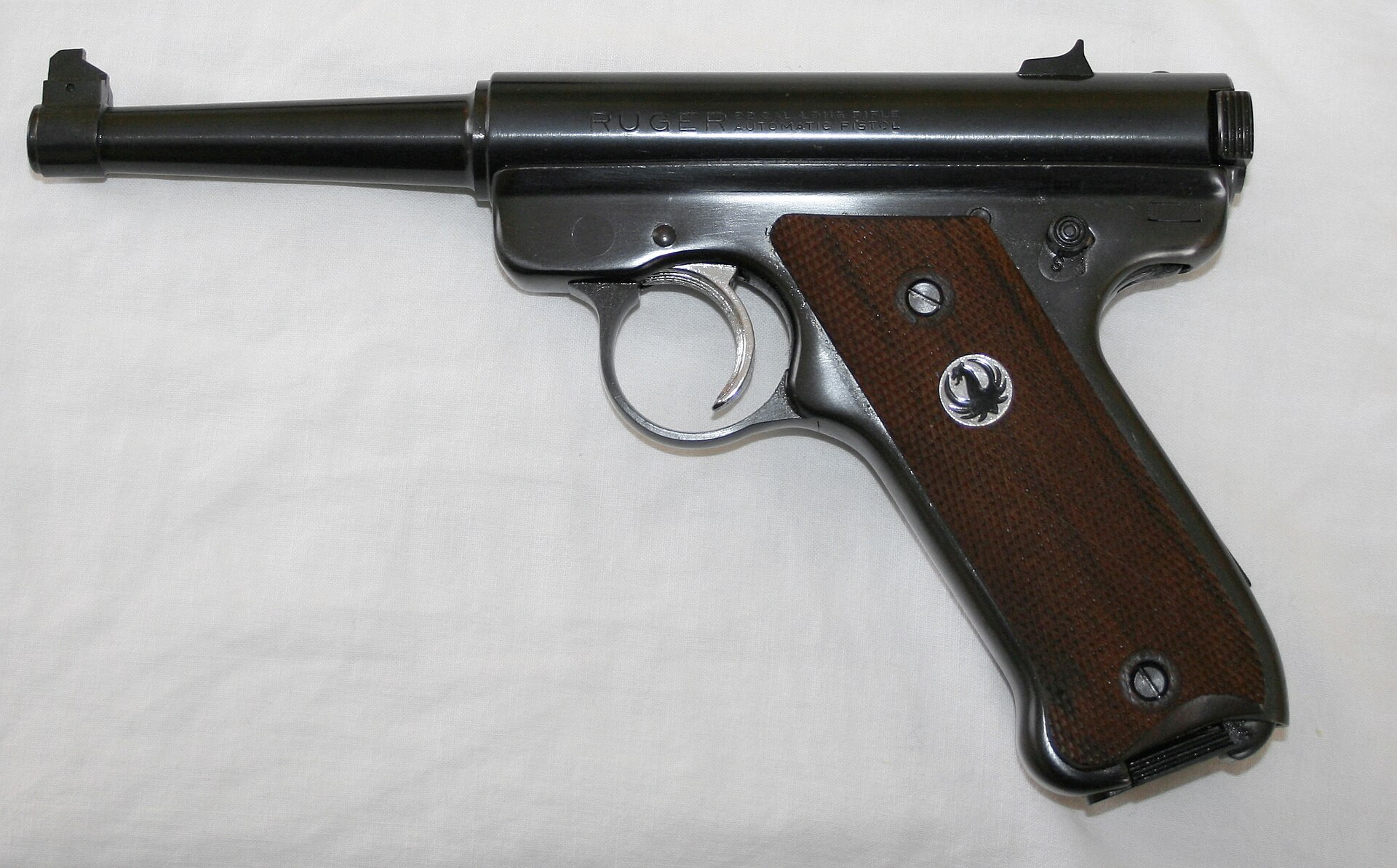
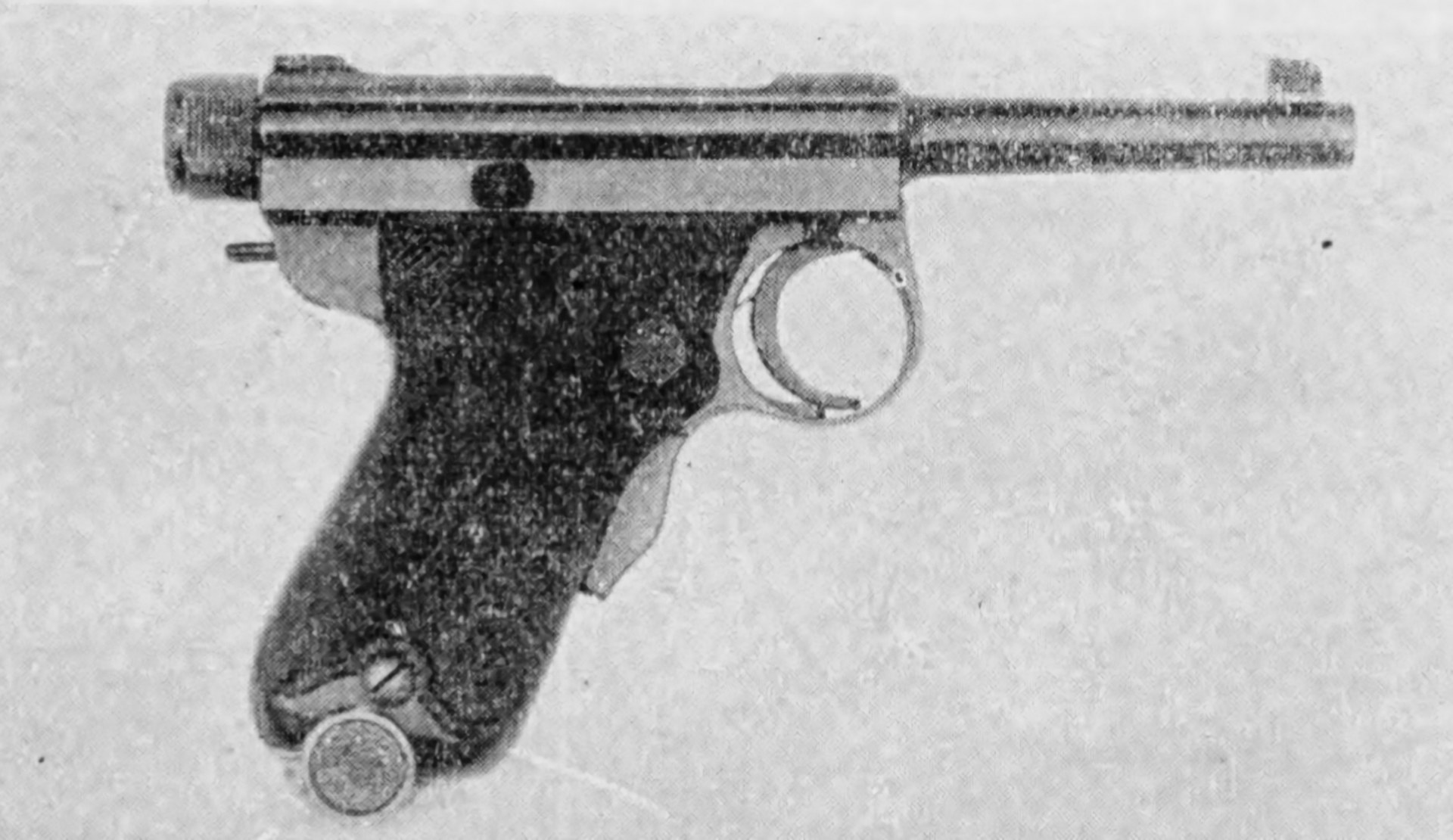
The Standard looks like a Luger. It has the raked grip, the long exposed barrel in front of a compact action, and a name that rhymes. The resemblance sold pistols in a country full of returning servicemen who had wanted a Luger as a souvenir, and the NRA Museums’ director is explicit that it misleads: “the shape of the gun was actually inspired by the Nambu, not the Luger.”2
The Japanese Nambu family — the Type 14 service pistol and the smaller “Baby” Nambu — has the same raked grip and the same visual arrangement of a round receiver behind a slim barrel. The Baby Nambu in particular is widely described as the pistol Ruger studied. How and when he came by one is told in more than one way, and the version in the NRA article cited here cannot be right as printed: it has him acquiring a Nambu “souvenired in the South Pacific” at the age of ten, which would put a Pacific war souvenir in about 1926. The influence is attested; the anecdote is not, and it is not repeated here.
What makes the shape question more than trivia is that Ruger protected the shape separately. US Design Patent D164,735, “Pistol,” by W. B. Ruger, was filed on 29 April 1950 and issued on 2 October 1951.8 In a design patent the solid lines are the design being claimed and the broken lines show the surroundings. In Ruger’s drawing, the receiver, barrel and trigger guard are drawn in broken lines. The only thing drawn solid is the grip.
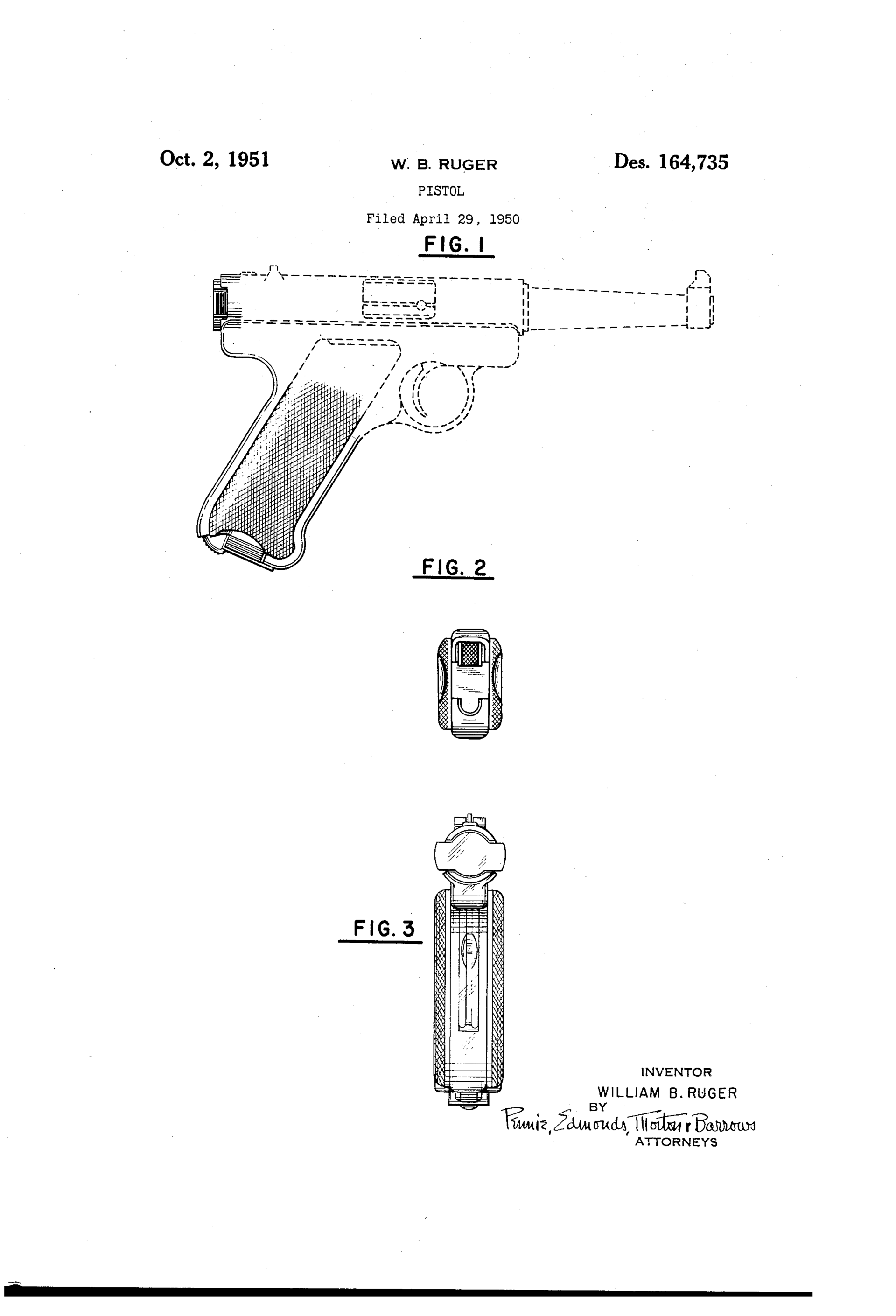
The utility patent covers how the pistol is built; the design patent covers what it looks like; and what Ruger chose to claim as its look was the grip. That grip angle has survived every generation of the steel-frame line. The 22/45 polymer variant of 1992 changed it to match the Colt 1911, and that is the only branch of the family in which it was changed deliberately (Volume 2).
1.7 $37.50 against the Woodsman and the High Standard
The American market for a .22 target and sporting pistol in 1949 belonged to two makers. Colt’s Woodsman — a John Browning design introduced in 1915 and sold under the Woodsman name from 19279 — was the prestige choice. High Standard’s .22 automatics were the other. Both were conventional slide-action designs with machined frames.
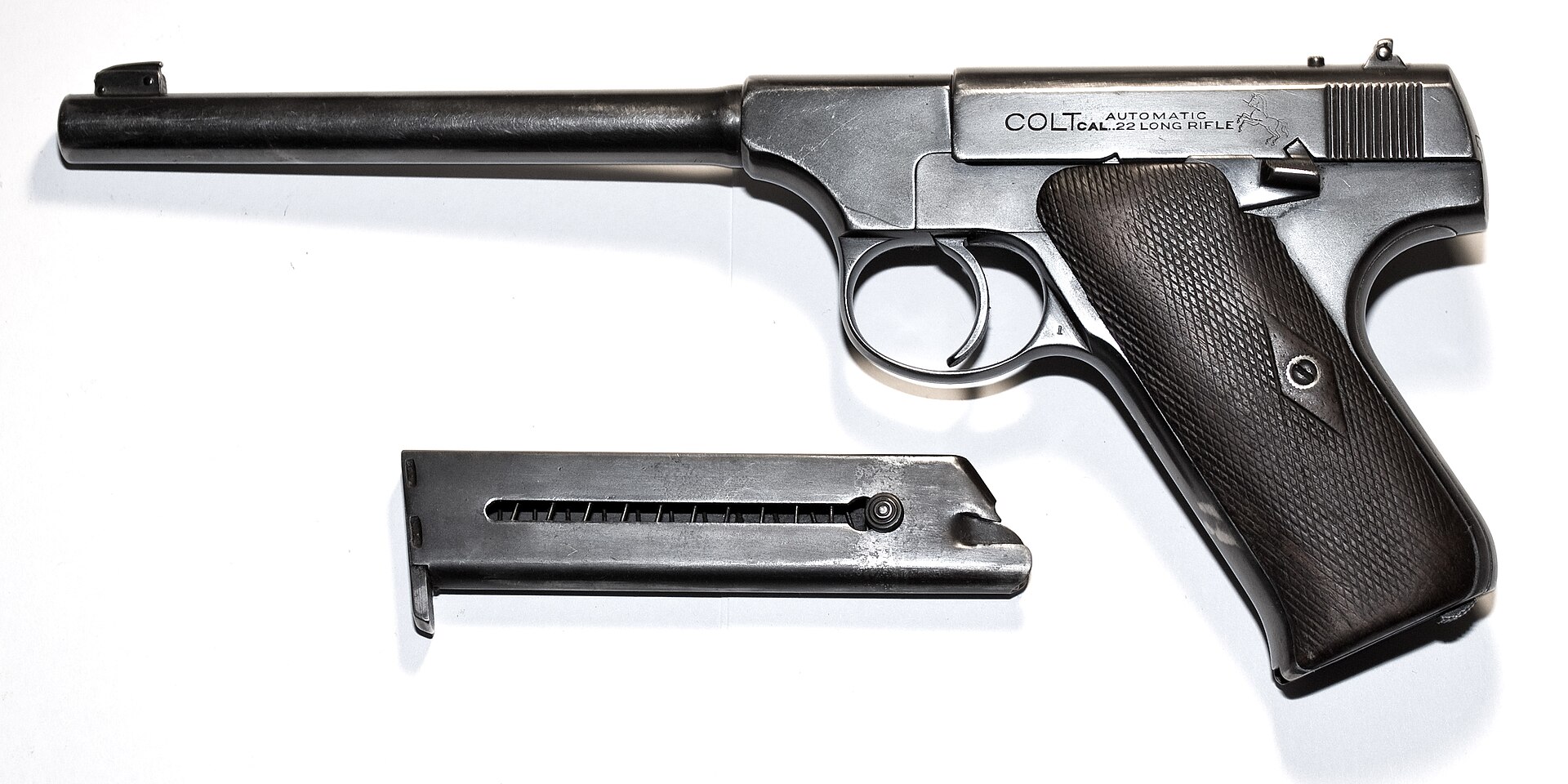
The Standard went on sale at $37.50. The NRA account gives the Woodsman’s price at the time as $60, which put the Ruger at a little under two-thirds of the incumbent’s price — a gap that follows directly from the patent’s stampings, tubing and weld.2
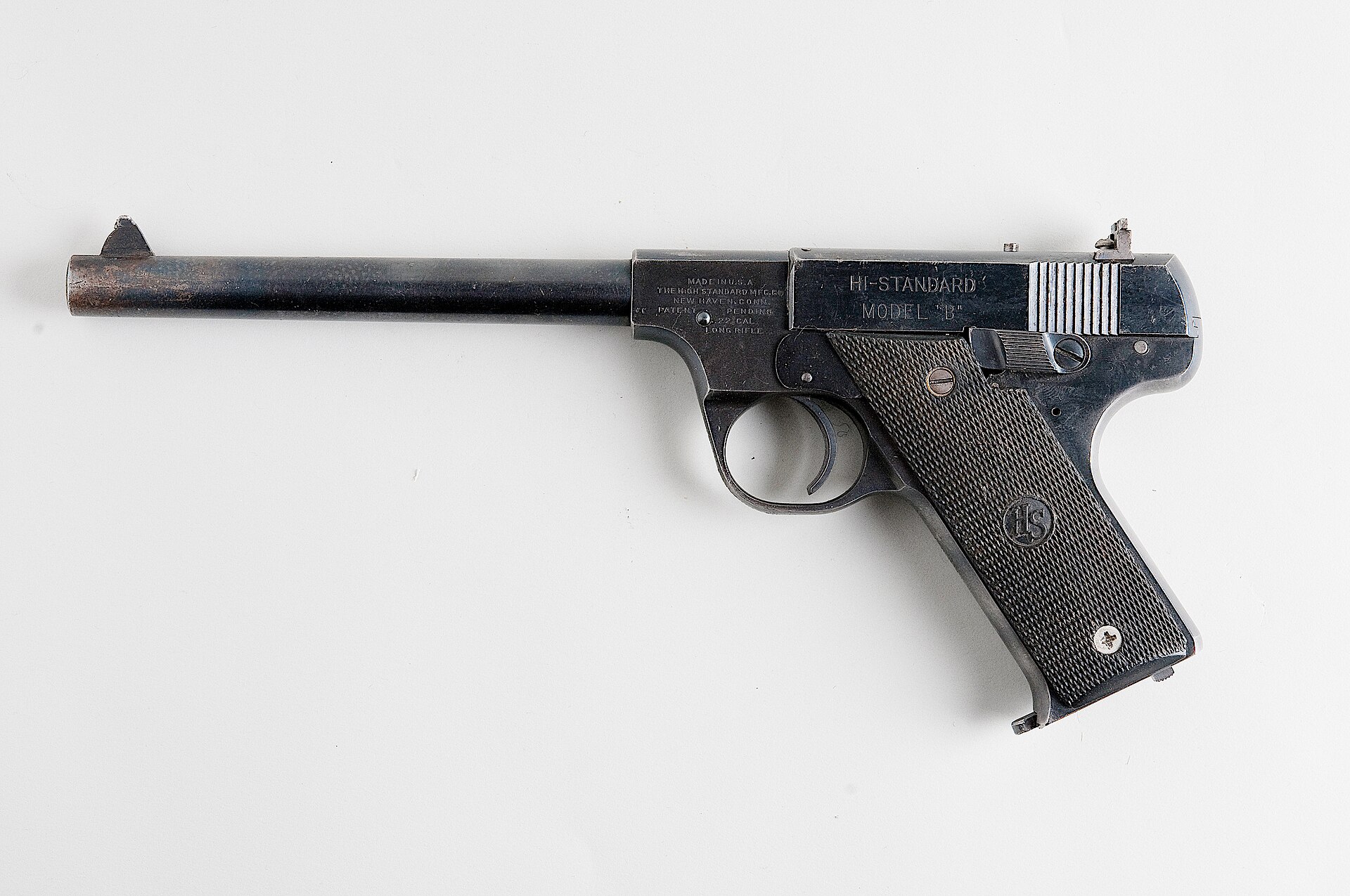
Two further engineering choices are credited by the NRA account with the pistol’s durability as well as its price. Ruger used coil springs throughout, in place of the flat and V-springs that were still normal in pistols of the period and that “proved prone to breaking.” And because the bolt is inside the receiver and the sights are on the receiver and barrel, “when the pistol was fired, the front and rear sights stayed stationary.”2 A slide pistol carries its rear sight on a moving part. The Ruger does not, and Ruger’s own spec sheets, seventy years later, still lead with the consequence: “Internal cylindrical bolt construction ensures permanent sight to barrel alignment and higher accuracy potential than conventional moving slide designs.”10
1.8 Hatcher’s review and the red eagle
The pistol’s reputation was made by one review. Major General Julian S. Hatcher, then American Rifleman’s technical editor, reviewed the “.22 Ruger Pistol” in the October 1949 issue:
“Shaped like a Luger pistol, the gun looks good and handles splendidly. It hangs and balances just right, and points naturally, which is a great aid in quick shooting. … We like this new gun a lot and at the very moderate price of $37.50 it represents real value.”11
Hatcher also wrote, in the line the NRA has quoted ever since, that “one can readily see that the designer of this pistol knows something about shooting as well as designing.”12 The NRA account credits the review with spurring sales “to heights undreamt of by the two aspiring gun manufacturers.”2
Hatcher’s own comparison is worth noticing: he said it was shaped like a Luger. The Nambu inspiration is a later museum-director’s correction of a resemblance that the pistol’s first and most influential reviewer took at face value.
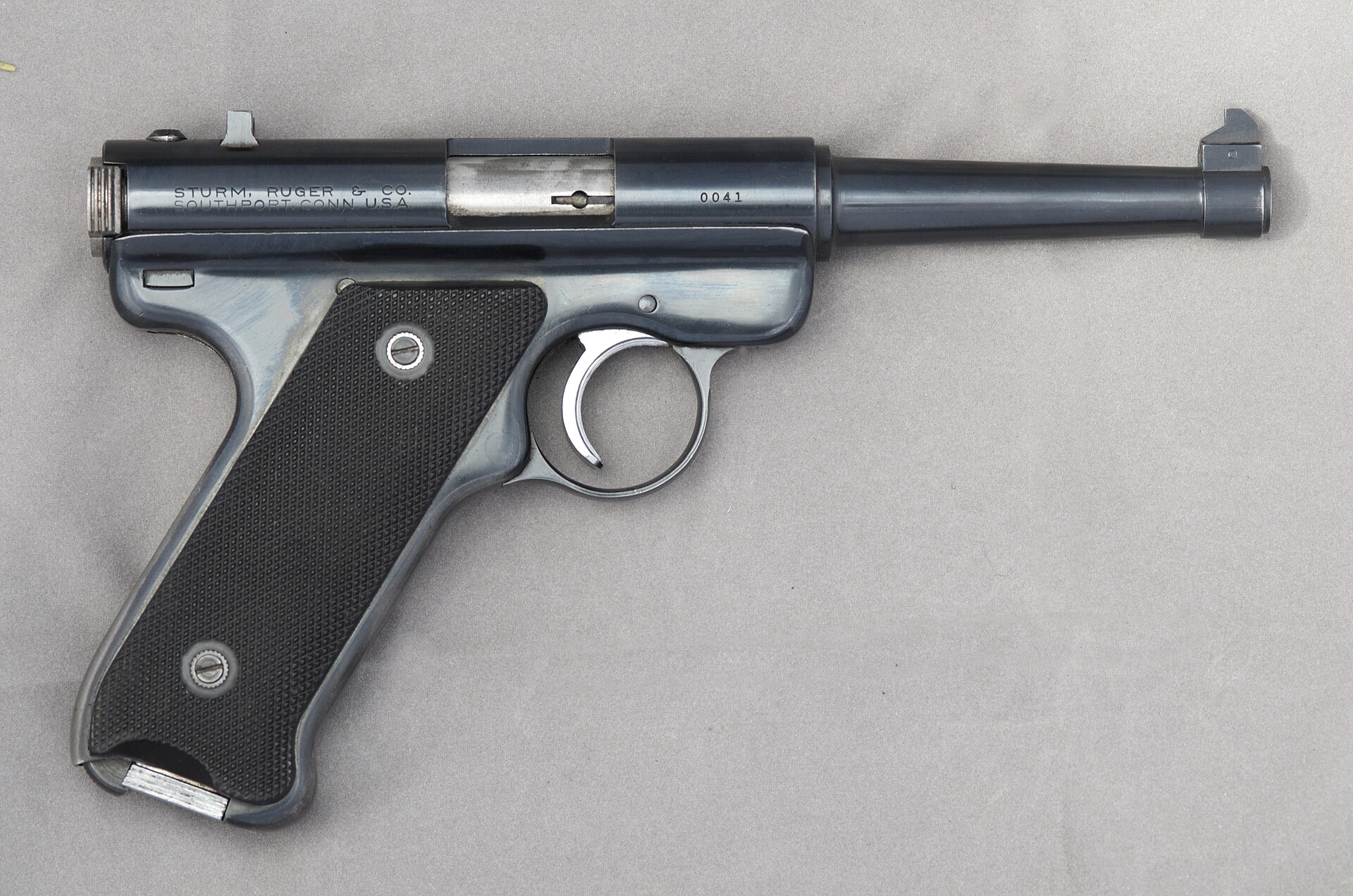
The pistols sold. The NRA’s figure is that “by 1980, more than one million units had been made, and nearly double that number have been made in the four decades since.”2 That is the only production total used in these volumes, because it is the only one found that is attributed to an identifiable source. Ruger publishes a serial-number history for every generation, and it is tempting to read a production count off it. It cannot be done. Ruger’s own chart gives serial 463239 for the start of 1967 and “10-00001” for the start of 1968;13 read as a count, that would put the millionth pistol in 1968, twelve years before the NRA does. The hyphenated prefix is a change of numbering format, not a leap in production, and Ruger’s chart warns that it gives only “the approximate first serial number shipped” and that “Ruger does not necessarily produce firearms in serial number order.”13
1.9 A match pistol within a decade
The clearest measure of how quickly the pistol was taken seriously is a document that has nothing to do with Ruger’s marketing. In July 1959 the Departments of the Army and the Air Force published TM 9-1005-226-14 / AFM 50-11, the operation and maintenance manual for the services’ commercial match weapons. Its list is short: the High Standard Supermatic, the “Cal. .22 Ruger Mark I Automatic Pistol (Target Model) (6-7/8 In. Barrel)”, the Smith & Wesson K-38 Masterpiece, the Winchester Model 70 and Model 52, and the Remington 40X.14
The manual’s description of the Ruger is an efficient summary of the Mark I:
“The Ruger pistol mark I is a 9-shot magazine-loaded cal .22 weapon, chambered for the cal .22 long rifle cartridge only. The ‘micro’ rear sight is attached to the receiver and does not move with the recoil action of the weapon. … A positive lock safety lever is provided which locks the sear in the safe position. It also can be used to lock the bolt in the rear.”14
Its data table gives the Mark I Target at 42 ounces, 10⅞ inches overall, a 6⅞-inch barrel with six grooves and one turn in 14 inches, a 9-round magazine, a trigger pull of 2¼ to 3¼ pounds, and a 9⅜-inch sight radius.14 A pistol that had been a $37.50 mail-order proposition ten years earlier was now a service match weapon alongside the Winchester 70. Ruger’s later manuals describe a “Government Target” model with “a longer, heavyweight barrel just like pistols delivered to the U.S. Government for target shooting and training,” which is the commercial echo of that adoption.5
The target-pistol market that the Army manual defines is also where the Ruger’s most important later competitor lives. Smith & Wesson’s Model 41, a premium American target .22 introduced in the late 1950s, is the natural rival; its history and mechanism are the subject of the Smith & Wesson Model 41 dive, which makes the direct comparison with the Ruger Target in detail. These volumes do not repeat it.
1.10 How these volumes are organised
Table 2 — How these volumes are organised
| Vol | Title | What it settles |
|---|---|---|
| 1 | Origins | The 1946 patent, the founding, the price and the first reception |
| 2 | Four Generations | What actually changed at each generation, when, and the Mark III’s reputation |
| 3 | How It Works | The tube, the bolt and the pin; the hammer, sear and disconnector; the Mark III safeties and the Mark IV takedown |
| 4 | Takedown and Reassembly | Ruger’s own procedures from four generations of manuals, and why the Mark I–III reassembly defeats people |
| 5 | The Mark IV Recall | Ruger’s notice, the serial ranges, the “S” mark, and the half-on safety warning that predates it |
| 6 | Magazines | Which magazine fits which pistol, and why the Mark III magazine has a window |
| 7 | The Pistols Documented Here | The Mark III Target and the Mark IV as recorded in September 2026, and what the planned Volquartsen parts would change |
| 8 | Keeping It Running | Cleaning, lubrication, inspection, wear parts, malfunctions, the Army’s 1959 detail strip, and bench versus factory repair |
Ammunition choice for these pistols, velocities from pistol-length barrels, and the case for a .22 pistol as a suppressor host are owned by the .22 Rimfire dive, especially its Volumes 4, 9 and 10, and are linked rather than re-derived here.
References
Footnotes
-
“William B. Ruger,” English Wikipedia, consulted 2026-09-19, for his birth (21 June 1916, Brooklyn) and death (6 July 2002, Prescott, Arizona) and the T10/T23E1 light machine gun and Springfield Armory appointment. ↩ ↩2
-
Philip Schreier (Director, NRA Museums), “The Ruger Standard Pistol,” Shooting Illustrated, 11 December 2023, https://www.shootingillustrated.com/content/the-ruger-standard-pistol/ , consulted 2026-09-19. Source for the 1943 Savage 99 article, Springfield Armory and Auto-Ordnance, the Nambu inspiration, the $37.50 and $60 prices, coil springs, the little red barn, deferred deposits, the salt-cod box, Sturm’s emblem and its colour change, and the “more than one million by 1980” figure. The article’s statement that Ruger acquired a Nambu at the age of ten is internally inconsistent and is not used. ↩ ↩2 ↩3 ↩4 ↩5 ↩6 ↩7 ↩8 ↩9 ↩10
-
W. B. Ruger, US Patent 2,655,839, “Blowback Autoloading Pistol,” application serial no. 707,773, filed 5 November 1946, issued 20 October 1953. Full text and drawings via Google Patents, https://patents.google.com/patent/US2655839A/en , consulted 2026-09-19. Quotations are from the specification; “broaching” is rendered as printed in the specification, which the OCR text gives as “breaching”. ↩ ↩2 ↩3 ↩4
-
“Alexander McCormick Sturm,” English Wikipedia, consulted 2026-09-19, for his birth (23 June 1923, Westport), Yale education, illustrated books, and death of viral hepatitis on 16 November 1951. ↩ ↩2
-
Sturm, Ruger & Co., Instruction Manual for Ruger Mark III Standard, Target, Government Target, Competition, Hunter and 22/45 Models Autoloading Pistols (© 2015; code “AP & KAP 9/15 R15”), https://ruger-docs.s3.amazonaws.com/_manuals/markIII.pdf , consulted 2026-09-19 — “A Brief Account of an Extraordinary Achievement” (p. 47) and the model descriptions (p. 11). ↩ ↩2 ↩3
-
Sturm, Ruger & Co., Form 8-K, Exhibit 99.1, Letter to Shareholders, 12 March 2018, served at https://ruger.com/about-ruger/history-of-ruger , consulted 2026-09-19. ↩
-
Sturm, Ruger & Co., “Ruger Commemorates 70th Anniversary with Limited Edition Mark IV,” 26 April 2019, https://ruger.com/news/2019-04-26b.html , consulted 2026-09-19. ↩
-
W. B. Ruger, US Design Patent D164,735, “Pistol,” filed 29 April 1950, issued 2 October 1951; drawing sheet reproduced on Wikimedia Commons as File:Ruger Pistol Design Patent Drawing.png, consulted 2026-09-19. ↩
-
“Colt Woodsman,” English Wikipedia, consulted 2026-09-19, for the Browning design, the 1915 introduction and the 1927 adoption of the Woodsman name. ↩
-
Sturm, Ruger & Co., spec sheet, Mark III Target model 10101, as archived 14 January 2016, http://web.archive.org/web/20160114101901/http://www.ruger.com:80/products/markIIITarget/specSheets/10101.html?buy=1 , consulted 2026-09-19. ↩
-
Mark A. Keefe IV, “Mark IV: The Ruger Evolution,” American Rifleman, 20 March 2017, https://www.americanrifleman.org/articles/2017/3/20/mark-iv-the-ruger-evolution/ , consulted 2026-09-19, quoting Hatcher’s October 1949 review. ↩
-
NRA Staff, “My Favorite Ruger,” American Rifleman, 15 July 2012, https://www.americanrifleman.org/content/my-favorite-ruger/ , consulted 2026-09-19, quoting Hatcher. ↩
-
Sturm, Ruger & Co., “Serial Number History — Standard & Mark I Pistol (manufactured from 1949 to 1982),” https://ruger.com/service/productHistory/PI-MarkI.html , consulted 2026-09-19. ↩ ↩2
-
Departments of the Army and the Air Force, TM 9-1005-226-14 / AFM 50-11, Operation and Unit Maintenance: Cal .22 High Standard Automatic Pistol (Supermatic); Cal .22 Ruger Mark I Automatic Pistol (Target Model) (6-7/8-in. Barrel); …, 20 July 1959, paras. 3b, 5b and 46; Wikimedia Commons File:TM-9-1005-226-14.pdf, consulted 2026-09-19. ↩ ↩2 ↩3
Comments (0)