Protector Palm Pistol · Volume 7
Restoration & Conservation
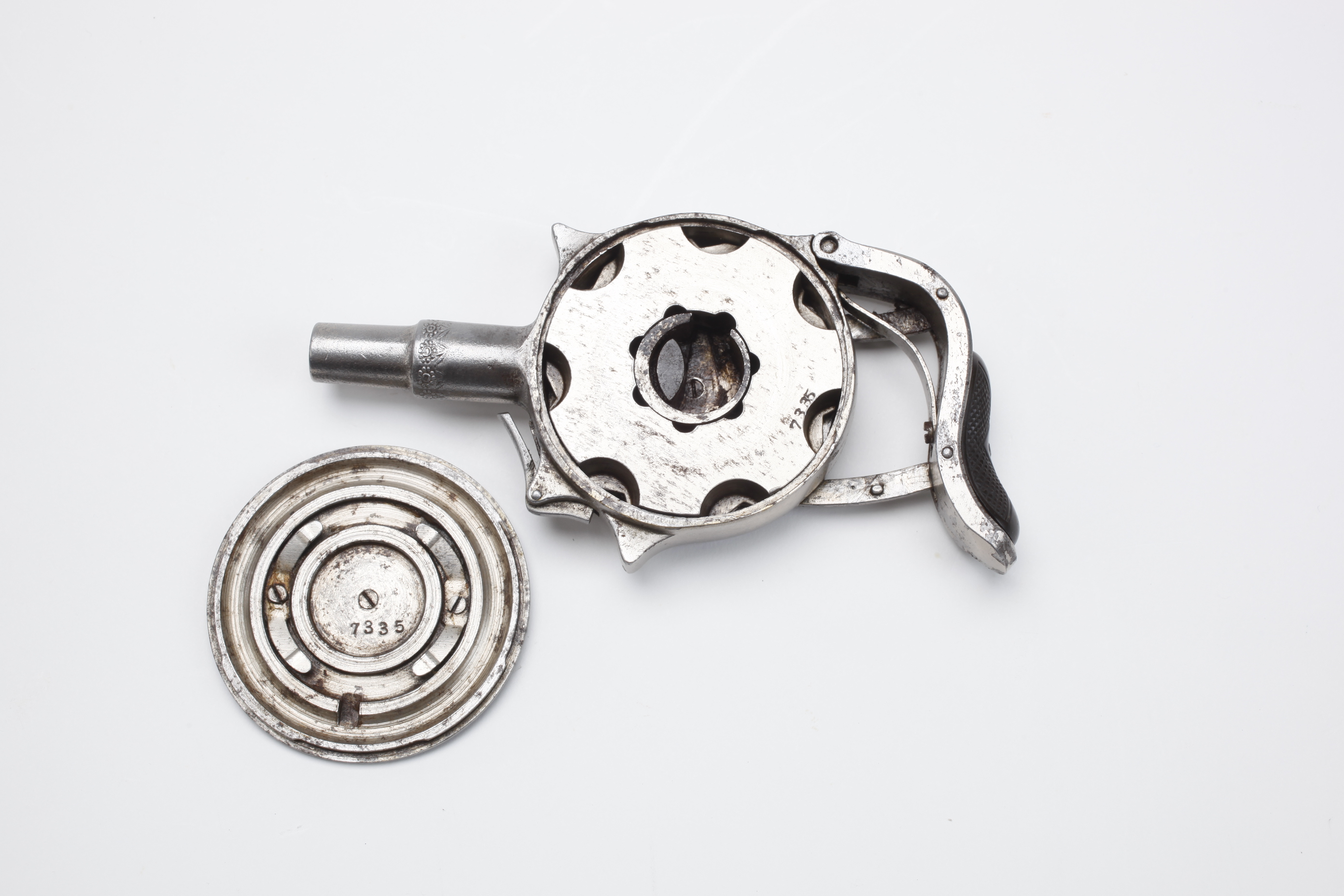
This is the volume written most directly for the bench, and it is the longest because the Protector concentrates almost every hard problem in antique-arms conservation into one watch-sized package: irreplaceable one-off parts, brittle period materials, springs under permanent tension, an obsolete and unreloadable cartridge, and a value structure that punishes over-restoration severely. The governing message is simple and should be read before anything else: stabilize, do not refinish; conserve, do not restore-to-new; and never, under any circumstances, fire it. Everything below expands that message. And the standing caveat from Vol 1 applies with full force here — no factory disassembly manual for the Protector was found, so treat this as a conservation framework built from the patent mechanics (Vol 4, Vol 5) plus general period-arms best practice, to be validated against the actual specimen and, ideally, a published exploded diagram before it becomes a teardown procedure.
7.1 Disassembly Sequence and Its Traps
Work in the teardown order established in Vol 5: cover, turret, indexing/locking, hammer/sear lock, actuating levers, casing. Each stage has a specific trap.
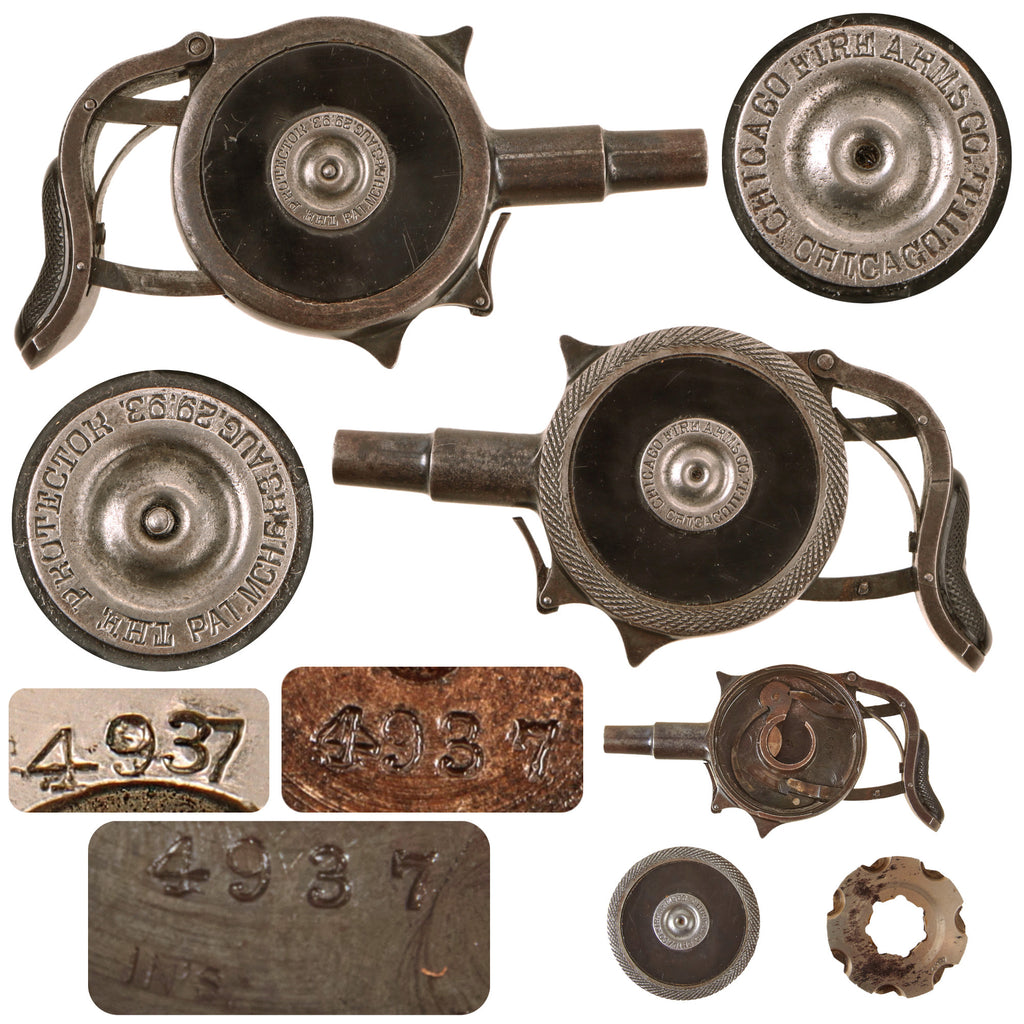
- The side cover is the entry point, and it is a trap. Expect a friction or spring detent, not a screw, on many examples, and remember the Chicago/Ames side-plates are brittle hard rubber — a period plastic-precursor, closer to old vulcanite or gutta-percha than to any modern polymer, and prone to cracking with age and UV exposure. A worn or mistimed catch that is forced springs or cracks the cover. Support the plate fully and release the catch, never lever against the plate itself.12
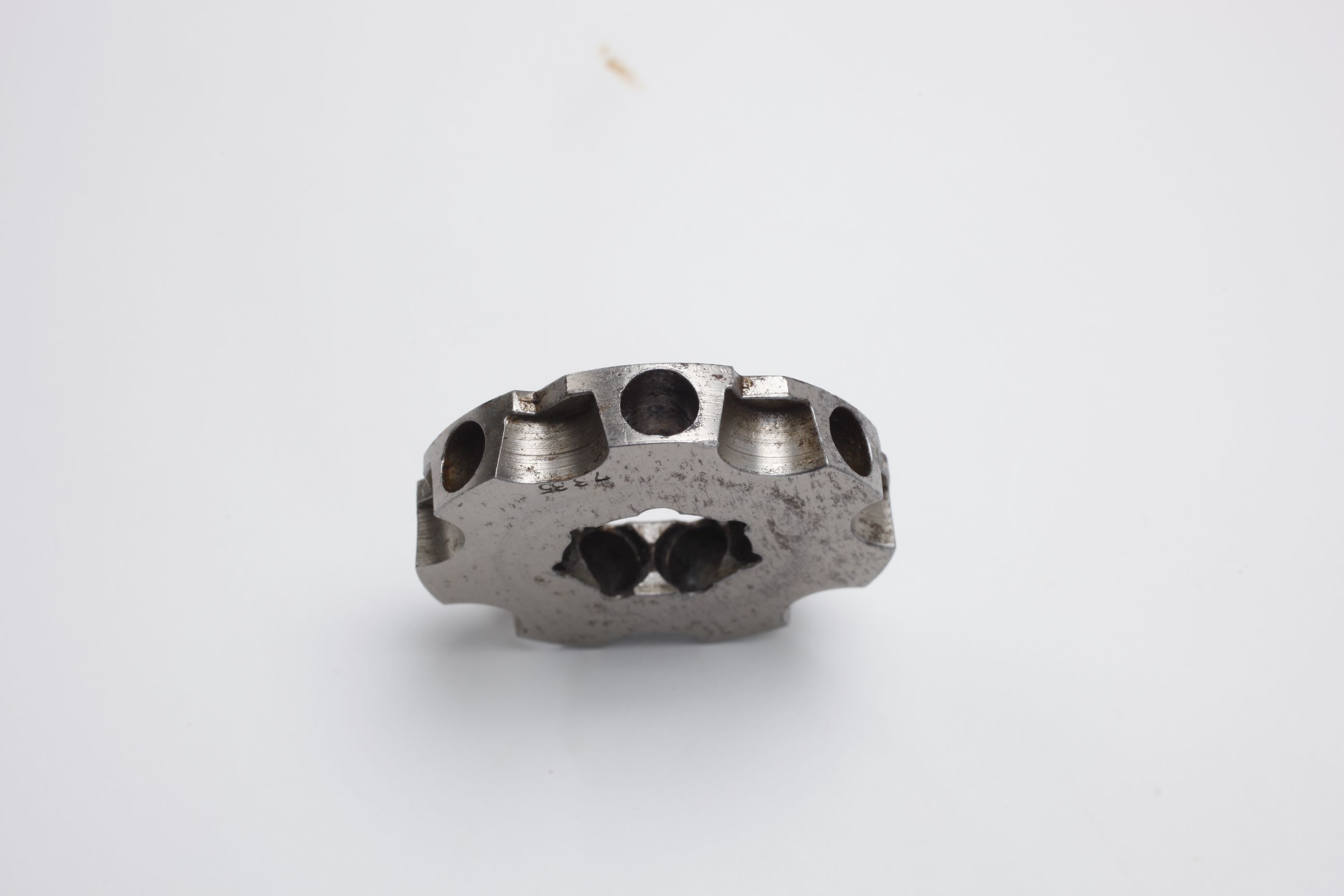
- The turret lifts out once the cover is off — handle it as the highest-value part. The radial chambers are thin-walled by design, and a century-plus of corrosion, a case swollen in place, or a prior owner’s forced ejection are the usual sources of hairline cracks and peened chamber mouths. Inspect under magnification before anything else, and do not load-and-fire test regardless of what you find.
- Assume the springs are set. The mainspring and the lever-return spring sit under continuous tension in this design’s resting state — unlike a conventional revolver, whose mainspring loads only on cocking. A Protector closed for decades almost certainly has a permanently set or fatigued mainspring. That is expected condition, not proof the gun is broken.
- Screw slots will be soft and buggered. On a 130-plus-year-old pocket-sized gun the screws are almost always previously mangled or shallow from amateur disassembly. Use properly fitted hollow-ground gunsmith bits, back screws off in small increments while supporting the frame, and accept that the thin castings are unforgiving of any leverage mistake.
- Do not remove the barrel unless there is a specific documented reason. On this design the barrel is a structural, pinned or threaded component integral to the front of the casing, not a pull-pin assembly — removing it invites more damage than it cures.
7.2 Common Damage Patterns
The failure modes cluster predictably, and knowing them speeds a condition assessment:
Table 1 — The failure modes cluster predictably, and knowing them speeds a condition assessment
| Damage | Where it shows | Note |
|---|---|---|
| Rust pitting | Blued examples especially | Blue is thinner/less protective than nickel; blued Chicago guns are also the rarer, higher-value variant, so pitting hits value hardest exactly where value is highest |
| Lost/worn nickel | Finger bearings, muzzle, squeeze lever | Flaking and base-metal show-through is extremely common; treat as honest wear, not damage to correct |
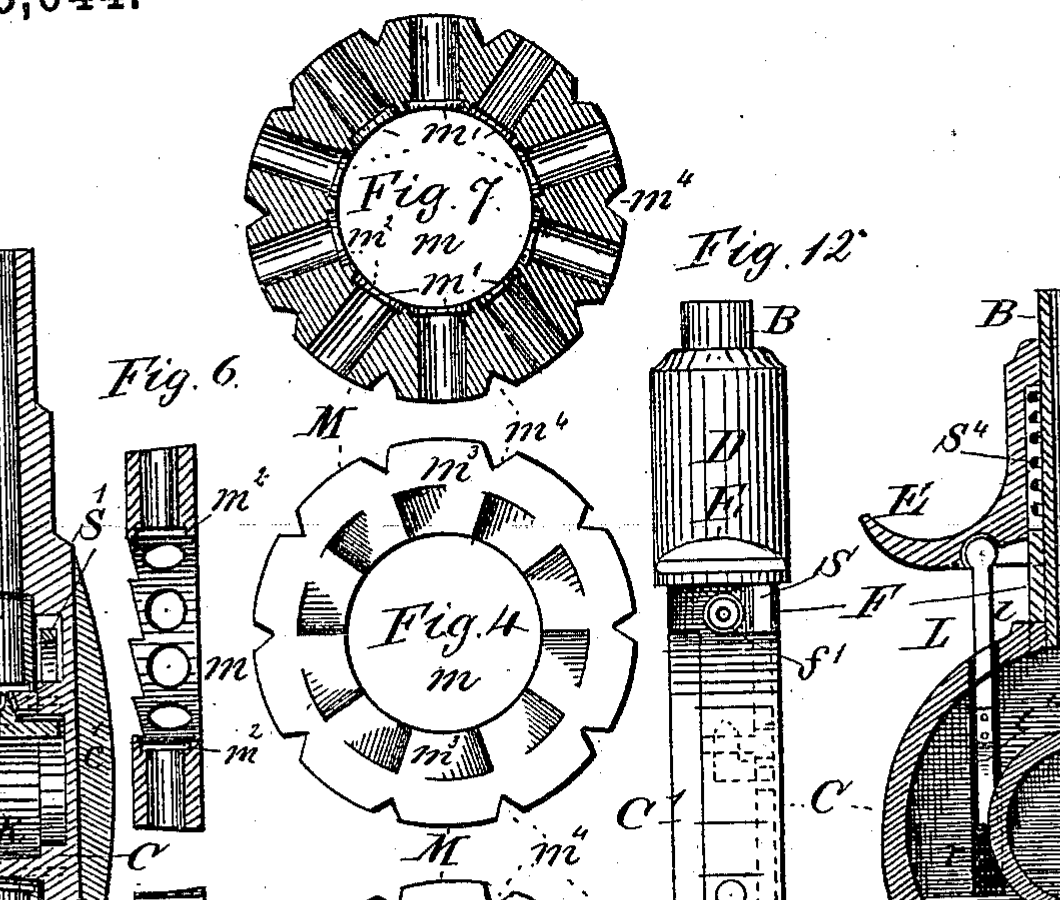
| Broken striker | Hammer/tumbler forging | One-piece hammer+tumbler means fabricating the whole forging, not swapping a pin — a real lab job, no parts stock exists |
| Weak/broken springs | Mainspring, lever return | Expected after a century; the most common functional fault |
| Cracked side plate | Hard-rubber cover | From brittle aging or forced disassembly |
| Turret cracking / mouth peening | Radial chambers | From corrosion-swollen or forcibly removed cases |
The two damage types with no parts-bin remedy — the broken one-piece striker and the cracked numbered cover — are the two to protect hardest during any handling, because their loss is either a fabrication project or a permanent hit to matching-numbers provenance.
7.3 Stabilize Versus Refinish — the Decision That Defines the Piece
For a genuinely scarce ~130-year-old antique — total original production across all makers was on the order of sixteen thousand units at most, and survivors are a fraction of that — the advanced-collector conservation posture applies with extra force:
- Stabilize, don’t restore-to-new. Arrest active rust with light oil or wax and controlled-humidity storage. Do not buff, polish, or strip original finish to freshen a worn gun. Collector value here is driven substantially by original finish percentage and matching numbers (Vol 9); refinishing a worn-but-honest specimen typically destroys far more value than it adds, because it erases the as-issued evidentiary state that collectors and museums actually pay for.
- The nickel re-plating debate. As with any nickel-finish antique, re-plating is contentious. Modern electroplating, buffing prep, and plating chemistry do not replicate 1890s nickel finishing, and a re-plated gun is usually obvious to an experienced eye — over-polished edges, wrong luster, softened rollmarks — and should be disclosed on resale. Default: do not re-plate an original-finish gun, however worn. The only defensible exception is a genuinely ruined, pitted-through specimen with no finish left to preserve, where the goal is explicitly a display/shooter piece and collector value is already gone. If a specimen retains any meaningful original finish, leave it alone.
- Function and cosmetics can be conserved somewhat independently. Cleaning, light lubrication, spring inspection, and careful reversible repairs — a sympathetically hand-fitted replacement spring, for instance — are standard and defensible. Anything that changes the external appearance or removes original material is not.
7.4 Fabricating Replacement Parts in the Lab
Where a reversible mechanical repair is warranted, a well-equipped gunsmithing shop is more than equal to the parts most likely to need it:
- Springs are the common case and the most defensible fabrication. The mainspring and lever-return spring can be hand-made from appropriate spring stock — flat leaf or coil per the original — heat-treated and hand-fitted to the original geometry. Keep the original if it can be re-tempered; make new only if it is broken or hopelessly set. Document the substitution.
- Screws are routinely replaced because the originals are so often buggered; single-point-cut or CNC-turned replacements with correctly proportioned, hollow-ground-fitting slots are straightforward, but keep the originals with the gun.
- The hammer/tumbler forging is the hard one: a broken one-piece striker means re-creating the entire hammer-and-tumbler part. CNC milling from an appropriate tool steel, wire EDM for the fine internal profiles, and hand-fitting to the lock timing (Vol 5) are all in-lab operations — but this is a genuine fabrication project, not a repair, and it should be undertaken only when the gun is otherwise a functional-demonstration piece rather than a preserved collector specimen. Any fabricated hammer changes the gun’s originality and must be disclosed.
The principle over all of it: reversible and documented before irreversible; conserve the original part before making a new one.
7.5 Ammunition — and Why You Do Not Fire It
The ammunition reality closes off live fire on its own, before the fragility argument even begins.
-
.32 Extra Short rimfire is long obsolete. Remington made it (marketed interchangeably as “.32 Extra Short” or “.32 Protector”) until about 1920; general US production of this bore trailed off after WWII, and .32 Extra Short specifically has been made only in sporadic collector/boutique small batches since. It is not commercially manufactured today in any regular sense.3
-
Rimfire cases cannot be conventionally reloaded. The priming compound is swaged into the folded rim and is consumed and deformed on firing; there is no primer pocket to reprime as with centerfire brass. This is basic rimfire construction, but worth stating plainly so the centerfire reloading toolkit never comes out for this gun.3
-
Make dummy/display rounds, not live ones. Collectors fabricate dummy .32 Extra Short rounds for a display-loaded turret: turned brass blanks or repurposed period cases, deactivated (drilled rim, no primer, no powder), sized to the correct rim diameter and case length so they seat correctly in the radial chambers. Genuine period .32 Extra Short cases do appear in the collector cartridge market and are the best basis for a display dummy, since chamber and rim geometry on a gun this small and old is unforgiving of “close enough.”3
-
French 6mm/8mm centerfire versions are chambered in cartridges that likewise no longer exist as standardized commercial rounds — same “obsolete, no supply, do not fire” posture, arguably stronger since even less is documented about exact French case dimensions.
-
Do not fire an original Protector, full stop. Beyond the ammunition problem, this is a 130-plus-year-old mechanism never designed for smokeless pressures, with a thin-walled turret that was never a high-strength design even when new, and a one-piece hammer/striker that cannot be replaced from stock if it breaks. The correct posture — consistent with the general antique conservation ethic and doubly true for a design this delicate and this scarce — is display and mechanical-function demonstration only, never live fire. This is a mechanism-demonstration piece, not a shooter, and the hub-wide ethic in the hub’s legal-posture notes treats it that way.
7.6 Bibliography
Footnotes
-
littlegun.info, “TURBIAUX Jacques Edmond (Protector)” — https://littlegun.info/arme%20francaise/artisans%20s%20z/a%20turbiaux%20jacques%20gb.htm (side-cover loading; internal marking/matching-numbers detail). ↩
-
IMA-USA, blued-finish Chicago Firearms Co. Protector, matching serial 4937 — https://www.ima-usa.com/products/original-u-s-antique-rare-blued-finish-the-protector-palm-pistol-by-chicago-firearms-co-with-matching-serial-4937-only-1-000-made-with-blued-finish (hard-rubber side-plates; blued-finish scarcity and value). ↩
-
Search-engine synthesis of .32 Extra Short rimfire history and availability, drawing on CollectibleAmmunition.com listings, Wikipedia’s “.32 rimfire” article, and the International Ammunition Association forum; general rimfire-reloading impossibility is standard cartridge construction, not Protector-specific. ↩ ↩2 ↩3
Comments (0)