Protector Palm Pistol · Volume 10
Cheatsheet
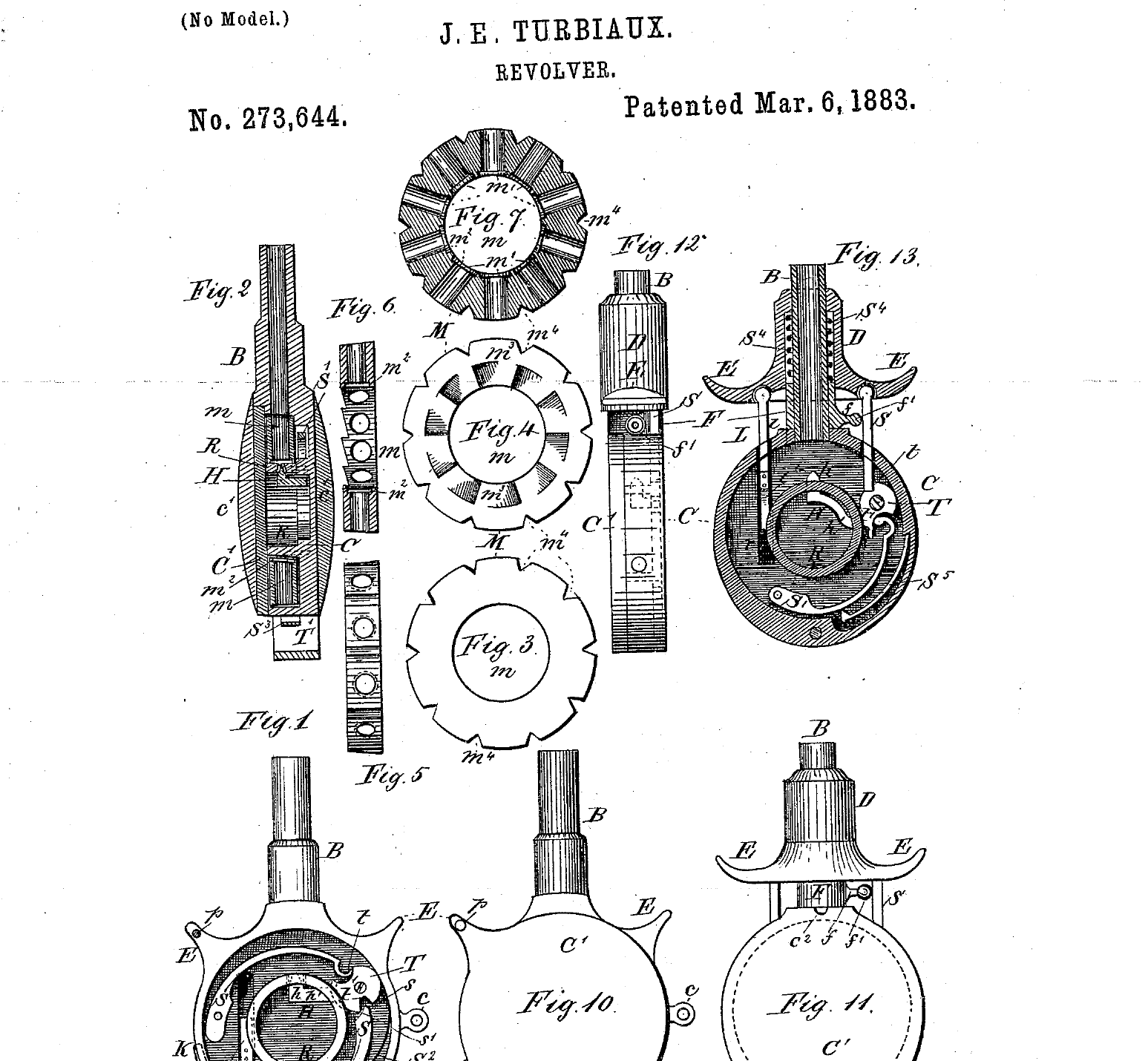
This volume is the laminate-ready synthesis: the spec table, the lineage timeline, the disassembly order, the legal decision tree, the value table, and the source URLs, all in one place. It restates conclusions the earlier volumes argued; where a figure is uncertain or a claim rests on a conflicted source, the caveat is carried forward in short form, with a pointer to the volume that argues it in full. Nothing here is legal advice — see Vol 8 and the hub’s legal-posture notes.
10.1 Spec Table
Table 1 — Spec Table
| Attribute | Value |
|---|---|
| Type | Radial-turret palm pistol, double-action-only, squeeze-fired |
| Patent (US) | US 273,644, Turbiaux, filed 1882-06-29, granted 1883-03-06 |
| Patent (French) | No. 149,466, 9 Jun 1882 (British filing was No. 2,731, 10 Jun 1882) — per the US 273,644 specification header; see Vol 2 |
| US caliber / ignition | .32 Extra Short rimfire (“.32 Protector”) |
| US capacity | 7 radial chambers |
| French calibers | 8mm centerfire (7-shot, large ~130 mm) · 6mm centerfire (10-shot, small ~110 mm) |
| Barrel | Single fixed rifled bore, ~1¾ in. on US guns (approx) |
| Action | Squeeze lever → indexing pawl → conical locking pin → one-piece hammer/tumbler + mainspring → sear |
| Loading | Removable turret via quarter-turn/hinged side plate; cartridges rim-first |
| Finish | US: nickel standard, blued scarce (Chicago). French: nickel or blue, ebony/ivory inserts |
| Total production | French: unknown/scarce · Minneapolis: ~3,000 · Chicago/Ames: ~12,800–13,000 |
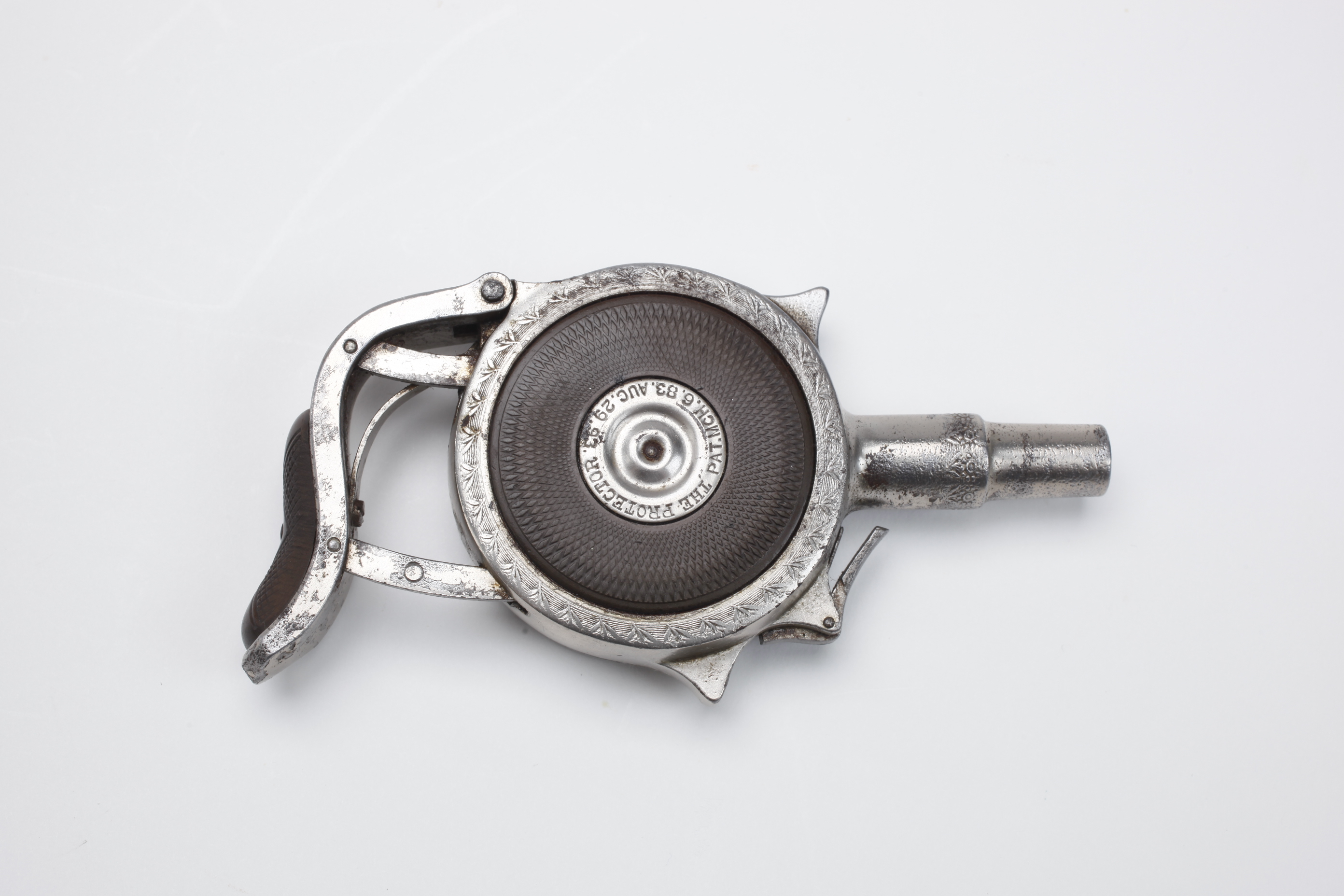
10.2 Lineage Timeline
Table 2 — Lineage Timeline
| Date | Event |
|---|---|
| 1882 | Turbiaux files French + US patents (US 273,644 filed 29 Jun 1882) |
| 1883 | US patent granted (6 Mar) — this is the patent year, not US production start |
| c. 1891–1892 | Minneapolis Firearms Co. — first US guns, ~3,000, contract-built by James Duckworth of Springfield MA (contractor detail unverified) |
| 1892 | Peter H. Finnegan buys patent rights → founds Chicago Fire Arms Co. |
| 1893 | Finnegan contracts Ames Sword Co. (Chicopee MA) for 15,000 for the World’s Columbian Exposition; Ames delivers ~1,500 by deadline |
| 1893+ | Litigation (Finnegan sues, Ames countersues, settles) → Ames controls production |
| 1892–c.1898 | Bulk of Chicago/Ames manufacture (serial 3,700–5,400 = 1893–1897) |
| ~1910 | Inventory sold off, design abandoned |
Conflict flag: the Cody Firearms Museum states production ran “early 1900s through 1910,” which disagrees with the 1892–c.1898 manufacture reading and, if literally true, would change the antique analysis — see Vol 3 and Vol 8. The “into WWI production” claim is likely erroneous and is not carried.
10.3 Disassembly Order (see Vol 5 and Vol 7)
- Side cover / plate — spring/friction detent, not a screw; brittle hard rubber, cracks if forced; carries serial.
- Turret / magazine — lifts out; thin walls; highest-value part; inspect under magnification; never load-and-fire.
- Indexing & locking — spring-lever pawl + conical locking pin; timed as a system.
- Hammer & sear lock — one-piece hammer/tumbler forging (broken striker = fabricate the whole part), mainspring, sear.
- Actuating levers & return — squeeze lever, hammer lever, return spring; springs sit under continuous tension, expect them set.
- Casing — structural; leave the integral barrel in place unless documented reason.
Use hollow-ground bits; expect buggered screws; conserve originals; reversible-and-documented before irreversible.
10.4 Legal Decision Tree (US federal — see Vol 8; not legal advice)
Is the specimen genuine and manufactured on/before 1898?
├── YES (Minneapolis, and most Chicago/Ames)
│     → GCA antique firearm, § 921(a)(16)(A): no FFL.
│     → NFA: excluded as antique firearm, § 5845(a)/(g) — the antique
│        carve-out comes BEFORE the AOW classification, so NOT an NFA firearm,
│        despite Rev. Rul. 55-44 calling the mechanism an AOW.
│     → Confidence: HIGH.  (Synthesis of two primary sources — no single
│        ruling states both halves together.)
│
└── NO / UNSURE (late-serial Chicago/Ames outlier, post-1898?)
      → Manufacture-date antique prong fails; Rev. Rul. 55-44 AOW
         classification could bite → NFA registration in play.
      → Likely rescued by the obsolete-ammunition antique prong (.32 Extra
         Short no longer commercially made) — but UNTESTED for this gun.
      → Get an ATF classification request or NFA counsel before transfer/mod.

ALWAYS: confirm STATE law (CA/NY/NJ/MA/HI etc. may not mirror the federal
antique carve-out) before possession/carry/transport. Never fire it.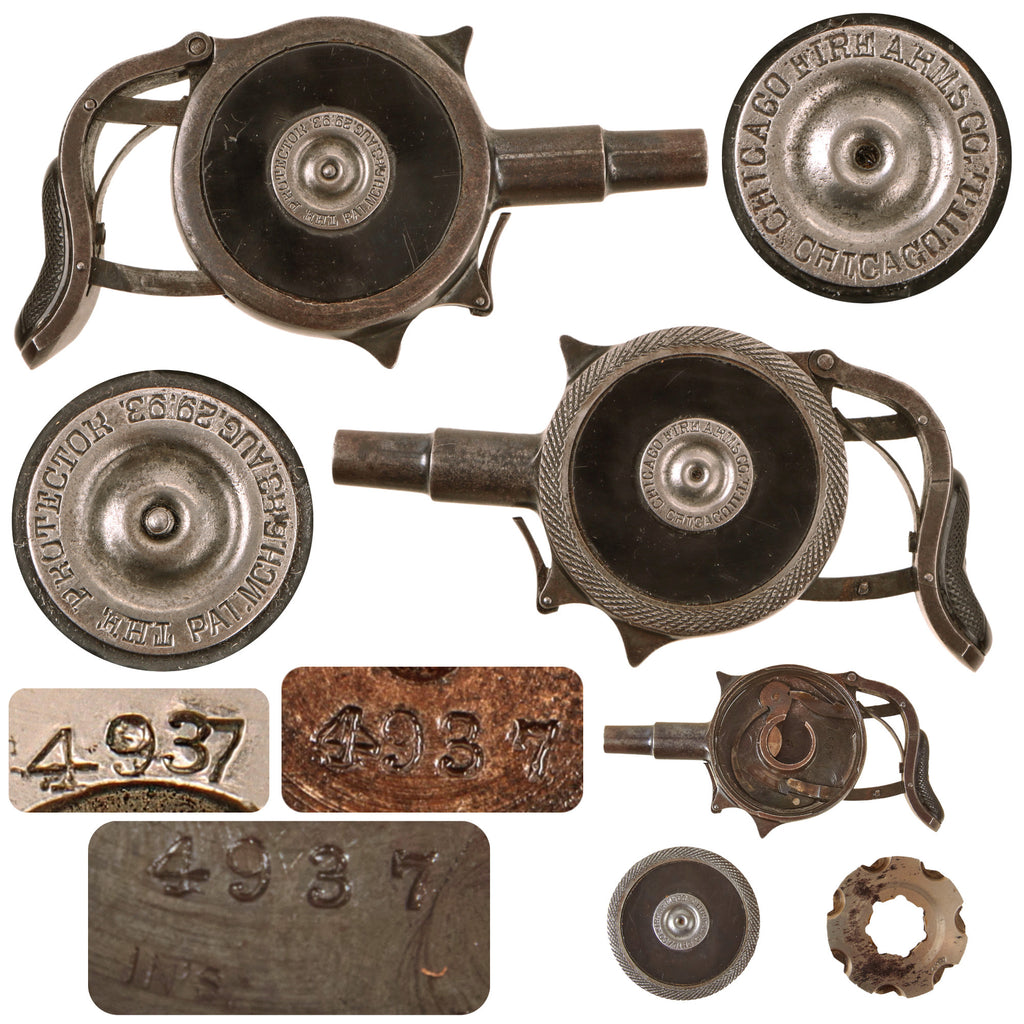
10.5 Value Table (indicative — see Vol 9)
Table 3 — Value Table (indicative — see [Vol 9](/actual-firearms/pistols/protector-palm-pistol/vol-9/))
| Specimen | Result / asking |
|---|---|
| French Turbiaux 6mm 10-shot (LSB) | ~$1,226 |
| Minneapolis, serial 2902, 95–98% nickel (Bonhams 2014) | ~$2,574 incl. premium |
| Chicago/Ames, matching serial (IMA-USA asking) | low-hundreds to ~$1,000+ |
| Chicago/Ames ”+” condition (heldef.ch asking) | CHF 1,490 (~$1,640) |
| Cased gold-and-pearl / exhibition-grade Ames (RIA) | top tier — open RIA lots to price |
Value drivers: maker (French / cased-Ames > nickel Chicago > Minneapolis) · finish (blued > nickel on Chicago) · original finish % · matching numbers · completeness (case, grips) · sub-variant rarity. Fraud risk low; refinished-sold-as-original is the more common integrity issue.
10.6 Source URLs
- US 273,644 (Turbiaux) — https://patents.google.com/patent/US273644
- US 504,154 (Finnegan, general revolver patent — not the Protector patent) — https://patents.google.com/patent/US504154
- 18 U.S.C. § 921 — https://www.law.cornell.edu/uscode/text/18/921
- 26 U.S.C. § 5845 — https://www.law.cornell.edu/uscode/text/26/5845
- Rev. Rul. 55-44 (index/excerpt; full text unverified) — https://www.taxnotes.com/research/federal/irs-guidance/revenue-rulings/rev-rul-55-44/d13t
- Wikipedia, “Protector Palm Pistol” — https://en.wikipedia.org/wiki/Protector_Palm_Pistol
- littlegun.info (Turbiaux) — https://littlegun.info/arme%20francaise/artisans%20s%20z/a%20turbiaux%20jacques%20gb.htm
- NRA National Firearms Museum — https://www.nramuseum.org/guns/the-galleries/the-american-west-1850-to-1900/case-21-tin-stars-sixguns-frontier-justice/chicago-firearms-co-protector-palm-pistol.aspx
- Cody Firearms Museum (date-conflict source) — https://centerofthewest.org/2020/03/19/museum-minute-the-palm-protector-pistol/
- IMA-USA blued serial 4937 — https://www.ima-usa.com/products/original-u-s-antique-rare-blued-finish-the-protector-palm-pistol-by-chicago-firearms-co-with-matching-serial-4937-only-1-000-made-with-blued-finish
10.7 Standing Cautions
- French patent number: the US 273,644 header recites France No. 149,466 and Britain No. 2,731 — so littlegun.info’s “2,731 = French” is wrong; a period French gazette is the ideal final confirmation (Vol 2).
- 1883 vs 1891–92: 1883 is the patent year; US production began ~1891 (Vol 3).
- Manufacture end date: 1892–c.1898 primary; Cody’s “1900s–1910” flagged, legally consequential (Vol 3, Vol 8).
- Rev. Rul. 55-44: real and on-point, but full text unverified; AOW-vs-antique interaction is a synthesis, not one quoted holding (Vol 8).
- No factory teardown manual exists — mechanism/disassembly is patent-derived, verify against the specimen (Vol 4, Vol 7).
- Never fire it. Obsolete, unreloadable ammunition; thin turret; irreplaceable one-piece striker (Vol 7).
10.8 Bibliography
All sources for this volume are consolidated in the Source URLs section above and argued in full in Vol 1 through Vol 9. Primary sources: US 273,644; US 504,154; 18 U.S.C. § 921; 26 U.S.C. § 5845 (all fetched directly). Secondary/flagged: Rev. Rul. 55-44 (excerpt only), Wikipedia, littlegun.info, NRA Museum, Cody Museum, IMA-USA, Bonhams, LSB, heldef.ch.
Comments (0)