Protector Palm Pistol · Volume 4
How It Works
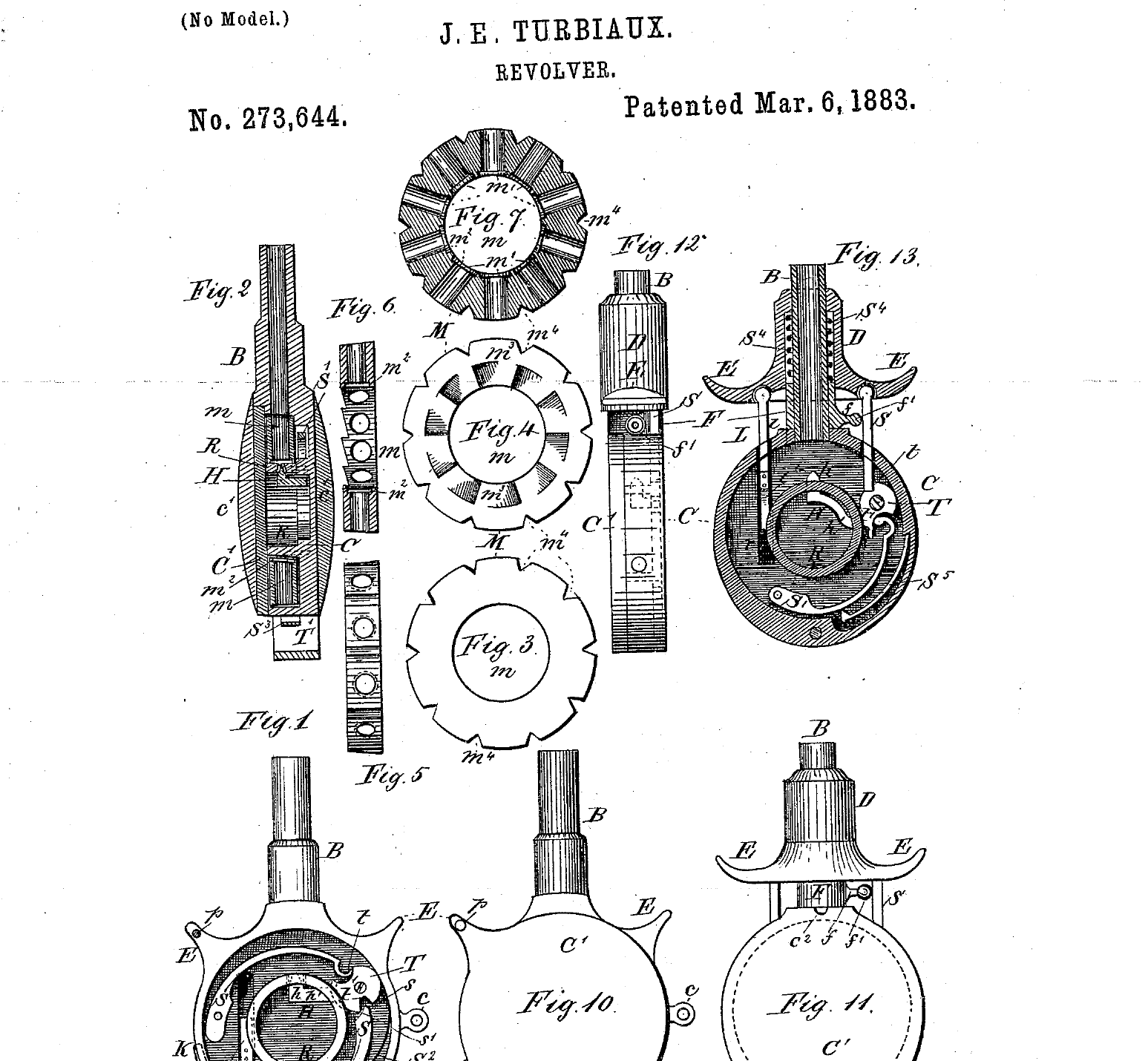
This is the volume the whole series orbits: what actually happens inside the disc when you close your fist. The Protector folds a complete double-action lock and a rotating magazine into a pocket-watch-sized casing, and it does it with an architecture found in almost no other production firearm — a flat radial turret behind a single fixed rifled barrel, indexed and fired by squeezing rather than by a trigger pull. Everything below is grounded in the US 273,644 patent text (Vol 2), cross-checked against dealer and museum descriptions of surviving guns. Where the patent is the only source, the text says so, because — as Vol 1 warned — no factory teardown manual for this gun was found, and the fine detail of a real disassembly should be confirmed against an actual specimen before it is treated as gospel.
4.1 Overall Architecture
The Protector is a flat, roughly disc-shaped metal casing (C), built to be gripped inside a closed fist, with a short barrel (B) protruding forward between two fingers so that only the muzzle shows outside the hand.1 Two finger bearings (E) project from opposite sides of the casing as grip lugs; the palm supports the body from beneath. There is no conventional grip, trigger, or trigger guard on the earliest French pattern — the fist is the grip and the squeeze is the trigger. Later American Chicago/Ames guns added a trigger-guard-like bow around the actuating lever, which doubles as a knuckle-duster once the ammunition is spent.2 Inside that flat casing sit four functional systems: the radial magazine, the indexing-and-locking mechanism, the hammer-and-sear lock, and the return system that resets everything when you relax your grip.
4.2 The Radial Magazine (Turret)
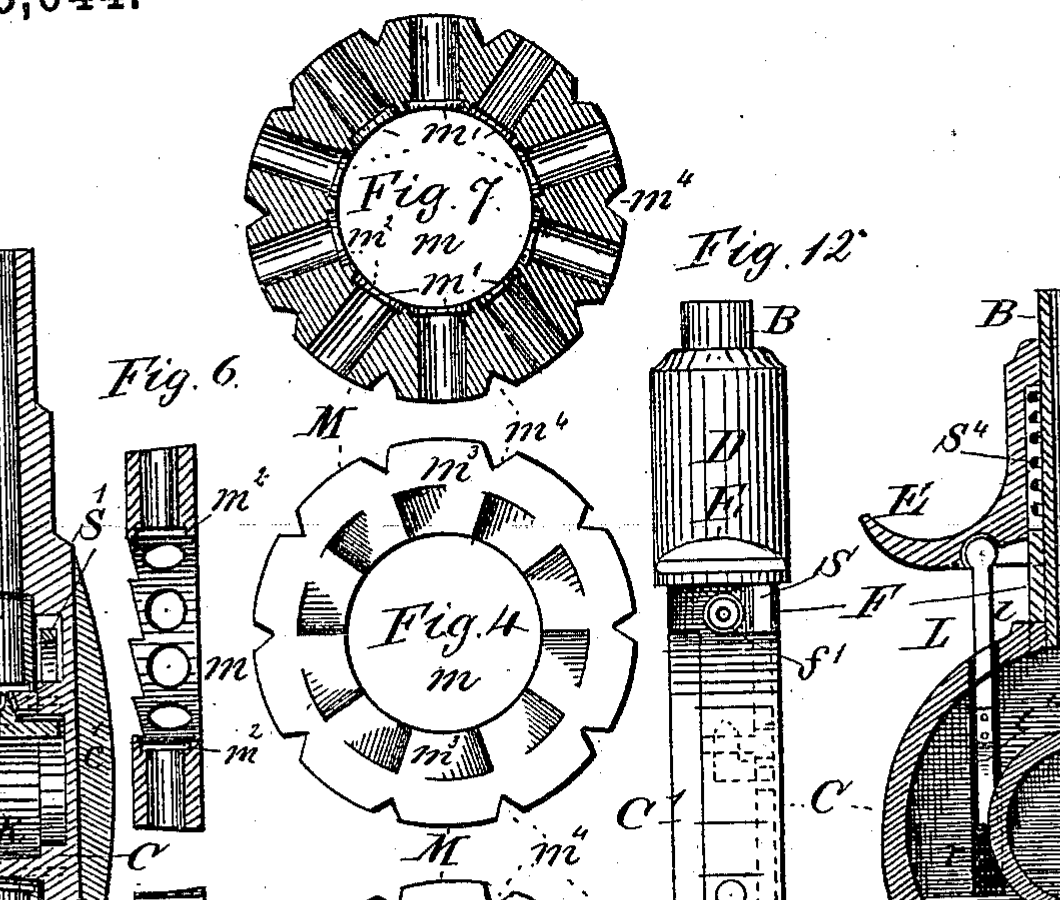
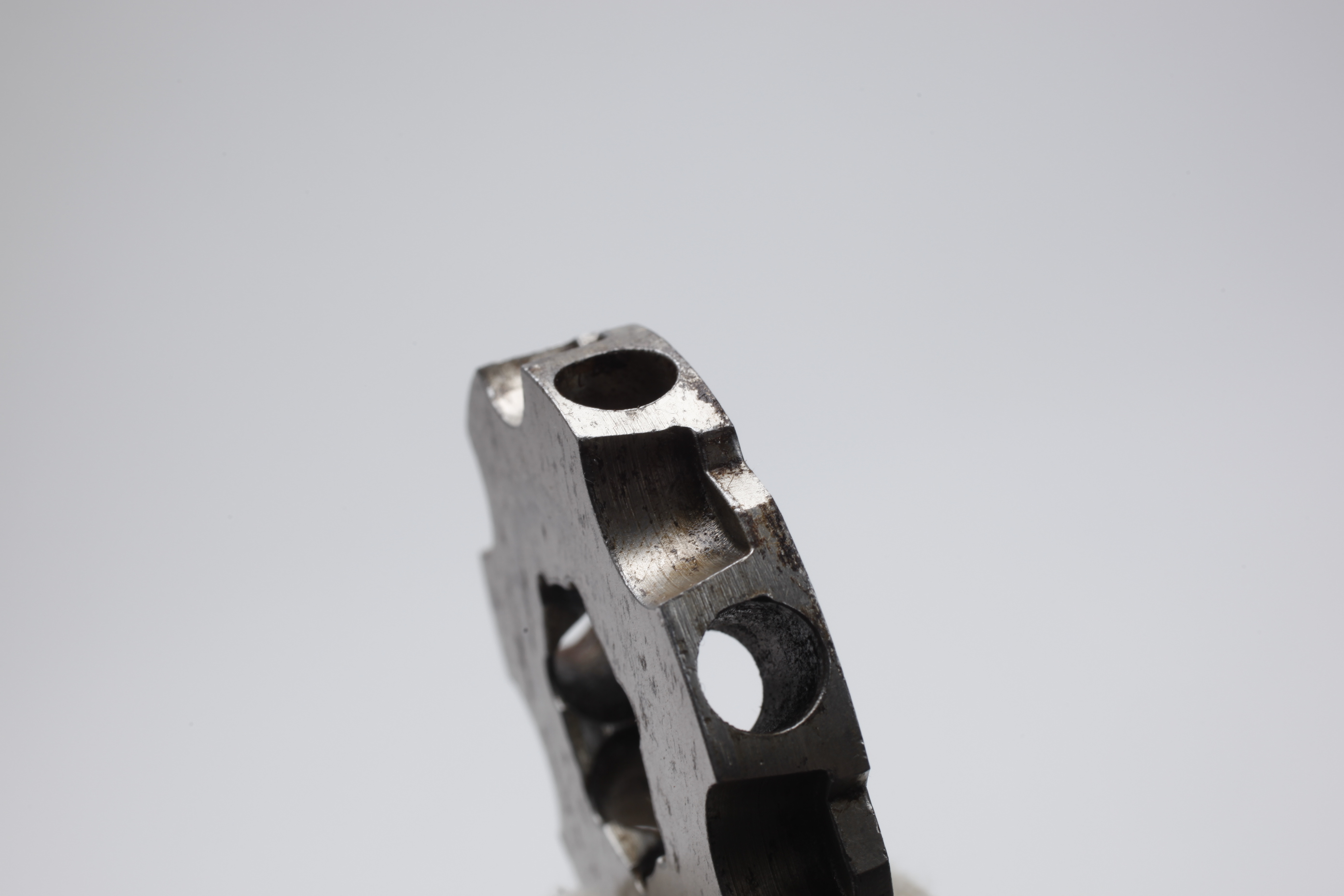
At the center of the gun is the cartridge-magazine (M) — not a cylindrical revolver cylinder but a flat rotating disc, or turret, fitted over a central annular breech-block (R). The patent specifies “a series of radial chambers, m′, for the reception of a corresponding series of cartridges,” arranged like spokes around the central axis, each chamber’s rear end enlarged to seat the cartridge’s rim or flange.1 Museum staff describe it, unfailingly, as looking “like the spokes of a wagon wheel” lying flat in the hand.3
The capacity and caliber depend entirely on the maker, and this is one of the sharpest identification cues in the whole design:
Table 1 — The capacity and caliber depend entirely on the maker, and this is one of the sharpest identification cues in the whole design
| Production | Caliber | Ignition | Chambers |
|---|---|---|---|
| US — Minneapolis and Chicago/Ames | .32 Extra Short (marketed as “.32 Protector”) | Rimfire | 7 |
| French — Turbiaux large model | 8mm | Centerfire | 7 |
| French — Turbiaux small model | 6mm | Centerfire | 10 |
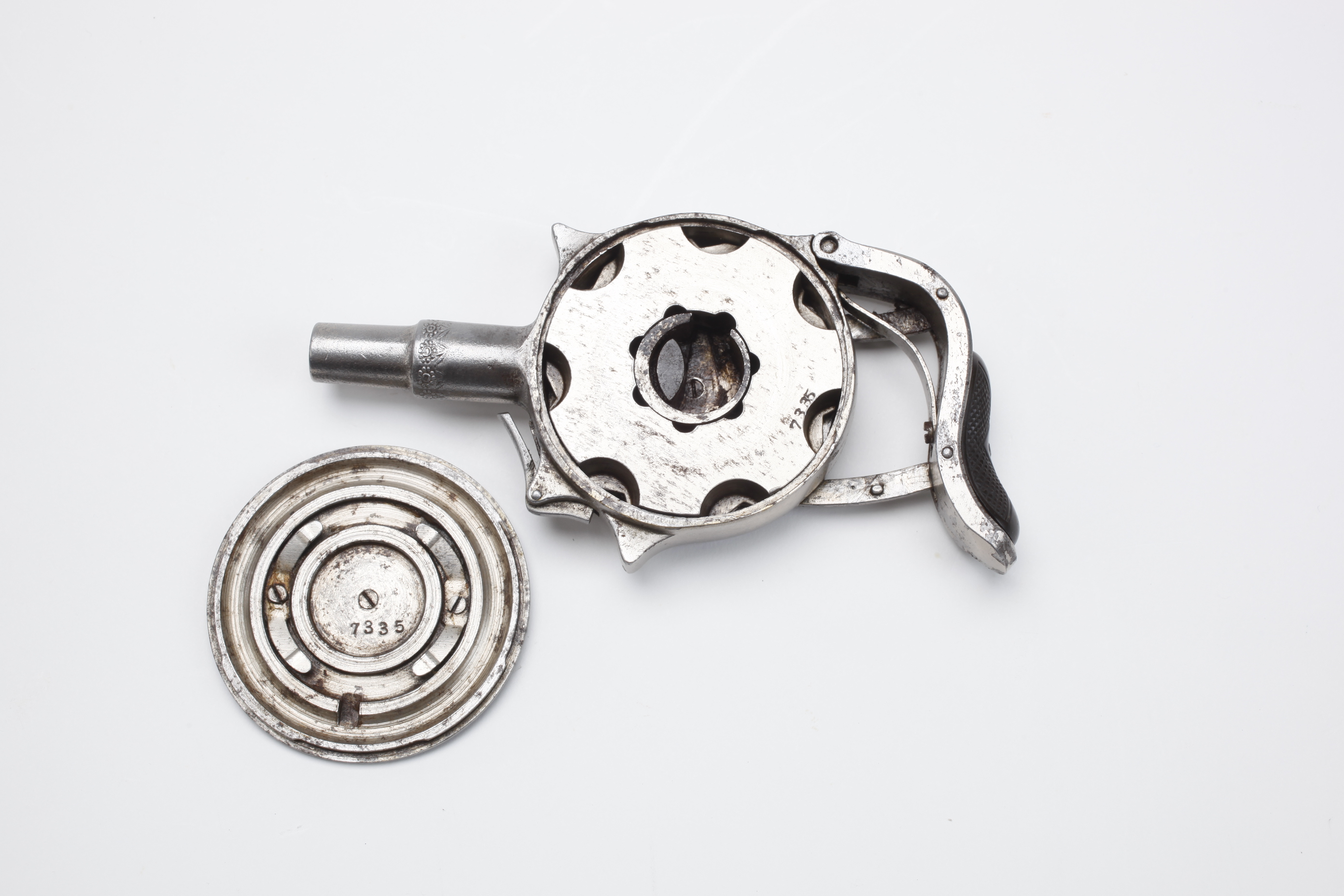
So a rimfire, .32-caliber, seven-chamber gun is almost certainly American; a 6mm centerfire ten-shot is French Turbiaux.456 Because 8mm French guns are also seven-shot, caliber and chamber count together — not caliber alone — are the safe cue. Vol 6 develops this into a full identification key. For the mechanism, the important structural fact is that the turret is thin-walled by necessity: fitting a whole ring of chambers into a watch-sized disc leaves very little metal around each bore, which is central to why Vol 7 forbids live fire.
4.3 The Firing Sequence: Squeeze, Index, Cock, Release
The patent’s key innovation is operation “by alternately moving the fingers toward and from the palm of the hand.”1 One squeeze does four jobs in sequence, and understanding that sequence is understanding the gun:
- Squeeze. The shooter closes the fist around the casing, depressing a spring-lever (L) mounted at the rear/palm side — the functional equivalent of a trigger, but worked by the whole hand.
- Index the turret. As the lever moves, a spring-lever pawl engages teeth (m³) cut into the face of the magazine disc and rotates the turret one increment, bringing the next loaded chamber into line with the barrel.1
- Lock. A conical locking pin (P) drops into a V-shaped notch on the magazine’s periphery, positively locking the turret in the firing position so it cannot rotate out of alignment under the shock of discharge.1 This is the element the patent claims most emphatically, and for good reason — an unlocked radial turret firing slightly out of index would be a catastrophe.
- Cock the striker. The same squeeze, through a second lever, cocks the hammer (H), which the patent describes as forged “of one piece of metal” with the tumbler (T), carrying a firing cone or pin set at right angles to the hammer arm to reach the cartridge’s primer through the breech-block. A mainspring (S′) stores the energy that will drive the hammer forward.1
- Sear release — fire. A sear (S), described in the patent as “a lever pivoted to a trigger, T′,” controls hammer release. At full squeeze the sear disengages, the mainspring drives the hammer/tumbler forward, and the chambered round fires.1
- Return. Releasing grip pressure lets a return spring reset the levers to the ready position — which on the next squeeze both re-cocks the hammer and advances the turret one more chamber.
Functionally this is a double-action-only (DAO) lock: there is no separate cocking step, no single-action notch, just squeeze-to-fire. The novelty is entirely in the input (a palm-squeeze lever instead of a trigger) and the magazine geometry (a radial spoke turret instead of an axial drum). Dealers reasonably call it a “turret revolver” or “radial cylinder” mechanism, and the US patent office simply called the whole thing a “Revolver” (Vol 2) — a word choice with legal consequences in Vol 8, where a 1955 ruling held the Protector is not a revolver in the statutory sense precisely because of this radial-magazine-behind-a-single-fixed-barrel architecture.
4.4 Barrel, Breech-Block, and the Single Fixed Bore
Unlike a pepperbox — where multiple barrels rotate — the Protector has one fixed, rifled barrel, and the magazine rotates behind it. Blue Book copy describes a roughly 1¾-inch rifled barrel on the US guns.7 The rifling is not incidental: it is the feature that, on its face, would make the gun look like an ordinary excluded pistol under the National Firearms Act, and it is exactly the feature the 1955 tax ruling declined to let the gun hide behind (Vol 8). Behind the barrel sits the annular breech-block (R), the fixed ring the turret rotates against; the hammer’s firing cone reaches the cartridge through this block when a chamber is locked in the firing position. The single-fixed-barrel design is why the gun can be rifled and still concealable — there is only one bore to hide, buried in a fist.
4.5 Loading and Unloading — the Side Plate
The magazine disc is removable, and that is how the gun is loaded. Dealer and collector descriptions consistently reference a quarter-turn or hinged side cover/plate on the casing which, once released, lets the turret be lifted out.52 Cartridges are inserted rim-first into each radial chamber from the disc’s edge; the charged disc is dropped back into the casing and the cover closed and (typically) quarter-turn-locked. Serial numbers and maker’s marks are commonly stamped on the internal, normally hidden parts — frame, turret, and cover — which is the standard matching-numbers authentication point for the design.58 A restorer should expect the side-plate catch to be a friction or spring detent, not a screw, on many examples, and — critically — the hard-rubber side-plates of Chicago/Ames guns are brittle with age; forcing a worn or mistimed catch is the fastest way to crack an irreplaceable part (Vol 7).
4.6 The Safety Question — Unresolved Per Variant
Some European examples are described as having a sliding safety bar that must be pushed forward before the squeeze lever can move — the forefinger clearing a small lever before the closing fist can actuate the mechanism.24 American Chicago/Ames guns are generally described without this safety, or with a simpler pin-based arrangement. But the research behind this series could not confirm the exact safety mechanism per variant from a disassembled specimen, so “US guns lack a safety” should be treated as unverified pending inspection of the actual gun in front of you. Do not write a definitive safety description into provenance notes without confirming it on the specimen.
4.7 Why This Matters Before You Touch One
Two mechanical realities from this volume govern everything downstream. First, the turret is thin-walled and the hammer/tumbler is a single forging with no parts supply — a broken striker is a fabrication job, not a swap (Vol 5, Vol 7). Second, the loading path runs through a brittle side plate and a spring-detent catch, so the single most common self-inflicted damage is a cracked cover or a sprung catch from forcing the entry point. Understand the sequence — squeeze, index, lock, cock, release, return — before you attempt any disassembly, because every trap in Vol 7 is a place where that sequence can be run backward against parts that were never meant to be forced.
4.8 Bibliography
Footnotes
-
US Patent 273,644, “Revolver,” Jacques Edmond Turbiaux — https://patents.google.com/patent/US273644 (primary source; part letters C, B, E, M, R, m′, m³, P, H, T, S′, S, T′, L quoted or paraphrased from the patent text and drawings). ↩ ↩2 ↩3 ↩4 ↩5 ↩6 ↩7
-
Search-engine synthesis of mechanism descriptions (safety-lever operation, side-cover loading, knuckle-duster guard) drawn from multiple dealer/auction listings; cross-checked against the US 273,644 patent text where they overlap. ↩ ↩2 ↩3
-
Cody Firearms Museum / Buffalo Bill Center of the West, “Museum Minute: The Palm Protector Pistol” — https://centerofthewest.org/2020/03/19/museum-minute-the-palm-protector-pistol/. ↩
-
Wikipedia, “Protector Palm Pistol” — https://en.wikipedia.org/wiki/Protector_Palm_Pistol. ↩ ↩2
-
littlegun.info, “TURBIAUX Jacques Edmond (Protector)” — https://littlegun.info/arme%20francaise/artisans%20s%20z/a%20turbiaux%20jacques%20gb.htm (source of the French 6mm/8mm model specs and the removable-disc loading description). ↩ ↩2 ↩3
-
Bonhams, “A French 6MM Centre-Fire Système Turbiaux Ten-Shot ‘Le Protector’ Palm Pistol” — https://www.bonhams.com/auction/26793/lot/203/ (corroborates the French 6mm centerfire ten-shot pattern). ↩
-
Blue Book of Gun Values, Chicago Firearms Co. / Protector Palm Pistol — https://bluebookofgunvalues.com/products/chicago-firearms-co-revolvers-cartridge-protector-palm-pistol (source of the ~1¾-inch rifled-barrel figure). ↩
-
IMA-USA, blued-finish Chicago Firearms Co. Protector, matching serial 4937 — https://www.ima-usa.com/products/original-u-s-antique-rare-blued-finish-the-protector-palm-pistol-by-chicago-firearms-co-with-matching-serial-4937-only-1-000-made-with-blued-finish (matching-numbers authentication point). ↩
Comments (0)