Protector Palm Pistol · Volume 5
Sub-Assemblies & Exploded View
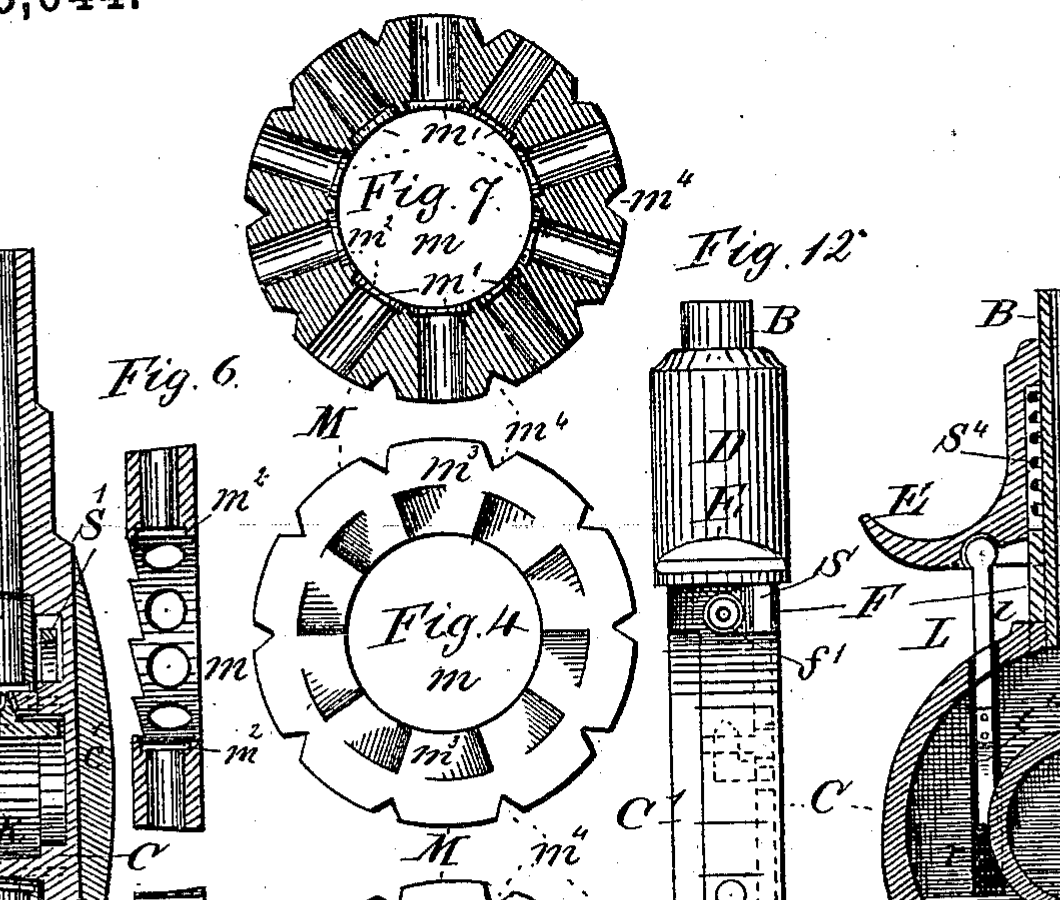
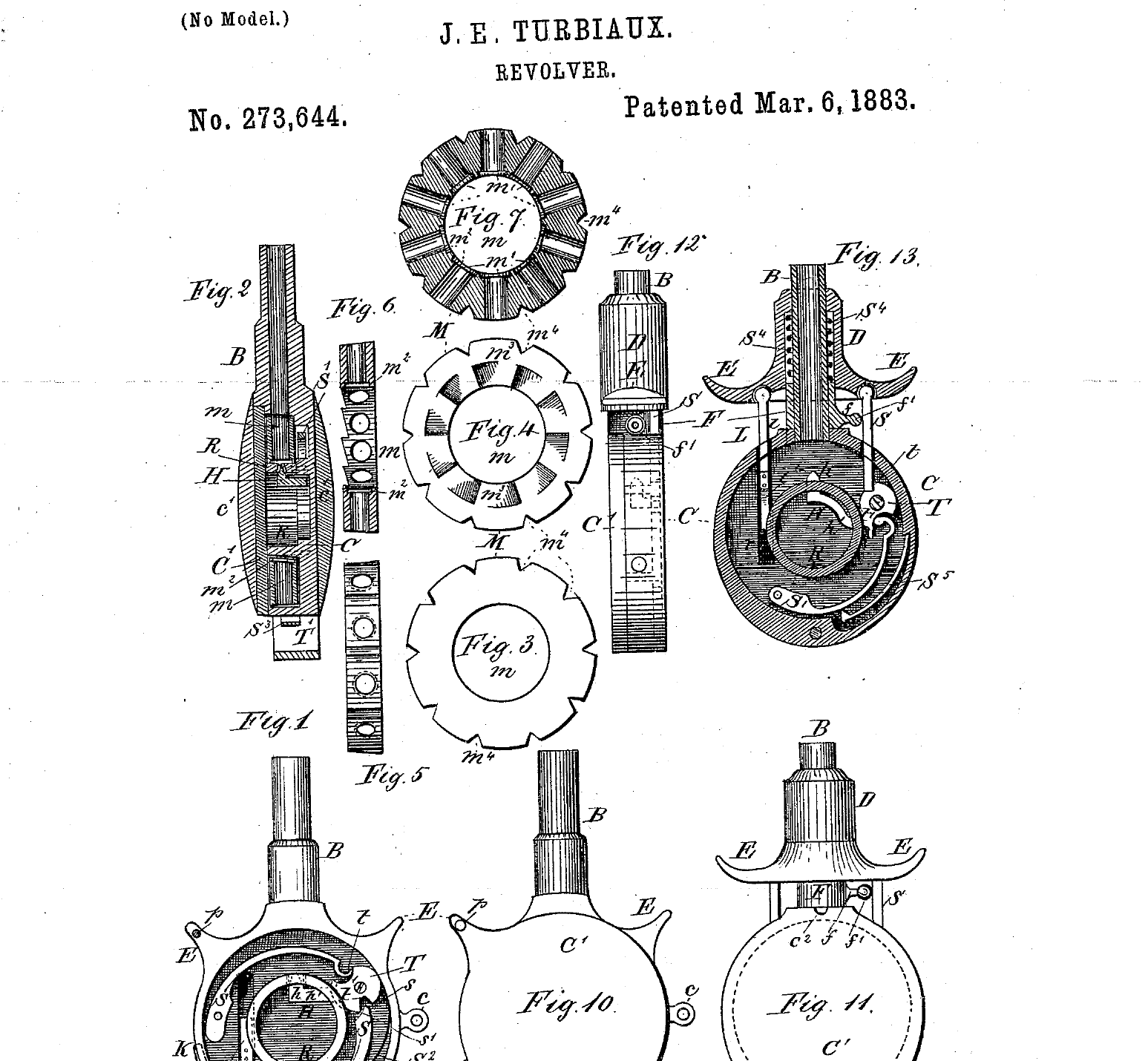
Vol 4 walked the firing sequence end to end; this volume stops the film and takes the gun apart on paper, one sub-assembly at a time, one layer of detail below the sequence. The goal is a mental exploded view — the discrete groups a restorer separates during a teardown, what each contains, how the groups interface, and where the fragile interdependencies live. A caution carries over from Vol 1 and Vol 4: no factory exploded diagram or teardown manual for the Protector was located, so the groupings below are reconstructed from the US 273,644 patent parts list cross-checked against dealer descriptions. The patent’s detail sheet (this volume’s lead figure) is the closest thing to an authoritative exploded view that exists, and it should be printed and kept at the bench.
5.1 The Casing Group
The casing (C) is the structural foundation and the part that defines the gun’s silhouette — the flat, disc-shaped body sized to a closed fist, with the two finger bearings (E) projecting from opposite edges as grip lugs.1 Everything else mounts to or inside it. On US Chicago/Ames guns the casing carries checkered hard-rubber side-plates, a period plastic-precursor material that ages brittle (Vol 7).2 The casing is also where the barrel attaches at the front; on this design the barrel is a structural, pinned or threaded component integral to the casing, not a pull-pin assembly, which is why Vol 7 says leave the barrel alone unless there is a documented reason to remove it. The casing group is the last thing you strip and the first thing you inspect: cracks here, or a sprung finger bearing, compromise the whole gun.
5.2 The Side-Plate / Cover Group
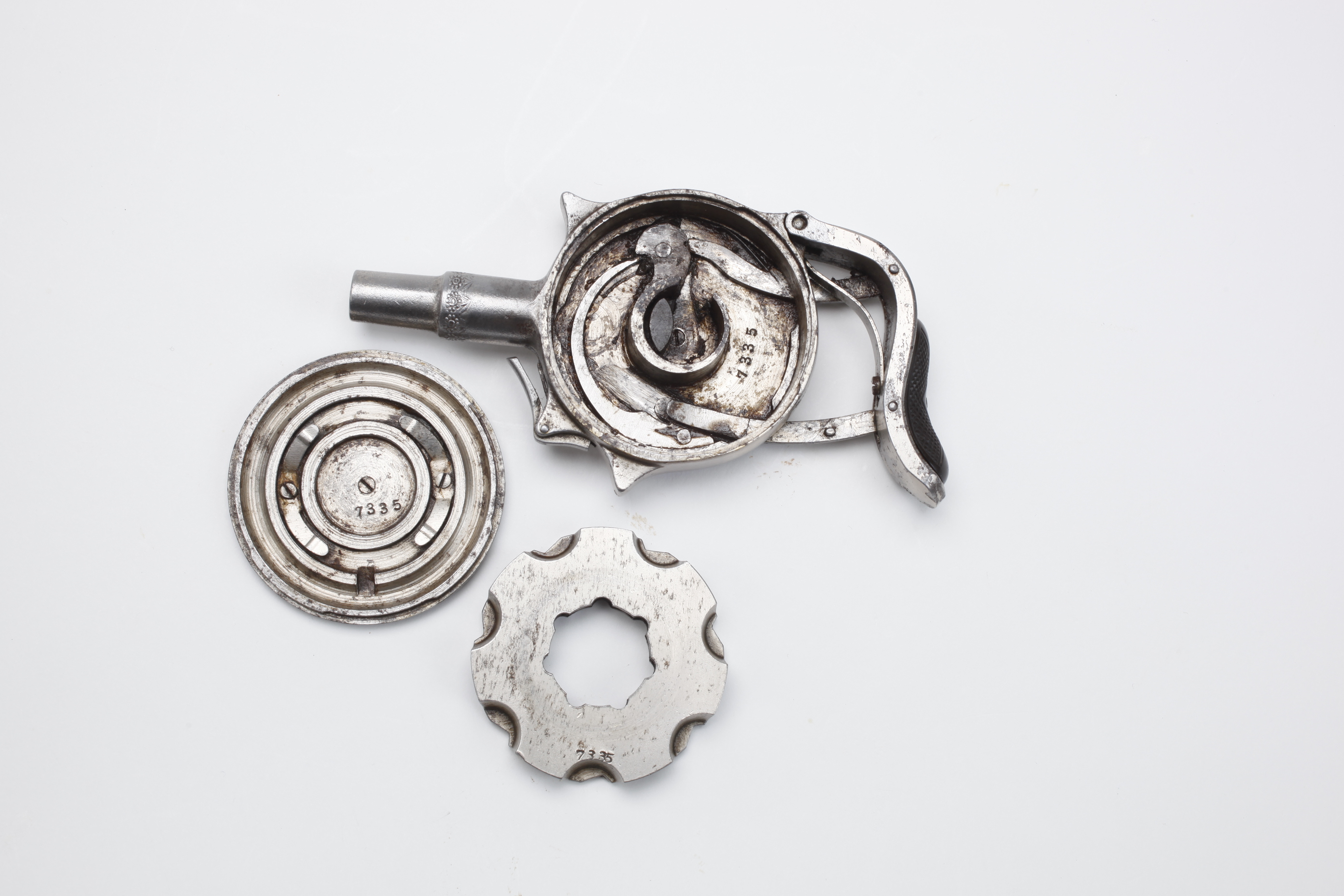
The cover (side plate) is a functional sub-assembly in its own right because it is the entry point for every teardown and the retainer for the turret. It releases by a quarter-turn or hinged catch — a friction or spring detent on many examples, not a screw — and once off, it frees the magazine disc to lift out.34 Two things make this the highest-risk group to handle. First, on Chicago/Ames guns the plate itself is the brittle hard rubber noted above, so a worn or mistimed catch that is forced will crack it. Second, the cover commonly carries a matching serial number — so a replaced cover breaks the matching-numbers provenance that drives collector value (Vol 9). Conserve the original cover if it is at all salvageable; a fabricated replacement is a last resort and must be disclosed.
5.3 The Magazine / Turret Group
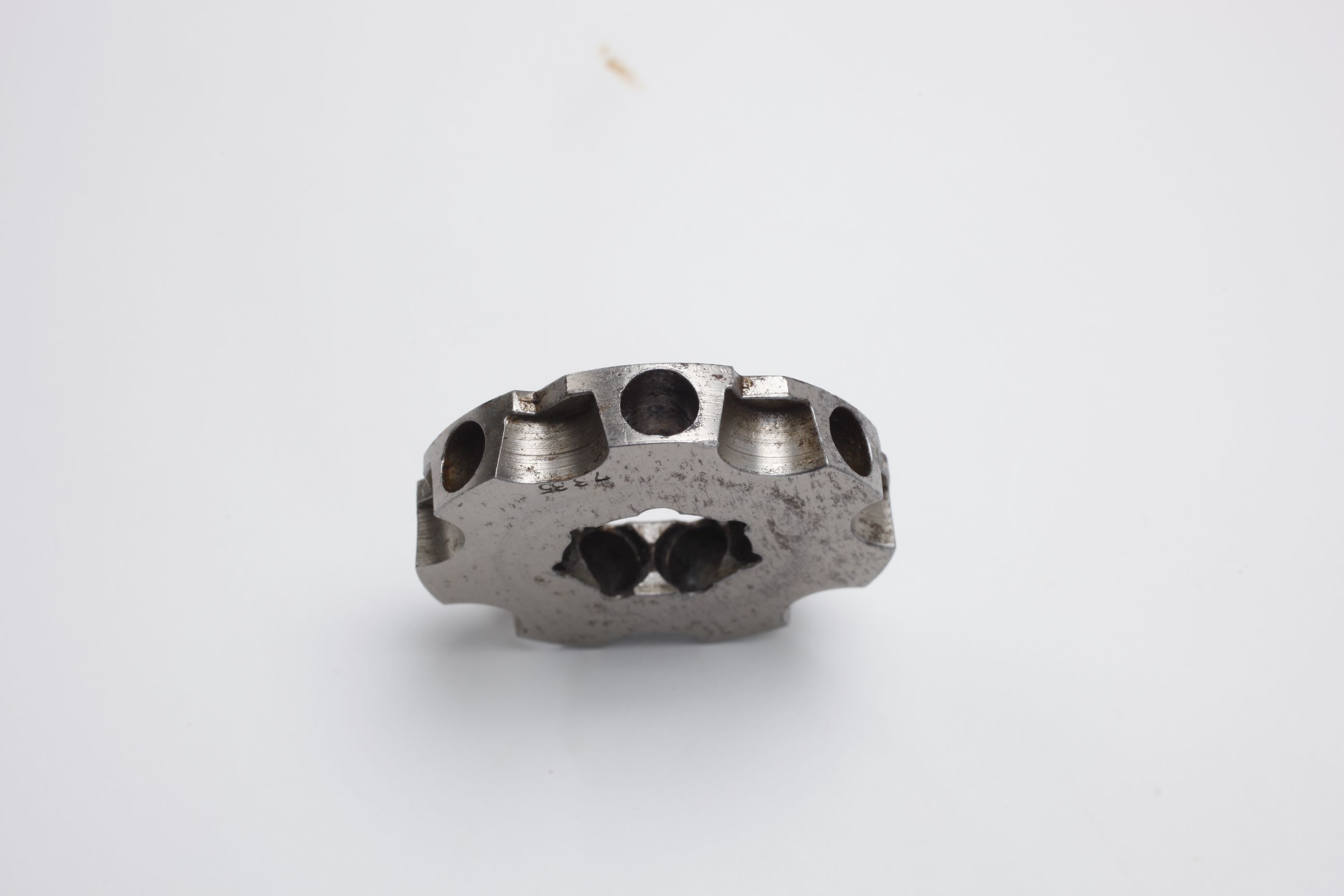
The cartridge-magazine (M) — the flat turret with its radial chambers (m′) and the indexing teeth (m³) cut into its face — is the single highest-value part to handle carefully.1 It rides on the central annular breech-block (R), which is fixed and forms the rear face the cartridges seat against. The chambers are thin-walled by design (a full ring of them has to fit in a watch-sized disc), so a century-plus of corrosion, a case swollen in place, or a prior owner’s forced ejection are the most likely sources of hairline cracks or peened chamber mouths. This group interfaces with three others at once: with the cover (which retains it), with the indexing mechanism (whose pawl drives its face teeth), and with the locking pin (which drops into its peripheral notches). Because it touches everything, damage or wear here shows up as a timing fault everywhere. Inspect it under magnification before anything else, and — as Vol 7 insists — never load and fire it regardless of condition.
5.4 The Indexing and Locking Group
This is the group that turns a squeeze into a rotation and then freezes that rotation for firing. It comprises the spring-lever pawl, which engages the magazine’s face teeth (m³) and advances the turret one chamber per squeeze, and the conical locking pin (P), which seats in a V-notch on the turret periphery to lock it positively in the firing position.1 The two must be timed to each other and to the hammer: the pawl finishes indexing and the pin seats before the sear releases the hammer, or a round fires out of alignment. Wear in the pawl tip, the face teeth, or the locking pin’s cone is the classic cause of a Protector that “fires between chambers” or fails to lock — and it is a timing problem to diagnose as a system, not a single worn part to blame in isolation.
5.5 The Hammer and Sear (Lock) Group
The firing lock is the hammer (H), forged “of one piece of metal” with the tumbler (T), carrying a firing cone or pin at right angles to strike the primer through the breech-block; the mainspring (S′) that powers it; and the sear (S), “a lever pivoted to a trigger, T′,” that holds and releases the hammer.1 Two restorer-relevant facts define this group. First, because the hammer and tumbler are a single forging, a broken striker is not a pin swap — it means re-fabricating the whole hammer/tumbler part, a real lab job with no parts-bin shortcut (Vol 7).
5.6 The Actuating-Lever and Return Group
Binding the whole thing together is the input side: the spring-lever (L) at the palm/rear that the fist depresses, the second lever that cocks the hammer, and the return spring that resets both to the ready position when grip pressure is relaxed.1 The patent’s central claim is precisely this two-lever arrangement — one lever working the magazine, one working the hammer, both driven by the same closing motion (Vol 2). The return spring, like the mainspring, lives under working tension and is a prime candidate for fatigue after a century. A weak return is one of the most common functional complaints on a surviving gun and one of the more defensible things to address, since a sympathetically hand-fitted replacement spring is reversible and changes nothing external (Vol 7).
5.7 The Groups as an Exploded View
Reading the groups in teardown order gives the exploded view a restorer actually uses:
Table 1 — Reading the groups in teardown order gives the exploded view a restorer actually uses
| Order | Group | Key parts | Chief hazard |
|---|---|---|---|
| 1 | Cover / side plate | cover, quarter-turn/spring catch | brittle hard rubber; carries serial |
| 2 | Magazine / turret | turret (M), chambers (m′), face teeth (m³), breech-block (R) | thin walls; highest-value part |
| 3 | Indexing & locking | spring-lever pawl, locking pin (P) | timing/wear as a system |
| 4 | Hammer & sear lock | hammer/tumbler (H/T) one-piece forging, mainspring (S′), sear (S) | one-piece striker = fabrication if broken |
| 5 | Actuating levers & return | squeeze-lever (L), hammer lever, return spring | springs under continuous tension, fatigued |
| 6 | Casing | casing (C), finger bearings (E), integral barrel (B) | structural cracks; barrel best left in place |
The dependency worth carrying into Vol 7 is that groups 2, 3, and 4 are timed to one another, so they are diagnosed together — and that the two parts with no replacement path (the one-piece hammer/tumbler and the numbered original cover) are the two you protect above all others during any disassembly.
5.8 Bibliography
Footnotes
-
US Patent 273,644, “Revolver,” Jacques Edmond Turbiaux — https://patents.google.com/patent/US273644 (primary source for all part letters and the two-lever claim). ↩ ↩2 ↩3 ↩4 ↩5
-
IMA-USA, blued-finish Chicago Firearms Co. Protector, matching serial 4937 — https://www.ima-usa.com/products/original-u-s-antique-rare-blued-finish-the-protector-palm-pistol-by-chicago-firearms-co-with-matching-serial-4937-only-1-000-made-with-blued-finish (hard-rubber side-plates; matching numbers). ↩
-
littlegun.info, “TURBIAUX Jacques Edmond (Protector)” — https://littlegun.info/arme%20francaise/artisans%20s%20z/a%20turbiaux%20jacques%20gb.htm (removable-disc / side-cover loading and internal-marking detail). ↩
-
Search-engine synthesis of dealer/collector mechanism and side-cover descriptions; cross-checked against the US 273,644 patent text where overlapping. ↩
Comments (0)