Protector Palm Pistol · Volume 3
The Maker Lineage
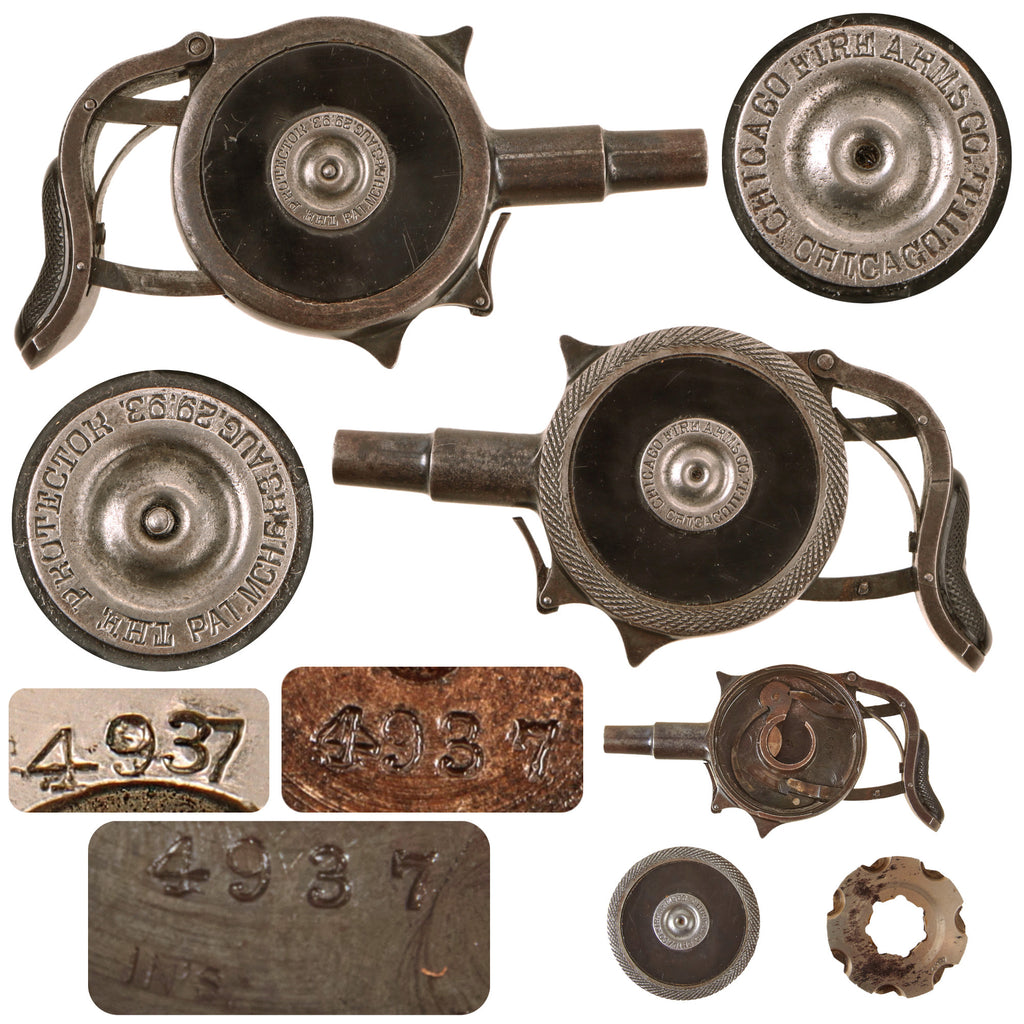
The Protector’s manufacturing history is a chain of four names — Turbiaux, Minneapolis, Finnegan/Chicago, and Ames — connected by a patent sale, a World’s Fair contract, and a lawsuit. Getting that chain right matters for more than trivia: the maker determines the caliber and markings you look for (Vol 6), and the dates attached to each link determine whether a given specimen is legally an antique (Vol 8). This volume lays out the best-supported reading of the lineage, states the production numbers, and is honest about the two date questions the sources will not settle cleanly.
3.1 Turbiaux to America
Turbiaux patented the design in France and the United States in 1882 (Vol 2) but did not build it at industrial scale himself; he licensed the concept abroad. The design’s American life began with the Minneapolis Firearms Co. (also seen as “Minneapolis Fire Arms Co.”), which produced the first US-made Protectors — reportedly about 3,000 units, with one source saying roughly 3,500.12 Treat the figure as “approximately 3,000”; the spread between sources is estimate variance, not a documented discrepancy.
Two details about the Minneapolis guns deserve flags rather than flat assertions. First, the production window: the commonly repeated shorthand says Minneapolis began “in 1883,” but that date is almost certainly a confusion with the US patent grant year. The more specific dealer and collector sourcing places actual Minneapolis manufacture at c. 1891–1892.2 This series uses 1891–92 and treats 1883 as the patent year — but if you see “1883” attached to a Minneapolis gun elsewhere, that is why. Second, the Minneapolis guns were reportedly contract-manufactured by James Duckworth of Springfield, Massachusetts, meaning Minneapolis Firearms Co. was the marketer, not literally the factory.3 That contract-builder detail comes from a single AI-synthesized search result, not a directly fetched primary page, so carry it as plausible-but-unverified.
3.2 Finnegan and the Chicago Fire Arms Co.
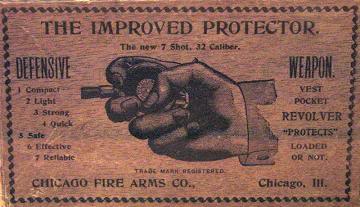
In 1892, Peter H. Finnegan, of Austin, Illinois, bought the patent rights and founded the Chicago Fire Arms Co. (Chicago Fire Arms Co.) to manufacture and market the pistols.2 Finnegan is the same man whose name is on the general revolver-improvement patent US 504,154 (Vol 2) — a patent often miscaptioned as “the Protector patent,” which it is not. Finnegan’s ambition, and the thing that shaped the rest of the story, was tying the Protector to the biggest promotional stage America had to offer that decade.
3.3 The Columbian Exposition Contract and the Ames Litigation
In anticipation of the 1893 World’s Columbian Exposition in Chicago, Finnegan contracted the Ames Sword Company of Chicopee, Massachusetts to manufacture 15,000 pistols.2 It was a bet on a mass-market moment — a novel, concealable, distinctly American gadget-gun sold to the crowds of a world’s fair.
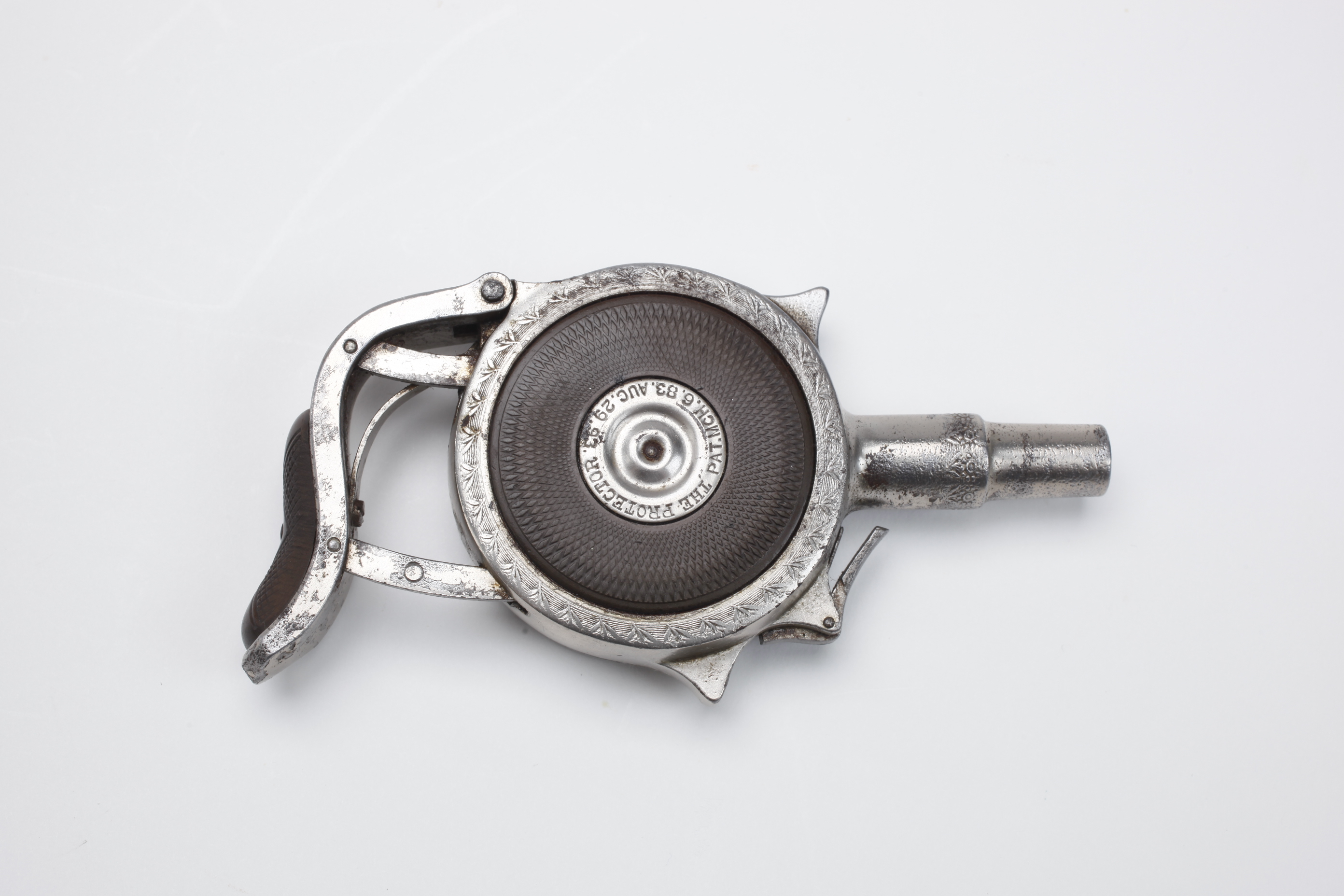
The bet failed on delivery. Ames produced only about 1,500 pistols by the exposition deadline. Finnegan sued Ames for damages; Ames countersued; the parties settled — and the settlement left Ames in control of production.24 Over the following years Ames amassed a total run reported as about 12,800 pistols (Wikipedia’s figure), which the NRA National Firearms Museum independently renders as “nearly 13,000”5 — the two are consistent. Ames sold down the inventory over roughly a decade and the design was abandoned by about 1910.2
One version of the story adds that Finnegan’s company was declared insolvent after the failed 15,000-unit contract and that Ames secured the patent rights through the litigation.4 That is consistent with the settlement leaving Ames in control. A separate strand of the same AI-synthesized source, however, claims Ames continued manufacture “into the 20th century until around the U.S. entry into World War I.” That “into WWI” framing does not reconcile with the specific 12,800-total / abandoned-by-1910 account, has no independent corroboration, and should be treated as a likely error and dropped rather than repeated.
A minor variant detail from the same lower-confidence source: some later guns are said to carry a double or reinforced trigger-guard bow attributed to John T. Norris of Springfield, Ohio. Plausible and specific, but single-sourced and unverified — note it, do not rely on it.
3.4 Production Numbers and Dates — the Honest Table
Table 1 — Production Numbers and Dates — the Honest Table
| Maker | Country | Reported production | Best-estimate window | Confidence on dates |
|---|---|---|---|---|
| Jacques Turbiaux (own production) | France | Unknown total; scarce | 1882–late 1880s | Low (little documentation) |
| Minneapolis Firearms Co. | USA | ~3,000 (one source ~3,500) | c. 1891–1892 | Moderate; “1883” is the patent year, not production |
| Chicago Fire Arms Co. / Ames Sword Co. | USA | ~12,800 (Wikipedia) / “nearly 13,000” (NRA Museum) | Mostly 1892–c.1898 manufacture; inventory sold through ~1910 | Moderate, but disputed — see below |
3.5 The Date Conflict That Actually Matters
The most consequential unresolved fact in the entire Protector record is the end date of Ames/Chicago manufacture, because it is the pivot for whether every surviving Chicago/Ames gun is unambiguously a pre-1899 antique. Three end-dates surfaced in the research:
- 1892–1898 manufacture, sold through 1910 — the best-supported reading. It is backed by the one piece of physical dealer data in the record: IMA-USA’s dating of the 3,700–5,400 blued-finish serial band to 1893–1897, tied to a specific matching-serial specimen (serial 4937, the blued gun in this volume’s lead figure).6 A serial-range-to-date mapping from an actual specimen is worth more than a generic summary.
- Abandoned by 1910 (Wikipedia) — read most naturally as sales running to 1910, not continued manufacture.
- “Early 1900s through 1910” — the Cody Firearms Museum’s own blog post frames manufacture this way.7 Taken literally, that would mean few or no Chicago/Ames guns qualify as pre-1899 antiques by the manufacture-date test — a materially different legal conclusion.
This series takes reading (1) as primary, because it rests on specific serial-range evidence rather than a generic date phrase, and explicitly flags the Cody Museum’s “into the 1900s–1910” claim as a real museum voice that disagrees. It is not silently overridden — a curator said it, and it is on the record — but it is treated as the lower-confidence minority account. Vol 8 builds the legal analysis so that it survives either reading: the great majority of Chicago/Ames guns date before 1899, and the analysis explicitly accounts for the possibility of late-serial outliers. The takeaway for a restorer is concrete: when provenance or legal status turns on the date, read the serial number against the known bands rather than trusting a round-number decade in a caption.
3.6 Bibliography
Footnotes
-
littlegun.info, “TURBIAUX Jacques Edmond (Protector)” — https://littlegun.info/arme%20francaise/artisans%20s%20z/a%20turbiaux%20jacques%20gb.htm. ↩
-
Wikipedia, “Protector Palm Pistol” — https://en.wikipedia.org/wiki/Protector_Palm_Pistol (synthesis citing Flayderman/Hogg/Walter/Barnes-type references and a 2023 Royal Armouries video by curator Jonathan Ferguson). ↩ ↩2 ↩3 ↩4 ↩5 ↩6
-
Search-engine synthesis (James Duckworth of Springfield MA as Minneapolis contract manufacturer); single AI-synthesized source, not independently fetched — treat as unverified. ↩
-
Search-engine synthesis of the Finnegan/Ames litigation and post-litigation timeline (insolvency, Ames securing rights, the “into WWI” claim, the John T. Norris double-guard variant) — contains at least one likely-erroneous claim (WWI-era production) and is not independently corroborated. ↩ ↩2
-
NRA National Firearms Museum, “Chicago Firearms Co Protector Palm Pistol” — https://www.nramuseum.org/guns/the-galleries/the-american-west-1850-to-1900/case-21-tin-stars-sixguns-frontier-justice/chicago-firearms-co-protector-palm-pistol.aspx. ↩
-
IMA-USA, blued-finish Chicago Firearms Co. Protector, matching serial 4937 — https://www.ima-usa.com/products/original-u-s-antique-rare-blued-finish-the-protector-palm-pistol-by-chicago-firearms-co-with-matching-serial-4937-only-1-000-made-with-blued-finish (source of the 3,700–5,400 = 1893–1897 serial-range dating and the ~1,000 blued figure). ↩
-
Cody Firearms Museum / Buffalo Bill Center of the West, “Museum Minute: The Palm Protector Pistol” — https://centerofthewest.org/2020/03/19/museum-minute-the-palm-protector-pistol/ (contains the conflicting “early 1900s through 1910” production-date claim). ↩
Comments (0)