Protector Palm Pistol · Volume 6
Variants & Identification
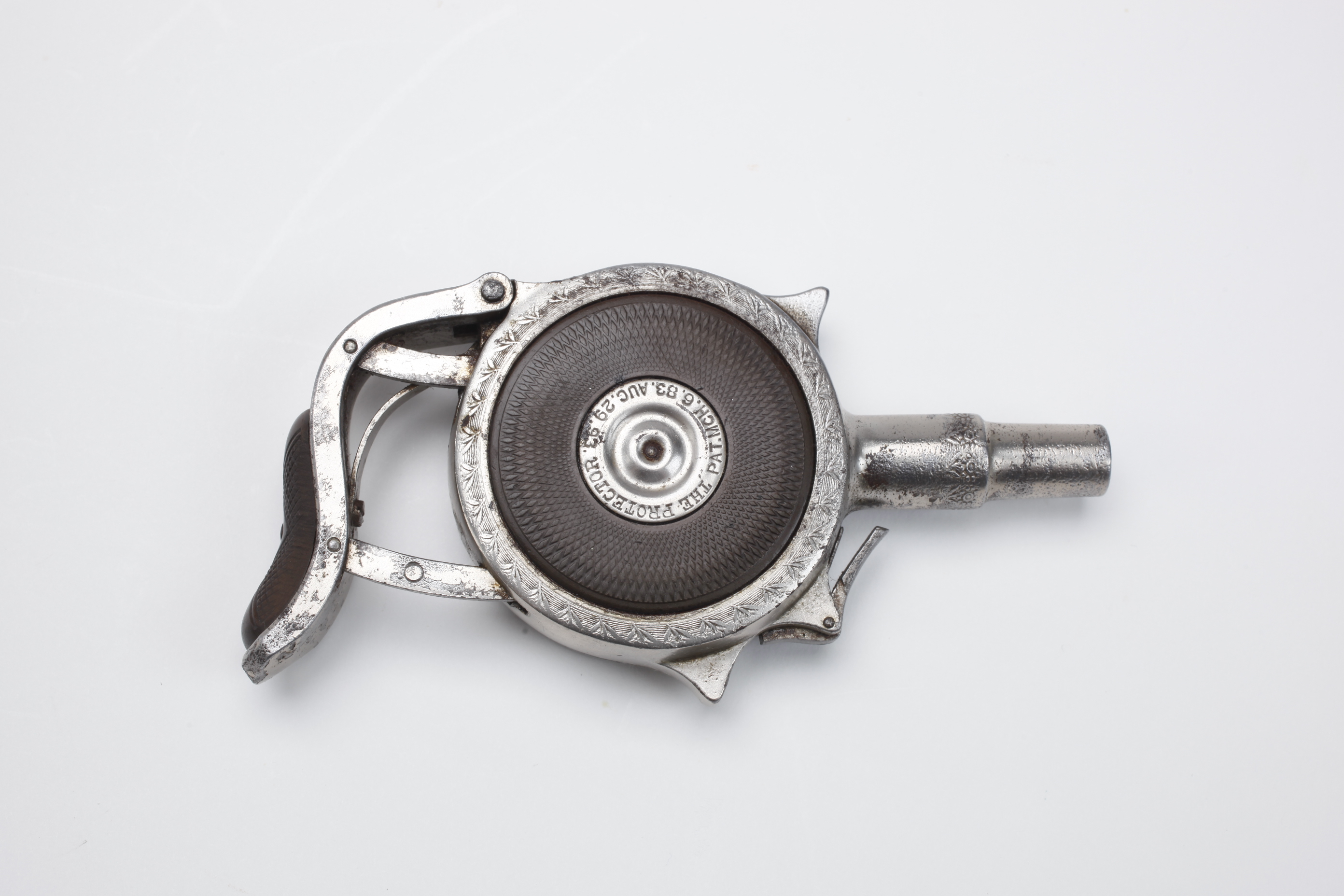
A Protector across the table could be a French Turbiaux worth a premium, a common nickel Chicago/Ames gun, a scarce blued Chicago example, or a piece of the wider squeezer family that only looks like a Protector. Telling them apart is a skill built from a few reliable cues — caliber, ignition type, chamber count, markings, and finish — and from knowing which “related” guns are not Protectors at all. This volume is the identification key, and it also draws the boundary around the family so a Merveilleux or a Gaulois never gets logged as a Protector.
6.1 The Three Production Families
Every genuine Protector traces to one of three manufacturing families, and each has a distinct fingerprint:
Table 1 — Every genuine Protector traces to one of three manufacturing families, and each has a distinct fingerprint
| Maker | Country | Caliber | Ignition | Chambers | Marking family | Window | Qty |
|---|---|---|---|---|---|---|---|
| Jacques Turbiaux (own production, large) | France | 8mm | Centerfire | 7 | ”SYSTÈME E. TURBIAUX / LE PROTECTOR” rollmark | 1882–late 1880s | Scarce; total unknown |
| Jacques Turbiaux (own production, small) | France | 6mm | Centerfire | 10 | Same rollmark family, smaller frame (~110 mm vs ~130 mm) | 1882–late 1880s | Scarce; total unknown |
| Minneapolis Firearms Co. | USA | .32 Extra Short | Rimfire | 7 | ”THE PROTECTOR” + “MINNEAPOLIS FIRE ARMS CO.” | c. 1891–1892 | ~3,000 |
| Chicago Fire Arms Co. / Ames Sword Co. | USA | .32 Extra Short (“.32 Protector”) | Rimfire | 7 | ”THE PROTECTOR” + “CHICAGO FIRE ARMS CO.” | 1892–c.1898 (sold to ~1910) | ~12,800 |
6.2 The Identification Key
Work the cues in this order and most specimens resolve quickly:
- Read the rollmark language. English — “THE PROTECTOR” — means American. The company name after it separates the two US makers: “MINNEAPOLIS FIRE ARMS CO.” versus “CHICAGO FIRE ARMS CO.” French — “SYSTÈME E. TURBIAUX” — means a French Turbiaux-made gun.
- Determine ignition and caliber. American guns are .32 Extra Short rimfire. French guns are 6mm or 8mm centerfire. Rimfire-versus-centerfire is visible at the breech face and is one of the most decisive single cues: a rimfire .32 is American, a centerfire 6mm/8mm is French.
- Count the chambers. Ten chambers on a centerfire gun means the French 6mm small model; seven chambers, on either a French 8mm or any American gun, does not by itself separate French 8mm from American — so pair the count with caliber and ignition, never rely on it alone.
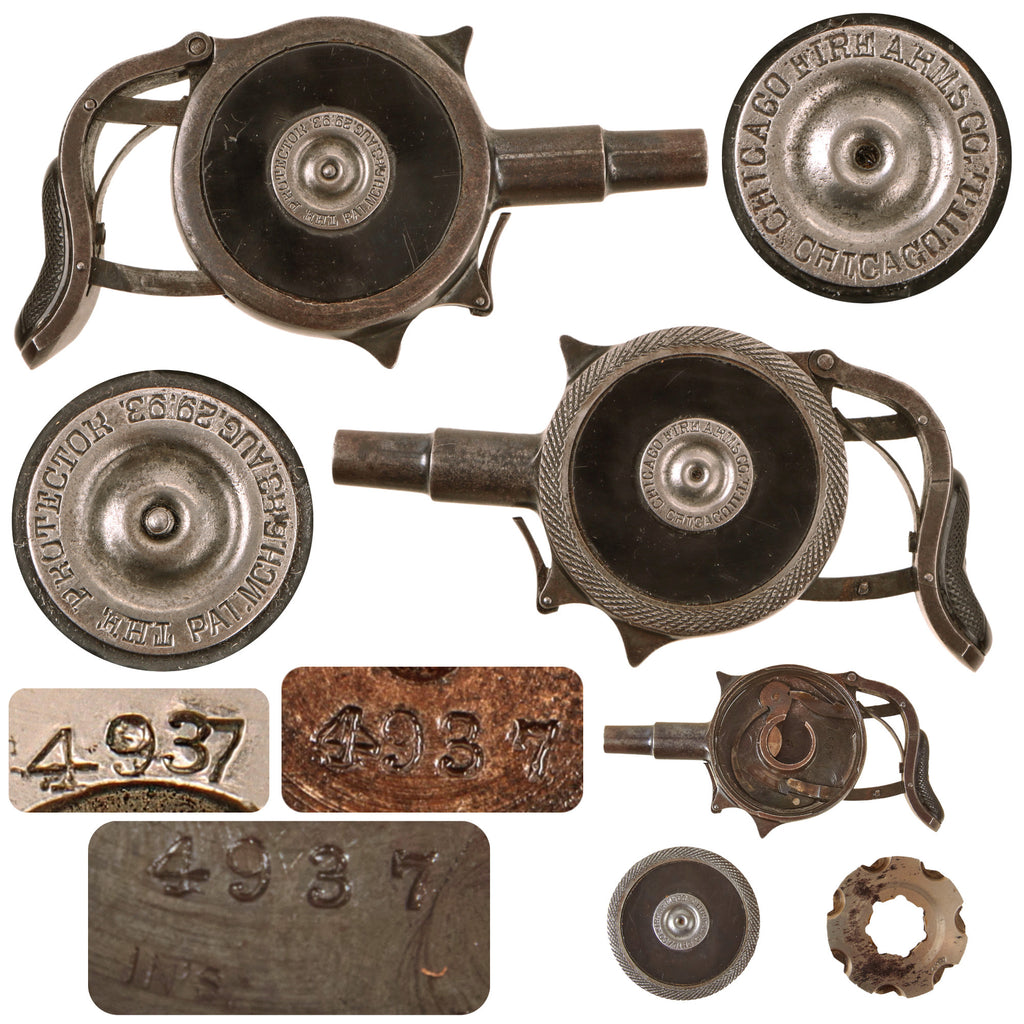
- Note the finish. On Chicago/Ames guns, nickel is standard and blued is scarce — reportedly only about 1,000 of the 3,700–5,400 serial band were blued.3 A blued, matching-serial Chicago gun is a meaningfully rarer and pricier animal than a common nickel one (Vol 9).
6.3 Markings, Finishes, and Side-Plate Variants
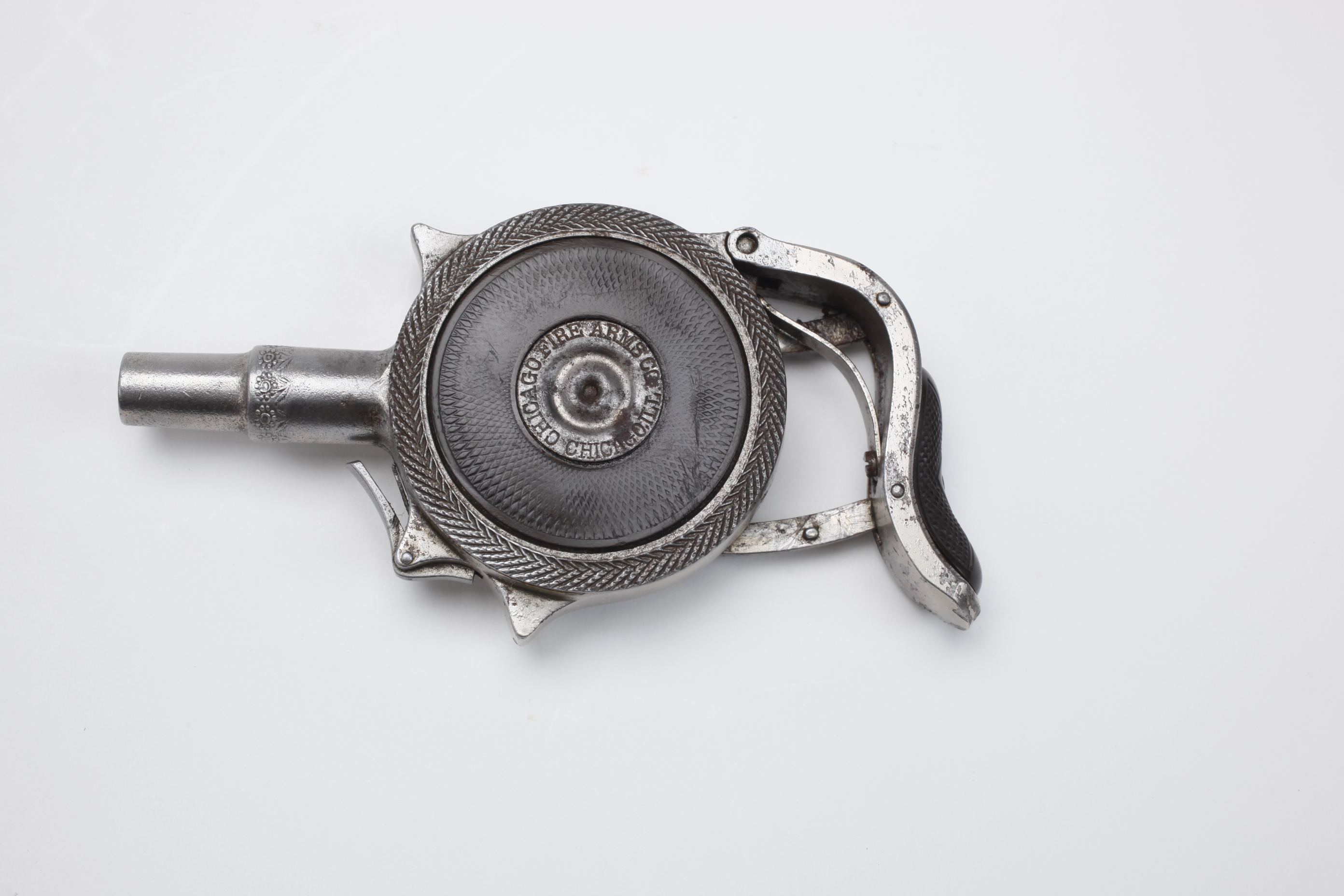
The markings are the primary maker discriminator and are rolled onto the casing; read them carefully, because “THE PROTECTOR” alone does not tell you Minneapolis from Chicago — the company name does. Finish splits two ways: French guns appear in nickel or blue with ebony or ivory grip inserts, while American guns are predominantly nickel, with the scarce blued Chicago run as the notable exception. Side-plates are a Chicago/Ames hallmark: checkered hard rubber, a brittle period material (Vol 5, Vol 7) whose pattern and condition are both an ID cue and a fragility warning. A minor, unverified later-variant detail — a double or reinforced trigger-guard bow attributed to John T. Norris of Springfield, Ohio — surfaced in a single AI-synthesized source (Vol 3); note it if you see it, but do not treat its presence or absence as diagnostic.
6.4 Two Cautions on Anomalous Listings
Two things in the dealer record deserve skepticism rather than acceptance. First, an IMA-USA listing described a Minneapolis gun as “.30 cal centerfire.” Every other source agrees the US guns are .32 Extra Short rimfire, so this is almost certainly a dealer typo or mislabel for a rimfire gun, not evidence of a genuine centerfire American variant — treat it as an error unless a second independent source corroborates. Second, the serial ranges in this series are given only where the notes support them (the 3,700–5,400 blued Chicago band, tied to matching-serial specimen 4937); do not extrapolate maker or date from a serial number outside a documented band, and do not invent range boundaries the record does not contain.
6.5 The Wider Squeezer Family — What Is Not a Protector
The Protector belongs to a short-lived French genre, and the fastest way to misidentify one is to confuse it with a cousin. Two matter:
- Rouchouse “Le Merveilleux” — Jacques Rouchouse, designed 1889, produced from about 1892. Seven-shot, in proprietary 8mm or 5.5mm “Merveilleux” cartridges (not interchangeable with the Turbiaux rounds), and fired by a front-facing sliding piece that releases a side-mounted hammer — a push-in, not a squeeze-in-fist.5 Different trigger action, different cartridge, French-only.
- “Le Gaulois” — Manufacture d’Armes et Cycles de Saint-Étienne, from 1893 (first “Le Mitrailleuse,” then renamed). Five-shot 8mm, squeeze-fired but fed from an internal box magazine, not a radial turret.5 It became the best-known French squeezer after the Protector.
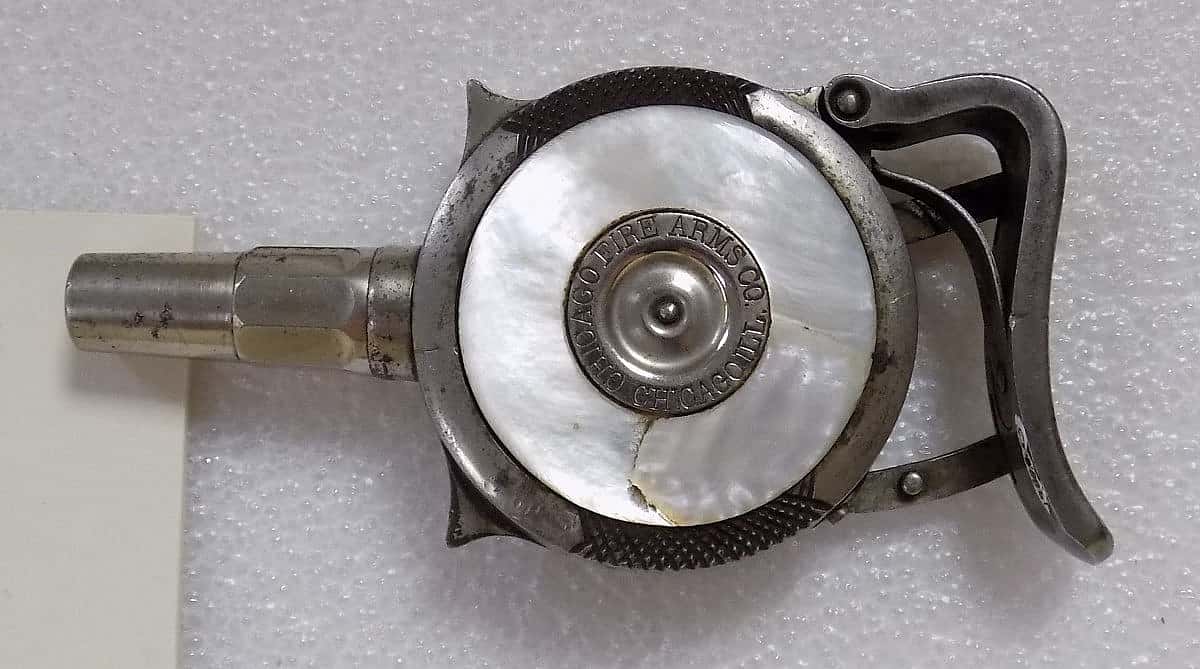
The decisive distinction is architecture: the Protector is a radial turret behind a single fixed rifled barrel, fired by a rear palm-squeeze lever. The Merveilleux uses a sliding front trigger and a side hammer; the Gaulois uses an internal box magazine. When a listing conflates any of these — “Turbiaux-type Gaulois,” “Merveilleux Protector” — treat the whole description as unreliable, because the seller has not understood what they are holding. As Vol 8 will show, this is not just pedantry: the Protector’s specific single-rifled-barrel-plus-radial-magazine architecture is what earned it a distinct legal classification the other squeezers never received.
6.6 Bibliography
Footnotes
-
littlegun.info, “TURBIAUX Jacques Edmond (Protector)” — https://littlegun.info/arme%20francaise/artisans%20s%20z/a%20turbiaux%20jacques%20gb.htm (French 6mm/8mm model specs, rollmark, internal-marking authentication). ↩
-
Wikipedia, “Protector Palm Pistol” — https://en.wikipedia.org/wiki/Protector_Palm_Pistol (US caliber/capacity, maker lineage). ↩
-
IMA-USA, blued-finish Chicago Firearms Co. Protector, matching serial 4937 — https://www.ima-usa.com/products/original-u-s-antique-rare-blued-finish-the-protector-palm-pistol-by-chicago-firearms-co-with-matching-serial-4937-only-1-000-made-with-blued-finish (blued scarcity ~1,000 of the 3,700–5,400 band; the anomalous “.30 cal centerfire” listing is a separate IMA product title flagged as a likely error). ↩ ↩2
-
Bonhams, “A French 6MM Centre-Fire Système Turbiaux Ten-Shot ‘Le Protector’ Palm Pistol” — https://www.bonhams.com/auction/26793/lot/203/ (French 6mm centerfire ten-shot corroboration). ↩
-
Search-engine synthesis on Rouchouse “Le Merveilleux” and “Le Gaulois,” drawing on guns.fandom.com and Italian-language arms-history articles; variant dates and calibers here are lower-confidence than the Turbiaux/Protector primary material. ↩ ↩2
Comments (0)