Protector Palm Pistol · Volume 2
Turbiaux and the Patent
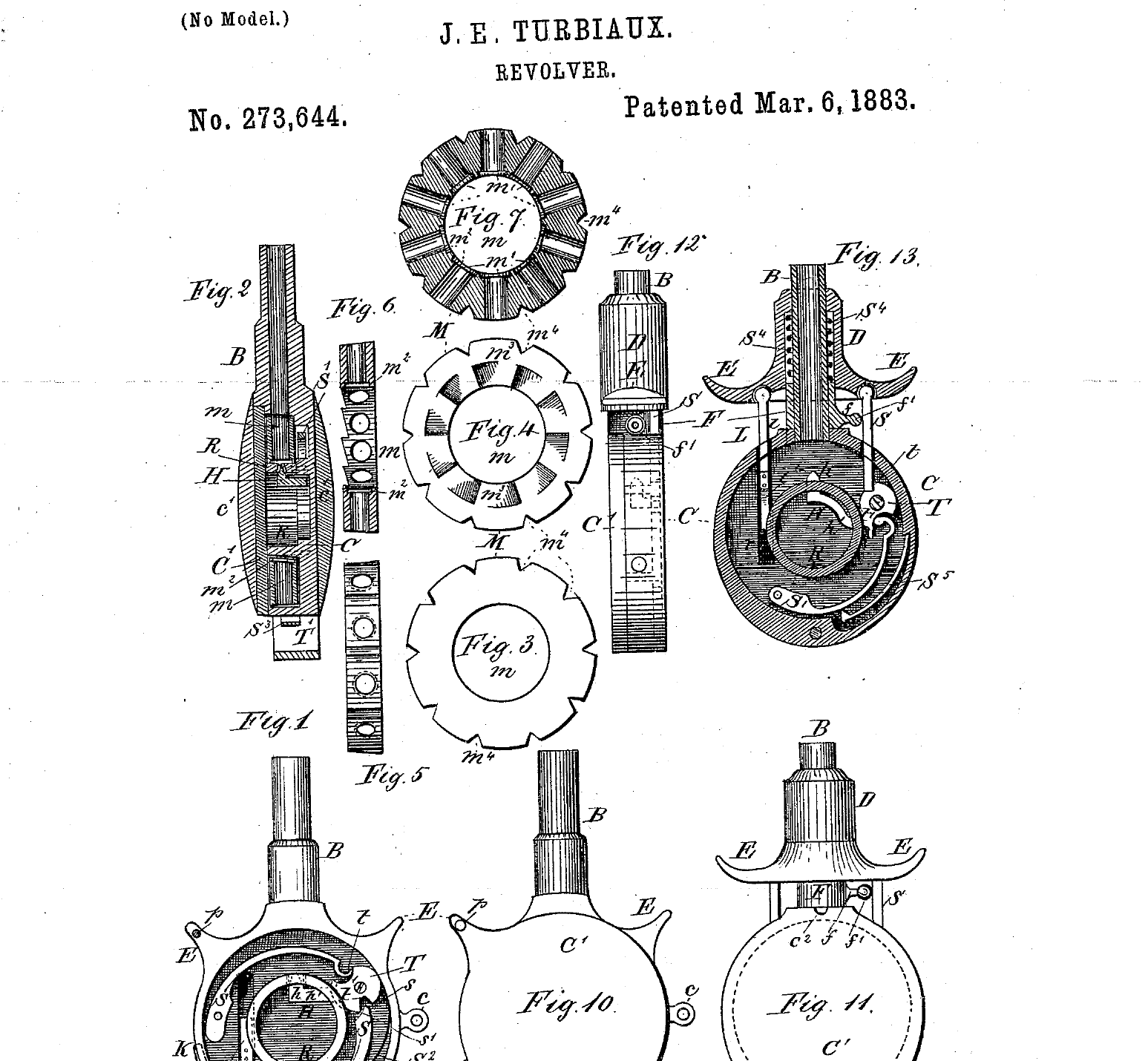
Every claim in this series ultimately rests on a single primary document: the patent Jacques Edmond Turbiaux filed in the summer of 1882. It is the clearest surviving description of how the mechanism was intended to work, it supplies the vocabulary the rest of these volumes use for the parts, and — because US patents of this era are public domain — its drawing sheets are the best-guaranteed figure material available for the internal workings. This volume is about the inventor, what the patent actually claims, what its drawings show, and a bibliographic knot the secondary sources could not settle — the French patent number — which the US patent’s own text turns out to resolve.
2.1 The Inventor
Jacques Edmond Turbiaux was a Parisian gunsmith and inventor, professionally active roughly 1880 to 1895, with recorded workshop addresses at 210 Rue St-Maur and 11 Rue Bichat in Paris.1 He is not a figure the historical record documents richly — what survives is largely the patent trail and the guns themselves. What the patents establish is that he conceived the radial-magazine palm pistol as a system, filed it across several countries in quick succession in 1882, and licensed or sold the rights internationally rather than building it at industrial scale himself. The American commercial history in Vol 3 is downstream of that decision to license abroad.
2.2 US 273,644 — the Verified Anchor
The one patent this series treats as fully load-bearing is the American one, because it was fetched directly from the primary source and every field is confirmed:
Table 1 — The one patent this series treats as fully load-bearing is the American one, because it was fetched directly from the primary source and every field is confirmed
| Field | Value |
|---|---|
| Patent number | US 273,644 |
| Title | ”Revolver” |
| Inventor | Jacques Edmond Turbiaux, of Paris, France |
| Assignee | None listed |
| Filed | 29 June 1882 |
| Granted | 6 March 1883 |
| Source | https://patents.google.com/patent/US273644 |
The title is worth pausing on: the patent office called it a “Revolver,” and that word choice will matter in Vol 8, because whether the finished object is legally a “revolver” or something else is the crux of a 1955 tax ruling. The patent itself has no such doubts — it treats the radial turret as simply an unconventional revolving magazine.
Note also the “1883” that appears in so much popular copy about this gun. It is the grant year of this patent, not the start of US manufacture, which began around 1891. The two get conflated constantly; Vol 3 untangles it.
2.3 What the Patent Claims
The heart of the patent is the combination it protects — the fist-squeeze operation of a radial magazine behind a fixed barrel. Two passages from the Google Patents rendering carry the essential vocabulary:
“the combination, with a barrel, a casing adapted to be held as described, a cartridge-magazine, and a hammer located within said casing, of two levers arranged to operate the cartridge-magazine and hammer, respectively”2
and
“a lever for actuating the hammer and a lever for actuating the cartridge-magazine, and a locking pin to lock said magazine in position for firing by the alternate movement of the fingers toward and from the palm.”2
Three ideas are being claimed here at once. First, the casing “adapted to be held as described” — the flat body gripped in a closed fist, not a frame with a grip. Second, the two-lever arrangement: one lever indexes and locks the cartridge magazine, the other cocks and releases the hammer, both driven by the same closing motion. Third — and this is the phrase the whole design turns on — operation “by the alternate movement of the fingers toward and from the palm.” The locking pin that positively locks the magazine in the firing position is called out as its own element, because a radial turret that could rotate out of alignment under the shock of firing would be dangerous; the pin is what makes the flat magazine safe to fire. These are the parts — casing, cartridge-magazine, hammer, tumbler, sear, locking pin, the two levers — that Vol 4 traces through the full firing sequence and Vol 5 breaks into sub-assemblies.
2.4 The Drawings
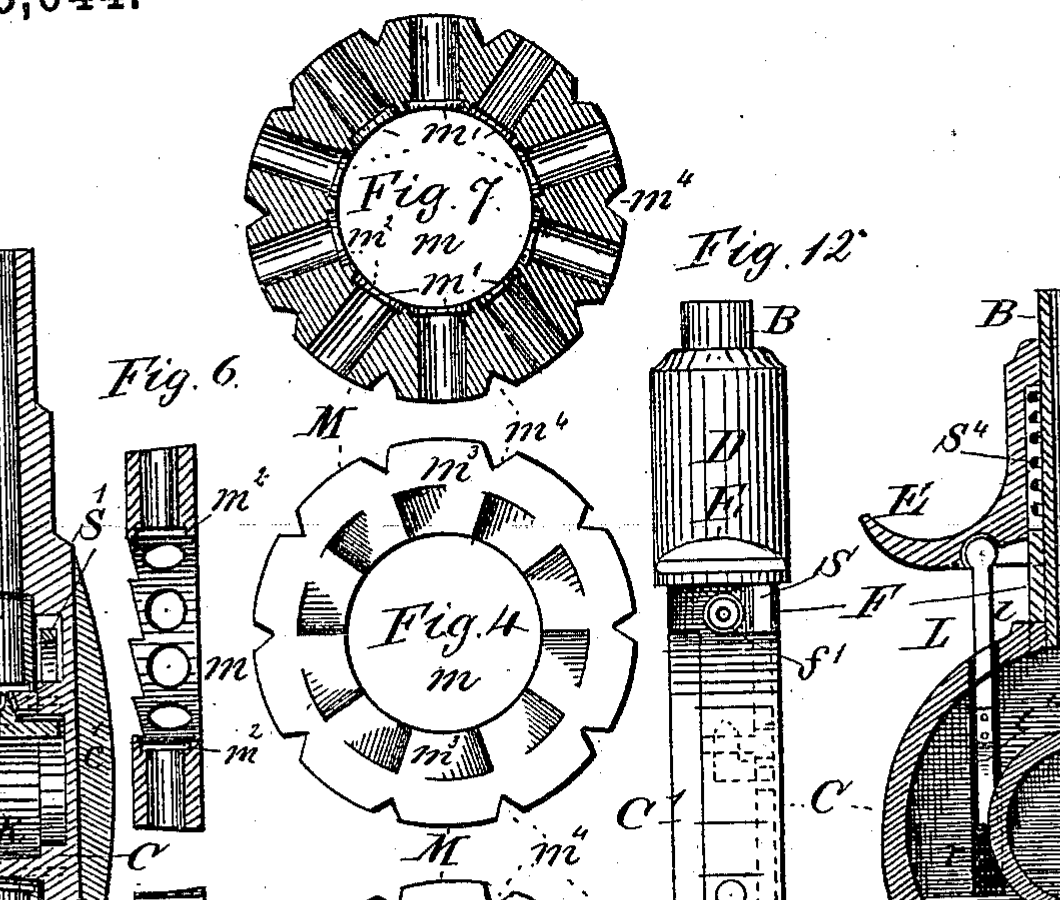
Google Patents’ image CDN served two small cropped thumbnails for this record, which had earlier suggested a multi-sheet drawing set with a missing “sheet 2.” Pulling the full patent PDF directly settles it: US 273,644 has a single drawing sheet (page 1 of the five-page PDF; pages 2–5 are the specification text), and that one sheet carries the complete figure set — Figs 1 through 13, including the elevation (Fig 1), the disc/turret face and edge views (Figs 3, 4, 7), the barrel and breech sections (Figs 6, 12), and the internal-lock cutaways (Figs 10, 11, 13).2 The lead figure of this volume is that full sheet; the detail figure is a magnified crop of the turret-and-breech figures. What they show is exactly the material most needed: annotated cutaways in which the casing, the cartridge-magazine, the hammer, the tumbler, the sear, and the levers appear as separate, labeled parts. For a design with no surviving factory exploded diagram, these patent figures are the single best window into the internal architecture, and they recur throughout the mechanism and restoration volumes.
2.5 The French Patent Number — Resolved by the Patent’s Own Text
The secondary sources genuinely conflict here, and the research behind this series flagged the French patent number as unresolved. Two accounts disagreed:
- The specialist French-arms reference littlegun.info attributes French Patent No. 2,731 (1882) to Turbiaux’s original French filing, and also cites German Patent 21,929.1
- A separate, AI-synthesized search summary (Grokipedia-derived, lower-reliability) instead put the French filing of 9 June 1882 under No. 149,466 and attributed No. 2,731 to the British filing of 10 June 1882.3
They cannot both be right, and the research pass, unable to check a primary French source, correctly declined to print a number. But the answer was sitting inside the one document this entire series is anchored on. The specification header of US 273,644 itself recites Turbiaux’s foreign filings — a primary US-government document, read directly from the patent PDF:
“Application filed June 29, 1882. (No model.) Patented in France June 9, 1882, No. 149,466; in Belgium June 9, 1882, No. 58,148; in England June 10, 1882, No. 2,731, and in Italy June 14, 1882, Nos. 14,318 and 346.”2
That recital resolves the conflict. The French patent is No. 149,466 (9 June 1882); the number 2,731 belongs to the British (England) filing (10 June 1882), not the French one; Belgium is No. 58,148 and Italy Nos. 14,318 and 346. In other words, the Grokipedia-derived attribution was correct and littlegun.info’s assignment of 2,731 to the French patent is mistaken — a genuinely useful correction for anyone documenting provenance, because 2,731 is repeated as “the French patent” in more than one place.
One honest boundary on the strength of this: these are the foreign-filing numbers as recited in the US patent, which is a strong primary source but is not the same as reading the French grant in a period INPI gazette. The confidence is high — a US patent’s foreign-priority recital was a formal legal statement — but a period French gazette would be the ideal final confirmation, and the numbers should be carried as “per the US 273,644 specification header” rather than as independently re-verified French records.
2.6 The Other Patent People Confuse With This One
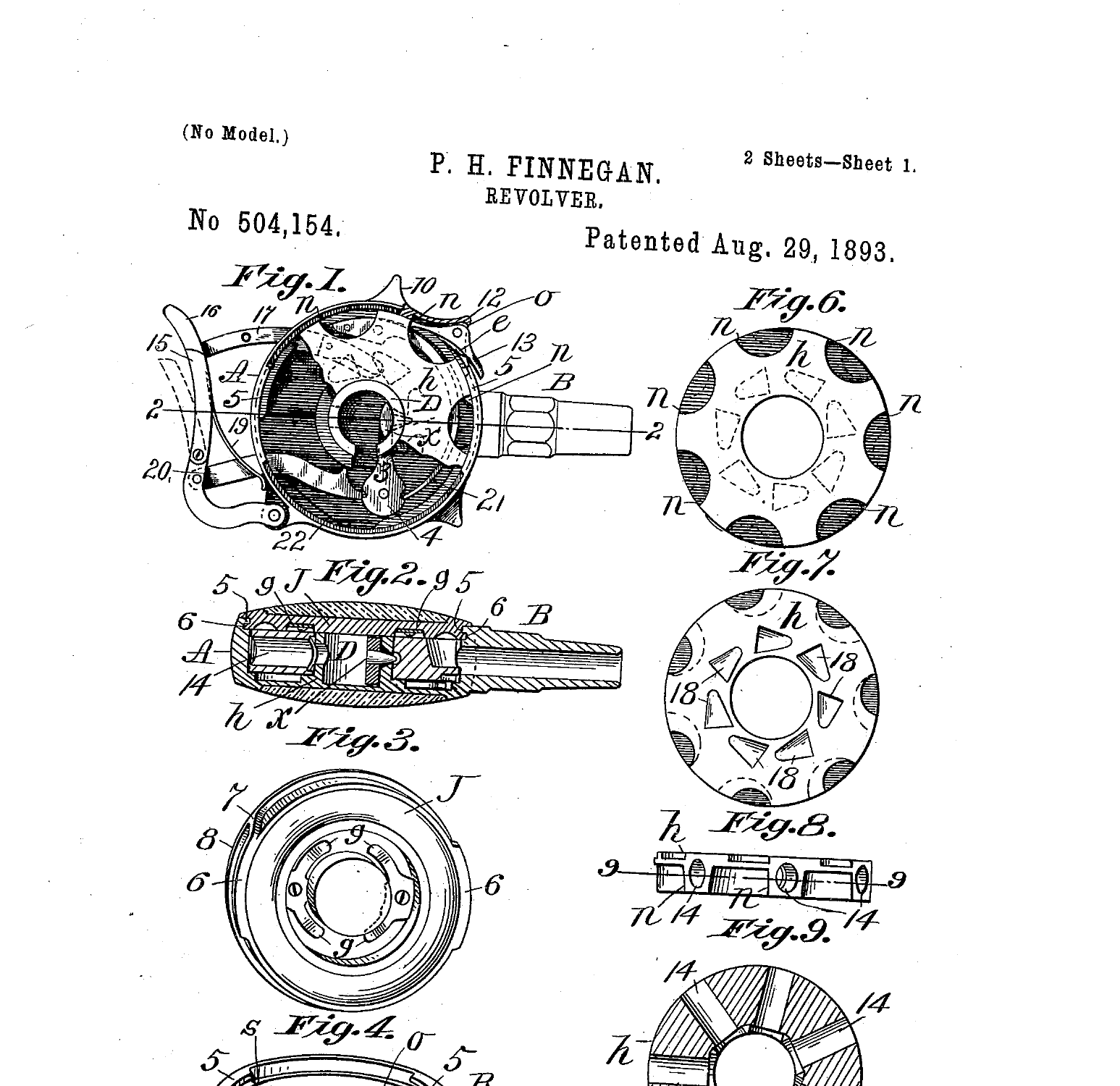
One further patent belongs in this volume as a warning, because it is routinely miscaptioned in dealer copy and casual writing. US 504,154, granted 29 August 1893 to Peter H. Finnegan, is a general revolver-construction patent — an improvement filed during the Chicago Fire Arms era, verified directly from Google Patents.4 It is not the Protector patent, not the patent that protects the palm-squeeze turret, and not a redesign of Turbiaux’s mechanism. Finnegan was the man who bought the Turbiaux rights in 1892 (Vol 3), so his name attaches to the Protector’s commercial story, but US 504,154 covers ordinary revolver construction. If you see it captioned as “the Protector patent,” that is an error. The Protector patent is Turbiaux’s US 273,644, full stop.
2.7 Bibliography
Footnotes
-
littlegun.info, “TURBIAUX Jacques Edmond (Protector)” — https://littlegun.info/arme%20francaise/artisans%20s%20z/a%20turbiaux%20jacques%20gb.htm (fetched directly; source of the workshop addresses and the French/German patent-number attribution). ↩ ↩2
-
US Patent 273,644, “Revolver,” Jacques Edmond Turbiaux — https://patents.google.com/patent/US273644; full PDF https://patentimages.storage.googleapis.com/db/17/e2/8cb3bc44560085/US273644.pdf (primary source; claim language and the foreign-filing recital quoted from the patent text). The PDF is five pages: one drawing sheet (Figs 1–13) plus the specification. The figure images in this series are rendered from that drawing sheet. ↩ ↩2 ↩3 ↩4
-
Search-engine-rendered synthesis referencing Grokipedia’s Protector Palm Pistol page — an AI-generated encyclopedia, lower reliability; used only for the alternate French/British patent-number attribution, which is flagged here as unresolved. ↩
-
US Patent 504,154, Peter H. Finnegan, filed 10 February 1893, granted 29 August 1893 — https://patents.google.com/patent/US504154 (primary source; a general revolver-construction patent, not Protector-specific). ↩
Comments (0)