Protector Palm Pistol · Volume 1
Overview & Why It Fascinates
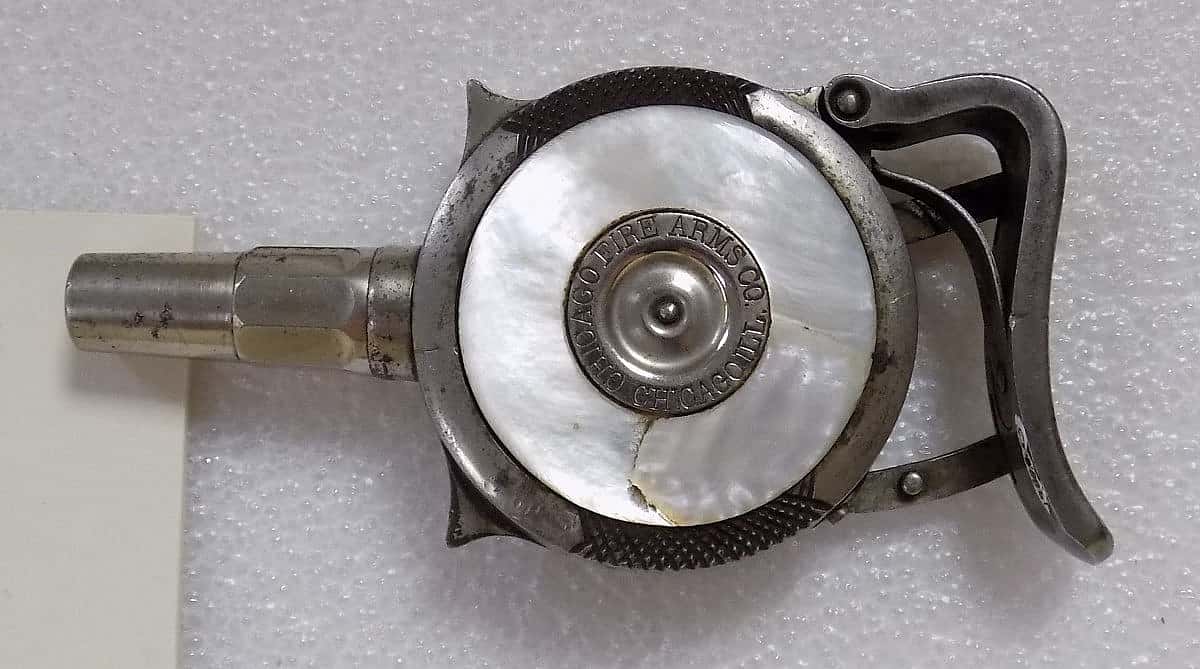
There is a particular kind of object that stops a collector cold the first time it sits in the hand, and the Protector is one of them. It is a disc of nickeled steel about the size of a large pocket watch, and it disappears inside a closed fist with only a short muzzle poking out between two fingers. You do not point it so much as make a fist at something. There is no grip, no visible trigger on the earliest pattern, no cylinder swinging out — just a flat turret of radial chambers hidden in the palm and a lever you squeeze. For a gunsmith who restores antiques, it is one of the most mechanically peculiar late-Victorian designs you can own, and it belongs to a small, strange family of French “squeezer” pistols that briefly convinced the 1890s that the future of concealed defense was a machine you wore like a fob. This first volume sets the stage: what the thing is, where it sits in that squeezer family, and how the rest of the series is laid out.
1.1 The Disc You Hide in Your Fist
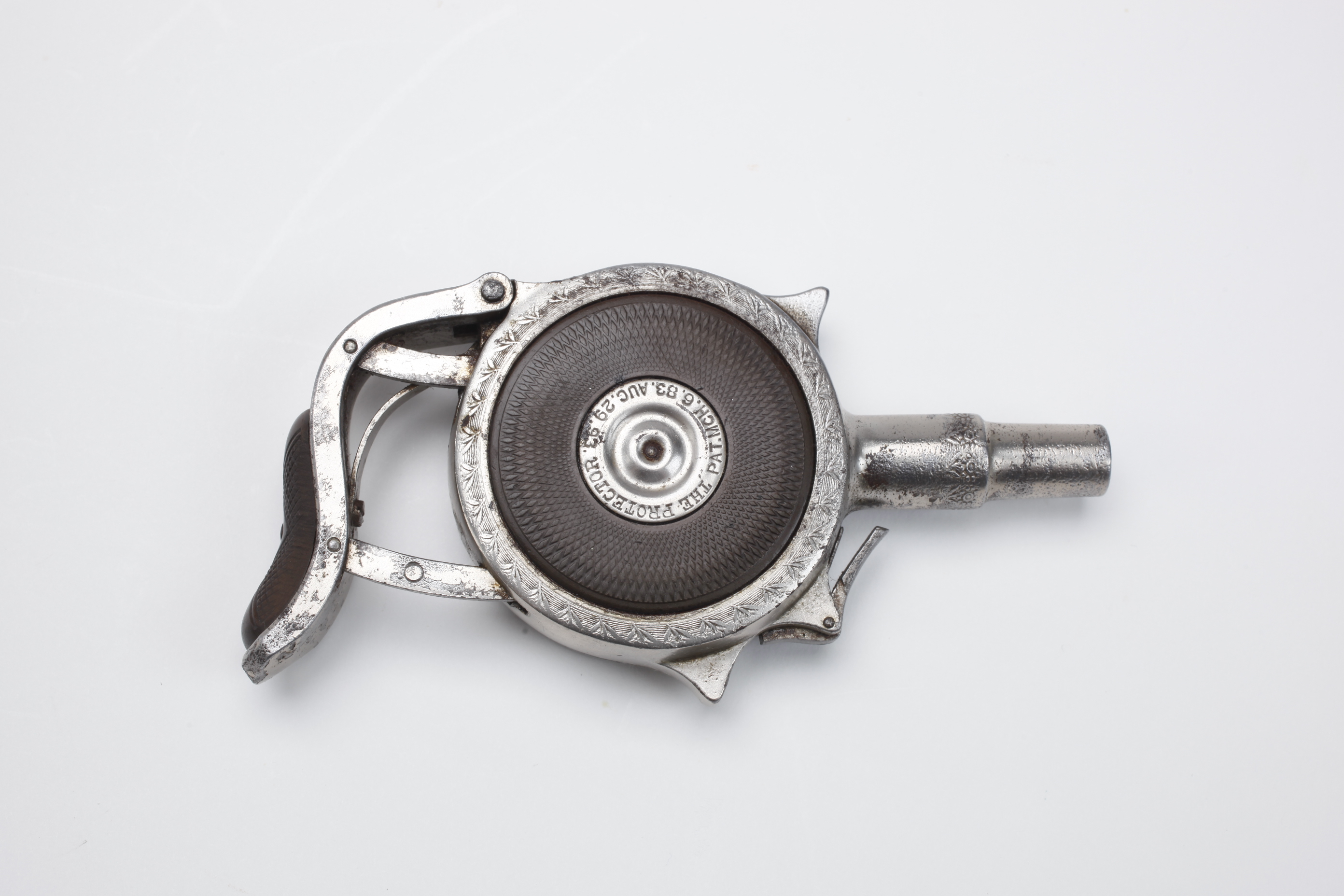
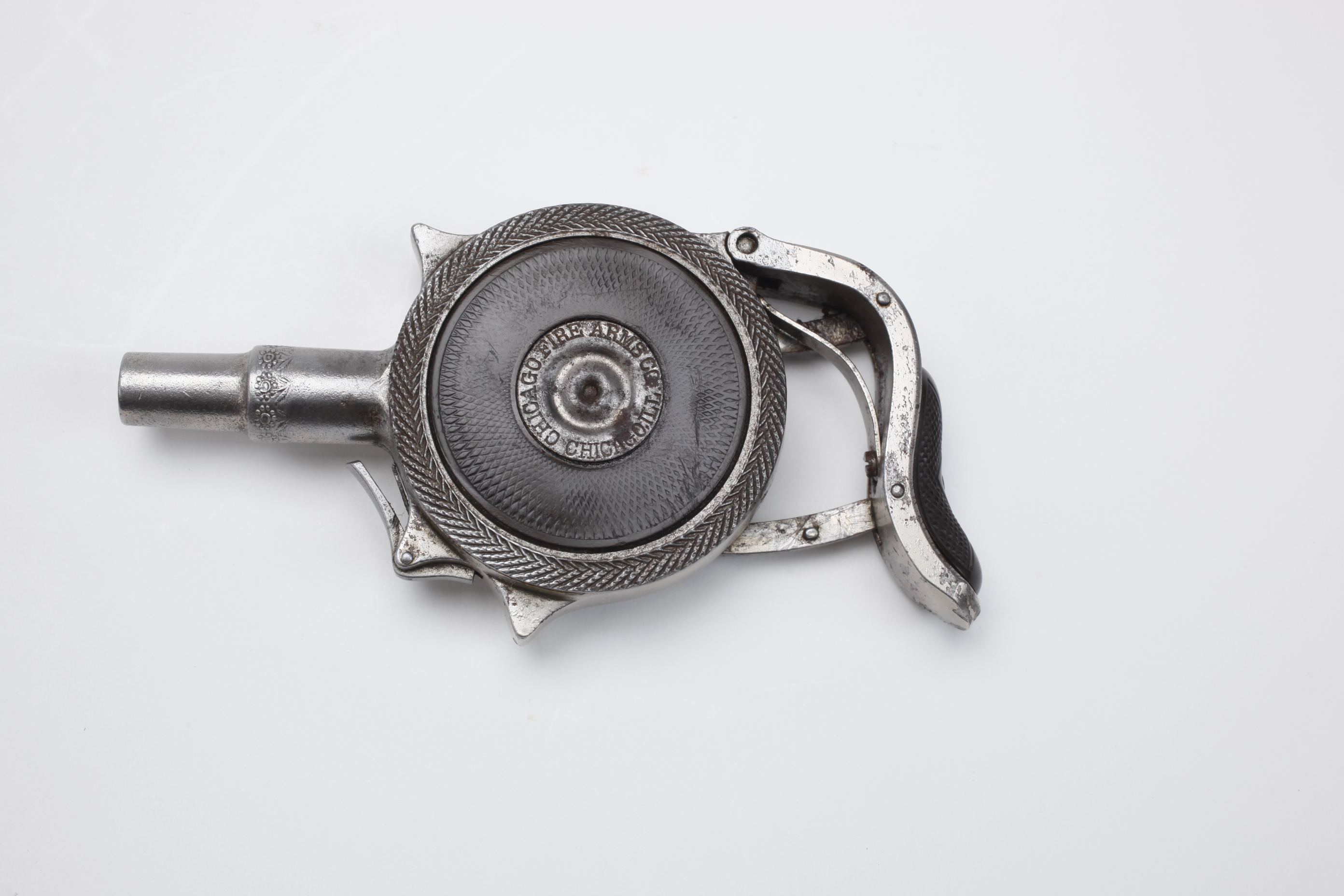
The Protector’s whole identity flows from one decision: put the ammunition in a flat radial turret rather than a conventional revolver cylinder, and drive the action by closing your hand rather than pulling a trigger. The cartridges lie like spokes of a wagon wheel around a central axis, all in one plane, inside a round casing you can close a fist around. Two finger bearings project from opposite edges as grip lugs; the palm carries the body from below; the short rifled barrel protrudes forward between the index and middle fingers.1 Squeeze, and a spring lever indexes the turret one chamber, cocks an internal hammer, and releases it. Relax the grip and the mechanism resets. It is, in effect, a double-action-only pocket revolver folded flat and re-shaped so that a fist is the only visible gesture.
That flatness is the point of the whole exercise. A conventional derringer or vest-pocket revolver still reads as a gun in the hand. The Protector reads as nothing — a watch, a compact, a piece of jewelry — until it is fired. Museum staff and dealers reach for the same phrase every time: it looks “like the spokes of a wagon wheel” sitting flat in the palm.2 For the late-nineteenth-century market in genteel, deniable self-defense, that concealment was the entire sales pitch, and it is a large part of why the object still fascinates today.
1.2 The “Squeezer” Family It Belongs To
The Protector did not appear in a vacuum. It is the earliest and most influential member of a short-lived French genre — the pistolet de poing à pression, the palm-squeeze pistol — and keeping the family straight is the first thing that separates an informed collector from a confused one. Three names recur, and they are mechanically and commercially distinct from one another:
- Turbiaux “Le Protector” — the subject of this series. Radial turret behind a single fixed rifled barrel, fired by a rear palm-squeeze lever. Patented 1882; the only member of the family to be manufactured in quantity in the United States.
- Rouchouse “Le Merveilleux” — designed by Jacques Rouchouse in 1889, in production from about 1892. Seven-shot, in proprietary 8mm or 5.5mm “Merveilleux” cartridges, fired by a front-facing sliding piece that releases a side-mounted hammer — a push, not a fist-squeeze.3
- “Le Gaulois” — made by the Manufacture d’Armes et Cycles de Saint-Étienne from 1893 (first called “Le Mitrailleuse,” then renamed). Five-shot 8mm, squeeze-fired with an internal box magazine rather than a radial turret; it became the best-known French squeezer after the Protector itself.3
The trap is to lump them together as “those French fist guns.” They share a silhouette and an era, but the Protector’s radial-turret-behind-a-single-rifled-barrel architecture is its own thing — and, as Vol 8 will show, that architecture is precisely what gives the Protector a subtle legal character the others do not share. When a lot description or an old reference conflates a Merveilleux or a Gaulois with a Protector, treat it as a red flag on the whole listing.
1.3 Why It Fascinates a Restorer Specifically
For someone who works on antique arms with a full bench, the Protector is interesting for reasons beyond its silhouette. It packs a complete double-action lock — hammer, tumbler, sear, mainspring, indexing pawl, locking pin — into a disc the size of a hunter-case watch, with wall thicknesses and spring dimensions that leave almost no margin.1 There is no surviving parts supply chain: this was a production run in the low tens of thousands across all makers in the 1890s, and a broken striker means fabricating a hammer-and-tumbler forging, not ordering a part. Every conservation decision is therefore high-stakes, and Vol 7 treats those decisions at length. It is also a genuinely scarce collectible — total original production across every maker was on the order of sixteen thousand units at most — so the ethics of stabilize-versus-refinish bite harder here than on a common service revolver.
One honest caveat threads through this entire series and is worth stating on page one: no factory disassembly manual or gunsmithing monograph specific to the Protector was located in the research behind these volumes. The mechanical descriptions here are built from the US patent text cross-checked against dealer and museum descriptions of surviving guns. That is a solid foundation, but it is not the same as a documented factory teardown, and where a claim rests on the patent rather than on a confirmed disassembled specimen, the text says so. Treat the mechanism and restoration volumes as an informed framework for your own hands-on assessment, not as a verified shop manual.
1.4 The Lineage in One Breath
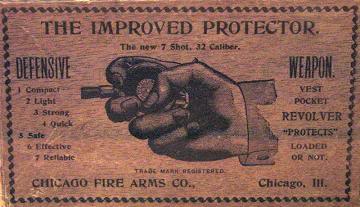
The full story is Vol 3’s job, but the one-paragraph version orients everything else. Jacques Edmond Turbiaux, a Paris gunsmith, patented the radial-magazine squeeze pistol in France in 1882 and in the United States as US 273,644 (granted 1883). The design crossed the Atlantic: the Minneapolis Firearms Co. sold the first US-made Protectors (roughly 3,000, contract-built c. 1891–92), then the patent passed in 1892 to Peter H. Finnegan, who founded the Chicago Fire Arms Co. and contracted the Ames Sword Co. of Chicopee, Massachusetts to build 15,000 pistols for the 1893 World’s Columbian Exposition. Ames delivered only about 1,500 by the deadline; litigation followed; Ames ended up controlling production, which ran to roughly 12,800–13,000 units, made mostly in the 1890s.45 Note already that the commonly repeated “built in the USA in 1883” is almost certainly a confusion with the patent-grant year — actual US manufacture began around 1891 — and that at least one museum voice dates production later than the mainstream account. Those date questions are not pedantry; Vol 8 shows they are the hinge of the legal analysis.
1.5 What the Rest of This Series Covers
Vol 2 is Turbiaux and the patent — the 1882 invention, what US 273,644 actually claims, the drawings, and the French patent number the patent’s own text finally pins down. Vol 3 is the maker lineage in full, including the Columbian Exposition contract, the Ames litigation, and the conflicting production dates. Vol 4 is the mechanical heart: the turret, the squeeze lever, the indexing pawl, the striker and sear, and the full firing sequence, drawn straight off the patent figures. Vol 5 drops one layer further into the sub-assemblies and an exploded view. Vol 6 is variants and identification — French versus Minneapolis versus Chicago/Ames, and how to tell them apart. Vol 7 is restoration and conservation, the longest volume, including the ammunition reality and why you do not fire this gun. Vol 8 is the legal posture — antique-firearm status, the AOW wrinkle, and the edge case. Vol 9 is collecting, value, auction results, and museum holdings. Vol 10 is a laminate-ready cheatsheet. The hub-wide legal and ethical framing lives in the hub’s legal-posture notes and governs everything here.
1.6 Bibliography
Footnotes
-
US Patent 273,644, “Revolver,” Jacques Edmond Turbiaux, filed 29 June 1882, granted 6 March 1883 — https://patents.google.com/patent/US273644 (primary source). ↩ ↩2
-
Cody Firearms Museum / Buffalo Bill Center of the West, “Museum Minute: The Palm Protector Pistol” — https://centerofthewest.org/2020/03/19/museum-minute-the-palm-protector-pistol/. ↩
-
Search-engine synthesis on Rouchouse “Le Merveilleux” and “Le Gaulois,” drawing on guns.fandom.com and Italian-language arms-history articles; variant-specific dates and calibers are lower-confidence than the Turbiaux/Protector primary material. ↩ ↩2
-
Wikipedia, “Protector Palm Pistol” — https://en.wikipedia.org/wiki/Protector_Palm_Pistol. ↩
-
NRA National Firearms Museum, “Chicago Firearms Co Protector Palm Pistol” — https://www.nramuseum.org/guns/the-galleries/the-american-west-1850-to-1900/case-21-tin-stars-sixguns-frontier-justice/chicago-firearms-co-protector-palm-pistol.aspx (“Nearly 13,000… produced in the 1890s”). ↩
Comments (0)