FP-45 Liberator · Volume 9
Conservation & Display
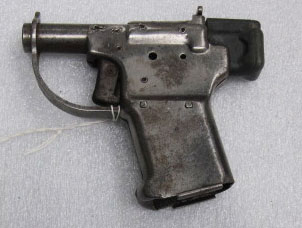
An original Liberator is a difficult object to conserve precisely because it was built to be disposable. Thin stamped low-carbon steel, minimal or no protective finish, and — for a complete kit — flimsy paper and cardboard ephemera are exactly the materials that do not age gracefully. The conservation goal is therefore arrest, don’t restore: stabilize the piece as it is, protect it from further deterioration, and resist every temptation to make it look new. This volume covers preserving the metal, storage, the ethics of not refinishing, and displaying the pistol with its instruction sheet. It is written for a maker fully capable of re-bluing or re-welding this gun — which is exactly why the central message is don’t.
9.1 Understand What You Are Preserving
The Liberator’s construction (Vol 3, Vol 4) dictates its conservation needs. It is stamped and drawn low-carbon sheet steel joined by crude spot-welds, with a die-cast zinc cocking piece and originally little in the way of protective finish. Each of those materials has its own vulnerability:
- Thin sheet steel has a high surface-area-to-mass ratio, so active rust does proportionally more damage faster than it would on a heavy forged part. There is not much metal to lose.
- Crude welds are stress risers and can be sites where finish is thin or absent, so they corrode preferentially.
- Die-cast zinc is prone to its own slow degradation (zinc pest/intergranular corrosion in poor castings) and does not want to be treated like steel — no aggressive abrasives, no harsh chemistry.
- Original finish, where any survives, is part of the artifact’s value (Vol 6: “condition matters less than originality”), so cleaning must never remove it.
9.2 Preserving the Metal
The conservation approach for stamped sheet steel is conservative and reversible:
- Stabilize the environment first. Corrosion is driven by humidity; controlling storage conditions (below) does more good than any surface treatment.
- Clean minimally. Remove loose dirt and active red rust gently — a light oil and a soft cloth or, at most, a non-abrasive approach — and stop there. Do not strip, bead-blast, wire-wheel, or abrasive-clean; on thin sheet with original finish those operations destroy exactly what makes the piece original.
- Protect with a reversible barrier. A light film of a conservation-grade oil or microcrystalline wax is appropriate; both are removable and neither changes the appearance. Avoid anything that bonds permanently or alters color.
- Leave the zinc cocking piece alone beyond gentle dusting and a wax barrier — no abrasives, no aggressive chemistry.
The governing principle is reversibility: any treatment you apply should be undoable by a future conservator, and none should remove original material or finish.
9.3 Storage
Because the failure mode is corrosion of thin steel, storage is the highest-leverage intervention:
- Control humidity. Stable, moderate relative humidity is the single most important factor; desiccant in a sealed case and/or a climate-controlled room. Avoid damp basements and unheated outbuildings.
- Avoid corrosive contact. Keep the pistol out of untreated leather, felt, or foam that can off-gas or trap moisture against the steel; use inert, archival materials.
- Handle with clean, dry hands or gloves. Skin oils and salts drive fingerprint etching on bare steel.
- Separate dissimilar materials. Store the paper ephemera (below) in its own archival protection rather than pressed against oiled metal.
9.4 The Paper Is Harder Than the Gun
For a complete kit, the instruction sheet, box label, and cardboard are more fragile and more conservation-sensitive than the pistol — and, per Vol 5 and Vol 6, they carry a large share of the value. Treat them as archival paper artifacts: acid-free enclosures, no lamination (lamination is irreversible and destroys collector value), no tape or adhesives, stable low humidity, and minimal light exposure. The wooden dowel is similarly humble and similarly easy to lose or damage; store it with the kit, not loose.
9.5 The Ethics of Not Refinishing
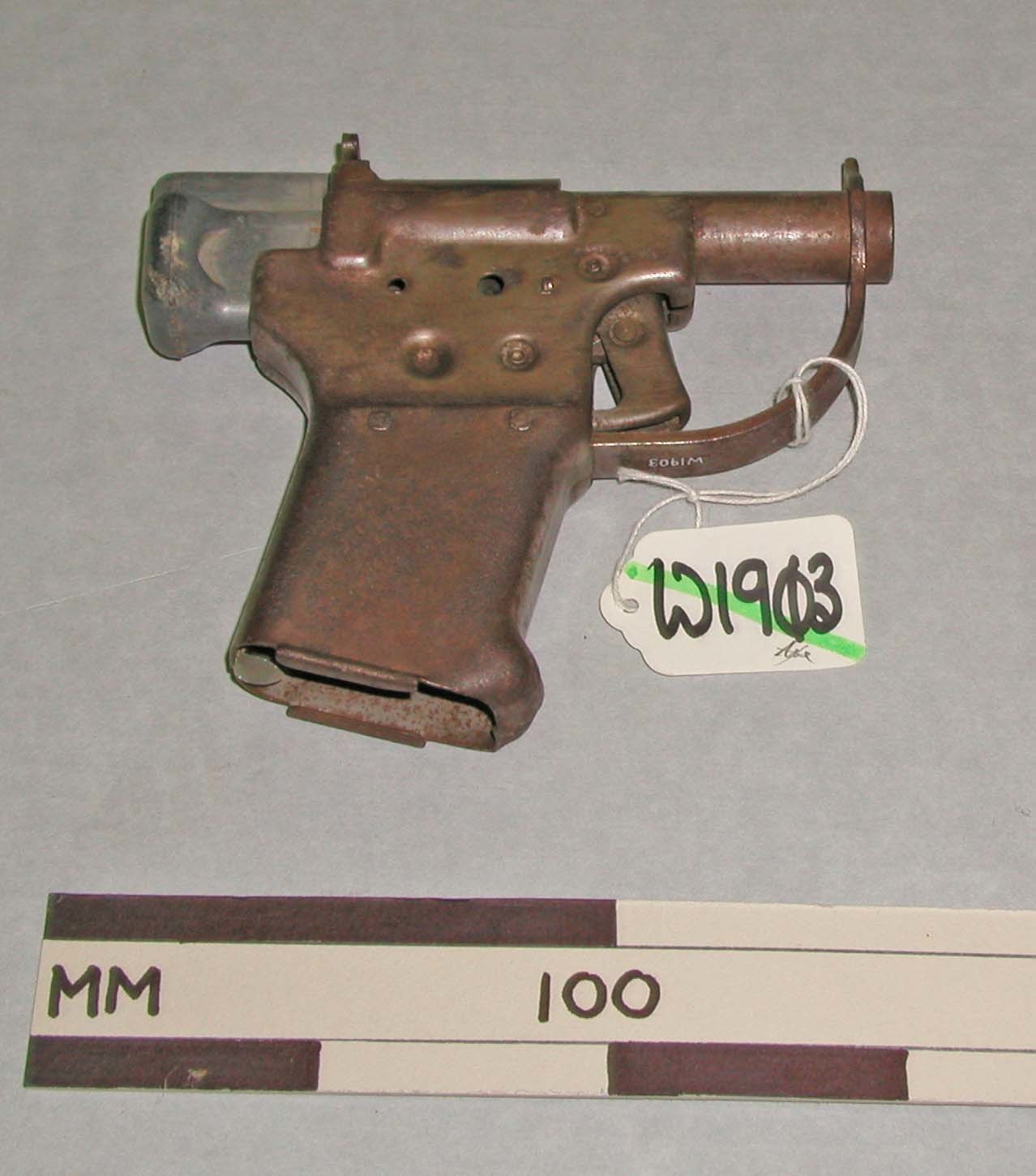
This is the heart of the volume, and it runs against a gunsmith’s instincts. A capable shop can make this gun look better — re-blue it, dress the welds, clean up the zinc casting. Doing so destroys the artifact. The market has already rendered its verdict: for the Liberator, originality outweighs condition — a crude, unmarked, original-finish pistol is worth more than a “restored” one, because the crudeness is the history (Vol 6).1 Refinishing:
- Removes original material and finish, which cannot be put back.
- Erases authentication tells (Vol 5) — the crude welds, rough zinc, and unmarked surfaces that prove the piece is genuine.
- Reduces, not increases, value — a refinished Liberator reads as either a damaged original or a suspected fake.
The correct posture for a genuine original is arrest and stabilize, never restore. If a piece is so far gone that it needs structural intervention to survive, that is conservation work for a specialist, documented and reversible — not a weekend re-blue.
9.6 Displaying It Right
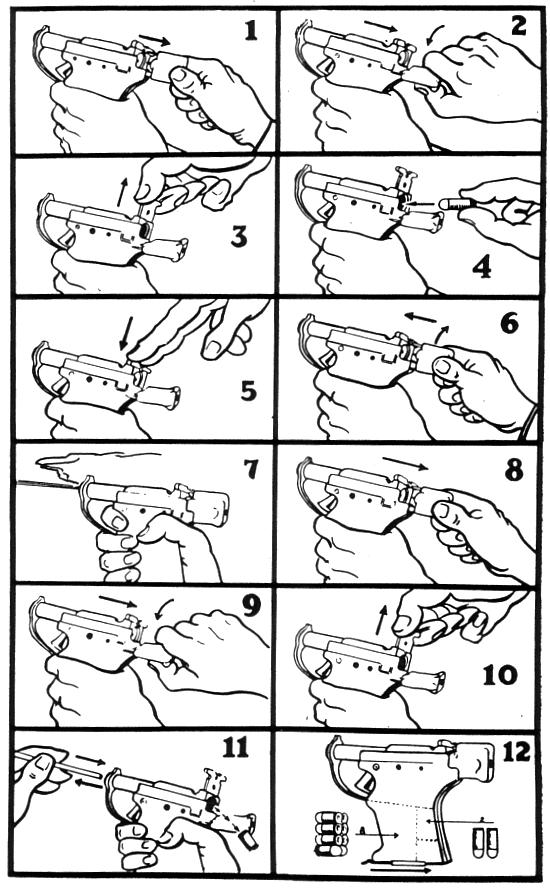
The Liberator displays best as what it was: a complete kit, not a bare gun. Show the pistol with its instruction sheet (and box and dowel, if present) — the wordless comic-strip sheet is half the story and the most evocative single object in the kit (Vol 4). Practical display guidance follows from the conservation points above:
- Low, non-UV light. Both the steel’s finish and especially the paper degrade under UV; use low-UV lighting and keep levels modest.
- Stable humidity in the display case, with archival mounts that do not press adhesives or acidic materials against either metal or paper.
- Support the paper flat in an acid-free mount rather than folding it to fit.
- Include the context, not just the object — a display that pairs the pistol, the sheet, and a line about the real distribution history (Vol 2) tells a truer story than the gun alone.
Displayed this way, an original Liberator is one of the more compelling small objects in a WWII collection: cheap, crude, disposable, and — because so few of a million survive intact — genuinely rare.
9.7 Bibliography
Footnotes
-
“World War II ‘Liberator’ Pistol.” American Rifleman (NRA) — for the “condition matters less than originality” market observation. https://www.americanrifleman.org/content/world-war-ii-liberator-pistol/ ↩
Comments (0)