FP-45 Liberator · Volume 10
Cheatsheet
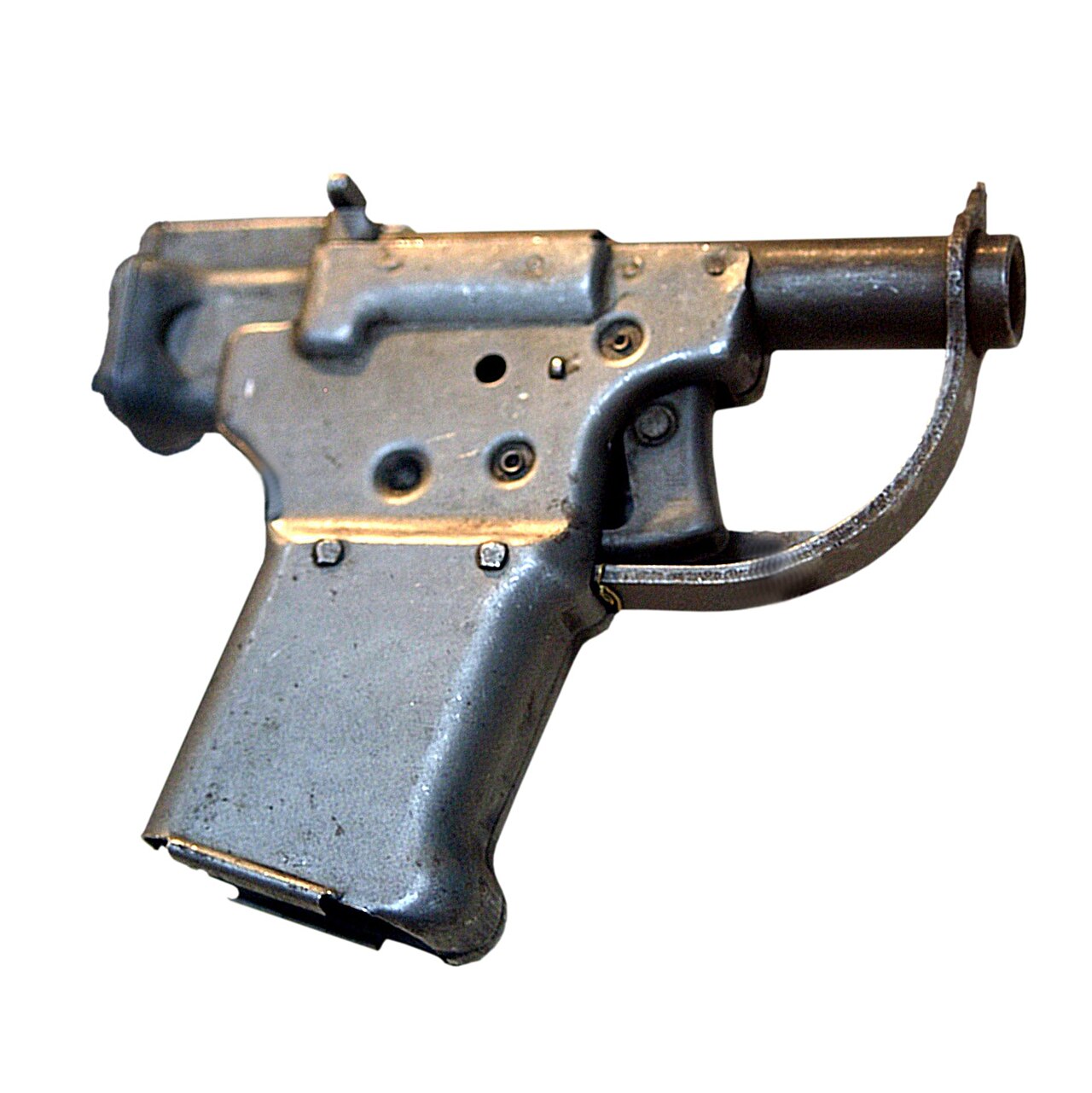
This is the laminate-ready synthesis: the specifications, the timeline, the legal decision tree, the value table, and the source URLs, condensed for quick reference. Every figure here is drawn from the earlier volumes; where a value is uncertain it is marked typical/approx, and where a claim is unsettled it says so. For the reasoning behind any line, follow the cross-reference to its volume.
10.1 Specifications
Table 1 — Specifications
| Spec | Value | Note |
|---|---|---|
| Type | Single-shot, breech-loading pistol | Manually cocked striker, no hammer (Vol 3) |
| Caliber | .45 ACP | Fixed pistol cartridge — not a shotgun shell |
| Barrel | 4 in (100 mm), smoothbore | No rifling; bore ~.450 in on originals |
| Overall length | ~5.5 in | Smithsonian: 5-1/2 × 4-5/8 × 1-1/8 in |
| Weight | ~1 lb (450 g) unloaded | |
| Parts count | 23 | Mostly stamped sheet steel + 1 zinc die-cast cocking piece |
| Spare ammo storage | 10 rounds in grip cavity | Not 5 |
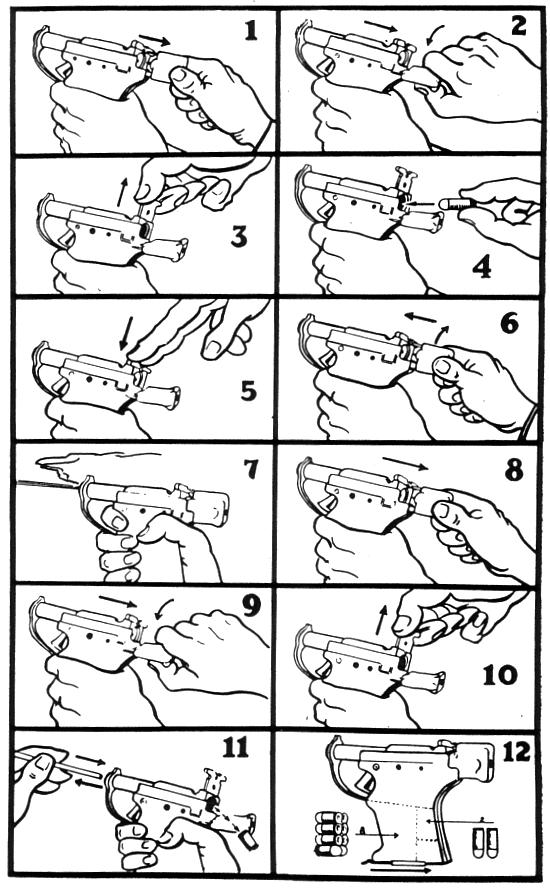
| Extraction | Wooden dowel down the bore | No mechanical extractor |
| Trigger pull | ~10–11 lb | typical/approx, single-source |
| Muzzle velocity | ~820 ft/s (250 m/s) | Single-sourced (Wikipedia); reasonably reliable, not corroborated |
| Effective range | A few yards; useful grouping ~6 yd | Sources vary widely — see spread below |
| Unit cost (1942) | Modern-dollar equivalents approx | |
| Safety | Rotated position of the cocking piece | The only “safety”; not a separate part |
Effective-range spread (no single authoritative number, Vol 8): Wikipedia 1–4 yd / ~25 ft; American Rifleman “<50 ft”; Alderfer “~25 ft”; measured useful grouping ~6 yd, “clearly beyond useful range” by 20 yd.
10.2 Timeline
Table 2 — Timeline
| Date | Event |
|---|---|
| March 1942 | Concept attributed to a Polish military attaché; taken up by the Joint Psychological Warfare Committee, backed by Gen. Marshall |
| Early May 1942 | George Hyde (Inland Div., GM) submits ~5 prototypes; approved by Army Ordnance |
| ~May 15, 1942 | Order for 1,000,000 units placed with Guide Lamp Div., Anderson, Indiana |
| June–Aug 1942 | Entire run built in ~11 weeks, ~300 workers, ~6.6 sec labor/pistol |
| Aug 1943 | ~100,000 shipped to Jorhat, India (onward to China) |
| 1944 | ~200,000 to Calcutta; small OSS distribution to Greece; MacArthur receives ~50,000 for the Pacific |
| Postwar | Most never issued; >500,000 melted down or dumped at sea |
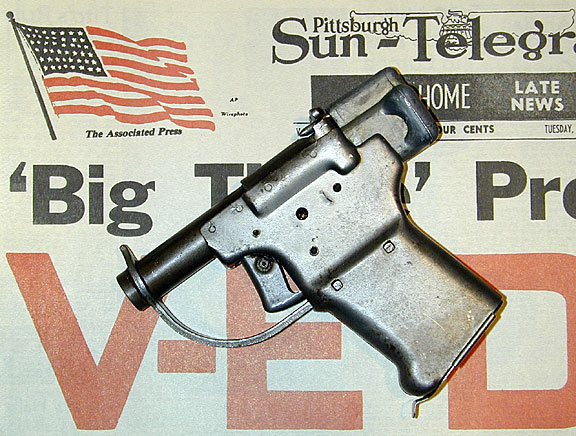
Distribution reality: the mass European air-drop was rejected by Eisenhower’s command; ~25,000 of ~500,000 kept for possible emergency use; no written evidence of significant distribution in France. Largest actual theater = China/CBI, then the Pacific (Vol 2).
10.3 Legal Decision Tree (Vol 7 — not legal advice)
Is it an ORIGINAL (smoothbore, unserialized)?
├─ YES → Almost certainly an NFA "Any Other Weapon" (AOW)
│        under the GENERAL concealable-weapon clause of 26 U.S.C. § 5845(e)
│        (NOT the "fixed shotgun shell" clause — .45 ACP is not a shotgun shell;
│         fails the "rifled bore" exclusion because the bore is smooth).
│   ├─ C&R eligible? YES (1942, >50 yr) — but C&R does NOT exempt it from the NFA.
│   ├─ Antique exemption? NO (1942, fixed in-production .45 ACP).
│   ├─ THE decisive question: is THIS specimen registered on the NFRTR?
│   │   ├─ Registered → transferable on Form 4 (historically $5 tax; see 2026 note).
│   │   └─ Unregistered → contraband; illegal regardless of C&R status.
│   └─ UNRESOLVED: statute says AOW, but some dealers advertise originals as
│       ordinary "C&R OK" sales; no ATF ruling letter names the FP-45. Confirm
│       registration per specimen, in writing, with an FFL/SOT and/or NFA attorney.
└─ NO — modern REPRODUCTION (rifled, serialized) → ordinary Title I firearm,
         NOT an AOW. The simple path. See /replicas/pistols/fp-45-liberator-replica/.
Tax note (flagged, recent): the historical AOW transfer tax is $5 (vs. $200 for most NFA categories). Per the brief for this series, the NFA making/transfer tax for AOWs was reduced to $0 effective 2026-01-01 under recent federal legislation — this is not in the primary research file; confirm against 27 CFR Part 479 and current ATF guidance. Either way, the registration/Form 4 process still applies.
10.4 Value Table (Vol 6; all typical/approx)
Table 3 — Value Table ([Vol 6](/actual-firearms/pistols/fp-45-liberator/vol-6/); all typical/approx)
| Item | Value | Confidence |
|---|---|---|
| Loose original pistol (fair-good, original) | ~$2,000–$3,000 | Consistent across sources |
| Original complete kit (pistol+box+sheet+dowel) | ~$1,750–$4,000+ | Upper end for complete/original |
| Original box alone | +$600–$800 | Single source |
| Original instruction sheet alone | +$400–$600 | Single source |
| Auction pre-sale estimates seen | $900–$1,300 to $3,500–$5,500 | Estimates, not realized |
| Modern reproduction (VOCO, rifled/serialized) | ~$500–$775 | Vendor pricing |
Rarity: ~1,000,000 made; fewer than 300 complete boxed examples believed to survive. Originality outweighs condition. Fakes — including faked boxes and sheets — are a documented problem.
10.5 Authentication Quick-Check (Vol 5)
Genuine original = crude breech welds, no markings, no serial number, rough zinc cocking piece, smoothbore ~.450 in bore, no real sights. Modern reproduction = rifled ~.454 in, serialized (front of grip frame), maker/model/caliber marks under the barrel. The bore is the single most diagnostic feature: smooth = original (an NFA question) or illegal copy; rifled = lawful reproduction.
10.6 Handling (Vol 8)
Don’t fire an original. Documented progressive metal fatigue: with 230-gr jacketed ball, visible cover-slide/tube-strap bowing after ~27 rounds (one documented test; stopped at 35 as unsafe); low-power cast loads went ~50–70 rounds. Excessive headspace (up to 0.020 in), no heat treatment, “half hard” cover slide. Every factory unit was proof-fired; some fired up to 50× in QC. Accuracy is essentially nil past a few yards.
10.7 Source URLs
- FP-45 Liberator — Wikipedia: https://en.wikipedia.org/wiki/FP-45_Liberator
- “The Liberator Pistol” — American Rifleman: https://www.americanrifleman.org/content/the-liberator-pistol/
- “World War II ‘Liberator’ Pistol” — American Rifleman: https://www.americanrifleman.org/content/world-war-ii-liberator-pistol/
- The Armory Life: https://www.thearmorylife.com/the-fp-45-liberator-pistol/
- Alderfer Auction: https://www.alderferauction.com/blog/detail/the-fp-45-liberator-a-crude-but-effective-weapon-of-resistance
- Vintage Ordnance — brief history: https://vintageordnance.com/brief-history-of-the-fp-45-liberator-pistol/
- Vintage Ordnance — firing the original: https://vintageordnance.com/firing-the-original-fp-45-liberator-pistol/
- Vintage Ordnance — reproductions: https://vintageordnance.com/product-category/fp-45-liberator/
- George Hyde (gun designer) — Wikipedia: https://en.wikipedia.org/wiki/George_Hyde_(gun_designer)
- 26 U.S.C. § 5845 — Cornell LII: https://www.law.cornell.edu/uscode/text/26/5845
- 27 CFR § 479.11 — Cornell LII: https://www.law.cornell.edu/cfr/text/27/479.11
- Curio & Relic classification — LegalClarity: https://legalclarity.org/curio-and-relic-firearms-atf-classification-rulings/
- AOW overview — NationalFirearmsAct.com: https://nationalfirearmsact.com/nfa-regulated-items/any-other-weapon-aow/
- AOW overview — Silencer Central: https://www.silencercentral.com/blog/any-other-weapon/
- FP-45 Liberator — Guns Wiki (Fandom): https://guns.fandom.com/wiki/FP-45_Liberator
- Smithsonian NMAH object nmah_417898: https://americanhistory.si.edu/collections/object/nmah_417898
- Imperial War Museums object 30036235: https://www.iwm.org.uk/collections/item/object/30036235
- Wikimedia Commons category: https://commons.wikimedia.org/wiki/Category:FP-45_Liberator
10.8 Related
- Reproduction / buildable path:
/replicas/pistols/fp-45-liberator-replica/ - Hub legal & ethics framing: the hub’s legal-posture notes
10.9 Bibliography
All facts in this cheatsheet are synthesized from Volumes 1–9; primary and secondary sources are listed under “Source URLs” above and cited in full in the bibliographies of the respective volumes.
Comments (0)