FP-45 Liberator · Volume 1
Overview & Why This Gun Matters
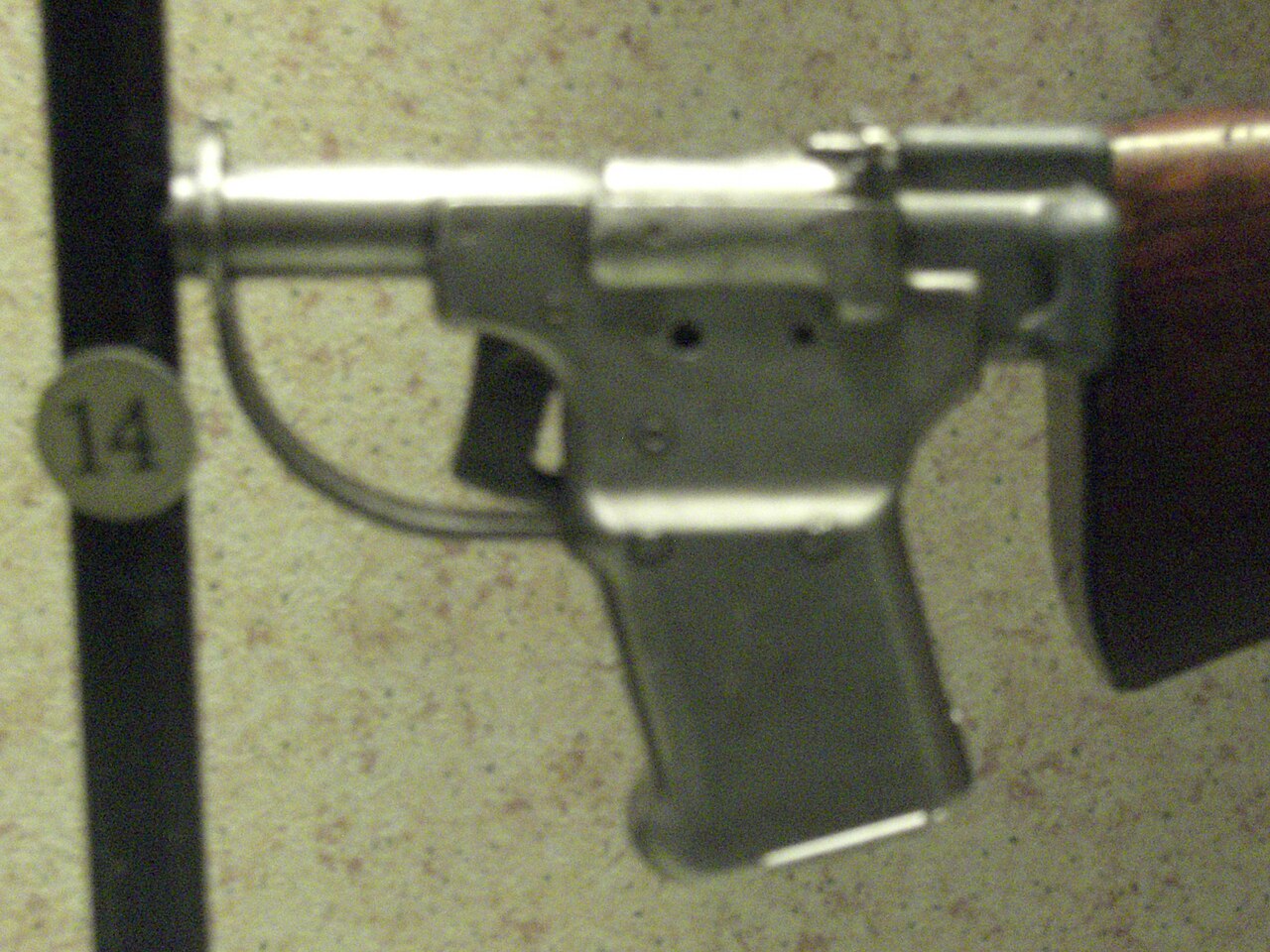
The FP-45 Liberator is the cheapest, crudest, most cynical pistol the United States ever mass-produced, and that is precisely why it is worth a ten-volume deep dive. It is a single-shot .45 ACP pistol stamped out of sheet steel in about eleven weeks in the summer of 1942, a million of them, at a unit cost most often cited as $2.10 for the complete boxed kit.12 It has almost no machined parts, no rifling, no serial number, no real sights, and a “safety” that is the same part you cock it with. It was never meant to be a good gun. It was meant to be a disposable one — handed to a resistance fighter so they could kill an occupying soldier at arm’s length and take his rifle. Everything about the object flows from that single design intent, and once that intent is understood, every crude feature stops looking like a defect and starts looking like an answer.
This first volume sets the stage: what the gun is, why it matters as an engineering and historical artifact, and — because the Liberator is buried in more myth than almost any other WWII small arm — which of the famous “facts” about it are actually true. The rest of the series then takes each thread apart in detail.
1.1 What It Actually Is
Strip away the legend and the FP-45 is a remarkably honest piece of production engineering. It is a single-shot, breech-loading .45 ACP pistol with a 4-inch (100 mm) smoothbore barrel, roughly 5.5 inches overall and about 1 lb (450 g) unloaded.13 It is built from 23 parts, nearly all of them stamped or drawn sheet steel, plus a single die-cast zinc cocking piece.12 The Smithsonian’s own catalog record gives the overall envelope as 5-1/2 in by 4-5/8 in by 1-1/8 in.4
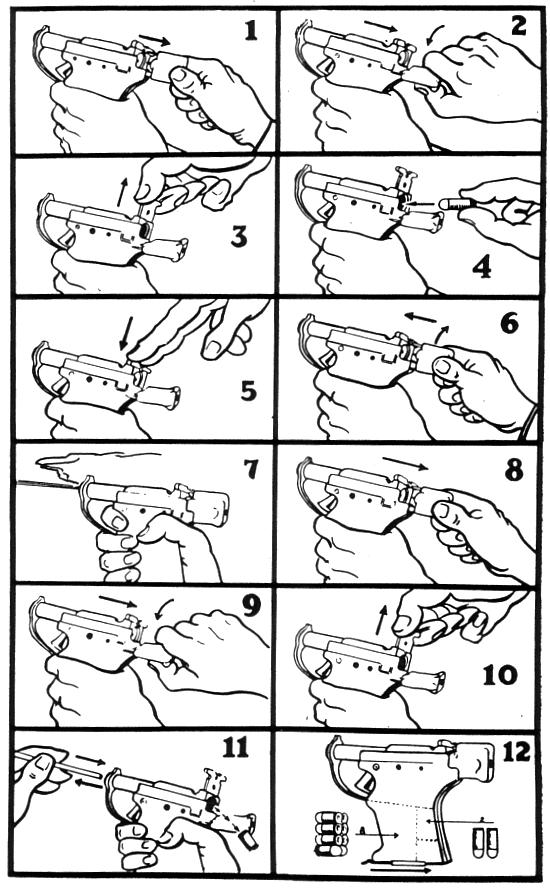
You load it by rotating and lifting a cocking piece at the rear, dropping a single cartridge into the chamber, closing it, and rotating the piece back in line to cock the striker. You fire it with a heavy trigger pull. You extract the spent case by shoving a wooden dowel down the bore from the muzzle. Ten spare rounds ride loose in a cavity in the grip. That is the entire manual of arms, and it was communicated to recipients — many illiterate, most non-English-speaking — with a wordless comic-strip instruction sheet in the box.12 Vol 3 walks the mechanism in full; Vol 4 covers how it was made.
1.2 Why It Matters
Three things make the Liberator worth this much attention, and none of them is that it was a good weapon.
It is the high-water mark of “arm the maximum number of people for minimum cost and time.” The design brief was to produce a firearm so cheaply that a million could be made almost overnight, using unskilled labor and light stamping machinery instead of gunsmiths and machine tools. The result — 23 stamped parts, ~$2.10 a unit, ~11 weeks for the whole run, a reported 6.6 seconds of labor per pistol across ~300 workers — is an object lesson in wartime production engineering that has few equals.12 Vol 2 tells that story.
It is a genuinely difficult collectible. Because so few of the million produced survive relative to that huge number, and because complete boxed kits (pistol, box, instruction sheet, and dowel all matching) are believed to number fewer than 300, the Liberator is one of the more actively faked pieces in the militaria market.56 Vol 5 and Vol 6 cover identification, variants, and buying.
It sits in an unusually thorny legal box. An original is a concealable smoothbore handgun, and that combination lands it squarely in the NFA “Any Other Weapon” category — a fact that a surprising amount of gun-press writing gets subtly wrong. Vol 7 is the heaviest volume in the series precisely because the legal posture is both important and genuinely unsettled. If you take nothing else from this deep dive before handling an acquisition, take Volume 7.
1.3 Myth vs. Fact, Up Front
The Liberator attracts folklore, and the folklore is load-bearing enough that it is worth clearing before going further.
Table 1 — Myth vs. Fact, Up Front
| Common claim | Reality |
|---|---|
| ”They were air-dropped all over occupied Europe to the French Resistance.” | Substantially a myth. ~500,000 went to Britain nominally for France, but Eisenhower’s command rejected the mass air-drop plan; only ~25,000 were kept for possible emergency use, and there is no written evidence the FP-45 was ever distributed in any significant quantity in France.23 See Vol 2. |
| ”It holds 5 spare rounds in the grip.” | 10 rounds, not 5 — corroborated by Wikipedia, IWM, and American Rifleman/RIA material.12 |
| ”It’s a rifled pistol / it fires a shotgun shell.” | Neither. Smoothbore barrel, chambered for .45 ACP — an ordinary pistol cartridge, not a shotgun shell. This distinction is the whole crux of Vol 7. |
| ”C&R status makes it legal to just buy like any old gun.” | Oversimplified and, on the NFA angle, misleading. C&R eligibility does not exempt an AOW from NFA rules — Vol 7 untangles this. |
| ”The SOE dismissed it as useless.” | Widely repeated, but not traceable to any primary SOE source located in research. Treat as unverified folklore, not fact. |
The single most important habit for this piece is refusing to repeat the comfortable story. The Liberator was not the pistol of the French maquis; its real theater was the Pacific and, above all, China/CBI, which received the largest actual distribution.3 Most of the million were never issued at all — over half a million were melted down or dumped at sea after the war.27
1.4 The Original vs. the Reproduction
One structural fact shapes everything downstream, including the legal chapter: the original is not the same object as the modern reproduction, legally or physically. Original wartime pistols are smoothbore and unserialized. Modern reproductions — most prominently Vintage Ordnance Company’s “VOCO” line — are legally required to be rifled and serialized specifically so they are ordinary Title I firearms rather than NFA AOWs.68 That means “the Liberator” is really two different regulatory animals wearing the same silhouette. This series is about the original; the buildable/reproduction path is a separate deep dive at /replicas/pistols/fp-45-liberator-replica/, and the general firearms legal framing lives in the hub’s legal-posture notes.
1.5 What the Rest of This Series Covers
Vol 2 is the history — the Joint Psychological Warfare Committee, George Hyde, the Guide Lamp production run, and the distribution truth. Vol 3 is how it works, mechanism and sequence of operation. Vol 4 is how they were made — stamping, cost, the instruction sheet, packaging. Vol 5 is identification, variants, and markings; Vol 6 is collecting and where to buy. Vol 7 is the legal and regulatory posture — the AOW analysis and its unresolved edges. Vol 8 is live fire and handling (and why you should not); Vol 9 is conservation and display; Vol 10 is a laminate-ready cheatsheet. Where a figure is uncertain or source-dependent, it is flagged typical/approx in the text.
1.6 Bibliography
Footnotes
-
FP-45 Liberator. Wikipedia. https://en.wikipedia.org/wiki/FP-45_Liberator ↩ ↩2 ↩3 ↩4 ↩5 ↩6
-
“The Liberator Pistol.” American Rifleman (NRA). https://www.americanrifleman.org/content/the-liberator-pistol/ ↩ ↩2 ↩3 ↩4 ↩5 ↩6 ↩7
-
“The FP-45 Liberator Pistol.” The Armory Life. https://www.thearmorylife.com/the-fp-45-liberator-pistol/ ↩ ↩2 ↩3
-
“FP-45 Liberator Single Shot Pistol,” object nmah_417898, Smithsonian National Museum of American History. https://americanhistory.si.edu/collections/object/nmah_417898 ↩
-
“Brief History of the FP-45 Liberator Pistol.” Vintage Ordnance Co. https://vintageordnance.com/brief-history-of-the-fp-45-liberator-pistol/ ↩
-
Authentication features summarized from Vintage Ordnance / collector-market discussion; the underlying detailed reference is cited by secondary sources as Man At Arms, Vol. 35 No. 2 (April 2013), p. 39 — bibliographic detail not independently confirmed in research. ↩ ↩2
-
“World War II ‘Liberator’ Pistol.” American Rifleman (NRA). https://www.americanrifleman.org/content/world-war-ii-liberator-pistol/ ↩
-
FP-45 Liberator. Guns Wiki (Fandom). https://guns.fandom.com/wiki/FP-45_Liberator ↩
Comments (0)