FP-45 Liberator · Volume 2
History & the OSS Program
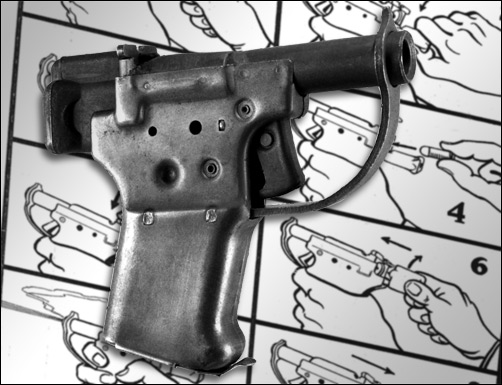
The Liberator’s history is a better story than its ballistics. It was conceived as psychological warfare as much as armament — a weapon whose value was less in what it could do to an enemy soldier than in what the possibility of a million armed civilians could do to an occupier’s peace of mind. This volume traces the program from its origin in the spring of 1942 through the production sprint at Guide Lamp, and then confronts the part everyone gets wrong: where the guns actually went. The popular image — Liberators raining onto occupied France for the Resistance — is largely a myth, and correcting it is the point of the second half of this volume.
2.1 Origin, Spring 1942
The concept traces to a request in March 1942 attributed to a Polish military attaché, to arm resistance fighters in occupied Europe with something cheap and abundant.123 The U.S. Army’s Joint Psychological Warfare Committee picked up the idea within about two weeks, with the backing of Army Chief of Staff General George C. Marshall.13 (Sources render the committee’s name variously as “Joint Psychological Committee” and “Joint Psychological Warfare Committee”; the latter is the fuller and more consistent form.) The logic was psychological warfare in the literal sense: a weapon so cheap it could be scattered by the hundreds of thousands would force an occupying force to treat every civilian as a potential threat.
2.2 The Designer and the Cover Name
The design is credited to George J. Hyde, the chief/lead designer for the Inland Manufacturing Division of General Motors in Dayton, Ohio — the same engineer later associated (with Frederick W. Sampson) with the M3 “Grease Gun” submachine gun.134 The work reportedly happened in a very small room at the Inland facility, and five prototypes were submitted to Army Ordnance and approved in early May 1942.13
One secondary source (The Armory Life) states Hyde designed the pistol while working directly for Guide Lamp rather than Inland; the more consistent account is that Inland designed it and Guide Lamp manufactured it — Inland itself being tied up producing M1 Carbines.23 Treat the Inland-designs / Guide-Lamp-builds version as the better-supported one.
The name itself was a cover story. Officially the pistol was the “Flare Projector, Caliber .45” — hence FP-45 — so that shop-floor workers, shipping manifests, and any leaked paperwork would read as a signaling device rather than a gun.13 Internal Guide Lamp engineering drawings reportedly went further, using code words: the barrel was a “tube,” the trigger a “yoke,” the firing pin a “control rod,” the trigger guard a “spanner.”13
2.3 The Production Sprint at Guide Lamp
The order — for 1,000,000 units — was placed around May 15, 1942, and the entire run was built by the Guide Lamp Division of General Motors in Anderson, Indiana.13 Production ran roughly June–August 1942, with the bulk of assembly done in about 11 weeks (commonly cited as ~10–11 weeks) by about 300 workers, at a reported average of 6.6 seconds of labor per pistol.135 The million-in-eleven-weeks figure is corroborated across Wikipedia, American Rifleman, and Rock Island Auction’s material, so it is well supported — though it is a widely repeated round number rather than an audited production ledger.
The unit cost is most often cited at $2.10 for the complete boxed kit; American Rifleman separately breaks out $1.73 as the manufacturing cost of the pistol alone.13 Inflation-adjusted figures vary by source and conversion year (roughly $32–$42 in present-day dollars); treat any specific modern-dollar figure as approximate. Vol 4 covers how $2.10 was possible.
2.4 The Distribution Truth — Correcting the Europe Myth
Here is where the folklore and the record part ways. The image of Liberators air-dropped across occupied France is substantially a myth.
Europe / France. Roughly 500,000 units were shipped to Britain, nominally for the French Resistance. But General Eisenhower’s command rejected the mass air-drop plan as a poor use of scarce Allied air-transport capacity; only on the order of 25,000 of the 500,000 were deemed acceptable for possible emergency use. As the record stands, “there is no written evidence showing that the FP-45 was ever distributed in any significant quantity in France.” Most of the European allocation was never distributed and was later dumped at sea or scrapped.32
China / CBI — the real theater. The largest actual distribution was to the China–Burma–India theater: roughly 100,000 in an August 1943 shipment to Jorhat, India (onward for China), and a further ~200,000-unit shipment reaching Calcutta in July 1944, with sub-allocations including ~40,000 to Ceylon and ~44,000 to Burma. Remaining CBI stocks were reportedly destroyed postwar; exactly how many reached Chinese hands versus were diverted locally is not well documented.2
Pacific / Philippines. General MacArthur requested and received on the order of 50,000 units; he reported using an initial ~8,000 to arm native villagers on Tulagi and Guadalcanal in the Solomons. Smaller numbers reached the Philippine Commonwealth Army, the Philippine Constabulary, and Filipino guerrillas, some apparently delivered by submarine.23
Greece. The OSS reportedly distributed a small number to Greek resistance fighters in 1944.26
Documented use is extremely thin. The sources come back again and again to essentially one well-known wartime photograph — a pistol tucked in a man’s waistband in Kunming, China — plus a small handful of first- or second-hand anecdotes. Named-individual accounts (for example, a German military policeman’s story of an assassination) trace to single popular retellings rather than primary military records, and should be treated as unverified.1 Likewise, the frequently repeated claim that the SOE formally judged the weapon “useless” could not be substantiated in any primary British source; do not repeat it as fact.
2.5 Postwar Fate
The large majority of the million produced were never issued. Commonly cited: more than half a million were melted down or dumped in the ocean after the war; American Rifleman separately states that roughly 383,000 were sent to active theaters with no record of their return, implying the remainder — well over half a million — never left U.S. custody and were destroyed outright.35 The upshot for collectors (Vol 6) is stark: a million were made, and survivors are prized precisely because so few of that million remain.
2.6 Bibliography
Footnotes
-
FP-45 Liberator. Wikipedia. https://en.wikipedia.org/wiki/FP-45_Liberator ↩ ↩2 ↩3 ↩4 ↩5 ↩6 ↩7 ↩8 ↩9 ↩10
-
“The FP-45 Liberator Pistol.” The Armory Life. https://www.thearmorylife.com/the-fp-45-liberator-pistol/ ↩ ↩2 ↩3 ↩4 ↩5 ↩6
-
“The Liberator Pistol.” American Rifleman (NRA). https://www.americanrifleman.org/content/the-liberator-pistol/ ↩ ↩2 ↩3 ↩4 ↩5 ↩6 ↩7 ↩8 ↩9 ↩10 ↩11 ↩12 ↩13
-
George Hyde (gun designer). Wikipedia. https://en.wikipedia.org/wiki/George_Hyde_(gun_designer) ↩
-
“World War II ‘Liberator’ Pistol.” American Rifleman (NRA). https://www.americanrifleman.org/content/world-war-ii-liberator-pistol/ ↩ ↩2
-
“The FP-45 Liberator: A Crude but Effective Weapon of Resistance.” Alderfer Auction. https://www.alderferauction.com/blog/detail/the-fp-45-liberator-a-crude-but-effective-weapon-of-resistance ↩
Comments (0)