FP-45 Liberator · Volume 5
Identification, Variants & Markings
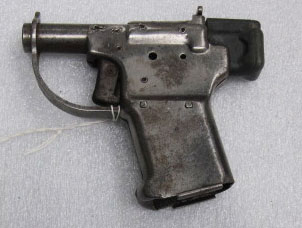
Identifying a genuine wartime FP-45 is an unusual problem because the thing that normally identifies a firearm — its markings — is exactly what an original lacks. There is no serial number, no maker’s stamp, no model designation on the gun. Authentication therefore runs on the opposite logic from most collecting: you are not matching stampings, you are reading crudeness, and you are leaning heavily on the paper and packaging that came with it. This volume covers what an original looks like, the collector “Model 1/2/3” progression, how to separate genuine from reproduction, and why the box and instruction sheet are the rarest and most decisive parts.
5.1 Originals Are Essentially Unmarked
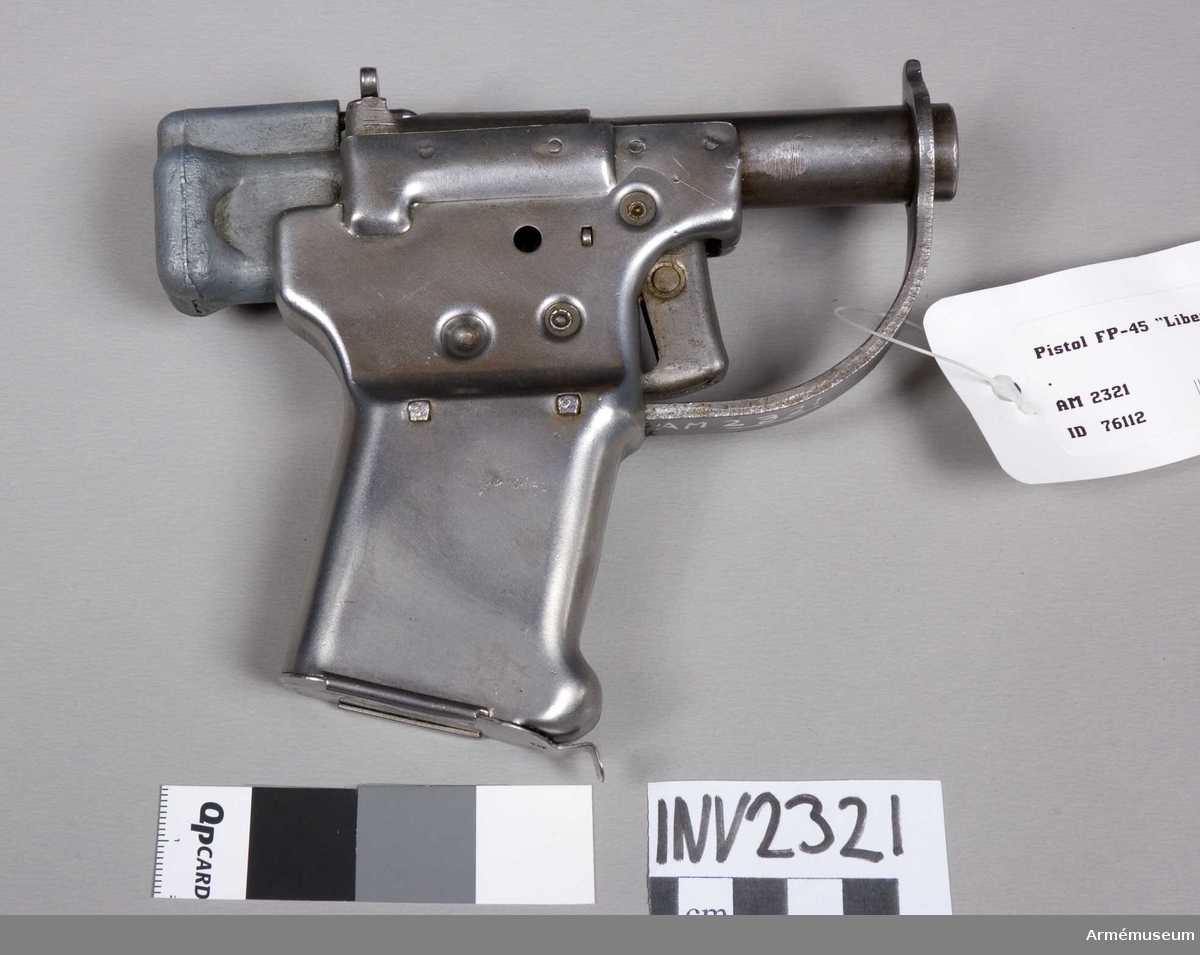
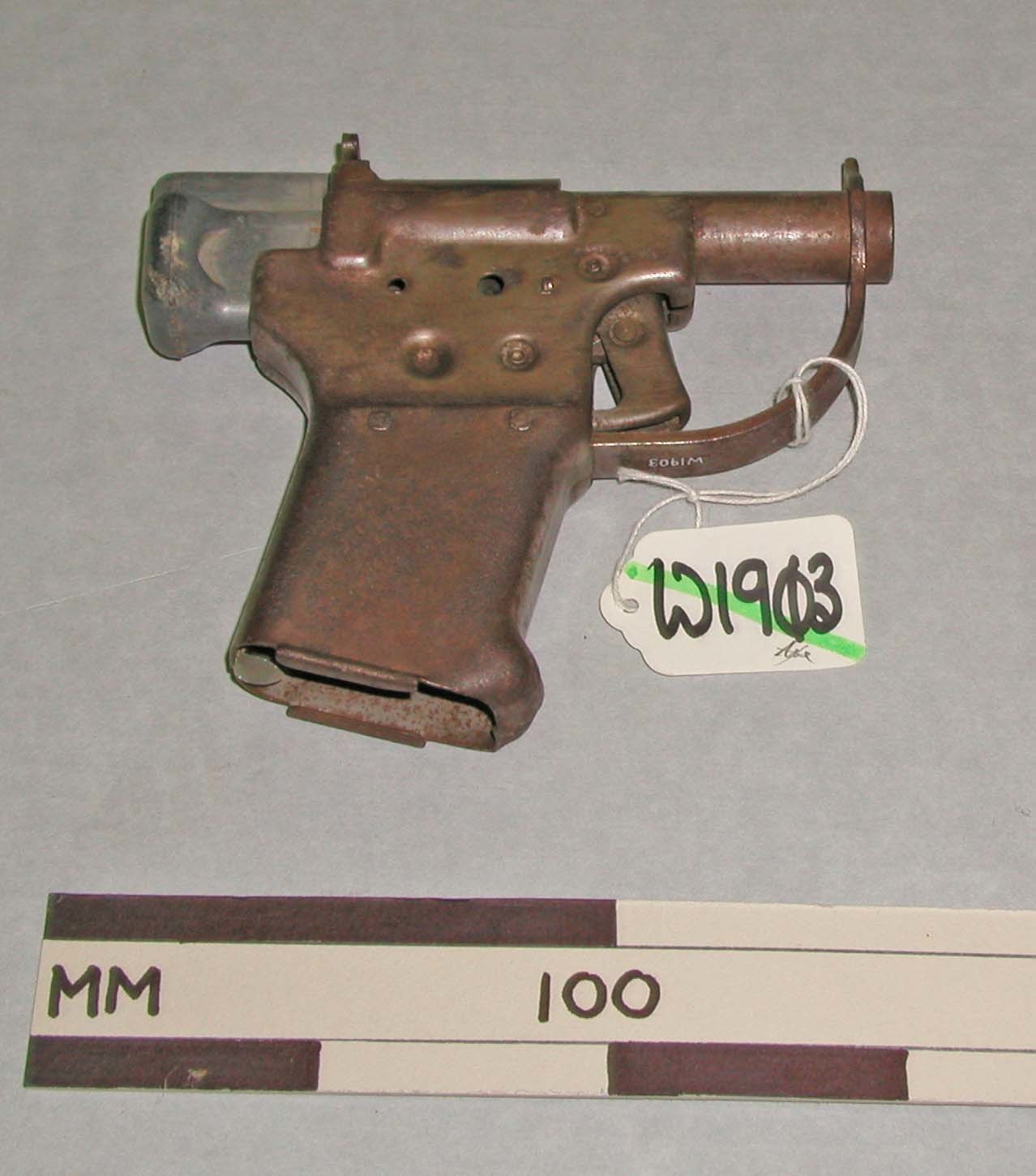
An original wartime Liberator is, in most cases, externally unmarked: no serial number, no visible manufacturer’s mark, no model designation.12 This was a deliberate byproduct of the secrecy program — the whole point of the “Flare Projector” cover (Vol 2) was that nothing on the object or its paperwork should identify it as a firearm made by General Motors. For the collector this means the absence of markings is itself a characteristic, not a red flag — but it also means the gun cannot be authenticated by markings, only by construction and provenance.
5.2 Authentication Tells for a Genuine Original
The most detailed public authentication guidance comes from Vintage Ordnance Company, a source that also sells reproductions and therefore has a commercial incentive to be precise about the original-vs-repro line.3 The tells for a genuine WWII-production original are, in essence, that it should look worse than a modern part would:
- Visibly poor, crude welding at the top of the breech — wartime spot-welds, not a clean modern joint.
- No manufacturer markings and no serial number.
- A poorly finished, rough zinc cocking piece — a crude casting, not a refined machined part.
- A .450 in bore diameter on originals, versus .454 in groove-to-groove on at least one modern reproduction line — a measurable, physical differentiator.
- No usable sights, no rifling, generally slow to load, and crude in overall fit and finish.
The single most important secondary reference cited for authentication is Man At Arms, Vol. 35 No. 2 (April 2013), p. 39, described by collectors as the best authentication write-up — but that citation was not independently confirmed in research, so treat the bibliographic detail as unverified even though the magazine itself is real and long-running.3
5.3 The “Model 1 / 2 / 3” Progression
Vintage Ordnance’s historical write-up describes three developmental configurations, useful to know because they explain the design’s few internal changes:2
- Model 1 — the earliest prototype-stage design; the firing pin reportedly sometimes missed the primer entirely, leaving tell-tale dents in the cover slide of surviving samples where the striker failed to align. Never issued.
- Model 2 — added a guide pin atop the cocking piece to fix the alignment problem, but the guide pin itself was fragile and would not hold up under recoil. Never issued.
- Model 3 — the standard, final production configuration actually made in quantity at Guide Lamp, with the cocking piece reinforced by a heavy supporting rib to strengthen the guide-pin mounting point. Virtually every surviving collectible original is a Model 3.
Treat “Model 1/2/3” as collector nomenclature. It is not clear from the sources whether General Motors or Army Ordnance used these designations contemporaneously or whether they are retrospective collector shorthand; the official-versus-retrospective status is unverified.2 Use the terms as a convenient shorthand for the development progression, not as confirmed wartime model numbers.
5.4 Genuine vs. Reproduction
The clean physical line between an original and a lawful modern reproduction is the same line that matters legally (Vol 7):
Table 1 — The clean physical line between an original and a lawful modern reproduction is the same line that matters legally ([Vol 7](/actual-firearms/pistols/fp-45-liberator/vol-7/))
| Feature | Genuine WWII original | Modern reproduction (e.g. VOCO) |
|---|---|---|
| Bore | Smoothbore, ~.450 in | Rifled (~.454 in groove-to-groove on one line) |
| Serial number | None | Serialized (typically on the front of the grip frame) |
| Maker/model marks | None | Company/model/caliber marks (typically under the barrel behind the trigger guard) |
| Welds / finish | Crude wartime spot-welds, rough | Cleaner modern manufacture |
| Cocking piece | Rough zinc casting | Better-finished modern casting |
The rifling and serial number on a reproduction are not cosmetic — they are legally required so the reproduction is an ordinary Title I firearm rather than an NFA AOW (Vol 7).34 That makes the bore itself the single most diagnostic feature: a smooth bore points to either a genuine original (an NFA question) or an illegal unserialized copy; a rifled bore points to a lawful modern reproduction.
5.5 The Box and Sheet Are the Rarest Parts
Because the pistol was disposable and its paper ephemera flimsy, the box and instruction sheet are rarer than the gun — and, being valuable, they are also the most reproduced and faked items (Vol 6). Vintage Ordnance estimates that fewer than 300 complete boxed examples — pistol, original box, instruction sheet, and dowel, all matching — are believed to survive.2 Treat that as an approximate collector estimate rather than an audited census, but it captures the reality: a bare pistol is uncommon; a complete kit is genuinely rare, and its completeness is most of its value.
5.6 Bibliography
Footnotes
-
“Firing the Original FP-45 Liberator Pistol.” Vintage Ordnance Co. https://vintageordnance.com/firing-the-original-fp-45-liberator-pistol/ ↩
-
“Brief History of the FP-45 Liberator Pistol.” Vintage Ordnance Co. https://vintageordnance.com/brief-history-of-the-fp-45-liberator-pistol/ ↩ ↩2 ↩3 ↩4
-
Authentication features summarized from Vintage Ordnance / collector-market discussion; underlying detailed reference cited by secondary sources as Man At Arms, Vol. 35 No. 2 (April 2013), p. 39 — bibliographic detail not independently confirmed in research. ↩ ↩2 ↩3
-
FP-45 Liberator. Guns Wiki (Fandom). https://guns.fandom.com/wiki/FP-45_Liberator ↩
Comments (0)