FP-45 Liberator · Volume 3
How It Works
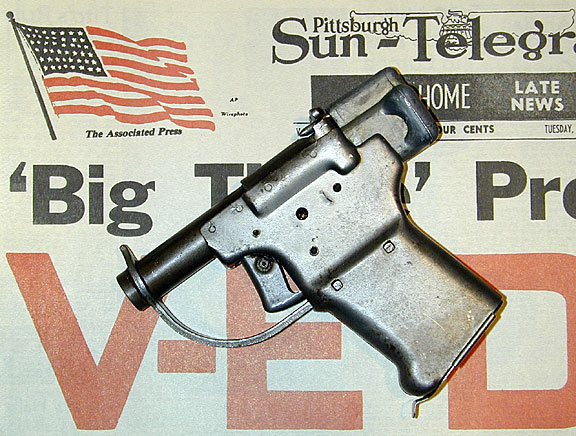
For an experienced hand the Liberator is almost startling in its simplicity — there is genuinely less mechanism here than in a decent single-shot cap pistol. It is a single-shot, breech-loading .45 ACP with a 4-inch smoothbore barrel, a manually cocked striker (there is no hammer), and a “safety” that is not a separate part at all but a position of the cocking piece.12 This volume walks the mechanism and then the full sequence of operation. The mechanism detail below is reconstructed from the operating-instruction material associated with the pistol (liberatorpistol.com) and collector firing writeups; where a specific figure is soft it is flagged.34
3.1 The Parts, and the Ones That Matter
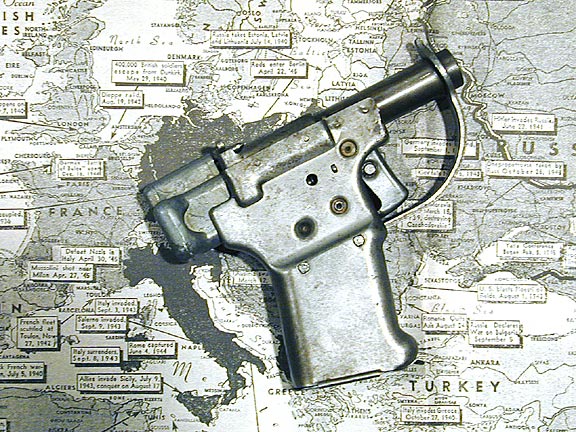
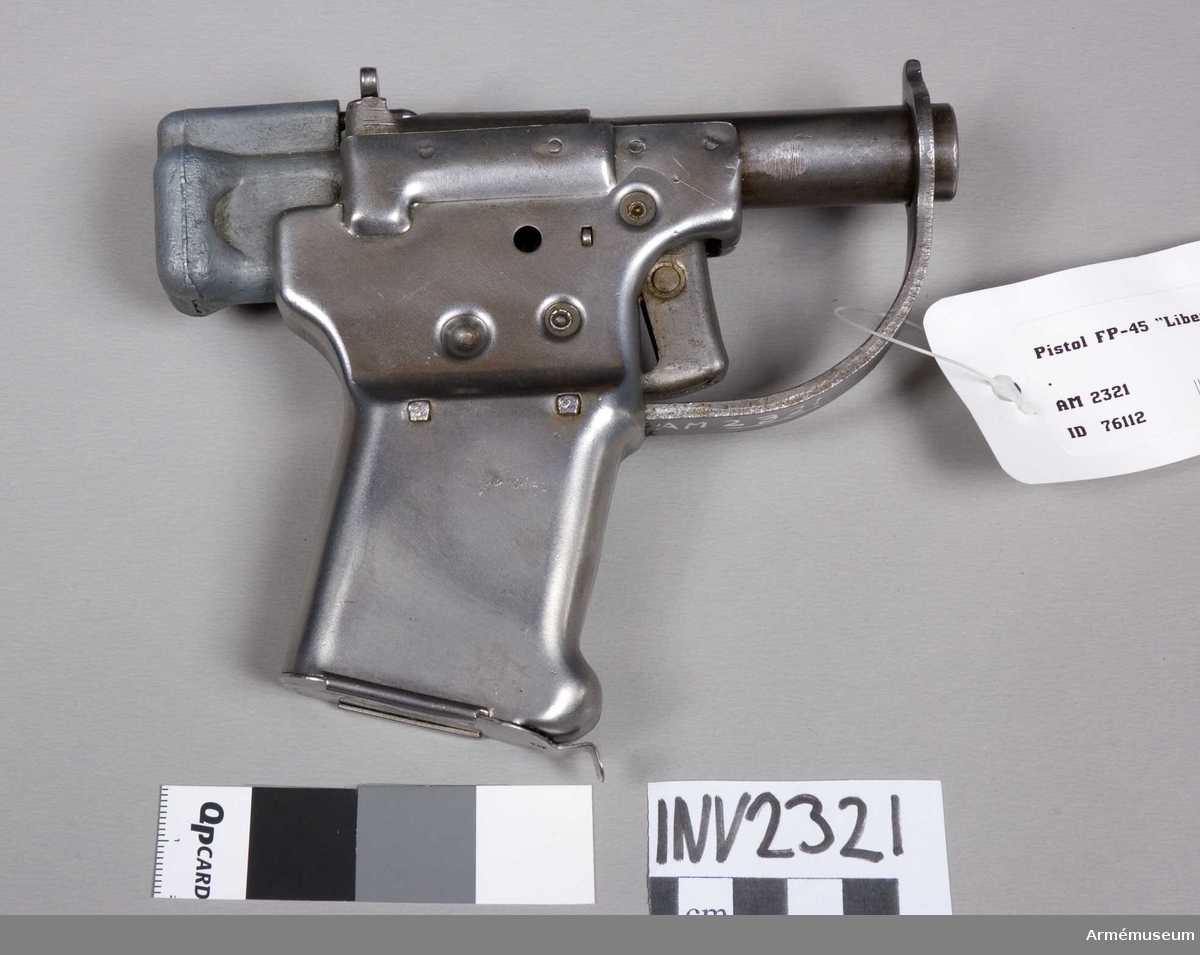
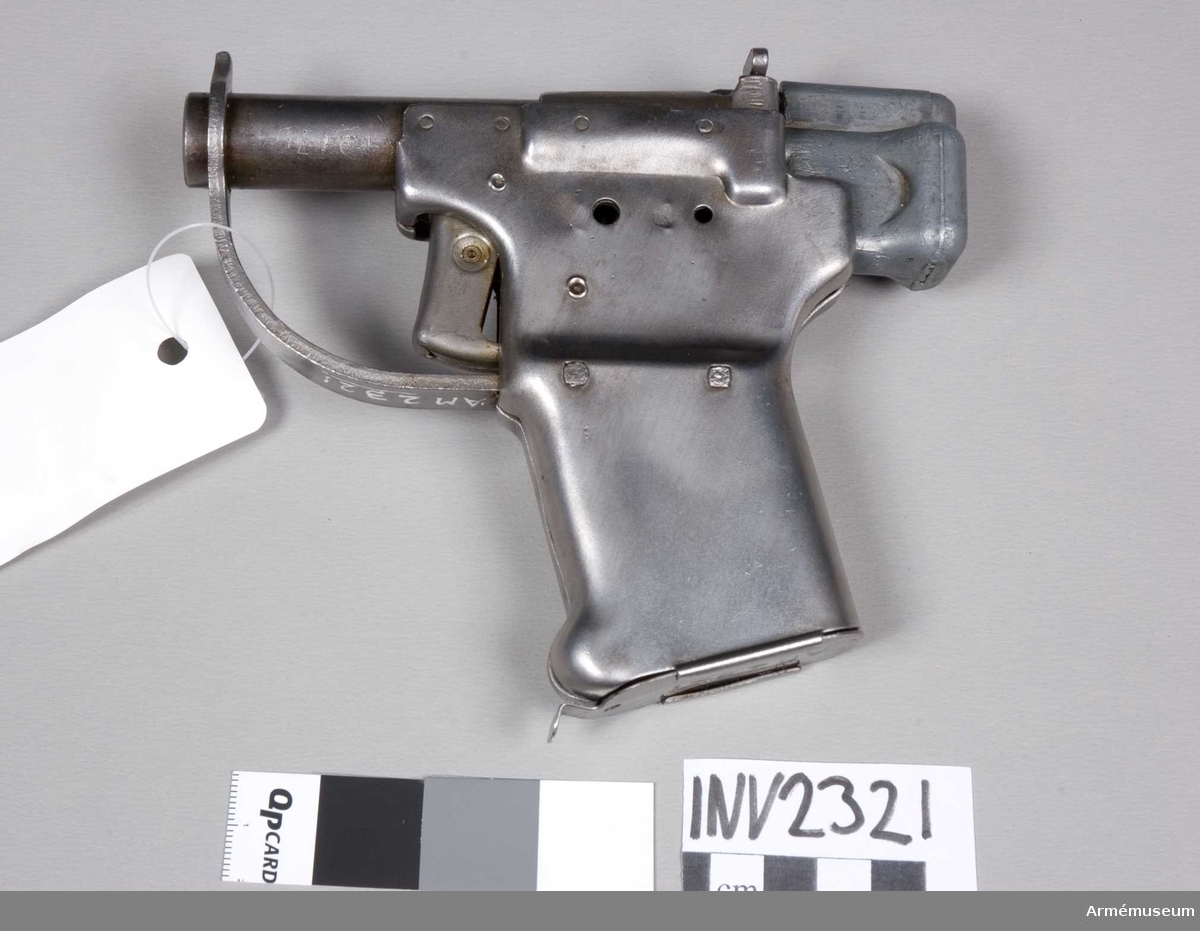
The pistol is 23 parts, the overwhelming majority stamped or drawn from sheet steel, with resistance welds holding sub-assemblies together, and a single significant die-cast zinc cocking piece at the rear.125 Of those 23, only a handful are mechanically interesting:
- The barrel — a plain smoothbore tube, ~4 in, no rifling, no chamber niceties. On originals the bore measures about .450 in; the loose fit and lack of rifling are deliberate, the cheapest possible way to make a barrel.16
- The breechblock / rear-sight assembly — a stamped piece that lifts to expose the chamber for loading and closes over the case head to contain the round.
- The cocking piece — the die-cast zinc knob at the rear. This one part is the striker actuator, the breech unlock, and the only safety. Everything about operating the gun runs through it.
- The striker and sear — the cocking piece drives an internal connector/striker that the sear holds until the trigger releases it.
- The grip frame — folded sheet steel forming a hollow cavity that both houses the lockwork and stores spare ammunition.
3.2 The Cocking Piece Does Everything
The clever, cost-driven heart of the design is that one part carries three jobs. Pulled straight back against spring pressure about 1/2 in, past a felt or heard click, the cocking piece engages an internal connector against the sear — this is cocking.3 Rotated 90° to left or right and lowered against the rear of the grip frame, it does two more things at once: it unlocks the breech for loading, and in that rotated position it cannot be pulled back to release the striker, which is exactly what makes it the pistol’s only safety.3 There is no separate safety lever, no cross-bolt, nothing to add cost. The safety is free because it is just a position of a part that had to exist anyway.
3.3 Striker, Sear, and the Trigger
Firing is a heavy, deliberate act. Trigger pull is reported at 10–11 lb.3 Pulling the trigger cams the connector off the sear, and the cocking piece — with its internal striker — snaps forward about 1/8 in to hit the primer.3 There is no trigger take-up worth describing, no reset in the conventional sense; after firing you are back to a full load-and-cock cycle for the next shot. On the earliest developmental pieces the striker sometimes missed the primer entirely (see the Model 1/2/3 progression in Vol 5); the production gun added a guide arrangement and a reinforcing rib on the cocking piece to keep the strike aligned.7
3.4 Extraction Is a Stick
There is no extractor mechanism worth the name. After firing, the spent case is punched out by hand: the supplied wooden dowel, carried in the grip cavity, is pushed down the bore from the muzzle to drive the empty case rearward out of the opened breech.3 It is slow, it is deliberate, and it is entirely in keeping with a weapon expected to fire a round or two in anger and then be discarded or used to acquire a better weapon.
3.5 Ten Rounds in the Grip
The hollow grip frame doubles as ammunition storage: 10 rounds of .45 ACP ride loose in the grip cavity, reached through a sliding/removable buttplate.152 This is the “ten, not five” correction from Vol 1 — earlier briefs that assumed five rounds are simply wrong; Wikipedia, IWM, and American Rifleman all give 10. There is no magazine and no feed mechanism; the grip is a box, and the rounds are loose in it.
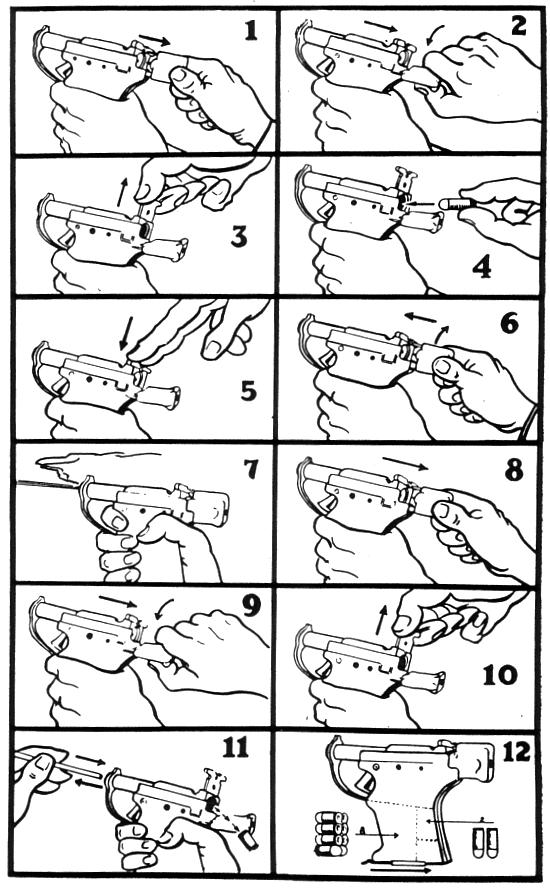
3.6 Sequence of Operation
Putting it together, the full cycle is:
- Cock. Pull the cocking piece straight back ~1/2 in against spring pressure until it clicks, engaging the sear.
- Open / safe. Rotate the cocking piece 90° and lower it against the grip frame. The breech is now unlocked and the striker cannot be released.
- Load. Lift the breechblock/rear-sight assembly, drop a single .45 ACP round into the chamber, and press the block back down.
- Ready. Rotate the cocking piece back in line, re-engaging the sear with the striker cocked.
- Fire. A 10–11 lb trigger pull cams the connector off the sear; the striker snaps forward ~1/8 in and fires the round.
- Extract. Open the breech, run the wooden dowel down the bore from the muzzle, and punch the empty case out the back.
- Repeat from step 1 with a fresh round from the grip cavity.
3.7 What the Simplicity Costs
The same choices that made the pistol buildable in seconds make it a poor shooter. There is no rifling, so accuracy is a matter of luck past a few yards (Vol 8 gives the measured grouping data). Muzzle velocity is on the low side for .45 ACP — ~820 ft/s (250 m/s) per Wikipedia, a single-sourced figure to treat as reasonably reliable but not independently corroborated — consistent with a short, unrifled, loosely fitted bore bleeding gas around the bullet.1 And the loose fit and lack of heat treatment that make the parts cheap also make the gun fragile under repeated firing, the subject of Vol 8.
3.8 Bibliography
Footnotes
-
FP-45 Liberator. Wikipedia. https://en.wikipedia.org/wiki/FP-45_Liberator ↩ ↩2 ↩3 ↩4 ↩5
-
“The Liberator Pistol.” American Rifleman (NRA). https://www.americanrifleman.org/content/the-liberator-pistol/ ↩ ↩2 ↩3
-
FP-45 operating instructions, liberatorpistol.com — mechanism detail (cocking travel, rotation-as-safety, trigger pull, striker throw, dowel extraction) reconstructed from this operating-instruction source via search; direct fetch failed on a TLS hostname mismatch, so specific figures are treated as soft. http://www.liberatorpistol.com/fp-45-operating-instruction.html ↩ ↩2 ↩3 ↩4 ↩5 ↩6
-
“Firing the Original FP-45 Liberator Pistol.” Vintage Ordnance Co. https://vintageordnance.com/firing-the-original-fp-45-liberator-pistol/ ↩
-
“FP-45 Liberator pistol,” object 30036235, Imperial War Museums. https://www.iwm.org.uk/collections/item/object/30036235 ↩ ↩2
-
Bore/authentication detail summarized from Vintage Ordnance / collector-market discussion (originals ~.450 in bore); underlying detailed reference cited elsewhere as Man At Arms, Vol. 35 No. 2 (April 2013). ↩
-
“Brief History of the FP-45 Liberator Pistol.” Vintage Ordnance Co. https://vintageordnance.com/brief-history-of-the-fp-45-liberator-pistol/ ↩
Comments (0)