FP-45 Liberator · Volume 4
How They Were Made
The interesting engineering in the FP-45 is not in the pistol; it is in the production system that could turn out a million of them in eleven weeks for about two dollars each. To a maker with a machine shop this is the genuinely instructive part of the whole story: a firearm deliberately engineered to eliminate every slow, skilled, expensive operation that normally defines gunmaking. This volume covers how it was made, why $2.10 was achievable, and the two pieces of “production design” beyond the pistol itself — the wordless instruction sheet and the packaging.
4.1 Stamping and Drawing, Not Machining
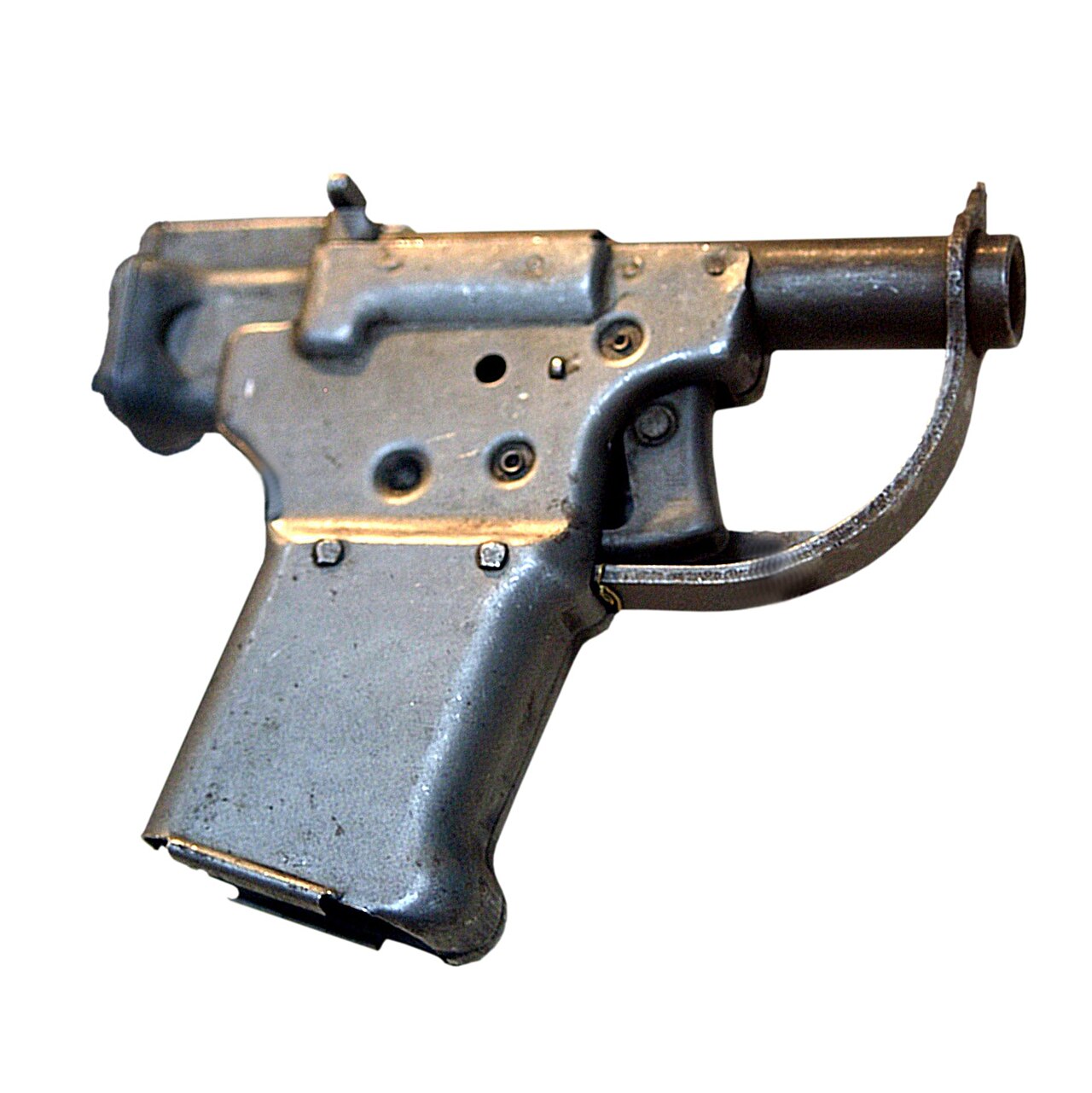
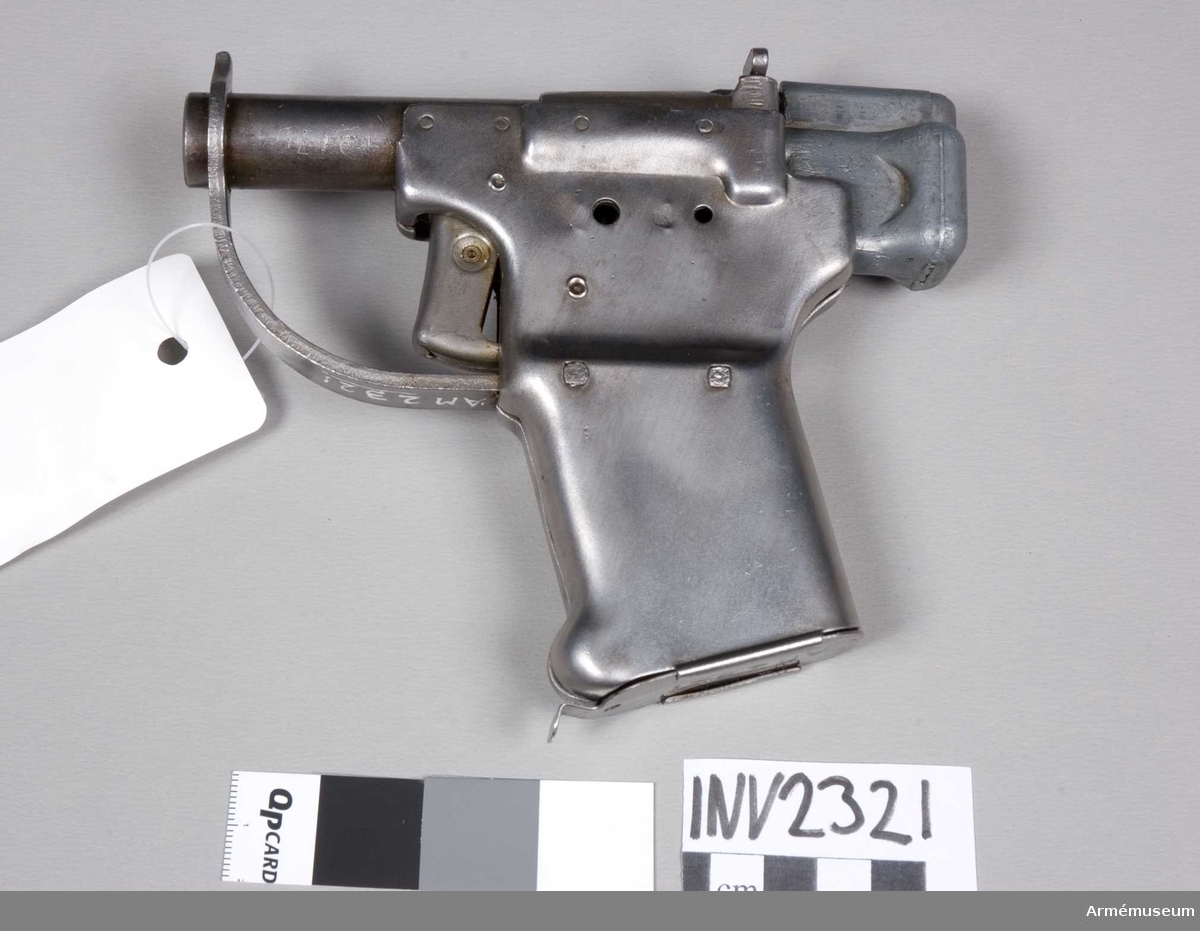
Nearly the entire pistol is sheet-metal stampings and drawings joined by resistance welds, with the die-cast zinc cocking piece as the one significant casting.123 That single decision — stamped sheet instead of machined steel — is the reason the design could be tooled up and mass-produced so fast. Consider what it deletes from a conventional pistol:
- No machined receiver or slide. The frame is folded and welded sheet, not milled from a forging or billet.
- No rifling. The barrel is a plain smoothbore tube. Rifling is normally one of the slowest, most capital-intensive barrel operations; deleting it removes an entire class of machinery and cycle time.
- No fitted lockwork. The striker/sear/connector are simple stamped and formed parts held in a folded-sheet housing, not hand-fitted components.
- One casting. The cocking piece is die-cast zinc — fast, cheap, near-net-shape, no machining from solid.
Guide Lamp was, by trade, a maker of automotive lamps and stamped trim for General Motors — a shop already built around high-volume sheet-metal stamping and spot welding. The FP-45 was designed to that shop’s existing competence, which is exactly why it went from order to a million units so quickly. Vol 3 covers what those parts do; this volume is about why they were shaped the way they were.
4.2 Why $2.10 Was Possible
The ~$2.10 boxed-kit cost (with ~$1.73 cited as the pistol-only manufacturing cost) is not a mystery once the process is laid out.12 It is the product of three multiplied savings:
- Cheap operations. Stamping, drawing, and spot welding are fast and use inexpensive tooling once the dies exist. No rifling, no precision machining, no hand-fitting.
- Cheap labor. Roughly 300 workers, largely unskilled or semi-skilled, doing simple repetitive assembly. The reported labor content was about 6.6 seconds per pistol — a number that only makes sense if every operation is a stamping press stroke or a spot-weld, not a machinist’s setup.12
- Cheap materials. Low-carbon sheet steel and die-cast zinc, in small quantities per unit.
The program’s own framing — repeated in secondary sources and best treated as a paraphrase rather than a verified period quote — was that you could arm a million people in occupied Europe for roughly the cost of a single battleship.23 Whether or not the exact phrasing is genuine, the arithmetic behind it is real: at ~$2.10 a unit, a million pistols cost on the order of two million dollars, a rounding error against a capital ship. The design was, in effect, an argument that quantity and disposability could substitute for quality.
4.3 The Wordless Instruction Sheet
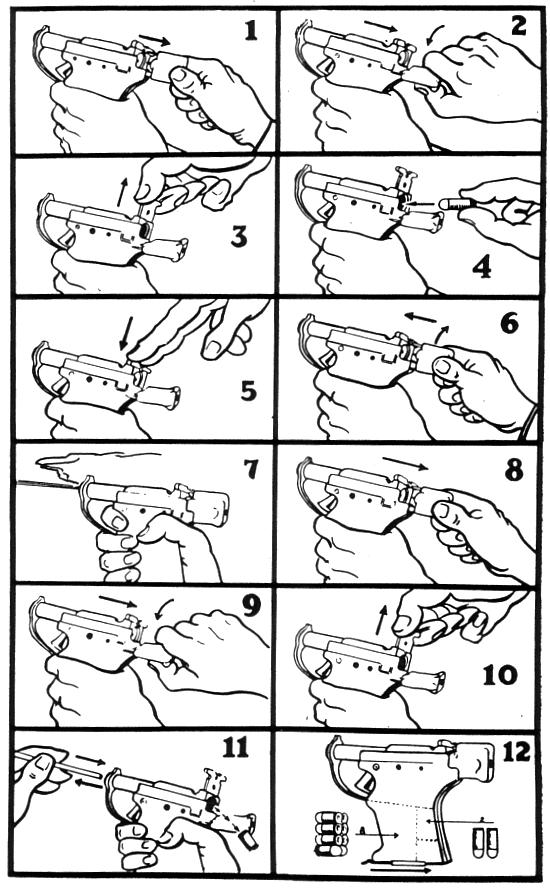
Every kit included a wordless, comic-strip-style pictorial instruction sheet, deliberately free of text so it could be understood regardless of the recipient’s language or literacy.142 It shows, in sequential drawings, how to load, fire, and extract the case with the dowel — the full manual of arms of Vol 3, rendered as pictures. This is production design in its own right: with the guns destined for recipients across France, Greece, China, the Philippines, and elsewhere, printing multilingual text would have been slower, costlier, and self-defeating. A picture strip solved the problem once, for everyone. A period example survives on Wikimedia Commons as FP-45 operating instructions.jpg.
For the collector, the sheet matters out of all proportion to its size: because it was flimsy paper meant to be read once and discarded, surviving original sheets are among the rarest parts of a complete kit, and a major driver of value (Vol 6).
4.4 Packaging
Each kit shipped in a small cardboard box containing the pistol, 10 rounds of .45 ACP, the wooden extraction dowel, and the instruction sheet.14 That is the complete, canonical kit — and the reason “complete boxed examples” are counted separately (and prized) in Vol 5 and Vol 6.
One frequently repeated packaging detail should be flagged: some accounts describe a waxed-paper or waterproof coating on the packaging for parachute or maritime delivery. This detail could not be confirmed in any source located during research — several sources describe the cardboard box generally, but none confirmed a wax coating specifically. Treat the waxed-paper claim as unverified; it may be genuine and simply documented only in specialist references (such as Ralph Hagan’s 1996 book) not accessible here, but it should not be stated as fact.
4.5 What a Maker Takes From This
For a well-equipped shop, the FP-45 is less a gun to admire than a design philosophy to study: identify the slow, skilled, expensive operations and engineer them out of existence, accepting a worse product in exchange for radically cheaper and faster production. The actual buildable/reproduction path — where a maker would add back rifling and a serial number to keep the result a lawful Title I firearm rather than an NFA AOW — is treated separately in the replica dive at /replicas/pistols/fp-45-liberator-replica/, and the reason those two features are mandatory on a reproduction is the whole subject of Vol 7.
4.6 Bibliography
Footnotes
-
FP-45 Liberator. Wikipedia. https://en.wikipedia.org/wiki/FP-45_Liberator ↩ ↩2 ↩3 ↩4 ↩5
-
“The Liberator Pistol.” American Rifleman (NRA). https://www.americanrifleman.org/content/the-liberator-pistol/ ↩ ↩2 ↩3 ↩4 ↩5
-
“The FP-45 Liberator Pistol.” The Armory Life. https://www.thearmorylife.com/the-fp-45-liberator-pistol/ ↩ ↩2
-
“FP-45 Liberator pistol,” object 30036235, Imperial War Museums. https://www.iwm.org.uk/collections/item/object/30036235 ↩ ↩2
Comments (0)