FP-45 Liberator · Volume 8
Live Fire & Handling
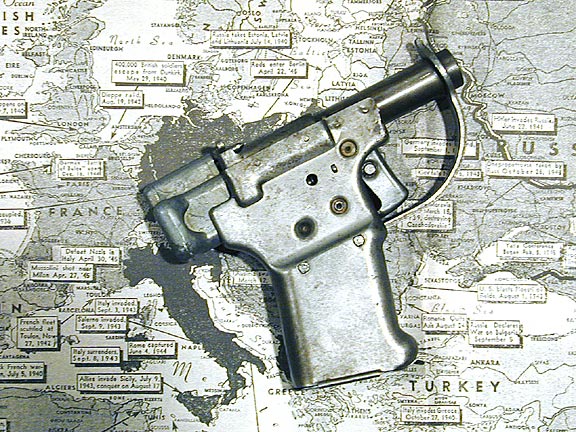
The short version of this volume is: don’t. Firing an original FP-45 is inadvisable on two independent grounds — it consumes a rare historical artifact, and the design has documented structural weaknesses that make firing genuinely hazardous to the shooter. Neither point is precautionary hand-waving; both come from the collector community that owns and has actually tested these guns. This volume lays out the case, the measured failure behavior, the accuracy reality, and the honest spread of the “effective range” claims — which vary enough across sources that giving one number would be misleading.
8.1 Why Not to Shoot an Original
The dealer/collector community discourages firing originals in unusually blunt terms. Vintage Ordnance’s own detailed write-up states flatly that “it is flatly unadvisable to fire any original FP-45 Liberator Pistol because of some inherent weaknesses related to their design that could result in damage to the weapon and injury or death to the shooter or others in the vicinity” — this on top of the obvious point that firing consumes a rare artifact.1 When the people who sell and shoot these for a living say “injury or death,” that is worth taking at face value.
8.2 The Documented Failure Mode
The weaknesses are specific and were characterized in actual firing tests, per Vintage Ordnance citing Ralph Hagan’s 1996 book The Liberator Pistol: Development, Production, Distribution as the underlying research:1
- A conical, loose-fitting chamber rather than a straight, properly toleranced one.
- Excessive headspace — up to 0.020 in of free play measured on original specimens.
- No specified heat treatment for the low-carbon steel tube strap or cover slide; the cover slide is noted as only “half hard” temper — soft enough to deform rather than crack.
The measured behavior is the most useful data point for a maker. Firing low-power cast-bullet loads, one original handled 50–70 rounds without apparent issue. Switched to standard 230-grain jacketed military-spec ball, the same pistol showed visible fatigue — bowing of the cover slide and tube strap — after just 27 rounds, worsening progressively until the tester stopped at 35 rounds as unsafe to continue.1 This is a progressive metal-fatigue failure, not a single dramatic event. Note the source’s confidence: this is one documented test of specific specimens, reported by a commercial collector source citing a specialist book — credible and specific, but not a large sample.
Importantly, no source located in research documented a specific catastrophic “case rupture” or “pistol blew up” incident by name. The real, sourced failure mode is progressive fatigue and deformation under full-power ball ammunition — not a single catastrophic burst. That distinction is worth preserving: dramatizing a catastrophic blow-up would go beyond what the record supports, while the documented progressive bowing is bad enough on its own.
This behavior also explains a wartime quality-control practice: every factory pistol was proof-fired once, and some were fired up to 50 times during QC, specifically to weed out units that would not survive even modest use.1 The fatigue-proneness was a known, accepted trade-off from day one — the gun was expected to fire a few rounds, not a service life.
Table 1 — The Documented Failure Mode
| Load | Rounds before trouble | Observed |
|---|---|---|
| Low-power cast-bullet | ~50–70 | No apparent issue in the documented test |
| 230-gr jacketed military ball | ~27 | Visible bowing of cover slide + tube strap; stopped at 35 as unsafe |
| Factory QC proof | 1 (some up to 50) | Deliberate overtest to cull weak units |
8.3 Accuracy: Essentially None
By modern standards the Liberator has no accuracy to speak of, which is entirely consistent with its point-blank, contact-range design intent. The measured grouping data from the same firing test tells the story: at 6 yards, roughly 3.25 in groups — but landing 9.5–10 in above point of aim; at 20 yards, 8.5–14.5 in groups landing about 30 in above point of aim, “clearly beyond the useful range.”1 The gun does not so much aim as point. This is why Vol 3’s “hand it to them and point” characterization is not a joke — it is the actual manual of arms.
8.4 Muzzle Velocity
Muzzle velocity is reported at ~820 ft/s (250 m/s) per Wikipedia — a single-sourced figure, not independently corroborated in research, so treat it as reasonably reliable but not confirmed.2 It is on the low side for .45 ACP, consistent with a short (4 in), unrifled, loosely fitted bore bleeding gas around the bullet (Vol 3).
8.5 Effective Range: A Spread, Not a Number
The “effective range” of the Liberator is genuinely inconsistent across sources, and giving a single figure would misrepresent the record. All sources agree it is extremely short; they disagree on how short:
Table 2 — The "effective range" of the Liberator is genuinely inconsistent across sources, and giving a single figure would misrepresent the record. All sources agree it is extremely short; they disagree on how short
| Source | Effective-range claim |
|---|---|
| Wikipedia | Designed for 1–4 yards; cites ~25 ft (7.6 m) |
| American Rifleman (“The Liberator Pistol”) | “useful range of less than 50 feet” |
| Alderfer Auction | ”effective only to about 25 feet” |
| Vintage Ordnance / Hagan (measured) | Useful grouping ~6 yards; “clearly beyond useful range” by 20 yards |
The honest synthesis is a few yards — point-blank, essentially a contact weapon, with useful accuracy on the order of ~6 yards and everything past that a matter of luck.2341 A round-number characterization of roughly 8 yards is consistent with the sourced ~6-yard useful-accuracy figure, but it is not a verbatim value from any single source, so it should be presented as an approximation of the range of claims rather than a hard specification.
8.6 If You Handle One Anyway
For a collector who insists on function-checking or firing an original despite the above, the failure modes to watch are exactly the documented ones: cover-slide and tube-strap bowing under repeated firing (especially with full-power ball), excessive headspace risking case-head problems, and the crude welds (Vol 5) as mechanical weak points under recoil stress. The single most protective choice, if firing at all, is to stay with low-power cast-bullet loads — the documented tests show a dramatic difference between those and full-power ball — and to stop at the first sign of deformation. The more defensible choice for anyone who actually wants to shoot a Liberator is to buy a modern reproduction (Vol 6; /replicas/pistols/fp-45-liberator-replica/), which is built to be shot and does not consume an irreplaceable artifact in the process.
8.7 Bibliography
Footnotes
-
“Firing the Original FP-45 Liberator Pistol.” Vintage Ordnance Co. (citing Ralph Hagan, The Liberator Pistol: Development, Production, Distribution, 1996). https://vintageordnance.com/firing-the-original-fp-45-liberator-pistol/ ↩ ↩2 ↩3 ↩4 ↩5 ↩6
-
FP-45 Liberator. Wikipedia. https://en.wikipedia.org/wiki/FP-45_Liberator ↩ ↩2
-
“The Liberator Pistol.” American Rifleman (NRA). https://www.americanrifleman.org/content/the-liberator-pistol/ ↩
-
“The FP-45 Liberator: A Crude but Effective Weapon of Resistance.” Alderfer Auction. https://www.alderferauction.com/blog/detail/the-fp-45-liberator-a-crude-but-effective-weapon-of-resistance ↩
Comments (0)