MG 42 · Volume 1
From the MG 34 to the MG 42: The Single Machine Gun, Remade in Sheet Steel
Why the Wehrmacht wanted a second general-purpose gun, who designed it, what is documented about where the roller lock came from, and how the Allies first met it in 1943
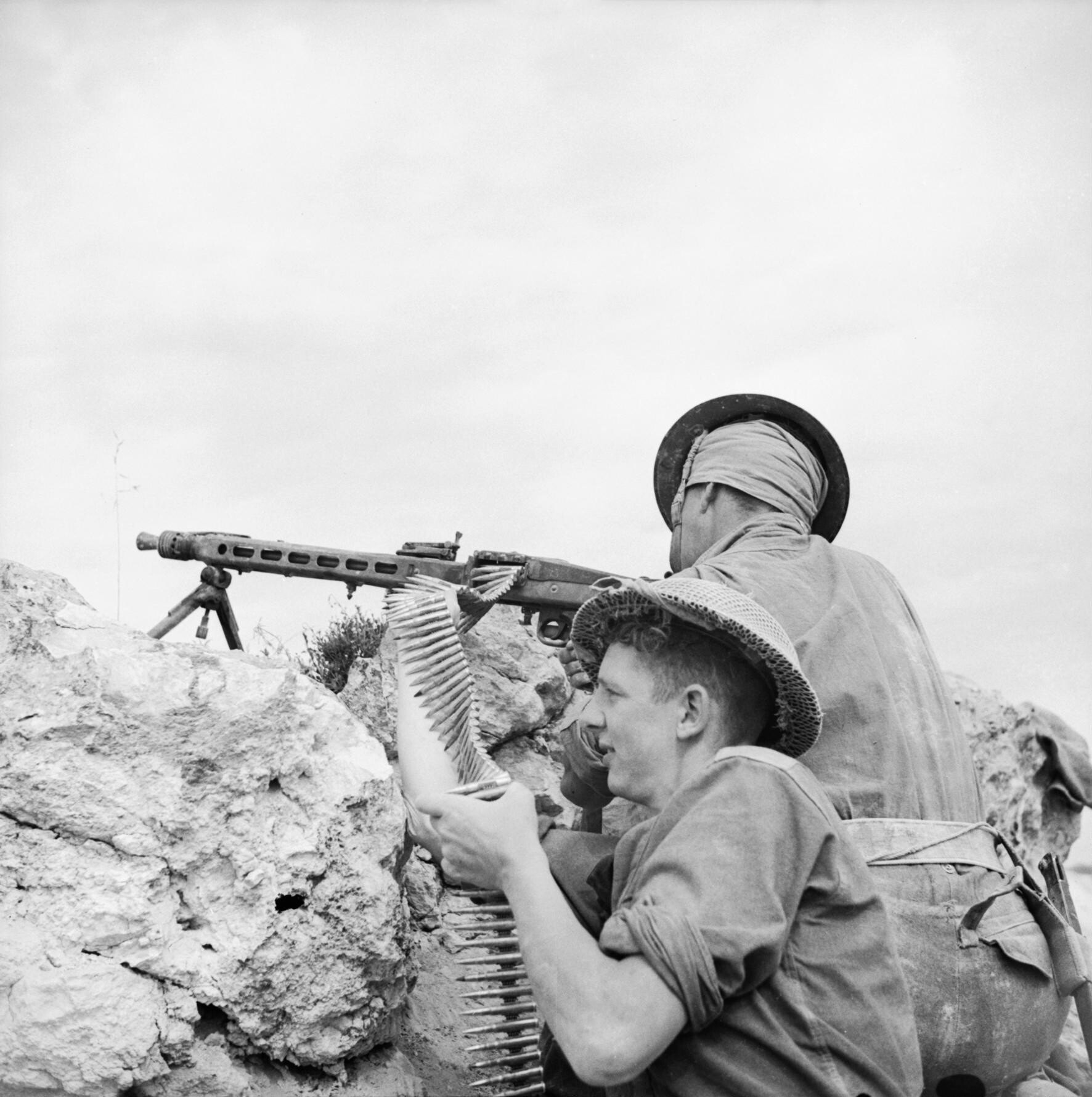
1.1 What this dive covers
The Maschinengewehr 42 is the German general-purpose machine gun of the second half of the Second World War: a belt-fed, air-cooled, recoil-operated gun in 7.92×57 mm, made largely from pressed and welded sheet steel, locked by two rollers, and fitted with a barrel that a gunner could change in seconds. It fired fast enough that its own users and its enemies both remarked on the sound, and it survived the war to become the Bundeswehr’s MG 1 and MG 3, Yugoslavia’s Šarac, Italy’s and Austria’s MG 42/59, and Austria’s MG 74, some of which are still in service.
This dive is a reference work on a select-fire machine gun. It covers history, mechanism, identification, maintenance and law. It contains no build, replica-making or conversion content of any kind, and nothing in it should be read as a procedure for making or altering a firearm.
The eight volumes are:
- This volume: the MG 34 background, the designer, the roller-lock question, and the dates.
- Production: the makers, the stamping, the numbers, and the American copy that failed.
- How it works: the roller lock, the muzzle booster, the two-stroke feed and the trigger.
- In service: the barrel change, the rate of fire and the “buzzsaw” reputation checked against the record, and the Lafette tripod.
- Identification: codes, markings, and telling the MG 42 from the MG 34 and its own descendants.
- Field strip, maintenance and stoppages, from the wartime US translation of German practice and the maker’s MG 3 manual.
- After 1945: the MG 1, MG 2 and MG 3, the M53, the MG 42/59 and MG 74, users worldwide, and the roller-delayed rifles the design fed.
- Owning one in the United States: registered transferables, § 922(o), dewats, the market, and semi-automatic look-alikes as products.
Earlier machine-gun history is told in this hub’s Lewis gun and Chauchat dives, and the general law of machine-gun ownership is in MP 40 Volume 6. The roller-delayed G3 family, which descends from the MG 42’s lock by way of Mauser’s StG 45(M), is covered in the H&K PSG1 dive; Volume 7 links to it rather than repeating it.
1.2 The gun in one paragraph
The MG 42 is a short-recoil gun: barrel and bolt recoil together, locked, for about half an inch; then fixed cams in the receiver squeeze two rollers in the bolt head out of recesses in the barrel extension, the barrel stops and returns, and the bolt runs on to the rear on its own momentum, helped by a muzzle booster that traps propellant gas to kick the barrel backwards.123 It fires only fully automatic, from an open bolt, at a cyclic rate that wartime sources put anywhere from 1,050 to 1,500 rounds a minute (Volume 4 sets every figure side by side).45 It feeds from the left from non-disintegrating 50-round belts that can be joined, or from a 50-round belt in a drum clipped to the feed.1 Its barrel is changed through a hinged door in the right side of the jacket, and the manuals called for a change every 250 rounds of sustained fire.1 Its receiver, jacket and most of its small assemblies are stampings, spot-welded and riveted, “with very few machined parts” in the words of the US War Department in 1943.3
1.3 The MG 34 and the idea of one machine gun
The MG 42 replaced, and for the rest of the war served alongside, the MG 34, and its design brief makes sense only against that gun.
George M. Chinn, who wrote the US Navy’s four-volume history of the machine gun from captured documents and test reports, describes the MG 34’s requirement as “a single machine gun using the 7.92-mm rifle cartridge” that could serve “as both a light and heavy machine gun and, if need be, for antiaircraft work against low flying attack planes.” The design came to Mauser from Berlin as “the further development of a mechanism patented by Louis Stange, an engineer of Rheinmetall-Borsig”, and was required to feed from left or right, from drum or belt. Development began in 1934 and the gun was in production in 1936.6 It became, in Chinn’s words, “the standard machine gun of the German Army”, on a bipod as a light gun and on a tripod as a heavy one.6
That is the concept the MG 42 inherited whole: one gun, one cartridge, one belt, carried by the section as a light machine gun and mounted by the machine-gun company as a heavy one. The German term is Einheitsmaschinengewehr; the English one that later stuck is “general-purpose machine gun”. The US War Department’s 1943 handbook called both guns “dual-purpose”.1

The MG 34’s own operation is close kin to the MG 42’s and differs in the part that mattered to the factories: it locked with a rotating bolt head, which Chinn traces through Stange’s Rheinmetall patents and the US War Department called “the Solothurn rotating bolt-head” in 1943.3 Like the MG 42 it used a muzzle booster and short recoil. Unlike the MG 42 it had a double trigger, the top part marked E (Einzelfeuer, single shot) and the bottom part D (Dauerfeuer, continuous fire), and its barrel was changed by pressing a catch, turning the whole receiver almost half a turn and tipping the barrel out of the back of the jacket. The same 1943 manual gives both guns the same barrel schedule: a change after 250 rounds of automatic fire, 400 in an emergency.41
This hub’s DL-44 dive uses the MG 34’s flash hider as a donor-part candidate for the Han Solo blaster; the gun itself appears there only as a source of that one part.
1.4 Why a second gun
The plainest statement of why Germany wanted a second general-purpose gun comes from the first Allied report on it. Tactical and Technical Trends No. 20, the US War Department’s intelligence digest, said on 11 March 1943 that “the M.G. 42 is designed for faster and cheaper production by an extensive use of stamping and welding in the receiver, barrel casing, feed mechanism, operating handle, and antiaircraft rear sight,” and that “the above changes eliminate many of the intricate machine-tool operations needed for the bolt and other parts of the M.G. 34.”4
Chinn, writing in 1951, put it more strongly. The Germans “simply had mastered the art of producing fine automatic weapons with no more expense and time than would be needed to make a dozen cap pistols,” and the rough external finish had led Allied observers to “the erroneous belief that a desperate shortage of certain materials existed in Germany and that automatic weapons of inferior quality were being made.”2
Ian McCollum of Forgotten Weapons summarises the aim as “a more reliable and easier to manufacture replacement for the MG34”, made with heavy stampings that reduced German need for expensive alloy steels.7
A widely repeated figure, that the MG 42 cut the labour per gun from 150 to 75 working hours, is attributed by German Wikipedia to Günter Wollert and Reiner Lidschun’s Illustrierte Enzyklopädie der Infanteriewaffen (1998), page 199. That book was not seen for this dive, and the figure is not given here as established; it is recorded so that a reader can check it at its source. No MG 34 cost or hour figure from a primary document was found.
1.5 Werner Gruner and his firm
The MG 42 was not designed by an arms company. Its designer was Werner Gruner, an engineer at the Johannes Großfuß Metall- und Lackierwarenfabrik of Döbeln in Saxony, a maker of pressed and lacquered sheet-metal goods.72
What is documented about Gruner is mostly from after the war. The Technische Universität Dresden’s official list of its rectors records Werner Gruner, born 7 June 1904 in Terpitsch, Grimma district, died 29 June 1995 in Dresden, Professor of Agricultural Machinery Engineering (Landmaschinentechnik), rector of the university from 1958 to 1961.8 So the man who drew the most copied machine gun of the century spent his later career in East Germany teaching the design of farm machinery.
McCollum states that Gruner had no previous military or small-arms design experience.7 German Wikipedia says the same in substance: that he was a technician specialising in series production and sheet-metal pressing rather than a weapons specialist, and that he probably had help from locking-mechanism specialists. Neither claim is sourced to a document in the pages read.
1.5.1 A name to watch: “Dr. Grunow”
Chinn’s 1951 history does not use Gruner’s name at all. It credits “Dr. Grunow, a German industrialist, whose specialty was mass production by metal stampings”, says he “was ordered to devote his talents toward manufacture of the weapon without employing complicated methods or equipment,” and lists the Großfuß works with the note “(Dr. Grunow was on its staff)”.2 A German enthusiast site, balsi.de, gives “Dr. Gunow”. These are almost certainly garbled forms of Gruner’s name in post-war interrogation and translation; the Dresden record is the authority for the spelling. A reader who meets “Grunow” in older English-language literature is reading Chinn’s error.
Chinn’s framing also matters. He calls the MG 42 “a weapon of devisement, contributed to by many, rather than the single invention of any individual”, with Gruner’s role being production engineering: “Dr. Grunow’s accomplishment of this task by extensive use of pressing, riveting, and spot welding was a thing that will be studied and closely copied in machine gun construction for years to come.”2 Whether Gruner also originated the locking system, or was given it, is not settled by anything read for this dive (next section).
1.6 Where did the roller lock come from?
Three claims circulate about the origin of the MG 42’s roller lock. They are set out here with what each rests on.
1. Gruner designed it. McCollum and German Wikipedia credit the design of the gun to Gruner without separating the lock from the rest.7 No Gruner patent for the lock was located for this dive.
2. It came from a Polish design seized in 1939. Chinn wrote: “the locking was an adaptation of the patented locking arrangement of Edward Stecke, a citizen of Warsaw, Poland. It is believed by many that, with the overrunning of Poland in 1939, one of the things seized by the Germans was a mock up of a machine gun having Stecke’s locking action.”2 Note his words: “believed by many”. He gives no document for the seizure.
What can be shown is that Stecke held a patent. French patent FR 775,341, “Automatic rifle”, names Edward Stecke as inventor and the Państwowe Wytwórnie Uzbrojenia (the Polish state arms works) in Warsaw as assignee; it claims priority from a Polish application of 8 July 1933 and was published on 26 December 1934. Its patent classification places it among recoil-operated arms with “semi-rigid bolt locks, i.e. having locking elements movably mounted on the bolt.”9 The text and drawings were not obtained for this dive, so whether Stecke’s locking elements were rollers is not established here. A reader should treat “the MG 42’s lock is Stecke’s” as a plausible lead with one patent behind it, not as a documented transfer.
3. It descends from earlier German roller and flap locks. The idea of locking a bolt by pushing elements sideways into recesses was old by 1937; the US War Department’s 1943 description says the MG 42’s locking “is novel to those familiar with machine guns other than the Russian Degtyarev”, a gun that also locks by pushing elements out sideways from the bolt.3 This is an observation of family resemblance, not of descent.
The honest summary is that the gun’s production engineering is Gruner’s by every account, and the provenance of its lock is open.
1.7 From prototype to service: the dates in print
The development sequence most often printed runs as follows: a 1937 call for designs; trials of a Großfuß gun as the MG 39 against rival Rheinmetall and Stübgen designs; a modified MG 39/41 made in a small batch for troop trials in 1941; and adoption as the MG 42 in 1942. No primary document for any step before 1942 was found for this dive. The sources that carry these steps (a fan wiki, the Internet Movie Firearms Database and English Wikipedia) give no checkable citation for them, and they do not agree with each other about whether the 1937 decision was to supplement or replace the MG 34. They are reported here as the commonly told story and nothing more.
One step is supported by a contemporary document. The War Department’s Tactical and Technical Trends No. 21, of 25 March 1943, reported that “a new model, the MG 41, is reported to exist. A still newer model, MG 42, exists and is more satisfactory than the MG 41.”10 An Allied intelligence officer in early 1943 had therefore heard of a gun called the MG 41 that preceded the MG 42. Whether that “MG 41” was the Großfuß MG 39/41, Rheinmetall’s MG 34/41 (a different, shortened MG 34 that the War Department described separately in August 1943), or something else, the report does not say.11
For the date the gun entered service, the sources give two kinds of answer:
Table 1 — For the date the gun entered service, the sources give two kinds of answer
| Date | What it is | Source |
|---|---|---|
| ”Mitte 1942” (mid-1942) | Introduced into the Wehrmacht | Display placard, Deutsches Panzermuseum, Munster, as photographed and transcribed on Wikimedia Commons12 |
| 1942 | ”In 1942 the Germans, after nearly 3 years of war, introduced into their services a machine gun known as the MG-42” | Chinn (1951)2 |
| 11 October 1943 | Formal introduction order (Einführungsverfügung), OKH (Ch H Rüst u. BdE) 72d-AHA/In 2 II d | Cited by German Wikipedia; the order itself not seen |
The two are compatible. A German weapon could be issued to troops and fought with well before the order that formally introduced it, and a gun captured in Tunisia and described in Washington in March 1943 was plainly in the field by the end of 1942. The 1943 date is recorded as the reported date of the formal order, not of first issue.
McCollum’s example, an early Gustloff-made gun with a horizontal charging handle, an unreinforced wooden butt and an adjustable front sight, is in his judgement most likely a North African capture, since Rommel’s forces were primary users of the very early MG 42s.7 The early features themselves are identification points and are taken up in Volume 5.
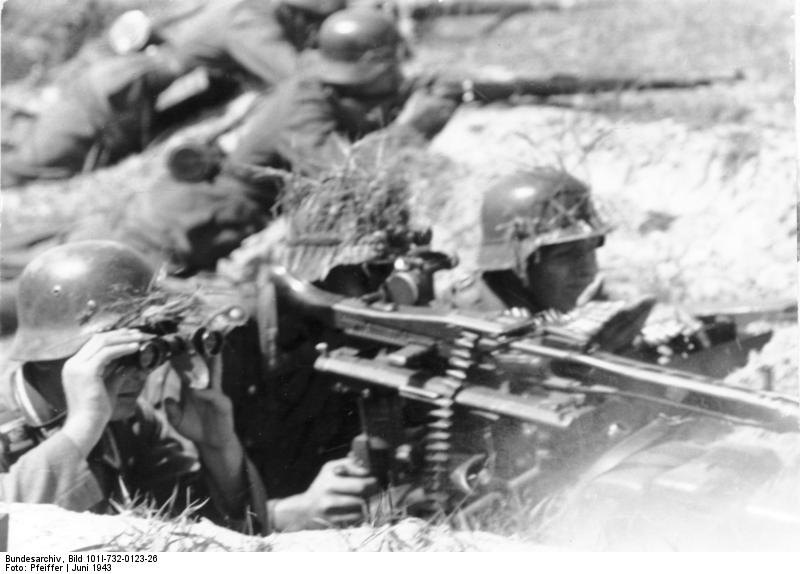
1.8 How the Allies met it: the 1943 intelligence record
The US War Department’s published intelligence on the MG 42 can be followed issue by issue through 1943, and it is worth reading in order because it shows how much was known, and how quickly.
11 March 1943. Tactical and Technical Trends No. 20: “Recently captured specimens reveal that the Germans are using a new machine gun that is superior to their standard M.G. 34 in several respects.” Five differences are listed: stamping and welding; “an excellent barrel-change arrangement which is much faster than that of the M.G. 34”; “an improved method of locking the barrel to the bolt”; no semi-automatic fire; and a cyclic rate “stepped up to 1,050 rpm in the M.G. 42 as compared to the 900 rpm of the M.G. 34”. It notes that the MG 34’s tripod slots are absent and that the MG 42 “is designed to use a different tripod”.4
25 March 1943. Tactical and Technical Trends No. 21 adds the MG 41 note quoted above and a judgement: “An increase in the rate of fire of ground MGs over the M.G. 34 (cyclic rate 900 rpm) is likely to prove of doubtful value, since the increased expenditure of ammunition will present difficulties without obtaining any real advantage.”10
25 May 1943. The Military Intelligence Service’s German Infantry Weapons (Special Series No. 14) gives the gun eleven pages. “Recently a new dual-purpose machine gun has appeared which may eventually replace the M.G. 34 in the German Army.” It is “far easier to manufacture and less smooth in finished appearance than the M.G. 34. It is, however, equally as serviceable as the older model, which is still the main armament of all types of German units.” Its seven identification points, its stripping instructions and its barrel-change schedule are used in Volumes 4 to 6.1
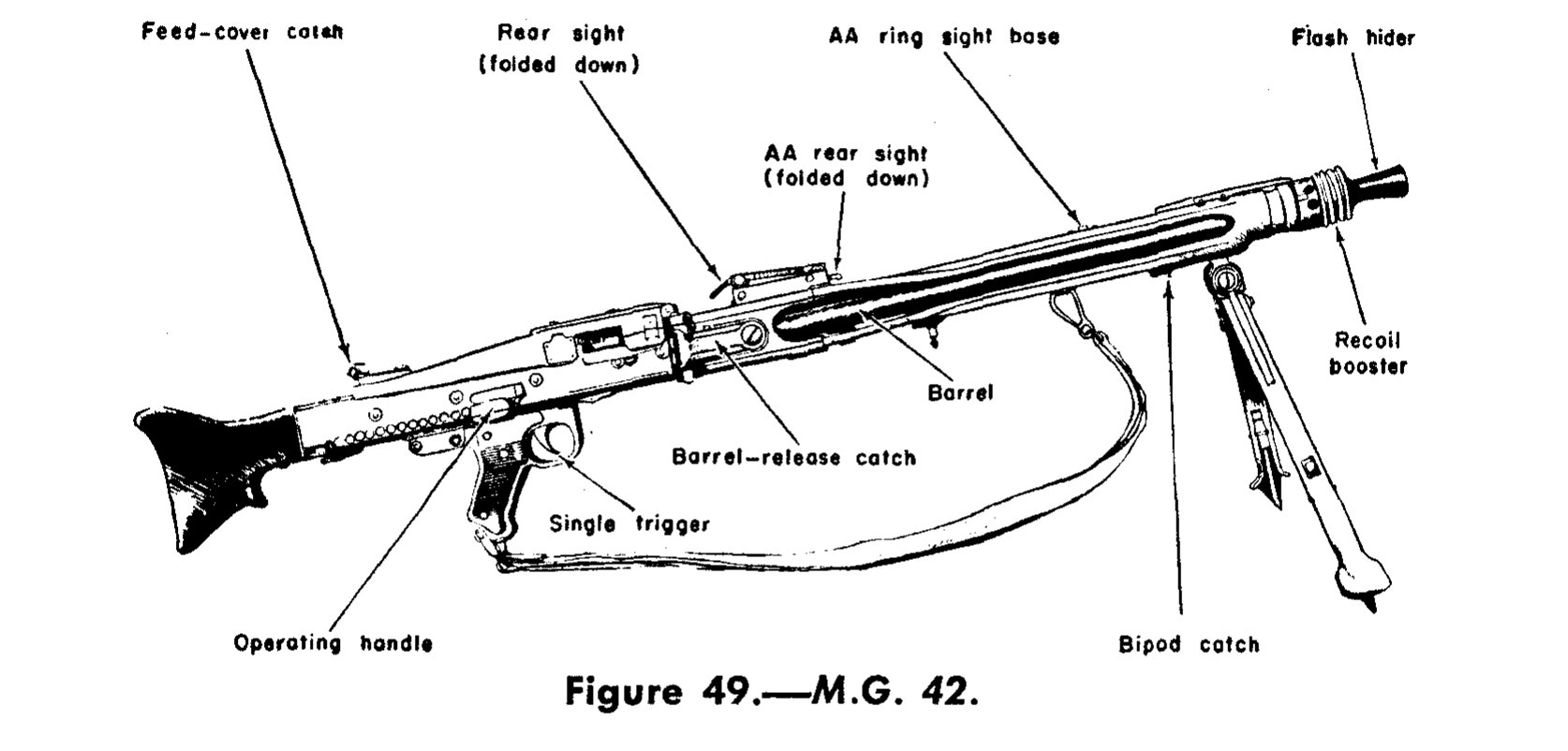
12 August 1943. Tactical and Technical Trends No. 31, “More Details of the German MG 42”, publishes a drawing of the roller lock and a table of characteristics (Volume 3), and concludes that “it seems evident that this weapon is designed to replace the MG 34 although the actual extent of replacement is not known.”3
August 1943. Tactical and Technical Trends No. 32 compares the MG 34, the MG 34 (modified), the MG 34S, the MG 34/41 and the MG 42 on “data received from the Aberdeen Proving Grounds”, and adds that the MG 42’s “bipod, antiaircraft and heavy ground mount are provided but these mounts are not interchangeable with those used with the MG 34.”11
Within six months of the first captured specimens, then, the US Army had the gun’s construction, its lock, its feed, its barrel change and its rate of fire in print, and an American copy was already on the drawing board (Volume 2).
1.9 Two guns to the end of the war
The MG 42 did not replace the MG 34 outright. The May 1943 handbook calls the MG 34 “still the main armament of all types of German units”, and McCollum’s summary is that the two “served side by side until the end of World War Two”.17 The MG 34 remained the gun of armoured vehicles in particular, where its ball-mount version had no MG 42 equivalent in the 1943 comparison.11
How many MG 42s were made, and by whom, is the subject of Volume 2.
1.10 What could not be established
- Any primary document for the 1937 competition, the MG 39 or the MG 39/41, including the size of the trial batch. The commonly told sequence is reported, not confirmed.
- Whether Edward Stecke’s 1933 locking elements were rollers, and whether the Germans used his design. A patent exists (FR 775,341); its drawings were not seen.
- The text of the 11 October 1943 introduction order, and the official German designation history.
- The 150-to-75-hour labour figure, attributed to Wollert and Lidschun (1998), not seen.
- Gruner’s own account of the design, if one exists; and any Gruner patent.
References
Footnotes
-
US War Department, Military Intelligence Service, German Infantry Weapons, Special Series No. 14 (25 May 1943), section 13, “M.G. 42”, pp. 83–94. Internet Archive, https://archive.org/details/German_Infantry_Weapons_1943_MIS_Special_Series_No._14 ; transcription at Lone Sentry, https://www.lonesentry.com/manuals/german-infantry-weapons/mg42-machine-gun.html , consulted 2026-10-19. ↩ ↩2 ↩3 ↩4 ↩5 ↩6 ↩7
-
George M. Chinn, The Machine Gun, vol. I (Washington: Bureau of Ordnance, Department of the Navy, 1951), chapter 33, “MG-42 Machine Gun”, pp. 484–489. Internet Archive, https://archive.org/details/TheMachineGunVolume1ByGeorgeMChinn , consulted 2026-10-19. ↩ ↩2 ↩3 ↩4 ↩5 ↩6 ↩7
-
Tactical and Technical Trends No. 31 (12 August 1943), item 16, “More Details of the German MG 42”, pp. 37–39. Internet Archive, https://archive.org/details/TacticalAndTechnicalTrendsNos31-40 ; transcription at Lone Sentry, https://www.lonesentry.com/articles/ttt/mg42.html , consulted 2026-10-19. ↩ ↩2 ↩3 ↩4 ↩5
-
US War Department, Military Intelligence Service, Tactical and Technical Trends No. 20 (11 March 1943), item 16, “The New German Machine Gun — M.G. 42”, p. 28. Internet Archive, https://archive.org/details/TacticalAndTechnicalTrendsNos1-20 , consulted 2026-10-19. ↩ ↩2 ↩3 ↩4
-
Tactical and Technical Trends No. 42 (13 January 1944), “Firing Data, German MG-42”. Lone Sentry transcription, https://www.lonesentry.com/articles/ttt09/mg42-firing-data.html , consulted 2026-10-19. ↩
-
Chinn, The Machine Gun, vol. I (1951), the Mauser MG 34 section, pp. 473–477, same scan. ↩ ↩2
-
Ian McCollum, “Hitler’s Zipper: The MG-42 Universal Machine Gun”, Forgotten Weapons, 4 November 2020, https://www.forgottenweapons.com/hitlers-zipper-the-mg-42-universal-machine-gun/ , consulted 2026-10-19. ↩ ↩2 ↩3 ↩4 ↩5 ↩6
-
Technische Universität Dresden, Universitätsarchiv, “Vorsteher, Direktoren, Rektoren”, entry for Werner Gruner, https://tu-dresden.de/ua/dokumentationen/dokumentationen/vorsteher-direktoren-rektoren , consulted 2026-10-19. ↩
-
Edward Stecke, “Automatic rifle”, French patent FR 775,341 A, assignee Państwowe Wytwórnie Uzbrojenia, Warsaw; priority PL 8 July 1933; filed 4 July 1934; published 26 December 1934. Bibliographic record, Google Patents, https://patents.google.com/patent/FR775341A/en , consulted 2026-10-19. ↩
-
Tactical and Technical Trends No. 21 (25 March 1943), item 12, “Some Notes on German Weapon Development”, p. 25. Internet Archive, https://archive.org/details/world-war-ii-tactical-and-technical-trends-bulletins , consulted 2026-10-19. ↩ ↩2
-
Tactical and Technical Trends No. 32 (August 1943), item 12, “Comparison of German Machine Guns”, pp. 36–37. Internet Archive, https://archive.org/details/TacticalAndTechnicalTrendsNos31-40 , consulted 2026-10-19. ↩ ↩2 ↩3
-
“MG42 Munster.JPG”, photograph by WerWil, October 2006, of the MG 42 display at the Deutsches Panzermuseum, Munster, with the display text transcribed in the file description. Wikimedia Commons, https://commons.wikimedia.org/wiki/File:MG42_Munster.JPG , consulted 2026-10-19. ↩

Comments (0)