MG 42 · Volume 5
Identification: Telling an MG 42 From Its Relatives, and Reading Its Markings
The 1943 identification list, the MG 34 beside it, the post-war guns that look almost the same, maker codes and what is and is not known about them, and the cautions a buyer or collector needs
5.1 How to use this volume
Four kinds of gun are easily taken for an MG 42: its predecessor, the MG 34; its West German descendants, the MG 1, MG 2 and MG 3, and the Italian and Austrian MG 42/59; the Yugoslav M53 Šarac; and Austria’s MG 74. Externally the post-war guns differ from the wartime one in details, and the most important difference, calibre, cannot be seen at all. This volume gives the differences the sources document, shows them side by side, and says where the sources run out.
Every photograph in the plates below was checked against its holding institution’s or seller’s identification, and the rule applied is recorded in the dive’s photo_credits.txt. No image is mirrored: in the right-side plate every gun points right, in the left-side plate left. The plates are not to a common scale.
5.2 The 1943 identification list
The US War Department’s May 1943 handbook gave seven points by which “the M.G. 42 may be identified”:1
- “Rectangular shape of receiver and barrel jacket.”
- “Barrel jacket opening on the right side to allow change of barrel. (This change is effected by a handle, also on the right side.)”
- “Operating handle much larger than that of the M.G. 34 and grooved for the fingers.”
- “Leaf rear sight sliding on ramp (unlike the M.G. 34 rear sight, which is of the upright leaf type).”
- “Separate antiaircraft rear sight hinged on the right sight base.”
- “Bolt of a different pattern from that of the M.G. 34, the body being round and having a separate bolt head of a nonrotating type.”
- “Single trigger. (The trigger mechanism is not equipped with two triggers as in the M.G. 34, and the gun cannot fire semi-automatically.)”
The list was written to tell the MG 42 from the MG 34, the only comparison that mattered in 1943. Points 1, 2, 3, 4 and 7 can be checked from outside; 5 distinguishes the wartime gun from its descendants as well (below); 6 needs the gun opened.
5.3 MG 42 and MG 34
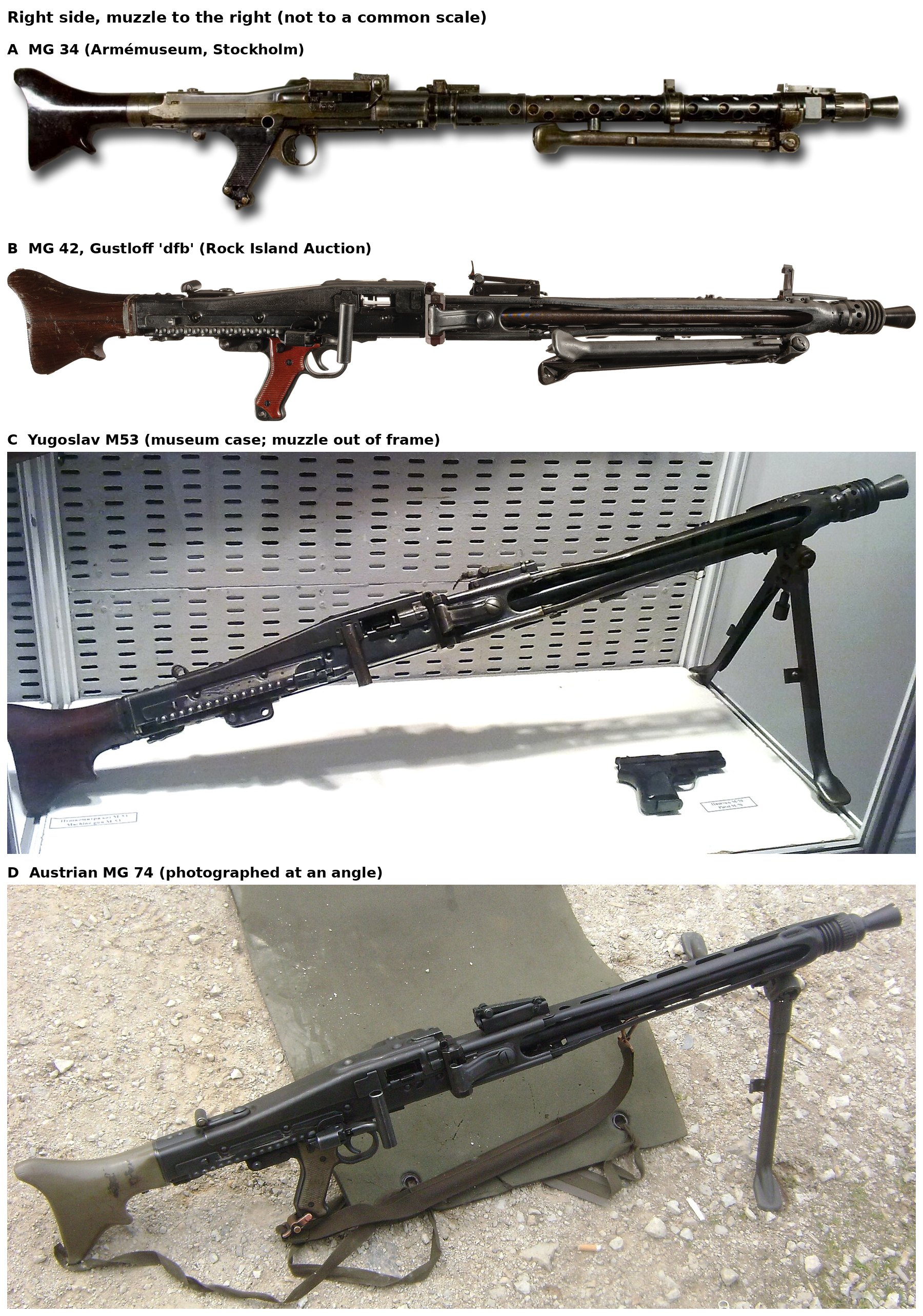
The two wartime guns are easy to tell apart by the jacket alone: the MG 34’s is round and drilled with round holes; the MG 42’s is square in section with long oval slots and a long opening on the right for the barrel change.1 The MG 34’s double trigger, top half marked E for single shots and bottom half D for continuous fire, against the MG 42’s single trigger, is the other unmistakable point.1 The MG 34’s barrel is changed by turning the whole receiver on the jacket, so it has no barrel-change lever on the side.1
5.4 MG 42 and its descendants
The post-war guns keep the MG 42’s silhouette, and the differences the sources name are small.
MG 1, MG 2, MG 3 (West Germany). Rheinmetall rebuilt the MG 42’s technical data package and produced it in 7.62×51 mm NATO for the Bundeswehr as the MG 1, and later the MG 3; converted wartime guns became the MG 2 (Volume 7). McCollum lists the features that the MG 3 carried forward from Rheinmetall’s commercial MG 42/59: “a top cover hinge that holds the cover open, a feed tray for modern belt boxes, an integrated anti-aircraft rear sight, and a new muzzle booster design.”2 Against the 1943 list, the integrated AA rear sight replaces point 5’s “separate antiaircraft rear sight hinged on the right sight base”, and the booster’s shape differs (Volume 3 shows the two in section).12 Rheinmetall’s own MG 3 manual names a feed tray under the cover and a barrel change flap on the jacket.3
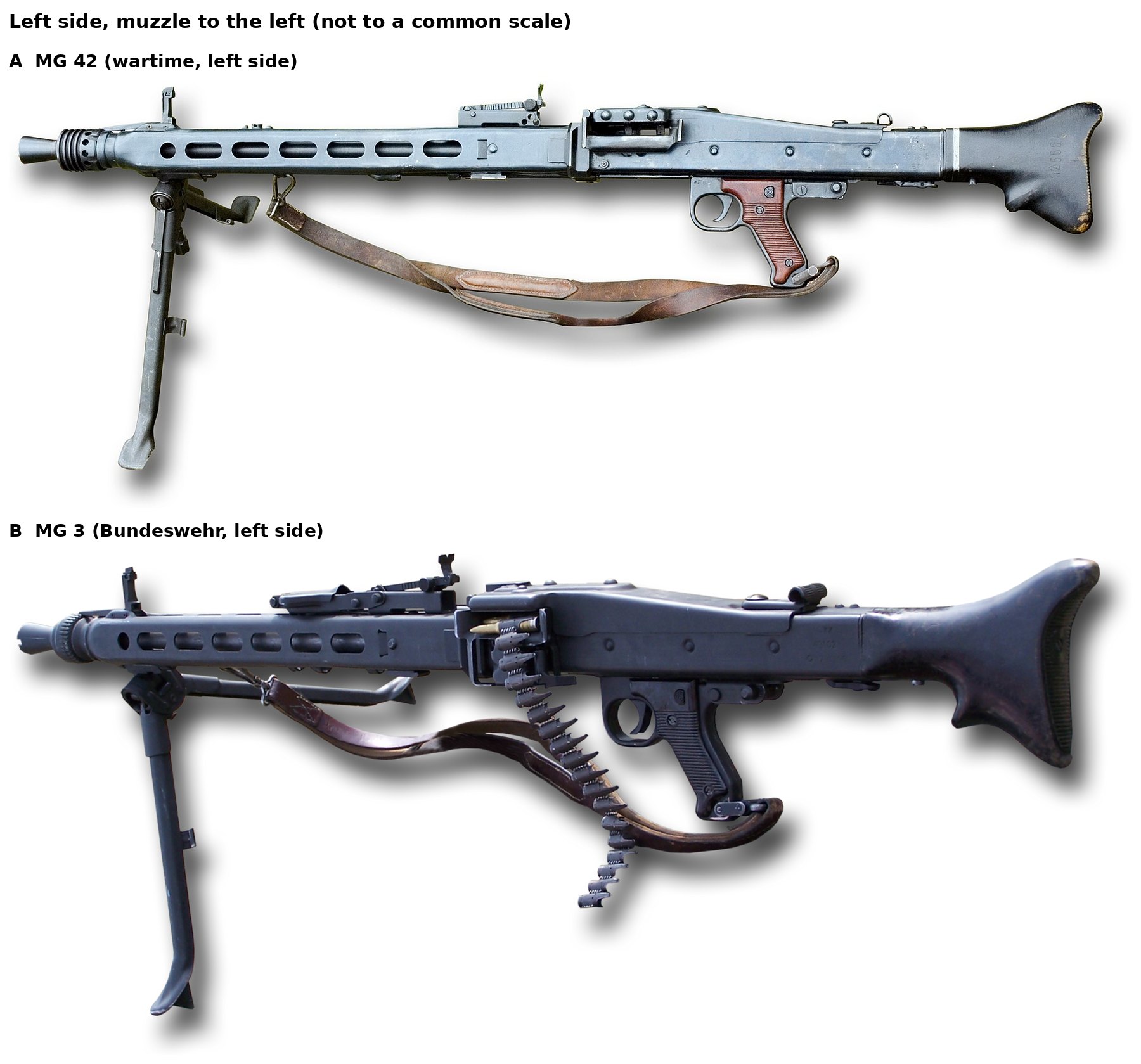
MG 42/59 (Italy, Austria). Rheinmetall’s commercial model, made in Italy (the Austrian source names Beretta as a partner) and adopted by Austria around 1960 before the MG 74 was developed from it. It shares the MG 3’s later features, and the version McCollum describes has a heavier bolt and a lower rate of fire.24 Externally it cannot be told from an MG 1 or MG 3 by anything in the sources read.
M53 Šarac (Yugoslavia). Made by Zastava from 1954, in the original 7.92 mm calibre. Zastava’s own history calls it the “machine gun 7,9 mm M42 ‘Sarac’” in the year production began, while its photo caption of the testing calls it the M53.5 No source read for this dive documents an external difference from a wartime MG 42.
MG 74 (Austria). Steyr-made, 7.62×51 mm, developed from the MG 42/59 with the rate reduced to about 850 rounds a minute, and with “a plastic stock” in place of the wooden one of the older model, according to an Austrian enthusiast source drawing on the Bundesheer.4 The green-grey synthetic butt in plate D is the readiest external clue.
Calibre is the decisive difference and it is invisible. A 7.62×51 mm gun and a 7.92×57 mm gun look the same from the side. The barrel, bolt, feed and markings settle it; a buyer must not rely on silhouette.
5.5 Tell them apart: the table
Table 1 — Tell them apart: the table
| Feature | MG 34 | MG 42 (wartime) | MG 1 / MG 2 / MG 3, MG 42/59 | M53 Šarac | MG 74 | Where to look |
|---|---|---|---|---|---|---|
| Barrel jacket | round, round holes | square section, long oval slots, opening on the right | as MG 42 | as MG 42 | as MG 42 | jacket, both sides |
| Trigger | double: E (single), D (auto) | single, automatic only | single | single | single | trigger |
| Barrel change | rotate the receiver on the jacket | lever on the right swings the barrel out | barrel-change flap on the right (MG 3 manual) | as MG 42 | as MG 42 | right side of jacket |
| AA rear sight | separate | separate leaf hinged on the right of the sight base | integrated in the rear sight | not documented | not documented | rear-sight base |
| Calibre | 7.92×57 mm | 7.92×57 mm | 7.62×51 mm (MG 2: converted wartime guns) | 7.92×57 mm | 7.62×51 mm | chamber, barrel, markings |
| Butt | not compared here | plastic (Chinn, MIS 1943); wooden on early guns (McCollum) | not documented here | wood (plate C) | plastic (doppeladler) | butt |
| Receiver markings | maker code, serial | ”M.G. 42”, serial, maker code, sometimes year (left side) | post-war maker and model | not documented here | not documented here | receiver, left side in front of the butt |
Sources: points from the May 1943 handbook (MG 34, MG 42), McCollum (MG 3 family), Rheinmetall’s MG 3 manual, Zastava, and doppeladler.com, as cited above. “Not documented” means no source read for this dive described it.
5.6 Early wartime features
McCollum describes an early Gustloff-made MG 42 as having “an early horizontal charging handle, an unreinforced wooden stock, and an adjustable front sight”, features he associates with the very early guns used in North Africa.6 No dated sequence of production changes for the MG 42 was found in a primary source, and this dive does not offer one. A reader dating a gun by its features should treat any change list without a documentary source as provisional.
5.7 Where the markings are
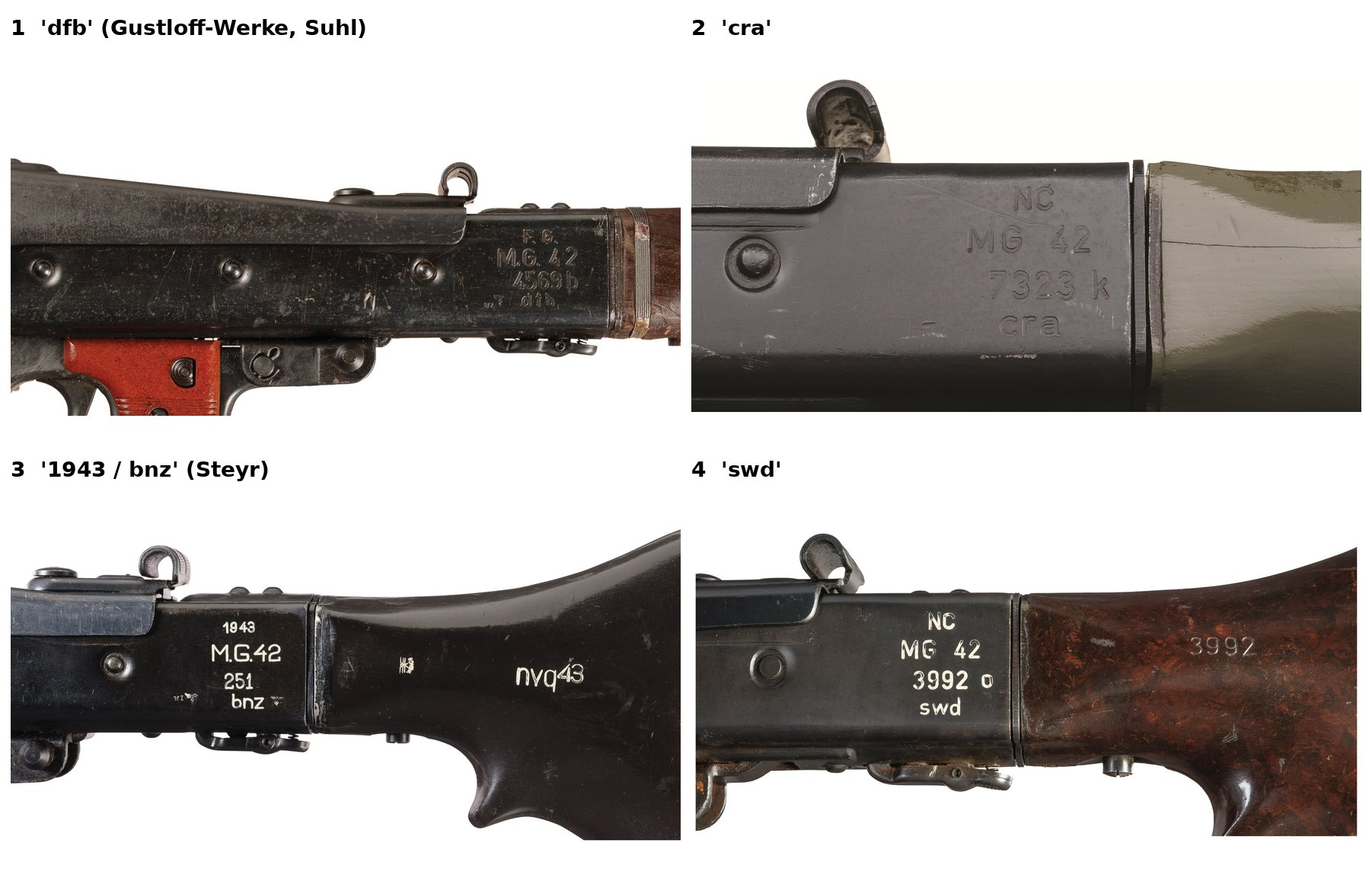
Rock Island Auction’s catalogue for a Gustloff gun states that the receiver “bears the manufacturer markings on the left side”.7 The receivers photographed for the auctions read below carry three or four lines stamped on the left of the receiver just in front of the butt: on some an upper line (a year, or letters), then the model “M.G. 42” or “MG 42”, a serial number with a letter suffix, and the maker’s code. Serial numbers are shown here because the sellers published them; they identify those particular guns, not any owned by this hub’s owner.
Two features of these marks deserve care:
- The upper line. Two of the four guns, coded cra and swd, carry the letters NC above the model name, and so does a third cra-coded gun in Romania’s national heritage register, whose record reads the marks as “NC”, a manufacturing year of 1944–1945, “MG 42”, serial and “cra”.8 No source read for this dive explains the letters, and this dive does not guess.
- The butt’s own markings. The Steyr gun’s butt is stamped “nvq 43”, a separate maker’s code and date for the butt itself; the swd gun’s butt repeats the receiver’s serial. A butt with no number, or a different one, is not proof of anything on its own; butts are wear parts and were replaced.
5.8 Maker codes
German armaments makers marked their products with letter codes issued by the Heereswaffenamt, the Army Weapons Office, instead of with their names. Fifteen code lists are known, compiled in 1977 by Karl R. Pawlas from the Heereswaffenamt’s Liste der Fertigungskennzeichen für Waffen, Munition und Gerät; the 1944 list was not seen for this dive.9
The codes found on MG 42s, and the strength of the evidence for each attribution, are these:
Table 2 — The codes found on MG 42s, and the strength of the evidence for each attribution, are these
| Code | Maker as attributed | Evidence read for this dive |
|---|---|---|
| dfb | Gustloff-Werke, Suhl | Rock Island Auction lot titles (“WWII Gustloff ‘dfb’ MG42”); collector listings; Chinn names Gustloff as a maker710 |
| bnz | Steyr (Steyr-Daimler-Puch) | Rock Island Auction lot title (“Steyr ‘1943/bnz’ MG42”); Chinn names Steyr-Daimler-Puch as a maker1110 |
| bpr | Johannes Großfuß, Döbeln | International Military Antiques catalogue (“bpr 45, for Johannes Grossfuss, located in Döbeln/Sachsen”); collector listings12 |
| ar | Mauser-Werke, Berlin-Borsigwalde | Collector listings only; Chinn names “Mauser Werke, Berlin” as a maker10 |
| cra | Maget, Berlin | Romania’s classified-heritage record for a cra-coded MG 42 (“„cra” codul fabricantului „MAGET” din Berlin”); collector listings8 |
| swd | Maget, late-war replacement code | Collector listings only |
| svq | Gustloff, late-war replacement code | Collector forum only |
Rows resting on collector listings come from collectors’ forums and reference pages that cite no document, and should be confirmed against Pawlas or the Heidler code reference before being relied on. A code identifies the factory that made the marked part, not necessarily the factory that assembled the gun.
5.9 Mixed parts, rebuilds and display guns
Wartime guns were rebuilt in arsenals and after the war, and parts were mixed. The auction and dealer descriptions read for this dive show what that looks like:
- Rock Island’s 2023 lot was described as having “evidence of rewelding on the right side of the heat shield” and “some replaced components, likely from a 7.62mm conversion (not verified, paperwork for weapon lists caliber as 7.92)”.13
- Every one of the seven transferable guns in Rock Island’s catalogues from 2020 to 2026 was described as refinished.7
- International Military Antiques sold a display gun “rebuilt on an inert BATF compliant newly made dummy receiver, which is completely hollow”, whose parts carried the codes bpr (jacket and feed tray) and ar (barrel extension), and on which “some components may display Yugoslav stock markings in addition to German wartime markings.”12 The Yugoslav M53’s long post-war service makes Yugoslav-marked parts common on guns assembled from surplus.
The practical rule follows: a code on one part dates and attributes that part. The receiver’s markings identify the gun, and in the United States the receiver is also what the law registers (Volume 8).
5.10 What could not be established
- The 1944 code list itself; every attribution except dfb, bnz and bpr rests on collector listings.
- The meaning of “NC” on some receivers.
- A documented sequence of wartime production changes (charging handle, butt, sights, bolt).
- External differences between the M53 and the wartime MG 42, and between the MG 42/59 and the MG 3.
References
Footnotes
-
US War Department, Military Intelligence Service, German Infantry Weapons, Special Series No. 14 (25 May 1943), sections 12–13, pp. 58–94. Internet Archive, https://archive.org/details/German_Infantry_Weapons_1943_MIS_Special_Series_No._14 , consulted 2026-10-19. ↩ ↩2 ↩3 ↩4 ↩5
-
Ian McCollum, “Rheinmetall MG42/59: The Slow-Fire Commercial MG42”, Forgotten Weapons, 4 May 2022, https://www.forgottenweapons.com/rheinmetall-mg42-59-the-slow-fire-commercial-mg42/ , consulted 2026-10-19. ↩ ↩2 ↩3
-
Rheinmetall International S.A., Machine Gun MG3 Operator’s Manual (1992), pp. 8–11, 16. Internet Archive, https://archive.org/details/machine-gun-mg-3-operators-manual-1992 , consulted 2026-10-19. ↩
-
“7,62 mm Maschinengewehr MG 74 (Steyr)”, doppeladler.com, https://www.doppeladler.com/oebh/infanterie/mg74.htm , consulted 2026-10-19. ↩ ↩2
-
Zastava Arms, “1945–1970 (Crvena Zastava Works)”, http://www.zastava-arms.rs/cms/index.php?id=321 , as archived by the Internet Archive on 7 May 2012, https://web.archive.org/web/20120507230509/http://www.zastava-arms.rs/cms/index.php?id=321 , consulted 2026-10-20. ↩
-
Ian McCollum, “Hitler’s Zipper: The MG-42 Universal Machine Gun”, Forgotten Weapons, 4 November 2020, https://www.forgottenweapons.com/hitlers-zipper-the-mg-42-universal-machine-gun/ , consulted 2026-10-19. ↩
-
Rock Island Auction Company, sale 4098 (21–23 August 2026), lot 1311, https://www.rockislandauction.com/detail/4098/1311/ ; and lots 81/1510, 85/482, 89/406, 4092/1365, 4093/1363, 4094/1388 (2020–2025), consulted 2026-10-19. ↩ ↩2 ↩3
-
Institutul Național al Patrimoniului (Romania), classified movable heritage record “Mitralieră 7,92 mm MG 42 cu afet”, CIMEC, https://clasate.cimec.ro/Detaliu.asp?tit=Mitraliera—Mitraliera-7-92-MM-MG-42-cu-afet&k=16782ddd28f34c6cbc0fdc33357fa7b1 , as reproduced in the descriptions of the institute’s photographs on Wikimedia Commons (“Mitralieră MG 42 cu afet” 01–26, 31 October 2022), consulted 2026-10-20. ↩ ↩2
-
“Fertigungskennzeichen”, Crypto Cellar Research, https://cryptocellar.org/enigma/efabcode.html (describing the Heereswaffenamt’s Liste der Fertigungskennzeichen für Waffen, Munition und Gerät, Berlin 1944, and Karl R. Pawlas’s 1977 compilation, ISBN 3-88088-214-2), consulted 2026-10-19. ↩
-
George M. Chinn, The Machine Gun, vol. I (1951), chapter 33, p. 488. Internet Archive, https://archive.org/details/TheMachineGunVolume1ByGeorgeMChinn , consulted 2026-10-19. ↩ ↩2 ↩3
-
Rock Island Auction Company, sale 4093 (6–8 December 2024), lot 1363, “Steyr ‘1943/bnz’ MG42”, https://www.rockislandauction.com/detail/4093/1363/ , consulted 2026-10-19. ↩
-
International Military Antiques, “Original German WWII MG 42 Display Machine Gun marked bpr for Johannes Grossfuss Metalworking”, item ONAC23027, https://www.ima-usa.com/products/original-german-wwii-mg-42-display-machine-gun-marked-bpr-for-johannes-grossfuss-metalworking , consulted 2026-10-20. ↩ ↩2
-
Rock Island Auction Company, sale 89 (25–27 August 2023), lot 406, “German MG42 Machine Gun, Class III/NFA Fully Transferable”, https://www.rockislandauction.com/detail/89/406/ , consulted 2026-10-19. ↩
Comments (0)