MG 42 · Volume 2
Making It: Stampings, Five Factories, Uncertain Numbers and the American Copy That Failed
Who built the MG 42, what pressed-steel construction meant in practice, how many were made according to whom, the barrels still being made for the Soviets in 1946, and why Saginaw could not copy it
2.1 A gun built like a sheet-metal product
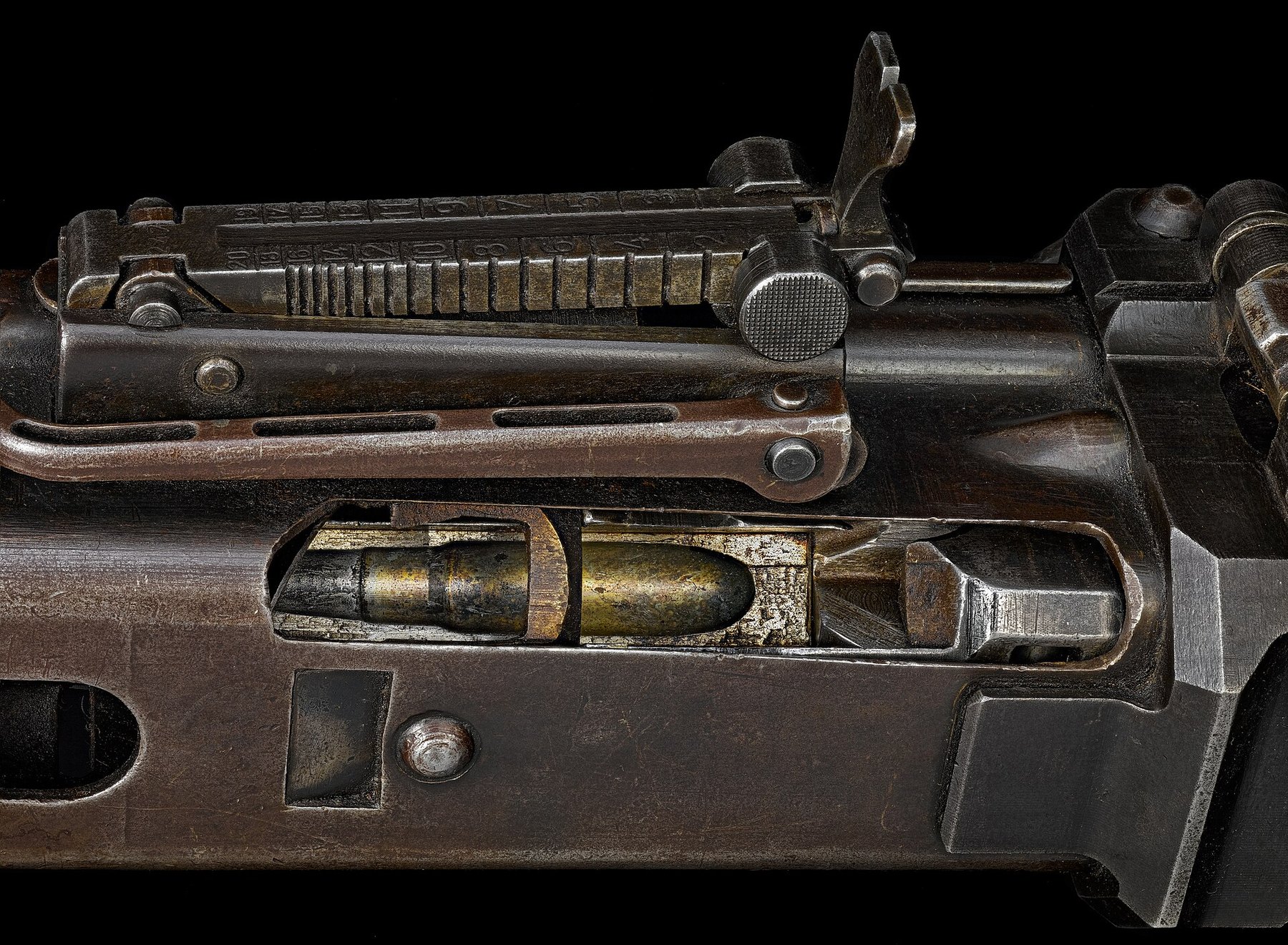
Every account of the MG 42 begins with its construction, because that is what the Allied technical intelligence noticed first. The first US description, in March 1943, listed “an extensive use of stamping and welding in the receiver, barrel casing, feed mechanism, operating handle, and antiaircraft rear sight.”1 By August the War Department had examined the gun more closely: “The extensive use of pressing, riveting and spot-welding in the construction (there are very few machined parts) gives the gun a less-finished appearance than is usual in German weapons. Considerable effort has been made to lighten the gun without the loss of strength — for example by making holes in the operating handle. There is no reason for assuming, however, that its life and performance are not up to the usual German standard.”2
The firm that designed it, Johannes Großfuß of Döbeln, made pressed and lacquered metal goods, and its engineer Werner Gruner’s contribution was, by Chinn’s account, “manufacture of the weapon without employing complicated methods or equipment” by “extensive use of pressing, riveting, and spot welding.”3 Volume 1 covers Gruner and the question of where the lock came from.
2.2 What was pressed and what was machined
The sources read for this dive agree on the general division and are thin on the detail.
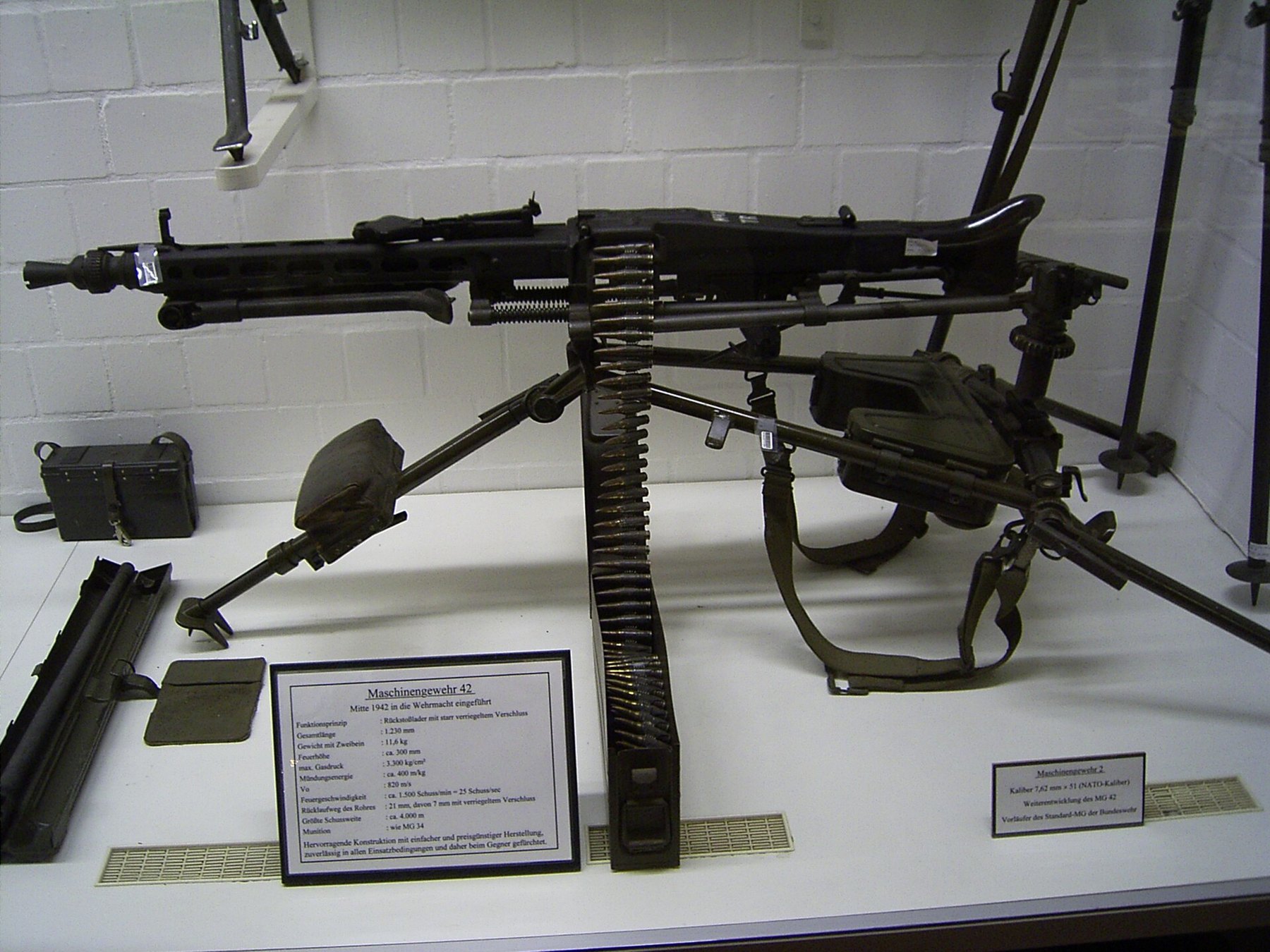
Pressed, welded and riveted. Chinn: “The barrel-jacket cover and feed parts and receiver were constructed of stamped lightweight sheet steel welded lengthwise. The bolt’s slideways were welded inside the receiver.”3 The Aberdeen comparison of August 1943 adds the cover assembly and trigger group to the stamped list.4 The barrel jacket, a square-section tube with long oval cooling slots and the large opening on its right side for the barrel change, is the most visible pressing.
Machined or forged. The Aberdeen report: “The bolt carrier is a forging.”4 The barrel, the bolt head and the rollers are necessarily machined. Rock Island Auction’s catalogue for a Gustloff-made gun describes “a machined trunnion” connecting “the stamped shroud to the stamped receiver.”5 The barrel extension that carries the locking recesses is a separate part screwed to the barrel; Chinn: “The barrel has a relatively short but heavy barrel extension which is screwed to its aft end.”3
Plastic. The butt of the gun Chinn describes was “made of plastic”, and the MIS handbook’s figure labels it “plastic shoulder stock”.36 Wooden butts also occur, on early guns and on many surviving examples (Volume 5).
A German Wikipedia figure, that labour per gun fell from 150 to 75 hours, is attributed to Wollert and Lidschun (1998), a book not seen for this dive; it is not adopted here.
2.3 The makers
Chinn names five factories:
“The following arms plants manufactured the MG-42 for the German Army: The Johannes Grossfuss Metall- und Lackierwarenfabrik, Döbeln, Saxony (Dr. Grunow was on its staff); Mauser Werke, Berlin; Magnet, Berlin; Gustloff Co., Suhl Gun Works, Suhl, Germany; and Steyr-Daimler-Puch A.G., Vienna, Austria.”3
German Wikipedia gives the same five as “Großfuß, MAGET, Mauser Werke, Steyr-Daimler-Puch, Wilhelm-Gustloff-Stiftung”. Two details deserve a note.
- “Magnet” or “Maget”. Chinn’s text reads “Magnet”; German Wikipedia and collector references read Maget, a Berlin-Tegel firm. The scanned page of Chinn is OCR-damaged at this word, and Maget is the form the German-language sources use; this dive uses Maget.
- Steyr’s location. Chinn puts Steyr-Daimler-Puch at Vienna, its head office. Guns attributed to Steyr carry the code bnz, which collector references assign to Steyr’s arms works at Steyr in Upper Austria; Rock Island Auction catalogued a gun marked “1943 / bnz” as Steyr-made.7
Each maker marked its guns with a letter code from the German armaments code lists rather than with its name. The codes, how they changed late in the war, and what a reader can and cannot infer from them are in Volume 5. One claim about Großfuß circulates among collectors: that it made receivers for other firms to assemble rather than complete guns. No document was found to confirm or refute it.
2.4 How many were made
No primary production figure for the MG 42 was found for this dive. The figures in circulation are these:
Table 1 — No primary production figure for the MG 42 was found for this dive. The figures in circulation are these
| Figure | Where it is printed | What it rests on |
|---|---|---|
| 352,000 to 400,000 | German Wikipedia, citing Wollert and Lidschun, Illustrierte Enzyklopädie der Infanteriewaffen aus aller Welt (1998), p. 199 | Not seen |
| 414,964 | Several English-language enthusiast sites (a fan wiki, the Internet Movie Firearms Database) | No source given |
| ”over 400,000” | Various | No source given |
| about 70,000 at Steyr | Collector forum post | No source given |
The obvious primary for wartime output, the United States Strategic Bombing Survey’s tables of German armaments production, is held on the Internet Archive as a lending-only item and could not be read for this dive. A reader who wants a production figure should treat everything in the table as unconfirmed, and should not combine the rows into an average.
2.5 After the surrender: barrels for the Red Army
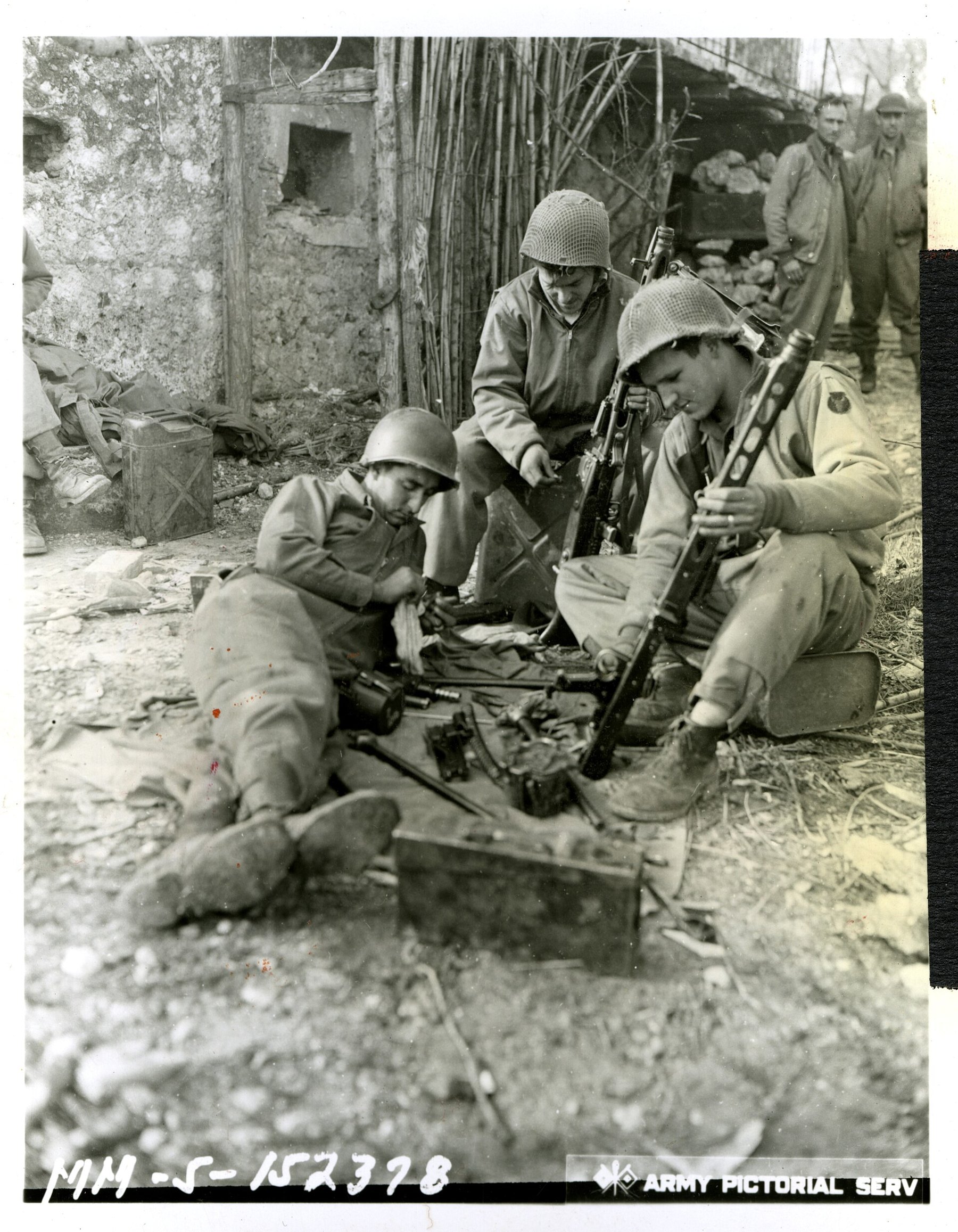
Production did not end cleanly in May 1945. A Central Intelligence Agency information report dated 12 November 1946, declassified through the CIA’s CREST database, records that “according to the report of one Rieger, an engineer employed by Kirchbach & Co., Coswig near Dresden, this plant, among other things, is producing barrels for the MG 42 (machine gun) and they are being delivered to the Russians.”8
The report is one paragraph from a single informant and says nothing about numbers or purpose. It is still a useful fact: in the Soviet occupation zone, eighteen months after the war, a Saxon firm was making MG 42 barrels for the occupying army. Döbeln, where Großfuß had been, and Dresden, where Gruner later taught, were in the same zone. Who used those barrels is not known from this source.
2.6 The American copy: the T24
The United States tried to copy the MG 42 during the war, and the attempt is documented in Chinn’s history. “After the United States entered the war against Germany, the Ordnance Department sought to copy a captured German MG-42. The Saginaw Steering Gear Division of General Motors was given the assignment. Drawings were completed in June 1943 and the first guns produced were test fired on 1 October 1943.”3
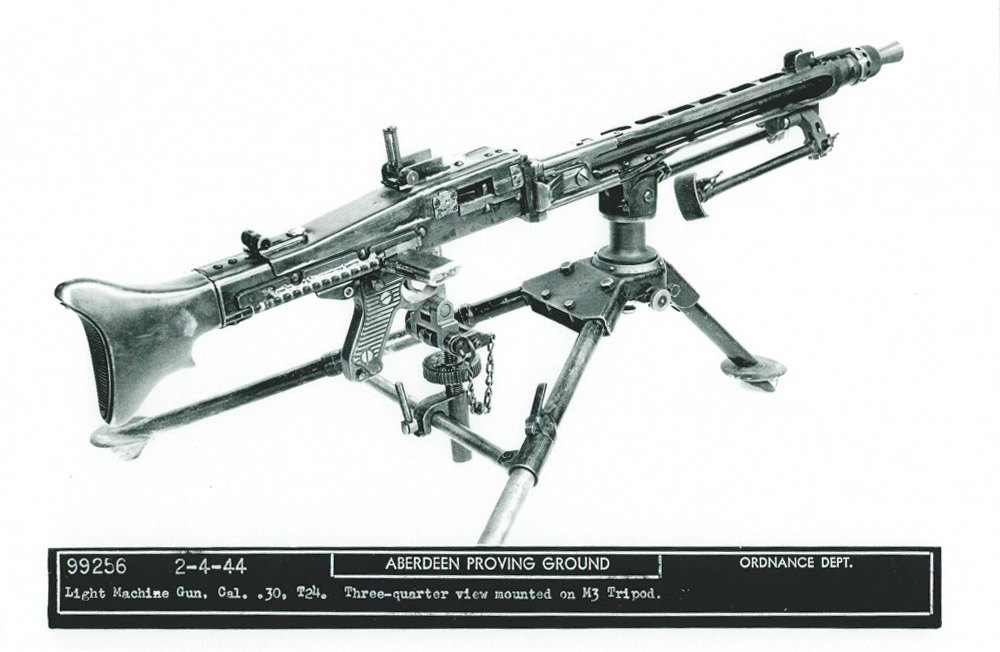
The American gun was chambered for the US service cartridge, .30-06, and designated the Machine Gun, Cal. .30, T24. An Aberdeen Proving Ground photograph dated 4 February 1944 shows it on the US M3 tripod, captioned “Light Machine Gun, Cal. .30, T24. Three-quarter view mounted on M3 Tripod.”9
The trials went badly. Chinn again:
“Serious malfunctions were found to result and the components were then reworked. When it was thought to be ready, it was again put on trial in February 1944. The results were so discouraging that the discharge of a hundred rounds had to be done in bursts of two and three shots. Again the parts were modified and ‘beefed up’ until it was thought to be capable of the basic 10,000-round endurance test required by the Army before being considered even for limited use. After 1,483 rounds had been expended, the test was stopped, there having been over 50 serious stoppages.”3
2.7 Why the T24 failed
The investigation that followed found a dimensional error, not a flaw in the German design. Chinn:
“The investigation revealed that inadequate compensation for the difference between the cartridge length of our caliber [.30] M2 and the German 7.92-mm cartridge case had been made and that the receiver on the American version was too long. The rear lugs on the bolt body also had not been placed far enough back to allow the bolt face to recoil behind the ejection slot in the bottom of the receiver. As a result the receiver yoke interfered with the cartridge guide plate by as much as a quarter of an inch.”3
(The scan of Chinn’s page reads “.50 M2” at the bracketed point; the context, a comparison with the 7.92 mm rifle cartridge in a .30-calibre gun, makes the .30 M2 ball cartridge the only sense, and the word is OCR-damaged.)
The 7.92×57 mm and .30-06 cases differ in length by some 6 mm. A gun whose cycle depends on the bolt travelling a precise distance relative to the feed and the ejection opening is unforgiving of a lengthened receiver if the bolt’s own geometry is not moved with it. Chinn’s account is that the American engineers lengthened one and not the other.
“It was concluded that extensive redesign would be necessary to correct these serious defects in both receiver and bolt mechanisms and further expenditures or developments were ordered stopped. Two models of this American made failure … were shipped to the Springfield Armory and placed in its museum for reference and historical purposes.”3
The MG 42’s influence on American design did not stop there. After the war the US Ordnance Corps grafted the MG 42’s belt feed onto the FG 42’s action as the T44, which led in time to the M60; Volume 7 notes that line and links to it.10
2.8 What could not be established
- Any primary production figure, total or by maker. All circulating totals are unsourced or rest on a book not seen.
- Whether Großfuß made complete guns or principally receivers for other assemblers.
- The scale and purpose of the 1946 Coswig barrel production beyond the single CIA paragraph.
- The T24’s surviving examples. Chinn says two went to the Springfield Armory museum in 1951; their present location was not checked.
References
Footnotes
-
US War Department, Military Intelligence Service, Tactical and Technical Trends No. 20 (11 March 1943), item 16, p. 28. Internet Archive, https://archive.org/details/TacticalAndTechnicalTrendsNos1-20 , consulted 2026-10-19. ↩
-
Tactical and Technical Trends No. 31 (12 August 1943), item 16, “More Details of the German MG 42”, pp. 37–39. Internet Archive, https://archive.org/details/TacticalAndTechnicalTrendsNos31-40 , consulted 2026-10-19. ↩
-
George M. Chinn, The Machine Gun, vol. I (Washington: Bureau of Ordnance, Department of the Navy, 1951), chapter 33, “MG-42 Machine Gun”, pp. 484–489. Internet Archive, https://archive.org/details/TheMachineGunVolume1ByGeorgeMChinn , consulted 2026-10-19. ↩ ↩2 ↩3 ↩4 ↩5 ↩6 ↩7 ↩8 ↩9
-
Tactical and Technical Trends No. 32 (August 1943), item 12, “Comparison of German Machine Guns”, pp. 36–37, same scan. ↩ ↩2
-
Rock Island Auction Company, August Premier Firearms Auction (21–23 August 2026), lot 1311, “WWII Gustloff ‘dfb’ MG42, Class III/NFA C&R Machine Gun”, https://www.rockislandauction.com/detail/4098/1311/wwii-gustloff-dfb-mg42-class-iiinfa-cr-machine-gun , consulted 2026-10-19. ↩
-
US War Department, Military Intelligence Service, German Infantry Weapons, Special Series No. 14 (25 May 1943), section 13, figure 51. Internet Archive, https://archive.org/details/German_Infantry_Weapons_1943_MIS_Special_Series_No._14 , consulted 2026-10-19. ↩
-
Rock Island Auction Company, December 2024 Premier Firearms Auction (6–8 December 2024), lot 1363, “Steyr ‘1943/bnz’ MG42, Class III/NFA C&R Fully Transferable”, https://www.rockislandauction.com/detail/4093/1363/ , consulted 2026-10-19. ↩
-
Central Intelligence Agency, information report, “Production of MG.42 Barrels for Russians by Kirchbach & Co., Coswig”, 12 November 1946, CIA-RDP82-00457R000100390012-9 (CREST). Internet Archive, https://archive.org/details/CIA-RDP82-00457R000100390012-9 , consulted 2026-10-19. ↩
-
Aberdeen Proving Ground, Ordnance Department, photograph 99256, 4 February 1944, “Light Machine Gun, Cal. .30, T24. Three-quarter view mounted on M3 Tripod.” Wikimedia Commons, https://commons.wikimedia.org/wiki/File:T24mg6.jpg , consulted 2026-10-19. ↩
-
Chinn, The Machine Gun, vol. III (1953), chapter 14, “Ordnance Corps Light Machine Gun, 7.92-mm”, section 1. Internet Archive, https://archive.org/details/TheMachineGunVolume3ByGeorgeMChinn , consulted 2026-10-19. ↩

Comments (0)