MG 42 · Volume 7
After 1945: MG 1, MG 3, Šarac, MG 42/59, MG 74, and the Rifles the Roller Fed
Captured guns in other hands, the West German rebuild in 7.62 mm, the Yugoslav and Austrian and Italian guns, users worldwide as far as they are documented, and the two lines of descent, belt feed to the M60 and rollers to the G3, linked rather than retold
7.1 Captured guns, 1943 onward
The MG 42’s second career began before the first ended. Captured guns were turned against their makers from Tunisia onward: Volume 1 shows British infantry firing one in April 1943, and Volume 2 US infantry cleaning a batch in Italy in January 1944. Yugoslav partisans used them, and so did the Polish Home Army in the Warsaw Uprising.
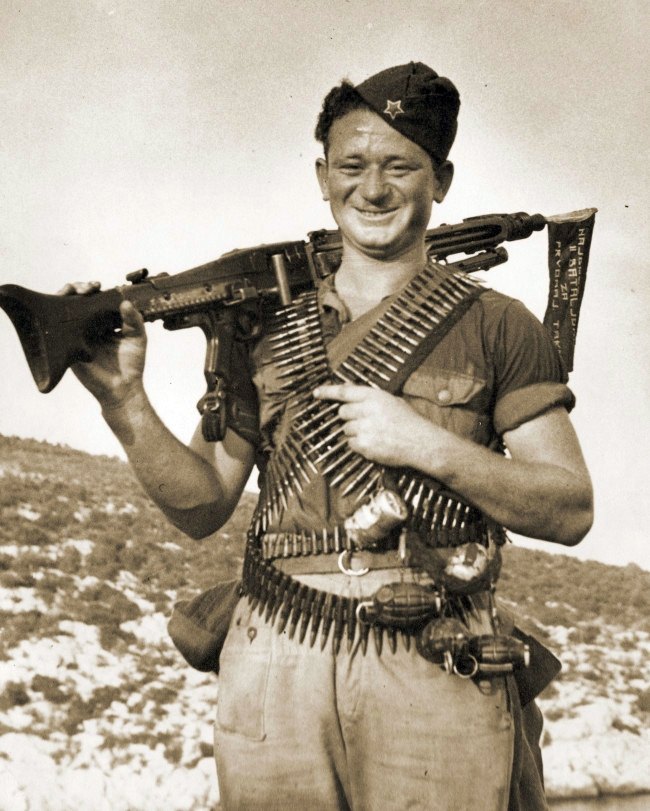
The war’s end left large stocks in the hands of the victors and of the states that had fought on either side. In the Soviet zone of Germany, as Volume 2 records, a firm at Coswig near Dresden was still making MG 42 barrels “delivered to the Russians” in November 1946.1 Yugoslavia went further and put the gun back into production (below).
7.2 West Germany: MG 1, MG 2, MG 3
When West Germany rearmed, it chose the MG 42 again. Ian McCollum’s account: “the Bundeswehr chose the MG42 as its standard general-purpose machine gun. Rheinmetall recreated the technical data package”, completing the work in 1958, and produced new guns in 7.62×51 mm NATO “for export and for the Bundeswehr, which designated the gun the MG1.”2 German Wikipedia gives the MG 1 as new-made guns adapted to 7.62 mm “ab 1956” and the MG 2 as wartime MG 42s converted to 7.62 mm NATO “ab 1965”, both without citations. The 1956 and 1958 dates are given side by side; the 1958 date is McCollum’s, for the completion of the data package.
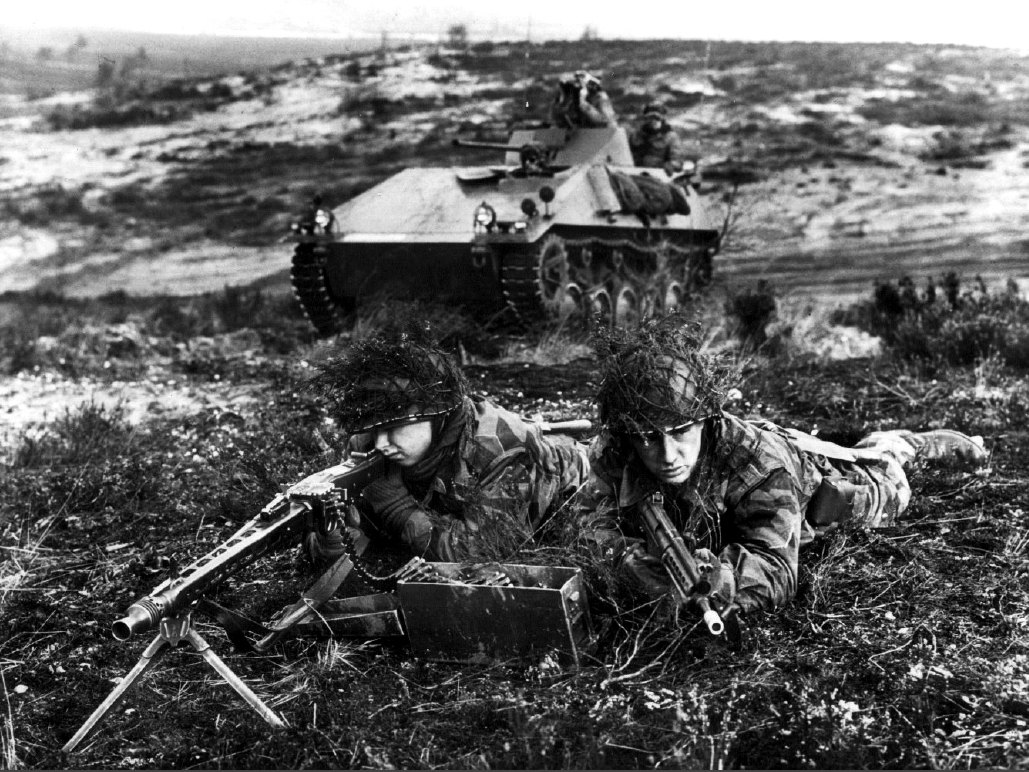
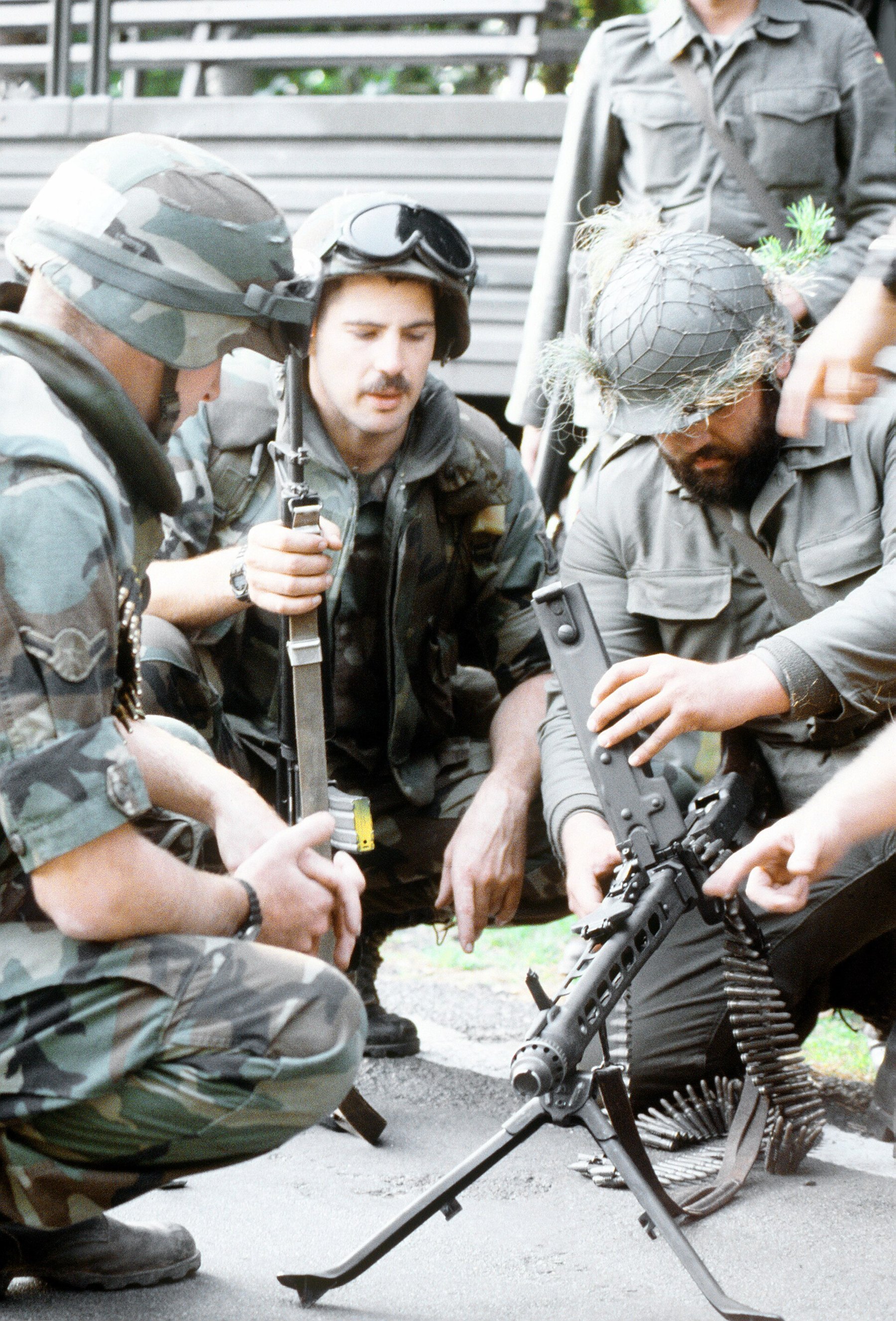
The MG 3 followed. The Bundeswehr’s own page: “Schon 1969 eingeführt, hat es sich über Jahrzehnte bewährt” (introduced as early as 1969, it has proved itself over decades). It gives the MG 3 as 7.62 mm, up to 1,200 rounds a minute, 11.5 kg, barrel 565 mm, effective to 1,200 m (600 m from the bipod).3 Rheinmetall’s 1992 manual gives 1,000 to 1,300 rounds a minute, 11.9 kg with bipod and sling, 1,225 mm long, sights to 1,200 m and an anti-aircraft sight graduated for targets at 100 to 250 metres a second, that is, for propeller aircraft and jets.4 The manual’s description of the action, “recoil loader with moving barrel” and “locking roll system”, is the MG 42’s.4 The features that tell the MG 3 from the wartime gun are in Volume 5.
7.3 Rheinmetall’s MG 42/59, and Italy
Rheinmetall also sold a commercial version. McCollum: Rheinmetall “nearly doubled the bolt weight, from 550 g (1.2 lb) to 950 g (2.1 lb), to bring the rate of fire to a more manageable 700–900 rpm. The Bundeswehr did not adopt this bolt, but one other client bought it.” The model introduced features later used on the MG 3: “a top cover hinge that holds the cover open, a feed tray for modern belt boxes, an integrated anti-aircraft rear sight, and a new muzzle booster design.” The example he filmed was made in 1964.2
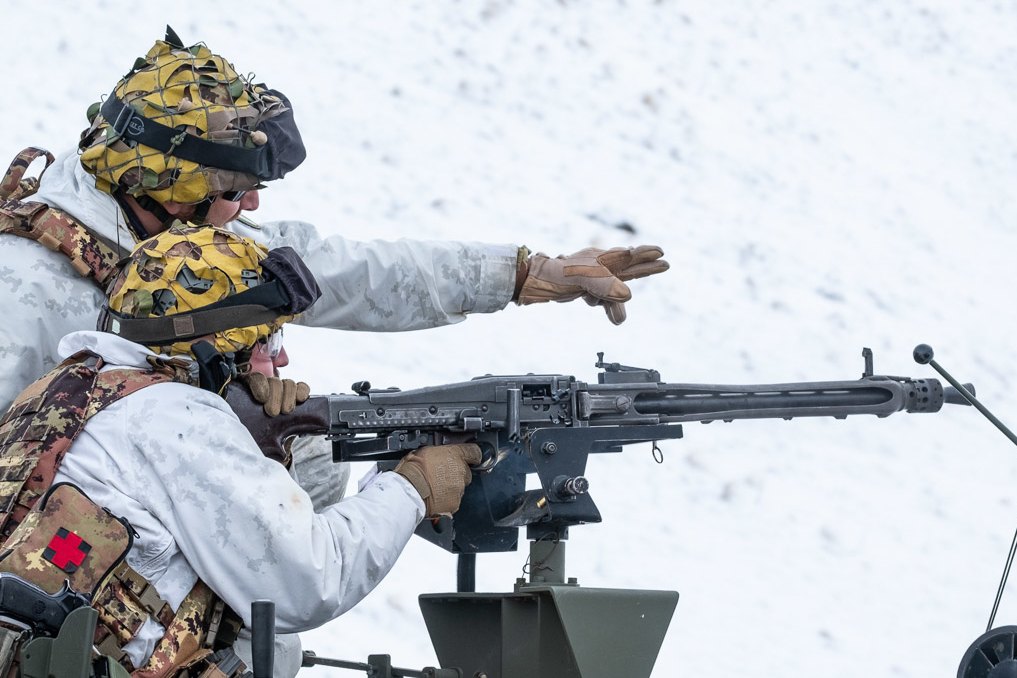
Italy adopted the MG 42/59 and still uses it. Italian Army photographs released on Wikimedia Commons show it in service with the Alpini and the cavalry in 2022 and 2024, and the Commons category for Italian service guns names Beretta as the maker.5
7.4 Austria: MG 42/59 and MG 74
The Austrian Bundesheer adopted the MG 42/59 around 1960 and then developed its own gun from it. An Austrian armed-forces enthusiast site, drawing its data from the Bundesheer, gives the MG 74 as a development of the MG 42/59 by the Amt für Wehrtechnik with Steyr Mannlicher and Beretta, in 7.62×51 mm, with the cyclic rate reduced “from 1,200 to 850 rounds per minute”, the rate adjustable by changing the bolt, a plastic butt in place of the wood of the older gun, and a weight of about 12 kg with bipod. The coaxial vehicle version is the MG 74Pz.6 The Bundesheer’s own page for the gun was not found. The MG 74 appears in plate D of Volume 5.
7.5 Yugoslavia: the M53
Yugoslavia made the MG 42 in its original calibre. Zastava’s own history of its works for 1945 to 1970 records that “in 1954 the factory started the production of shotguns and small bore rifles, as well as machine gun 7,9 mm M42 ‘Sarac’”, and captions a photograph of the trials “Testiranje M53” (testing of the M53).7 The gun is therefore found as both M42 and M53, and as Šarac, the name under which it is remembered.
The Šarac’s long service matters to collectors outside Yugoslavia: guns assembled from surplus parts commonly mix German and Yugoslav markings (Volume 5). A reprint seller lists a Yugoslav M53/MG 42 armourer’s manual of 1963.8
7.6 Switzerland: the MG 51, a relative
Switzerland’s MG 51 is often grouped with the MG 42’s descendants. McCollum’s account is that when Switzerland sought a universal machine gun to replace both its MG 11 Maxim and LMG 25, “both SIG and Waffenfabrik Bern started from the German MG42”, and W+F Bern’s MG 51 won, with a milled receiver in place of the stamped one, a heavier barrel for sustained fire and an anti-bounce system against out-of-battery discharges.9 How much of the MG 42’s mechanism the MG 51 kept is not set out in the summary read, and this dive does not characterise its lock.
7.7 Users worldwide: what is documented
No authoritative list of MG 42 and MG 3 users was found. The countries below are those for which this dive found a primary photograph, a government page or the maker’s own record of use; the list is not complete.
Table 1 — Users worldwide: what is documented
| Country | Gun | Evidence |
|---|---|---|
| Germany (Bundeswehr) | MG 1, MG 3 | US Army photograph 1960; Bundeswehr MG 3 page3 |
| Italy | MG 42/59 | Italian Army photographs, 2022–20245 |
| Austria | MG 42/59, MG 74 | doppeladler.com (Bundesheer data)6 |
| Yugoslavia, Serbia | M42/M53 Šarac | Zastava’s history7 |
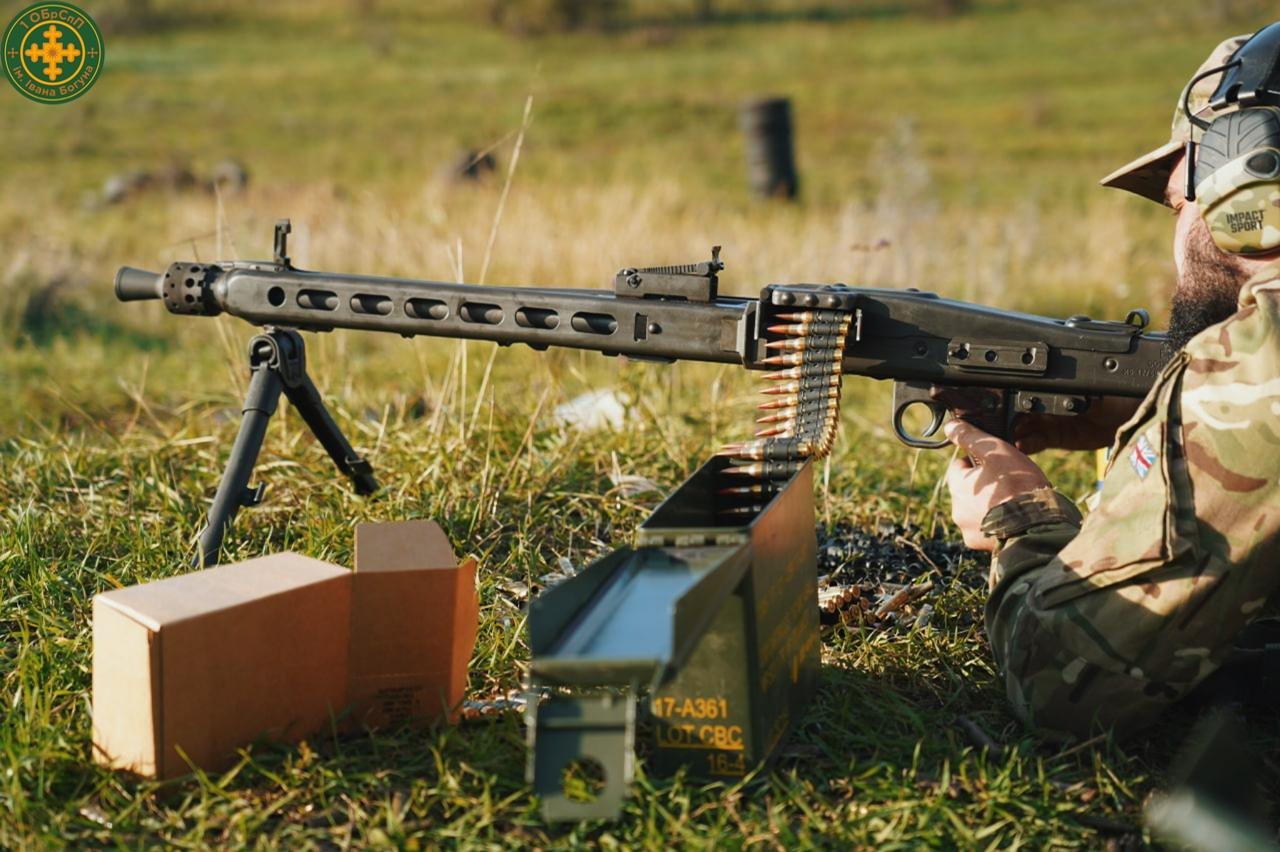
| Ukraine | MG 42/59 | photograph of the 1st Ivan Bohun Special Purpose Brigade training, 202210 |
| Poland (Home Army, 1944), Yugoslav partisans, Lithuanian partisans (1946–49) | captured MG 42 | wartime and post-war photographs in the Commons categories for each11 |
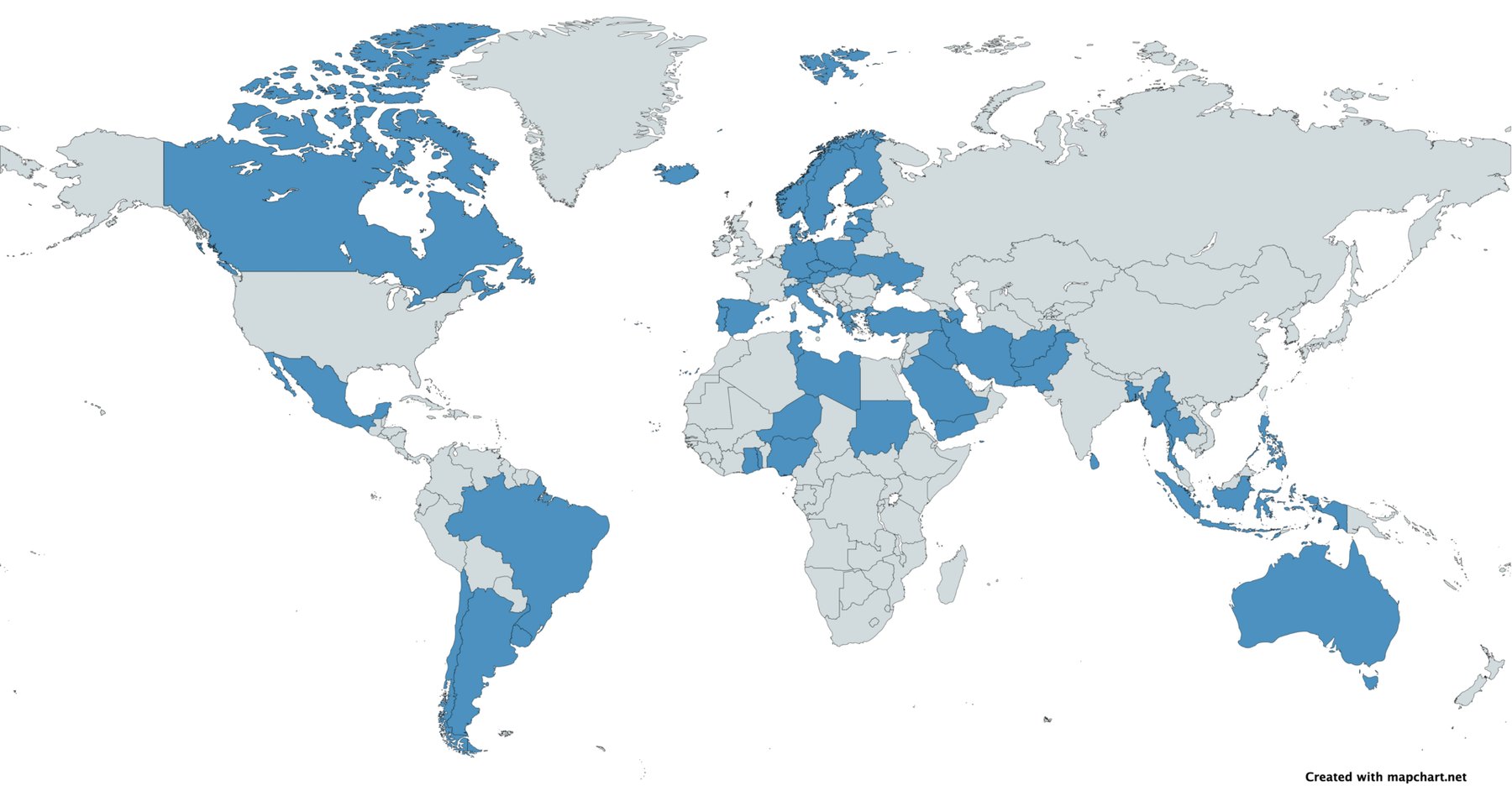
A Wikimedia Commons contributor’s map of MG 3 users shows a much wider spread, across most of Europe, South America, parts of Africa and Asia, and Australia. It is reproduced as a contributor’s compilation, not as a source: the map gives no references.
7.8 The feed’s descendant: T44 to M60
The American failure to copy the MG 42 in .30-06 (Volume 2) did not end US interest in it. After the war the Ordnance Corps tried “to refine and improve the design of the Krieghoff 7.92-mm FG-42 and, if possible, to convert it from clip to belt feed, employing the feed system of another popular German light machine gun, the MG 42.” The work was done “under the designation ‘Gun Machine, Light, 7.92-mm T44’ by the Bridge Tool and Die Works”, and “by December 1946, the mechanical solution for the conversion had been completed.”12 The T44 began the line that became the US M60, as the title of McCollum’s video on it (“The First M60 Prototype”) puts it. This dive does not follow it further; the M60 belongs to its own history. McCollum’s video “The First M60 Prototype: FG42 + MG42 = T44” covers the T44 itself.13
7.9 The rollers’ descendant: StG 45(M), CETME, G3
The other line runs through the rollers, and it changed their job.
At Mauser’s Oberndorf works late in the war, according to McCollum, an attempt to make a roller-locked rifle (the Gerät 03) was followed by the Gerät 06H, and “an accident with automatic fire and bolt bounce sparked the idea of roller-delayed blowback”. The Gerät 06H “was ordered to be fully developed, with the designation StG-45(M)”, and after the war its design “developed into the CETME rifle and adopted by Spain”, and then into the “massive worldwide use as the G3 rifle, MP5 submachine gun” and their relatives.14
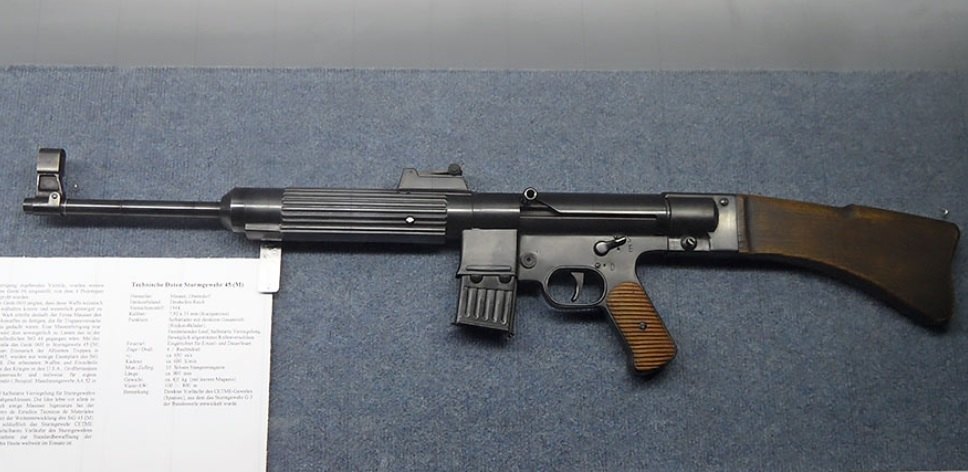
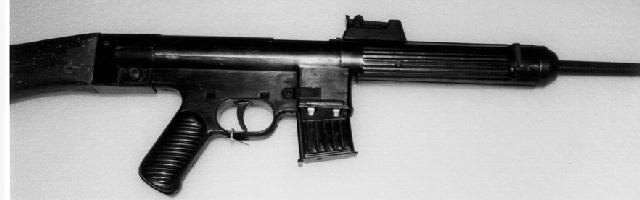
The difference between the MG 42’s locked rollers and the G3’s delaying rollers is set out in Volume 3. The G3 line, its 1:4 roller ratio and its precision variant are covered in this hub’s H&K PSG1 dive, especially Volume 1 for the Mauser-to-CETME-to-G3 history and Volume 3 for the mechanism.
7.10 What could not be established
- Production totals for the MG 1, MG 2, MG 3, M53, MG 42/59 and MG 74.
- A sourced list of MG 3 users; the map reproduced is a contributor’s compilation.
- The Bundesheer’s own MG 74 data; the figures given are from an enthusiast site.
- The MG 1’s start date: 1956 (German Wikipedia, uncited) against 1958 for the completed data package (McCollum).
- How the MG 51’s lock relates to the MG 42’s.
References
Footnotes
-
Central Intelligence Agency, information report, “Production of MG.42 Barrels for Russians by Kirchbach & Co., Coswig”, 12 November 1946, CIA-RDP82-00457R000100390012-9. Internet Archive, https://archive.org/details/CIA-RDP82-00457R000100390012-9 , consulted 2026-10-19. ↩
-
Ian McCollum, “Rheinmetall MG42/59: The Slow-Fire Commercial MG42”, Forgotten Weapons, 4 May 2022, https://www.forgottenweapons.com/rheinmetall-mg42-59-the-slow-fire-commercial-mg42/ , consulted 2026-10-19. ↩ ↩2
-
Bundeswehr, “MG3”, https://www.bundeswehr.de/de/ausruestung-technik-bundeswehr/ausruestung-bewaffnung/mg3 , consulted 2026-10-19. ↩ ↩2
-
Rheinmetall International S.A., Machine Gun MG3 Operator’s Manual, Cal. 7.62 mm x 51 (1992), sections 2 and 5.5. Internet Archive, https://archive.org/details/machine-gun-mg-3-operators-manual-1992 , consulted 2026-10-19. ↩ ↩2
-
Wikimedia Commons, “Category:Beretta MG 42/59”, including Italian Army photographs “Italian Army - 2nd Alpini Regiment troops firing a MG42 machine gun from a VTML Lince vehicle during a training exercise in Valloire, France” (2022, CC BY 2.5), https://commons.wikimedia.org/wiki/Category:Beretta_MG_42/59 , consulted 2026-10-19. ↩ ↩2
-
“7,62 mm Maschinengewehr MG 74 (Steyr)”, doppeladler.com, https://www.doppeladler.com/oebh/infanterie/mg74.htm , consulted 2026-10-19. ↩ ↩2
-
Zastava Arms, “1945–1970 (Crvena Zastava Works)”, http://www.zastava-arms.rs/cms/index.php?id=321 , as archived 7 May 2012, https://web.archive.org/web/20120507230509/http://www.zastava-arms.rs/cms/index.php?id=321 , consulted 2026-10-20. ↩ ↩2
-
German Manuals (reprint seller), catalogue, https://www.germanmanuals.com/manuals.html , consulted 2026-10-19. ↩
-
Ian McCollum, “MG51: When the Swiss Make an MG42”, Forgotten Weapons, https://www.forgottenweapons.com/mg51-when-the-swiss-make-an-mg42/ , consulted 2026-10-19. ↩
-
“UA MG42-59 training 01.jpg”, 1st Ivan Bohun Special Purpose Brigade, 9 October 2022, CC BY 4.0. Wikimedia Commons, https://commons.wikimedia.org/wiki/File:UA_MG42-59_training_01.jpg , consulted 2026-10-19. ↩
-
Wikimedia Commons categories “MG 42 in Polish service”, “MG 42 in Lithuanian service” and “MG 42” (Yugoslav partisan photographs), https://commons.wikimedia.org/wiki/Category:MG_42 , consulted 2026-10-19. ↩
-
George M. Chinn, The Machine Gun, vol. III (1953), chapter 14, “Ordnance Corps Light Machine Gun, 7.92-mm”, section 1. Internet Archive, https://archive.org/details/TheMachineGunVolume3ByGeorgeMChinn , consulted 2026-10-19. ↩
-
Ian McCollum, “The First M60 Prototype: FG42 + MG42 = T44”, Forgotten Weapons, https://www.forgottenweapons.com/the-first-m60-prototype-fg42-mg42-t44/ , consulted 2026-10-19. ↩
-
Ian McCollum, “WW2 Mauser Becomes Heckler & Koch: the StG-45(M), or Gerät 06H”, Forgotten Weapons, 20 July 2018, https://www.forgottenweapons.com/ww2-mauser-becomes-heckler-koch-the-stg-45m-or-gerat-06h/ , consulted 2026-10-19. ↩

Comments (0)