MG 42 · Volume 4
In Service: The Barrel Change, the Rate of Fire, the 'Buzzsaw', and the Gun on Its Tripod
How the barrel was changed and how often, every published rate of fire set side by side, what the Germans said the rate was for, the nicknames checked against the wartime record, and the Lafette, the sight and the muzzle brake of the heavy-gun role
4.1 The barrel change
The MG 42’s barrel change was the first thing the US War Department praised: “an excellent barrel-change arrangement which is much faster than that of the M.G. 34. A simple movement allows a hot barrel to be removed from the gun and a fresh, cool barrel inserted with a reverse movement.”1
The May 1943 handbook gives the procedure:
“Cock the gun and set the safety catch to the ‘safe’ position. Push the barrel-change lever forward, and rotate the rear end to the right and forward (see fig. 51). This will bring the rear end of the barrel clear of the barrel jacket, and it can be withdrawn by grasping it with the asbestos hand pad furnished with maintenance kit. Place the cool barrel in the loop of the barrel-change lever, and seat the muzzle of the barrel in the front end of the barrel jacket; then swing the barrel-change lever toward the barrel jacket until it locks in place. Set the safety catch to ‘fire’ and recommence firing.”2
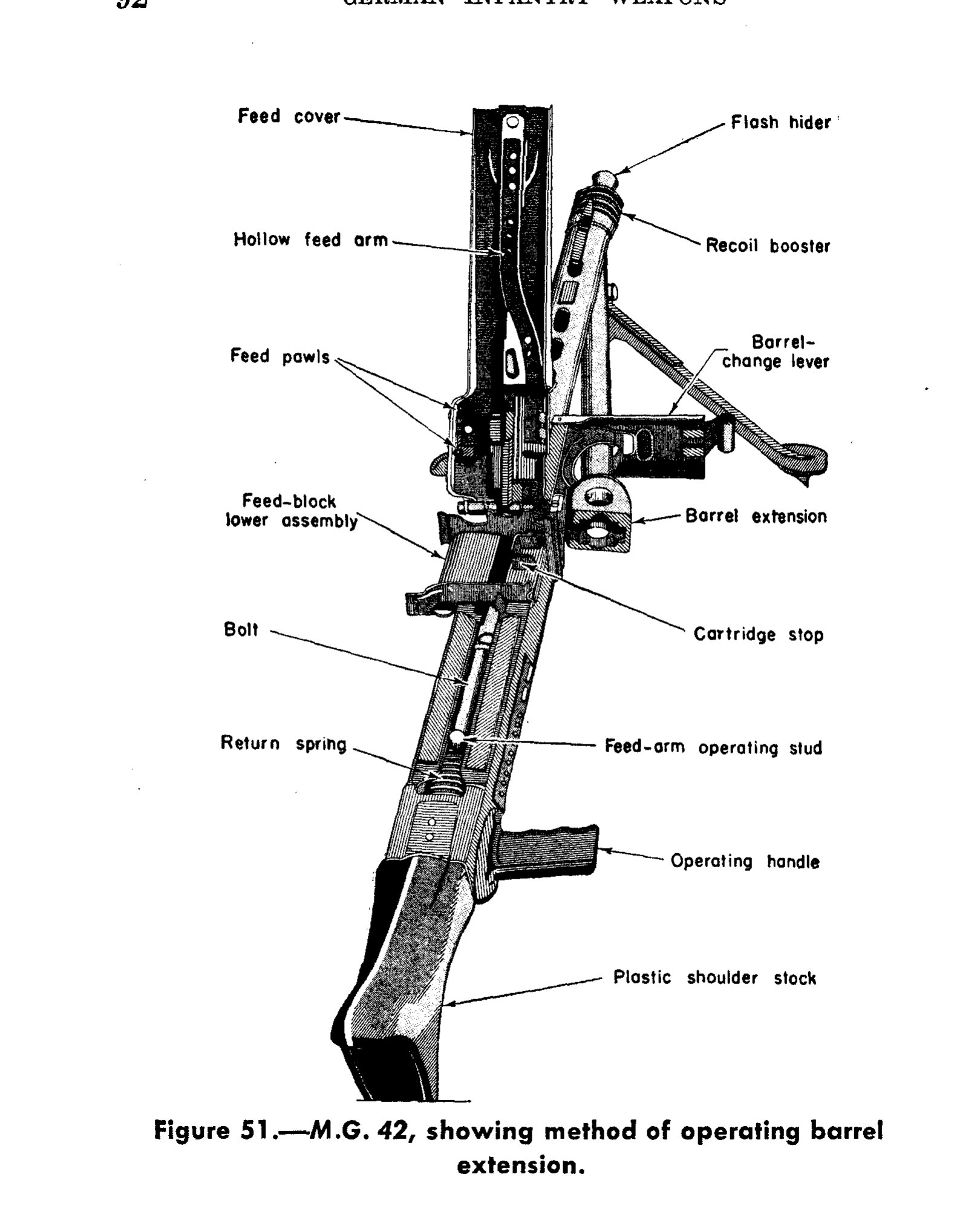
The muzzle end of the barrel stays in the booster at the front of the jacket while its rear end swings out sideways through the long opening in the jacket’s right side. Chinn adds that the hot barrel could be “pivoted out of the rear of the barrel jacket and dropped without handling.”3 Rheinmetall’s MG 3 manual reduces the same operation to three pictures and three lines: cock the bolt and put the safety to S; unlatch and open the barrel-change flap, remove the barrel; insert the spare barrel and close the flap.4
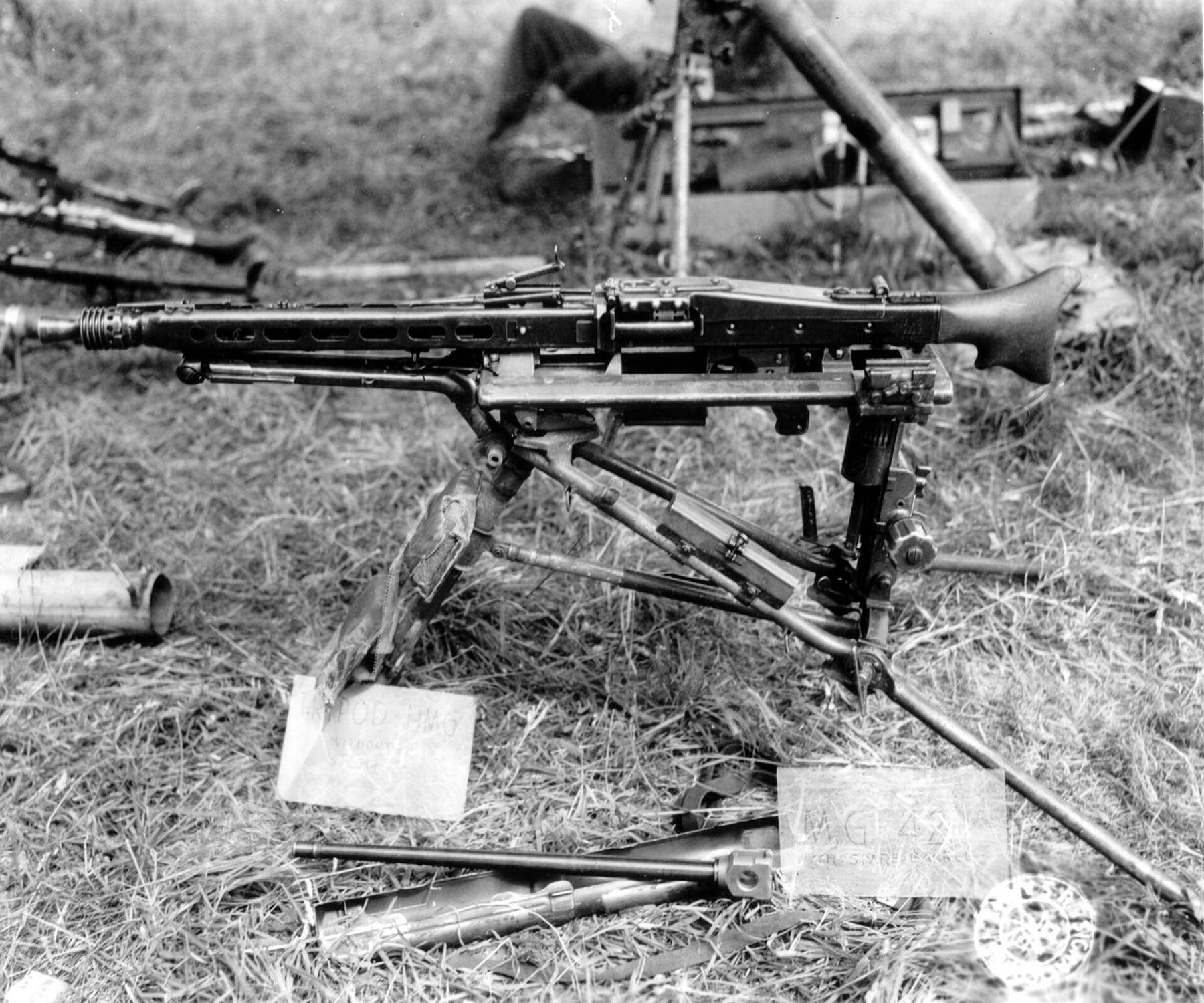
Spare barrels were carried by the crew. The 1943 handbook: “Spare barrels are regular equipment with the M.G. 42 and are carried in either single- or double-barreled containers by the gun crew. The single-barreled container opens up so that the hot barrel can be laid on it and exposed to the air to facilitate cooling.”2 The transferable Gustloff gun Rock Island Auction sold in August 2026 came with four spare barrels and four belt drums (Volume 8).5
4.2 How often: 250 rounds, or 150
The sources give two different barrel-change schedules, sixty years apart:
Table 1 — The sources give two different barrel-change schedules, sixty years apart
| Gun | Change the barrel after | Source |
|---|---|---|
| MG 42 (1943) | “250 rounds in full-automatic fire, or, in cases of emergency, after firing 400 rounds” | US MIS handbook, May 19432 |
| MG 34 (1943) | the same: 250, or 400 in emergency | same handbook2 |
| MG 3 (1992) | “approx. 150 rounds” | Rheinmetall operator’s manual4 |
The 1943 figure is a US translation of German practice for both wartime guns. The 1992 figure is the maker’s instruction for the 7.62 mm descendant, and it also gives a rule the wartime handbook does not: “If round fails to ignite in barrel which is fired hot, only cock bolt after time allowed for cook-off has elapsed (approx. 5 minutes).”4 Neither source says what rate of fire or burst pattern its round count assumes, so the two numbers are not directly comparable and are not combined here.
4.3 How fast does it fire?
The rate of fire is the MG 42’s reputation, and no two sources give the same number. Every figure found for this dive is below, as its source states it.
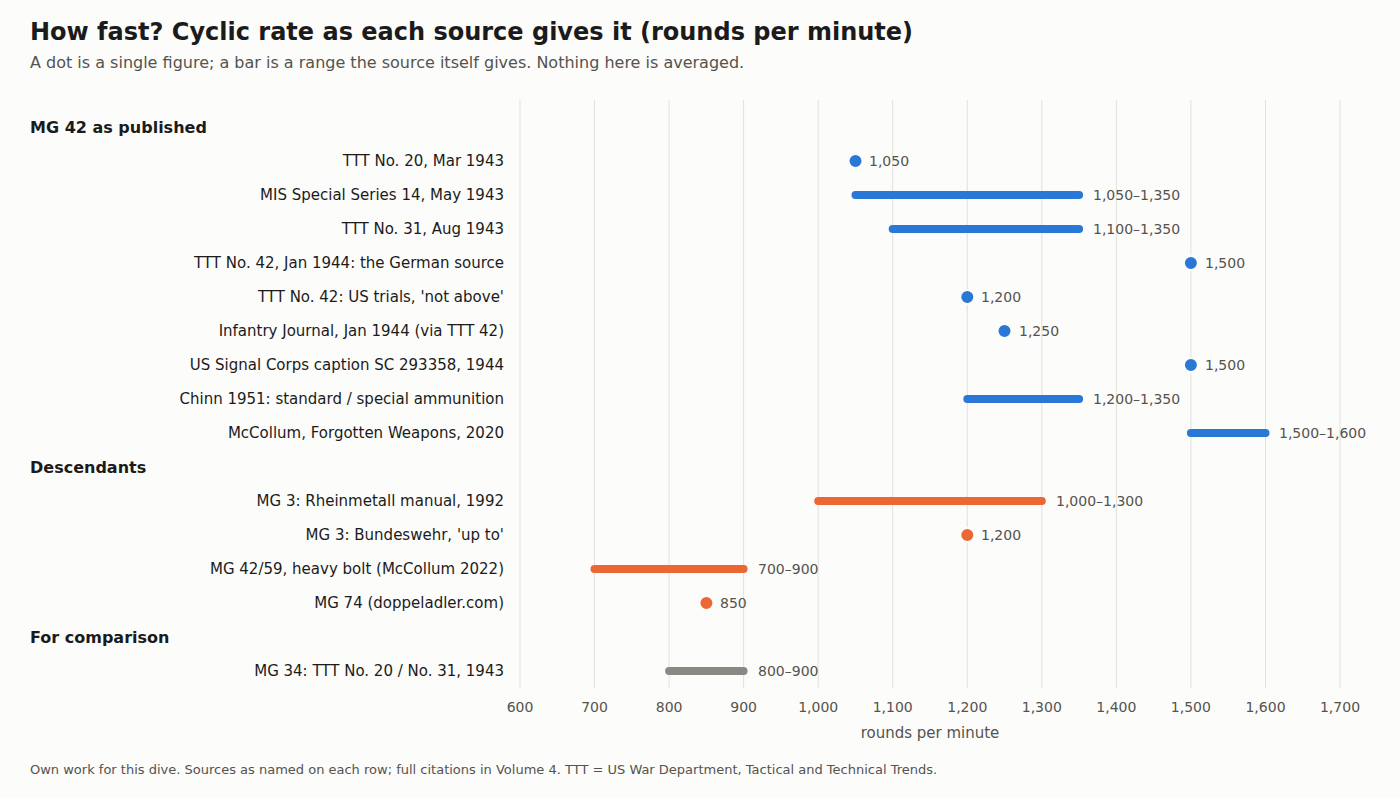
Table 2 — How fast does it fire?
| Source | Date | MG 42 cyclic rate |
|---|---|---|
| Tactical and Technical Trends No. 20 | Mar 1943 | ”stepped up to 1,050 rpm” (MG 34: 900)1 |
| MIS German Infantry Weapons | May 1943 | ”1,050 to 1,350 rounds per minute”2 |
| Tactical and Technical Trends No. 31 | Aug 1943 | ”1,100–1,350 rpm” (MG 34: 800–900)6 |
| Tactical and Technical Trends No. 42, quoting “a German source” | Jan 1944 | 1,500 (MG 08: 420; MG 34: 900)7 |
| same, US “preliminary trials in this country” | Jan 1944 | ”have not produced a rate of fire above 1,200 rpm”7 |
| Infantry Journal, as cited in TTT No. 42 | Jan 1944 | ”about 1,250 rounds per minute”7 |
| US Signal Corps photograph caption, SC 293358 | 1944 | the gun “uses it up at the rate of 1500 rounds a minute”8 |
| Chinn, The Machine Gun | 1951 | 1,200 “with standard ammunition”; “asserted to be 1,350” with “special ammunition”; “22 shots a second”3 |
| Rheinmetall, MG 3 operator’s manual (MG 3, 7.62 mm) | 1992 | ”from 1,000 to 1,300 rds/min”4 |
| Bundeswehr, MG 3 page | current | ”Bis zu 1.200 Schuss … pro Minute” (up to 1,200)9 |
| Ian McCollum, Forgotten Weapons | 2020 | ”1500–1600 rounds per minute”10 |
| Rock Island Auction catalogue copy | 2020–2026 | ”about 1,200” (2020), “up to 1,200” (later)5 |
The War Department itself flagged the problem in January 1944: “There have been a number of conflicting reports as to the rate of fire of the MG-42.”7
4.4 Why the figures differ
Three things in the record explain part of the spread; none explains all of it.
- Ammunition. Chinn ties his two figures to two kinds of cartridge: 1,200 with standard ammunition, 1,350 “asserted” with “special ammunition”. He does not say what the special ammunition was.3
- Who measured, and on what. The highest wartime figure, 1,500, comes from a German document; the American trials of the same period “have not produced a rate of fire above 1,200”.7 A rate quoted in a manual can be a design figure; a rate measured on a captured, worn gun with captured ammunition is not the same measurement.
- The bolt and spring. The descendants show how sensitive the rate is to the reciprocating mass. Rheinmetall’s heavy bolt for the MG 42/59, 950 g against 550 g, brought the rate to 700 to 900 rounds a minute in McCollum’s account, and Austria’s MG 74 is given at 850 by an Austrian enthusiast source.1112 Volume 7 covers both.
The span is wide enough that a single number for “the MG 42’s rate of fire” says more about which source the writer read than about the gun. The defensible statement is that wartime sources put it between about 1,050 and 1,500 rounds a minute, between about a sixth and two-thirds faster than the MG 34 as the same sources rate it (800 to 900).
4.5 What the rate was for: the German firing doctrine
The most useful document on the rate is the one that explains how the Germans meant to use it. Tactical and Technical Trends No. 42 (13 January 1944) summarised “a German source” on firing the MG 42.7
Its premise: the MG 42 “has a close and dense cone of fire which results in greatly improved observation. The cone of fire has a slight ‘creep’ hence this machine gun can be held on the target for only a short time compared with the slower firing machine guns.”
As a light machine gun: “Trials under battle conditions have shown that the best results are obtained from bursts of 5 to 7 rounds, as it is not possible to keep the gun on the target for a longer period … Under battle conditions the firer can get off approximately 22 bursts in a minute, or approximately 154 rounds. Comparative trials under the same conditions with the MG-34 showed that the best results in this case were obtained with 15 bursts in the minute, each of 7 to 10 rounds, i.e. approximately 150 rounds.” The German conclusion: ammunition use “a little higher than with the MG-34, but to balance this, the results on the target with the MG-42 are increased up to approximately 40%.”
As a medium machine gun: “Long periods of sustained fire must definitely be avoided … if the extraordinarily dense cone of fire of the MG-42 is on the target, then this should be destroyed in approximately 50 rounds.” The worked example is precise: at 2,000 yards the time of flight is 4.7 seconds, so no observation of the strike is possible in under six seconds, and “sustained fire for a period of six seconds … is the equivalent of an ammunition expenditure of 150 rounds, whereas an observation … could have been obtained with 50 rounds.” Hence bursts of about 50, with the aim rechecked between them.
The doctrine therefore treated the high rate not as a way of firing more ammunition but as a way of putting a dense burst on target in the short time the gun stayed there. Total expenditure per minute, by the German figures, was about the same as the MG 34’s.
Chinn read it the same way in 1951: the gun “was ordinarily only fired for a fraction of a second during each burst. Since it was being discharged at a rate of 22 shots a second, the striking bullets could be held to a small enough area to cover it thoroughly. It acted more in the capacity of a long-range shotgun than as a machine gun.”3
4.6 The Allied verdict on the rate
The first American assessments were sceptical. Tactical and Technical Trends No. 21 (March 1943): “An increase in the rate of fire of ground MGs over the MG 34 (cyclic rate 900 rpm) is likely to prove of doubtful value, since the increased expenditure of ammunition will present difficulties without obtaining any real advantage.”13 The May 1943 handbook: the rate “has been increased over that of the M.G. 34, but a certain decrease in accuracy has resulted”, with a footnote that the increase “is not desirable from any point of view except that of use as an antiaircraft machine gun, because the accuracy is decreased considerably.”2 August 1943: “this high rate of fire has not been obtained without a certain decrease in accuracy compared with the MG 34.”6
By January 1944 the same publication was printing the German doctrine above without rebuttal, and adding only that “a high degree of skill and training are required to obtain the best results from the MG-42.”7
4.7 The sound, and the nicknames checked
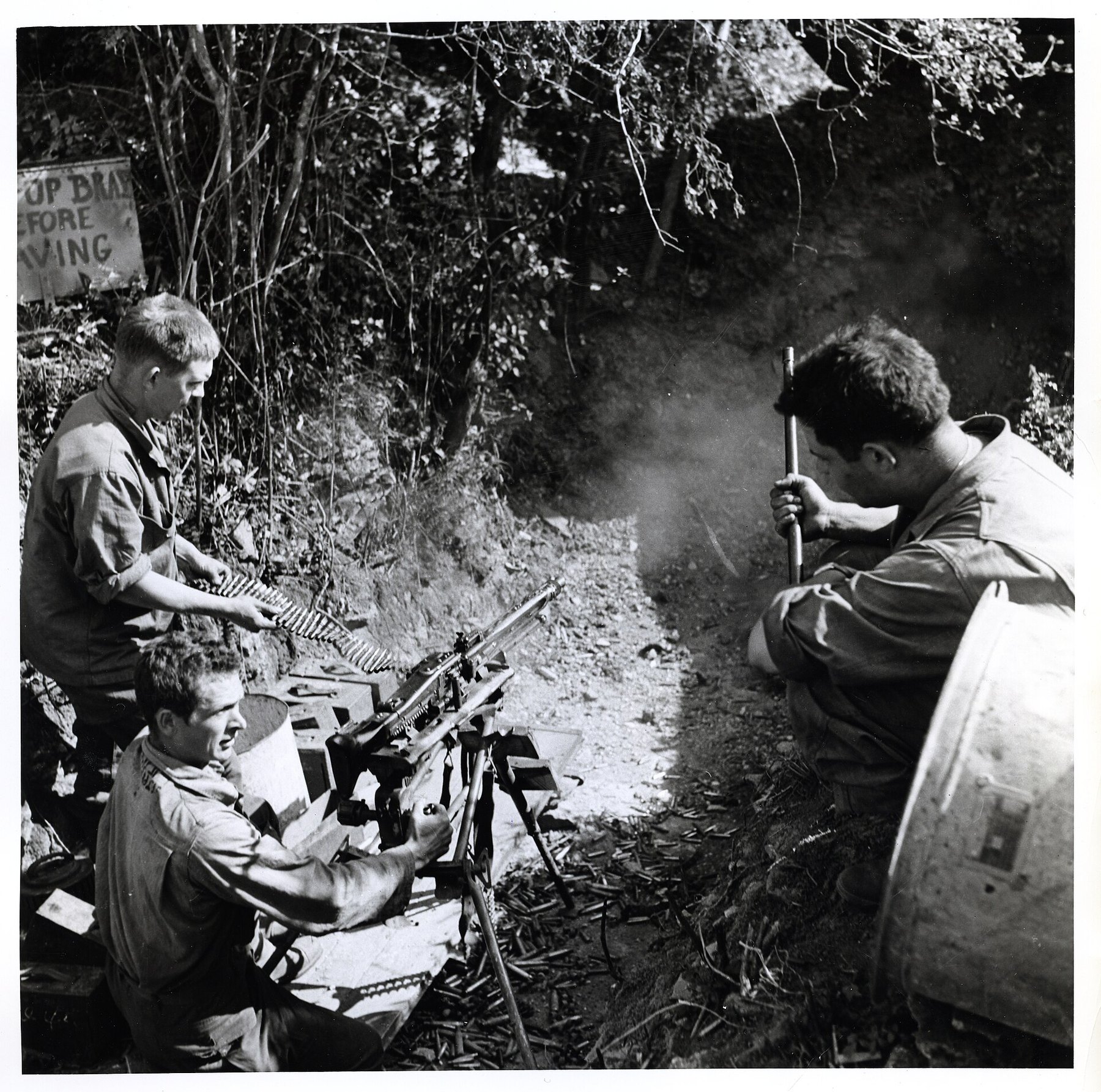
At 1,050 to 1,500 rounds a minute the individual reports run together, and the gun’s sound is the thing veterans and writers return to. The nicknames attached to it in modern English-language writing include “Hitler’s buzzsaw”, “Hitler’s zipper” and “the linoleum ripper”. Rock Island Auction’s catalogue copy uses the first and either of the others; McCollum’s 2020 article is titled “Hitler’s Zipper”; the American Rifleman’s 2025 article on wartime assessments is titled “‘Hitler’s Buzz Saw’”.51014 German Wikipedia gives German soldiers’ names for it as Hitlersäge (Hitler’s saw), Singende Säge (singing saw) and Knochensäge (bone saw), without a source.
This dive checked the English nicknames against the wartime record it could reach:
- The US Army’s published intelligence does not use them. None of Tactical and Technical Trends Nos. 20, 21, 31, 32 and 42, the May 1943 German Infantry Weapons, or the Intelligence Bulletins of November 1942 to October 1943 gives the gun any nickname.
- American newspapers of 1942 to 1946, as digitised in the Library of Congress’s Chronicling America collection, return no match for “Hitler’s buzz saw” or “Hitler’s zipper”. A search for “buzz saw” with “German machine gun” returned some thirty pages, none of which, in the text examined, applied the phrase to the MG 42 (two uses were a 1942 Ernie Pyle human-interest column and a 1944 report calling A-20 bombers “diving buzzsaws”).15 Chronicling America is a sample of American papers, and an OCR search can miss a phrase, so this is evidence of absence in one large corpus, not proof that no soldier said it.
- The American Rifleman article uses “Hitler’s Buzz Saw” as its title and in one sentence of its own, but cites no wartime document that uses it.14
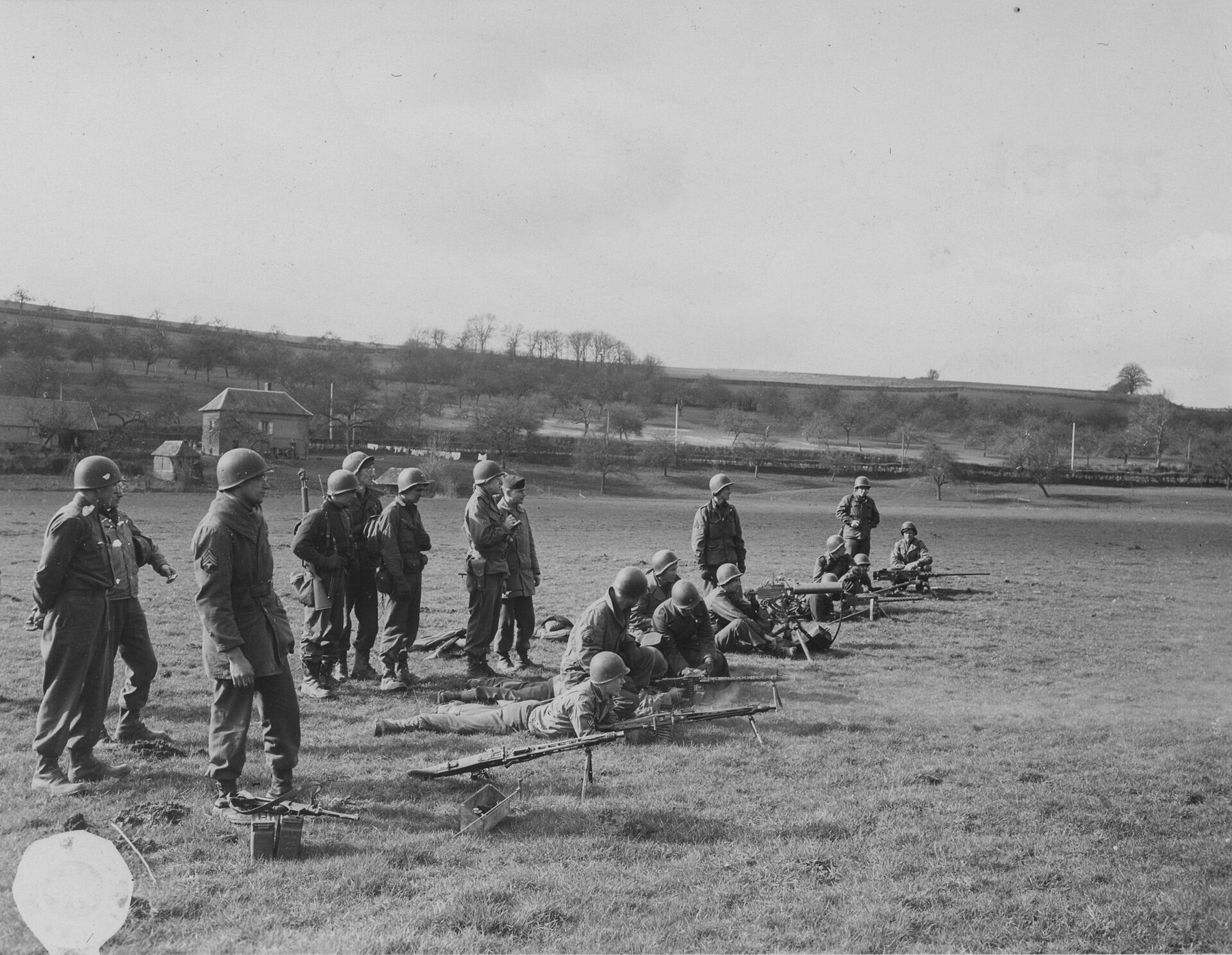
The nicknames are therefore best treated as post-war usage of unestablished wartime currency. What is established is that the US Army took the sound seriously enough to train soldiers on it. A Signal Corps photograph of 24 February 1945 shows a Military Intelligence training unit “firing German and American automatic weapons to familiarize troops with their characteristic sounds”.16 The War Department’s Film Bulletin No. 181, Automatic Weapons, American vs German, compared the guns on film; Tom Laemlein quotes its narrator’s closing line as “Remember, their bark is worse than their bite.”1714 (The film’s audio was not transcribed for this dive; the line is given on Laemlein’s authority.)
4.8 The heavy machine gun: the Lafette tripod
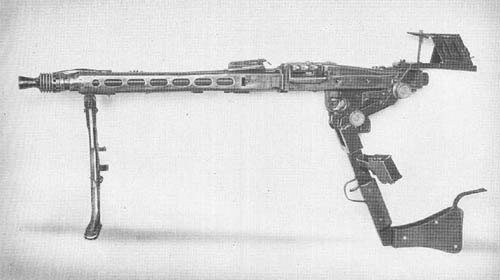
Like the MG 34, the MG 42 became a heavy machine gun by being mounted on a tripod, the Lafette. The sources disagree on how far the MG 34’s tripod served the MG 42:
- May 1943: “The tripod mount is the same as that of the M.G. 34 except for the method of fastening the gun to the mount.”2
- August 1943: “Bipod, antiaircraft and heavy ground mount are provided but these mounts are not interchangeable with those used with the MG 34.”18
- A reprint seller’s catalogue lists the German manual D 124/2, dated 5 March 1943, as covering the MG 34 and MG 42 on the Lafette.19
The two US statements can both be true of different things: a tripod whose legs, elevating gear and traverse are common, carrying a cradle that differs for each gun. The documents read do not settle it.
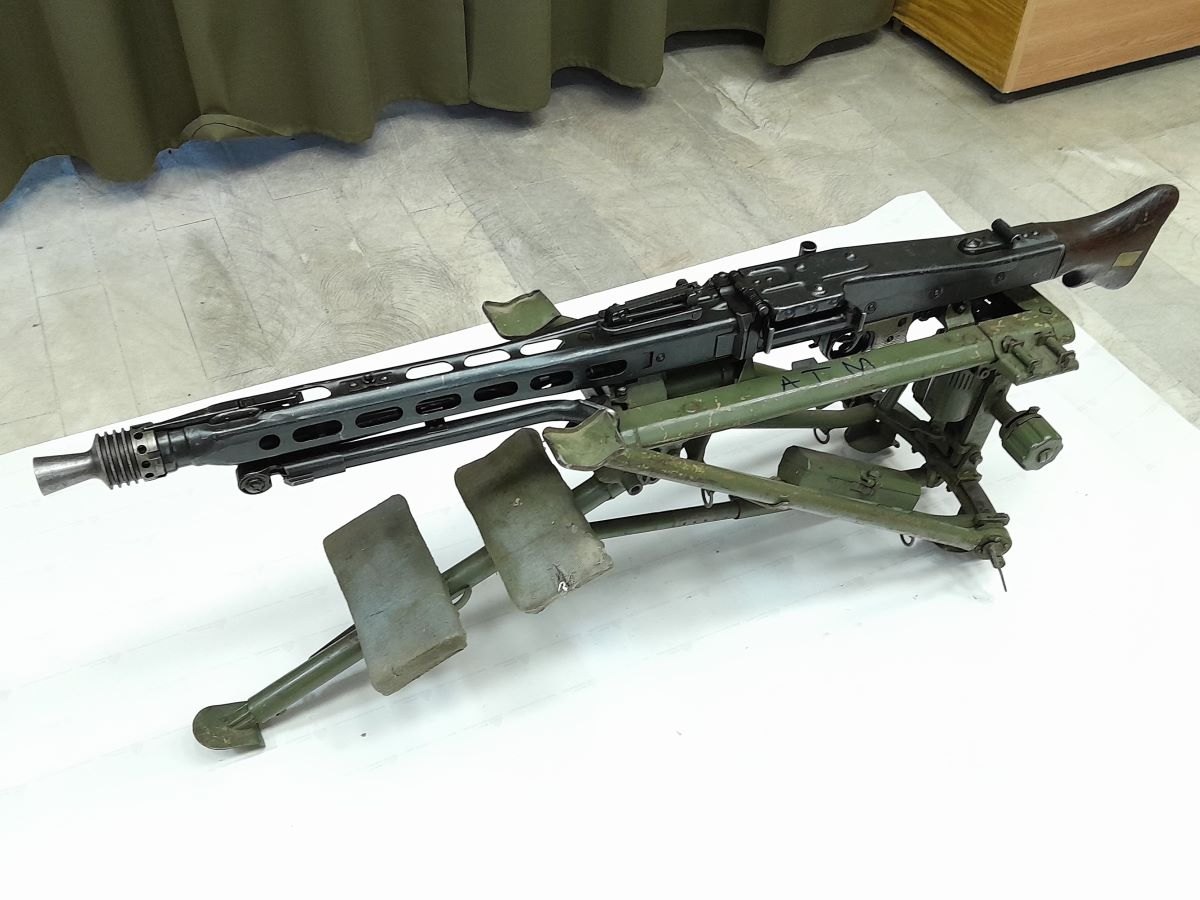
The tripod’s working parts are described in the 1943 handbook for the MG 34: a front leg on a clamping lever, two rear legs on wing nuts, a cradle with claws for the gun’s rear projections and a hinged clamp at the front, an elevating gear with a handwheel and adjustable stops, and a traversing slide on a graduated arc with adjustable stops.2 A surviving MG 42 tripod in Romania’s national heritage register is described the same way and adds detail: three legs, the rear pair pivoting and locked by wing nuts, the front leg folding and telescopic with two canvas-covered pads for carrying the tripod on a soldier’s shoulders, a recoil-absorbing cradle fired from a lever, a rail on the upper left “for mounting an optical aiming device”, a sheet-metal accessory box on the left, and a firing grip with its own oil reservoir.20 With the tripod came the optical sight: on the MG 34, “a telescopic sight is mounted on the tripod … graduated up to an effective range of 3,500 meters (3,827 yards)”, used in direct and indirect fire, and the same handbook notes that the telescopic sight “may also be used with the M.G. 42”.2
4.9 The muzzle brake for the heavy role
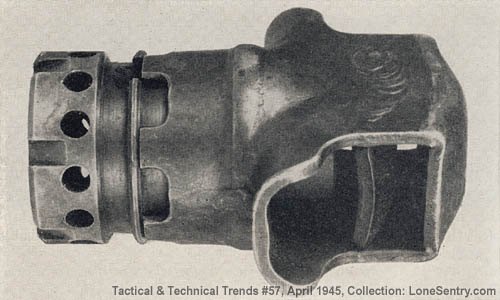
The high rate that suited a light gun’s short bursts made a mounted gun climb. Tactical and Technical Trends No. 57 (April 1945) reported that “a muzzle brake is being fitted to the German M. G. 42 when this weapon is used as a heavy machine gun. The muzzle brake counteracts the gun’s tendency to climb during automatic fire. Although the new device was first revealed in 1943, it has not appeared in quantity.” The booster’s usual cone-shaped front became cylindrical, and “the muzzle brake slips over the cylindrical booster end, so that the booster end is brought close to the baffle plates … The brake has two baffle plates and is attached to the flash-eliminator and recoil intensifier. The latter affects only the recoil of the barrel, whereas the brake affects the recoil of the gun as a whole.”21
Chinn adds a claim TTT No. 57 does not make: that the brake “was made to give more braking effect and lower cyclic rate than did the standard one”, first used “late in 1943 and … continued effectively until the war’s end”.3 He also says it “followed the unsuccessful trials of a standard booster” in the heavy role. The April 1945 report says only that it “has not appeared in quantity”.
4.10 Anti-aircraft use
The MG 42 carried its own anti-aircraft sights. The 1943 handbook lists a “separate antiaircraft rear sight hinged on the right sight base” as an identification point, and an “antiaircraft ring sight, kept in the maintenance kit, and fitting on the barrel jacket”.2 It was used “as an antiaircraft machine gun (on a special tripod)”, of which the handbook says only that “no detailed information on the antiaircraft tripod is available.”2 Chinn calls the gun’s adaptation to every role, “from antiaircraft in batteries to individual-burst fire by the infantryman”, its “only real weakness”, and the infantryman’s use “its most effective”.3
4.11 What could not be established
- A German statement of the MG 42’s rate of fire in an original German document. The 1,500 figure is from “a German source” as summarised by US intelligence.
- What Chinn’s “special ammunition” was.
- Whether “Hitler’s buzzsaw” or “Hitler’s zipper” was used during the war. Not found in US Army intelligence or in Chronicling America for 1942–46.
- The Lafette’s interchangeability between the MG 34 and MG 42; the German manual D 124/2 was not seen.
- The narration of Film Bulletin 181, quoted here at second hand.
References
Footnotes
-
Tactical and Technical Trends No. 20 (11 March 1943), item 16, p. 28. Internet Archive, https://archive.org/details/TacticalAndTechnicalTrendsNos1-20 , consulted 2026-10-19. ↩ ↩2
-
US War Department, Military Intelligence Service, German Infantry Weapons, Special Series No. 14 (25 May 1943), section 12 (M.G. 34) and section 13 (M.G. 42), pp. 58–94, figure 51. Internet Archive, https://archive.org/details/German_Infantry_Weapons_1943_MIS_Special_Series_No._14 , consulted 2026-10-19. ↩ ↩2 ↩3 ↩4 ↩5 ↩6 ↩7 ↩8 ↩9 ↩10 ↩11
-
George M. Chinn, The Machine Gun, vol. I (Washington: Bureau of Ordnance, Department of the Navy, 1951), chapter 33, pp. 484–489. Internet Archive, https://archive.org/details/TheMachineGunVolume1ByGeorgeMChinn , consulted 2026-10-19. ↩ ↩2 ↩3 ↩4 ↩5 ↩6
-
Rheinmetall International S.A., Machine Gun MG3 Operator’s Manual, Cal. 7.62 mm x 51 (1992), pp. 6–7, 16. Internet Archive, https://archive.org/details/machine-gun-mg-3-operators-manual-1992 , consulted 2026-10-19. ↩ ↩2 ↩3 ↩4
-
Rock Island Auction Company, lot descriptions for transferable MG 42s, 2020–2026, e.g. sale 4098 (August 2026), lot 1311, https://www.rockislandauction.com/detail/4098/1311/ ; sale 81 (December 2020), lot 1510, https://www.rockislandauction.com/detail/81/1510/ ; sale 85 (May 2022), lot 482, https://www.rockislandauction.com/detail/85/482/ , consulted 2026-10-19. ↩ ↩2 ↩3
-
Tactical and Technical Trends No. 31 (12 August 1943), item 16, pp. 37–39. Internet Archive, https://archive.org/details/TacticalAndTechnicalTrendsNos31-40 , consulted 2026-10-19. ↩ ↩2
-
Tactical and Technical Trends No. 42 (13 January 1944), “Firing Data, German MG-42”. Lone Sentry transcription, https://www.lonesentry.com/articles/ttt09/mg42-firing-data.html , consulted 2026-10-19. ↩ ↩2 ↩3 ↩4 ↩5 ↩6 ↩7
-
US Army Signal Corps photograph SC 293358, photographer Kenny, 1944, caption as given. Wikimedia Commons (via the Signal Corps Archive), https://commons.wikimedia.org/wiki/File:SC_293358_-_Pfc_Mike_Westby_of_Deerfield,_Wisconsin,_fires_a_German_MG_42_machine_gun_in_a_test_pit_at_an_Ordnance_Depot_in_Normandy,_France._(50061824707).jpg , consulted 2026-10-19. ↩
-
Bundeswehr, “MG3”, https://www.bundeswehr.de/de/ausruestung-technik-bundeswehr/ausruestung-bewaffnung/mg3 , consulted 2026-10-19. ↩
-
Ian McCollum, “Hitler’s Zipper: The MG-42 Universal Machine Gun”, Forgotten Weapons, 4 November 2020, https://www.forgottenweapons.com/hitlers-zipper-the-mg-42-universal-machine-gun/ , consulted 2026-10-19. ↩ ↩2
-
Ian McCollum, “Rheinmetall MG42/59: The Slow-Fire Commercial MG42”, Forgotten Weapons, 4 May 2022, https://www.forgottenweapons.com/rheinmetall-mg42-59-the-slow-fire-commercial-mg42/ , consulted 2026-10-19. ↩
-
“7,62 mm Maschinengewehr MG 74 (Steyr)”, doppeladler.com (Austrian armed-forces enthusiast site), https://www.doppeladler.com/oebh/infanterie/mg74.htm , consulted 2026-10-19. ↩
-
Tactical and Technical Trends No. 21 (25 March 1943), item 12, “Some Notes on German Weapon Development”. Internet Archive, https://archive.org/details/world-war-ii-tactical-and-technical-trends-bulletins , consulted 2026-10-19. ↩
-
Tom Laemlein, “‘Hitler’s Buzz Saw:’ Wartime Assessments Of The German MG42 Machine Gun”, American Rifleman, 6 February 2025, https://www.americanrifleman.org/content/hitler-s-buzz-saw-wartime-assessments-of-the-german-mg42-machine-gun/ , consulted 2026-10-19. ↩ ↩2 ↩3
-
Library of Congress, Chronicling America, full-text searches limited to 1942–1946, run through the loc.gov JSON interface on 2026-10-19:
"Hitler's buzz saw"(0 results),"Hitler's zipper"(0),"buzz saw" German machine gun(25–31 page results, none applying the phrase to the MG 42 in the text examined),"MG 42"(4). https://www.loc.gov/collections/chronicling-america/ ↩ -
US Army Signal Corps photograph SC 221576, 24 February 1945, “Firing German and American automatic weapons to familiarize troops with their characteristic sounds”, US National Archives. Wikimedia Commons, https://commons.wikimedia.org/wiki/File:SC_221576_-_Firing_German_and_American_automatic_weapons_to_familiarize_troops_with_their_characteristic_sounds._(51986573530).jpg , consulted 2026-10-19. ↩
-
US War Department, Film Bulletin No. 181, Automatic Weapons, American vs German (NARA identifier 24562). Internet Archive, https://archive.org/details/FB-181 , consulted 2026-10-19. ↩
-
Tactical and Technical Trends No. 32 (August 1943), item 12, pp. 36–37, same scan. ↩
-
German Manuals (reprint seller), catalogue page, entries for D 124/2 (5 March 1943) and other MG 42 manuals, https://www.germanmanuals.com/manuals.html , consulted 2026-10-19. ↩
-
Institutul Național al Patrimoniului (Romania), classified movable heritage record “Mitralieră 7,92 mm MG 42 cu afet”, CIMEC, https://clasate.cimec.ro/Detaliu.asp?tit=Mitraliera—Mitraliera-7-92-MM-MG-42-cu-afet&k=16782ddd28f34c6cbc0fdc33357fa7b1 , as reproduced in the descriptions of the institute’s photographs on Wikimedia Commons (31 October 2022), consulted 2026-10-20. ↩
-
Tactical and Technical Trends No. 57 (April 1945), “Muzzle Brake for M. G. 42”. Lone Sentry transcription, https://www.lonesentry.com/articles/ttt07/mg42-muzzle-brake.html , consulted 2026-10-19. ↩


Comments (0)