MG 42 · Volume 8
Owning One in the United States
Why transferable MG 42s exist and what they sell for, curio-and-relic status, dewats and display guns, the receiver as the regulated part, semi-automatic look-alikes treated only as products, and Michigan
Nothing here is legal advice. The sources are quoted so that a reader can take them to someone qualified. This volume describes no procedure for making, converting, reactivating or altering any firearm.
8.1 Start with the MP 40 and the Lewis gun
This hub’s MP 40 dive, Volume 6, sets out the general law of machine-gun ownership in the United States: the statutory definition of a machinegun, 18 U.S.C. § 922(o) and the register closed to new civilian machineguns on 19 May 1986, the four categories (transferable, pre-1986 dealer sample, post-1986 dealer sample, and everything else), the ATF Form 4 transfer, and the fact that Public Law 119-21 of 4 July 2025, which cut the National Firearms Act tax on short-barrelled rifles and suppressors to $0, left the $200 transfer tax on machineguns in place. The Lewis gun dive, Volume 8, sets out the 1968 amnesty, deactivated war trophies (dewats), reactivation as “making”, and curio-or-relic status, quoting ATF’s National Firearms Act Handbook and the Justice Department Inspector General. Neither is repeated here. What follows is what is particular to the MG 42.
8.2 The MG 42 in law
The MG 42 is a machinegun on any reading. It has one mode of fire, and every source describing it says so: “There is no provision for single shots” (US War Department, 1943); the gun “cannot fire semi-automatically” (the US handbook of May 1943).12 Under 26 U.S.C. § 5845(b), as ATF summarises it, a machinegun is “any weapon which shoots, is designed to shoot, or can be readily restored to shoot, automatically more than one shot, without manual reloading, by a single function of the trigger.”3 An MG 42 that is mechanically complete and functional is the plainest case under the first limb.
The same is true of every descendant in Volume 7: the MG 1, MG 2 and MG 3, the MG 42/59, the M53 and the MG 74 are all automatic-only belt-fed guns.
8.3 Why transferable MG 42s exist
Section 922(o) bars transfer and possession of machineguns except those lawfully possessed before it took effect.4 Every wartime MG 42 is old enough; the question for a particular gun is only whether it was lawfully registered before the register closed. Guns reached the register as war trophies registered at the time or in the 1968 amnesty, as lawful imports while importation for civilian sale was possible, and as dealers’ guns. The routes are described in general terms in the Lewis gun volume; no count of MG 42s on the register is public.
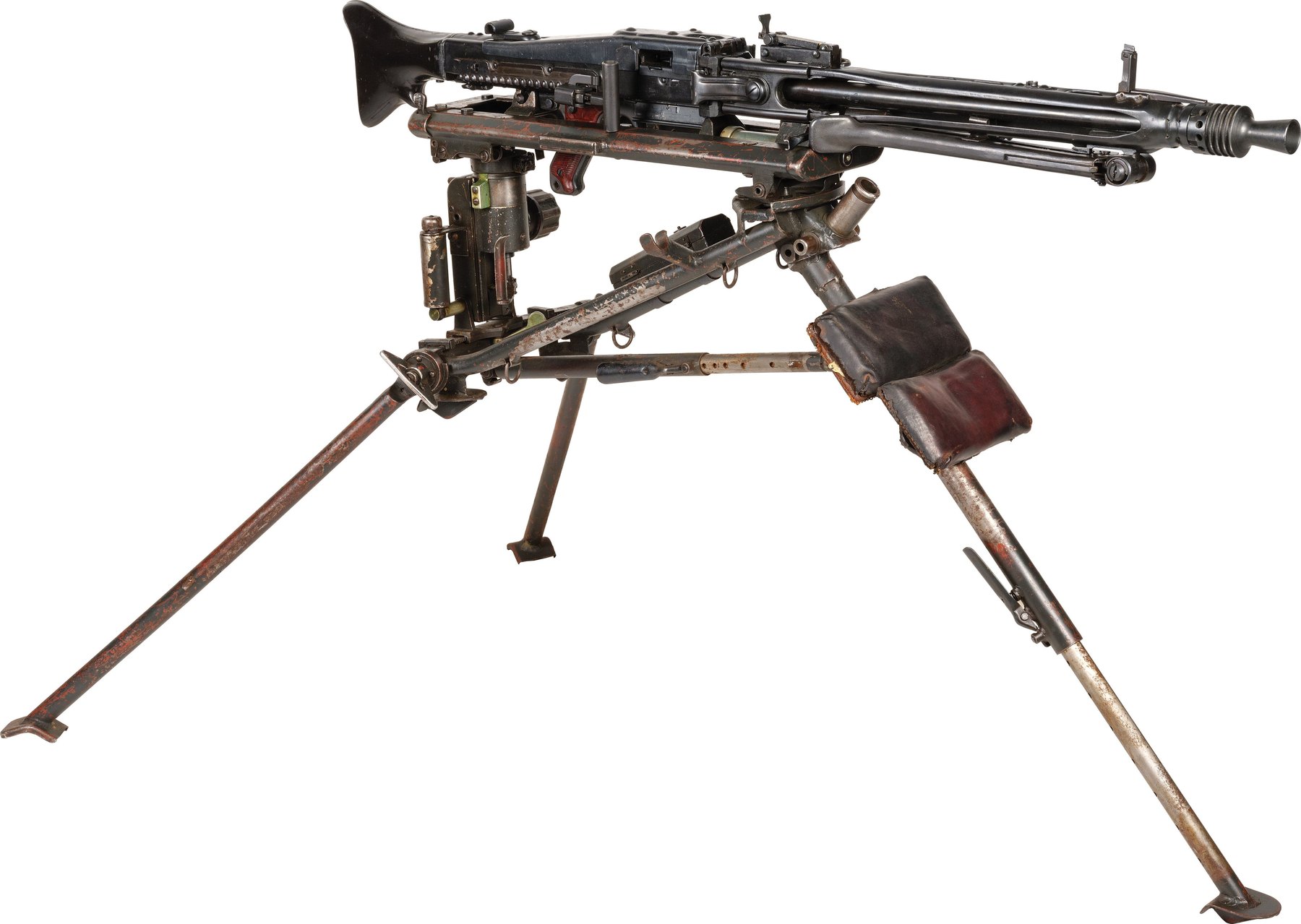
That they exist in some numbers is shown by the market. Rock Island Auction Company alone has sold at least seven described as “fully transferable” between 2020 and 2026 (below), each with the catalogue note that the gun “is a National Firearms Act (NFA), fully transferable Class 3, which is registered with the Bureau of Alcohol, Tobacco, Firearms and Explosives, (BATFE) that is classified as a ‘Curios or Relic’ as defined in 27 CFR, 478.11. These weapons are still subject to the provisions of 18 U.S.C. Chapter 44 and 27 CFR part 479.”5
8.4 Curio or relic
The auction catalogues classify transferable MG 42s as curios or relics under 27 CFR 478.11.5 For an NFA weapon, curio-or-relic status does not remove it from the National Firearms Act: the registration, the Form 4 and the $200 tax still apply, as the catalogue note itself says. What C&R status changes, and how it applies to a holder of a federal C&R licence, is set out in the Lewis gun volume and in the MP 40 volume; it should be confirmed for a particular gun and buyer with ATF or a qualified attorney.
8.5 What the market shows, 2020 to 2026
Rock Island Auction’s own lot pages give these results for transferable MG 42s. All figures are hammer prices in US dollars, before the buyer’s premium, read from the lot pages on 19 October 2026; the premium and total paid were not recorded.6
Table 1 — What the market shows, 2020 to 2026
| Sale | Lot | As catalogued | Estimate | Hammer |
|---|---|---|---|---|
| 4–6 Dec 2020 | 81/1510 | ”cra” MG42, 60% arsenal-refurbished blue | $32,500–45,000 | $55,000 |
| 13–15 May 2022 | 85/482 | ”cra” code MG42, 97% refinished, with accessories | $30,000–45,000 | $110,000 |
| 25–27 Aug 2023 | 89/406 | MG42, refinished, rewelding on jacket, parts “likely from a 7.62mm conversion (not verified)“ | $35,000–55,000 | $45,000 |
| 23–25 Aug 2024 | 4092/1365 | Gustloff “dfb” MG42, professionally refinished | $27,500–42,500 | $65,000 |
| 6–8 Dec 2024 | 4093/1363 | Steyr “1943/bnz” MG42 with tripod | $30,000–45,000 | $75,000 |
| 2–4 May 2025 | 4094/1388 | ”swd” code MG42, refinished | $40,000–60,000 | $65,000 |
| 21–23 Aug 2026 | 4098/1311 | Gustloff “dfb” MG42, refinished, four spare barrels and drums | $40,000–60,000 | $75,000 |
Three things stand out. Every gun was described as refinished; no original-finish transferable gun appears in this sample. The hammer price exceeded the high estimate in six of seven sales. And the spread, $45,000 to $110,000, follows condition, accessories and documentation more than maker: the cheapest gun was the one with reweld marks and possibly mixed 7.62 mm parts.6 This is one auction house’s results and not a price guide.
8.6 The post-war guns
Post-war guns can also be transferable if they were lawfully registered before May 1986. McCollum’s 2022 video features a Rheinmetall MG 42/59 made in 1964 that “was imported early enough to be a registered, transferable C&R item.”7 Whether a post-war MG 1, MG 3 or M53 is transferable, a pre-1986 or post-1986 dealer sample, or not lawfully possessable at all depends entirely on its own registration history; there is no general answer by model.
8.7 Dewats and display guns
Many war-trophy machine guns were registered as dewats, deactivated war trophies, which ATF treats as NFA firearms that must still be registered and transferred through ATF, tax-exempt on Form 5 as curios or ornaments.8 The Lewis gun volume quotes ATF’s definitions and warns that a foreign deactivation certificate does not make a gun lawful in the United States.
A different kind of display MG 42 is sold openly. International Military Antiques describes one built from “a legally demilitarized (de-milled) parts set”, “rebuilt on an inert BATF compliant newly made dummy receiver, which is completely hollow … with no internals or way to mount them”, whose barrel-change system still works.9 The dealer’s description is the dealer’s; whether any particular display gun is not a firearm is a question of what its receiver is and how it was made, and the classification belongs to ATF, not to a seller.
8.8 The receiver is the firearm
Federal law defines a firearm to include its frame or receiver, and for a machinegun the receiver is the registered item.4 An MG 42 parts kit without a receiver is a box of parts; for a registered gun it is a source of spares, and for a collector a display item. There is no lawful route by which a private person can combine an MG 42 parts kit with a new machinegun receiver, because § 922(o) bars making a machinegun as firmly as it bars transferring one.4 An original wartime receiver that was never registered is not a parts-kit component at all: it is an unregistered machinegun receiver.
The MP 40 dive’s warnings about parts kits and foreign deactivations apply to the MG 42 without change.
8.9 Semi-automatic look-alikes, as products
Semi-automatic rifles built to look like the MG 42 exist on the US market. They are built in the United States on semi-automatic receivers made for the purpose, with surplus parts and new semi-automatic components; US firms sell semi-automatic MG 42 bolt assemblies and receiver parts, and a dealer listing of 14 July 2017 described a complete rifle in 8 mm Mauser as “closed bolt, hammer fired, semi automatic”, “922r compliant” and assembled on a US-made receiver.1011 How each maker produced its receiver differs from listing to listing, and the legal status of any particular rifle rests on that history and on its design, not on its appearance. This dive describes them only as products and identifies the law that governs them; it gives no information on how they are made.
The legal points a buyer needs are these:
- “Designed to shoot” automatically. The statutory definition reaches a weapon “designed to shoot” automatically, and ATF has explained that “the ‘designed’ definition includes those weapons which have not previously functioned as machine guns but possess design features which facilitate full automatic fire by simple modification or elimination of existing component parts.” In ATF Ruling 82-2 it held an open-bolt, blowback, fixed-firing-pin semi-automatic pistol to be a machinegun on that ground.3 The MG 42 fires from an open bolt. A semi-automatic look-alike’s legal status depends on its design, and a buyer should know whether ATF has classified the particular model.
- Imported parts. A semi-automatic rifle assembled in the United States from imported surplus parts is subject to 18 U.S.C. § 922(r) and the parts-count rule at 27 CFR 478.39; the hub’s STEN dive, Volume 6 treats that rule in detail.
- Never on an original receiver. A wartime MG 42 receiver is a machinegun receiver whatever is done to it afterwards.
- A semi-automatic look-alike is not a substitute for registration. It is a different firearm, legal or not on its own merits; it confers nothing on any MG 42 parts its owner holds.
8.10 Michigan
Michigan’s machine-gun statute, MCL 750.224, and the open question of how its licensee exception applies to a private holder of a registered transferable machinegun, are set out in MP 40 Volume 6 and are not resolved here either. A Michigan buyer of a transferable MG 42 needs a Michigan lawyer’s answer to that question before buying. The Lewis gun volume adds the same unresolved question for dewats in Michigan.8 On the statute’s wording, a semi-automatic look-alike that is a lawful rifle federally is not a machine gun under Michigan’s statute either, because it does not fire “automatically more than 1 shot … by a single function of the trigger”; its overall length and any short-barrel question would be governed by the ordinary Michigan rules.
8.11 What could not be established
- How many MG 42s are on the National Firearms Registration and Transfer Record. Not public.
- Total prices paid, including the buyer’s premium, for the auction results above.
- ATF classifications of specific semi-automatic MG 42 look-alikes. None was located in a public ATF document.
- The status of hollow “dummy receiver” display guns beyond the dealer’s description.
- Michigan’s treatment of registered transferables and dewats, as in the MP 40 and Lewis gun dives.
References
Footnotes
-
US War Department, Military Intelligence Service, Tactical and Technical Trends No. 31 (12 August 1943), item 16, p. 37. Internet Archive, https://archive.org/details/TacticalAndTechnicalTrendsNos31-40 , consulted 2026-10-19. ↩
-
US War Department, Military Intelligence Service, German Infantry Weapons, Special Series No. 14 (25 May 1943), section 13, p. 85. Internet Archive, https://archive.org/details/German_Infantry_Weapons_1943_MIS_Special_Series_No._14 , consulted 2026-10-19. ↩
-
ATF Ruling 82-2 (KG-9 pistol), as printed in ATF, National Firearms Act Handbook (2009), Appendix B, “Rulings and ATF Articles”, p. 142. ATF, https://www.atf.gov/file/58146/download (ATF’s server refused automated access; read from the Internet Archive’s copy, https://web.archive.org/web/2024/https://www.atf.gov/file/58146/download ), consulted 2026-10-19. ↩ ↩2
-
This hub, MP 40 dive, Volume 6, “Owning One Today in the United States”, /actual-firearms/rifles/mp-40/vol-6/ (18 U.S.C. §§ 921, 922(o); MCL 750.224; Public Law 119-21). ↩ ↩2 ↩3
-
Rock Island Auction Company, sale 4098 (21–23 August 2026), lot 1311, condition and NFA note, https://www.rockislandauction.com/detail/4098/1311/ , consulted 2026-10-19. ↩ ↩2
-
Rock Island Auction Company lot pages, consulted 2026-10-19: https://www.rockislandauction.com/detail/81/1510/ ; https://www.rockislandauction.com/detail/85/482/ ; https://www.rockislandauction.com/detail/89/406/ ; https://www.rockislandauction.com/detail/4092/1365/ ; https://www.rockislandauction.com/detail/4093/1363/ ; https://www.rockislandauction.com/detail/4094/1388/ ; https://www.rockislandauction.com/detail/4098/1311/ . Estimates and hammer prices as shown in each page’s lot data. ↩ ↩2
-
Ian McCollum, “Rheinmetall MG42/59: The Slow-Fire Commercial MG42”, Forgotten Weapons, 4 May 2022, https://www.forgottenweapons.com/rheinmetall-mg42-59-the-slow-fire-commercial-mg42/ , consulted 2026-10-19. ↩
-
This hub, Lewis gun dive, Volume 8, “Owning One in the United States”, /actual-firearms/machine-guns/lewis-gun/vol-8/ (ATF, National Firearms Act Handbook, 2009; US Department of Justice, Office of the Inspector General, report I-2007-006). ↩ ↩2
-
International Military Antiques, “Original German WWII MG 42 Display Machine Gun marked bpr for Johannes Grossfuss Metalworking”, item ONAC23027, https://www.ima-usa.com/products/original-german-wwii-mg-42-display-machine-gun-marked-bpr-for-johannes-grossfuss-metalworking , consulted 2026-10-20. ↩
-
BRP Corp, “MG42 Semi Auto Bolt Parts” (catalogue page), https://www.brpguns.com/mg42-semi-auto-bolt-parts/ , consulted 2026-10-19. Cited only to show that the product category exists. ↩
-
Legacy Collectibles, “SOLD - MG42 German Machine Gun - Semi-Auto - Original Parts” (sold listing dated 14 July 2017), https://legacy-collectibles.com/mg42-german-machine-gun-semi-auto-original-parts-714 , consulted 2026-10-20. Cited only to show that the product category exists; its build description is deliberately not repeated. ↩
Comments (0)