Lewis Gun · Volume 8
Owning One in the United States
Why a transferable Lewis exists, the war trophies and the 1968 amnesty, dewats and what reactivation means in law, curio-and-relic status, the auction evidence, and Michigan
Nothing here is legal advice. The sources are quoted so that a reader can take them to someone qualified.
8.1 Start with the MP 40
This hub’s MP 40 dive, Volume 6, sets out the general law of machine-gun ownership in the United States, and this volume does not repeat it: the statutory definition of a machinegun, 18 U.S.C. § 922(o) and the register closed on 19 May 1986, the four categories (transferable, pre-1986 dealer sample, post-1986 dealer sample, and everything else), the Form 4 transfer, and the fact that Public Law 119-21 of 4 July 2025, which cut the National Firearms Act tax to $0 for short-barrelled rifles and suppressors, left the $200 tax on machineguns in place.1 What follows is what is particular to the Lewis.
A Lewis gun is a machinegun in law on any reading: it has one mode of fire, and the Savage handbook’s own words are that it “will fire automatically as long as trigger is held back until magazine is empty.”2
8.2 Why transferable Lewis guns exist
Section 922(o) bars transfer and possession of machineguns except those lawfully possessed before it took effect.13 The Lewis was made between 1913 and the Second World War, so every Lewis is old enough; the question for any given gun is only whether it was lawfully registered before the register closed.
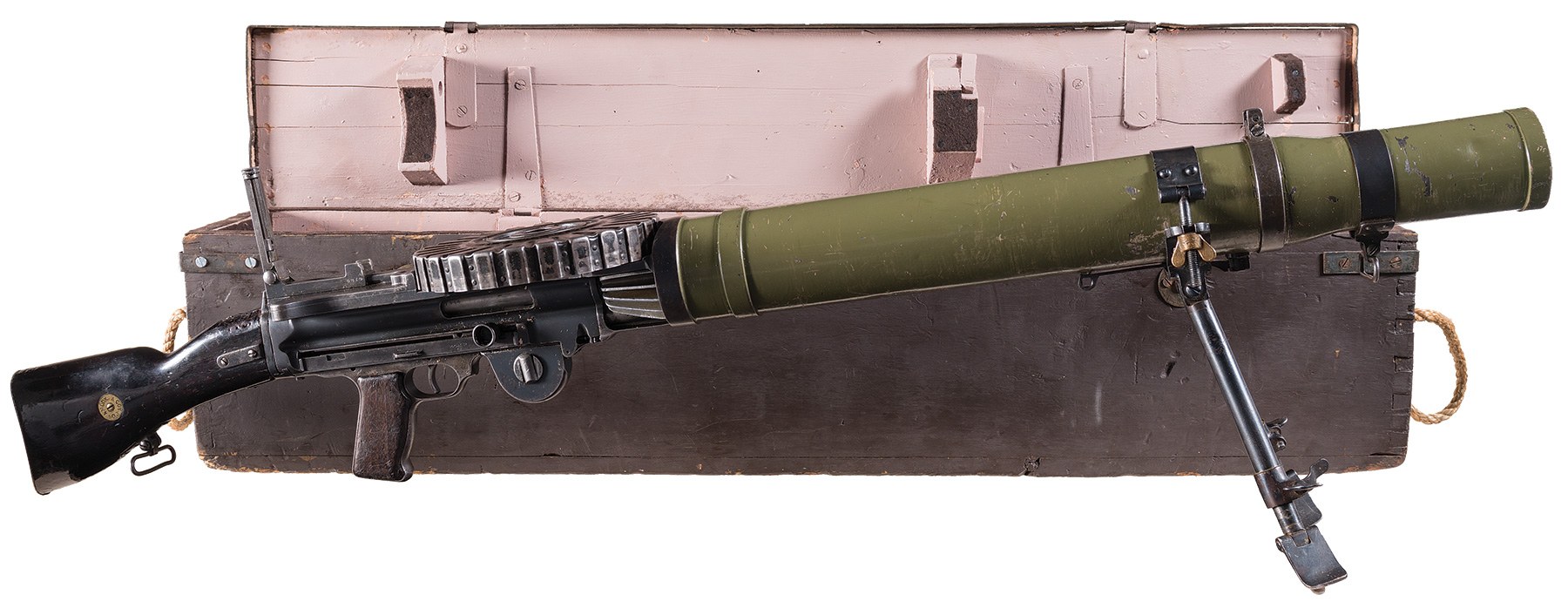
Guns reached the register by several routes, which the sources describe in general terms: lawful importation and registration while that was possible, war trophies registered at the time or in the 1968 amnesty, and dealers’ guns. Auction catalogues show the result. Rock Island Auction has sold a Savage-built US Model 1917 described as “a National Firearms Act (NFA), fully transferable Class 3, which is registered with the Bureau of Alcohol, Tobacco, Firearms and Explosives, (BATFE) that is classified as a ‘Curios or Relic’ as defined in 27 CFR, 478.11”, and a BSA ground gun with the same note; Poulin Auctions sold a Japanese Type 92 in 2025 as “FULLY TRANSFERABLE”.456 Transferable examples of the British, American and Japanese patterns therefore all exist.
How many are on the register is not public. The DOJ Inspector General’s 2007 report on the National Firearms Registration and Transfer Record does not break registrations down by model, and no count of Lewis guns was found.3
8.3 The 1968 amnesty
The Gun Control Act of 1968 rewrote the National Firearms Act and opened a single window. The Inspector General: “the GCA called for a 30-day amnesty period ending December 1, 1968, where anyone possessing an NFA weapon could register the weapon without consequence. However, any NFA weapon not registered during the amnesty is considered contraband, cannot be registered, and must be forfeited or voluntarily surrendered to ATF.”3 ATF’s NFA Handbook adds that the 1968 amendments allowed further amnesty periods of up to 90 days, but “To date, no additional amnesty periods have been declared. Requests for further amnesty periods have been denied, principally because additional periods could jeopardize pending ATF investigations and prosecutions of NFA violations.”7
For a weapon brought home from either world war, the amnesty is the dividing line. A trophy Lewis registered by December 1968 can be on the register today; one that was not is contraband, and no paperwork found later changes that.
8.4 Dewats
Many war trophies were registered as dewats, deactivated war trophies. ATF’s NFA Handbook: “Deactivated War Trophy (DEWAT) firearms are still firearms under the NFA, but have been rendered unserviceable (i.e., incapable of discharging a shot by means of an explosive and incapable of being readily restored to a firing condition).” The deactivation “may have been accomplished by various means such as (but not limited to) welding of the chamber, cutting the barrel/chamber/breech, plugging the barrel, welding the bolt to the chamber”. And: “Regardless of being unserviceable, the DEWAT firearm must be registered and approved for transfer as any other NFA firearm.” Because it is unserviceable it is “transferred tax-exempt as a curio or ornament on an ATF Form 5”.7
Three consequences follow for anyone looking at a deactivated Lewis.
- A registered dewat is still an NFA firearm. It can be owned and transferred, but only through ATF, tax-exempt.
- An unregistered “deactivated” Lewis is not made lawful by being deactivated. The Handbook’s general rule on unserviceable firearms: “rendering a firearm unserviceable does not remove it from the definition of an NFA firearm.”7 Whether a particular object has been destroyed to the point where it is no longer a firearm at all is a technical determination for ATF, not a seller’s description. The MP 40 dive’s warning about foreign deactivation certificates applies in full.1
- The paperwork must match the gun. A Lewis may carry a struck-through original number and a later one, or a rebuilder’s stamp (Volume 4). The registration describes one gun, and a buyer needs to see that it is this one.
8.5 Reactivation is making
The 2009 NFA Handbook: “A DEWAT that has been returned to a serviceable condition (or reactivated) is often referred to as Reactivated War Trophy (REWAT). The act of returning a DEWAT to a serviceable condition is considered the ‘making’ or ‘manufacturing’ of a firearm by ATF.” It then says that a Form 1 “may be used to reactivate a properly registered unserviceable firearm, including registered unserviceable machineguns”, and describes the route by which a qualified manufacturer reactivates one and returns it on a taxed Form 4. Curio-or-relic status is retained.7
Two cautions. First, that edition is from April 2009; whether ATF currently approves a Form 1 from a private individual to reactivate a registered machinegun dewat, given § 922(o)‘s bar on making machineguns, could not be confirmed for this dive and must be checked with ATF or an NFA attorney before anyone relies on it. Second, it is a legal process, and this dive describes no part of the work. The only lawful sequence starts with an approved form, never with a tool.
8.6 Curio or relic
The auction catalogues all describe their Lewis guns as curios or relics under 27 CFR 478.11. The Handbook explains what that does and does not mean: an NFA firearm classified as a curio or relic “is still an NFA ‘firearm’ and is still subject to the registration and transfer provisions of the NFA. The primary impact of a curio or relic classification is that a properly registered NFA firearm classified as a curio or relic may be lawfully transferred interstate to, or received interstate by, a person licensed as a collector of curios or relics under the GCA.”7 It does not change the tax, the form, or the wait.
8.7 What the market shows
No realised price for a transferable Lewis could be read for this dive: Rock Island’s results are behind a login, and no other auction archive was checked. The MP 40 dive’s posture applies: take current prices from the auction houses’ published results, dated, and from no general reference, this one included.1
What the catalogues do show is what buyers are told and what they should check:
- Mark and model names in sale titles are not reliable. Rock Island catalogued a radiator-cased ground gun as a “Mark II”, which the RAF’s 1918 notes call the aircraft gun (Volume 4).58
- Origin claims are the auctioneer’s. Poulin’s Type 92 is described as “Originally introduced as the Type 91 Navy Aircraft Machine Gun”, which no primary source consulted supports, and one of its photographs shows a later “REBUILT BY” stamp.6
- Accessories carry value and information. The Savage Model 1917 lot came with three magazines, oilers, a magazine case, bipod, wooden transport case and manual.4 Magazines, which the period manuals treat as consumables (Volume 6), matter to whether a gun can be used at all.
8.8 Parts, magazines and display guns
The registered part is the gun. The MP 40 dive notes that federal law defines a firearm to include its frame or receiver, and that for a machinegun there is no lawful way for a private person to supply a new receiver to a set of parts.1 For a Lewis the receiver is the body (Volume 3). Magazines, pans, loading tools, spring balances, mounts and manuals are accessories; the period kits listed in Volume 6 are the reference for what belongs with a gun.
Non-firing replicas and inert display pieces are outside this volume. If they are truly incapable of being made to fire they are not firearms federally, but they are imitation firearms with their own marking rules, as the MP 40 dive explains.1
8.9 Michigan
Michigan’s machine-gun statute, MCL 750.224, and its exception for persons licensed by the federal government are quoted and discussed in the MP 40 dive’s Michigan section, which deliberately leaves unresolved how the exception applies to a private owner of a registered transferable machine gun.1 The same question applies to a Lewis, and this dive does not answer it either.
A Lewis-specific question follows from it and is also left open: whether a registered dewat, which federal law still treats as a machinegun-type NFA firearm but which cannot fire, is within MCL 750.224’s “machine gun or firearm that shoots or is designed to shoot automatically”. The statute’s “designed to shoot” wording is the reason not to assume it is not. A Michigan lawyer is the person to ask.
8.10 What could not be established
- How many Lewis guns are on the NFA register, by pattern.
- Current transferable prices: no realised price could be read.
- ATF’s present practice on Form 1 reactivation of a registered machinegun dewat by a private individual.
- Michigan’s treatment of a registered transferable machinegun owned by a private person, and of a registered dewat.
References
Footnotes
-
This hub, MP 40 dive, Volume 6, “Owning One Today in the United States”, sections 6.1 to 6.6. /actual-firearms/rifles/mp-40/vol-6/ ↩ ↩2 ↩3 ↩4 ↩5 ↩6 ↩7
-
Savage Arms Corporation, Hand-Book of the Lewis Machine Gun, Model 1918, Caliber .30 (c. 1918), p. 31. https://www.forgottenweapons.com/wp-content/uploads/Lewis/lewismanual.pdf, consulted 2026-10-19. ↩
-
US Department of Justice, Office of the Inspector General, The Bureau of Alcohol, Tobacco, Firearms and Explosives’ National Firearms Registration and Transfer Record, Evaluation and Inspections Report I-2007-006 (June 2007), executive digest. https://oig.justice.gov/archives/reports/ATF/e0706/exec.htm, consulted 2026-10-19. ↩ ↩2 ↩3
-
Rock Island Auction Company, sale 89, lot 3357, “U.S. Savage Model 1917 Lewis Gun, Class III/NFA C&R”. https://www.rockislandauction.com/detail/89/3357/us-savage-model-1917-lewis-gun-class-iiinfa-cr, consulted 2026-10-19. ↩ ↩2
-
Rock Island Auction Company, sale 73, lot 3393, “BSA Co Lewis Machine Gun Mk II”. https://www.rockislandauction.com/detail/73/3393/bsa-co-lewis-machine-gun-mk-ii, consulted 2026-10-19. ↩ ↩2
-
Poulin’s Antiques and Auctions, “Very rare Japanese Type 92 Lewis aircraft machine gun”, 19 February 2025. https://www.poulinauctions.com/2025/02/19/very-rare-japanese-type-92-lewis-aircraft-machine-gun/, consulted 2026-10-19. ↩ ↩2
-
Bureau of Alcohol, Tobacco, Firearms and Explosives, ATF National Firearms Act Handbook, ATF E-Publication 5320.8, revised April 2009, sections 2.1.9, 2.3, 3.2.1, 6.6, 7.3.3 and 10.1.5. Copy in the First Circuit’s citation archive, https://www.ca1.uscourts.gov/sites/ca1/files/citations/ATFNationalFirearmsActHandbook.pdf, consulted 2026-10-19. ↩ ↩2 ↩3 ↩4 ↩5
-
Royal Air Force, Instructional Notes on the Lewis Gun (April 1918), section II. https://archive.org/details/raflewisgun, consulted 2026-10-19. ↩
Comments (0)