Lewis Gun · Volume 7
Stoppages, Immediate Action and Repair
Why a Lewis stops, how the gunner was taught to tell from the cocking handle what had gone wrong, the separated case and the clearing plug, the runaway gun, headspace, and what breaks
As with Volume 6, nothing here describes altering a gun. This is the period manuals’ diagnosis of a gun that has stopped, and the division they drew between what the gunner did and what an armourer did.
7.1 A gun with a reputation
The Lewis was known for stoppages from the first. The 1913 Springfield trial recorded 206 jams and malfunctions and 35 broken parts in the endurance test (Volume 1).1 The General Staff’s 1916 notes compared it to a Grand National runner that “will win if it stands up”, and said it contained “a greater number of easily broken parts” than the Vickers.2 In 1929 the War Office listed “too liable to stoppages” as one of its two faults.3
The manuals’ answer was drill. Pridham: “Roughly, about 90 per cent. of all Stoppages can be rectified at once by the application of what is known as ‘Immediate Action.’” Immediate action “must be practised until it becomes a habit. It should be Instantaneous and Automatic.”4 The Savage handbook says the same in its own register: “The slightest unusual symptom when the gun is firing must tell the operator at once not only what is the matter, but how to fix it. … Recognition should be immediate and instinctive—correction, immediate and reflexive.”5
7.2 Ammunition first
Pridham, writing in 1940 with twenty-five years of hindsight, put the main cause outside the gun: “Faulty (foreign manufactured) ammunition has, in the past, been the main cause of STOPPAGES.” His stoppage table’s order of probability “was originally compiled as a result of experience gained in the War of 1915-18 … From 1915 onwards, and for many years afterwards, vast quantities of Ammunition of Faulty (Foreign) Manufacture were used, causing Breakages, Blowbacks and Burst Cases.” With good British ammunition, “very few Stoppages that are not cured by Immediate Action should be incurred”, and by October 1940 “extremely few Stoppages are now incurred”.4
The War Office took the point seriously enough to use the Lewis as a test instrument. The Textbook of Small Arms 1929 describes the “casualty proof” of service ammunition, fired in a rifle, a Lewis, a Hotchkiss and two Vickers. “The Lewis gun used is fitted with a barrel which has fired at least 6,000 rounds, and a gun with a striker protrusion at the low limit is selected”, and the proof is designed “to detect missfires, blowbacks, bursts, and split necks; that in the Lewis gun being also arranged to discover bullets breaking up, or failing to take the rifling.”3 A worn Lewis was the gun that found bad ammunition.
7.3 The cocking handle tells you
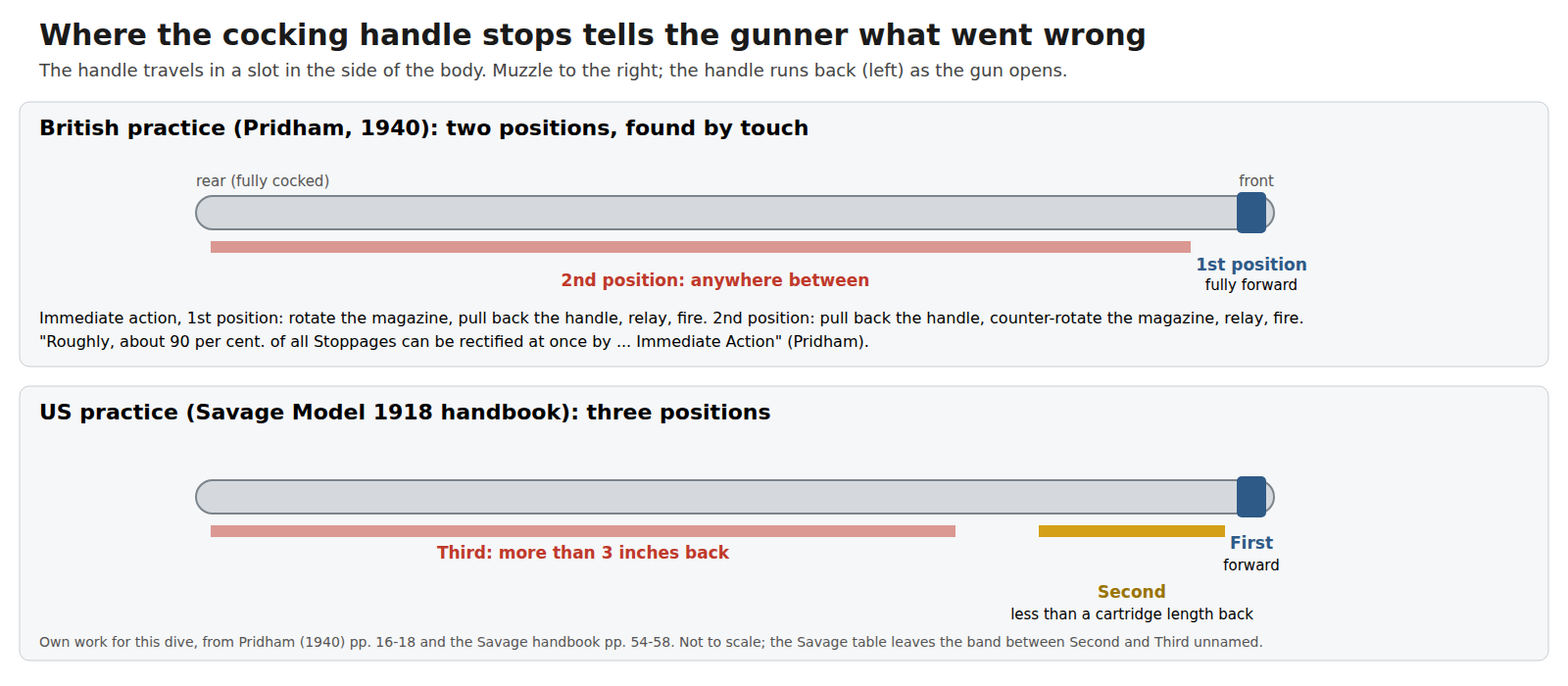
The whole diagnostic system rests on one observation: where the cocking handle stops. Because the handle is fixed to the piston rod, it shows how far the moving parts got before they stopped.
- British: two positions. Pridham: “1st Position C.H. is fully forward. 2nd Position C.H. in any position between 1st (as above) and Gun fully cocked.” It can be found by touch: “With Butt in Shoulder, raise Fingers (extended) of Right Hand straight up from the Pistol Grip. If C.H. is felt at the Tips of the Fingers—1st Position. If C.H. is felt on any other part of the Hand—2nd Position.”4
- American: three positions. The Savage table distinguishes a First position (handle forward), a Second (“less than a cartridge length from forward position”) and a Third (“more than 3 inches back”). The handbook’s “Sequence of Immediate Action” chart defines the second and third positions instead by the handle’s place relative to the thumb-piece of the safety.5
7.4 Immediate action, British
Pridham’s drill:4
- 1st position (handle forward): “Rotate Magazine—Pull back C.H.—Relay Gun, and carry on Firing.”
- 2nd position (handle part way): “Pull back C.H.—Counter-rotate Magazine—Relay Gun, and carry on Firing.”
If the gun stops again in the same position, “Further Action”: in the 1st position, remove the magazine, examine the feed mechanism (the pawls), pull back the handle and examine the striker; in the 2nd position, pull back the handle, remove the magazine and examine the chamber, ejection opening, cartridge slot and guide.4
The logic follows from the feed (Volume 3). A gun stopped with the handle forward has either fired its last round, misfired, or failed to feed; turning the magazine by hand tells which, because an empty pan spins freely and a full one stops against the cartridge stop. A gun stopped part way has met an obstruction going forward, usually a cartridge or case in the wrong place.
7.5 Immediate action, American
The Savage handbook’s chart for the First position (handle forward) begins “Try Magazine”: if it is free to rotate, it is empty, so change it, reload, relay and fire; if it is fixed, pull the charging handle and watch. If the gun then fires single shots, examine the gas regulator; if a cartridge is ejected, examine its primer, and if the primer is struck, carry on, but if it is not struck, “Change piston and rack”. If no cartridge is ejected, examine the feed mechanism.5
For the Second position, “Force rack charging handle” home; if the stoppage recurs, “Take out gas regulator, fire a shot. Insert with large hole to rear. Clean and oil”. For the Third, examine the ejection opening: a case in the boltway means the ejector; an obstructed chamber means the magazine is to be removed and the rim of the cartridge examined: “If rim cut in two places”, carry on; “If rim not cut”, change the bolt, because the extractors have not gripped it.5
7.6 Immediate action, in the air
The RAF’s 1918 drill was shorter, because an observer had less time and a double drum: “Glancing blow on magazine towards left front, using palm of left hand. Magazine rotates. Change magazine. Relay. Fire.” Instructors were told to train with a cloth over the magazine, removed only at the firing position, and that “It is unnecessary to say ‘Gun stops.‘“6
7.7 The stoppages, by cause
The Savage handbook’s stoppage table and Pridham’s Table B, combined. Causes are the manuals’; where only one manual lists a cause, it is marked.54
Table 1 — The stoppages, by cause
| Handle position | Symptom | Probable cause | Remedy in the manual |
|---|---|---|---|
| forward | magazine turns freely | empty magazine | change magazine |
| forward | magazine fixed; round ejected unfired, primer struck | misfire | pull back, relay, fire |
| forward | primer not struck | broken or damaged striker; weak or broken spring | change piston and rack (Savage); change piston rod (Pridham) |
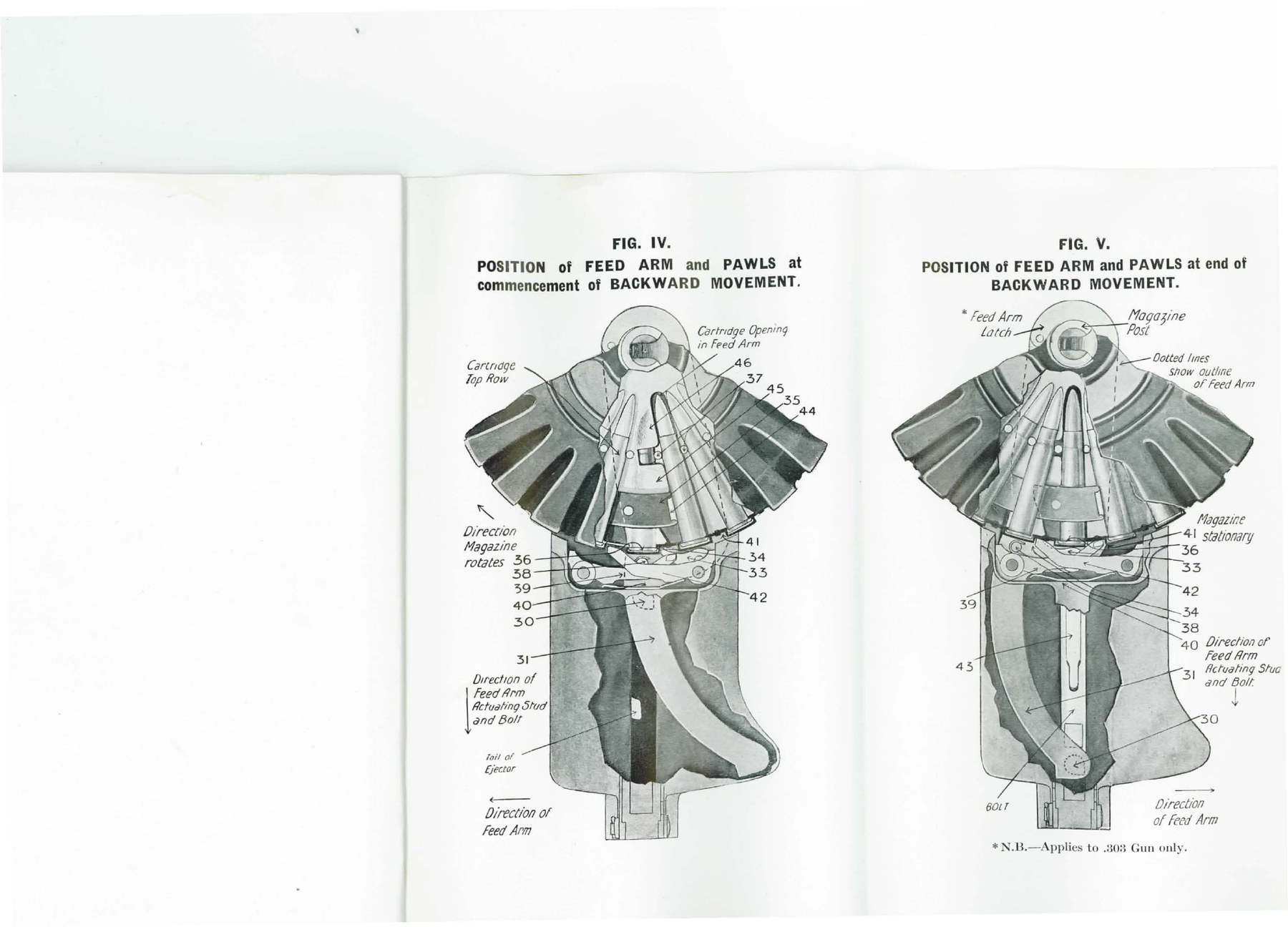
| forward | magazine does not rotate, nothing ejected | broken or weak feed arm pawl spring, worn pawl | change pawl spring (Pridham); examine feed and stop pawls (Savage) |
| forward | handle will not come back | hard extraction: expanded case, grit or rust in chamber | handle extension, or belt; examine chamber (Savage) |
| part way | round cannot enter chamber | separated case in chamber | clearing plug (Pridham, Savage “shell extractor”) |
| part way | live round jammed against an empty in the chamber | broken, worn or gritty extractor | clear gun and change bolt (Pridham) |
| part way | empty case in the boltway | faulty ejection | clear gun; if it recurs change ejector |
| part way | mechanism jammed | broken piece of metal in the boltway | strip down; “Prolonged Stop” (Pridham) |
| part way | double feed | faulty action of the right stop pawl; dirt or wear | clear, change the stop pawl (Pridham) |
| more than 3 in back (Savage) | bolt short of the cartridge base | friction in gas cylinder; hard extraction | remove regulator, fire one shot, refit large hole to rear; clean and oil (Savage) |
| more than 3 in back | little or no resistance on the handle | weak or broken mainspring | tighten; if broken, change gear casing |
| more than 3 in back | handle flies forward when magazine removed, or cannot move | damaged magazine, magazine not seated, broken magazine catch spring, damaged spacer ring | change magazine |
| more than 3 in back | cartridge out of place on the feed way | weak or broken cartridge guide spring; mainspring too weak; too much gas | correct cartridge; test guide spring and mainspring |
Two notes in the Savage table read like field experience. On separated cases: “In nine cases out of ten the next cartridge pulls out the separation.” And if separations keep recurring: change the bolt, because of “Too sharp extractors, which cut cartridge case at base”.5
7.8 The separated case and the clearing plug
A rimmed case that separates leaves its front portion in the chamber, and the next round cannot chamber. Both manuals supply a tool. Pridham’s sequence for the clearing plug: insert its tapered end into the chamber “with centre pin pushed back”; press the trigger, “allowing Bolt to force centre pin forward”; “Give Clearing Plug Handle an up-and-down rocking motion”; pull back the handle and withdraw the plug with the separation on it; press the trigger, load, and carry on. “If Clearing Plug not available, and SEPARATION does not adhere to next round—increase TENSION on RETURN SPRING, and repeat.”4 Savage’s equivalent, the shell extractor, is inserted with the magazine off, “push home with bolt and withdraw with front portion of separated case”.5
7.9 The runaway gun
An open-bolt gun that keeps firing after the trigger is released has a sear that is not catching the rack. Savage, in a note beneath its stoppage table: “If the gun continues to fire after the trigger is released, push forward trigger with hand on right side. This will be caused by broken or weak spring, or damaged sear.”5 The practical instruction for anyone handling a live gun is older than the Lewis: keep it pointed safely and let the magazine run out if nothing else works. The Lewis’s 47-round pan limits a runaway to the rounds left in it.
7.10 Headspace
The Lewis cannot be adjusted for headspace. The Textbook of Small Arms 1929: for “Lewis, Madsen, Hotchkiss … As a rule no adjustment is provided and the only remedy is the exchange of unserviceable for serviceable components.” It adds that “In some guns the substitution of a new barrel will affect the cartridge head space, and this is particularly so in the case of the Lewis, in which the condition of the projection on the rear face of the barrel is a determining factor”, and that when gauging a Lewis, “no longitudinal play should exist” between body and barrel.3
The Savage handbook’s test is the maximum gauge: “A bolt which closes over the maximum heading gauge must be changed.”5 The remedy in both systems is a part swap, bolt or barrel, not a fitting job.
Chinn’s account of the 1913 failure is also a headspace story: a bolt that began to unlock too early “had the same effect as too much head space”, and cases stuck or ruptured as a result.1 A modern owner with case-head separations or stretched cases has the same two suspects the manuals had: the gauge and the dwell, meaning the condition of the cam slot and striker post.
7.11 What breaks
The sources name these as the parts that fail:
- Feed arm pawl spring and feed pawl. First item in Pridham’s Table B; “Fault usually found in Feed Arm Pawl Spring. But Feed Arm Pawl may be worn.”4
- Stop, rebound and feed pawls under a high rate. Chinn: on the speeded-up guns of 1918 the muzzle booster “resulted in wearing off the stop, rebound and feed pawls, after the firing of a few magazines”, cured by changing their heat treatment.1
- Extractors. Too weak (under three pounds on the spring balance, Savage), broken, or too sharp (“cut cartridge case at base”).5
- Striker. Broken or damaged; worn by dry-firing on a tight spring (“Simplex”).57
- Mainspring. Broken; Savage: “If the main spring is broken, the collet pin will be ‘out.’” Too little tension “might cause breakage of parts”.5
- Striker post and cam slot. Burring, to be stoned by an armourer (Volume 6).5
- Gas cylinder. Split at the rear if unscrewed without the rack fully home.5
- Magazines. Dented rims and spacer rings; “If a full one is dropped on hard ground it will probably be so dented that it will not fit the gun.”2
- Front sight. Chinn: the original bronze front sight was “too soft to be satisfactory, as the set screw could not hold the sight in place”, and steel sights replaced it.1
- Volute spring on speeded-up aircraft guns: replace at 1 inch.6
7.12 Bench or armourer
The manuals draw the line clearly.
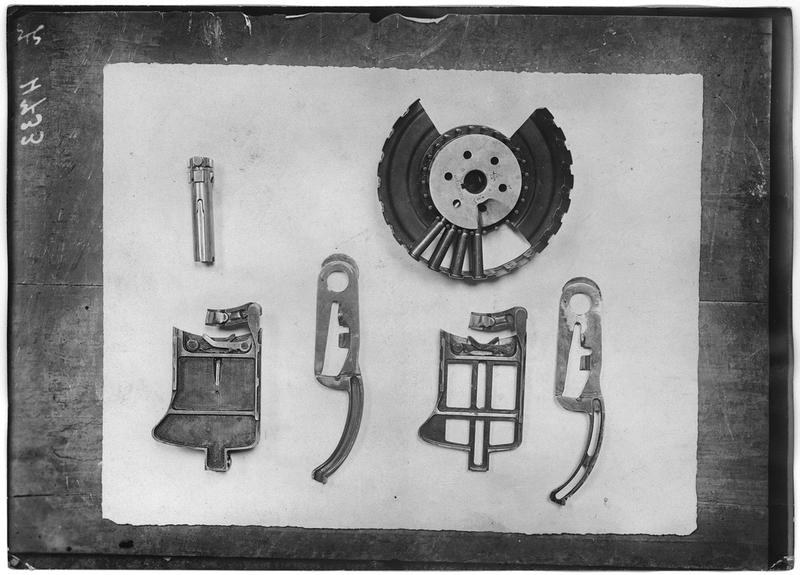
- The gunner’s work: immediate action; clearing a separated case; changing a magazine, a cartridge guide, the stop and feed pawls, extractors, the gear complete, the charging handle and the ejector. The Savage handbook’s “Immediate Action in Replacing Parts” lists exactly what must come off to change each.5
- The armourer’s work: anything with a file, stone or emery (“Adjustment by use of file, oil-stone or emery should be made only by an armorer”); smoothing the striker post and cam slot; headspace gauging; barrel replacement; separating piston from rack.5
For a gun on the National Firearms Act register today, the second list belongs with someone qualified to work on registered machine guns. Repairing a registered gun with replacement parts is a different legal act from making one, but which repairs are which is a question for Volume 8 and for ATF, not for a workbench.
7.13 What could not be established
- Parts availability today: no maker’s or dealer’s catalogue of Lewis parts was consulted, and no prices are given.
- Failure rates by part: no source gives numbers beyond the 1913 trial totals.
- The headspace gauge dimensions for .303 or .30-06 Lewis guns: not given in the manuals consulted.
References
Footnotes
-
George M. Chinn, The Machine Gun, vol. I, Part IV, chapter 1 (Bureau of Ordnance, 1951). https://www.ibiblio.org/hyperwar/USN/ref/MG/I/MG-4.html, consulted 2026-10-19. ↩ ↩2 ↩3 ↩4
-
General Staff, Some Notes on Lewis Guns and Machine Guns, S.S. 122 (September 1916). https://archive.org/details/1916-uk-ss-122, consulted 2026-10-19. ↩ ↩2
-
War Office, Textbook of Small Arms 1929 (HMSO), cartridge head space and ammunition proof. https://archive.org/details/textbooksmallarms1929, consulted 2026-10-19. ↩ ↩2 ↩3
-
Major C. H. B. Pridham, Lewis Gun Mechanism Made Easy, 6th edition (Gale & Polden, 1940), preface and sections X to XI, Tables A and B. https://www.forgottenweapons.com/wp-content/uploads/Lewis/Lewis%20Gun%20Mechanism%20Made%20Easy.pdf, consulted 2026-10-19. ↩ ↩2 ↩3 ↩4 ↩5 ↩6 ↩7 ↩8
-
Savage Arms Corporation, Hand-Book of the Lewis Machine Gun, Model 1918, Caliber .30 (c. 1918), pp. 9–10, 41–61. https://www.forgottenweapons.com/wp-content/uploads/Lewis/lewismanual.pdf, consulted 2026-10-19. ↩ ↩2 ↩3 ↩4 ↩5 ↩6 ↩7 ↩8 ↩9 ↩10 ↩11 ↩12 ↩13 ↩14 ↩15 ↩16
-
Royal Air Force, Instructional Notes on the Lewis Gun (April 1918), sections VI and VII. https://archive.org/details/raflewisgun, consulted 2026-10-19. ↩ ↩2
-
“Simplex”, Instruction on the Lewis Automatic Machine Gun, 3rd edition (Forster Groom, 1917), chapter V. https://archive.org/details/instructionlewisautomaticmachinegun1917, consulted 2026-10-19. ↩
Comments (0)