Lewis Gun · Volume 2
Liège, Birmingham, Utica: Making the Lewis Gun and Taking It to War, 1913–1918
Armes Automatiques Lewis, the BSA contracts, Savage's two calibres, two guns a company, the aircraft gun and its 97-round pan, and the Marines who had to hand theirs in
2.1 Europe, 1913
Volume 1 left Lewis sailing for Europe in January 1913 with four American-made prototypes. Chinn and Truby agree on what followed: a Belgian company, Armes Automatiques Lewis, was formed at Liège, and production began there before being moved to the Birmingham Small Arms Company (BSA) in England.12
The Liège phase was short. Chinn lists a “Model 1913, Liége” of which “a few were made in Belgium during this year, before contract was transferred to Birmingham Small Arms”.1 The Belgian name survived on the British guns: BSA’s top plates read “Manufactured by The Birmingham Small Arms Co Ltd, ENGLAND, for Armes Automatiques Lewis, BELGIUM”, with “Lewis Auto. Gun Mod 1914 - Pat.” stamped on the body cover, as on the Imperial War Museum’s gun FIR 9220 and the Australian War Memorial’s Sergeant McDougall gun.34 Volume 4 shows these markings.
The aeroplane remained the selling point. Chinn records a Belgian demonstration at the Brasschaat military aeronautics ground in December 1912, which he calls “the first official demonstration of its kind in Europe”, and the first aerial firing in England, from a Grahame-White biplane flown by the civilian Marcus D. Manton over Bisley on 27 November 1913.1 Truby has the Belgian firing in “the Fall of 1912” with Lieutenants Nelis and Stellingwerff.2
2.2 Birmingham Small Arms
BSA’s Lewis production is described in detail only by Truby, from BSA figures. His sequence, attributed to him throughout:2
Table 1 — Birmingham Small Arms
| Date | Order or output (Truby 1976) |
|---|---|
| July 1914 | 10 guns for the Admiralty and War Office |
| two weeks later | 45 for the air service |
| two weeks later | 200, at 25 a week |
| late 1914 | 400 for general service; contract price £175 a gun |
| March 1915 | contract for a minimum of 100 guns a week, no end date |
| May 1915 | 2,000 more, at 100 a week from 6 September 1915 |
| end of 1915 | 300 a week |
| following March | 500 a week |
| near the 10,000th delivery | 750 a week, for the duration of the war |
Truby also says BSA eventually ran “more than ten thousand machine tools” on the gun, operated largely by women. The Auckland War Memorial Museum holds aircraft-gun components labelled as made by women war workers, which fits the picture but does not test the figure.5
The official British view of why the Lewis was bought at all is given in the War Office’s Textbook of Small Arms 1929: the production of Maxim-pattern guns “could not keep pace with the expansion of the army. Consequently the Lewis gun was introduced, and the new units were armed with it in place of the Vickers”. When a lighter gun was needed to keep up with infantry, “the Lewis and Hotchkiss were adopted to fill the gap. The Lewis being the more accurate was adopted for infantry purposes, and the Hotchkiss, being more robust and better shaped for carrying in a bucket, for cavalry.”6 Chinn gives the manufacturing argument: “It was estimated by the manufacturers that six Lewis guns could be made to one Maxim-Vickers.”1 That is a statement about labour per gun. Truby’s later “six times as many Lewis guns as Vickers” ordered is a different claim, about orders, and he gives no source for it.2
2.3 Two guns a company: the Lewis on the Western Front
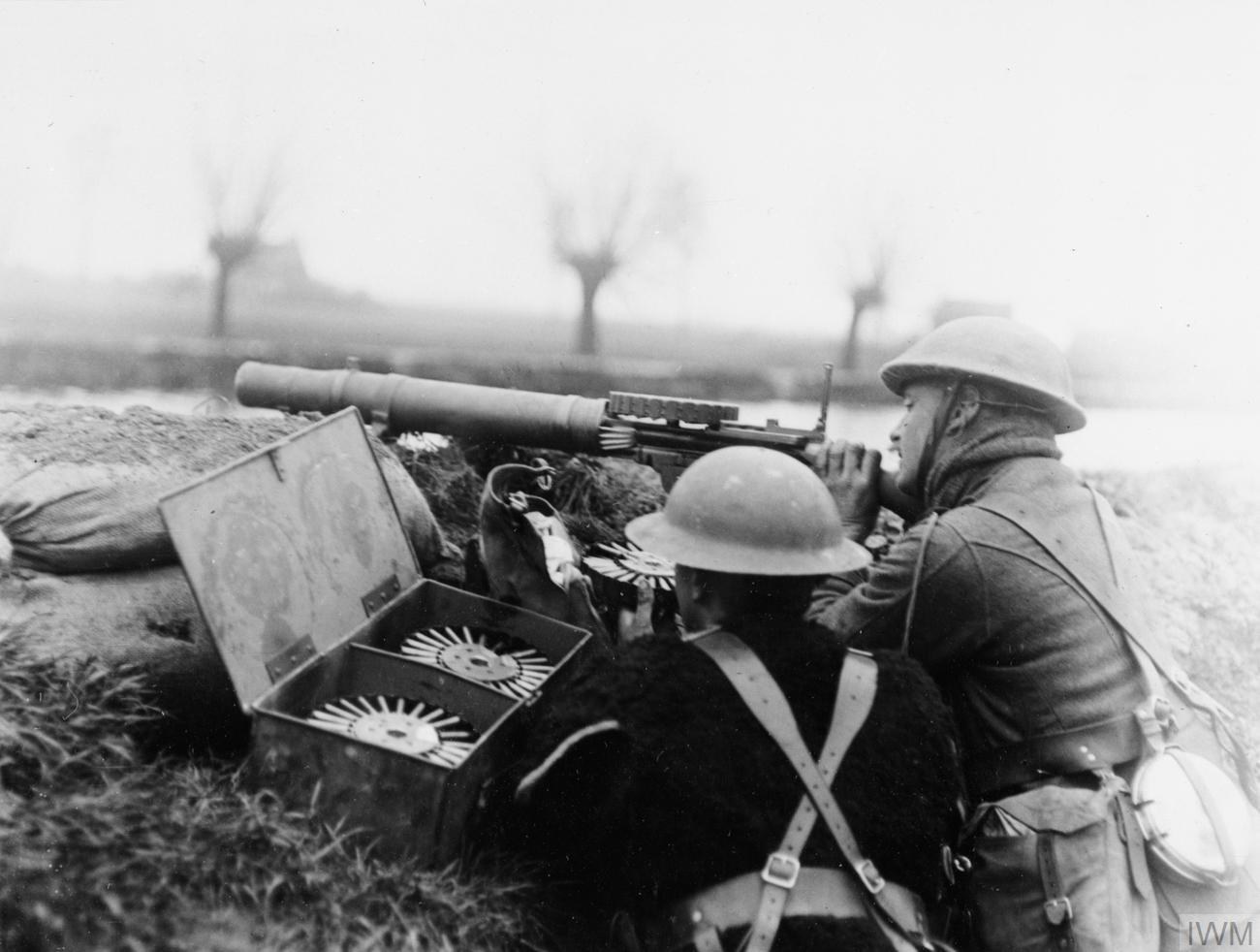
The scale of issue grew quickly. The General Staff’s pamphlet S.S. 122, Some Notes on Lewis Guns and Machine Guns, issued in September 1916 and “written by a regimental officer with considerable experience”, opens: “Now that two Lewis guns are added to the equipment of each Company, any officer may find himself in command of this new weapon”.7 The Imperial War Museum’s label for its Lewis gun says that by the end of the war the scale was “two per platoon”.3
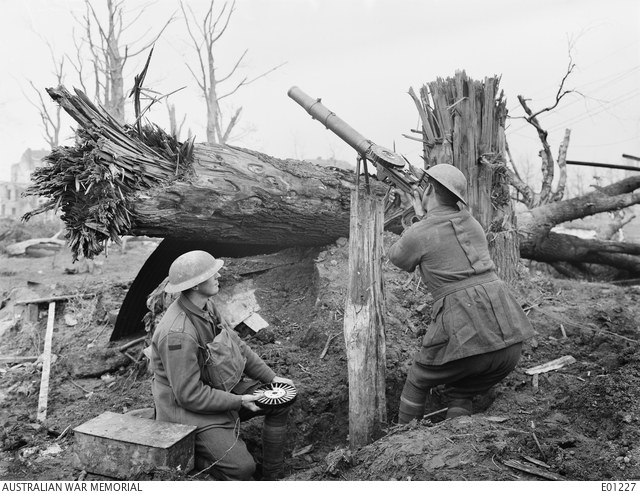
The tactical job is stated plainly in S.S. 122: “One of the main jobs of Lewis guns is knocking out enemy machine guns.” The pamphlet rates a short burst as equal to “about 20-30 rifles”, fired “from a single loophole, or, in the open, from a frontage of two men”, and notes that “the volume of fire is not decreased till more than 66 per cent. of the team become casualties”.7 The commercial instruction book Instruction on the Lewis Automatic Machine Gun (third edition, 1917), by the pseudonymous “Simplex”, adds the limits: the gun cannot be used “for overhead, indirect, or accurate night firing, as can the Vickers Gun”, and “not more than 12 magazines can be fired in succession”.8
2.4 What the officers who used it said
The period sources are not uncritical, and their complaints are the background to Volume 7.
- S.S. 122 (1916): the gun “will be red hot if 700 or 800 rounds are fired rapidly. If more are fired they may burst.” It is “more exposed to dust, wet and mud” than the Vickers and contains “a greater number of easily broken parts”. A full magazine dropped on hard ground “will probably be so dented that it will not fit the gun”. And: “A Lewis gun is a more delicate piece of mechanism than a motor car and needs more constant attention. A rough stupid man can put it out of action for a long time in cleaning it”.7
- S.S. 122 also compares it to the Grand National starter of whom “all the prophets say that ‘it will win if it stands up.’”7
- The War Office’s verdict in 1929, when looking for a replacement: “the Lewis gun has two disadvantages, its weight is too great and it is too liable to stoppages.”6
Against that, the Imperial War Museum’s own assessment is that “it can lay claim to being the most successful light machine-gun design used by any of the combatant powers during the First World War”, while calling it “a rather complex weapon to maintain”.3
2.5 In the air
The Lewis had been sold as an aircraft gun from the first, and it remained one throughout the war, because it could not be synchronised. Chinn: “Because the bolt was held in a cocked position, the Lewis gun could not be synchronized to fire through the propeller arc as could front-seared machine guns.”1 An open-bolt gun’s firing is timed by the trigger releasing the whole moving mass, not by a trigger motor that can be keyed to a propeller. So the Lewis went where the propeller was not: in the observer’s cockpit on a ring mounting, on pusher aircraft, and above the top wing of single-seaters.
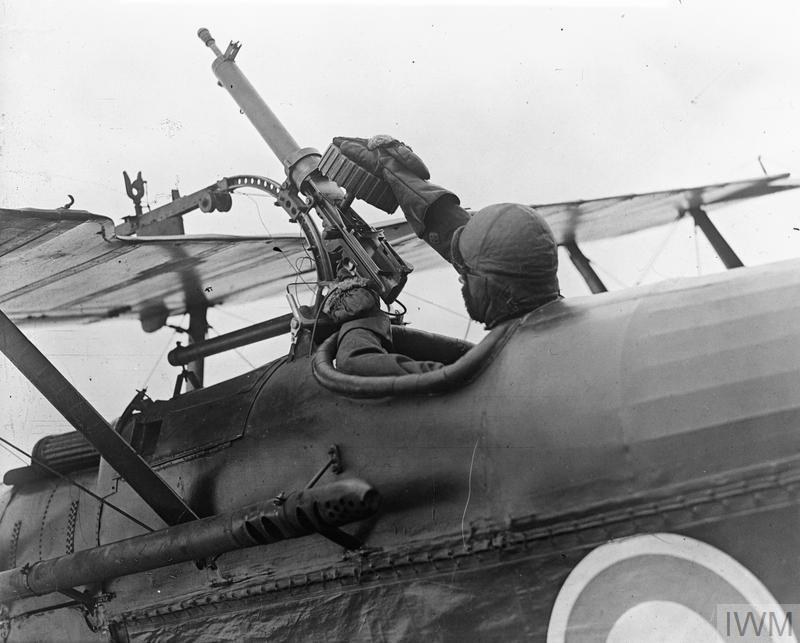
Chinn records the first use against an aircraft: on 22 August 1914, Lieutenants L. A. Strange and Penn Gaskell carried a Lewis gun aloft on their own initiative and fired a drum at a German Albatros at about 1,000 yards without effect, “the first record of a machine gun being fired at an enemy in the air”. He adds that the immediate result was a High Command order prohibiting machine guns in aircraft, soon rescinded.1
The aircraft gun was a distinct pattern. The Royal Air Force’s Instructional Notes on the Lewis Gun of April 1918 gives the weights as “Ground Gun (Mark I) 26 lbs. Aerial Gun (Mark II) 17 lbs.”, and describes the difference: “In the aerial gun the casing is in one piece, known as the Barrel Casing. There is no radiator, and the casing is of smaller diameter, except at the rear end”. The barrel’s muzzle thread, which carries the mouthpiece on the ground gun, takes “the nut which secures the Norman Vane Foresight” on the Mark II, a sight whose vane turned in the slipstream to give an automatic speed allowance.9
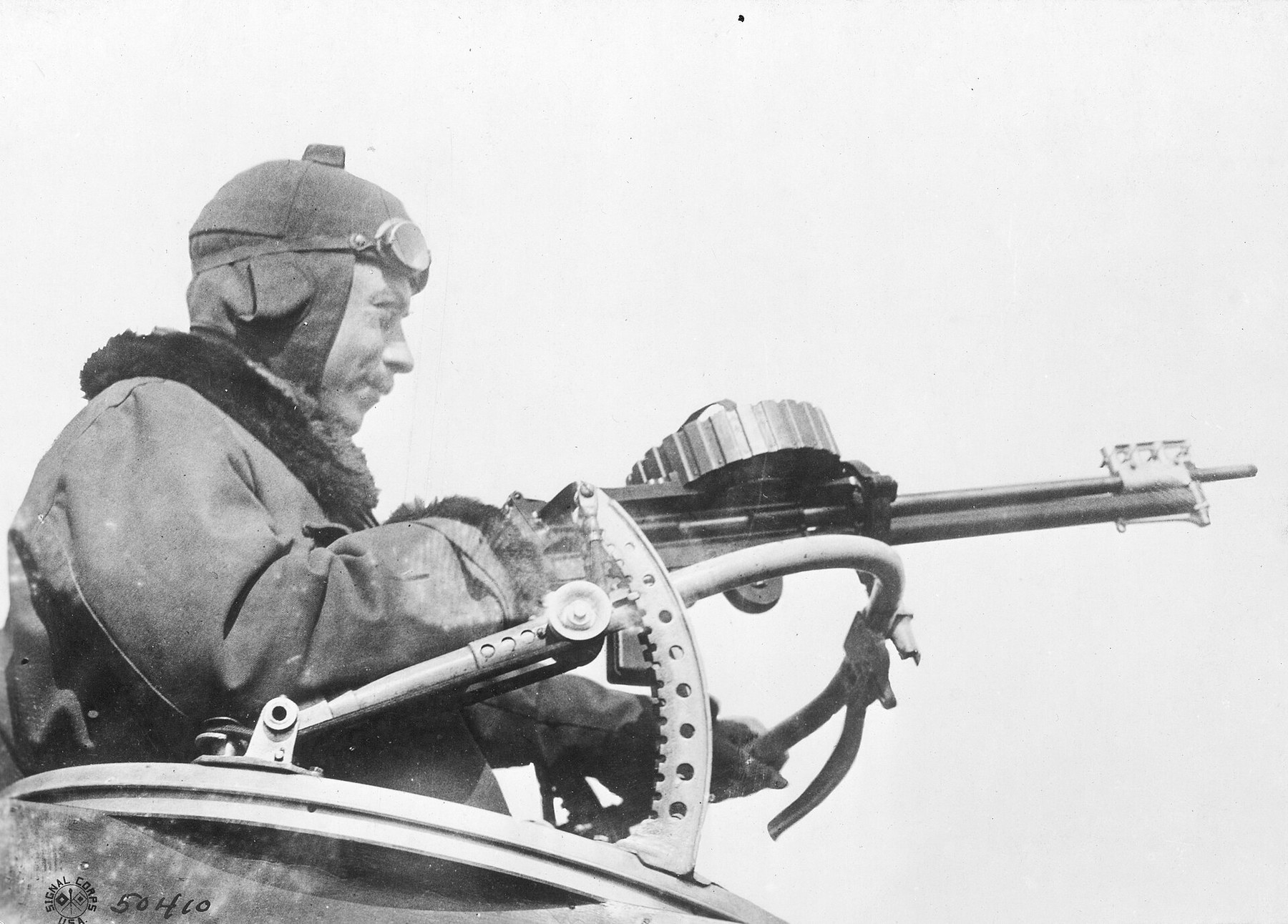
The aircraft magazine held more. The same notes: “Single Magazines. These hold 47 cartridges and weigh when empty 1½ lbs.; when full 4¼ lbs. Double Magazines. These hold 97 cartridges and weigh when empty 3¾ lbs.; when full 8 lbs., 14 ozs.” The drill section adds that “Double magazines should always be used”.9 The capacity of the double pan is not quoted consistently, and Volume 4 sets the figures side by side.
2.6 Speeding it up
Aircrews wanted a higher rate of fire, and the RAF’s 1918 notes describe the British answer. “In order to make Lewis Guns more certain of functioning at high altitudes with the double magazine, and also to increase the rate of fire”, Conversion Sets were being fitted: a Mark 1* barrel with a larger gas hole, marked “1* A.S.” on a flat near the muzzle; a Mark 1* gas regulator with a plug reducing its internal capacity; and a plug and volute spring in the rear of the piston rod as a buffer against the spade grip. Until enough sets were available, the Hazleton muzzle attachment, which “speeds up the gun by allowing more of the gases to be trapped”, was used instead, with a warning in capitals: “H.M.A’s and the Conversion Sets must never be used together, as otherwise excessive breakages would result.”9
The American programme is in Chinn, prompted by a cable from General Pershing on 28 May 1918 reporting French experiments. The American Expeditionary Force replied that the French had “a reliable speed of about 850 shots per minute”; over a thousand had been reached “but performance of gun has not been satisfactory”. Savage first opened the gas orifice from .130 to .190 inch and found that the extractor tore through case rims; the company “were unable to fire a single full drum of ammunition without some serious malfunction or parts breakage”. The Ordnance Department then had the orifice set at .150 with the Hazelton attachment, which wore out the stop, rebound and feed pawls until their heat treatment was changed; thereafter one gun fired 8,000 rounds at 800 to 850 a minute without excessive wear. Three holes of 0.0625 inch were drilled through the cylinder and casing to vent gas that was fouling the mechanism. Five thousand boosters were ordered, but because the receiver ramps also needed a milled cut, “only a limited number of the improved guns were actually delivered”.1
The two sources spell the attachment differently: “Hazleton” (RAF) and “Hazelton” (Chinn).
2.7 Tanks
Truby, citing the Royal Armoured Corps Tank Museum, describes the Lewis as secondary armament of the British Mark II, III and IV male tanks and primary armament of the females, and quotes a tank report of 1918: “Every Lewis gun in the section had its barrel (cooling jacket) peppered with bullet holes.”2 He says an armoured sleeve was tried and dropped, and that the British turned to the Hotchkiss in the last year of the war. No primary tank document was located for this volume; the claims are his. Volume 3 explains why a gun that depends on drawing air along its barrel casing is a poor choice inside a closed vehicle.
2.8 Savage Arms, Utica
Savage Arms of Utica, New York, built the Lewis in two calibres: .303 British for Britain and Canada, and .30-06 for the United States.
The production engineering is documented in an unusual primary source: a series in American Machinist, “The Manufacture of the Lewis Machine Gun”, running from 6 December 1917 to 6 June 1918 and written from inside the Savage plant. Its opening claims: every part “subjected to one hundred per cent. inspection”, “each and every piece manufactured will interchange absolutely”, and the gun “may be assembled or stripped without special tools of any kind”. In final inspection guns were taken apart, the parts mixed, and guns reassembled “from parts taken promiscuously from these groups so that each completed gun is composed of members taken from ten or more different guns”. The receiver began as a vanadium-steel drop forging of 18 pounds, of which “nearly 15 lb. of metal are cut away” in “over one hundred and fifty actual operations”.10 The series describes the aircraft model as having functioning parts “exactly the same as those of the standard model”, without the radiator and with a magazine that “holds 97 cartridges where 47 only are carried in the standard magazine”.10
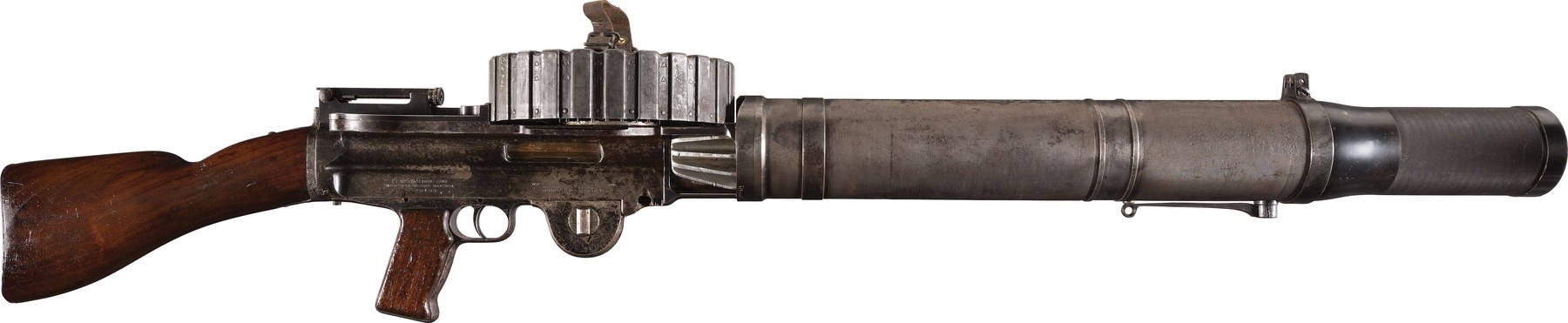
The American orders are where the sources diverge most. Truby, citing Savage company records: an initial government order in 1916 for 353 .303 guns from British production, rushed to the Mexican border; 1,300 guns for the Army a week after the declaration of war; 2,500 in May 1917 at $239.89 each; 9,270 for the Navy and Marines; and “47 thousand” aircraft guns.2 Chinn: the Army’s “original order for the ground gun was placed during the latter months of 1917”.1 The Crozier memorandum of 1916, in paragraph 15, records “the purchase of three Lewis Machine Guns, chambered for British ammunition, which it is intended to mount on aeroplanes on the Texas border and in Mexico”.1 These cannot all be reconciled, and they are left side by side.
2.9 The US Navy and the Marines
The Navy did not share the Army’s view of the gun. Chinn, writing for the Navy’s Bureau of Ordnance, gives its contracts:1
Table 2 — The US Navy and the Marines
| Date | Savage contract for the Navy |
|---|---|
| 5 February 1917 | Savage first approached for .30-06 guns for Marine Corps testing |
| 5 April 1917 | acceptance tests run by Navy and Marines, “one day before declaration of war” |
| 25 April 1917 | first contract, 3,500 guns |
| 22 June 1917 | 350 |
| 6 April 1918 | 2,500 |
| 13 June 1918 | 3,000 |
“A total of 9,350 guns with spare barrels and accessories was delivered in time for actual service before Armistice Day.” Truby’s figure for Navy and Marine guns is 9,270.12 Chinn also records that the Navy had Savage alter the American gun in September 1917 to conform with a British sample, “so that it would be identical with those used by Great Britain and France”.
The Marines’ war with the Lewis was brief. Chinn: “they were the only American troops to arrive in France armed with Lewis guns”; once attached to Army formations, “they were ordered to turn their Lewis models in. Greatly inferior Chauchats were issued as replacements.”1 This hub’s dive on the Chauchat covers the gun they were given.
For the US Army’s later aircraft guns, Chinn’s account of production at Savage is: by May 1918 “more than 16,000 had been produced and delivered. Over 10,000 of these were of the aircraft type; the other 6,000 were delivered to the Navy for Marine Corps use. By August 1918, 25,000 of the aircraft type alone had been made and by Armistice Day, 34,000 of this model had been delivered.”1 Truby prints the same five figures in almost the same words twenty-five years later, so they are one source, not two.2 Truby separately quotes Iron Age as reporting, by June 1918, 2,500 Lewis guns and 4,500 aircraft Lewis guns delivered by the War Department, which does not agree with Chinn’s 16,000 by May.2
2.10 How many were made?
No authoritative total for Lewis production was located. Each figure in circulation is tied here to its source:
Table 3 — No authoritative total for Lewis production was located. Each figure in circulation is tied here to its source
| Figure | What it counts | Source |
|---|---|---|
| more than 40,000 in use by early 1916 | British, French and Belgian forces | Truby2 |
| 40,000 “battle-tested” by June 1916 | all Allied guns | Chinn1 |
| ”nearly 40,000 in actual and daily operation” | British, French, Italian and Russian armies, February 1917 | Sidney Brooks, Philadelphia Public Ledger, 14 February 1917, as quoted by Chinn1 |
| ”over one hundred thousand” in combat | by the time American troops reached France | Truby, undated, unsourced2 |
| 34,000 aircraft guns | Savage, US contracts, by the Armistice | Chinn; repeated by Truby1 |
| 9,350 | Savage, US Navy contracts, delivered by the Armistice | Chinn1 |
| 9,270 | Savage, Navy and Marines | Truby2 |
| 12,500 | Savage, British and Canadian .303 contract | Truby2 |
| ”over 15,000 thousand by 1918” | BSA | Australian War Memorial collection page; the figure as printed is garbled and cannot be used4 |
2.11 Claims that do not survive checking
- “92 percent of all casualties.” Truby has David Lloyd George telling the House of Commons on 20 December 1915 that machine-gun casualties “are probably 92 percent of all casualties”.2 The only version of the remark located in a period source is Sidney Brooks’s 1917 recollection, “I remember Mr. Lloyd George stating that more than ninety percent of the casualties were due to them alone”, quoted by Chinn, which is about machine guns in general and is a recollection.1 Neither is a Hansard citation, and the figure is not used in this dive.
- Zeppelins. The Cyclopaedia of American Biography of 1918 says “Lewis guns have accounted in all for eight of the nine Zeppelins that have so far been shot down”;11 Brooks in February 1917 has “of the seven Zeppelins we have accounted for six were brought down by the Lewis gun”.1 Both are wartime publicity, they disagree with each other, and neither is used as a fact.
- The first machine gun fired from an aircraft. Truby calls the College Park firing “the first time a machine gun has ever been fired from an aircraft”.2 The 1918 Cyclopaedia is more careful: fired “with accuracy from an aeroplane … a feat which had never before been attempted”.11 Whether any earlier firing occurred elsewhere was not researched for this dive, so the claim is stated as American and of 1912.
2.12 What could not be established
- BSA’s production figures rest on Truby alone. No BSA or Ministry of Munitions record was consulted.
- US Army ground-gun orders: Truby’s 1,300 and 2,500 in April and May 1917 against Chinn’s “latter months of 1917”.
- The total number of Lewis guns made: no source gives one that can be checked.
- Tank use: from Truby only.
References
Footnotes
-
George M. Chinn, The Machine Gun, vol. I, Part IV, chapter 1 (Bureau of Ordnance, Department of the Navy, 1951). HyperWar transcription, https://www.ibiblio.org/hyperwar/USN/ref/MG/I/MG-4.html, consulted 2026-10-19. ↩ ↩2 ↩3 ↩4 ↩5 ↩6 ↩7 ↩8 ↩9 ↩10 ↩11 ↩12 ↩13 ↩14 ↩15 ↩16 ↩17 ↩18 ↩19
-
J. David Truby, A Pictorial History of the Lewis Gun (Paladin Press, 1976). https://archive.org/details/lewis-gun-paladin, consulted 2026-10-19. ↩ ↩2 ↩3 ↩4 ↩5 ↩6 ↩7 ↩8 ↩9 ↩10 ↩11 ↩12 ↩13 ↩14 ↩15
-
Imperial War Museums, “Gun, Lewis, .303 inch [2nd issue]”, object FIR 9220, catalogue and label text. https://www.iwm.org.uk/collections/item/object/30034920, consulted 2026-10-19. ↩ ↩2 ↩3
-
Australian War Memorial, “Lewis Mk 1 Light Machine Gun: Sergeant S R McDougall VC, MM, 47 Battalion, AIF”, RELAWM C239470. https://www.awm.gov.au/collection/C239470, consulted 2026-10-19. ↩ ↩2
-
Auckland War Memorial Museum, “Machine gun part”, 1951.211.19, “Lewis gun distant pieces (air service) WW1 Components manufactured by Women War workers 1914-1918”, via Wikimedia Commons, https://commons.wikimedia.org/wiki/File:Machine_gun_part_(AM_1951.211.19-1).jpg, consulted 2026-10-19. ↩
-
War Office, Textbook of Small Arms 1929 (London: HMSO, 1929), introduction to machine guns. https://archive.org/details/textbooksmallarms1929, consulted 2026-10-19. ↩ ↩2
-
General Staff, Some Notes on Lewis Guns and Machine Guns, S.S. 122 (London: HMSO, September 1916). https://archive.org/details/1916-uk-ss-122, consulted 2026-10-19. ↩ ↩2 ↩3 ↩4
-
“Simplex”, Instruction on the Lewis Automatic Machine Gun, 3rd edition (London: Forster Groom, 1917), chapter X. https://archive.org/details/instructionlewisautomaticmachinegun1917, consulted 2026-10-19. ↩
-
Royal Air Force, Instructional Notes on the Lewis Gun (April 1918), sections II, III and VI. https://archive.org/details/raflewisgun, consulted 2026-10-19. ↩ ↩2 ↩3
-
“The Manufacture of the Lewis Machine Gun”, American Machinist, vol. 47 no. 23 (6 December 1917) to vol. 48 no. 23 (6 June 1918), compiled scan. https://archive.org/details/Ame-mach-lewis-gun, consulted 2026-10-19. ↩ ↩2
-
The Cyclopaedia of American Biography, vol. VIII (1918), p. 98. https://archive.org/details/cyclopaediaofame08wilsuoft, consulted 2026-10-19. ↩ ↩2

Comments (0)