Lewis Gun · Volume 1
From McClean to Lewis: The Patents, the Company, and the Gun the Army Turned Down
A Cleveland doctor's gas-operated gun, an artillery colonel's air-cooled redesign, the 1912 aeroplane firing, and the 1913 Springfield trial that sent the Lewis gun to Europe
1.1 What this dive covers
The Lewis gun is a gas-operated, air-cooled, magazine-fed light machine gun that fires from an open bolt. It was developed in the United States between 1910 and 1912, rejected by the United States Army in 1913, manufactured first in Belgium and then in vast numbers in Birmingham, England, and in Utica, New York, and fought through two world wars. Its silhouette, a fat finned tube with a flat drum on top, is the most recognisable outline of any First World War weapon.
This is a select-fire machine gun, so the dive is history, mechanism, identification, maintenance and law only. There is no build, replica or conversion content in any volume.
- Vol 1 (this volume): Samuel McClean’s patents, Isaac Newton Lewis’s redesign, the 1912 aeroplane firing, and the 1913 trial the gun failed.
- Vol 2: production at Liège, Birmingham and Utica, the gun in the First World War on the ground, in the air and in tanks, and the US Navy and Marine Corps guns.
- Vol 3: how it works, from the Savage Arms handbook and the British manuals: the rack and clock spring, the striker post and cam slot, the feed and the pan magazine, and the cooling system.
- Vol 4: models and marks, and how to tell them apart, with photo plates and a table.
- Vol 5: after 1918: the users between the wars, the Second World War reissue to the Home Guard, merchant ships and small craft, and the Japanese Type 92.
- Vol 6: field strip, detail strip, cleaning and lubrication, from the period manuals.
- Vol 7: stoppages, immediate action and repair.
- Vol 8: owning one in the United States: the National Firearms Act register, § 922(o), war trophies and the 1968 amnesty, and Michigan.
1.2 Two men called Lewis
This hub already uses the phrase “the Lewis gun” once, for a different weapon. The Girardoni air rifle dive, Volume 4, discusses whether a surviving air rifle was the gun Meriwether Lewis carried on the Lewis and Clark expedition of 1803 to 1806. That “Lewis gun” is an air rifle and has nothing to do with Isaac Newton Lewis or the machine gun described here.
1.3 Samuel McClean and his company
The basic operating system of the Lewis gun was not Isaac Lewis’s invention, and the man whose patents it rested on spelled his name McClean. Modern summaries often write “McLean”; his own patent specifications, his company’s name, and both of the detailed histories used here spell it with a double c and an a.123
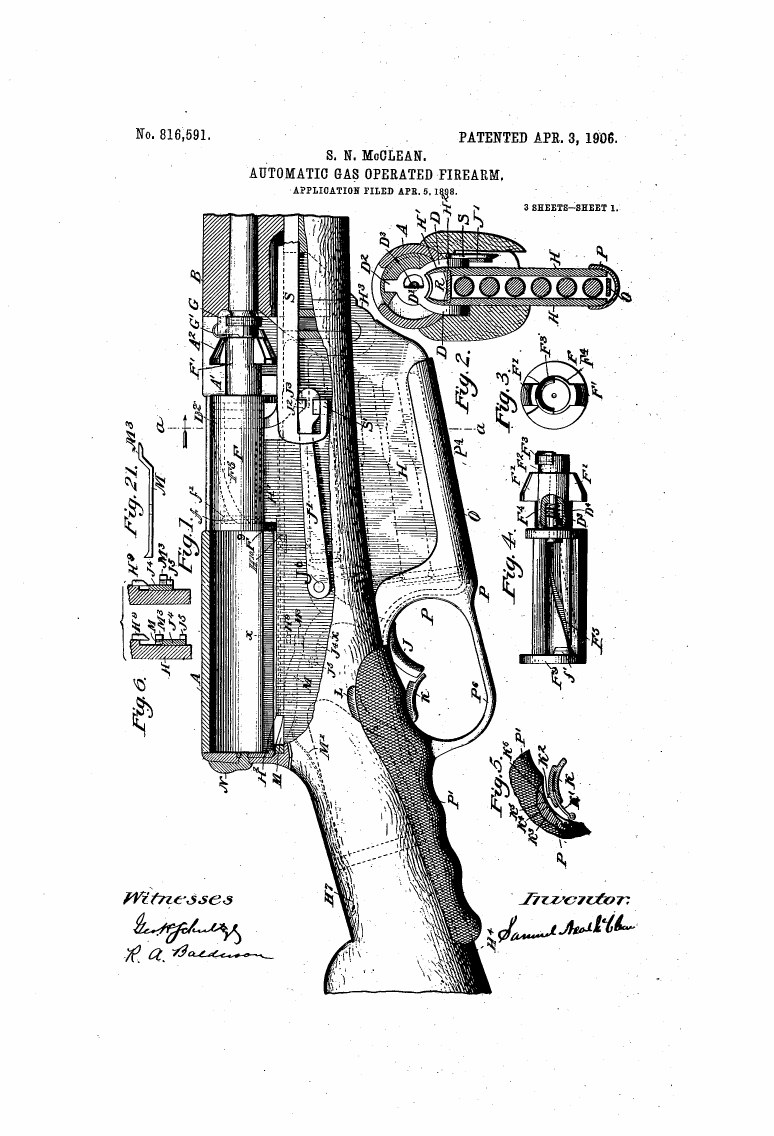
His 1906 patent opens: “Be it known that I, SAMUEL N. McCLEAN, a citizen of the United States, residing at Washington, in the county of Washington and State of Iowa, have invented certain new and useful Improvements in Breech-Loading and Discharge-Actuated Firearms.” The application was filed on 5 April 1898 and the patent, US 816,591, “Automatic gas-operated firearm”, was granted on 3 April 1906, assigned to the McClean Arms and Ordnance Company of Cleveland, Ohio.1 The specification’s stated aim is “a strong, light, cheap, simple, durable, accurate, and easily-manufactured discharge-actuated firearm”.
J. David Truby’s 1976 history, which was written from the Calfee family papers, Savage Arms records and other primary material, gives McClean’s background: born in Iowa on 7 January 1857, a medical degree from the University of Iowa in 1885, about eleven years in practice in Washington, Iowa, then Cleveland, where he founded the McClean Arms and Ordnance Company in 1900.3 Truby credits him with “forty-four U.S. and many foreign patents” by then. Ian McCollum of Forgotten Weapons gives the founding date as 1896 and the start of McClean’s firearms work as 1889.4 The two dates are given here side by side; neither source cites the incorporation record.
The company did not prosper. Truby records that McClean had lost financial control to his investors by 1906, that a group led by the financier Morris A. Bradley reorganised the management late in 1907, and that early in 1908 the company brought in two consultants: an ordnance salesman, Charles Dalley, and Isaac N. Lewis.3 A stockholders’ letter of 12 January 1910, quoted by Truby, says an ordnance expert had advised that the company “has little chance of doing business abroad unless a satisfactory air-cooled machine gun is produced”. By May 1910 the company’s property had been “foreclosed under chattel mortgages”, in the words of a letter from Henry W. Rudd reproduced in the book.
The US Navy’s official history of the machine gun, George M. Chinn’s The Machine Gun (Bureau of Ordnance, 1951), describes McClean’s gun as “better known as the McClean-Lissak automatic rifle”, after the Army officer Ormond M. Lissak who worked on it, and is blunt about its fault: “Having the basic principles for a reliable automatic machine gun, he added various other gadgets until the assembly was so overburdened it lost practically all value as a compact and efficient military weapon.” It was meant to be water- and air-cooled, tripod-mounted and detachable for shoulder firing, and was, in Chinn’s words, “too bulky for any specified purpose.”2
1.4 Isaac Newton Lewis
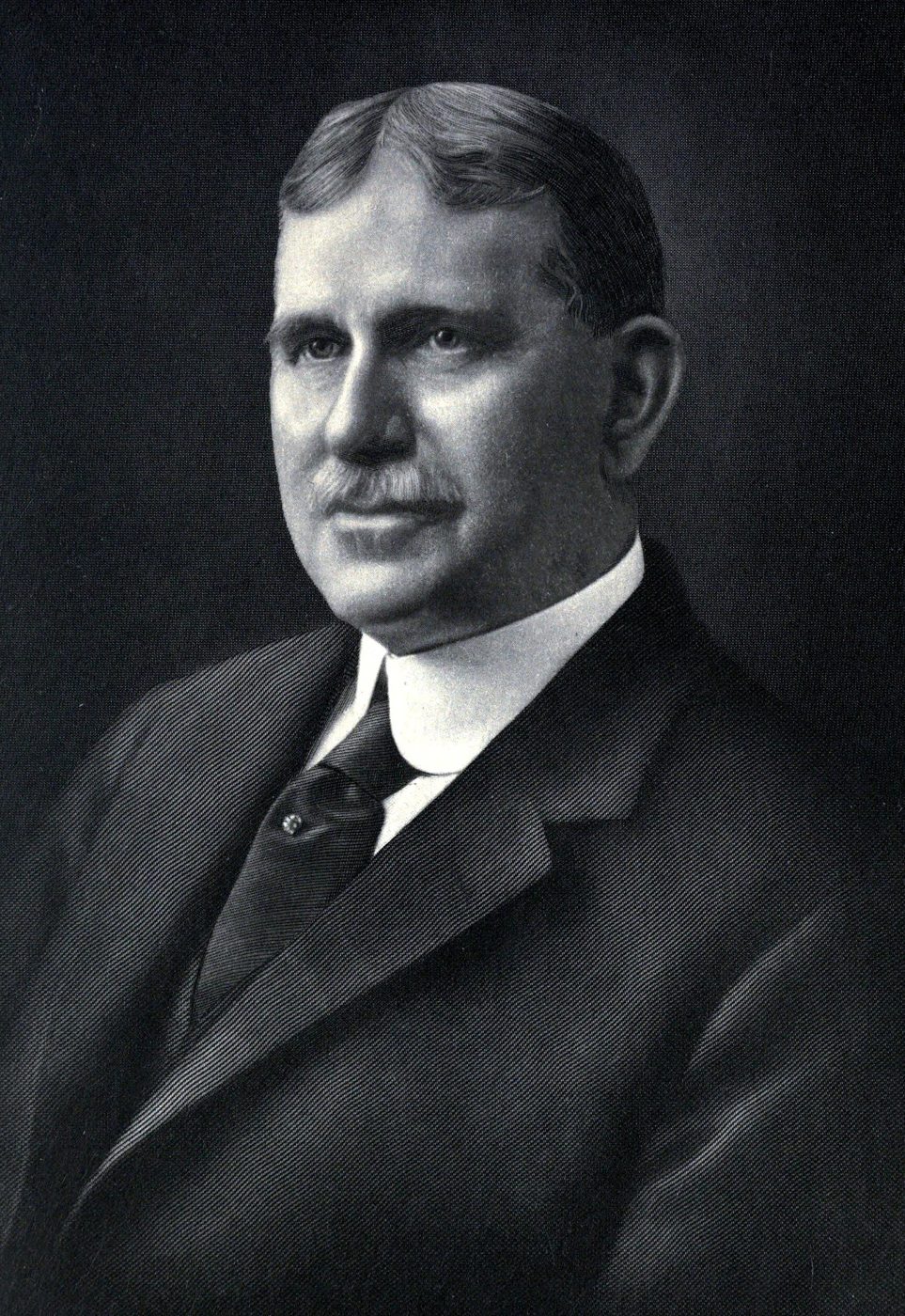
Isaac Newton Lewis was an artillery officer and a prolific inventor before he ever touched a machine gun.
The sources agree on his career and disagree on his birth year:
Table 1 — The sources agree on his career and disagree on his birth year
| Item | Chinn 1951 | Truby 1976 | Cyclopaedia of American Biography 1918 |
|---|---|---|---|
| Born | New Salem, Pa., 12 October 1858 | near New Salem, Fayette County, Pa., 12 October 1858 | New Salem, Pa., 12 Oct. 1848 |
| West Point | appointed from Kansas in 1880 “when 21 years of age”; graduated 11th of 37 in 1884 | entered 1880 after a competitive examination; 11th of 37 in 1884 | entered June 1880 as a cadet from Kansas; graduated June 1884 |
| Retired | as a colonel, after 25 years in the Coast Artillery | colonel 1913; retirement date 20 September 1913 | ”retirement as colonel in 1913” |
Sources: Chinn,2 Truby,3 Cyclopaedia.5 The Cyclopaedia’s 1848 would make Lewis a 31-year-old West Point cadet, and Chinn’s statement that he was appointed at 21 in 1880 fits 1858. On the internal arithmetic, 1858 is the better figure; the 1848 is recorded here because it appears in a standard reference of the period.
Before the gun, Lewis designed the first successful artillery range and position finder while stationed at Fort Leavenworth in 1888 and 1889, served as recorder of the Board of Ordnance and Fortification from 1898 to 1902, and directed the Coast Artillery School at Fort Monroe from 1904 to 1911.5 The Cyclopaedia also credits him with a self-regulating dynamo used in railway car lighting. Truby documents a long and public feud with Brigadier General William Crozier, Chief of Ordnance, which matters to what follows; he says Crozier called the Lewis gun “Lewis’ military mower”.3
The Cyclopaedia states the idea behind the gun in one sentence: “His conception of the gun was the result of his observation that a gun was needed that would bridge the gap between the soldier’s rifle and the heavy machine gun.”5
1.5 The Automatic Arms Company and the redesign
The McClean patents passed to a new company. Chinn: “At the time of the firm’s organization Samuel Neal McClean assigned to it all patent rights to his machine gun”.2 The firm was the Automatic Arms Company. Chinn and Lewis’s own 1915 patent place it in Buffalo, New York; Truby’s narrative places the reorganisation among the Cleveland investors, under the attorney Robert M. Calfee.263
Truby reproduces Lewis’s agreements with the company and reports one clause in particular: Lewis “had the Article of Agreement specifically exclude air-cooled automatic machine guns from the section which directed him to turn all patents over to the company”, in exchange for 150 shares valued at $100,000.3 Truby dates the agreement 12 September 1910 in one place and describes a 1 September 1910 assignment of the air-cooled gun’s patent rights to the company in another; they may be two documents, and the book does not reconcile them.
The redesign began badly. Truby quotes Lewis on the first trial of a McClean gun fitted with his aluminium cooling jacket: “I fired only about sixty shots before it heated up.” The idea, Lewis wrote, was fine; the gun was wrong, and needed redesign. A second attempt stopped after about forty rounds; Lewis found “the multiple holes in the barrel were sucking away the gas and not allowing it to blast open the action”, and concluded that the McClean gun would have to be redesigned more thoroughly than he had planned. The machinist O. A. Huberty, formerly McClean’s, did the shop work.3
The result was shown privately in 1911. Truby and Chinn agree that Lewis demonstrated a hand-made prototype to Major General Leonard Wood, Chief of Staff, in 1911, and then had four more guns made; Chinn adds that they were fired before the Secretary of War and senior officers at the Fort Myer range, and that all were chambered for the US .30-06 cartridge. Truby says the four were made “under a special arrangement with the Savage Arms Company” at $1,200 a gun.23
1.6 The patent: a spring kept out of the heat
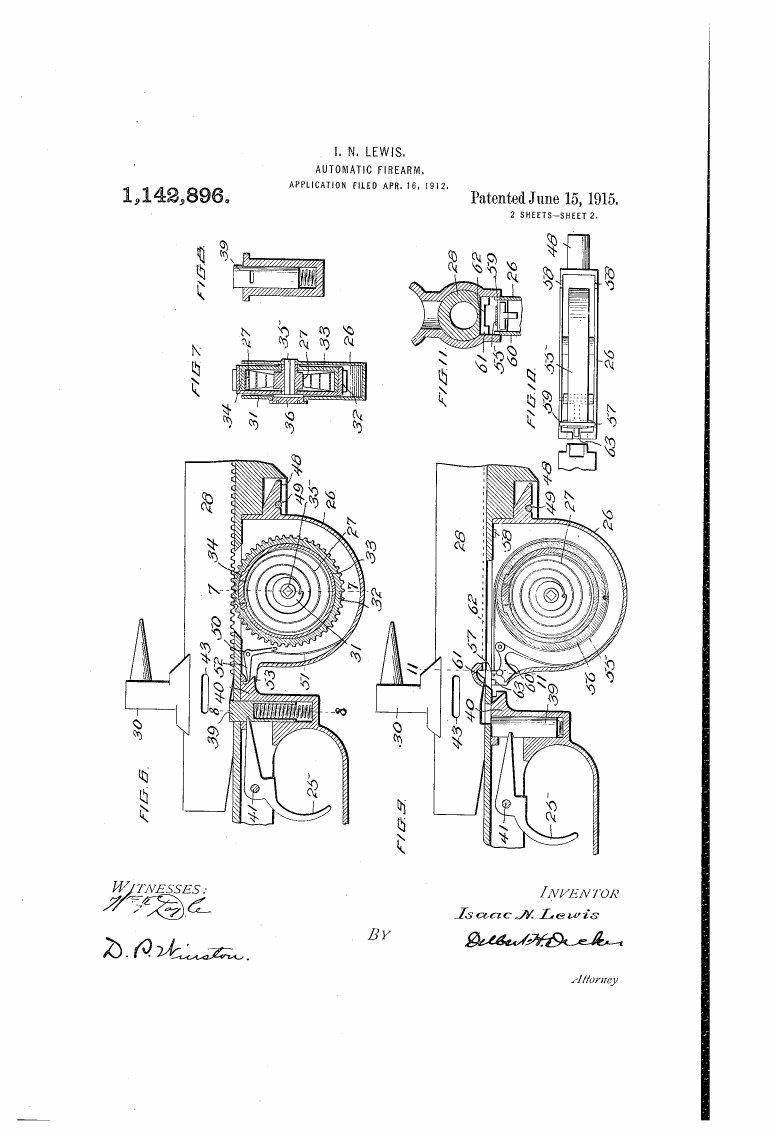
Lewis’s principal US patent for the gun is US 1,142,896, “Automatic firearm”, filed 16 April 1912 and granted 15 June 1915, assigned to “the Automatic Arms Company, of Buffalo, New York”.6 (Truby reproduces the drawing and reads the filing date as 10 April; the patent’s own heading says 16 April.)
The specification explains the single most distinctive feature of the gun, the clock spring, and why it is there:
“In gas-operated guns heretofore designed the mainspring—the spring in which one discharge stores power for the next—has usually been located in the gas cylinder around the rod of the gas-driven piston. As such gas cylinder parallels the gun barrel for the greater portion of the length of the barrel the spring is directly in the heated zone and quickly deteriorates from the effect of the heat. The present invention replaces that sort of spring by a small convolute spring located to the rear of the gun barrel entirely out of the heated zone.”6
The spring is “preferably so formed as to give practically a constant pull throughout each action thereof”, which the patent achieves “by gradually narrowing the spring while maintaining the same thickness”. A rack cut on the piston rod meshes with teeth on the spring drum, so the gas stroke winds the spring and the spring, unwinding, “furnishes alone the full power for operating the firing mechanism”. The patent drawing shows the gun on a tripod with the rotary magazine.
Chinn credits Lewis’s own contributions as “the cooling jacket, the clock-type spring and the rate-of-fire regulator”.2 Volume 3 explains each.
1.7 College Park, 7 June 1912
The 1912 aeroplane firing is the best-documented single event in the gun’s American story, and two of the dates in print for it are wrong.
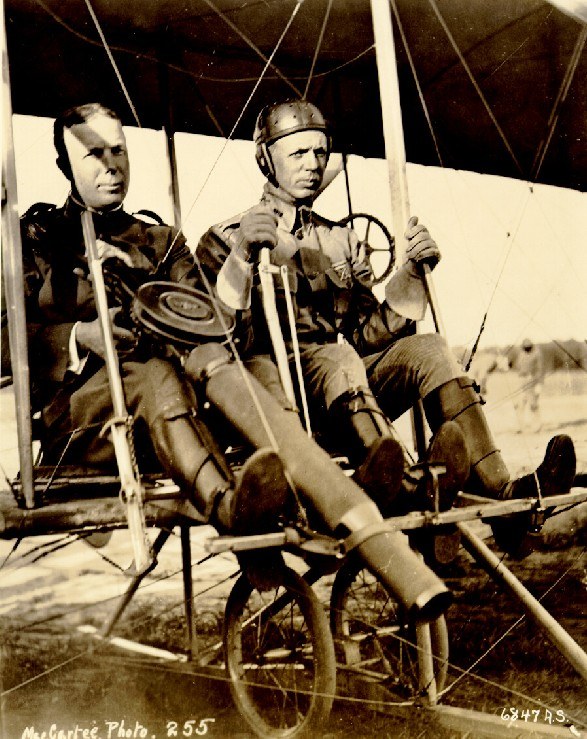
Chinn’s account: Lewis, with “no introduction other than his rank”, proposed an air firing to Captain Charles DeForest Chandler, commanding the Signal Corps flying school at College Park, Maryland, who offered to fire it himself. The gun “weighed 25 pounds, 6 ounces, and was chambered for the caliber .30/06” cartridge, with the ammunition in “a circular drum that slipped over a post on top of the receiver”. Its rate of fire “was given as well above 750 rounds per minute”, but for the trial Lewis slowed it by “putting unusual tension on the return spring” to about 500 a minute. Lieutenant Thomas DeWitt Milling flew three passes at 250 feet over a cheesecloth target six by seven feet; examination showed five hits.2
The date is 7 June 1912. The photograph’s own record on Wikimedia Commons is dated 7 June 1912, and the 1918 Cyclopaedia says “in June, 1912”.75 Truby’s text also gives 7 June, but a caption in the same book says “7 May 1912”, and the same caption names the other officer in the photograph “Lt. Roy T. Kirkland”; he was Roy Kirtland.3
1.8 The Board of Ordnance and Fortification
What happened next is usually told as a personal feud: Crozier against Lewis. Chinn, writing for the Navy, prints the Army’s side of it in full: a memorandum by Crozier as Chief of Ordnance, dated 17 June 1916, by which time, on Chinn’s count, 40,000 Lewis guns had already been in Allied service. Its record of the dealings is:2
Table 2 — The Board of Ordnance and Fortification
| Date | Event (Crozier memorandum, 17 June 1916) |
|---|---|
| 2 May 1912 | Automatic Arms Company letter offers “an air-cooled, gas-operated, automatic machine gun” and asks for a field test; Calfee and Huberty show it to the Board |
| 3 and 6 May 1912 | firing demonstrations at Fort Myer |
| 6 June 1912 | the Board will not accept the company’s proposed test; it offers “the tests usual for guns of this class under the Ordnance Department, including a field test” |
| 2 July 1912 | on reconsideration, the Board insists the gun “must be submitted to a technical test by the Ordnance Department”; firings at College Park “will have no weight whatever until the technical tests have demonstrated the structural efficiency of the gun” |
| 5–6 March 1913 | the company asks for a competitive test by officers of the several arms; the Board agrees, including tests “from airships” and against them |
| 15 September 1913 | the competitive board meets at Springfield Armory |
In January 1913, in the middle of that sequence, Lewis sailed for Europe with the four guns. Chinn says he was annoyed by “a strictly negative attitude”; Crozier’s memorandum shows the Ordnance Department equally annoyed at being unable to get a gun to test.23 Both accounts can be true. The gun that went to Springfield in September 1913 was not one of the American prototypes but “one of two model guns manufactured in England”, presumed by the Ordnance Department to be by the Birmingham Small Arms Company, because tools and gauges had been shipped to Lewis there in July.2
1.9 Springfield, September 1913: the numbers
The 1913 board tested seven makes of automatic gun. In the endurance test the Lewis recorded:2
Table 3 — Springfield, September 1913: the numbers
| Gun | Jams and malfunctions | Broken parts | Parts replaced, not broken |
|---|---|---|---|
| Lewis | 206 | 35 | 15 |
| Vickers rifle-calibre gun, light model | 23 | 0 | 0 |
| Benét-Mercié automatic machine rifle, M1909 (the service gun) | 59 | 7 | 0 |
The board’s conclusion, quoted by Crozier: “the Lewis Automatic Machine Rifle, as at present designed, is not considered superior to the service automatic machine rifle, on account of failure to maintain continuous fire, the large number of parts that were broken, and the large number of jams, many of the latter being reduced only after much difficulty and considerable time.” The Lewis was not given the field test; the Vickers was adopted.2
These are the figures behind the rejection that Lewis’s admirers, then and since, have attributed to spite. Whatever Crozier felt about Lewis, the gun the board saw in 1913 failed its endurance test by a wide margin.
1.10 Why it failed: Chinn’s explanation
Chinn offers a mechanical explanation, “brought to light years later”, which turns on one dimension. In the Lewis the barrel and receiver are fixed together so that the gas port lines up with the cylinder, so headspace cannot be adjusted by screwing the barrel; the remaining variables were the angle of the cam on the bolt and the length of the straight part of the cam slot, which lets the piston run back before unlocking begins.2
- In the early guns that straight “free movement” was 0.875 inch. Unlocking began while residual pressure in the barrel was still too high, the bolt “withdrew its support from the base of the cartridge”, cases stuck or ruptured, and the parts were overstrained, “a parts breakage that was all out of proportion”.
- After British and Belgian officers objected to the rate of fire, the straight portion was lengthened to a “dwell” of 1.0625 inches, which with a fixed gas orifice of .130 gave “an average rate of fire of around 600 shots per minute” and “the smoothest performance”. Chinn suggests the change may have been made by BSA when the drawings were converted, and that Lewis “did not even know of it”; he offers this as a possibility, not a finding.
- The Savage-built .30-06 guns, “basically the same as the unsuccessful earlier models with the exception of the added dwell”, “stood the test”.
The 1.0625-inch figure is consistent with the Savage handbook, which describes a first stage of rearward travel in which “the striker post moves back through the longitudinal part of its cut in the bolt” while “the bolt itself remains in its locked position and does not move”; the fraction printed in the surviving scan of the handbook is illegible, so the handbook cannot be quoted for the number.8
1.11 Who designed the Lewis gun?
The honest answer has two parts, as with the MP 40 and Schmeisser in this hub’s MP 40 Volume 2.
- The operating principle came with the McClean patents. Chinn: “the basic operating principles were already the property of the Automatic Arms Co. before Lewis became a member of the firm in late 1910.”2 The gas-operated, rotating-bolt layout was McClean’s.
- The gun that worked was Lewis’s. Chinn again: Lewis “redesigned, assembled, refined, and, in some features, created” it, and the cooling jacket, the clock spring outside the heated zone and the rate regulator were his.2 His 1912 patent claims the spring arrangement in his own name.
McClean contested it. Truby reports that in 1920 McClean sued Bradley, Calfee and others, claiming the transfer of his patents had been fraudulent; Lewis testified as a witness in March 1922, the court decided against McClean, and in 1924 the Circuit Court of Appeals rejected his claims.3 Forgotten Weapons states that “the issue was settled out of court”.4 The case citation could not be found for this volume, so which account is right is left open.
1.12 What could not be established
- The McClean company’s founding date: 1900 (Truby) or 1896 (Forgotten Weapons). Neither cites a record.
- The McClean lawsuit: court, docket and outcome are from Truby alone; a second source says it was settled out of court.
- Lewis’s agreements with the Automatic Arms Company: Truby gives both 1 September and 12 September 1910 without reconciling them.
- Whether BSA, not Lewis, lengthened the dwell: Chinn’s suggestion only.
- The Savage handbook’s free-travel fraction: illegible in the only scan located.
References
Footnotes
-
Samuel N. McClean, “Automatic gas-operated firearm”, US Patent 816,591, filed 5 April 1898, granted 3 April 1906, assignor to the McClean Arms and Ordnance Company, Cleveland, Ohio. https://patents.google.com/patent/US816591A/en, consulted 2026-10-19. ↩ ↩2
-
George M. Chinn, The Machine Gun, vol. I, Part IV, chapter 1 (Washington: Bureau of Ordnance, Department of the Navy, 1951), including the Chief of Ordnance’s memorandum of 17 June 1916 printed verbatim. HyperWar transcription, https://www.ibiblio.org/hyperwar/USN/ref/MG/I/MG-4.html, consulted 2026-10-19. ↩ ↩2 ↩3 ↩4 ↩5 ↩6 ↩7 ↩8 ↩9 ↩10 ↩11 ↩12 ↩13 ↩14 ↩15 ↩16
-
J. David Truby, A Pictorial History of the Lewis Gun (Boulder: Paladin Press, 1976). Internet Archive, https://archive.org/details/lewis-gun-paladin, consulted 2026-10-19. ↩ ↩2 ↩3 ↩4 ↩5 ↩6 ↩7 ↩8 ↩9 ↩10 ↩11 ↩12
-
Ian McCollum, “Before the Lewis Gun was the McClean Automatic Rifle”, Forgotten Weapons, https://www.forgottenweapons.com/before-the-lewis-gun-was-the-mcclean-automatic-rifle/, consulted 2026-10-19. ↩ ↩2
-
The Cyclopaedia of American Biography, new enlarged edition of Appleton’s, ed. J. G. Wilson, J. Fiske, C. Dick and J. E. Homans, vol. VIII (New York, 1918), p. 98, “LEWIS, Isaac Newton”. Internet Archive, https://archive.org/details/cyclopaediaofame08wilsuoft, consulted 2026-10-19. ↩ ↩2 ↩3 ↩4
-
Isaac N. Lewis, “Automatic firearm”, US Patent 1,142,896, filed 16 April 1912, granted 15 June 1915, assignor to the Automatic Arms Company, Buffalo, New York. https://patents.google.com/patent/US1142896A/en, consulted 2026-10-19. ↩ ↩2 ↩3
-
“ChandlerKirtlandLewisGun.jpg”, Wikimedia Commons, photograph by MacCartee dated 7 June 1912, https://commons.wikimedia.org/wiki/File:ChandlerKirtlandLewisGun.jpg, consulted 2026-10-19. ↩
-
Savage Arms Corporation, Hand-Book of the Lewis Machine Gun, Model 1918, Caliber .30 (Utica, N.Y., c. 1918), p. 28. Scan hosted by Forgotten Weapons, https://www.forgottenweapons.com/wp-content/uploads/Lewis/lewismanual.pdf, consulted 2026-10-19. ↩

Comments (0)