Lewis Gun · Volume 5
After 1918: Small Armies, the Home Guard, Small Ships and the Type 92
The War Office's verdict of 1929, the Bren, the Lewis guns brought back in 1940 for the Home Guard and the coasts, the US Navy's guns at war again in 1941–42, and the Japanese copy
5.1 Between the wars
The Lewis came out of the First World War in the hands of most of the Allied armies and several small ones, and it stayed there. Chinn: “it was the favorite infantry arm for many smaller countries long after the major powers sought to replace it with a more efficient weapon.” He records that the United States Marines used it “in the Nicaragua campaign”, that “The Norwegians made it under license in a 6.5-mm caliber and it is the only light machine gun definitely known to be used by their army”, and that “Japan produced it under the designation Models 1929 and 1932.”1 The Netherlands had a 6.5 mm model of its own, the M.20 (Volume 4).2 Truby’s photographs place Lewis guns with Dutch, Portuguese, Belgian, Hong Kong volunteer and Palestine police units through the 1920s and 1930s, and on aircraft into the 1930s, including early power-operated turrets.3
The aircraft role lasted longest. Because an open-bolt gun cannot be synchronised to fire through a propeller (Volume 2), the Lewis was the observer’s free gun, and Truby illustrates it in that role in British, American, French, Italian, Soviet and Japanese aircraft between the wars.3
5.2 The replacement
The British Army’s own assessment, written in 1929, is the plainest statement of why the Lewis was replaced. The Textbook of Small Arms 1929: with light machine guns now issued at two a platoon and pushed forward to pin the enemy while rifle sections manoeuvred, “For this purpose the Lewis gun has two disadvantages, its weight is too great and it is too liable to stoppages. Consequently a new problem has arisen, that of the production of a weapon which shall be of lighter weight and increased reliability, and yet equal in accuracy and in volume of fire to the Lewis.”4
The answer was the Bren. The Imperial War Museum’s label for its Lewis gun says it “was replaced by the Bren Gun in 1938”, and that “the Lewis saw limited use during the Second World War.”5 Pridham, writing in November 1940 for a much wider audience than the Army, describes the Lewis’s continuing users: “any sailor, soldier, airman-gunner, or A.A. gunner of the Mercantile Marine or Mine-Sweeping Flotillas, Auxiliary Military Pioneer Corps, and The Home Guard”.6
5.3 1940: the Lewis comes back
After Dunkirk the British Army had left much of its equipment in France, and the Lewis came back into service in numbers. The sources give the size of the return in figures that cannot be reconciled:
Table 1 — After Dunkirk the British Army had left much of its equipment in France, and the Lewis came back into service in numbers. The sources give the size of the return in figures that cannot be reconciled
| Figure | What it counts | Source |
|---|---|---|
| ”80,000 Lewis guns were purchased by England from the United States and other friendly powers” | after Dunkirk | Chinn 19511 |
| ”some 80,000 of them were ready to meet the Germans” | taken out of storage for the Home Guard | Truby 19763 |
| ”an emergency shipment of 1,157 Lewis guns”, then “an additional 45,880 Lewis guns … valued at $1,630,249.60” | released under Lend-Lease | Truby 19763 |
Chinn’s 80,000 are purchased; Truby’s are brought out of storage. They may be the same 80,000 described two ways, or two different numbers. Truby’s Lend-Lease figures, to the cent, suggest a document, but he does not name it. Neither is checked against a British or American government record here.
5.4 What the Home Guard got
The one point the primary source settles is what the American guns looked like. Pridham’s 1940 edition added “notes on the .300 (American) Lewis Gun” and says: “The .300 (American type) Lewis Gun—as issued to the Home Guard—has no Radiator or Radiator Casing, and is therefore similar in appearance to the Lewis Gun as used by the R.A.F.”6 In other words, the guns that came from the United States in 1940 were aircraft guns, and the Home Guard used them on the ground. Pridham’s notes on the differences of the .300 gun, the cocking handle on the left, the four-hole gas regulator, the gas chamber gland and the sear spring, are in Volume 3 and Volume 4.
Two problems followed from that, and Pridham’s book addresses both by implication. A .30-06 gun had to be kept away from .303 ammunition, and an aircraft gun had no butt, bipod or radiator. How the British marked and converted these guns, and the mark numbers they received, are described in the secondary literature but were not found in a primary source for this dive (Volume 4, “The British marks”). The widely repeated statement that .30-calibre weapons in British service were marked with a painted red band was likewise not traced to a primary source and is not relied on here.
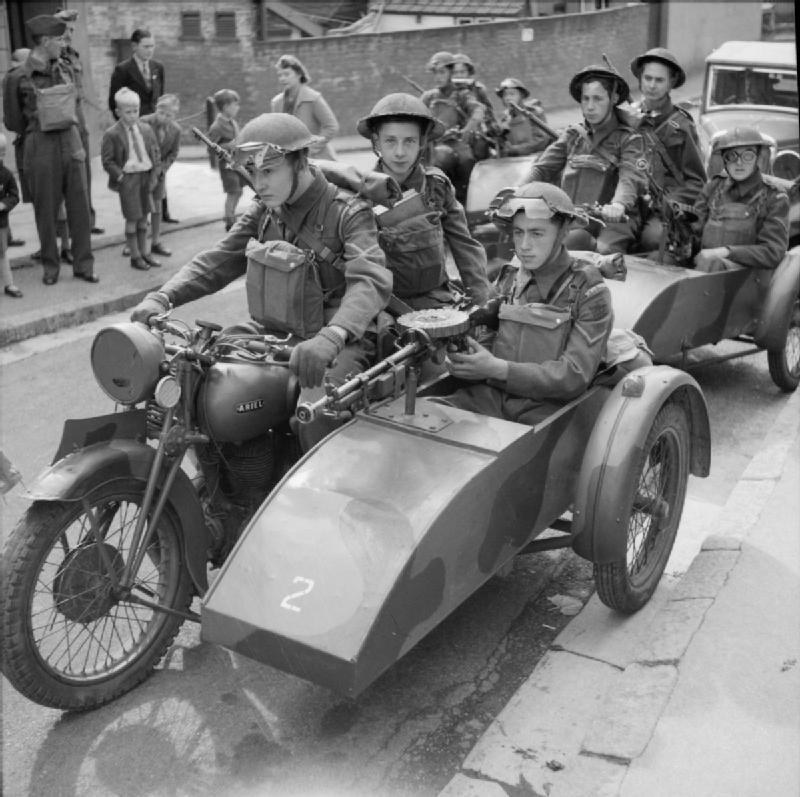
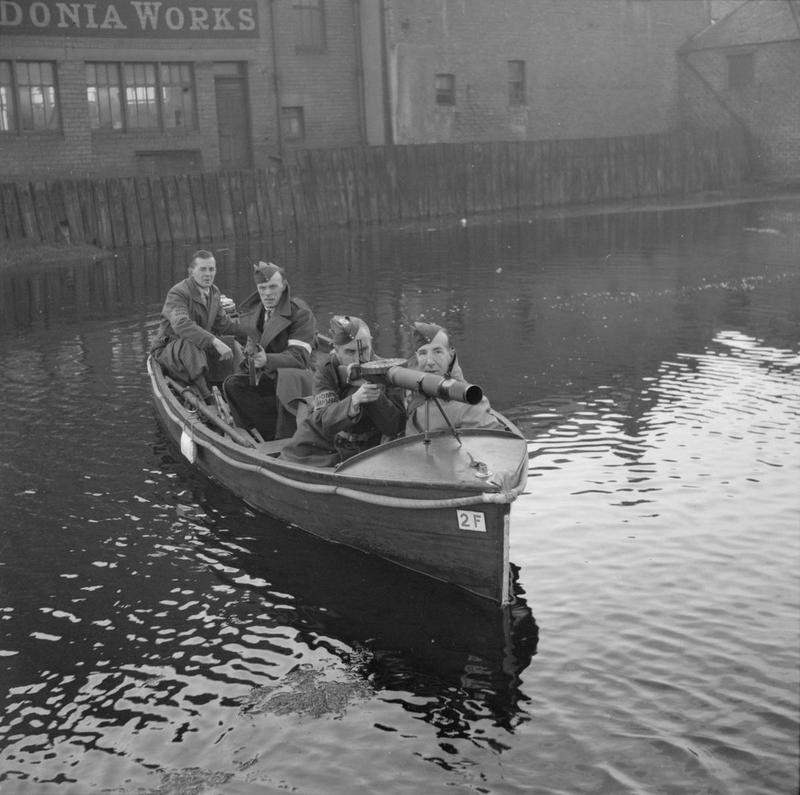
The War Office’s own photographs show the Home Guard’s Lewis guns in use: on sidecars, as in the photograph above; on canal patrol boats in Edinburgh; and carried to the ranges at the Altcar training camp in September 1940.78
5.5 Ships, boats and airfields
The second great user was at sea. Pridham’s list of readers, “the Mercantile Marine or Mine-Sweeping Flotillas”, reflects it. Merchant ships defended themselves against aircraft with what could be found, and the Lewis on a pillar mounting was one of the commonest answers; the Commons collection of wartime official photographs records Lewis guns on destroyers, motor torpedo boats, submarines and coast-watch posts.9
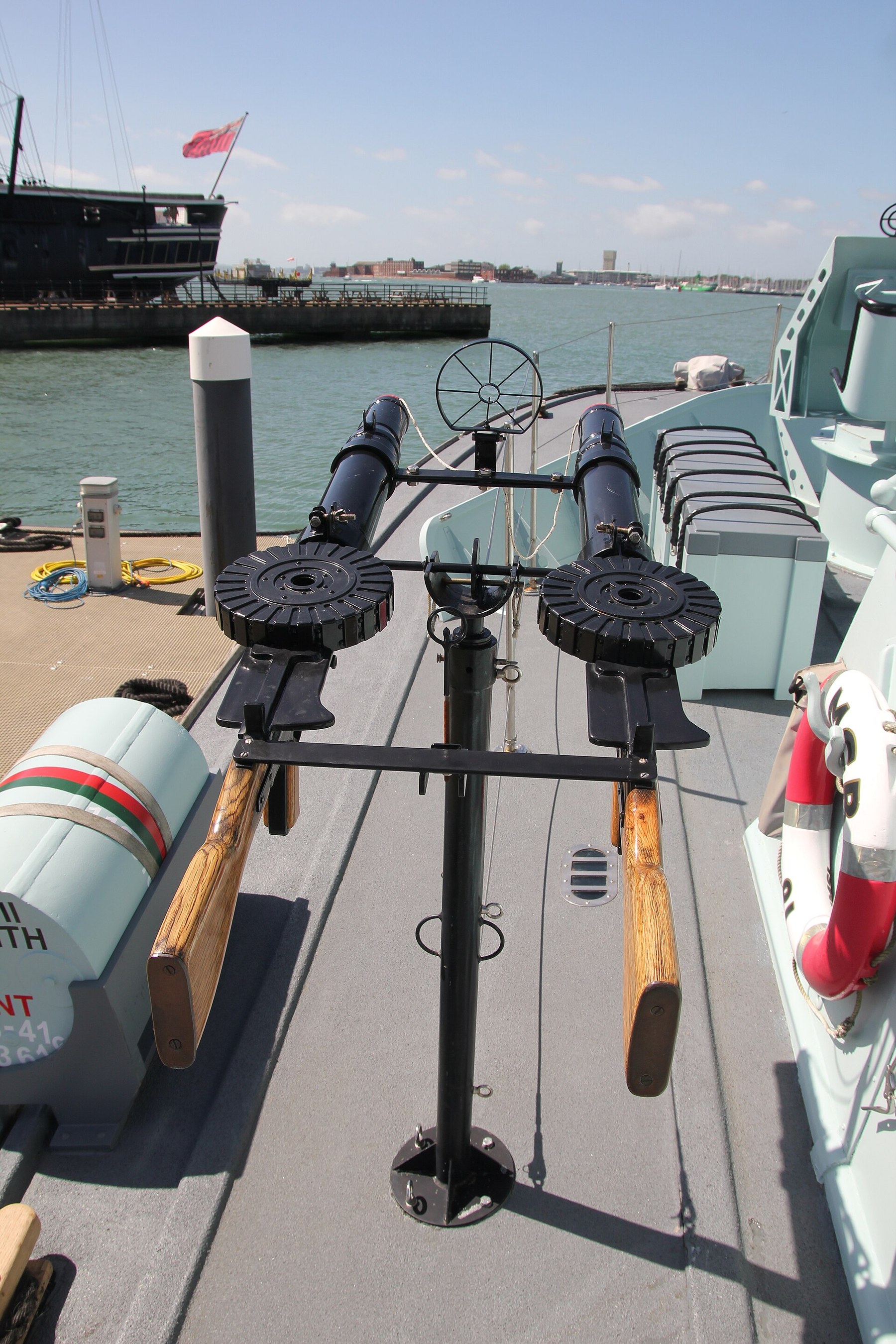
The Royal Air Force Regiment and airfield defence units used it as a light anti-aircraft gun for the same reason: it was available, it was light, and the aircraft pattern already came on mountings that let it point upward.9 No total for Lewis guns in naval or airfield service was located.
5.6 The United States, 1941–42
Chinn: “when the Japs struck at our fleet on 7 December 1941, the first pictures rushed back from Hawaii showed the old reliable Lewis being used as a makeshift antiaircraft gun.”1
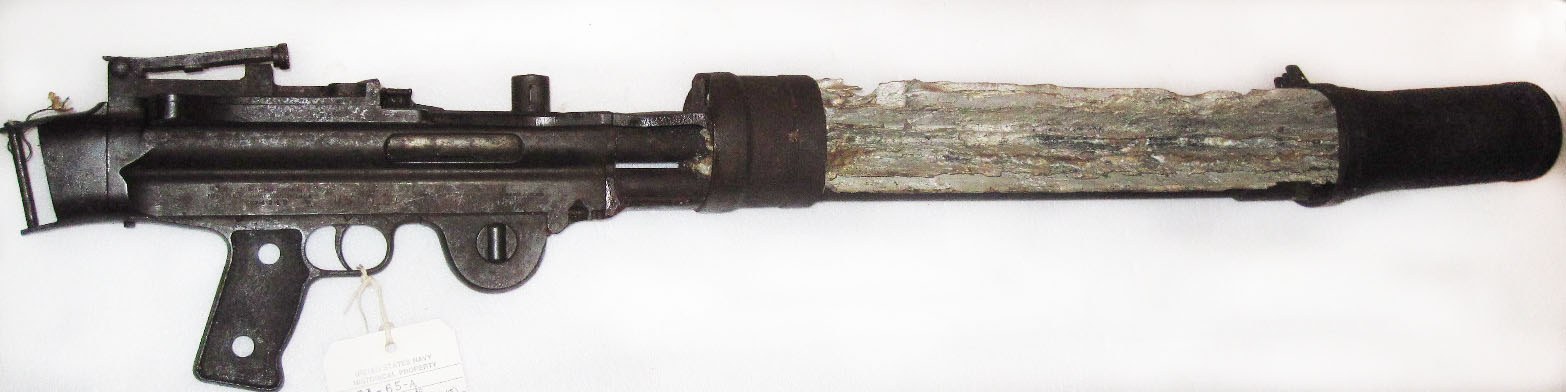
One surviving American gun records the period. The Naval History and Heritage Command holds a .30-calibre Lewis, accession 61-65-A, recovered as a relic from the destroyer USS Peary (DD-226), “sunk on the 19th of February 1942 after a Japanese air attack” at Darwin, with the loss of 80 men.10
Truby adds Coast Guard cutters with Lewis guns in 1942 and says “A few remained on U.S. Coast Guard ships, through 1946”; he also says the US gunboat Panay, sunk by Japanese aircraft in 1937, was armed with Lewis guns.3 These are from his captions and are not checked here.
5.7 Japan: the Type 92 in the Pacific
The Japanese Navy’s Lewis was the Model (Type) 92 of 1932, which the US War Department’s 1944 handbook describes as “a duplicate of the British Lewis” except for a cocking handle fixed on the left (Volume 4).11 It was used in two roles. As a flexible gun in multi-seat aircraft it appears in Truby’s sources on the Mitsubishi B2M torpedo bomber, with “a flexible Lewis gun … 7.7mm (Japanese Type 92)”.3 On the ground it was a tripod-mounted gun that could be converted to anti-aircraft use “in approximately 15 seconds”.11
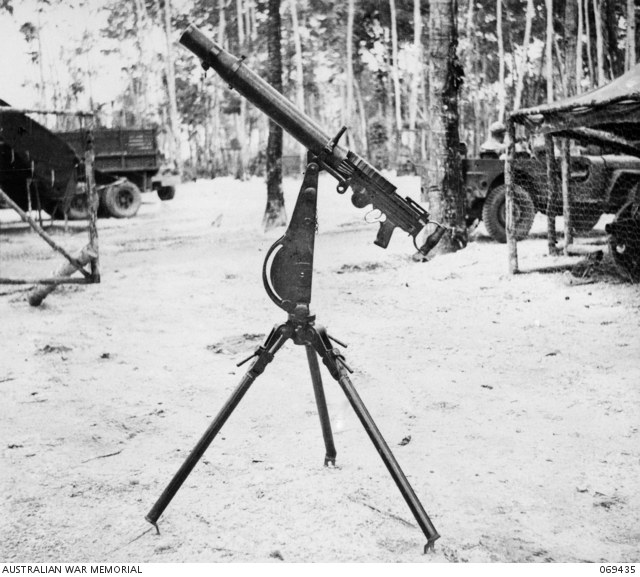
Its ammunition was the 7.7 mm rimmed round, “Japanese copy of British 0.303”, and the handbook says British Mark VII ball would also fire in it, so captured British stocks were usable.11 The same handbook warns that the Japanese 7.7 mm rimless round of the Type 99 and the semi-rimmed round of the Model 92 heavy machine gun, a different gun, are not interchangeable in the Type 99.11 Two different Japanese guns called “Type 92” in 7.7 mm is a frequent source of confusion: the handbook lists the Model 92 heavy machine gun and the Model 92 Lewis-type as separate weapons, and only the second is a Lewis.
5.8 The long tail
Truby lists later Lewis users: the Haganah in 1947–48, Israeli reserve and police units “by 1956”, and sightings in Biafra in 1969, Vietnam and Northern Ireland.3 Wikimedia Commons holds a category of photographs of the Lewis in Israeli service, and the Batey ha-Osef museum in Tel Aviv displays both ground and aircraft guns.12 The later sightings rest on Truby’s prose alone and are not repeated as fact.
5.9 What could not be established
- How many Lewis guns came back into British service in 1940, and from where: Chinn’s 80,000 purchased against Truby’s 80,000 from storage and 47,037 under Lend-Lease.
- The British conversion of the American aircraft guns for ground use, and their marks, from a primary document.
- The red-band marking of .30-calibre weapons: widely stated, not traced.
- The Japanese Type 92’s production numbers: no source found.
- Post-1948 use: Truby only.
References
Footnotes
-
George M. Chinn, The Machine Gun, vol. I, Part IV, chapter 1 (Bureau of Ordnance, 1951). https://www.ibiblio.org/hyperwar/USN/ref/MG/I/MG-4.html, consulted 2026-10-19. ↩ ↩2 ↩3
-
Heereswaffenamt, D 50/2 Kennblätter fremden Geräts, sheet 100 (h), 1 May 1944. https://commons.wikimedia.org/wiki/File:D50-2_Nr_100_(h)_(1944-05-01).png, consulted 2026-10-19. ↩
-
J. David Truby, A Pictorial History of the Lewis Gun (Paladin Press, 1976), “The Last Shots” and photograph captions. https://archive.org/details/lewis-gun-paladin, consulted 2026-10-19. ↩ ↩2 ↩3 ↩4 ↩5 ↩6 ↩7
-
War Office, Textbook of Small Arms 1929 (HMSO), introduction to machine guns. https://archive.org/details/textbooksmallarms1929, consulted 2026-10-19. ↩
-
Imperial War Museums, “Gun, Lewis, .303 inch [2nd issue]”, FIR 9220, label. https://www.iwm.org.uk/collections/item/object/30034920, consulted 2026-10-19. ↩
-
Major C. H. B. Pridham, Lewis Gun Mechanism Made Easy, 6th edition (Gale & Polden, November 1940), preface and p. 13. https://www.forgottenweapons.com/wp-content/uploads/Lewis/Lewis%20Gun%20Mechanism%20Made%20Easy.pdf, consulted 2026-10-19. ↩ ↩2
-
War Office official photographer, “The Home Guard, 1940”, IWM H 4937, 19 October 1940, via Wikimedia Commons. https://commons.wikimedia.org/wiki/File:The_Home_Guard,_1940_H4937.jpg, consulted 2026-10-19. ↩
-
Lt E. A. Taylor, War Office official photographer, “The Home Guard, 1940”, IWM H 4058, 11 September 1940, via Wikimedia Commons. https://commons.wikimedia.org/wiki/File:The_Home_Guard,_1940_H4058.jpg, consulted 2026-10-19. ↩
-
Wikimedia Commons, “Category:Lewis guns on anti-aircraft mounts” (wartime official photographs, including Royal Navy A-series, RAF CH- and C-series, and War Office H-series). https://commons.wikimedia.org/wiki/Category:Lewis_guns_on_anti-aircraft_mounts, consulted 2026-10-19. ↩ ↩2
-
Naval History and Heritage Command, “61-65-A Machine Gun, Cal 30, US, Lewis”, relic from USS Peary (DD-226), via Wikimedia Commons. https://commons.wikimedia.org/wiki/File:61-65-A_MACHINE_GUN_CAL_30,_US,_LEWIS_(5246920428).jpg, consulted 2026-10-19. ↩
-
US War Department, Handbook on Japanese Military Forces, TM-E 30-480 (1 October 1944), chapter IX, section II, 2. https://lonesentry.com/manuals/handbook-japanese-military/japanese-machine-guns.html, consulted 2026-10-19. ↩ ↩2 ↩3 ↩4
-
Wikimedia Commons, “Category:Lewis machine gun in Israeli service”. https://commons.wikimedia.org/wiki/Category:Lewis_machine_gun_in_Israeli_service, consulted 2026-10-19. ↩


Comments (0)