Lewis Gun · Volume 4
Models, Marks and Markings: Telling One Lewis From Another
Ground guns and aircraft guns, BSA and Savage, .303 and .30-06, the British marks, the Japanese Type 92 and the Dutch M.20, with photo plates, the markings that identify a maker, and a table
4.1 Two families: ground guns and aircraft guns
Every Lewis gun belongs to one of two families, and the difference is visible at a glance.
- Ground guns carry the fat cylindrical radiator casing, open at both ends and tapering past the muzzle, with the aluminium finned radiator inside it. They have a wooden butt (or a spade grip for confined positions), a pistol grip, a bipod or tripod fitting, and the 47-round pan.
- Aircraft guns have no radiator. The RAF’s 1918 notes: “In the aerial gun the casing is in one piece, known as the Barrel Casing. There is no radiator, and the casing is of smaller diameter, except at the rear end.”1 They have a spade grip at the rear, often a canvas or metal bag or chute for empty cases, a ring sight and a wind-vane foresight, and usually the larger pan.
Within each family, the maker, the calibre and the markings sort the rest. Most guns can be identified from three things: the barrel casing, the cocking handle side, and the stampings on the top of the body.
4.2 The plates
All the photographs below are reproduced at the width of the plate, so the guns are not at a common scale; the ground guns are around 50 to 51 inches long (Volume 3 gives the figures by source).
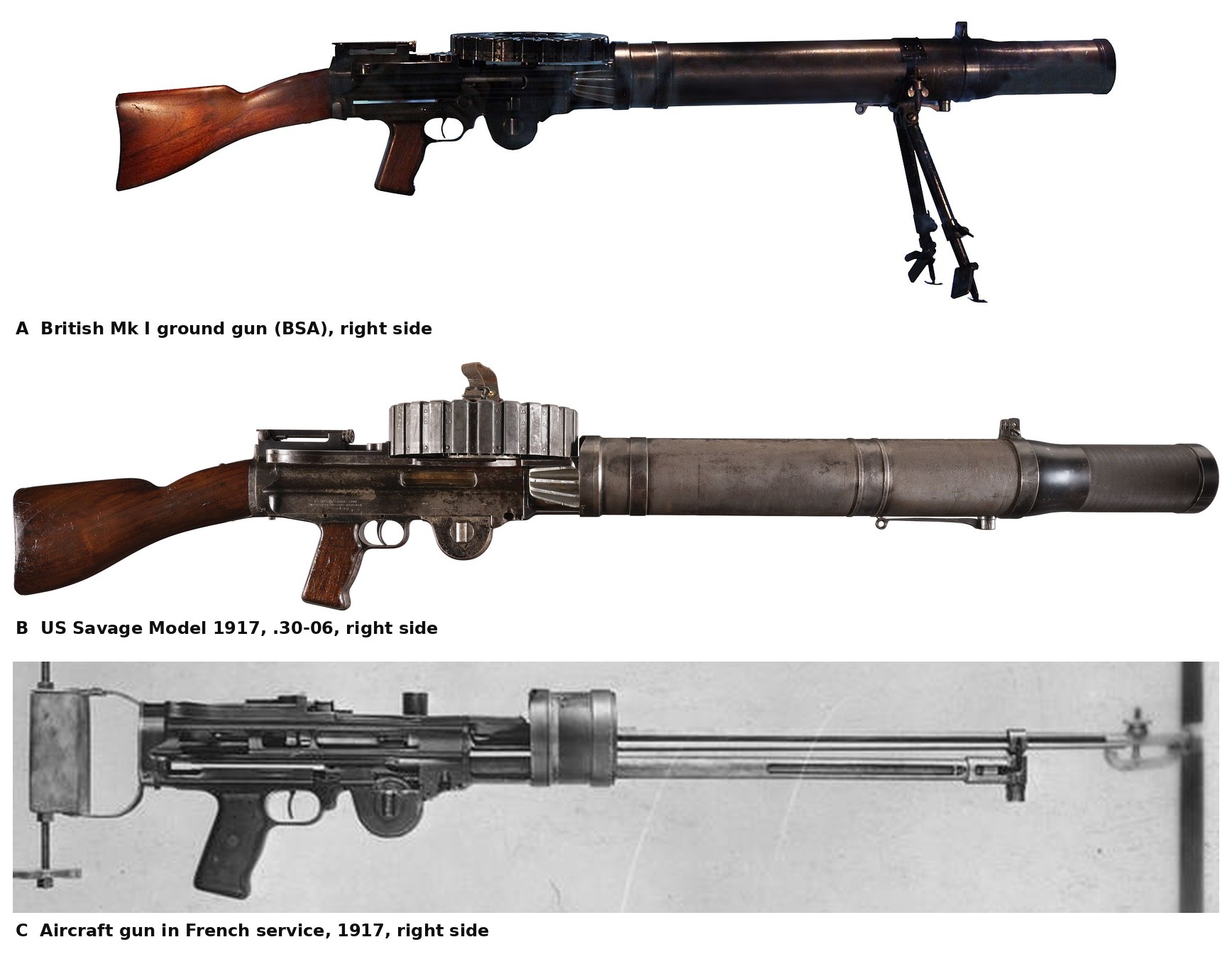
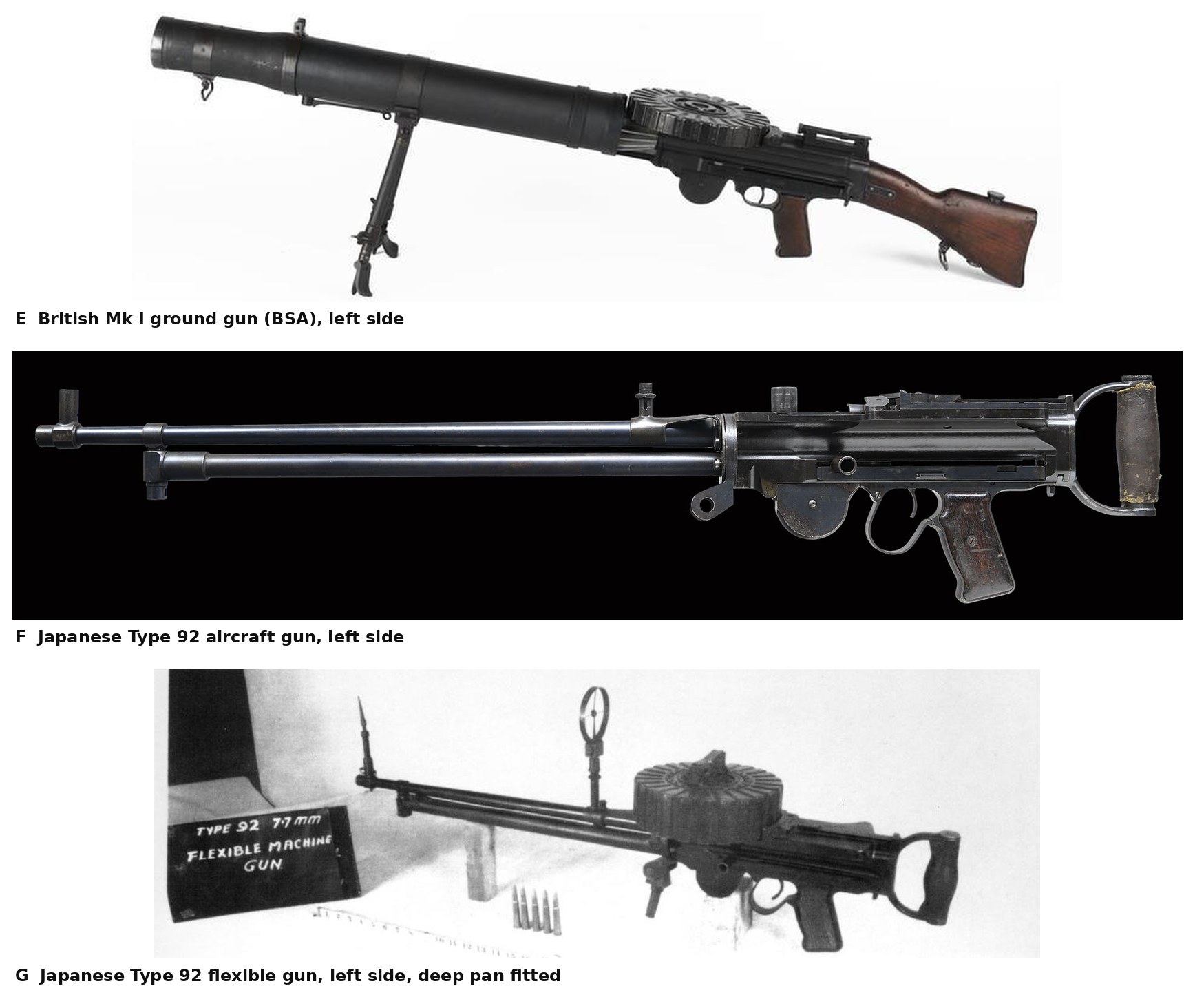
Panel identification rules applied (recorded in photo_credits.txt): a radiator casing means a ground gun; no radiator means an aircraft gun; a gun is called a Type 92 only where the source says so; the side is read from the muzzle direction, never from a mirrored image.
4.3 Markings
The top of the body is where a Lewis says who made it.
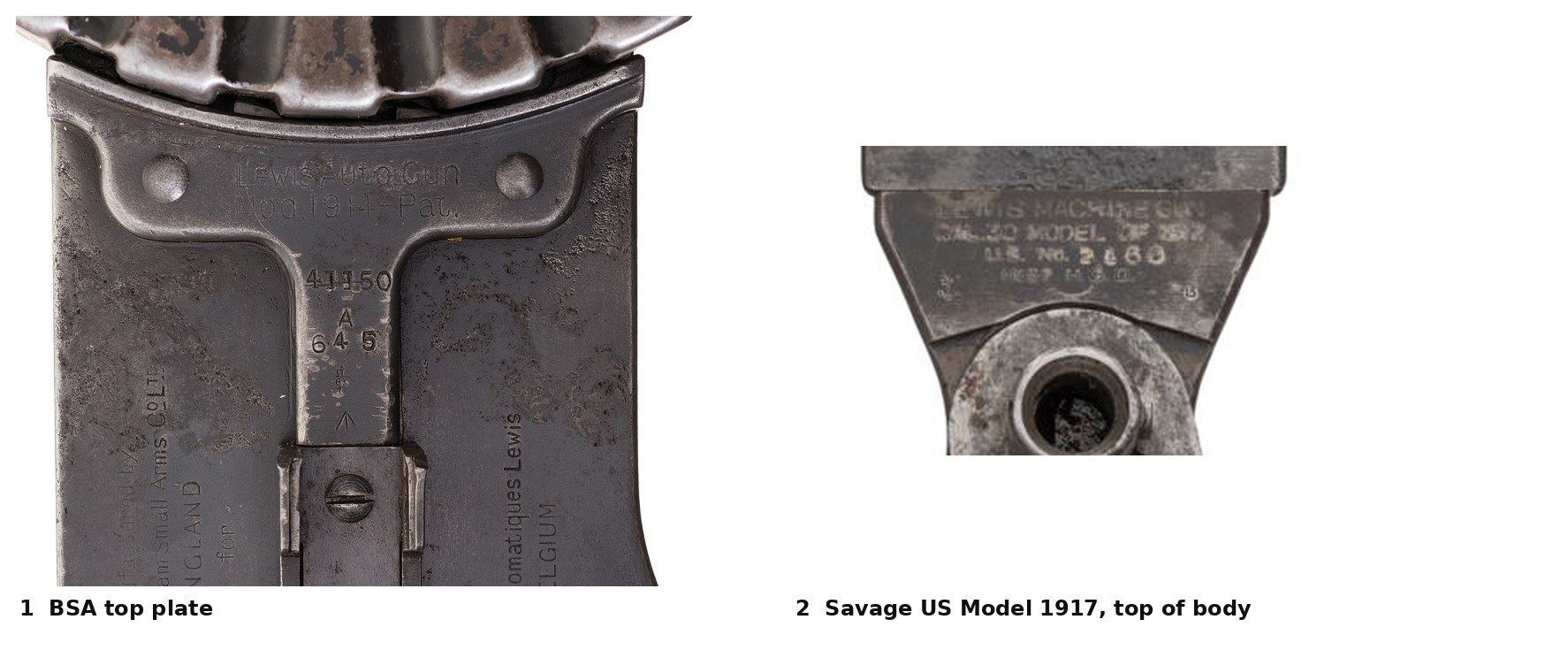
What the sources record for each maker:
- BSA. “Lewis Auto. Gun Mod 1914 - Pat.” on the body cover, and “Manufactured by The Birmingham Small Arms Co Ltd | ENGLAND | for | Armes Automatiques Lewis | BELGIUM” (Imperial War Museum, FIR 9220).2 The Australian War Memorial’s McDougall VC gun reads the same, “with ‘Lewis Auto Gun Mod 1914-PAT’ above the serial number”, as does its Mk II aircraft gun.34 The Imperial War Museum’s example is also stamped and struck through “DP”, the British mark for a drill-purpose (non-firing training) arm, on the body cover, rear sight and butt.2
- Savage, US contracts. Rock Island Auction’s catalogue of a US Model 1917: “The top of the receiver bears the U.S. nomenclature and a small ‘anchor’ stamp, with the Savage address and caliber marking on the top cover and additional Savage markings on the right side.”5 The anchor is a naval mark, which fits Chinn’s account of the Navy as the main American buyer of ground guns (Volume 2).6
- Japanese Model 92. The 1944 US Handbook on Japanese Military Forces: “The markings meaning ‘92 Model’ are stamped on the receiver.”7
Markings prove less than they appear to. The BSA gun in Panel 1 has been renumbered by its government owner. One of the Type 92 photographs sold by Poulin Auctions in 2025 shows a later marking, “REBUILT BY WOOLER, CARBONDALE”, stamped on the gun.8 A Lewis that has been rebuilt, reassembled from parts of several guns (which Savage’s own inspection deliberately did; see Volume 2), or re-marked can carry markings that describe its history, not its origin. For a registered gun the controlling identity is the one on the registration document, which is the subject of Volume 8.
4.4 Tell them apart: the table
Table 1 — Tell them apart: the table
| Feature | British Mk I ground (BSA or Savage .303) | US Model 1917 ground (Savage .30-06) | British aircraft gun (Mk II and later) | US aircraft gun (Savage .30-06) | Japanese Model / Type 92 | Where to look |
|---|---|---|---|---|---|---|
| barrel casing | large radiator casing, tapered front | large radiator casing | no radiator; one-piece casing “of smaller diameter, except at the rear end” (RAF 1918) | no radiator (“not required on the airplane model”, American Machinist) | exposed barrel and gas tube on the examples photographed | front half of the gun |
| butt | wooden butt; spade grip alternative | wooden butt; spade grip alternative | spade grip | spade grip | spade grip (aircraft); butt on ground guns (TM-E: tripod-mounted, 26 lb) | rear |
| cocking handle | right (Pridham shows the .303 handled from the right) | left (“The .300 (American type) Lewis Gun has Cocking Handle on left side of Body”, Pridham) | right (AWM Mk II: “small right hand cocking lever”) | see note below | left, not changeable (TM-E) | slot in the side of the body |
| gas regulator | 2 holes, L and S | 4 holes, numbered 1 to 4, and a gas chamber gland (Pridham) | 2 holes; Mk 1* “A.S.” regulator on speeded-up guns (RAF) | as US ground | not recorded | under the barrel, ahead of the casing’s rear |
| sear spring | on the trigger | on the sear (Pridham) | as ground | as US ground | not recorded | inside the trigger group |
| calibre | .303 British | .30-06 | .303 | .30-06 | 7.7 mm, “Japanese copy of British 0.303” (TM-E) | chamber, top-cover marking |
| top markings | ”Lewis Auto. Gun Mod 1914 - Pat.”, BSA / Armes Automatiques Lewis | ”LEWIS MACHINE GUN, CAL .30 MODEL OF 1917, U.S. No.” (photograph, Plate above); Savage address | as BSA ground (AWM) | not seen | ”92 Model” in Japanese (TM-E) | top of body and top cover |
| pan | 47 | 47 | 47 or 97 (RAF 1918) | 47 or 97 | 47; “Magazines having 97 round capacity also have been found” (TM-E) | on the post |
Sources: RAF Instructional Notes 1918;1 American Machinist;9 Pridham 1940;10 AWM C159989;4 TM-E 30-480;7 Rock Island lot 89/3357 photograph.5
Note on the cocking handle. Pridham is explicit that the American .300 gun has its handle on the left. The 1944 US handbook says the Japanese gun’s handle cannot be moved to the right, implying that on the British pattern it could be. A Savage photograph caption printed by Truby says the handle “can be mounted on left or right side”.11 Handle side is therefore a strong hint, not a verdict, and was not used alone to label any panel.
4.5 The British marks
The British designation of the ground gun is settled by the RAF’s 1918 notes: “Ground Gun (Mark I) 26 lbs. Aerial Gun (Mark II) 17 lbs.”1 The same notes describe Mark I and Mark II gas chambers, which “can only be used with Mark I and Mark II gas chambers respectively”, and the Mark 1* barrel and gas regulator of the speeded-up conversion. The Canadian War Museum describes its aircraft gun as “This Mark III model, the final version of the Lewis machine-gun introduced during the war”.12
Beyond that the primary record runs out for this dive. The British List of Changes, which assigned marks officially, was not consulted. The Historical Breechloading Smallarms Association’s data sheet says the gun was adopted by the United Kingdom and Empire in “all 8 marks”.13 The list usually given in the secondary literature, which this dive did not verify against the List of Changes, is:
Table 2 — Beyond that the primary record runs out for this dive. The British List of Changes, which assigned marks officially, was not consulted. The Historical Breechloading Smallarms Association's data sheet says the gun was adopted by the United Kingdom and Empire in "all 8 marks".[^hbsa] The list usually given in the secondary literature, which this dive did not verify against the List of Changes, is
| Mark (secondary literature) | Description as usually given |
|---|---|
| Mk I | the ground gun, from 1915 |
| Mk II | the first purpose-built aircraft gun: no radiator, slim casing, spade grip |
| Mk II* | Mk II with a higher rate of fire, 1918 |
| Mk III | aircraft gun with a still higher rate, late 1918 |
| Mk III* | in 1940, the US .30-06 aircraft guns converted for ground use with a simple butt |
| Mk III** | the .303 Mk III converted the same way |
| Mk III DEMS | for defensively equipped merchant ships, with a forward grip |
| Mk IV | assembled in 1940–41 from incomplete guns and parts, with a different return spring |
The 1940 primary does confirm the shape of the Second World War guns, if not their marks. Pridham’s sixth edition, written for, among others, “The Home Guard”: “The .300 (American type) Lewis Gun—as issued to the Home Guard—has no Radiator or Radiator Casing, and is therefore similar in appearance to the Lewis Gun as used by the R.A.F.”10 Volume 5 covers those guns in service. No photograph of a skeleton-butted Second World War conversion that could be identified with confidence was located for this dive.
4.6 The American guns
The American designations come from Chinn’s 1951 table, and they are not all consistent with the documents.6
Table 3 — The American guns
| Designation | Calibre | Use | Source |
|---|---|---|---|
| ”Test Model 1911” (one, handmade) | .30-06 | the prototype shown to Leonard Wood | Chinn |
| ”Test Model 1912” (4 made) | .30-06 | the College Park and Fort Myer guns | Chinn |
| Model 1915, M1916 (Savage) | .303 | for Britain and Canada | Chinn |
| US Army Model 1916 | .303 | the guns bought for the Mexican border | Chinn |
| US Army Model 1917 | .30-06 | ground gun | Chinn; marking photographed above |
| US Navy Mark VI, Mk VI Mod 1 | .30-06 | ground gun | Chinn |
| ”U.S.A.F.” Models 1917, 1918, 1919 | .30-06 | aircraft guns | Chinn |
| US Navy Mark X | .30-06 | aircraft gun | Chinn |
There is a conflict in the documents. The Savage company handbook used throughout this dive is titled Hand-Book of the Lewis Machine Gun, Model 1918, Caliber .30, yet it describes a ground gun with radiator, rifle butt or spade grip, bipod, and the 47-round magazine.14 Chinn’s table uses “Model 1918” only for an aircraft gun.6 The Ordnance Department’s own Handbook of Lewis machine gun, caliber .30, model of 1917, dated 16 November 1917, is catalogued by the University of North Texas but no scan was found.15 This dive does not resolve which “Model 1918” was which; the handbook is quoted for what it describes, a ground gun.
4.7 Other countries’ Lewis guns
Chinn’s table lists Lewis guns made or used in Belgium, Britain, Portugal, the United States, Honduras and Nicaragua (ex-US M1917s), the Netherlands (6.5 mm, Model 1920), France (8 mm, Model 1922, and a 1916 aircraft model), Russia (7.62 mm), Italy, and Japan (7.7 mm, Models 1929 and 1932), and says the Norwegians “made it under license in a 6.5-mm caliber”.6 Two of these are documented here from primary sources.
Japan: the Model (Type) 92. The US War Department’s Handbook on Japanese Military Forces, TM-E 30-480 (1 October 1944): “Model 92 (1932) 7.7-mm Lewis type MG … an air-cooled, gas operated, drum-fed, full automatic gun. With the exception that the cocking handle is on the left and that there is no provision allowing it to be changed to the right side of the gun, if so desired, this weapon is a duplicate of the British Lewis.” Its characteristics: length 56 inches, weight without tripod 26 pounds, 47-round magazine (97-round magazines “also have been found”), about 2,400 feet per second, 600 rounds a minute cyclic, and a rear sight graduated to 1,700 metres. It fires “7.7-mm rimmed ammunition, Japanese copy of British 0.303, and British MK VII .303 in. ball ammunition.”7 The year number 92 is the Japanese imperial year 2592, 1932, which is why Chinn calls it the Model 1932.
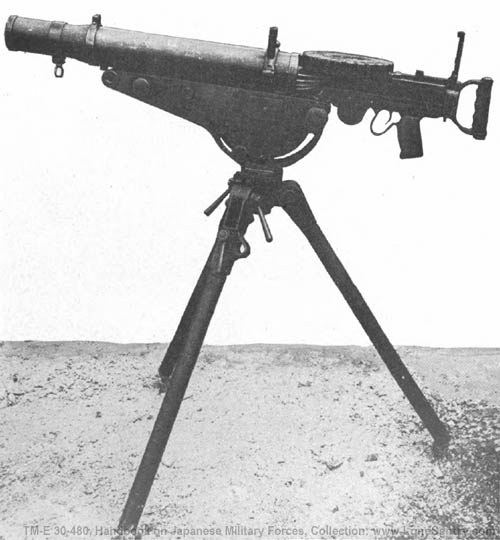
Poulin Auctions’ 2025 catalogue of a Type 92 aircraft gun says it was “Originally introduced as the Type 91 Navy Aircraft Machine Gun” and “utilized in both the Army & Navy”.8 Neither statement could be checked against a primary source, and both are left as the auctioneer’s.
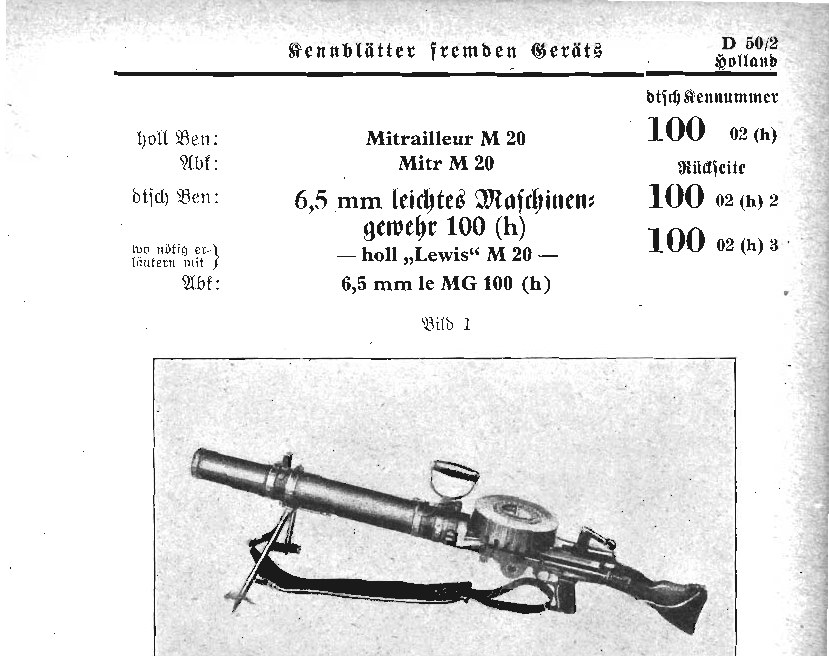
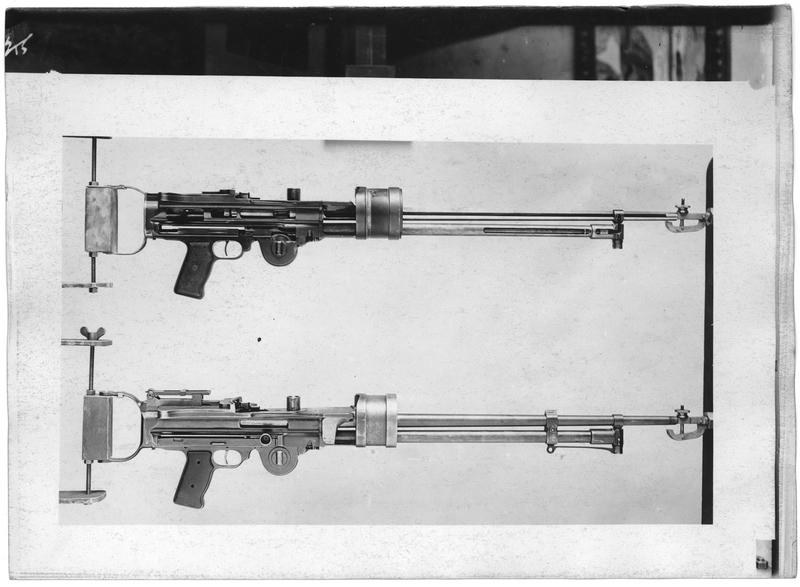
The Netherlands: the M.20. The German Army’s recognition handbook of foreign equipment, D 50/2, Kennblätter fremden Geräts, sheet 100 (h), dated 1 May 1944, identifies the Dutch “Mitrailleur M 20” as the “6,5 mm leichtes Maschinengewehr 100 (h) — holl. ‘Lewis’ M 20 —”.16 Chinn calls it the Holland Model 1920, 6.5 mm.6
4.8 Catalogue names are not designations
Rock Island Auction’s catalogue for sale 73, lot 3393 describes a “British Mark II … Lewis Medium Machine Gun with Crate and Bipod”, and then describes “a distinctive/large barrel jacket that encases the air cooling sleeve”, a “detachable buttstock and bipod”, and a rear sight “graduated to 1900 yards”.17 That is a ground gun, which the RAF’s 1918 notes call the Mark I; the Mark II is the aircraft gun without a radiator.1 Either the catalogue’s mark is wrong or the gun is a Mark II rebuilt to ground configuration, and the catalogue gives no evidence for the second. The same catalogue also calls the gun a “medium” machine gun, which no period source does. For identification, the gun and the period manuals govern, not the sale title.
4.9 What could not be established
- The British List of Changes for Mk II*, Mk III, Mk III*, Mk III**, Mk III DEMS and Mk IV. The table of WWII marks is secondary and unverified.
- A photograph of a 1940 skeleton-butted conversion that could be identified with confidence.
- “Model 1918”: whether Savage’s handbook title and Chinn’s table use the term for the same gun.
- The Ordnance Department’s 1917 handbook: catalogued, not found as a scan.
- The Type 92’s original designation: Poulin’s “Type 91” is unverified.
- US aircraft-gun handle side: not stated in any source consulted.
References
Footnotes
-
Royal Air Force, Instructional Notes on the Lewis Gun (April 1918). https://archive.org/details/raflewisgun, consulted 2026-10-19. ↩ ↩2 ↩3 ↩4
-
Imperial War Museums, “Gun, Lewis, .303 inch [2nd issue]”, FIR 9220. https://www.iwm.org.uk/collections/item/object/30034920, consulted 2026-10-19. ↩ ↩2
-
Australian War Memorial, RELAWM C239470. https://www.awm.gov.au/collection/C239470, consulted 2026-10-19. ↩
-
Australian War Memorial, “Lewis Mark II Aircraft Machine Gun”, C159989. https://www.awm.gov.au/collection/C159989, consulted 2026-10-19. ↩ ↩2
-
Rock Island Auction Company, sale 89, lot 3357, “U.S. Savage Model 1917 Lewis Gun, Class III/NFA C&R”. https://www.rockislandauction.com/detail/89/3357/us-savage-model-1917-lewis-gun-class-iiinfa-cr, consulted 2026-10-19. ↩ ↩2
-
George M. Chinn, The Machine Gun, vol. I, Part IV, chapter 1, “Models of the Lewis Gun” (Bureau of Ordnance, 1951). https://www.ibiblio.org/hyperwar/USN/ref/MG/I/MG-4.html, consulted 2026-10-19. ↩ ↩2 ↩3 ↩4 ↩5
-
US War Department, Handbook on Japanese Military Forces, TM-E 30-480 (1 October 1944), chapter IX, section II, 2.e. https://lonesentry.com/manuals/handbook-japanese-military/japanese-machine-guns.html, consulted 2026-10-19. ↩ ↩2 ↩3
-
Poulin’s Antiques and Auctions, “Very rare Japanese Type 92 Lewis aircraft machine gun”, 19 February 2025, catalogue and photographs. https://www.poulinauctions.com/2025/02/19/very-rare-japanese-type-92-lewis-aircraft-machine-gun/, consulted 2026-10-19. ↩ ↩2
-
“The Manufacture of the Lewis Machine Gun”, American Machinist, 6 December 1917. https://archive.org/details/Ame-mach-lewis-gun, consulted 2026-10-19. ↩
-
Major C. H. B. Pridham, Lewis Gun Mechanism Made Easy, 6th edition (Gale & Polden, 1940), pp. 1–13 and footnotes. https://www.forgottenweapons.com/wp-content/uploads/Lewis/Lewis%20Gun%20Mechanism%20Made%20Easy.pdf, consulted 2026-10-19. ↩ ↩2
-
J. David Truby, A Pictorial History of the Lewis Gun (Paladin Press, 1976). https://archive.org/details/lewis-gun-paladin, consulted 2026-10-19. ↩
-
Canadian War Museum, “Lewis Machine-Gun for Aircraft”. https://www.warmuseum.ca/firstworldwar/objects-and-photos/weapons-and-ammunition/firearms/lewis-machine-gun-for-aircraft/, consulted 2026-10-19. ↩
-
Historical Breechloading Smallarms Association, “Lewis machine gun .303”. https://hbsa-uk.org/lewis-machine-gun-303/, consulted 2026-10-19. ↩
-
Savage Arms Corporation, Hand-Book of the Lewis Machine Gun, Model 1918, Caliber .30 (c. 1918). https://www.forgottenweapons.com/wp-content/uploads/Lewis/lewismanual.pdf, consulted 2026-10-19. ↩
-
University of North Texas Libraries, Monthly Catalog record, “Handbook of Lewis machine gun, caliber .30, model of 1917”, Ordnance Department, 16 November 1917, 72 pp. https://mocat.library.unt.edu/catalog/279-ch897, consulted 2026-10-19. ↩
-
Heereswaffenamt, D 50/2 Kennblätter fremden Geräts, Maschinengewehre, Holland, sheet 100 (h), 1 May 1944, via Wikimedia Commons, https://commons.wikimedia.org/wiki/File:D50-2_Nr_100_(h)_(1944-05-01).png, consulted 2026-10-19. ↩
-
Rock Island Auction Company, sale 73, lot 3393, “BSA Co Lewis Machine Gun Mk II”. https://www.rockislandauction.com/detail/73/3393/bsa-co-lewis-machine-gun-mk-ii, consulted 2026-10-19. ↩

Comments (0)