CRT Timing · Volume 2
The Phosphor — What the Gun Is Actually Looking At
The P-designation system, P22's three materials, their spectra, how fast they light and how slowly they fade, what a silicon photodiode makes of each, and why a light gun is nearly blind to red
2.1 The surface the gun looks at
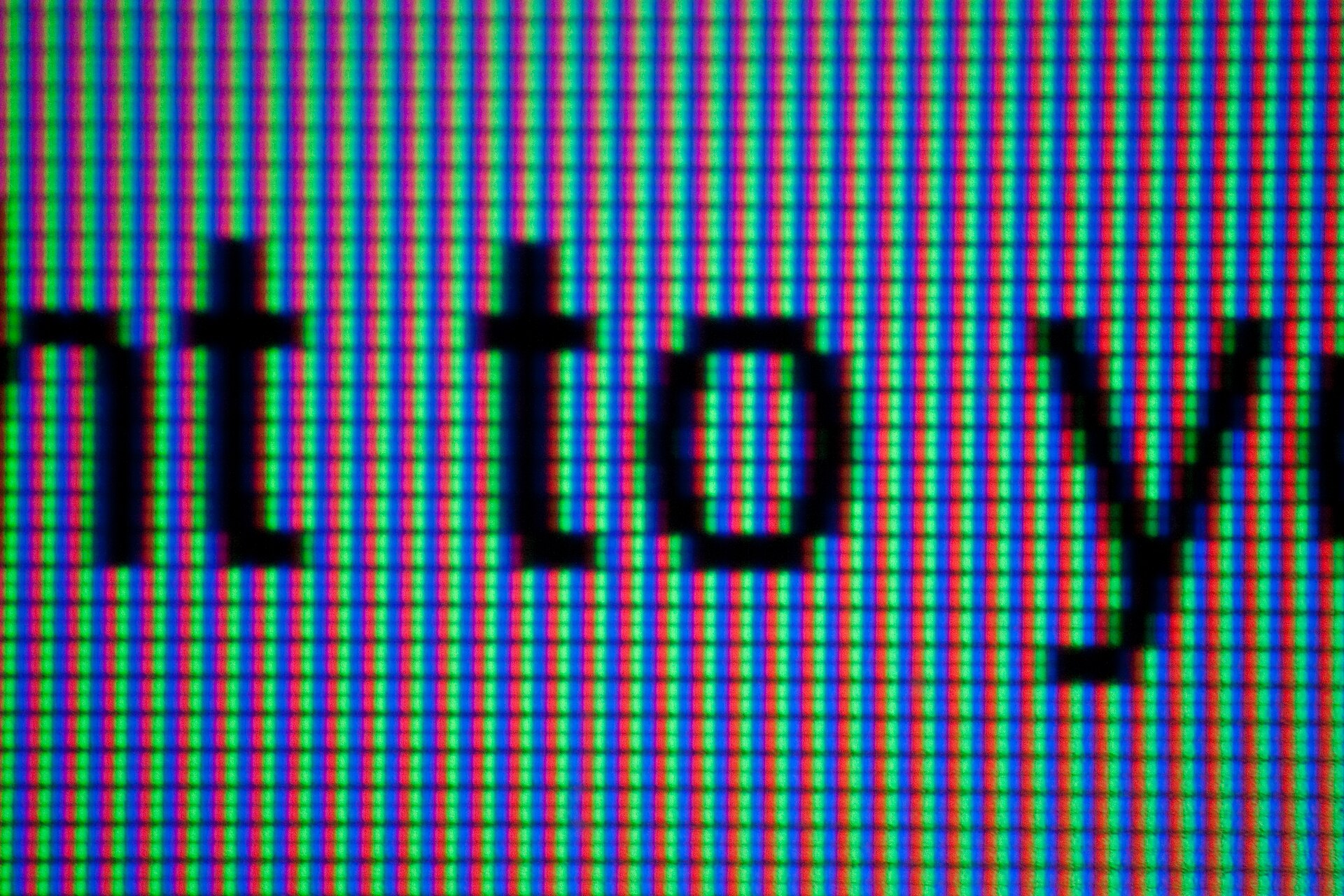
The inside of a colour tube’s face is coated with three phosphors laid down as dots (a shadow-mask tube) or vertical stripes (an aperture-grille tube such as Sony’s Trinitron). Each is a crystalline powder that emits light when struck by electrons. The light a gun receives is the sum of what those three powders emit within its field of view, so their behaviour in time is the first link in every light gun’s timing chain. A colour CRT gives the gun a choice of three different light sources in one patch of screen, and they do not behave alike.
2.2 The P-numbers
Phosphors for cathode-ray tubes are registered under P-numbers, a system begun by the US Radio Manufacturers Association and continued by the Electronic Industries Association (EIA) and JEDEC through their TEPAC committee. The definitive document is the EIA standard TEP116-C, Optical Characteristics of Cathode Ray Tube Screens. It was not read for this dive. The figures below come from Patrick Jankowiak’s compilation of the EIA, JEDEC, RETMA, Tektronix and other published data, which records each source’s figures separately where they disagree.1
Persistence in this system means the time for the light to fall to 10 % of its peak after excitation stops. Tobias Elze explains why the 10 % point is used rather than a time constant: the decay is “initially exponentially, later converging to a power law course”, so “decay constants … are not appropriate for decays to low percentages of the maximum”.2
Table 1 — 2.2 The P-numbers
| P-number | Material | Colour | Persistence (to 10 %) | Use | Relevance to a light gun |
|---|---|---|---|---|---|
| P4 | ZnS:Ag + (Zn,Cd)S:Cu (later forms) | white | ”not over 7 % of peak after 33 ms”; medium | black-and-white TV | The tube in every monochrome set a home computer or console was plugged into |
| P22B | ZnS:Ag (+ cobalt or pigment filter) | blue, 450 nm | medium (class for the whole set) | colour TV | Fast leading component: the gun’s best friend (§2.4) |
| P22G | ZnS:Cu,Al or ZnS:Cu,Au,Al | green, 530 nm | medium | colour TV | Fast leading component, long tail |
| P22R | Y2O2S:Eu (+ Fe2O3 or pigment) | red, 611 nm | medium | colour TV | No fast component: nearly invisible to a gun (§2.6) |
| P31 | ZnS:Cu or ZnS:Cu,Ag | green | medium short, 0.01–1 ms | oscilloscopes | — |
| P24 | ZnO:Zn | green | 1.5 µs | flying-spot scanners | Fast enough to be a scanner’s light source |
| P46, P47 | Y3Al5O12:Ce, Y2SiO5:Ce | green, blue | very short | beam-index tubes | Cerium phosphors: tens of nanoseconds |
| P53, P56 | Y3Al5O12:Tb, Y2O3:Eu | green, red | medium | projection tubes | See §2.9 |
P22 is not one phosphor. It is the designation for the set of three used in colour television tubes, “the set of phosphors used for color TV CRTs” in Jankowiak’s words, and every consumer colour CRT a light gun was used with carried some version of it.1 The table’s “medium” persistence class is the class for the set as a whole and hides the differences that matter here.
2.3 P22: three materials
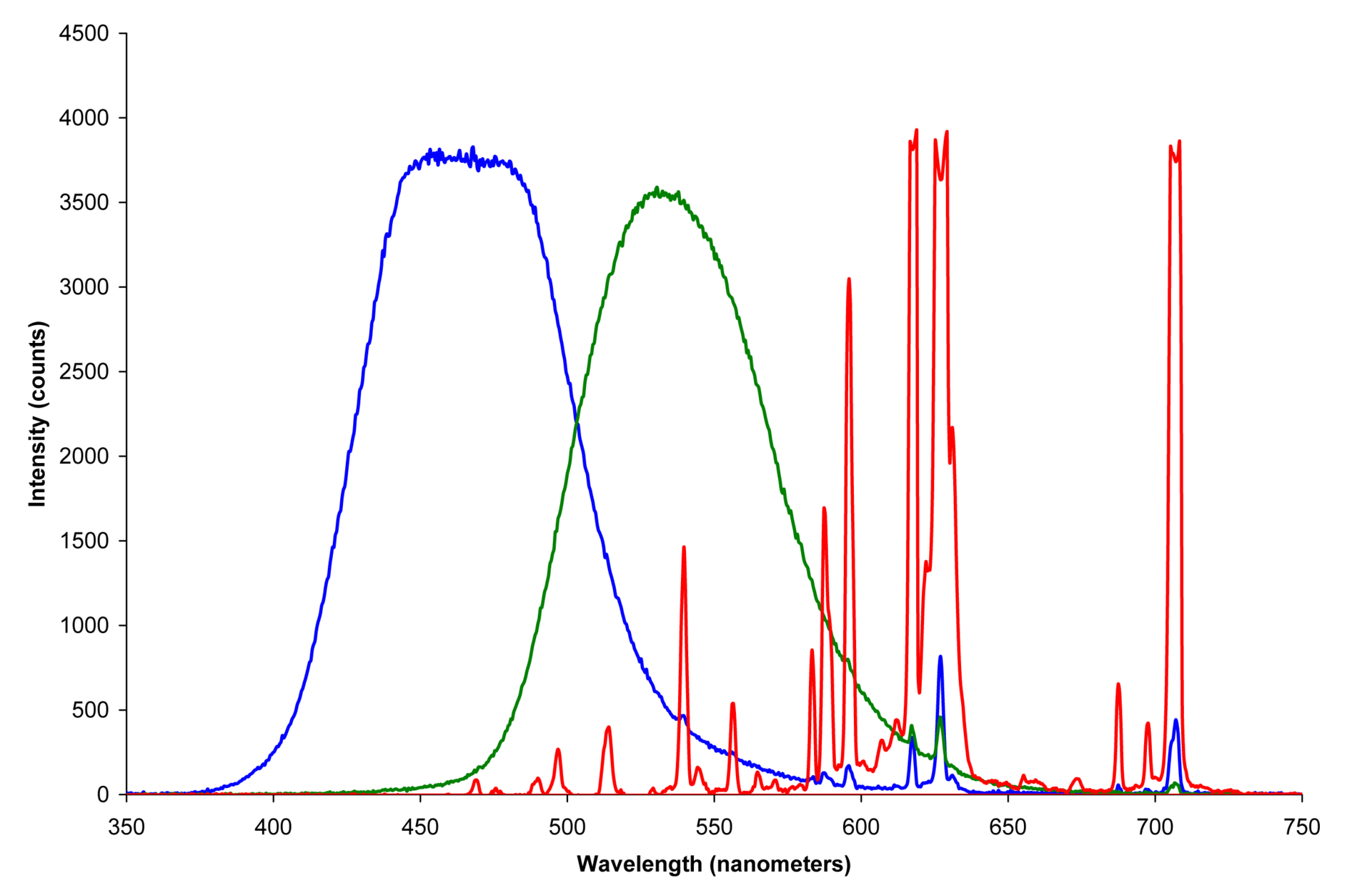
The three spectra are physically different kinds of emission, and the difference shows in the plot:
- Blue, ZnS:Ag. A broad band from a semiconductor host. Silver forms acceptor levels in the zinc-sulphide band gap, and the light comes from electrons and holes recombining through them. Recombination in a semiconductor can be fast.
- Green, ZnS:Cu,Al. The same host with copper as the acceptor and aluminium as a co-activator. It also emits a broad band. Its emission is a pairing of donors and acceptors spread through the crystal at a range of distances, so its decay is a mixture of fast and very slow components.
- Red, Y2O2S:Eu. An insulating host with europium ions, and a set of sharp lines. The light comes from transitions within the europium ion’s inner electron shell. Those transitions are quantum-mechanically “forbidden”, which in practice means slow: the excited ion holds its energy for a long time before emitting.
The physics in that list is standard phosphor science and is given as background. The consequences for a gun, in the next three sections, rest on measured figures.
The photodiode’s side of the match is simple. A standard silicon PIN photodiode such as Vishay’s BPW34 has its peak sensitivity at 900 nm and a 10 % bandwidth of 430 to 1,100 nm.3 All three phosphors fall inside that band, blue near its lower edge. Silicon responds more strongly per watt to red than to blue. Spectral sensitivity is not why guns are blind to red: the reason is time (§2.6).
2.4 How fast a phosphor lights
The beam crosses any one spot of phosphor in about a tenth of a microsecond: at about 10 km/s across a 27-inch face, a 1 mm stripe is under the beam for roughly 100 ns (Volume 1, §1.5). The excitation is therefore a short pulse, and what matters is how much of the energy it deposits comes back out as light within the first microsecond or so, because that is what makes an edge.
Elze’s description of a P22 phosphor is that “the luminance of the phosphor rises rapidly and reaches its maximum almost instantaneously”.2 His paper also gives a figure of 0.18 ms for a P22 red channel to reach its maximum, but that measurement was made with an optical transient recorder sampling 10,000 points per second over ten scan lines at once.2 It is a limit of that instrument and that method, not a rise time a light gun could use, and it should not be quoted as one.
The best published figure for the fast component of ZnS:Ag comes from outside the display industry. Zinc sulphide doped with silver is also a radiation scintillator, and Eljen Technology’s EJ-600, which it sells as “ZnS:Ag phosphor powder” for scintillation, lists a decay time of 200 ns with emission peaking at 450 nm.4 That is scintillator-grade material excited by alpha particles, not a CRT screen excited by a 25 kV beam. It nevertheless shows that the blue phosphor’s main emission is a sub-microsecond process. On a CRT, the blue phosphor therefore gives back most of each line’s light while the beam is still passing, and that light carries a sharp leading edge.
No primary figure was found for the fast component of ZnS:Cu,Al green. The working assumption in this dive, stated as such, is that green behaves like blue at the start (same host, same recombination physics) with a larger slow tail.
2.5 How slowly it fades
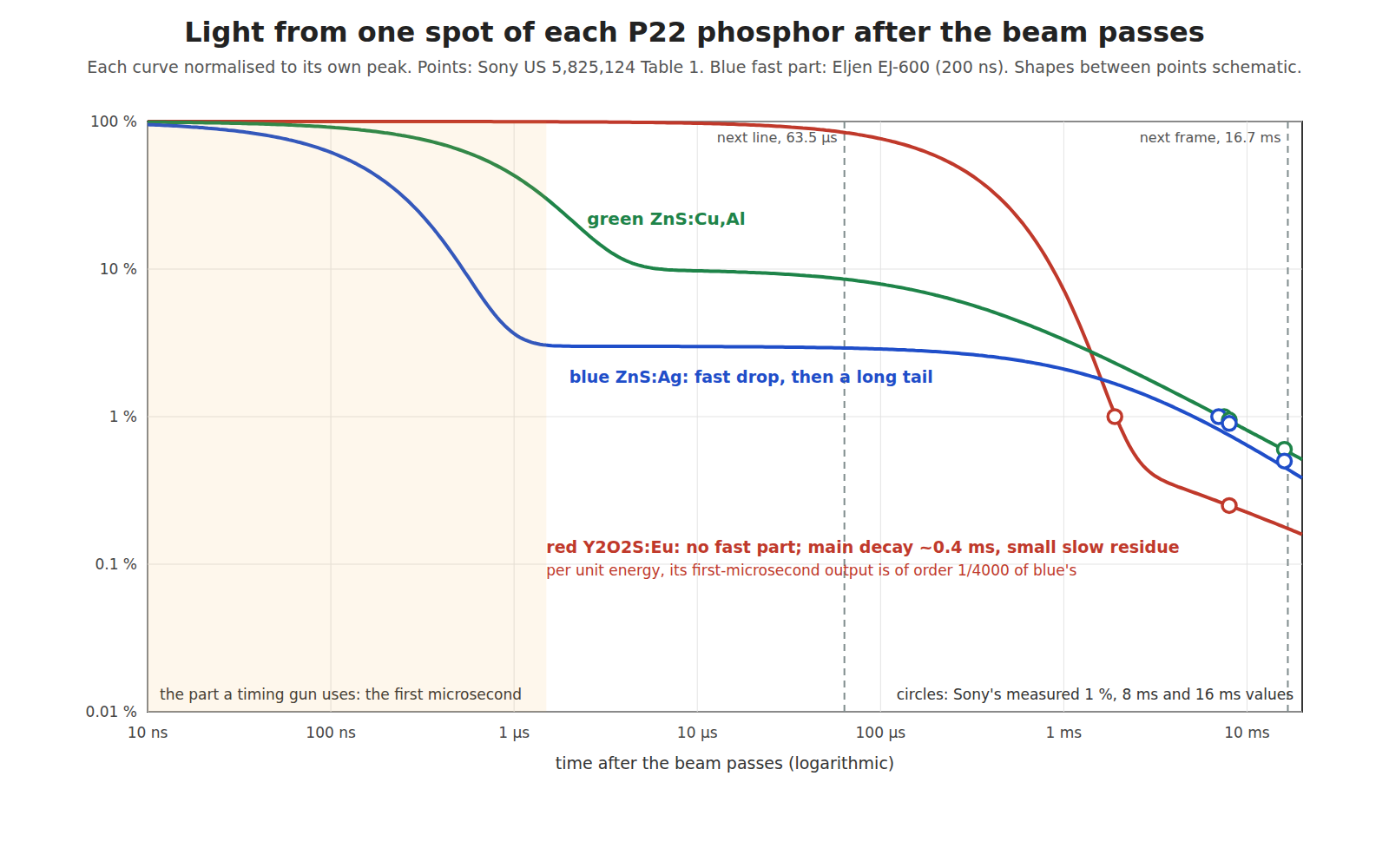
The tail is where the three materials are measured, and the best data in the sources read comes from a Sony patent. US 5,825,124 (Ohno and others, filed 1996, granted 1998) was about making P22 tubes fit for a 120 Hz three-dimensional television, where one eye’s image must be gone before the other’s is drawn. Its Table 1 gives the afterglow of “usual red, green, and blue phosphors of a color cathode-ray tube” after electron-beam excitation:5
Table 2 — 2.5 How slowly it fades
| Sony’s Table 1 | Time to fall to 1/100 | Afterglow at 8 ms | Afterglow at 16 ms |
|---|---|---|---|
| Red, Y2O2S:Eu | 1.9 ms | 0.25 % | 0 % |
| Green, ZnS:Cu,Al | 7.5 ms | 0.95 % | 0.6 % |
| Blue, ZnS:Ag | 7.0 ms | 0.9 % | 0.5 % |
The patent adds that CRTs are “designed to meet such a requirement that the afterglow intensity after excitation be at most 0.5% of the maximum afterglow intensity peak”.5
Read the table together with §2.4 and the pattern is clear:
- Blue and green have a fast start and a long tail. Most of the light comes in the first microsecond, but a small fraction lingers for milliseconds. At 16 ms, one 60 Hz frame later, about half a per cent is still there. This is the power-law behaviour Elze describes, and it is why “persistence” figures for these materials vary so much with how they are defined.
- Red has no fast start but a clean finish. It reaches 1 % in 1.9 ms and nothing at 16 ms, the “shortest” of the three by Sony’s measure. It is also the one a light gun cannot see.
The wider literature agrees in outline. Elze quotes Sherr’s Electronic Displays (1993) for P22 decay times “ranging from 1.5 ms to 6 ms”, and his own measurement of a P22 red channel on an Iiyama monitor decaying “to zero within 2 ms”.2 A Samsung patent describes conventional ZnS:Cu,Al green as having “a decay time of about 0.45 ms”; that figure was read only in a search snippet, without the patent’s definition of decay time, and is not used for any calculation here.6
2.6 Why the gun is nearly blind to red
Two independent sources record that light guns barely see red.
- Of the Super Scope, Martin Korth’s fullsnes: “When creating graphics for the SuperScope, note that the color red is not detected. For best results, use colors with the blue component over 75% and/or the green component over 50%.”7
- Of the GunCon, his psx-spx lists measured minimum brightness levels for the gun to return a position. Red needs
000099h, the highest single-channel level in the list, against007700hfor green; and on a plain red screen the gun returns wrong Y coordinates on about half of all frames.8 (The PlayStation’s 24-bit colour order is blue, green, red, so000099his red.)
The cause follows from §2.3 to §2.5. Sony’s figures show the red phosphor’s light falling to 1 % in 1.9 ms and then lingering at about a quarter of a per cent at 8 ms, so most of it decays in one roughly exponential step with a small slow residue. If that main step were a pure exponential reaching 1 % at 1.9 ms, its time constant would be about 1.9 ÷ ln(100) ≈ 0.41 ms. A 100 ns excitation of such a phosphor returns its energy spread over roughly 400 µs, so its peak intensity is of order 100 ns ÷ 400 µs, about 1/4,000 of what a phosphor that re-emitted the same energy within the excitation would give. Integrated over a frame, red is as bright to the eye as green; over the first microsecond, which is all a timing gun uses, it is almost dark. And the light it does give is a slow rise and a slow fall, with no edge for an AC-coupled amplifier to find (Volume 3).
That arithmetic is an inference from the patent’s figures and the stated assumption that the main decay is exponential. The 0.41 ms time constant was not read from a primary source for this dive. The conclusion does not depend on its exact value. Any time constant in the hundreds of microseconds puts red three to four orders of magnitude below blue and green in the first microsecond.
The engineering lesson for a CRT gun is that a timing gun sees only the fast phosphors, and the useful brightness of a target is its blue-plus-green content. A white or cyan target is ideal; yellow works through its green; pure red is nearly invisible.
2.7 What one line looks like to the photodiode
Combine the three phosphors and the burst of Volume 1 §1.6, and the photodiode current for a white target has three parts:
- A fast pulse on each line, a few microseconds wide (the time the spot takes to cross the patch), made of blue and green emission, with a leading edge as sharp as the lens’s focus on the patch edge allows.
- A slow red component under each pulse, small and smeared over hundreds of microseconds.
- A pedestal that builds up through the burst. Each line’s slow tails, from all three phosphors, last far longer than the 63.5 µs to the next line, so they pile up. By the twentieth line of a burst the photodiode carries a slowly varying offset from the previous nineteen lines’ afterglow, and that offset then decays over milliseconds after the burst ends.
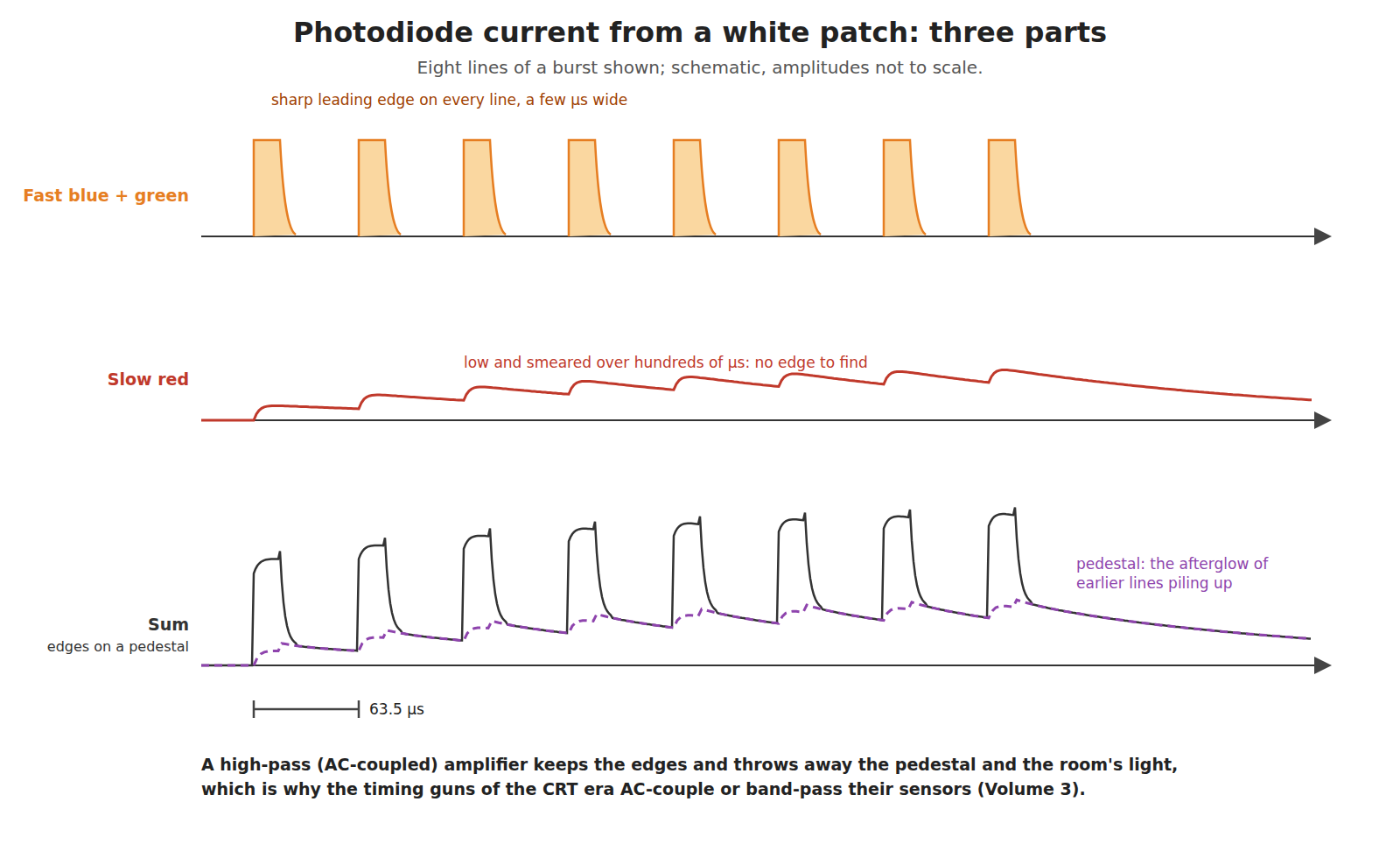
Part 3 is the reason the timing guns of the CRT era AC-couple or band-pass their sensors (the 1972 Odyssey rifle, a plain level detector, is the exception that proves it: its own manual admits a lamp can fool it, as History of Light Guns, Volume 2 records). The edges carry the timing; the pedestal, together with room light, carries none, and it would push a DC-coupled threshold around from line to line. The NESdev wiki’s emulator model of the Zapper describes its own output as the result of exactly this kind of integration: “luminance is collected as voltage into a capacitor, whose voltage drains out exponentially over the course of several scanlines, and the light bit is active while the voltage is above a threshold”.9 That is a description of the filtered signal, not the raw phosphor, but it is the same physics seen through the Zapper’s filter.
2.8 What a game must draw
The phosphors set the rules for the picture a light-gun game draws when it wants to be seen:
- Bright, and blue-green. White, cyan or bright green. Pure red fails (§2.6).
- Not black. The beam is off over black, so nothing is emitted. Atari’s 1980 hardware manual says so of the light pen: “The pen will not work if it is pointed at a black area of the screen, since the electron beam is turned off.”10 The GunCon documentation notes that the gun “won’t work on regions of the screen that contain too dark/black graphics”, and that with white text on black it returns “the position of the closest white pixels”.8
- Flash on the shot. Latch-gun games commonly turn the screen, or the targets, white for a frame when the trigger is pulled, so that wherever the gun points there is fast phosphor to see. Arcade Light Guns, Volume 2 records the same practice in the cabinets.
- Black means black for a frame. The Zapper’s anti-cheat check draws an all-black frame and requires no light (Volume 4). Sony’s figure of about 0.5 % afterglow one frame later (§2.5) is why the check must use a threshold rather than “zero”: the previous white frame is still faintly there.
2.9 Other tubes: monochrome, monitors and projection sets
- Monochrome sets use P4, a white blend that in its later forms is ZnS:Ag plus a copper-activated zinc-cadmium sulphide, both from the fast family.1 A black-and-white set is a perfectly good light-gun display, and many home-computer pens were used with one.
- Professional monitors (Sony PVM and BVM, for example) are P22 tubes like a consumer set. Their sharper focus and absence of digital processing make them good gun displays; nothing in their phosphor is different. Some later monitors and sets were not direct-drive, and that is a separate failure (Volume 6).
- Projection CRT sets use three separate small tubes, one per colour, with phosphors chosen for brightness at very high loading. Jankowiak lists the projection-tube phosphors as terbium-activated green (P53, Y3Al5O12:Tb; also yttrium silicate and gallium-garnet terbium types), europium-activated red (P56, Y2O3:Eu) and a ZnS:Ag,Al blue (P55).1 Terbium, like europium, emits from inner-shell transitions with millisecond-class decay. On that basis a projection set should present a gun with fast light only from its blue tube, which would make it a much weaker light-gun display than a direct-view set of the same brightness. This is an inference from the listed materials. No measurement of a light gun on a projection set was found, and the brightness lost through the projection optics is a second, separate disadvantage. Namco’s European Time Crisis manual excludes projection televisions for the G-CON45, but the reason it gives is burn-in (“the screen may burn”), not the phosphor, as Console Light Guns, Volume 4 records; the arcade makers’ move to infrared on projection cabinets is told in Arcade Light Guns, Volume 4.
2.10 What could not be verified
- TEP116-C itself; all P-number data here is from a compilation of secondary sources.1
- The fast-component decay time of CRT-grade ZnS:Cu,Al green. The 200 ns figure is for scintillator-grade ZnS:Ag.
- The red phosphor’s time constant (0.41 ms is derived from Sony’s 1 % figure, assuming the main decay is exponential).
- The OCR’d heading of Sony’s Table 1 read “1/000”; the context (“a time t over which the afterglow is reduced to”) and the 8 ms and 16 ms columns fit 1/100. Treated as 1/100.
- Any published measurement of a light gun on a projection CRT set.
Sources
Footnotes
-
Patrick Jankowiak (KD5OEI), “Cathode Ray Tube Phosphors Of Interest To The Experimenter”, revision 20100226, compiled from EIA, JEDEC, RETMA, Tektronix, Clinton Displays and other sources, http://www.labguysworld.com/crt_phosphor_research.pdf, read 2026-10-19. ↩ ↩2 ↩3 ↩4 ↩5
-
Tobias Elze, “Achieving precise display timing in visual neuroscience experiments”, Journal of Neuroscience Methods 191 (2010) 171–179, doi:10.1016/j.jneumeth.2010.06.018, §1.2.2 and Fig. 3, read 2026-10-19. ↩ ↩2 ↩3 ↩4
-
Vishay Semiconductors, BPW34 silicon PIN photodiode datasheet, document 81521, rev. 2.1, 23 August 2011, https://www.vishay.com/docs/81521/bpw34.pdf, read 2026-10-19. ↩
-
Eljen Technology, EJ-600 “ZnS:Ag phosphor powder”, product page (decay time 200 ns, maximum emission 450 nm), https://eljentechnology.com/products/zinc-sulfide-coated/ej-600, read 2026-10-19. ↩
-
Katsutoshi Ohno and others (Sony Corporation), “Cathode-ray tube having activated green and blue phosphors”, US Patent 5,825,124, filed 21 March 1996, granted 20 October 1998, column 1 and Table 1, USPTO full text read by OCR 2026-10-19. ↩ ↩2
-
Samsung Display Devices, “Mixed green-emitting phosphor and a cathode ray tube adopting the same”, US Patent 5,701,054, granted 23 December 1997; the “about 0.45 ms” figure was seen in a search excerpt only. ↩
-
Martin Korth (nocash), fullsnes, “SNES Controllers SuperScope (Lightgun)”, https://problemkaputt.de/fullsnes.htm, read 2026-10-19. ↩
-
Martin Korth (nocash), psx-spx, “Controllers — Lightguns — Namco (GunCon)”, “Minimum Brightness” and “Coordinates”, https://psx-spx.consoledev.net/controllersandmemorycards/, read 2026-10-19. ↩ ↩2
-
NESdev Wiki, “Zapper”, https://www.nesdev.org/wiki/Zapper, read 2026-10-19 via the Internet Archive. ↩
-
Atari, Inc., Atari 400/800 Hardware Manual (1980), light-pen section, as quoted in Home-Computer Light Guns, Volume 1. ↩
Comments (0)