Controls and Inputs · Volume 6
Pedals and Pumps — the Time Crisis Pedal, a Shotgun Slide on an MP7, and How Each Is Sensed
Namco's pedal is a spring-returned plate pushing a plunger onto a microswitch, greased every six months. A home pedal can be a $7.50 foot switch with a better switch inside it, wired to a 3.5 mm jack that every assistive switch also fits. A pump on an MP7 is a compromise, and the options for sensing one
6.1 What a Pedal Is For
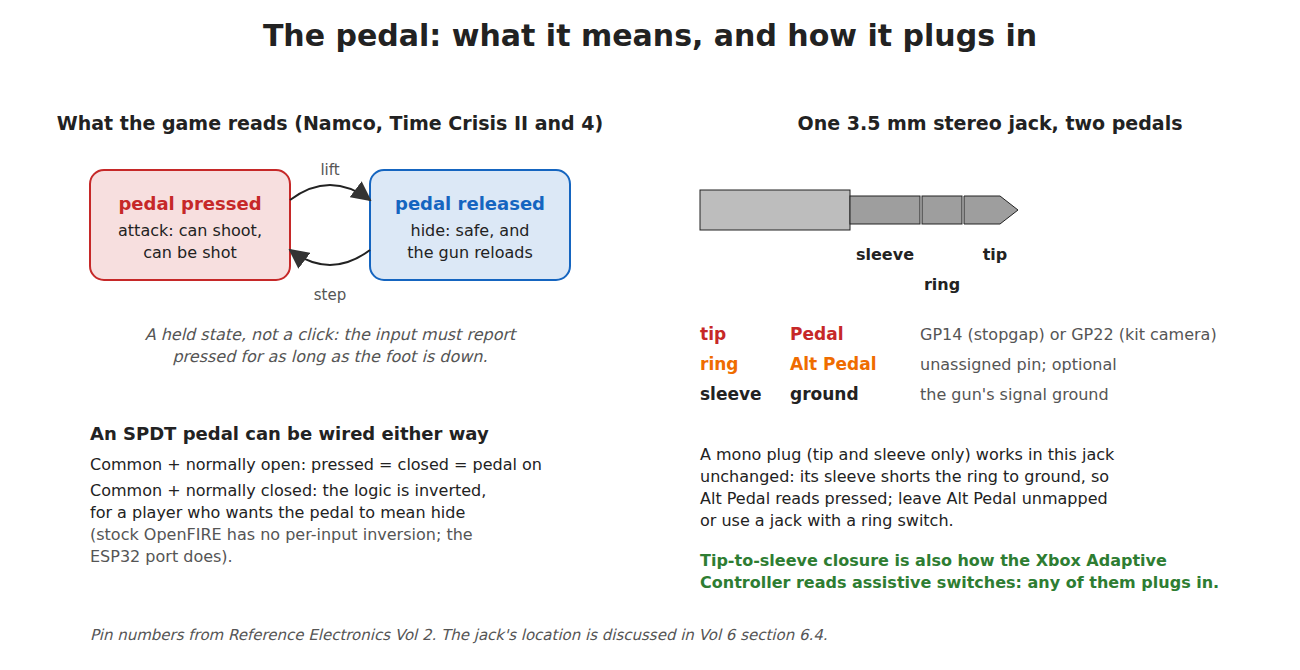
The pedal belongs to the Time Crisis series. Namco’s own manuals describe its meaning (Volume 1, §1.2): from Time Crisis II, “Step on the pedal = attack position … Release the pedal = defence position … Releasing the pedal recharges the gun”; from Time Crisis 4, the same two states, with weapon selection by “releasing the pedal and pressing the trigger” and, in the sniper event, zoom while the pedal is pressed and reload when it is released.
Two design facts follow. First, the pedal is a held state, not a click: the game reads whether it is down, continuously, and the player stands on it for most of the game. The firmware’s button library reports press and release like any other button, which is exactly right; nothing needs to change. Second, its default meaning is attack, not hide. A player who would rather press to hide needs the logic inverted, which an SPDT pedal can do in the wiring (6.4).
Outside Time Crisis, a pedal is simply a reload or an extra button under the foot. OpenFIRE’s defaults send Pedal as mouse button 4, the same as Button C (Open-Source Firmware, Volume 6, §6.3), so a pedal and the magazine-catch reload arrive at a game as the same button.
6.2 The Arcade Pedal, From Namco’s Manuals
Namco’s operator manuals describe the pedal assembly as a maintenance item, which says what it is made of and how it fails.
- Mechanism. A pedal plate on springs pushes a plunger, which presses a microswitch mounted on an adjustable holder. The Time Crisis SD parts list gives the pedal’s contents: pedal base, pedal, holder, cover, pedal plate, plate, stopper rubber, spring cover, plunger, switch stay, two springs (A and B) and “Microswitch K3L13”. (The maker of the K3L13 is not given.)
- Maintenance. Time Crisis II, §8-1-1: “Grease the plunger every six months.” §8-1-2: press the pedal by hand and check that the plunger presses the microswitch; “If the plunger is worn and not pressing the microswitch”, replace the plunger.
- Faults. The Time Crisis SD troubleshooting table lists, for “The pedal does not function”: the microswitch broken, the connector disconnected, or the plunger worn out.
- Installation. The Time Crisis 4 deluxe manual requires the pedal assembly to be pressed flat to the floor with “no space between the Pedal Assy and the floor”.
The lessons for a home pedal: the switch is the cheap, replaceable part; the plunger between the plate and the switch is the wear part; and a pedal that rocks on the floor feels wrong and loads its mechanism unevenly.
6.3 Pedals to Buy
Table 1 — 6.3 Pedals to Buy
| Pedal | Connection | Price and source (2026-10-19) | Notes |
|---|---|---|---|
| Sinden Arcade Pedal | USB; “pedal action triggers a USB keyboard press” | $237.49 (regular $264.99) at Stone Age Gamer, https://stoneagegamer.com/sinden-arcade-pedal.html | ”Time Crisis Arcade style”; powder-coated steel and aluminium; 25 × 25 cm, about 2.5 kg; made in England; two can be used for two players |
| Adafruit Foot switch (product 423) | bare cable; the page says it can be used “as either a ‘normally open’ or ‘normally closed’ type” | $7.50 (1–9 units), in stock, https://www.adafruit.com/product/423 | 2 m cable. A reseller’s listing gives the contact rating as 250 VAC 10 A, which makes it a silver mains-rated contact (Volume 3, §3.4) |
| Assistive-technology switches | 3.5 mm mono plug, tip-to-sleeve closure | various | made to plug into the Xbox Adaptive Controller’s jacks; see Volume 7 |
The Sinden pedal is a separate USB device. It does not go through the gun at all: it appears to the computer as a keyboard and the game must be told which key it sends. That works with any system, as the seller says, but it bypasses OpenFIRE’s mapping, its profiles and its two-player handling, and it needs its own USB port. For this build a pedal wired into the gun is the better fit; the Sinden pedal is the purchase if a heavy, arcade-grade plate matters more than integration.
The $7.50 foot switch is a mechanism, not a finished pedal. Its mains-rated contact runs at microamps in this circuit, far below the reference load a silver contact is specified for (Volume 3, §3.4). It can be used as bought, and may well work; the robust version opens it up and replaces the switch with a gold-contact D2F-01F or SS-01, the same parts used inside the gun. A heavier base plate (or a printed shell with a steel plate in it) answers Namco’s flat-to-the-floor point.
6.4 Connecting a Pedal to This Gun
The jack. A 3.5 mm stereo (TRS) jack: tip to Pedal, ring to Alt Pedal, sleeve to ground. Reasons:
- it carries both pedal functions the firmware knows on one plug;
- a mono assistive switch (tip and sleeve only) plugs straight in, because tip-to-sleeve closure is the convention the Xbox Adaptive Controller uses for its switch inputs (Adafruit’s guide: “only Tip and Sleeve contacts are used”; a press grounds the tip to the sleeve);
- the Modding Classic Light Guns GunCon 2 build already uses a 3.5 mm audio lead for its pedal, so pedals made for that build fit this one.
One catch: a mono plug’s sleeve also touches the jack’s ring contact, so with a mono switch plugged in, Alt Pedal reads permanently pressed. Either leave Alt Pedal unmapped (the proposal, Volume 1, §1.6) or use a jack with a switched ring contact.
The pins. Pedal is GP14 on the stopgap build and moves to GP22 on the kit-camera build; Alt Pedal has no pin in either budget (Reference Electronics, Volume 2, §2.5). The pedal’s switch, like every other contact, sees the firmware’s 32-read filter and 15 ms lockout (Volume 5).
Inversion. An SPDT pedal wired common to normally-closed reports pressed when the foot is off, which turns Time Crisis’s “press to attack” into “press to hide”. Stock OpenFIRE has no per-input inversion; the ESP32 port does (an inversion mask in its button library). In the wiring, it costs nothing.
Where the jack goes. The gun’s cable leaves through the magazine base plate on one locking GX connector carrying USB and the 24 V rail (decisions D6 and D31). Two places for the pedal jack:
- On the gun, beside the cable exit at the base plate. Simple to wire (a short lead to the carrier’s pedal JST), but a second cable hangs from the gun’s grip, and the player steps on and drags it.
- At the far end of the gun’s cable, in the breakout where the USB plug and the brick’s plug leave it, with the pedal signal and its ground carried up the umbilical on spare conductors and two spare pins of the GX connector. One cable from the gun, and the pedal lead lies on the floor where the pedal is.
Option 2 is better for the player and is proposed (row CI-7), but it depends on the GX connector’s pin allocation, which belongs to Power Supplies and Fully Wired, and on whether the pedal’s lead and the solenoid’s 24 V return can share an umbilical without the pedal line picking up the solenoid’s edges (Volume 5, §5.7: RC filter and TVS at the jack). Option 1 is the fallback.
6.5 What a Pump Is For
A pump is a shotgun’s slide. In light-gun play it is a reload: the Sinden’s pump-action bar under the barrel can be mapped to reload, and in Time Crisis the review quoted in Volume 1 used “the button on the side or the aforementioned pump-action bar on the bottom of the gun barrel”. OpenFIRE has a “Pump Action” input whose default sends the right mouse button in mouse mode and the left trigger in gamepad mode, the same as Button A (Open-Source Firmware, Volume 6).
The pump’s value is realism and rhythm: pumping after every shot is the shotgun game’s whole feel. Its weakness is that it is slow, and that any reload button does the same job.
6.6 A Pump on an MP7
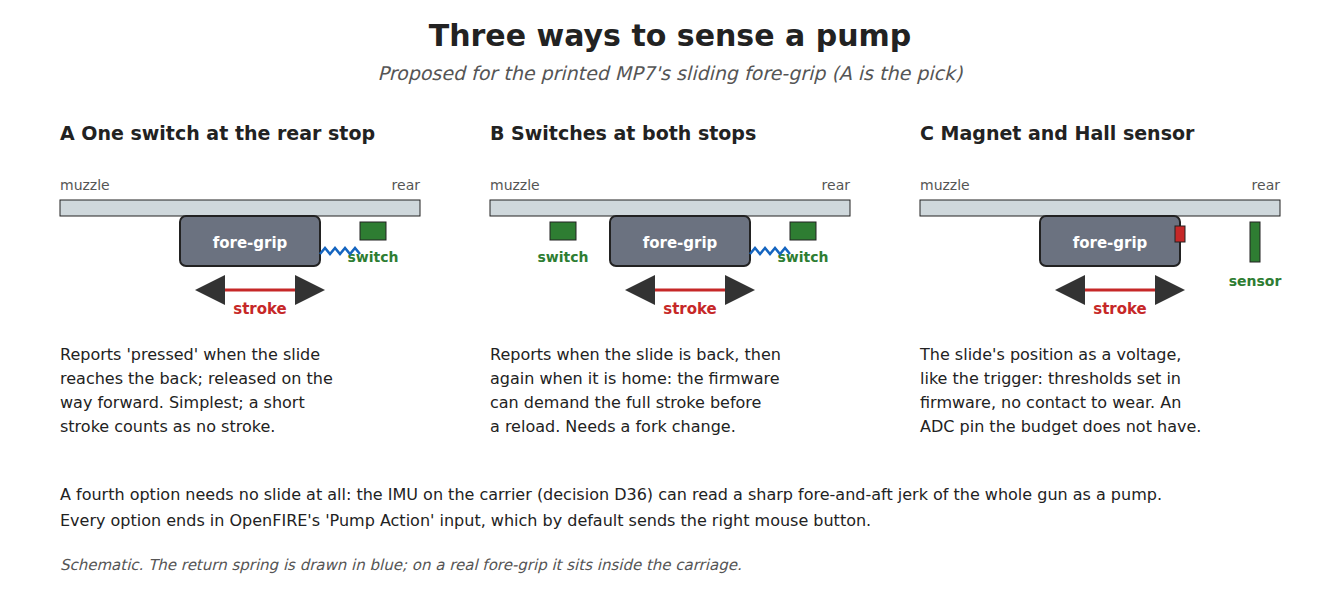
The real MP7 has no pump. Its folding fore-grip folds and locks; it does not slide (H&K’s manual: “In its folded position the grip is slightly locked, in its extended position the folding grip is firmly locked”). A pump on the printed MP7 is therefore a departure from the real gun, and three versions are possible:
- A sliding fore-grip. The printed grip rides on a short track under the receiver, spring-returned forward, and still folds. The support hand is already there. Proposed, as an optional part of the printed build that can be locked out for a gun that should look and work like the real one.
- The charging handle as the pump. The MP7’s charging handle is pulled straight back at the rear (Volume 2). Racking it is the real gun’s own “reload” gesture, and a D2F-01F at the end of its travel would sense it. But it is two-handed and slow, and Volume 2 gives it to Start.
- No pump. Shotgun games are played with the magazine-catch reload. The input stays free.
The choice is the owner’s, and depends on whether the builders want to play shotgun games on the MP7 at all or leave the pump for a later shotgun build in Actual Builds.
6.7 Sensing the Stroke
Table 2 — 6.7 Sensing the Stroke
| Method | What it reports | Cost | Verdict |
|---|---|---|---|
| A. One D2F-01F at the rear stop | pressed at the back of the stroke, released as it returns | one switch, one pin (already budgeted) | Picked. Works with stock firmware; a reload registers when the slide reaches the back, which is what a player expects |
| B. Switches at both ends | back, then home | two switches, two pins, and a fork change to combine them | Rejected: no pin, and A’s “short stroke does not count” already enforces most of a full stroke |
| C. Magnet and Hall sensor | position | an ADC pin | Rejected: no ADC pin left (the trigger and TMP36 take them) |
| D. The IMU (D36) | a sharp fore-and-aft acceleration | firmware only | Complement: works on a gun with no slide, and Positional and Inertial, Volume 6 lists a flick as a stand-in for a pump. Fork work |
The mechanical rules are the magazine catch’s (Volume 2, §2.4) and the trigger’s (Volume 4): a return spring firm enough that the solenoid’s kick cannot move the slide, a hard stop that ends the stroke inside the switch’s 0.25 mm of overtravel (the switch on a short lever, or the stop taking the load), and a detent at the rear so the end of the stroke is felt. A printed slide on a printed track clacks; a strip of felt or a rubber stop at each end is the difference between a pump and a rattle.
6.8 Why This, and Why Not the Others
Table 3 — 6.8 Why This, and Why Not the Others
| Choice | Picked | Rejected, and why |
|---|---|---|
| Pedal | A floor foot switch through a 3.5 mm TRS jack into the gun’s Pedal input; gold switch fitted inside | Sinden Arcade Pedal: excellent hardware, but a separate USB keyboard outside the gun’s mapping, at $237.49. A pedal on the gun’s own USB through a hub: more parts for nothing the jack does not do |
| Jack | 3.5 mm TRS, tip Pedal, ring Alt Pedal | 6.35 mm: larger hole, no gain; 2.5 mm: fragile; mono: one function only, and a TRS jack takes mono plugs anyway |
| Jack location | At the cable’s far end, carried up the umbilical (CI-7), if the GX pins allow | On the gun: a second cable from the grip (the fallback) |
| Pump | Optional sliding fore-grip, one switch at the rear (A) | Charging handle: two-handed, and it is Start. Hall slide: no ADC pin. Two switches: no pin |
6.9 What Could Not Be Verified
- The maker and rating of Namco’s pedal switch “K3L13” are not given in the manual.
- The Adafruit foot switch’s 250 VAC 10 A rating comes from a reseller’s listing, not Adafruit’s page.
- The Sinden pedal’s internal switch is not described by the seller.
- Whether the umbilical can carry the pedal line beside the solenoid return without false presses has not been tested.
- The stroke length and force for a printed sliding fore-grip are not yet designed.
Sources
- Namco, Time Crisis II Operation Manual (arcade), §7-2-1 and §8-1-1, §8-1-2. Central Library (read 2026-10-19).
- Namco, Time Crisis SD Operation Manual, §7-2-4 troubleshooting and §9-4 Pedal Assy parts list. Central Library (read 2026-10-19).
- Namco, Time Crisis 4 DX Operators Manual, Issue 2, “Fitting the Pedal Assy” and “How to Play”. Central Library (read 2026-10-19).
- Stone Age Gamer, Sinden Arcade Pedal, https://stoneagegamer.com/sinden-arcade-pedal.html (read 2026-10-19).
- Adafruit, Foot switch, product 423, https://www.adafruit.com/product/423 (read 2026-10-19).
- Adafruit Learning System, DIY Adaptive Game Controllers, “XAC Standards”, https://learn.adafruit.com/diy-adaptive-game-controllers/xac-standards (read 2026-10-19).
- Microsoft, Xbox Adaptive Controller product page, https://www.xbox.com/en-US/accessories/controllers/xbox-adaptive-controller (read 2026-10-19).
- Time Extension, Sinden Light Gun review (read 2026-10-19).
- Heckler & Koch, MP7 A1 Operators Manual (fax 2011), §3.2, via the H&K MP7 dive’s research file.
Comments (0)