Controls and Inputs · Volume 3
Switches Compared — Microswitches, Tact Switches, Navigation Switches, Rubber Domes and Hall Sensors, by the Datasheet
Force, travel, life and bounce from the makers' own sheets, and the number nobody checks: the minimum current a contact needs. A Pico's pull-up gives 41 to 66 µA; the 15 A microswitch a popular OpenFIRE build uses for its trigger asks for 160 mA
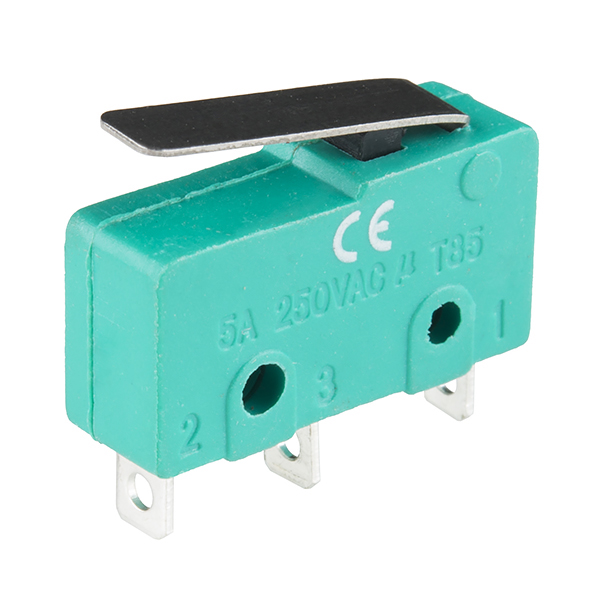
3.1 Five Ways to Make a Button
Table 1 — 3.1 Five Ways to Make a Button
| Family | How it works | Feel | Typical use in a light gun |
|---|---|---|---|
| Snap-action (“basic”, “micro”) switch | A pre-stressed spring blade flips the moving contact over at a set point and flips it back at a lower one | A distinct click at a fixed force; overtravel beyond it | Triggers, pedals, magazine catches, any lever |
| Tactile dome (“tact”) switch | A stamped metal dome collapses under a plunger and shorts two pads | A short, crisp click; very little travel | Side buttons, Start, Select |
| Navigation (multi-direction) switch | Several tact contacts under one tilting actuator, often with a centre press | A click in each direction | A D-pad on a small part |
| Conductive rubber dome | A moulded silicone dome with a carbon pill on its underside closes interleaved pads on a PCB | Soft, longer travel | Console controllers; the GunCon 2’s A, Start and Select |
| Hall-effect sensor | A magnet moves toward a sensor; there is no contact at all | Whatever the mechanism around it gives | The trigger (decision D8) |
The firmware treats all of them the same way: a contact (or an open-drain output) to ground, read through the RP2040’s internal pull-up (Reference Electronics, Volume 4, §4.2). What separates them is feel, life, size and one electrical property that the firmware cannot see, taken up in 3.4.
3.2 Reading a Snap-Action Datasheet
A snap-action switch’s datasheet gives its mechanics as a set of positions and forces, and each one is a design input for the lever or button that drives it.
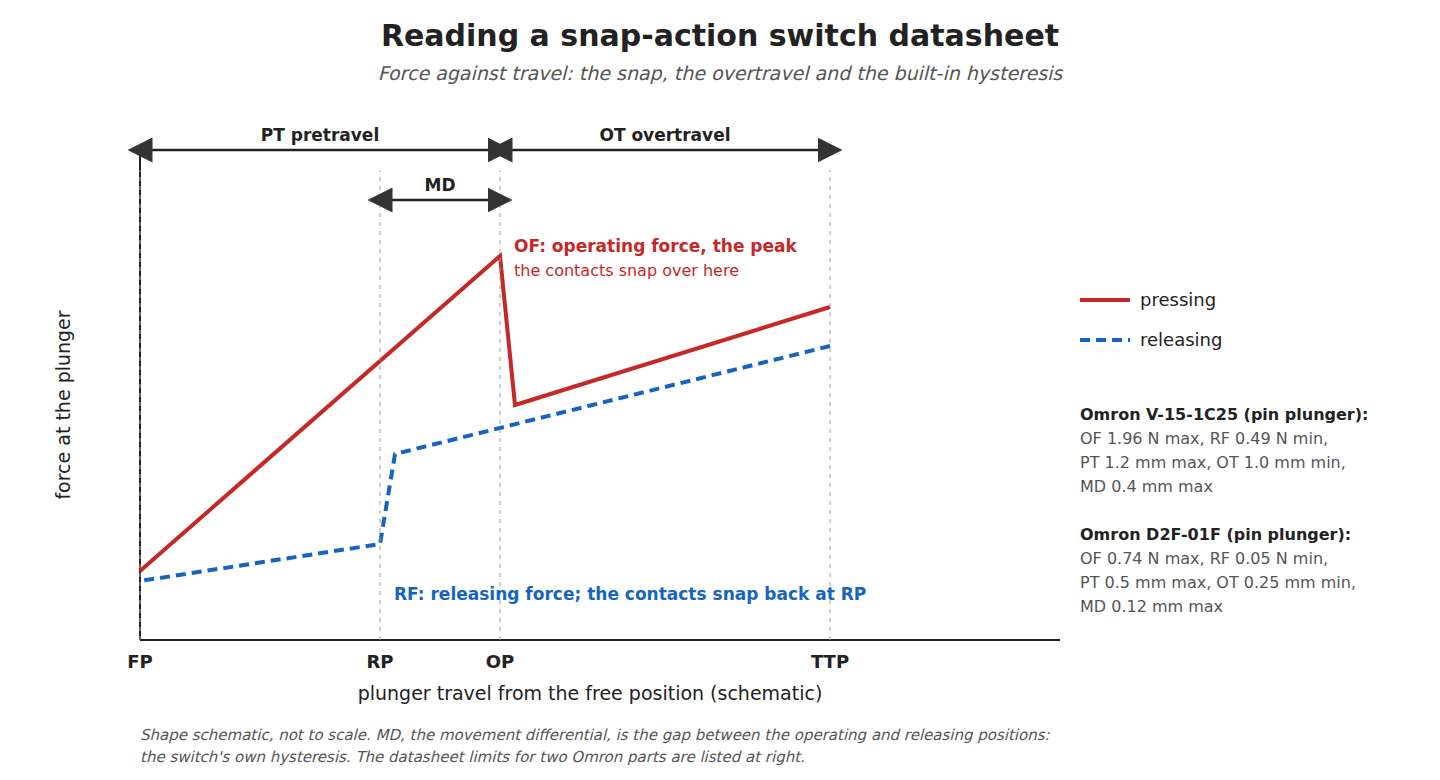
Table 2 — 3.2 Reading a Snap-Action Datasheet
| Term | Meaning | Why it matters on a gun |
|---|---|---|
| OF, operating force | force to make the switch operate (a maximum) | what the finger must overcome, added to any return spring in the lever |
| RF, releasing force | force below which it releases (a minimum) | the lever’s return spring must exceed it, or the switch sticks on |
| PT, pretravel | free position to operating position | slack before the click; on a trigger, the “take-up” |
| OT, overtravel | travel allowed past the operating point | the lever must stop inside it, or the switch is crushed |
| MD, movement differential | gap between operate and release | built-in hysteresis; the reason a snap-action switch does not chatter at the break point |
| OP, operating position | height at which it operates | sets where in the lever’s arc the click falls |
The MD is the snap-action switch’s quiet virtue. A finger resting near the operating point cannot make it flicker, because releasing needs the plunger to come back a fixed distance (0.12 mm on the D2F pin plunger, 0.4 mm on the V-15). The Hall trigger has no such thing in its silicon and has to be given it in firmware (Reference Electronics, Volume 4, §4.6: press at 50 % of the span, release at 40 %).
3.3 The Parts Side by Side
All figures are from the makers’ own datasheets or product pages, read 2026-10-19.
Table 3 — 3.3 The Parts Side by Side
| Part | Type | OF (max unless noted) | Travel | Mechanical life (min) | Contact | Minimum applicable load |
|---|---|---|---|---|---|---|
| Omron V-15-1C25 | miniature basic, pin plunger, 15 A 250 VAC, #187 tabs | 1.96 N | PT 1.2 mm max, OT 1.0 mm min, MD 0.4 mm max | 50,000,000 | silver alloy rivet, 1 mm gap | 160 mA at 5 VDC |
| Omron D2F | ultra-subminiature, pin plunger, 3 A 125 VAC | 1.47 N | PT 0.5, OT 0.25, MD 0.12 mm | 1,000,000 | silver alloy | 100 mA at 5 VDC |
| Omron D2F-01F | the same, 0.1 A 30 VDC, low force | 0.74 N | PT 0.5, OT 0.25, MD 0.12 mm | 1,000,000 (electrical 100,000) | gold alloy | 1 mA at 5 VDC |
| Omron D2F-01FL (hinge lever) | the same with a lever | 0.25 N | OT 0.55, MD 0.5 mm | 1,000,000 | gold alloy | 1 mA at 5 VDC |
| Omron SS-01 | subminiature, 0.1 A | 1.47 N (−F: 0.49, −E: 0.25) | per actuator | 30,000,000 | gold alloy crossbar | 1 mA at 5 VDC |
| Omron B3F-1000 | 6 × 6 mm tact switch | 0.98 ± 0.29 N | PT 0.25 +0.2/−0.1 mm | 1,000,000 | silver plated | 10 µA at 1 VDC |
| Omron B3F-1002 / -1005 | the same, firmer | 1.47 / 2.55 N | 0.25 mm | 300,000 / 100,000 | silver plated | 10 µA at 1 VDC |
| Alps SKRHABE010 | 4-way + centre push, SMD, 7.35 × 7.5 × 1.8 mm | 1.23 ± 0.69 N (directions), 2.35 ± 0.69 N (push) | 0.25 mm (directions), 0.15 mm (push) | 200,000 per direction and push | — | 10 µA at 1 VDC |
| TI DRV5023 / DRV5056 | Hall switch / linear sensor | none (contactless) | set by the mechanism | no contact to wear | — | — (powered: see Reference Electronics, Volume 4) |
The V-15-1C25 is in the table because it is the trigger switch the PICON-AS OpenFIRE build names (Reference Electronics, Volume 4, §4.5). Decoding Omron’s model legend: V-15 is the 15 A rating, the 1 is SPDT, C2 is #187 quick-connect terminals and the final 5 is the 1.96 N operating force on a pin plunger. The SS-01 is there because it is what Namco fitted. The parts list in the Time Crisis SD operation manual gives the gun’s microswitch as “SS-01GL2T”: an SS-01 with a hinge roller lever (GL2) and #110 tabs (T), gold contacts.
Two bounce figures are published. The B3F’s datasheet gives “Bounce time 5 ms max.” The D2F’s sheet says “Close or open circuit of the contact is 1ms max”, but that sentence is the malfunction criterion for its vibration and shock ratings, not a bounce specification. None of the snap-action sheets read gives a bounce time. Volume 5 takes up what that means for the firmware.
3.4 The Minimum Current
Every Omron basic-switch datasheet carries a line most hobby builds never read: the minimum applicable load. For a silver contact it is 100 to 160 mA at 5 VDC; for the gold versions, 1 mA at 5 VDC. The D2F sheet states the consequence in its precautions: “Using a model for ordinary loads to open or close the contact of a micro load circuit may result in faulty contact. Use models that are designed for micro loads,” and describes the value as an “N-level reference value”, a reliability reference rather than a cliff.
A light-gun input runs at a tiny current. The RP2040’s internal pull-up is 50 to 80 kΩ (datasheet, GPIO electrical characteristics), so a closed switch carries 41 to 66 µA at 3.3 V.
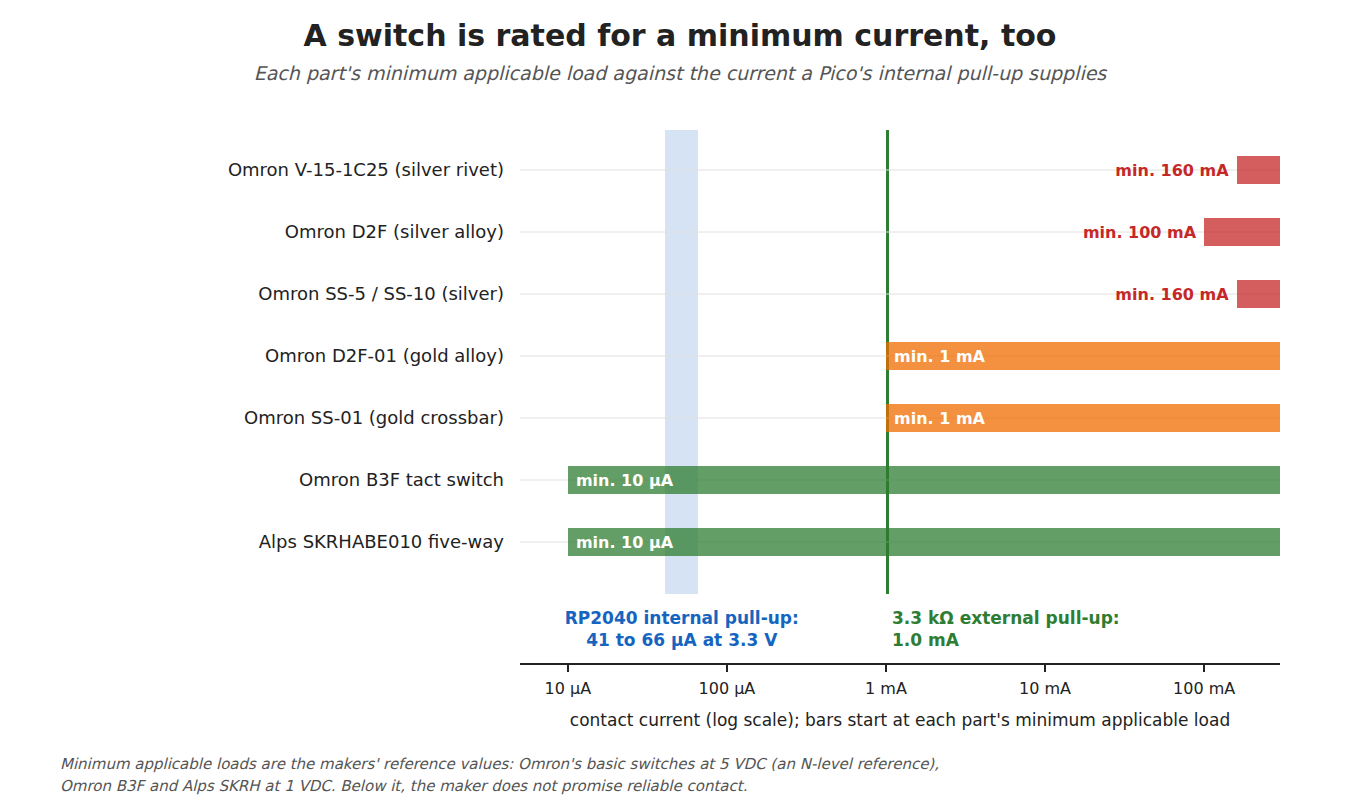
Three conclusions follow.
A mains-rated microswitch is the wrong part for a light-gun input, however good it feels. The V-15-1C25 runs at roughly 1/2,400 to 1/3,900 of its minimum reference load on an internal pull-up. Silver contacts rely on current and contact force to break through the surface film they grow; at microamps there is neither. Such switches often work for a while; the datasheet simply does not promise that they will keep working. Reference Electronics, Volume 4, §4.5 already advises gold or “low level” contacts; the datasheets turn that advice into numbers.
Even the gold microswitches are below their reference on an internal pull-up. The gold D2F-01 and SS-01 are rated to 1 mA. Namco’s choice of a gold SS-01 for an arcade gun shows the right instinct, but an arcade I/O board’s input circuit is not the RP2040’s 50 kΩ pull-up.
The fix costs one resistor per microswitch. An external pull-up of 3.3 kΩ to 3.3 V gives 1.0 mA through a closed contact, which meets the gold parts’ reference value. Six microswitch inputs held closed together draw 6 mA, which is nothing on a USB-powered gun. The tact switches and the navigation switch need nothing; they are rated to 10 µA. This is a change to the reference circuit, which belongs to Reference Electronics, Volume 4; it is proposed here as decision-log row CI-3 (Volume 7) and not drawn into that volume’s schematic.
3.5 Tact Switches: Force Buys Feel and Costs Life
The Omron B3F family shows the trade every tact switch makes: a firmer click wears the dome out sooner. From the datasheet: 1,000,000 operations at 0.98 N, 300,000 at 1.47 N, 100,000 at 2.55 N and 50,000 at 4.9 N. (The long-life B3F-4000 and B3F-5000 lines push that to 3 million and 10 million.)
For a light gun’s A button, a sensible target is the light end. At one press every few seconds, a player who uses A heavily might press it a few thousand times in an evening; the 0.98 N part’s million operations are years of play. The firmer parts are better reserved for buttons that must resist the squeeze of a grip, which this layout avoids by placement instead (Volume 2, §2.8). A printed cap over the switch adds its own spring and travel, and in practice the cap, not the switch, decides the feel; the switch decides the click and the life.
The B3F-1000 is 4.3 mm tall with a flat plunger and is a through-hole part, which suits a small daughter board or a hand-wired switch glued into a printed boss. Its rating (1 to 50 mA, 3 to 24 VDC) and its 10 µA minimum mean it runs correctly on the internal pull-up.
3.6 One Part for the D-pad and Home
The Alps SKRHABE010 is a four-direction switch with a centre push in a 7.35 × 7.5 × 1.8 mm surface-mount body. Alps gives 1.23 N for the directions and 2.35 N for the push, so a thumb rolling across the directions does not press Home by accident: the centre press needs nearly twice the force. Travel is 0.25 mm in each direction and 0.15 mm on the push, which a printed cross-shaped cap can multiply into something a thumb can feel.
Its life, 200,000 operations per direction, is a fifth of the B3F-1000’s. That is fine for a D-pad used in menus; it would not be for a button used in play. Its rating (50 mA maximum, 10 µA minimum at 1 VDC) suits the internal pull-up. It is a surface-mount part, so it wants a small PCB under the receiver panel, connected to the carrier by the five-way JST PH lead Reference Electronics already allocates to the D-pad (Reference Electronics, Volume 4, §4.8), plus one more conductor for Home.
Alps sells this part by the 1,300-piece reel; LCSC sells single pieces (3.9).
3.7 Rubber Domes and Hall Sensors
Conductive rubber is what the GunCon 2 used for A, Start and Select (Modding Classic Light Guns, Volume 2 covers cleaning and repair). It needs a PCB with interleaved pads under every button and a moulded silicone sheet, both of which make sense for a production run on a custom board and not for a printed prototype. No rubber-dome datasheet was read for this volume, so no numbers are offered for it; it is not used in this build.
Hall-effect sensors remove the contact entirely. The trigger uses one by owner decision (D8), and Reference Electronics, Volume 4, §4.6 chooses the DRV5056A4 linear sensor with a DRV5023 switch as its stock-firmware stand-in. Using Hall sensors for every button is possible and is how “magnetic” keyboard switches work, but it costs a powered sensor, a magnet and a mechanism per button, and for buttons pressed a few thousand times a session the contact’s wear is not the limit. The trigger is different because it is pressed most, and because an analog reading lets its break point be set in firmware (Volume 4).
3.8 The Picks
Table 4 — 3.8 The Picks
| Input | Pick | Why | Why not the others |
|---|---|---|---|
| Trigger | DRV5056A4 Hall sensor (Reference Electronics’ pick) | D8; no contact; break point in firmware; analog for a two-stage feel later (Volume 4) | A microswitch: wears, fixed break point; the V-15: fails 3.4 outright |
| Magazine catch (reload) | Omron D2F-01F, gold, pin plunger, 0.74 N | Gold contacts; low force, so the catch spring sets the feel; 0.12 mm MD stops chatter; 0.5 g body fits behind a printed catch | V-15: silver, 160 mA minimum, too big. SS-01: gold too, but larger and the stocked variant was out at LCSC. A tact switch: no overtravel for a lever that might be pushed hard |
| Selector (two contacts) | 2 × D2F-01F on cams on the selector shaft | Same part as the catch; OT 0.25 mm absorbs cam tolerance | A rotary switch: no gold-contact part was found in a size that fits behind a selector; to revisit when the shell is drawn |
| Bolt-catch lever (B), charging handle (Start), stock lever (Select), pump end stop | D2F-01F | One part number for every lever: one bag of spares, one footprint (D11: kits) | Different parts per position: no gain |
| A (thumb button) | Omron B3F-1000, 0.98 N | Rated to 10 µA; 1 M life; crisp click under a printed cap | B3F-1002/-1005: shorter life for a firmness the cap can supply |
| D-pad and Home | Alps SKRHABE010 | One part, five inputs; push force about twice the directions’, so Home is hard to hit by accident | Four tact switches under a printed cross: four parts, more holes, and Home needs a fifth |
| Pedal | the pedal’s own switch, through a jack (Volume 6) |
Every microswitch pick (D2F-01F) gets a 3.3 kΩ external pull-up (3.4).
3.9 Where to Buy
Prices are from each seller’s own product page on 2026-10-19, in US dollars. DigiKey, Mouser, RS and TME pages refused automated reading, so their prices are not given; the part numbers are standard and stocked by all of them.
Table 5 — 3.9 Where to Buy
| Part | Seller | Price (2026-10-19) | Stock shown | Link |
|---|---|---|---|---|
| Omron D2F-01F | LCSC C403989 | $0.6446 each (1+); $0.5377 (10+) | 926 | https://www.lcsc.com/product-detail/C403989.html |
| Omron B3F-1000 | LCSC C93157 | $0.1874 each (minimum order 5) | 6,500 | https://www.lcsc.com/product-detail/C93157.html |
| Alps SKRHABE010 | LCSC C139794 | $0.78 each (1+); $0.6418 (10+) | 7,313 | https://www.lcsc.com/product-detail/C139794.html |
| Omron SS-01GL2 (for comparison) | LCSC C231399 | $0.99 (1+), reference price | out of stock | https://lcsc.com/product-detail/Microswitches_Omron-Electronics-SS-01GL2-BY-OMI_C231399.html |
| TI DRV5056A4 | see Reference Electronics, Volume 9 |
A first set for the printed gun is seven D2F-01F (catch, two on the selector, bolt catch, charging handle, stock lever, pump) plus spares, two B3F-1000 (A, left and right), and one SKRHABE010: about $9 at LCSC’s single-piece prices, before shipping.
3.10 What Could Not Be Verified
- No snap-action datasheet read gives a bounce time; the B3F’s 5 ms is the only published bounce figure here.
- Omron’s minimum applicable load is a reliability reference; no published failure data for gold or silver microswitches at 40 to 70 µA was found. The long-run test in 3.4 is the way to find out.
- LCSC lists the SS-01GL2 as “SPST-NC”; Omron’s legend makes an SS-01GL2 an SPDT part. The listing is probably wrong.
- Gaming-mouse microswitches (Omron’s D2FC family) are designed for low-current logic inputs, but their datasheet could not be retrieved for this volume, so none is compared.
- No rubber-dome datasheet was read.
Sources
- Omron, D2F Ultra Subminiature Basic Switch, Cat. No. B036-E1-12: model legend, contact specifications, characteristics, operating characteristics and precautions. https://omronfs.omron.com/en_US/ecb/products/pdf/en-d2f.pdf (read 2026-10-19).
- Omron, V Miniature Basic Switch datasheet: model legend, contact specifications, characteristics, pin-plunger operating characteristics. https://omronfs.omron.com/en_US/ecb/products/pdf/en-v.pdf (read 2026-10-19).
- Omron, SS Subminiature Basic Switch datasheet: model legend, contact specifications, characteristics. https://omronfs.omron.com/en_US/ecb/products/pdf/en-ss.pdf (read 2026-10-19).
- Omron, B3F Tactile Switch datasheet: models, ratings, bounce time, durability, operating characteristics. https://omronfs.omron.com/en_US/ecb/products/pdf/en-b3f.pdf (read 2026-10-19).
- Alps Alpine, SKRHABE010 product page, SKRH series. https://tech.alpsalpine.com/e/products/detail/SKRHABE010/ (read 2026-10-19).
- Raspberry Pi Ltd, RP2040 Datasheet, GPIO pad control (SCHMITT) and electrical characteristics (pull-up resistance). Central Library text
rp2040-datasheet(read 2026-10-19). - Namco, Time Crisis SD Operation Manual, §9-5 Gun Assy parts list. Central Library (read 2026-10-19).
- LCSC product pages C403989, C93157, C139794 and C231399 (read 2026-10-19).
Comments (0)