Controls and Inputs · Volume 4
Trigger Feel — Pull Weight, Take-Up, the Break and the Reset, for a Trigger With No Contact in It
A Hall sensor reports where the trigger is and nothing else. The wall, the break, the overtravel and the reset that a gunsmith would recognise all have to be built around it, and the firmware's firing point should be set to the felt break, not to a percentage
4.1 The Vocabulary
The words are a gunsmith’s, used here in their ordinary sense: take-up (or pretravel) is the light travel before resistance builds; the wall is the point where resistance rises sharply; the break is where the shot goes; overtravel is the travel after the break before the trigger stops; the reset is how far the trigger must come forward before it will fire again. A snap-action switch’s datasheet describes the same things in its own terms (Volume 3, §3.2): pretravel, operating force, overtravel and movement differential.
A light-gun trigger is judged on the same five things as a firearm’s, by the same hands, and the decision to use a Hall sensor (D8) changes which of them come for free.
4.2 How Heavy
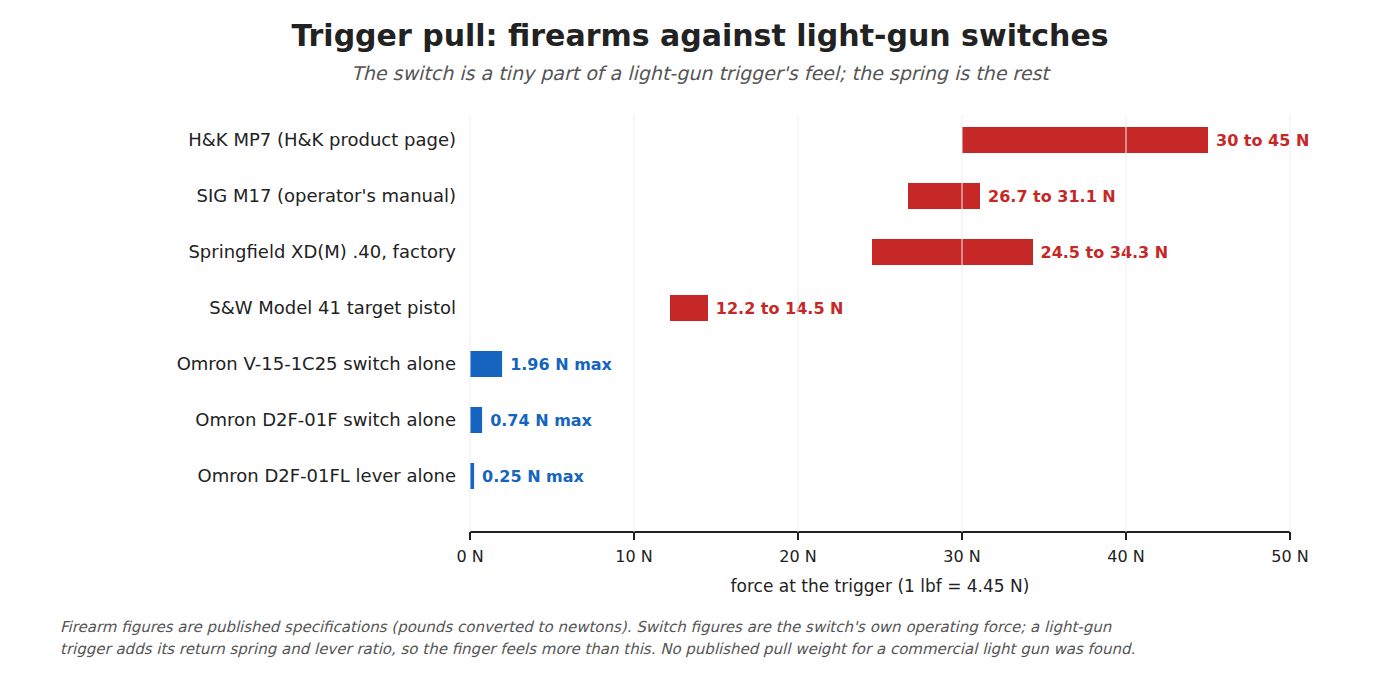
The firearm figures, converted at 4.45 N per pound-force:
Table 1 — The firearm figures, converted at 4.45 N per pound-force
| Firearm | Published pull | In newtons | Source |
|---|---|---|---|
| H&K MP7 | 30–45 N | 30–45 N | H&K product page, via the H&K MP7 dive |
| SIG M17 | 6.0–7.0 lb | 26.7–31.1 N | operator’s manual §18.2, SIG P320-M17, Volume 2 |
| Springfield XD(M) .40, factory | 5.5–7.7 lb | 24.5–34.3 N | Springfield XD(M) .40, Volume 1 |
| S&W Model 41 | 2.75–3.25 lb | 12.2–14.5 N | S&W specification, S&W Model 41, Volume 3 |
No pull weight for any commercial light gun was found published. Neither Namco’s arcade manuals nor the GunCon sources give one; the Modding Classic Light Guns dive leaves a slot to weigh a GunCon 2 trigger with a gram gauge. What can be said from the parts is that a microswitch trigger’s pull is the switch’s operating force (a few newtons at most) plus whatever return spring the designer added, and a light gun’s is built light.
There are good reasons for that. A light-gun game asks for far more trigger pulls than any range session; a player in a gallery game fires as fast as a finger will go, and a 30 N trigger worked for an hour would hurt. A realistic MP7 light gun therefore faces a real choice between realism (a pull near the real gun’s) and play (a pull a player can work for a whole game). A trigger built so that the spring can be changed lets the builders find out which they prefer rather than guess. A starting proposal, not drawn from any source: a light pull of the order of 5 N for play, with a spring that can be swapped toward 15 N to see how much realism the builders want, and the real MP7’s 30 N treated as a ceiling nobody is likely to want for a game.
4.3 What a Microswitch Trigger Feels Like, and Why
A conventional light-gun trigger is a blade on a pivot with a microswitch behind it. The switch provides three of the five qualities in 4.1 without anyone designing them:
- The wall and the break are the switch’s own snap: the force rises to its operating force and falls as the contacts snap over (Volume 3, figure “Reading a snap-action switch datasheet”). The finger feels it, and the shot is registered at exactly that instant, because the snap is the electrical event.
- The reset is the switch’s movement differential: the trigger must come back 0.12 mm (D2F pin plunger) to 0.4 mm (V-15) at the plunger before the contacts release.
- The overtravel is whatever the blade allows before it hits the switch body; a good design stops the blade inside the switch’s rated overtravel.
That coincidence of feel and function is why microswitch triggers feel “right” with very little design, and why the snap of an arcade gun’s trigger is so recognisable. It is also what a Hall trigger gives up.
4.4 What the Hall Trigger Has to Be Given
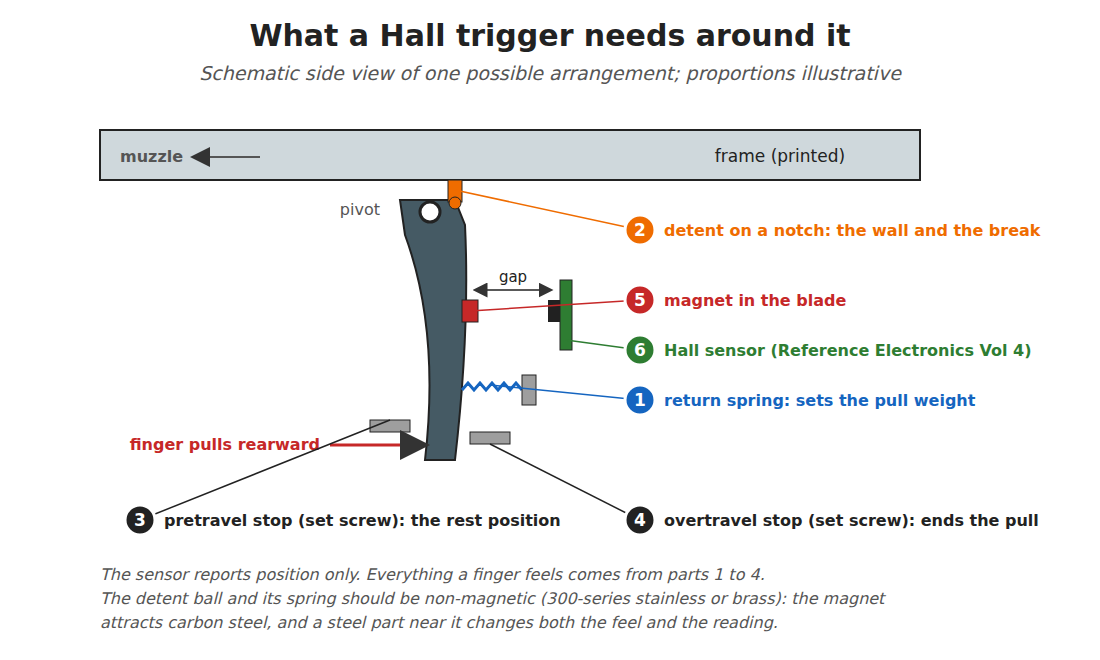
A Hall sensor reports a voltage that rises smoothly as the magnet approaches (Reference Electronics, Volume 4, §4.6). There is no snap, no wall and no reset in it. A Hall trigger with only a return spring feels like a spring: resistance rising steadily from rest to full pull, and a shot that goes somewhere in the middle with nothing to tell the finger where. Every quality in 4.1 has to be built:
- A return spring sets the pull weight. A torsion spring on the pivot or a small compression spring behind the blade; its rate times the travel at the spring, scaled by the lever ratio to the finger, is the pull. It should be the swappable part (4.2, 4.8).
- A detent makes the wall and the break: a spring plunger bearing on a notch or a ramp on the blade (or on a cam at the pivot). Force rises as the plunger climbs the ramp and drops as it passes the crest, which is the break. The detent’s own spring sets how pronounced the wall is.
- A pretravel stop sets where the trigger rests, so that the take-up is defined. A set screw against the front of the blade.
- An overtravel stop ends the pull just after the break, so that the blade cannot slam the magnet into the sensor and the gap at full pull is known. A second set screw.
A cheaper wall: a switch used only for its click. An unwired D2F-01F behind the blade gives a real snap at a known point, at the cost of a contact that will eventually wear (which matters little, since nothing reads it). Wired to a spare input it would also give the firmware a second, digital report of the break as a cross-check. That costs a pin the kit-camera budget does not have (Volume 1, §1.6). The plunger detent is the cleaner design; the switch is a quick way to get a wall on a first prototype.
Keep steel away from the magnet. The trigger magnet attracts carbon steel. A steel detent ball or spring near it is pulled toward the magnet, which changes the feel, and a steel part in the field between magnet and sensor changes the reading. A 300-series stainless ball and spring, or brass, avoids both. The magnet itself must also stay clear of the solenoid (Reference Electronics, Volume 4: standard N-grade magnets are rated to 80 °C).
4.5 Firing at the Break
Reference Electronics, Volume 4 proposes that the fork read the Hall sensor through the ADC, calibrate a rest count and a full-pull count, and fire at 50 % of the span and release at 40 %. Those numbers are a sound electrical default. With a detent in the mechanism, though, a percentage is the wrong reference: the shot should go at the felt break, and where the break falls in the span depends on where the detent’s notch was printed, which will not be at exactly 50 %.
The fix is a third calibration point. The calibration step asks the player to pull slowly to the break and hold (the detent makes that point easy to find and hold), records that count, and then sets:
- press threshold = the break count plus a small margin (a few percent of the span), so the shot goes as the detent is passed and not while the finger is still resting against the wall;
- release threshold = the break count minus the hysteresis (4.6).
The rest and full-pull counts are still needed: the fault detection (a reading outside the calibrated range means a failed sensor, treated as “not pressed”) and the drift tracking in Reference Electronics’ list both use them. This is a change to the fork’s calibration routine, logged as proposed row CI-5 for Our Firmware (Volume 7 lists the rows).
4.6 Reset, and How Fast a Player Can Shoot
In a Hall trigger the reset is the gap between the press and release thresholds: the trigger must come forward past the release point before another pull will fire. Reference Electronics’ example puts it at 10 % of the span, about 150 ADC counts against about 4 counts of noise, which is ample margin against chatter.
That 10 % is also a feel parameter. A short reset lets a player fire quickly by letting the trigger forward only a little; a long one forces a full release. For a game, short is better. The detent helps here too: if the release threshold sits just in front of the detent’s crest, the trigger resets as the plunger drops back into the notch, which the finger feels, much as a firearm’s reset is felt.
The firmware sets a ceiling on the rate. In stock OpenFIRE (the digital DRV5023 path), each accepted change of state starts a lockout of 15 ms for the trigger before the input is read again (Volume 5), so a full press-and-release cycle cannot take less than about 30 ms, a little over 30 pulls a second. No finger approaches that. The fork’s analog path need not use the button library’s lockout at all, since the threshold hysteresis already rejects noise; Volume 5 takes that up.
4.7 Two Stages and an Analog Trigger
Because the sensor reports position rather than a single make or break, the same hardware can later do things a microswitch cannot.
- A two-stage trigger in the firearm sense (a long, light first stage to a wall, then a crisp second stage) is a mechanism matter: two springs, the second engaged partway through the travel. The sensor needs nothing extra.
- A two-stage trigger in the game sense is a half-pull that does something, such as aiming down a scope, with the full pull firing. Namco’s Time Crisis 4 gives the sniper-rifle zoom to the pedal (“When the pedal is pressed, the screen zooms toward the target”); a trigger that zooms on a half-pull and fires at the break is the hand-held version. It needs the fork to report a second input at a first threshold.
- An analog trigger reports the position itself to the computer, as a gamepad’s trigger axis. OpenFIRE’s gamepad mode reports the trigger as a button (
PAD_RTin the descriptor table ofOpenFIREprefs.h), not an axis, so this too would be fork work and is noted for Our Firmware. No light-gun game known to this dive reads an analog trigger; it is listed as a possibility, not a requirement.
4.8 Adjustment
Table 2 — 4.8 Adjustment
| Parameter | Adjusted by | Why it should be adjustable |
|---|---|---|
| Pull weight | swapping the return spring | the realism-against-play choice in 4.2 is a matter of taste |
| Take-up (pretravel) | front set screw | some players want none; a realistic MP7 trigger has some |
| Wall strength | the detent’s spring, or a deeper notch | how pronounced the break feels |
| Overtravel | rear set screw | short is crisper; it also protects the sensor |
| Firing point and reset | firmware calibration (4.5) | follows the mechanism; recalibrate after any mechanical change |
Every mechanical change moves the counts the firmware has stored, so the rule is: adjust, then recalibrate. A trigger calibrated before its pretravel screw was turned will fire early or late.
4.9 Measuring It
A trigger’s feel is a force-travel curve, and the bench can measure one. A gram gauge or trigger-pull gauge on the blade at the finger position, read at steps of travel measured with a dial indicator or calipers, gives force against travel; the ADP3450’s voltmeter on the sensor output at the same steps gives the electrical curve. Plotted together, they show whether the firing point (4.5) sits where the force drops.
4.10 Why This, and Why Not the Others
Table 3 — 4.10 Why This, and Why Not the Others
| Choice | Picked | Rejected, and why |
|---|---|---|
| Wall and break | Spring-plunger detent on a notch, non-magnetic parts | Spring only: no break, the shot falls somewhere in a smooth pull. An unwired microswitch: works, wears, kept as a prototype shortcut |
| Firing point | At the felt break, by a three-point calibration (CI-5) | Fixed 50 % / 40 %: correct electrically, but the shot and the break would not coincide |
| Pull weight | Swappable spring; start light (about 5 N, a proposal) | Fixed at the real MP7’s 30–45 N: realistic, tiring over a game. Fixed light: forecloses the realism the build wants |
| Reset | Release just in front of the detent’s crest | A large fixed hysteresis: slower follow-up shots for no gain |
| Analog trigger output | Not now | No game in the target library reads one; fork work |
4.11 What Could Not Be Verified
- No published pull weight for any commercial or arcade light gun was found.
- The 5 N starting point is a proposal for a bench trial, not a sourced figure.
- The detent geometry (notch depth, plunger spring) depends on the printed blade and has not been drawn.
- Whether a stainless detent ball near an N52 magnet is truly unaffected should be checked on the bench: 300-series stainless can become slightly magnetic when cold-worked.
Sources
- Heckler & Koch, MP7 product page (“trigger pull 30–45 N”), as recorded in the H&K MP7 dive’s research file
research-specs-ammo.md. - The hub’s SIG P320-M17, Springfield XD(M) .40 and S&W Model 41 dives, volumes cited above, for published trigger-pull specifications.
- Omron, D2F and V datasheets (operating force, movement differential), read 2026-10-19.
- Texas Instruments, DRV5056 datasheet, as read in Reference Electronics, Volume 4.
- Namco, Time Crisis 4 DX Operators Manual, Issue 2, “How to Play” (sniper-rifle event). Central Library.
- TeamOpenFIRE, OpenFIRE-Firmware v6.2,
OpenFIREmain/OpenFIREprefs.h(trigger reported asPAD_RT; 15 ms debounce), read 2026-10-19.
Comments (0)