.17 Rimfires · Volume 7
Arrival — What a .17 Does to a Varmint, a Predator and the Pot
Terminal performance from the bullet makers' own descriptions and published energies: fragmenting varmint bullets, the loads built not to expand, the coyote question, and where the Mach 2 runs out
7.1 Arrival — What a .17 Does to a Varmint, a Predator and the Pot

A .17 rimfire bullet weighs 15 to 25 grains. What it does on arrival is decided almost entirely by how it is built, because there is so little of it: a polymer-tipped, thin-jacketed bullet at 2,000 to 3,000 fps comes apart in a small animal; a full metal jacket at the same speed punches through. The makers build both on purpose. This volume sets out what they say each bullet is for, what the published energies allow, and where the evidence runs out.
There is no controlled terminal-ballistics data for these cartridges in any maker’s literature read for this dive: no gelatine figures, no penetration depths, no recovered-weight tables. What follows is the makers’ stated design intent, the energies they publish, and a small number of attributed field observations. Nothing here is a measured wound result.
7.1.1 Two kinds of bullet
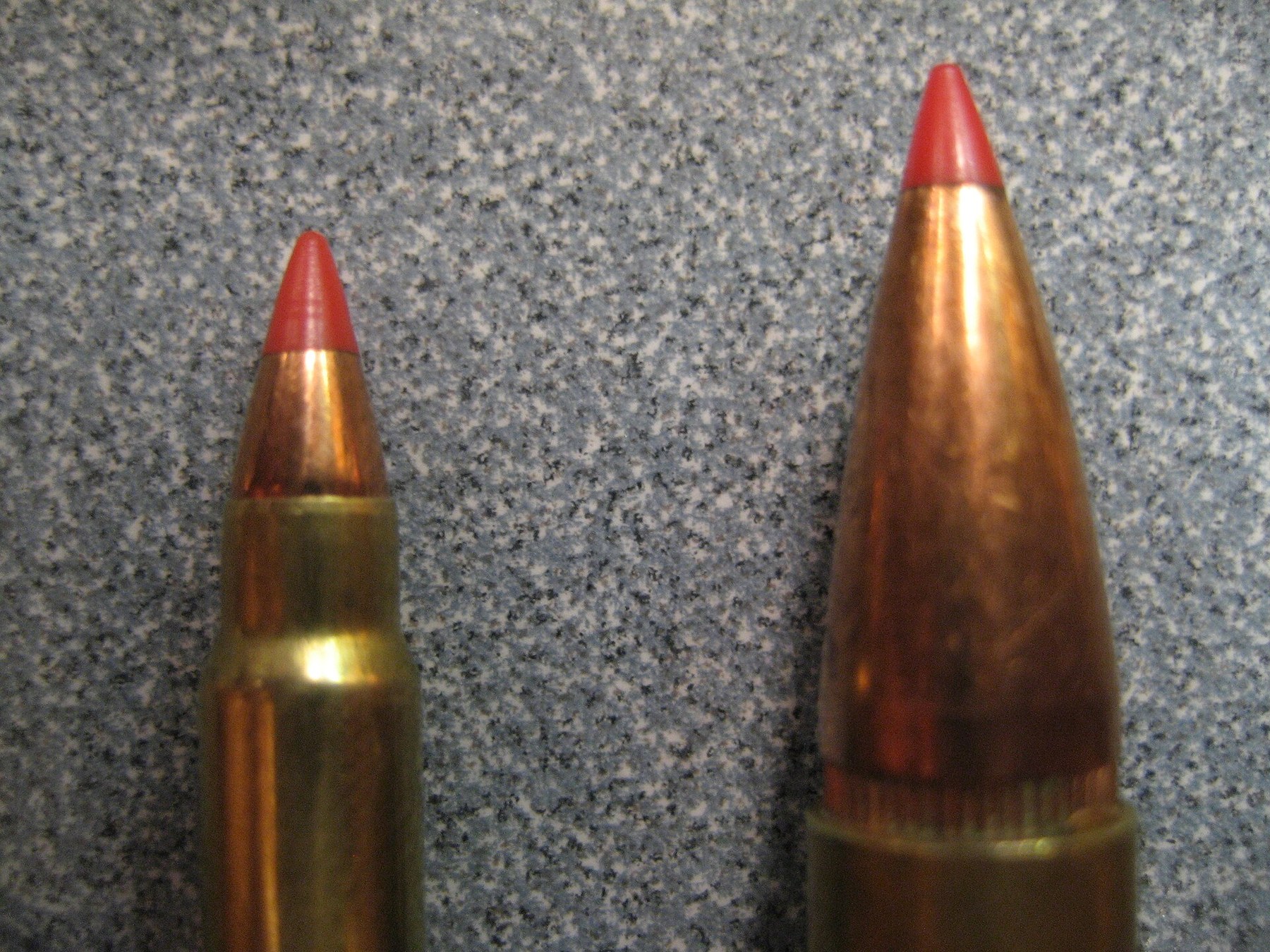
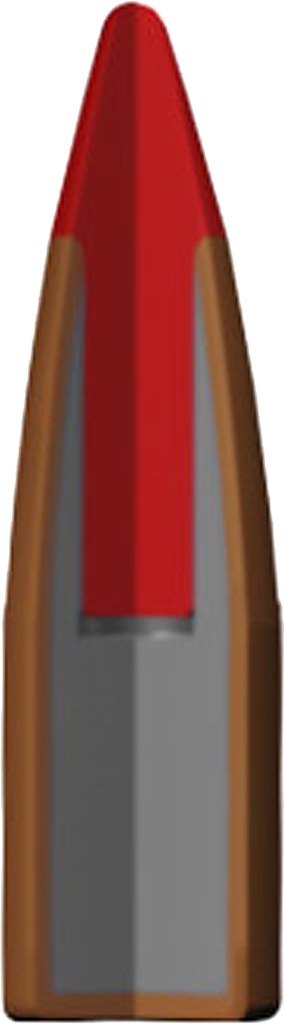
Built to come apart. Most .17 loads are varmint bullets designed to fragment.
- Hornady’s V-MAX, used in its own .17 HMR and .17 Mach 2 loads and loaded by CCI, Federal and Winchester: “Hornady’s V-MAX® bullets consistently achieve rapid fragmentation at all practical varmint shooting velocities”; “the polymer tip … creates dramatic expansion on impact.”1
- CCI’s VNT, a Speer bullet: “an extremely thin jacket and polymer tip” for “explosive terminal performance on impact”. CCI’s TNT hollow point: “explosive expansion on impact”. CCI’s A17 “Varmint Tip”: “explosive expansion and quick, clean kills.”2
- Winchester’s 17 WSM loads: the 20-grain Varmint HV is “about velocity”; the 25-grain Varmint HE “delivers maximum shock and deep penetration for an instant terminal upset upon impact”; the lead-free Varmint X has a “thin jacket with engineered sidewall profile for explosive fragmentation”.3
Built not to. A small number of .17 HMR loads exist for the opposite job.
- CCI’s 20-grain Full Metal Jacket: “Put more meat in your stew and less into scrap with our Small Game FMJ. It’s accurate, consistent and punches clean holes to minimize meat loss.” Its feature list says “No expansion”. CCI says the load is “a CCI exclusive”.2
- CCI’s 20-grain Gamepoint jacketed soft point: its “Dimple Tip allows the bullet to expand like a big game bullet for maximum energy transfer. The accurate, powerful load also minimizes meat and hide damage.”2
- Hornady’s 20-grain XTP hollow point is described only as “an accurate and hard hitting hollow point bullet for a wide range of varmints”; Hornady does not market it for meat.1
So the common line that a .17 HMR is the wrong cartridge if you want to eat what you shoot, which this hub’s .22 Rimfire dive prints, is true of the varmint loads and not of the cartridge. CCI makes two .17 HMR loads specifically for the pot. There is no equivalent load for the .17 Mach 2 or the .17 WSM: every load in both is a fragmenting varmint bullet (Volume 5).
Lead-free. Hornady’s 15.5-grain NTX (“a non-traditional core material … for use in areas with restrictions on the use of traditional bullets”), Winchester’s Varmint LF (which uses the NTX bullet), CCI’s 16-grain TNT Green and Winchester’s 15-grain WSM Varmint X are the lead-free options.132 They are lighter than the lead loads they replace and, on the makers’ own tables, carry less energy at range (Volume 5).
7.1.2 Energy at range
Energy is not killing power, and nothing in this section claims it is. It is the one terminal-related number every maker publishes, it is the number hunting rules are sometimes written around, and it shows plainly where each cartridge sits. From the makers’ own tables:1234
Table 1 — 7.2 Energy at range
| Load | Muzzle | 100 yd | 150 yd | 200 yd |
|---|---|---|---|---|
| .17 Mach 2, Hornady 17 gr V-MAX | 166 ft·lbf | 88 | — | 48 |
| .17 Mach 2, CCI 17 gr VNT | 152 | 80 | — | — |
| .22 LR, Federal 40 gr CPRN | 137 | 91 | 79 | — |
| .17 HMR, Hornady 17 gr V-MAX | 245 | 137 | — | 72 |
| .17 HMR, Hornady 20 gr XTP | 250 | 137 | — | 72 |
| .17 HMR, CCI 17 gr A17 | 265 | 151 | — | — |
| .22 WMR, Hornady 30 gr V-MAX | 322 | 141 | — | 70 |
| .22 WMR, Federal 50 gr JHP | 260 | 159 | 131 | — |
| .17 WSM, Winchester 25 gr Varmint HE | 375 | 276 | 235 | 199 |
| .17 WSM, Winchester 20 gr Varmint HV | 400 | 278 | 230 | 188 |
Three points stand out.
- The .17 Mach 2 carries about the energy of a .22 Long Rifle at 100 yards (80 to 88 ft·lbf against 91), in a bullet less than half the weight. It shoots flatter; it does not hit harder.
- The .17 HMR and the .22 WMR are an even match in energy at 100 to 200 yards (137 against 141 at 100 yards, 72 against 70 at 200 on Hornady’s figures), though the HMR starts with less. The 50-grain .22 WMR carries more energy at 100 and 150 yards than any HMR load.
- The .17 WSM at 200 yards carries more energy than the .17 HMR at 100. That is the WSM’s case in one line.
7.1.3 By quarry

What follows combines the makers’ stated uses with the energies above. The makers’ wording is quoted; the rest is reasoning from it.
Prairie dogs, ground squirrels, rats, starlings. The job the cartridges were built for. Hornady’s rimfire line is sold “from prairie dogs to coyote and fox”; Winchester’s Varmint X “for pursuing everything from prairie dogs to coyotes”.13 At these animals’ size, any of the fragmenting loads in any of the three cartridges is more than enough, and the limit is the shooter’s range and wind estimate (Volume 6).
Woodchucks. A large groundhog is a much bigger animal and the shots are often long. The .17 HMR’s flat trajectory to 150 yards suits it; the bullet’s small mass means placement matters. The .17 WSM, with nearly twice the HMR’s energy at 100 yards and the 25-grain Varmint HE built for “deep penetration”, is the stronger choice at distance.
Small game for the table. Squirrels and rabbits with a .17 HMR call for the non-expanding loads: CCI’s FMJ or its Gamepoint, both sold for small game by CCI. A fragmenting V-MAX on a squirrel is the reason for the folk warning in §7.1.
Furbearers. A fur hunter wants a hole in and, at most, a small hole out. CCI’s FMJ rationale, “punches clean holes”, is written for meat, but the same property is what preserves a hide; how much it reduces pelt damage on a given animal is not quantified in any source read for this dive. Michigan’s rules for rimfires on trap lines and for night hunting furbearers are set out in the Savage 93R17 dive, Volume 6; they apply to “a rimfire firearm .22 caliber or smaller”, which by plain reading includes all three .17s.
Foxes and coyotes. The makers name both as targets for their .17 loads. With 137 ft·lbf at 100 yards, the .17 HMR is at the light end for a coyote and needs a close, well-placed shot; with 276 to 278 ft·lbf at 100 yards and 188 to 199 at 200, the .17 WSM carries roughly twice that. Neither maker states a maximum range for coyotes and none is stated here.
Deer. None of the three. No maker markets a .17 rimfire load for deer, and this dive does not treat any of them as a deer cartridge. What is legal for which game is set by the current state digest; the .22 Rimfire dive, Volume 6 gives the Michigan pointers for rimfires generally.
7.1.4 The Mach 2 on a ground squirrel
The only first-hand field comparison found between the Mach 2 and the HMR comes from Varmint Al, who shoots ground squirrels with both and published his notes. Of the Mach 2: “The damage to the ground squirrels was not as spectacular as with the 17 HMR, but only 3 out of about a dozen ground squirrels were able to crawl to their hole.” Later on the same page he puts it at about half of the squirrels hit with the Mach 2 reaching their holes, and says “that doesn’t happen very frequently with the 17 HMR.” He calculates that a squirrel hit with the Mach 2 at 100 yards receives the energy the HMR delivers at about 167 yards, and adds that “the noise level on the 17 HM2 is noticeably less than with the 17 HMR”.5
That is one shooter, two sets of notes that do not agree with each other (a quarter, then a half), and no count of hits. It is consistent with §7.2: the Mach 2 is a .22 Long Rifle’s energy in a .17’s trajectory, and on an animal that can reach a burrow in one bound, that is marginal at range. It is reported here as his observation, not as a measured result.
7.1.5 Bibliography
Footnotes
-
Hornady product pages, items 83170, 83171, 83172, 83177 and 83202, “Features” sections, hornady.com, read 2026-10-19. ↩ ↩2 ↩3 ↩4 ↩5
-
CCI product pages, parts 949CC, 923CC, 948CC, 49, 53, 951, 52 and 55, “Product Overview” sections, cci-ammunition.com, read 2026-10-19. ↩ ↩2 ↩3 ↩4 ↩5
-
Winchester product pages for S17W20, S17W25, X17W15PLF and S17HMR1LF, winchester.com; Winchester 2025 consumer catalogue text (online.flippingbook.com/view/721179895/); read 2026-10-19. ↩ ↩2 ↩3 ↩4
-
Federal Premium product pages, parts 710 (22 LR) and 757 (22 WMR), federalpremium.com, read 2026-10-19. ↩
-
Varmint Al, “.17 HMR” page, varmintal.com/17hmr.htm, read 2026-10-19. ↩
Comments (0)