.17 Rimfires · Volume 2
Origins — The 17 Aguila, Hornady's Two, and Winchester's Nail-Gun Case
How the .17 HMR came from the .22 Magnum in 2002, how a patent turned CCI's Stinger case into the .17 Mach 2, and how Winchester built the .17 WSM on a case of its own
2.1 Origins — The 17 Aguila, Hornady’s Two, and Winchester’s Nail-Gun Case
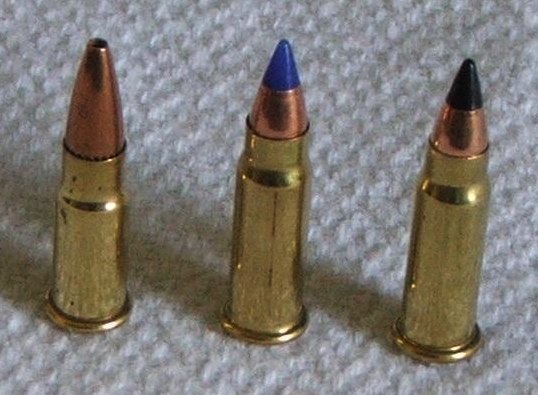
The three .17 rimfires were not designed together and were not designed by the same company. Two came from Hornady, a bullet and ammunition maker in Grand Island, Nebraska, working with gunmakers and with CCI, the rimfire specialist in Lewiston, Idaho. The third came from Winchester, eleven years later, as a direct attempt to beat the first. This volume follows each from the primary record where one exists, and marks where only press accounts survive.
2.1.1 Before Hornady: why .17, and why a rimfire
A .17 calibre bullet is not new. Centrefire .17s, the .17 Remington of 1971 among them, had long shown what a light, high-sectional-density bullet at high velocity does: it shoots flat, it fragments on a small animal, and it barely recoils. What none of them had was the economy of a rimfire, in which the priming is spun into the folded rim of a drawn case and the cartridge is made in one continuous process with no primer pocket, no primer and no reloading (the .22 Rimfire dive covers how).
The obvious move was to neck a rimfire case down to .17. The obvious problem, which Hornady’s own patent states plainly, is that a rimfire case cannot be fire-formed or reloaded, so whatever case the maker starts with fixes the powder capacity, and necking a case down reduces its volume.1
2.1.2 The .17 HMR, 2002
The .17 Hornady Magnum Rimfire necked the .22 Winchester Magnum Rimfire’s case to take a .172-inch bullet. SAAMI’s drawing for it is headed “17 Hornady Magnum Rimfire, issued 6/25/02”, and SAAMI’s velocity-and-pressure test barrel for it was issued the next day, 26 June 2002.2 Those two dates are the hardest evidence of when the cartridge was standardised.
CCI’s account of the launch, in a 2023 press release for the cartridge’s twentieth anniversary of production, reads: “Introduced in 2002, Hornady – working with both Marlin and Ruger – released the .17 Hornady Magnum Rimfire … created by necking down the .22 WMR to hold bullets of 0.172-inch diameter. In 2003, CCI released several loads in this cartridge.” CCI’s director of factory operations recalled having “to figure out how to keep our headers running 24 hours a day, 7 days a week to keep up with demand.” (A header is the press that forms the rim and head of a drawn case.)3 Retrospectives in American Rifleman and Guns & Ammo credit the design to Dave Emary, then Hornady’s senior ballistician, working with Marlin, Ruger and CCI.4
Hornady’s own corporate history says nothing about it. Its pages do not mention the HMR, the Mach 2 or rimfire ammunition at all.5
Two details in the record are worth correcting.
The “necked .22 WMR” description holds, to the thousandth. The two SAAMI drawings agree on rim diameter (.294 in), rim thickness (.050 in), body diameter (.242 in) and headspace (.050 to .056 in) exactly. The HMR’s maximum case length is 1.064 inch against the WMR’s 1.055, which is about what necking adds: Hornady’s own Mach 2 patent says a .036-inch reduction at the neck lengthened its case by .010, roughly 28% of the reduction, and the HMR’s neck is .049 inch smaller than the WMR’s body, which by that ratio would add about .014.21 That is this dive’s arithmetic, not a maker’s statement; whether production HMR cases are formed from WMR cases or on their own tooling is not stated by any maker read.
It came with a tight chamber. The HMR’s SAAMI chamber has a groove diameter of .172 and a bore of .168, a neck of .194 and a body of .245, with a cartridge that measures .1725, .193 and .242.2 Guns & Ammo’s retrospective quotes Emary telling Marlin and Ruger to keep bore, groove and throat dimensions tight, and attributes the cartridge’s early reputation for accuracy to it.4 The drawings bear out the tightness; the attribution of accuracy to it is the magazine’s.
2.1.3 The .17 Mach 2, 2004: a patent and a Stinger case
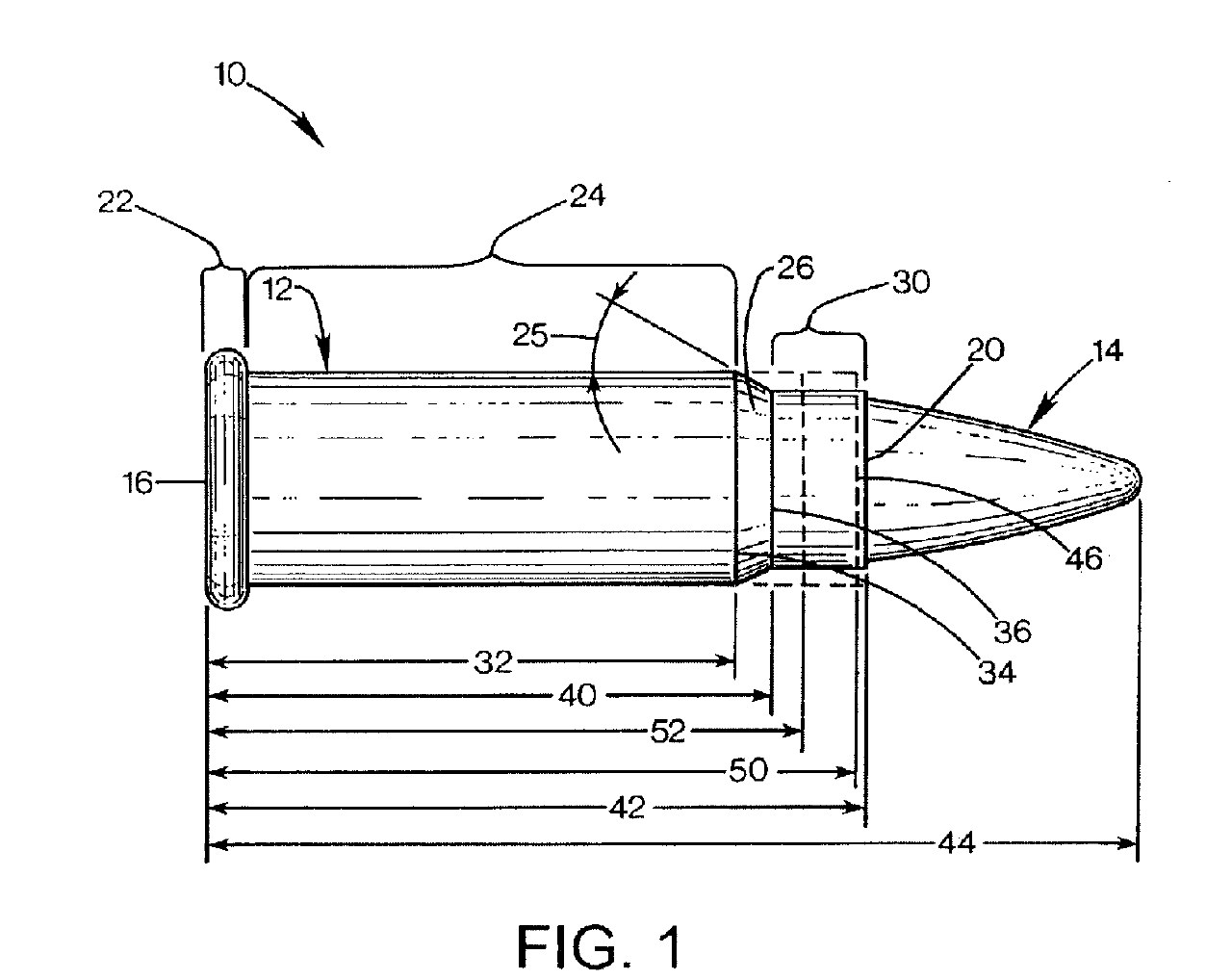
The Mach 2 is the one .17 rimfire whose design is fully on the public record, because Hornady patented it. US Patent 7,011,028, “Rimfire cartridge for a firearm”, was filed on 6 May 2003 by David E. Emary of St. Paul, Nebraska, assigned to Hornady, and granted on 14 March 2006. Hornady still prints the patent number on its 17 Mach 2 product page.16
The patent is short and its argument is clear.
The prior art was the 17 Aguila. Industrias Tecnos, the Mexican maker of Aguila ammunition, had already necked a standard .22 Long Rifle case to .17. The patent gives its dimensions: a case .657 inch long, a body of .487 inch to the shoulder, and the .22 LR’s 1.000-inch overall length. Necking down the standard case, it says, “reduces its volume, which limits the quantity of gun powder propellant that may be used. This limits the projectile velocity.”1
The answer was a longer parent case. Hornady’s design kept the .22 Long Rifle’s rim and body (body .226 inch, rim .036 to .043 inch thick) and its 1.000-inch overall length, so that the cartridge would fit actions built for the .22 LR, but started from a longer case. The patent names it: “the parent case is the same as that used for the Stinger® cartridge, which is a 22 LR cartridge having an extended case, and which is produced by CCI, a subsidiary of Alliant Techsystems.” The parent case is .700 inch long; necking it lengthens it by about .010 inch, so the finished case comes out at .702 to .710 without a trimming step. The neck is short, .100 inch, so that more of the case holds powder.1
It is primed before it is necked. The patent’s most interesting manufacturing line is almost an aside: “As the parent case is already primed, the cartridge manufacturing proceeds after case formation by filling the case with a propellant charge, and inserting and securing a bullet.”1 The priming compound is spun into the rim of the straight Stinger case first, as for any .22, and the bottleneck is formed afterwards. Volume 4 returns to what that means.
The claimed result was a 17-grain bullet at 2,200 fps and 183 ft·lbf, against the 17 Aguila’s 20 grains at 1,830 fps and a 40-grain .22 LR at 1,255 fps.1 Hornady’s 2005 launch page promised 2,100 fps and a trajectory “nearly seven inches flatter at 150 yards than a standard High Velocity 22 Long Rifle cartridge”, and printed a table (17 grain V-MAX, 2,100 fps at the muzzle, 1,530 at 100 yards, 1,134 at 200) that is almost unchanged on Hornady’s page today.7 SAAMI’s nominal figure is lower again, 2,010 fps, measured 15 feet from the muzzle (Volume 3). Three figures, three sources; Volume 5 sets them side by side.
SAAMI’s test barrel for the cartridge was issued on 23 June 2004.2 The SAAMI cartridge drawing allows a case up to .714 inch and draws the shoulder at 20 degrees, where the patent’s embodiment has 25; a standard written after a patent is not bound by the patent’s preferred dimensions.
What became of it. The Mach 2 never displaced the .22 LR, which costs a fraction as much, and never matched the HMR, which shoots flatter. Two makers load it today, one load each (Volume 5). The photograph at the top of this volume shows an Eley-loaded round; Eley’s current production of the cartridge was not confirmed for this dive.
2.1.4 The .17 Winchester Super Magnum, 2013
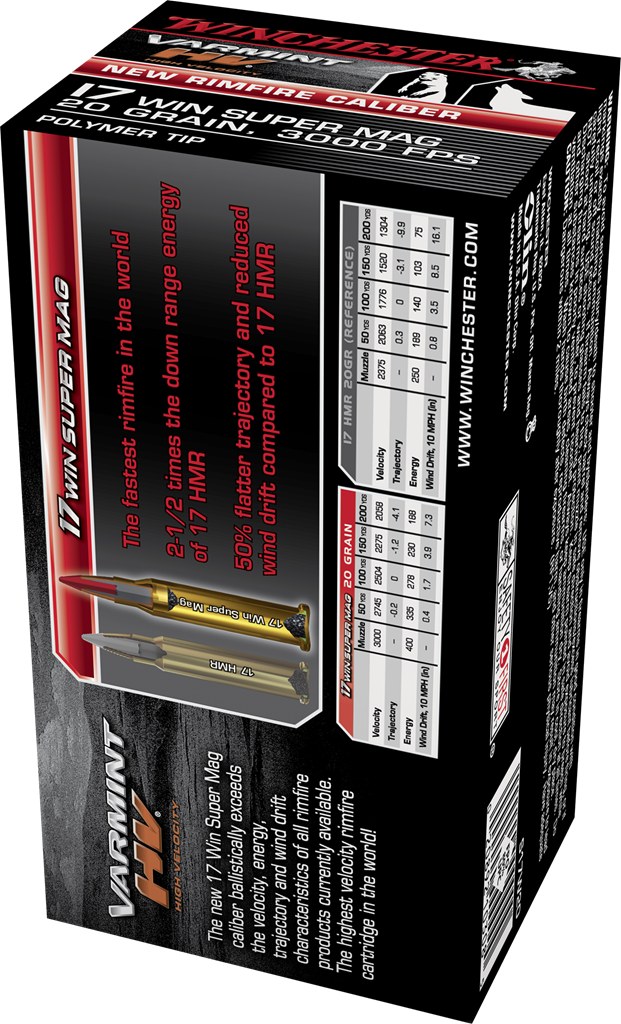
The .17 WSM is the only one of the three on a case built for the job. Winchester and Savage introduced it at the 2013 SHOT Show; SAAMI’s test barrel for it is dated 14 January 2013, the week of the show, and its cartridge and chamber drawing 24 July 2015.2
The primary record from Winchester itself is thin. Its 2013 product pages, as archived, show the launch loads: the Varmint HV 20-grain polymer tip (symbol S17W20), the Varmint HE 25-grain polymer tip (S17W25), and a Super-X 20-grain jacketed hollow point (X17W20) with a ballistic coefficient of 0.130 and 2,641 fps at 50 yards.8 The Super-X load is not in Winchester’s current catalogue. A lead-free 15-grain Varmint X load (X17W15PLF) has since been added, at 3,300 fps by Winchester’s own box: “17WSM, the world’s fastest rimfire, just got faster.”9
The rest of the origin story is reported rather than documented, and is given here as reported. Gun Digest quotes a Winchester announcement calling the cartridge “the most revolutionary rimfire cartridge in the company’s almost 150-year history”, and Brett Flaugher, then Winchester’s vice president of sales and marketing: “Our engineers have been developing the top-secret .17 Win Super Mag. caliber for more than three years … At 3,000 fps, it’s the fastest modern rimfire cartridge on the planet.” It says the case “descended from a .27-caliber nail-gun blank, which is necked down to take a .17-caliber bullet”, and that Winchester expected a box of 50 to retail for “about $15”.10 The .27 calibre powder-actuated-tool load is a rimfire blank; a rim of .333 by .066 inch on the SAAMI drawing is consistent with that parentage, but no Winchester document read for this dive states it.
The case is visibly heavier. Its rim is .066 inch thick against the HMR’s .050, and SAAMI allows it 33,000 psi against the HMR’s 26,000.2 That pressure is why the first rifle built for it was not a conventional rimfire. Savage’s B.MAG, launched with the cartridge, has rear locking lugs that rotate while the bolt body stays still, and it cocks on closing rather than on opening. Savage explains why in its own words: “Due to the high pressures of the 17 WSM, we needed a different locking system from our usual bolt action rimfire rifles”, and because the stronger rim needs a stronger firing-pin spring, cocking on opening would have made the bolt lift too heavy.11 Volume 8 returns to what that says about the cartridge.
Gun Digest lists the first rifles as the Savage B.MAG, the Winchester 1885 Low Wall single shot and a semi-automatic, the Franklin Armory F17.10 The B.MAG is still in Savage’s catalogue (Volume 9); the other two were not checked against their makers’ current pages.
Two of Gun Digest’s figures are worth flagging because they are repeated elsewhere: it says the WSM case is “about half a grain thicker” than the HMR’s, which is a unit error (a grain is a weight); and it gives the HMR’s 200-yard wind drift as 16.6 inches where Winchester’s own box prints 16.1.109
2.1.5 Who makes them now
Table 1 — 2.5 Who makes them now
| Who designed it | Who loads it, October 2026 | |
|---|---|---|
| .17 HMR | Hornady (2002) | CCI, Federal, Hornady, Remington, Winchester; others not surveyed |
| .17 HM2 | Hornady (patent 2006) | CCI, Hornady |
| .17 WSM | Winchester (2013) | Winchester only |
CCI, Federal and Remington ammunition have been one company’s brands since the Kinetic Group was formed, and in November 2024 the Czechoslovak Group bought it; the .22 Rimfire dive has the details. Hornady makes its own centrefire ammunition; who manufactures Hornady’s rimfire rounds is not stated on Hornady’s pages and is not asserted here. Volume 5 notes that CCI and Remington publish identical ballistic tables for two of their .17 HMR loads, and that Winchester’s lead-free .17 HMR uses Hornady’s NTX bullet.
2.1.6 Bibliography
Footnotes
-
US Patent 7,011,028 B1, “Rimfire cartridge for a firearm”, David E. Emary, assignee Hornady Manufacturing Company; application 10/430,729 filed 6 May 2003; granted 14 March 2006. Read from patentimages.storage.googleapis.com/pdfs/US7011028.pdf, 2026-10-19. ↩ ↩2 ↩3 ↩4 ↩5 ↩6 ↩7
-
ANSI/SAAMI Z299.1 (2018 approval), cartridge and chamber drawings pp. 9–11, 15, 18; test barrels pp. 62–64. Read from the Internet Archive capture of 2024-12-01. ↩ ↩2 ↩3 ↩4 ↩5 ↩6
-
CCI Ammunition press release, “CCI Celebrates 20-Year Anniversary of 17 HMR Rimfire Ammunition Production” (2023), as reprinted at huntinglife.com, read 2026-10-19. The release says Overberg was a line supervisor “in 2023 when we first started building this cartridge”; the year is evidently a misprint for 2003. ↩
-
American Rifleman, “20 Years With The .17 Hornady Magnum Rimfire”; Guns & Ammo, “20 Years of 17 HMR”. Secondary; consulted through search results only and attributed accordingly. ↩ ↩2
-
Hornady, “Company History”, hornady.com/corporate/company-history/, read 2026-10-19. ↩
-
Hornady, “17 Mach 2 17 gr V-MAX Varmint Express Rimfire”, item 83177, hornady.com, read 2026-10-19. ↩
-
Hornady, “17 Mach 2” new-product page, hornady.com/np_17_Mach_2.htm, Internet Archive capture 2005-03-05. ↩
-
Winchester, product page X17W20, Internet Archive capture 2013-02-18; 17 Win Super Mag hub page, capture 2013-09-28. ↩
-
Winchester Ammunition box art for S17W20 and X17W15PLF, winchester.com product pages, read 2026-10-19. ↩ ↩2
-
Gun Digest, “Ammo Brief: .17 Winchester Super Magnum Nails It”, gundigest.com, read 2026-10-19. Secondary. ↩ ↩2 ↩3
-
Savage Arms, “Things You Should Know about the Savage BMAG”, savagearms.com blog, 29 August 2023, read 2026-10-19. ↩
Comments (0)