.17 Rimfires · Volume 3
On Paper — What SAAMI Specifies, What Fits in What, and How to Tell Them Apart
The three .17 rimfires as the industry standard defines them: dimensions, headspace, pressures, test barrels and proof, the chamber mix-ups the drawings make possible, and an identification guide
3.1 On Paper — What SAAMI Specifies, What Fits in What, and How to Tell Them Apart
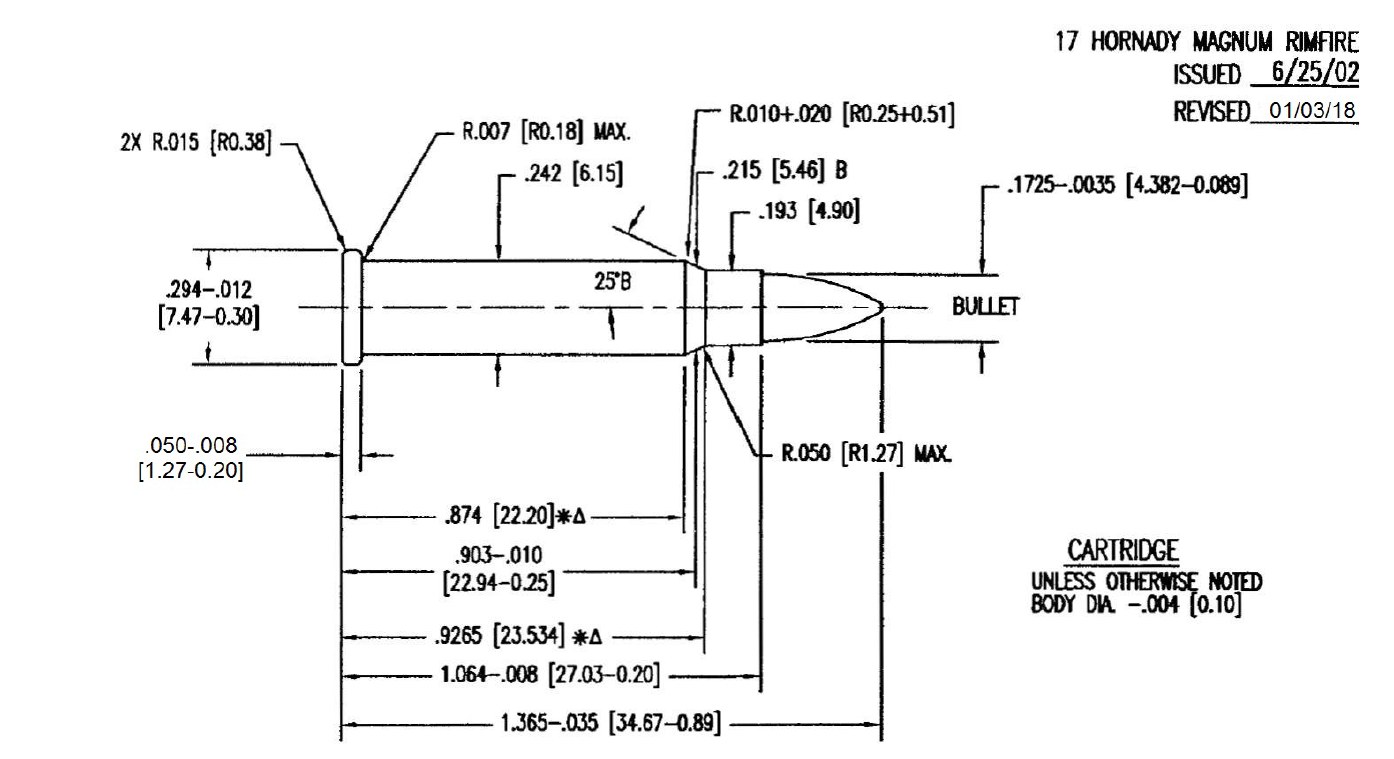
SAAMI, the Sporting Arms and Ammunition Manufacturers’ Institute, publishes the American standard that defines each rimfire cartridge: a drawing of the largest cartridge allowed and the smallest chamber allowed, a pressure limit, the barrel the pressure and velocity are measured in, and a proof load. ANSI/SAAMI Z299.1 covers rimfire. This volume reads it for the three .17s, and for their two parents. Every figure here is from the standard, read as page images from the 2018 approval of the 2015 edition.1
3.1.1 The standard, and which edition
SAAMI’s address for the rimfire standard, as linked from several sites, returned “not found” in October 2026. The 2018 approval was read from the Internet Archive’s copy. SAAMI’s site also lists a 2026 reaffirmation of the standard, but that file could not be retrieved either, so any change made in 2026 is not reflected here. Each SAAMI drawing carries its own notice that it “is subject to change” and that the current version is on SAAMI’s site.1
3.1.2 Dimensions
All in inches. Cartridge figures are maxima (tolerance minus); chamber figures are minima (tolerance plus .002 on diameters).
Table 1 — 3.2 Dimensions
| .22 LR (sporting) | .17 HM2 | .22 WMR | .17 HMR | .17 WSM | |
|---|---|---|---|---|---|
| Rim diameter | .278 −.012 | .278 −.012 | .294 −.012 | .294 −.012 | .333 −.009 |
| Rim thickness | .043 −.007 | .043 −.007 | .050 −.008 | .050 −.008 | .066 −.005 |
| Body diameter | .226 | .226 | .242 | .242 | .269 |
| Shoulder angle | — | 20° | — | 25° | 20° |
| Neck diameter | — | .190 | — | .193 | .1970 |
| Bullet diameter | .2255 | .1725 | .2245 | .1725 | .1725 |
| Case length | .613 | .714 | 1.055 | 1.064 | 1.200 |
| Overall length | 1.000 | 1.000 | 1.350 | 1.365 | 1.440 min, 1.590 max |
| Headspace (chamber) | .043–.051 | .043–.051 | .050–.056 | .050–.056 | .066–.071 |
| Bore / groove | .217 / .222 | .168 / .172 | .219 / .224 | .168 / .172 | .168 / .172 |
| Grooves | — | 6, .062 wide | — | 6, .062 wide | 6, .062 wide |
| Twist (chamber drawing) | 16 RH optional | 9 RH optional | 16 RH optional | 9 RH optional | 9 RH optional |
| Drawing issued | 5-29-79 | (test barrel 06/23/2004) | 5-29-79 | 6/25/02 | 07/24/2015 |
Three things stand out.
The families are exact. The HM2’s rim, rim thickness, body and headspace are the .22 Long Rifle’s to the thousandth, and its maximum overall length is the same 1.000 inch. The HMR’s are the .22 WMR’s to the thousandth. That is what makes a magazine, a bolt face and an extractor built for the parent work with the child, and it is also what makes the mix-ups in §3.5 possible.
The WSM is a different object. Its rim is .039 inch larger than the HMR’s and .016 inch thicker, and its body is .027 inch larger. Nothing from the .22 WMR family fits it, and a WSM round will not go into a WMR or HMR chamber.
The WSM alone has an overall-length range. The other drawings give a maximum with a tolerance; the WSM drawing gives “1.440 min, 1.590 max”. A rifle’s magazine and throat have to accept that whole span.
The .17s share one bore. All three call for a .168-inch bore, a .172-inch groove, six grooves .062 inch wide, and a minimum bore-and-groove cross-section of .0229 square inch. A .17 barrel blank is a .17 barrel blank; the chamber is what differs.
3.1.3 Pressure and velocity
SAAMI lists pressures in hundreds of psi measured with a transducer. Its figures:1
Table 2 — 3.3 Pressure and velocity
| MAP | Max. probable lot mean | Max. probable sample mean | |
|---|---|---|---|
| .22 Long Rifle | 24,000 | 24,600 | 25,500 |
| .22 WMR | 24,000 | — | — |
| .17 Mach 2 | 24,000 | 24,600 | 25,500 |
| .17 HMR | 26,000 | 26,700 | 27,700 |
| .17 WSM | 33,000 | 33,800 | 35,000 |
The maximum average pressure (MAP) is the ceiling on a lot’s mean. SAAMI derives the other two columns from it with a fixed coefficient of variation of 4%: the lot mean may sit two standard errors above MAP, and a sample tested after manufacture three more above that.1 Read the table this way: the HM2 is loaded to exactly the .22 LR’s pressure, the HMR to about 8% more than the .22 WMR whose head it shares, and the WSM to 27% more than the HMR, in a heavier case.
SAAMI’s velocity figures are “nominal mean instrumental” velocities measured 15 feet from the muzzle of the test barrel, not muzzle velocities.1
Table 3 — 3.3 Pressure and velocity
| Cartridge | Bullet | Velocity at 15 ft |
|---|---|---|
| .17 Mach 2 | 17 gr pointed | 2,010 fps |
| .17 HMR | 15½ gr pointed, non-lead | 2,475 fps |
| .17 HMR | 17 gr pointed | 2,525 fps |
| .17 HMR | 20 gr jacketed hollow point | 2,350 fps |
| .17 WSM | 20 gr pointed | 3,000 fps |
| .17 WSM | 25 gr pointed | 2,600 fps |
A light bullet sheds velocity fast. The makers’ own tables for 17-grain .17 HMR loads lose about 6 to 7 fps per yard over the first 50 yards (CCI’s V-Max: 2,550 to 2,220), so a figure taken 5 yards out sits roughly 30 fps below a muzzle figure for the same ammunition. Hornady’s box figure for its 17 grain HMR load is 2,550 fps; SAAMI’s nominal is 2,525. The two are not in conflict. Both come from the same 24-inch test barrel, which is the subject of §3.4.
3.1.4 Test barrels and proof
Each cartridge has a SAAMI velocity-and-pressure test barrel, and each of the three is 24.000 ± .010 inches long, with a 1:9 right-hand twist and the same six-groove .168/.172 rifling.1
Table 4 — 3.4 Test barrels and proof
| Test barrel | Issued | Revised |
|---|---|---|
| 17 HMR | 06/26/2002 | 07/27/2015 |
| 17 Mach 2 | 06/23/2004 | 07/27/2015 |
| 17 WSM | 01/14/2013 | 07/27/2015 |
So the velocities on every box come from a barrel 2 to 8 inches longer than most rifles that fire them (Volume 4 shows what that costs, which for the HMR is little). And note the distinction in the twist: the test barrel is specified at 1:9; the chamber drawing says “twist 9 RH, optional”. SAAMI does not require a .17 rifle to have a 1:9 barrel. It requires that ammunition be tested in one.
Proof. SAAMI’s proof table gives service and proof pressures for six rimfire cartridges:1
Table 5 — 3.4 Test barrels and proof
| Service MAP | Proof, min. average | Proof, max. average | |
|---|---|---|---|
| .17 Mach 2 | 24,000* | 31,000 | 34,000 |
| .17 HMR | 26,000* | 33,500 | 37,000 |
| .17 WSM | 33,000 | 42,500 | 47,000 |
| .22 Long Rifle | 24,000* | 31,000 | 34,000 |
The asterisk carries a note: “No specific recommendation is made as to proof testing Rimfire firearms designed for average service pressures at or below 26,000 psi.” The .17 HMR sits exactly on that line. The .17 WSM is the only rimfire cartridge in the standard above it, which makes it the only rimfire for which SAAMI’s proof recommendation applies to the rifle.
3.1.5 What fits in what
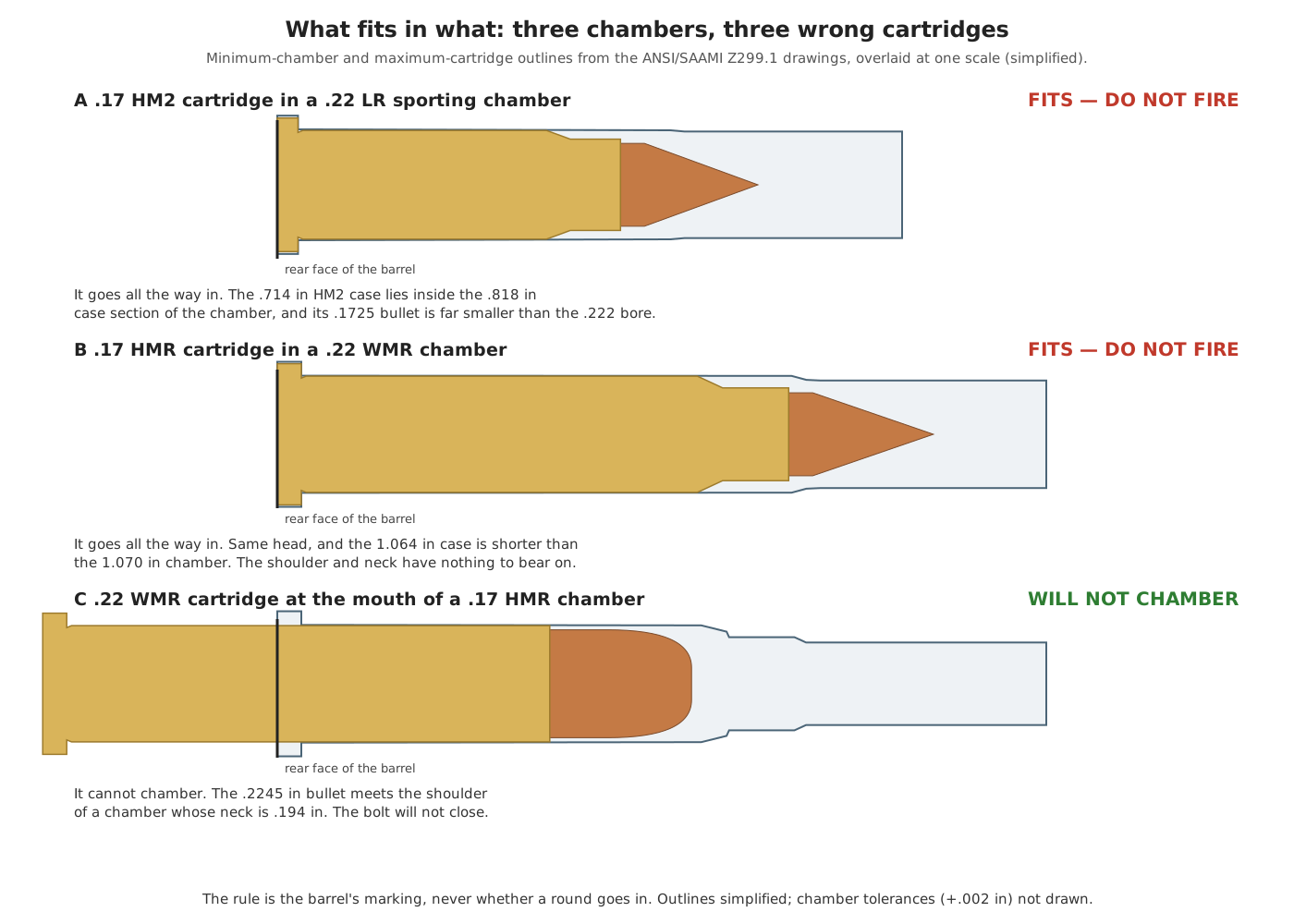
Because each .17 shares its head with a .22, the drawings allow two dangerous mix-ups. What follows is this dive’s reading of the SAAMI outlines, not a quoted SAAMI warning. SAAMI’s published table of unsafe combinations, in the edition found, does not list the .17 rimfires, and its 2021 interchangeability guidance covers only the .22 rimfires.2
A .17 HM2 in a .22 Long Rifle rifle. The .22 LR sporting chamber is a straight hole about .227 to .231 inch across and .818 inch long before the throat. The HM2 case is .226 across at most and .714 long, so the whole case, shoulder and neck included, sits inside that hole, and the .1725 bullet sits in a .222 groove with clearance all round. The rim seats against the same .043 headspace. On the drawings, the round chambers completely and the bolt closes. Fired, the case’s shoulder and neck have nothing to support them and the bullet has nothing to grip.
A .17 HMR in a .22 WMR rifle. Same story on the larger head. The WMR chamber is .244 inch across and 1.070 long; the HMR case is .242 and 1.064. It goes in, the bolt closes, and the shoulder and neck are unsupported.
The other way round does not work. A .22 WMR round cannot enter a .17 HMR chamber: its .2245 bullet meets the HMR chamber’s shoulder about half an inch short of seating. A .22 LR cannot enter an HM2 chamber for the same reason. A .17 WSM cannot enter either .22 rimfire chamber or the HMR’s, because its rim and body are too big. A .17 HMR dropped into a .17 WSM chamber would be loose in every dimension and its rim would sit at the wrong depth.
And the HM2 and HMR do not interchange: different heads, different lengths.
The practical rule is the oldest one: fire only the cartridge stamped on the barrel. CCI’s own warning on its 17 Mach 2 ammunition adds a second rule, aimed at .22 Long Rifle rifles rebarrelled to the Mach 2: “Do not use this ammunition in firearms that have been modified unless ALL the action components have been specifically designed and verified by the firearm manufacturer as intended for 17 Mach 2.”3 A .22 LR action converted with a new barrel still has a .22 LR bolt and firing pin, and the Mach 2 runs a different impulse through them (Volume 8).
3.1.6 Telling them apart
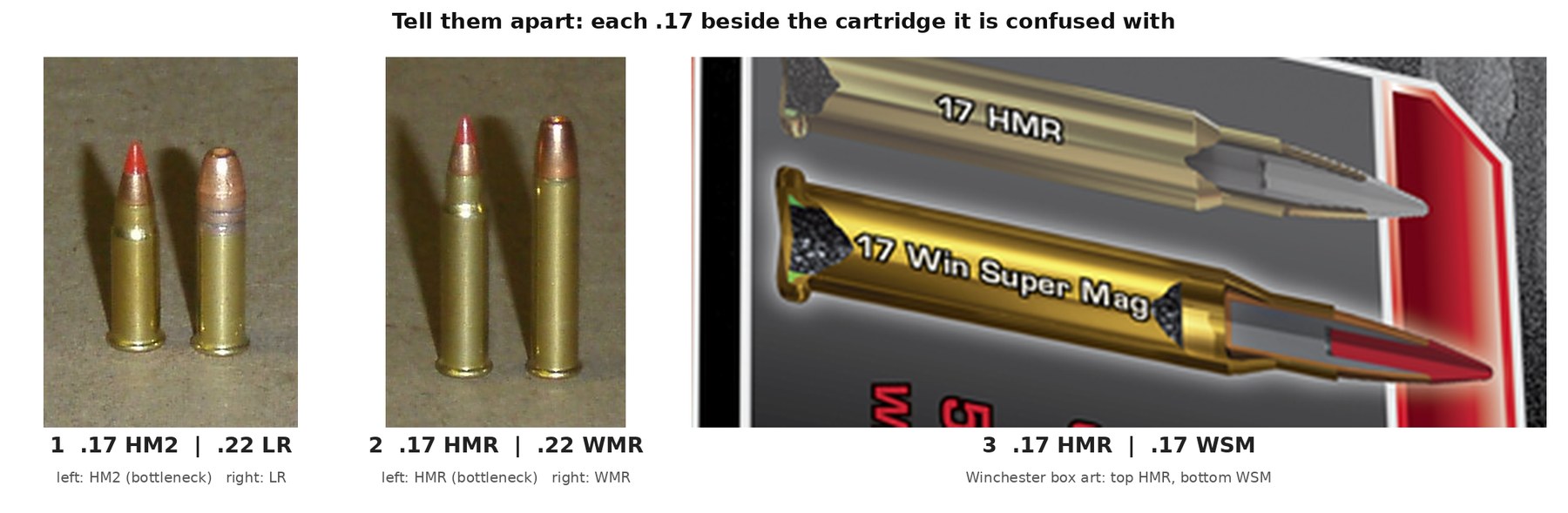
Rimfire cases carry a maker’s headstamp but no calibre marking (SAAMI says so in its interchangeability guidance),2 so a loose round has to be identified by its shape. The two .22 parents are straight-walled; all three .17s are bottlenecked. Among the .17s, length and rim tell them apart at a glance.
Table 6 — 3.6 Telling them apart
| Feature | .17 HM2 | .17 HMR | .17 WSM | Where to look |
|---|---|---|---|---|
| Overall length | 1.000 in, the length of a .22 LR | 1.365 in, a shade longer than a .22 WMR | 1.44–1.59 in, the longest rimfire made | Lay it beside a .22 LR |
| Case length | .714 in | 1.064 in | 1.200 in | Calipers on the case |
| Rim diameter | .278 in (.22 LR) | .294 in (.22 WMR) | .333 in | Calipers on the rim; WSM rim is visibly larger |
| Rim thickness | .043 in | .050 in | .066 in | Side view of the rim |
| Body diameter | .226 in | .242 in | .269 in | Calipers on the body |
| Neck | short, .190 | short, .193 | .197 | Not useful by eye |
| Box marking | ”17 Mach 2” or “17 HM2" | "17 HMR" | "17 Win Super Mag” or “17 WSM” | The box, and the barrel |
| Confused with | .22 LR, especially a Stinger-length round | .22 WMR | .17 HMR, at a glance | — |
Two quick checks need no tools. A .17 HM2 stood beside a .22 Long Rifle is the same height; a .17 HMR stood beside a .22 WMR is very nearly the same height, both with bottlenecks visible on the .17. And a .17 WSM is the only one of the three whose rim is visibly bigger than a .22 Magnum’s: set the two head to head and the difference (.333 against .294 inch) shows at once.
3.1.7 Bibliography
Footnotes
-
ANSI/SAAMI Z299.1 (2015 edition, approved 2018-06-13): velocity and pressure table, printed p. 6; drawings pp. 9–11 (17 Mach 2, 17 HMR, 17 WSM), p. 15 (22 LR sporting), p. 18 (22 WMR); headspace pp. 21–23; test barrels pp. 62–64; proof pressures p. 79; pressure statistics p. 5. URL
saami.org/wp-content/uploads/2022/08/ANSI-SAAMI-Z299.1-Rimfire-2018-Approved-2018-06-13.pdf(404 on 2026-10-19), read from the Internet Archive capture of 2024-12-01. ↩ ↩2 ↩3 ↩4 ↩5 ↩6 ↩7 -
SAAMI, “Generally Accepted Firearms and Ammunition Interchangeability” (10-8-2021), saami.org/wp-content/uploads/2024/11/, read 2026-10-19: covers .22 rimfire interchange and notes that rimfire headstamps carry no calibre marking; no .17 rimfire entry. SAAMI’s older unsafe-combinations sheet as reproduced elsewhere has no .17 rimfire entry either (secondary). ↩ ↩2
-
CCI, “VNT 17 Mach 2, 17 Grain”, part 948CC, Restrictions, cci-ammunition.com, read 2026-10-19. ↩
Comments (0)