.17 Rimfires · Volume 6
Flight — Trajectory, and the Wind Argument Read From the Makers' Own Tables
How flat the three .17s shoot against the .22 WMR and .22 LR, how far they drift, and how much of the .17's famous wind advantage survives a like-for-like comparison
6.1 Flight — Trajectory, and the Wind Argument Read From the Makers’ Own Tables
The case for a .17 rimfire has always been made in two numbers: drop and drift. A .17 shoots flatter than a .22 rimfire, so range errors cost less, and it drifts less in the wind, so wind errors cost less. Both claims are true. How much each is worth depends on which .22 it is set against, and that is where most of the published comparisons go soft. This volume reads both from the makers’ own tables, keeping each comparison within one maker’s method where it can.
The theory of wind drift, including the lag-time model used below, is in Ballistics Overview, Volume 7. It is not re-derived here. The one idea needed is that drift depends on how much a bullet slows down, not on how fast it starts: a bullet that kept its muzzle velocity would not drift at all, and the drift is proportional to the time it loses against that ideal.
6.1.1 Drop
Every maker prints drop for a particular zero, and they do not use the same one. Within each maker the comparison is fair.
Hornady, 100-yard zero, drop at 200 yards:1
Table 1 — 6.1 Drop
| Load | 200 yd |
|---|---|
| .17 HMR 17 gr V-MAX | −8.5 in |
| .17 HMR 20 gr XTP | −9.9 in |
| .17 HMR 15.5 gr NTX | −10.0 in |
| .17 Mach 2 17 gr V-MAX | −13.8 in |
| .22 WMR 30 gr V-MAX | −15.7 in |
Winchester, 100-yard zero, drop at 200 yards:2
Table 2 — 6.1 Drop
| Load | 200 yd |
|---|---|
| .17 WSM 20 gr Varmint HV | −4.1 in |
| .17 WSM 15 gr Varmint X | −4.3 in |
| .17 WSM 25 gr Varmint HE | −5.6 in |
| .17 HMR 20 gr (Winchester’s reference) | −9.9 in |
Federal, 50-yard zero, drop at 150 yards:3
Table 3 — 6.1 Drop
| Load | 150 yd |
|---|---|
| .17 HMR 17 gr V-Max | −3.1 in |
| .17 HMR 17 gr TNT | −3.5 in |
| .22 WMR 30 gr TNT | −7.0 in |
| .22 WMR 40 gr FMJ | −9.2 in |
| .22 WMR 50 gr JHP | −12.7 in |
| .22 LR 31 gr HP | −16.9 in |
| .22 LR 40 gr CPRN | −19.7 in |
Read across the three tables:
- The .17 HMR roughly halves the .22 WMR’s drop at 200 yards on Hornady’s like-for-like figures (−8.5 against −15.7), and drops a quarter as much as a 50-grain .22 WMR at 150 yards on Federal’s.
- The .17 WSM roughly halves the .17 HMR’s drop again (−4.1 against −9.9 on Winchester’s box, against the 20-grain HMR).
- The .17 Mach 2 sits between the HMR and the .22 WMR: at 200 yards it drops 13.8 inches, closer to the 30-grain WMR’s 15.7 than to the HMR’s 8.5. Its advantage is over the .22 Long Rifle, whose 40-grain load drops nearly 20 inches by 150 yards on a 50-yard zero.
For a hunter the useful form of this is the range at which the drop stays inside the kill zone of the animal without holdover. That depends on the target and the zero chosen; Volume 10 gives a starting zero for each cartridge, and the Scopes dive covers reticle holdover.
6.1.2 Drift: the makers’ own numbers
Federal and Remington print 10 mph drift on every rimfire page, computed the same way for every load, and Winchester prints it on its .17 WSM boxes. That gives, for the first time, a like-for-like comparison from one maker across all three rimfire families.342
Table 4 — 6.2 Drift: the makers' own numbers
| Load | Maker | MV | 50 yd | 100 yd | 150 yd | 200 yd |
|---|---|---|---|---|---|---|
| .17 WSM 25 gr Varmint HE | Winchester | 2,600 | 0.4 | 1.6 | 3.8 | 7.0 |
| .17 WSM 20 gr Varmint HV | Winchester | 3,000 | 0.4 | 1.7 | 3.9 | 7.3 |
| .17 WSM 15 gr Varmint X | Winchester | 3,300 | 0.6 | 2.4 | 5.8 | 11.2 |
| .17 HMR 17 gr AccuTip-V | Remington | 2,550 | 0.8 | 3.2 | 8.0 | — |
| .17 HMR 17 gr V-Max | Federal | 2,530 | 0.8 | 3.3 | 8.1 | — |
| .17 HMR 20 gr (reference) | Winchester | 2,375 | 0.8 | 3.5 | 8.5 | 16.1 |
| .17 HMR 20 gr JSP | Remington | 2,375 | 0.9 | 3.7 | 8.9 | — |
| .17 HMR 17 gr TNT | Federal | 2,530 | 0.9 | 3.8 | 9.4 | — |
| .17 HMR 17 gr JHP | Remington | 2,550 | 1.0 | 4.3 | 10.5 | — |
| .22 WMR 50 gr JHP | Federal | 1,530 | 1.2 | 4.7 | 10.7 | — |
| .22 LR 40 gr CPRN | Federal | 1,240 | 1.4 | 5.1 | 10.9 | — |
| .22 LR 38 gr CPHP | Federal | 1,260 | 1.5 | 5.5 | 11.7 | — |
| .22 WMR 40 gr FMJ | Federal | 1,880 | 1.4 | 5.8 | 13.6 | — |
| .22 WMR 30 gr TNT | Federal | 2,200 | 1.3 | 6.0 | 14.7 | — |
| .22 LR 31 gr HP | Federal | 1,430 | 1.8 | 7.1 | 15.1 | — |
Drift in inches, 10 mph full-value crosswind.
6.1.2.1 What the table says
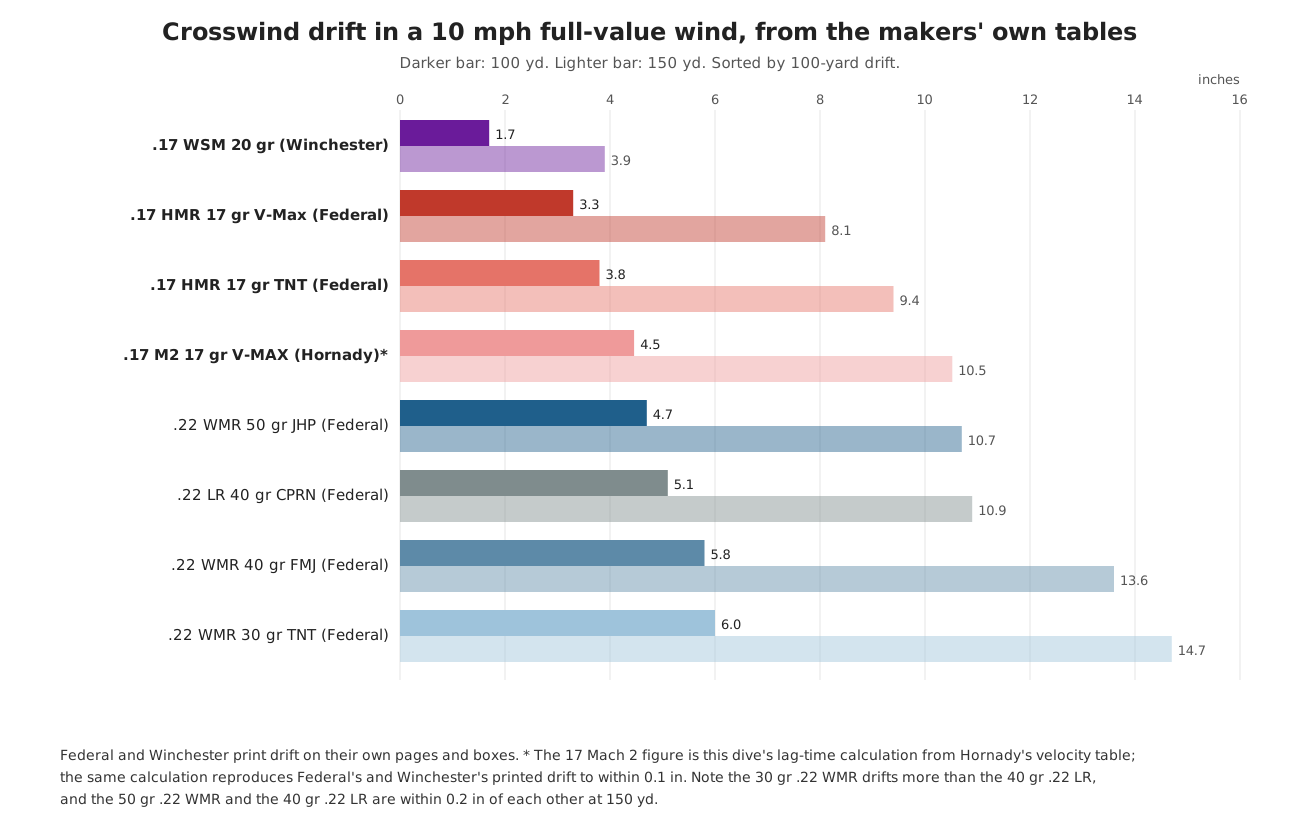
The .17 HMR’s advantage is real, and about a third, not a half. Against the heaviest .22 WMR (50 grains), Federal’s best .17 HMR drifts 3.3 inches at 100 yards against 4.7: 30% less. Against a 40-grain .22 LR it is 3.3 against 5.1, 35% less. At 150 yards the margins widen a little (8.1 against 10.7 and 10.9). The “half the drift of a .22 Magnum” that is often quoted is true only against the light, fast .22 WMR loads (3.3 against 6.0 is 45% less).
The bullet matters as much as the cartridge. Within the .17 HMR, a polymer-tipped 17-grain bullet with a BC of .125 drifts 3.2 or 3.3 inches at 100 yards; a hollow point with a BC of .100 from the same velocity drifts 4.3, almost as much as the 50-grain .22 WMR. The load chosen moves the result by more than the gap between cartridges.
A faster .22 WMR drifts more, not less. Federal’s 30-grain .22 WMR at 2,200 fps drifts 6.0 inches at 100 yards and 14.7 at 150; its 50-grain .22 WMR at 1,530 fps drifts 4.7 and 10.7; and its 40-grain .22 LR at 1,240 fps drifts 5.1 and 10.9. The fastest load of the three drifts most. It sheds speed fastest: the 30-grain WMR has lost 35% of its velocity by 100 yards, the 40-grain LR 18%. This hub’s Savage 93R17 dive found the same thing from Hornady’s and CCI’s velocity tables by calculation; Federal’s printed figures now confirm it from a third maker.
The 50-grain .22 WMR buys energy and drop, not wind. At 150 yards it drifts 10.7 inches against the 40-grain .22 LR’s 10.9. A .22 Magnum chosen for wind is the wrong reason to choose one.
The .17 WSM halves the .17 HMR. Winchester’s 20- and 25-grain loads drift 1.6 to 1.7 inches at 100 yards against 3.2 to 3.8 for the HMR loads, and 7.0 to 7.3 at 200 against Winchester’s HMR reference at 16.1. The fast 15-grain lead-free load gives a good part of that back (11.2 inches at 200), for the same reason as the fast .22 WMR.
6.1.3 The .17 Mach 2, calculated
Neither Hornady nor CCI prints drift for the Mach 2, and no other maker loads it. This dive calculates it, using the lag-time rule and nothing but the maker’s own velocity table: time of flight is integrated from the published velocities, and drift is the crosswind speed times the difference between that time and the time the bullet would take at its muzzle velocity. No drag model or BC is assumed. The script is 04-templates/wind_lag.py, adapted from the one the Savage 93R17 dive used.
The method checks out against the makers. Applied to loads whose makers do print drift, it reproduces the printed figures to within 0.1 inch: Federal’s .17 HMR V-Max, 0.77, 3.33 and 8.07 inches against Federal’s 0.8, 3.3 and 8.1; Winchester’s 20-grain WSM, 0.40, 1.67, 3.93 and 7.33 against the box’s 0.4, 1.7, 3.9 and 7.3; Winchester’s 25-grain WSM, 0.39, 1.62, 3.80 and 7.02 against 0.4, 1.6, 3.8 and 7.0; and Federal’s 40-grain .22 LR, 1.33, 5.10 and 10.91 against 1.4, 5.1 and 10.9.
The Mach 2 result:
Table 5 — The Mach 2 result:
| 10 mph, full value | 50 yd | 100 yd | 150 yd | 200 yd |
|---|---|---|---|---|
| .17 Mach 2, Hornady 17 gr V-MAX (from 2,100 / 1,531 / 1,133 fps) | 1.1 | 4.5 | 10.5 | 19.6 |
| .17 Mach 2, CCI 17 gr VNT (from 2,010 / 1,718 / 1,585 / 1,460 fps) | 1.1 | 4.6 | — | — |
| .17 HMR, Hornady 17 gr V-MAX, same method | 0.8 | 3.3 | 8.0 | 15.3 |
So the Mach 2 drifts about a third more than the HMR, and at 100 yards it is within 0.6 inch of a 40-grain .22 Long Rifle (4.5 against 5.1). Its real advantage over the .22 LR is drop (§6.1), not wind. These figures are calculations, not makers’ numbers, and are reported only within the range of the makers’ tables.
6.1.4 The long-range number that does not mean anything
This hub’s .22 Rimfire dive, Volume 5 quotes an aggregate web table giving 10 mph drift at 1,000 yards: 396 inches for the .22 LR and 470 for the .17 HMR. Neither number describes anything a rimfire does. No maker publishes rimfire data anywhere near that range, the .17 HMR’s tables stop at 200 yards, and by 1,000 yards both bullets would be far subsonic and at the mercy of assumptions the table does not state. Inside the range where the makers publish, the .17 HMR drifts less than the .22 LR at every distance. The 1,000-yard figure should not be used for either cartridge.
6.1.5 What it adds up to
- At 100 yards, a polymer-tipped .17 HMR drifts about 3.3 inches in a 10 mph crosswind and drops about nothing from a 100-yard zero. A .22 WMR 50-grain drifts 4.7; a .22 LR 40-grain 5.1. All three put a ground squirrel at risk if the wind is misjudged by half; the .17 HMR forgives the most.
- At 150 yards, the .17 HMR’s lead over the .22s grows in drop much more than in drift: about 3 inches of drop on a 50-yard zero against 7 to 20 for the .22s, and 8 inches of drift against 11.
- At 200 yards, the .17 HMR is at the edge of the makers’ tables (72 ft·lbf, 15 to 16 inches of drift), and the .17 WSM is the cartridge that still shoots flat (188 ft·lbf, 7 inches).
- The .17 Mach 2 is a flatter-shooting .22 Long Rifle, not a small .17 HMR.
6.1.6 Bibliography
Footnotes
-
Hornady product pages, items 83170, 83171, 83172, 83177 and 83202, hornady.com, read 2026-10-19. ↩
-
Winchester box images for S17W20, S17W25 and X17W15PLF as served on winchester.com, read 2026-10-19. ↩ ↩2
-
Federal Premium product pages, parts P771, P770, 770BTL250 (17 HMR); 757, 737, P765 (22 WMR); 710, 712, 724 (22 LR), federalpremium.com, read 2026-10-19. Federal’s tables give drift at 50, 100 and 150 yards and trajectory for a 50-yard zero with sights 1.5 inches above the bore. ↩ ↩2
-
Remington product pages, parts 29-28464, 29-20023, 29-20025, remington.com, read 2026-10-19. ↩
Comments (0)