.17 Rimfires · Volume 1
Overview — Three Cartridges, One Bullet Diameter
The .17 HMR, the .17 Mach 2 and the .17 Winchester Super Magnum: what they are, what the record actually shows, and the corrections this dive makes before anything else
1.1 Overview — Three Cartridges, One Bullet Diameter
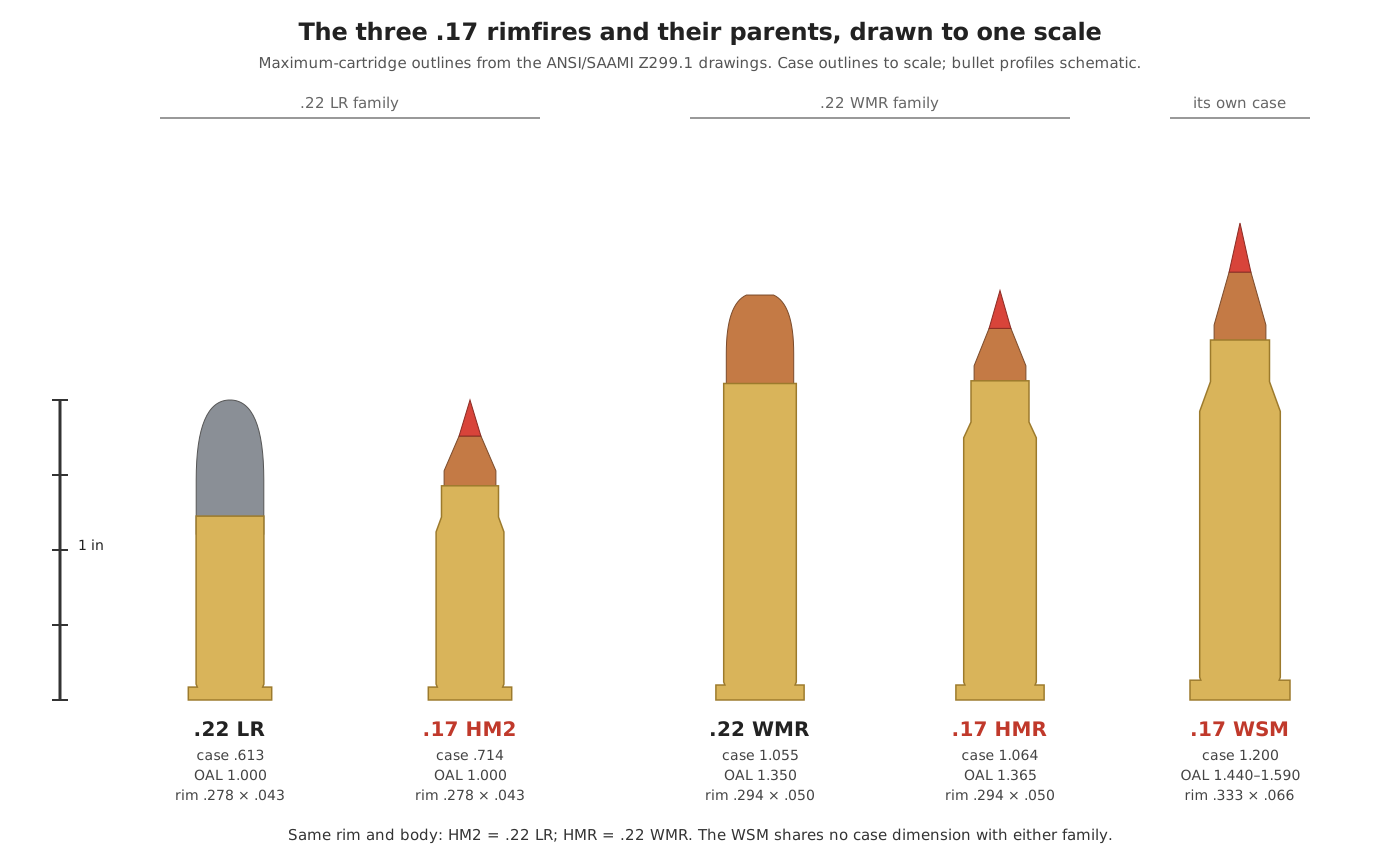
Between 2002 and 2013 three new rimfire cartridges came to market, all firing a bullet of .172 inch diameter, all with a bottlenecked case, and all built to the same promise: a rimfire that shoots flat enough to stop guessing range at 150 yards. The .17 HMR came first and is the one that stuck. The .17 Mach 2, usually written .17 HM2, followed two years later as its smaller, cheaper sibling. The .17 Winchester Super Magnum (.17 WSM) arrived a decade after that, on a case of its own, at a pressure no rimfire had been loaded to before.
They are usually discussed as one family. On paper they are three: two are built on the heads of existing .22 cartridges, and one is not, and the pressure each runs at, the rifles each can safely be fired in, and the shooting each is good for follow from that.
This volume says what each cartridge is, lays out the series, and lists the corrections this dive makes to things commonly said about them, including several that this hub’s own .22 Rimfire dive and Savage 93R17 dive say.
1.1.1 What the three cartridges are
The .17 HMR (Hornady Magnum Rimfire), 2002. A bottlenecked cartridge on the head and body of the .22 Winchester Magnum Rimfire. The SAAMI drawing that defines it was issued on 25 June 2002.1 It fires a 15.5 to 20 grain bullet at 2,375 to 2,650 fps from the makers’ test barrels, depending on the load (Volume 5). It is the commercially successful one: Savage alone lists 34 models chambered for it.2
The .17 Mach 2 (HM2), 2004. The same idea on the .22 Long Rifle’s head and body. Hornady’s patent for it, granted in 2006, describes forming it from the longer case of CCI’s Stinger, necking it down after the case has already been primed, and keeping the .22 Long Rifle’s 1.000 inch overall length so that it fits rifles built for that cartridge.3 It fires a 17 grain bullet at about 2,010 to 2,100 fps. Two makers load it today, CCI and Hornady, one load each.4
The .17 Winchester Super Magnum (WSM), 2013. Winchester’s, introduced with Savage at the 2013 SHOT Show. Its case is wider at the rim and body than any .22 rimfire, and its SAAMI maximum average pressure is 33,000 psi, against 26,000 for the .17 HMR and 24,000 for the .22 WMR and .22 Long Rifle.1 Winchester prints 3,000 fps for its 20 grain load and 3,300 fps for a 15 grain lead-free load.5 Winchester is the only maker of it.
1.1.2 What this dive covers
Table 1 — 1.2 What this dive covers
| Vol | Title | What it answers |
|---|---|---|
| 1 | Overview | What the three are; the corrections; the series map |
| 2 | Origins | The 17 Aguila, the HMR, the patented Mach 2, Winchester’s nail-gun case |
| 3 | On Paper | SAAMI dimensions and pressures; what fits in what; telling them apart |
| 4 | Made and Fired | How a bottlenecked rimfire is made; pressure, barrel length and the 1:9 twist; keeping a .17 bore clean |
| 5 | Every Factory Load | Every current loading, with each maker’s own figures and where makers disagree |
| 6 | Flight | Trajectory, and the wind argument against the .22 WMR and .22 LR, from the makers’ own drift tables |
| 7 | Arrival | Terminal performance on varmints, predators and small game; pelts and meat |
| 8 | The Semi-Automatic Question | The 2009 warnings and Remington’s recall, case heads and blowback, and what changed |
| 9 | Rifles, Suppressors and Cost | What is chambered for them today, with dated prices; suppressors; availability and cost per round |
| 10 | Cheatsheet | The numbers on one page |
The .22 rimfire family itself, and how rimfire ammunition is made in general, belong to the .22 Rimfire dive. This dive does not repeat them. External ballistics fundamentals, including the lag-time model of wind drift used in Volume 6, are in Ballistics Overview. Suppressor law and suppressor selection are in the Suppressors dives, linked from Volume 9.
1.1.3 The corrections, stated up front
Each of these is argued in the volume named, from a primary source.
Hornady neither invented nor loads the .17 WSM. It is Winchester’s cartridge and Winchester is its only maker. Hornady’s own catalogue, enumerated from its site map in October 2026, lists five rimfire loads: one .17 HM2, three .17 HMR and one .22 WMR (plus a .22 WMR defensive load). This hub’s .22 Rimfire dive says Hornady’s rimfire program includes the .17 WSM and that it is a cartridge Hornady invented; that is wrong on both counts (Volumes 2 and 5).4
The .17 HM2 is not a magnum, and it was not built to improve on the HMR. It is the smaller, later, Long Rifle-length cartridge, at a lower SAAMI pressure (24,000 psi) and lower velocity. Savage’s own 2025 guide to “magnum rimfire calibers” says the opposite on both points (Volume 2).2
The 2009 semi-automatic warning has a date, and the cartridge’s designer did not endorse it. The ammunition makers’ “17 HMR Ammunition Product Safety Notice and Warning” still carried on Federal’s and Remington’s sites is dated 20 August 2009, updated 31 August 2009. Remington’s recall of its Model 597 in .17 HMR was public by mid-August 2009. On 15 September 2009 Hornady published a message from Steve Hornady saying, in effect, that the ammunition met SAAMI standards and that whether a semi-automatic was safe with it was the gunmaker’s question. This hub’s Savage 93R17 dive says the date of the Remington notice could not be established; it can now (Volume 8).6
The .17 HMR’s wind advantage over the .22 Magnum is about a third, not a half. On one maker’s own tables, computed the same way for every load, Federal’s 17 grain .17 HMR drifts 3.3 inches at 100 yards in a 10 mph crosswind; its 50 grain .22 WMR drifts 4.7, and its 40 grain .22 Long Rifle 5.1. At 150 yards the 50 grain .22 WMR and the 40 grain .22 Long Rifle are within 0.2 inch of each other. The fast, light 30 grain .22 WMR drifts more than the .22 Long Rifle at both distances (Volume 6).7
Every number on a .17 box comes from a 24-inch test barrel, and SAAMI’s own figures are taken 15 feet from the muzzle. All three SAAMI test barrels are 24.000 inches long. A published barrel cut-down shows the .17 HMR flat from about 18 to 22 inches and losing about 1% at 16 inches and 10% at 10 inches (Volume 4).18
The 1:9 twist is a test-barrel twist, not a chamber requirement. All three SAAMI chamber drawings print “twist 9 RH, optional”. The test barrels are specified at 1:9 right-hand (Volume 4).1
The .17 WSM is the only rimfire for which SAAMI’s proof recommendation applies. SAAMI makes “no specific recommendation” for proof-testing rimfire firearms at or below 26,000 psi average service pressure. The .17 HMR sits exactly on that line. The .17 WSM, at 33,000, is the only rimfire cartridge in the standard above it (Volume 3).1
All three now have semi-automatic rifles in a major maker’s catalogue. In October 2026 Savage lists the A17 in .17 HMR, an A17 Sporter in .17 WSM, and an A Series Magnum in .17 HM2. Yet CCI’s page for its A17 load, which it says it “literally built … around the A17 rifle”, still carries the instruction not to use it in semi-automatic firearms without consulting the firearm’s maker (Volume 8).94
1.1.4 The three cartridges in one table
Table 2 — 1.4 The three cartridges in one table
| .17 HM2 | .17 HMR | .17 WSM | |
|---|---|---|---|
| Introduced | 2004 (Hornady, patent filed 2003) | 2002 (Hornady) | 2013 (Winchester, with Savage) |
| Built on | .22 LR head; Stinger-length parent case | .22 WMR head and body | A new case (reported as a .27 nail-gun blank) |
| Rim diameter × thickness | .278 × .043 in | .294 × .050 in | .333 × .066 in |
| Case length (max) | .714 in | 1.064 in | 1.200 in |
| Overall length (max) | 1.000 in | 1.365 in | 1.440–1.590 in |
| SAAMI MAP | 24,000 psi | 26,000 psi | 33,000 psi |
| SAAMI nominal velocity (15 ft, 24 in barrel) | 17 gr: 2,010 fps | 15.5 gr: 2,475; 17 gr: 2,525; 20 gr: 2,350 fps | 20 gr: 3,000; 25 gr: 2,600 fps |
| Current makers | CCI, Hornady | CCI, Federal, Hornady, Remington, Winchester (and others) | Winchester |
| Cost per round, October 2026 | 22–26¢ | 28–52¢ | 45–50¢ |
Sources: SAAMI Z299.1 for dimensions and pressures;1 the makers’ and one retailer’s pages for makers and prices (Volumes 5 and 9).
1.1.5 The worked example: my own .17 HMR
My own .17 is a Savage 93R17, the Model 93 bolt action in .17 HMR, with a thumbhole wood stock, a factory trigger and a 21-inch barrel. The rifle itself, its sub-model, and how to strip and maintain it are the subject of the Savage 93R17 dive. My inventory sheet once recorded the barrel as 20 inches; it is 21, which matches Savage’s catalogue for the thumbhole models.
This dive refers to that rifle where a general answer and a 93R17 answer differ, and says which is which. A bolt-action .17 HMR sits outside the semi-automatic question entirely (Volume 8), and at 20 or 21 inches it sits on the velocity plateau of Volume 4.
1.1.6 A note on sourcing
Every velocity, energy, price and specification in this dive is taken from the maker’s or seller’s own page, or from the standard itself, and dated. SAAMI’s rimfire standard was read as page images, because its columnar tables do not survive text extraction. Where makers disagree, the figures are given separately and attributed, never averaged. Where the dive computes something itself, notably the 17 Mach 2 wind drift in Volume 6, it says so and shows that the same method reproduces the makers’ own published figures. Search-engine summaries were used only to find documents, never as sources.
1.1.7 Bibliography
Footnotes
-
ANSI/SAAMI Z299.1, Voluntary Industry Performance Standards for Pressure and Velocity of Rimfire Sporting Ammunition for the Use of Commercial Manufacturers, edition approved 2018-06-13: velocity and pressure table (printed p. 6), cartridge and chamber drawings for the 17 Mach 2, 17 HMR and 17 WSM (pp. 9–11), .22 LR and .22 WMR drawings (pp. 15, 18), test barrels (pp. 62–64), proof pressures (p. 79). SAAMI’s URL
saami.org/wp-content/uploads/2022/08/ANSI-SAAMI-Z299.1-Rimfire-2018-Approved-2018-06-13.pdfreturned 404 on 2026-10-19; read from the Internet Archive capture of 2024-12-01. A 2026 reaffirmation is listed by title on SAAMI’s site but could not be retrieved. ↩ ↩2 ↩3 ↩4 ↩5 ↩6 -
Savage Arms, “Magnum Rimfire Calibers Deep Dive”, savagearms.com blog, 19 November 2025, read 2026-10-19. ↩ ↩2
-
US Patent 7,011,028 B1, “Rimfire cartridge for a firearm”, David E. Emary, assigned to Hornady Manufacturing Company; filed 6 May 2003, granted 14 March 2006. Hornady prints the patent number on its 17 Mach 2 product page. ↩
-
Hornady product pages and site map (hornady.com, items 83170, 83171, 83172, 83177, 83202); CCI product pages (cci-ammunition.com, caliber pages for 17 HMR and 17 Mach 2); all read 2026-10-19. See Volume 5. ↩ ↩2 ↩3
-
Winchester Ammunition, box art for symbols S17W20 and X17W15PLF as served on winchester.com product pages, read 2026-10-19; Winchester 2025 consumer catalogue. ↩
-
“17 HMR Ammunition Product Safety Notice and Warning, 8/20/09 – updated 8/31/09”, federalpremium.com and remington.com product-warning pages, read 2026-10-19; Hornady, “17 HMR message from Steve Hornady”, hornady.com/message-17hmr-091509.php, Internet Archive capture 2009-09-27. See Volume 8. ↩
-
Federal Premium product pages, parts P771, P770, 757, 737, P765, 710, 712, 724, read 2026-10-19. See Volume 6. ↩
-
“Bullberry Barrel Length vs. Velocity DATA”, reproduced at varmintal.com/17hmr.htm, read 2026-10-19. See Volume 4. ↩
-
Savage Arms model pages for the A17 Sporter, A Series Magnum and B.MAG, savagearms.com, read 2026-10-19. See Volume 9. ↩
Comments (0)