.17 Rimfires · Volume 4
Made and Fired — The Case, the Chamber, the Barrel and the Bore
How a bottlenecked rimfire is made and what happens in the chamber when it fires; pressure, barrel length and the 1:9 twist; and how to keep a .17 bore shooting
4.1 Made and Fired — The Case, the Chamber, the Barrel and the Bore
A .17 rimfire is a .22 rimfire in its making and a small centrefire rifle cartridge in its shape. Both halves matter: how the case is made sets what it can stand, and the bottleneck and the light bullet set what happens in the barrel. This volume covers both, then the barrel length and twist that turn the numbers on the box into the numbers from a rifle, and ends with keeping a .17 bore shooting.
4.1.1 How a bottlenecked rimfire is made
Every rimfire starts the same way: a brass cup drawn into a case, the head folded to form a hollow rim, wet priming compound spun into that rim, dried, then powder, bullet and crimp. The .22 Rimfire dive covers the sequence and why rimfire quality is a process-control problem. Three things are particular to the .17s.
The bottleneck is formed after priming. Hornady’s patent for the 17 Mach 2 states the order outright: the parent case, a straight Stinger-length .22 case, is necked down, and “as the parent case is already primed, the cartridge manufacturing proceeds after case formation by filling the case with a propellant charge, and inserting and securing a bullet.”1 The rim is primed while the case is a plain .22, and the neck and shoulder are formed on a case already carrying its primer. The patent’s dimensions are chosen so that the lengthening caused by necking (about .010 inch) brings the case to its finished length without a trimming step. No maker describes its .17 HMR or .17 WSM process in that detail, and nothing here assumes the same order for them.
The case is the cartridge’s strength. A rimfire has no separate primer, so the case head is also the primer’s container: a thin fold of brass, hollow inside. What the case can stand depends on that fold and on the brass. The .17 WSM is the illustration. Savage, explaining its B.MAG rifle, writes that “the cartridge needs a stronger case, which also calls for a stronger spring and firing pin due to the stronger rim.”2 SAAMI’s drawing gives the WSM rim a thickness of .066 inch against the HMR’s .050.3 Press accounts of the launch say the WSM’s case walls are about half as thick again as the HMR’s; Winchester’s own wording was not found.4
Makers sell the case. The .17 loads are the only rimfire ammunition whose makers advertise the brass. Hornady: “The uniformity of the Hornady 17 HMR case is equaled only by ultra-expensive match ammo.” CCI’s A17 load: “CCI-made and primed case” and an “exclusive headstamp”. Remington, of its current magnum rimfire: “Tighter tolerances, revamped primer mixes and industry-leading technology allows for greater consistency and lower chamber pressures for the same muzzle velocity.”5 These are claims, not measurements. They say where the makers think the cartridge’s quality lives.
What is inside one. Varmint Al, the engineer and varmint shooter whose long-running site documents his own testing, pulled a .17 HMR round apart and reported “5.4 gr of what looks like Lil’ Gun powder” behind the 17-grain bullet.6 No maker publishes its charge or powder, and the identification is his.
4.1.2 What happens when it fires
The firing pin strikes the edge of the rim and crushes the fold against the rear face of the barrel. The crushed priming compound ignites and flashes forward into the powder. As pressure rises, the thin case walls swell outward against the chamber and seal it; the case head is pressed back against the bolt face. Up to this point a .17 rimfire behaves exactly like a .22.
The bottleneck changes what follows.
The shoulder carries no headspace. On a centrefire bottleneck the shoulder locates the cartridge. On all three .17 rimfires the SAAMI headspace dimension is still measured on the rim: the rim seats in its recess and the bolt face closes on it, .043 to .051 inch for the HM2, .050 to .056 for the HMR, .066 to .071 for the WSM.3 The shoulder and neck sit in the chamber with clearance. That is why a .17 HMR can be dropped into a .22 WMR chamber and close (Volume 3): nothing at the front stops it.
The case thrusts back against the bolt with the force of pressure times the case head’s area. On a given head, more pressure means more bolt thrust. The .17 HMR runs about 8% more pressure than the .22 WMR on the identical head, so it pushes its bolt back about 8% harder at peak. The WSM’s larger head and 27% higher pressure push harder again. In a locked bolt action that thrust is carried by the lugs (or, on the Savage Model 93, by the root of the bolt handle in its notch). In a blowback self-loader it is resisted only by the bolt’s mass and spring. Volume 8 is about the consequences.
The bullet is light and leaves early. A 17-grain bullet has about 40% of the mass of a 40-grain .22 LR bullet and is driven more than twice as fast. Whether a light bullet spends less or more time in the barrel depends on the load and barrel, and no maker publishes barrel times for these cartridges. What the published data does show is the shape of the result, which is §4.3.
4.1.3 Barrel length
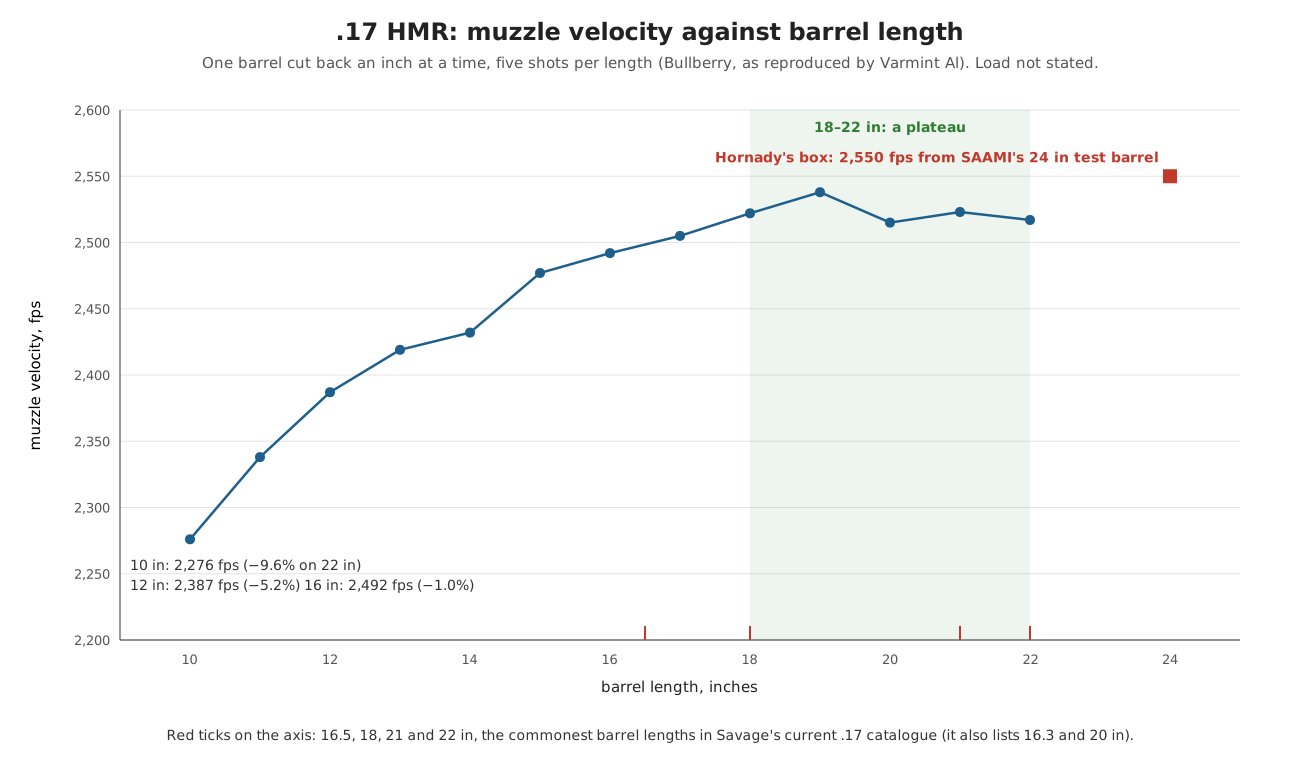
Every SAAMI velocity for these cartridges comes from a 24-inch test barrel, and so does every figure on a Hornady box (“Test Barrel (24”)” is printed above each table).35 Very few rifles have one. Savage’s current .17 catalogue has barrels of 16.3, 16.5, 18, 20, 21 and 22 inches; CZ’s .17 HMR models include 20- and 24-inch versions; Ruger’s are 16.1, 18 and 22 (Volume 9).
How much is lost has been measured for the .17 HMR. Bullberry, a barrel maker, cut one .17 HMR barrel down an inch at a time and chronographed five shots at each length. Varmint Al reproduces the data:6
Table 1 — 4.3 Barrel length
| Barrel | fps | Barrel | fps | |
|---|---|---|---|---|
| 22 in | 2,517 | 15 in | 2,477 | |
| 21 in | 2,523 | 14 in | 2,432 | |
| 20 in | 2,515 | 13 in | 2,419 | |
| 19 in | 2,538 | 12 in | 2,387 | |
| 18 in | 2,522 | 11 in | 2,338 | |
| 17 in | 2,505 | 10 in | 2,276 | |
| 16 in | 2,492 |
Varmint Al’s reading: “any barrel from about 18” to 22” will give essentially the same muzzle velocity”, with the caution that “five shots at each length is a very small sample”. The load is not stated in his reproduction, and Bullberry’s own page was not read. The shape is still clear: flat from 18 to 22 inches, about 1% down at 16, 5% at 12 and 10% at 10. The peak in the data is at 19 inches, inside the scatter.
Two things follow. First, a .17 HMR rifle of 18 to 24 inches will shoot within a few tens of fps of the box. The 21 inches of my own 93R17 is on the plateau. Second, the HMR’s powder appears to be largely burnt by about 18 inches, unlike the .22 Long Rifle, whose velocity peaks around 16 inches and then falls as friction outweighs the remaining gas (.22 Rimfire, Volume 4). No comparable published cut-down was found for the .17 HM2 or the .17 WSM, so nothing is said about their curves.
4.1.4 The 1:9 twist
SAAMI’s test barrels for all three are 1:9 right-hand, and its chamber drawings call 1:9 “optional”.3 In practice it is what is fitted: every current CZ 457 in .17 HMR lists “1 : 9 / 6”, one turn in 9 inches and six grooves.7 Twists other than 1:9 appear in places; Varmint Al, for example, gives a 1:10 figure for one of his rifles.6
What the twist does at these velocities is make the bullet spin very fast. Spin rate is muzzle velocity divided by the twist length: at 2,550 fps and one turn in 9 inches (0.75 foot) a bullet turns 3,400 times a second, about 204,000 rpm; the .17 WSM’s 20-grain bullet at 3,000 fps turns about 240,000 rpm. That arithmetic is this dive’s. Spin that fast puts real stress on a thin varmint jacket, and shooters’ folklore connects it with bullets that come apart in flight; but no maker or SAAMI document read for this dive states a spin-failure threshold for .17 rimfire bullets, so nothing more is claimed here.
Stability is not in question for these loads in a 1:9 barrel: the makers load 15.5 to 25 grain bullets for exactly that twist. The longest is the WSM’s 25-grain bullet, and Winchester loads it for rifles built to the SAAMI drawing.
4.1.5 Keeping a .17 bore shooting
A .17 bore is a .168-inch hole. That makes cleaning it a different job from cleaning a .22, and the Savage 93R17 dive works through it on a real rifle: Savage’s own cleaning procedure (always from the chamber end, solvent, patches, “a very thin film of oil”, and “do not disassemble the bolt assembly”), and the arithmetic of the rod. That dive’s figure, which is its own calculation, is that a rod scaled to a .17 bore is about 0.35 times as stiff as one scaled to a .22, because stiffness goes with the fourth power of diameter. A .17 rod bends easily and rubs the bore; a one-piece coated rod and a bore guide are the sensible answer.
What is particular to the .17s, as against .22 Long Rifle:
The fouling is copper, not lead. All current .17 loads use jacketed or plated bullets: V-MAX, NTX, VNT, TNT and FMJ jackets, a few “TNT Green” and NTX non-lead cores (Volume 5). There is no lead bullet and no wax lubricant to speak of. Varmint Al reports that his .17 HMR shot better than a minute of angle only when he cleaned with a copper solvent “until there is no more sign of copper”.6 That is one shooter’s experience with one rifle; it is consistent with the bullet construction.
There is no published cleaning interval. Savage’s manual gives none, only “‘more often’ is much safer than ‘not enough’”, which applies here as anywhere.8
Inspection is a centrefire habit applied to a rimfire. Look at the fired cases. A .17 rimfire case should come out with a crisp firing-pin dent on the rim, a case body that has filled the chamber, and a neck that has released the bullet without splitting. What the fired case tells you is in §4.6.
4.1.6 What a fired case tells you
Rimfire cases cannot be reloaded, so the only use of a fired case is as evidence. Read with care: most of the signs below are general cartridge-and-chamber reasoning, not maker statements, and they are offered as such.
Table 2 — 4.6 What a fired case tells you
| Sign on the fired case | What it usually means | What to do |
|---|---|---|
| Light or off-centre firing-pin dent, no ignition | Weak or dirty firing-pin spring, or a primer-compound void in the rim | Wait (hangfire), unload safely; if repeated, clean the bolt and check the firing pin; Savage’s manual sends bolt problems to Savage or a gunsmith |
| Neck split lengthwise | Brittle brass in that lot, or a chamber neck at the large end of tolerance | Note the lot; if every case splits, have the chamber measured |
| Shoulder blown forward, case bulged into a long straight cylinder | The cartridge was fired in the wrong chamber (a .17 in a .22 chamber, Volume 3) | Stop. Have the rifle examined before it is fired again |
| Case head bulged or ruptured at the rim | Excess headspace, an action opening while pressure was high, or the wrong cartridge | Stop. This is the failure Volume 8 is about |
| Gas or soot streaks along the case body | Case did not seal fully, often cold or soft brass, or a loose chamber | Usually harmless in a bolt gun; a warning sign in a blowback |
Savage’s manual, for the 93-series bolt actions, says the factory or a qualified gunsmith deals with anything past cleaning, and that the bolt assembly is not to be taken apart by the owner; the Savage dive has the detail.8
4.1.7 Bibliography
Footnotes
-
US Patent 7,011,028 B1, “Rimfire cartridge for a firearm”, D. E. Emary, assignee Hornady Manufacturing Company, granted 14 March 2006. Read from patentimages.storage.googleapis.com, 2026-10-19. ↩
-
Savage Arms, “Things You Should Know about the Savage BMAG”, savagearms.com blog, 29 August 2023, read 2026-10-19. ↩
-
ANSI/SAAMI Z299.1 (2018 approval): drawings pp. 9–11; headspace pp. 21–23; test barrels pp. 62–64. Read from the Internet Archive capture of 2024-12-01. ↩ ↩2 ↩3 ↩4
-
Gun Digest, “Ammo Brief: .17 Winchester Super Magnum Nails It”, read 2026-10-19. Secondary. ↩
-
Hornady product pages for items 83170–83172 (“Select Brass”; “Test Barrel (24”)”); CCI, “A17”, part 949CC; Remington, “Magnum Rimfire 17 HMR”, part 29-20023; all read 2026-10-19. ↩ ↩2
-
Varmint Al, “.17 HMR” page, varmintal.com/17hmr.htm, read 2026-10-19, including his reproduction of “Bullberry Barrel Length vs. Velocity DATA”. ↩ ↩2 ↩3 ↩4
-
CZ, CZ 457 American, Lux, Synthetic and Varmint model pages, czfirearms.com, variant specifications, read 2026-10-19. ↩
-
Savage Arms, rimfire bolt-action owner’s manual (Mark I, Mark II, Model 93, B.MAG), as summarised in the Savage 93R17 dive’s research notes; manual PDF archived 2022-12-19. ↩ ↩2
Comments (0)