Steyr AUG · Volume 6
What the Law Calls the Rifle — The Receiver, the Ten-Part Count, and the Select-Fire Parts in the Box
An AUG import kit under federal and Michigan law: which part is the firearm, where a receiver comes from, how §922(r) counts on a bullpup, and why the kit's trigger pack is the first thing to deal with
This volume is about law, and it is written from the primary texts: the United States Code, the Code of Federal Regulations as published on eCFR (current to 17 September 2026), the Federal Register, ATF’s own published study of the 1989 import decisions, and the Michigan Compiled Laws as published by the Michigan Legislature on 19 September 2026. Where the texts do not settle a question the volume says so, and the open questions are collected in §6.12. It is not legal advice, and on the two questions that matter most — the select-fire parts and the parts count — the honest answer for a builder is a written question to ATF.
The hub already has a canonical treatment of the §922(r) twenty-parts rule, built around the STEN (the STEN Gun dive, Vol 6), and a careful treatment of the same rule and the 1989 import history for the Kalashnikov (AK-47 Vol 16 and Vol 17). This volume does not re-derive them. It applies them to a rifle on which several of the twenty parts are in unexpected places.
6.1 Why the Law Comes Before the Build
On most rifles a parts-kit build is a mechanical project with a legal wrapper. On an AUG the order of operations is itself a legal question, for one reason: the surplus kits sold in the United States in September 2026 arrive with the military rifle’s select-fire trigger mechanism and military stock in the box, and without the receiver. A builder therefore starts with parts that belong only in a machine gun, and has to acquire the one part that is legally a firearm. What happens to the first before the second arrives is the most important decision in the project. The build sequence in Vol 7 is arranged around it.
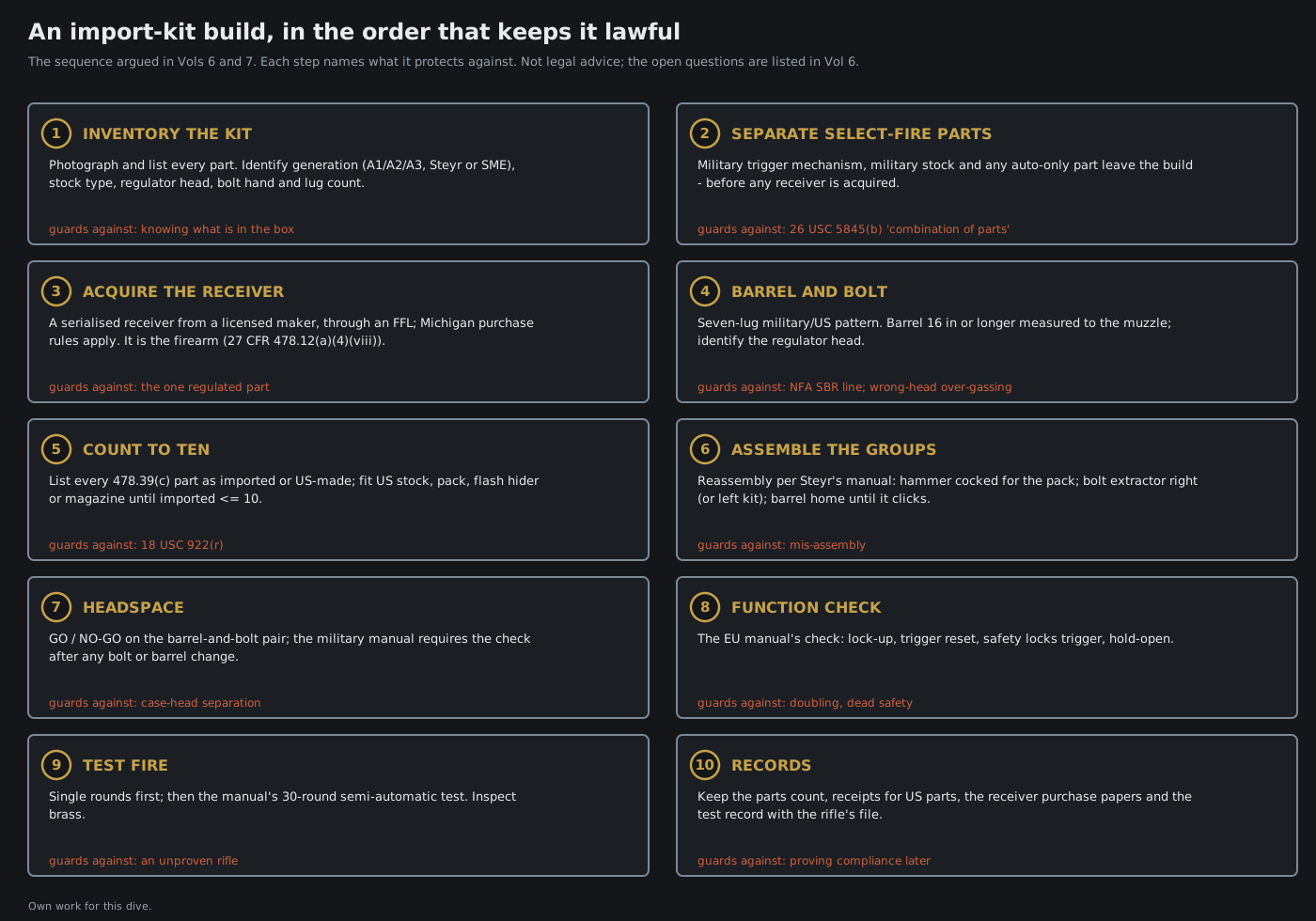
6.2 The Receiver Is Named in the Regulation
Which part of an AUG is “the firearm” has a direct answer, and it is in the regulation by name. The 2022 rule that rewrote the federal definition of “frame or receiver” gives a list of examples, and one of them is the AUG:
“(viii) Steyr AUG variant firearms: The receiver is the central part of the weapon that provides housing for the bolt.”1
That example applies the general definition for long guns in 27 CFR 478.12(a)(2): the receiver is “the part of a rifle … that provides housing or a structure for the primary component designed to block or seal the breech prior to initiation of the firing sequence (i.e., bolt, breechblock, or equivalent).” On an AUG the bolt runs in the receiver — Steyr’s “housing” — so that is the regulated part. The polymer stock is not the firearm, even though it holds the trigger, the sear and the hammer pack. Neither is the barrel, the bolt, or the trigger mechanism.
“Variant” is defined broadly, as “a weapon utilizing a similar frame or receiver design irrespective of new or different model designations or configurations,” so the example covers the Austrian rifles, the US-built A3 M1 and M2, and the MSAR STG-556 alike.1
Three further points about the text:
- The AUG is not one of the grandfathered oddities. Paragraph (f)(1) preserves earlier ATF determinations for designs whose regulated part is not the one the new definition would pick — the AR-15’s lower, the Ruger Mark IV’s upper, the Benelli M1’s lower, belt-fed machine guns’ side plates. The AUG is not in that list. It is in the list of examples where the new definition itself points at the right part.1
- The 2022 rule gives no reasoning for the AUG example. The final rule in the Federal Register (87 FR 24652, 26 April 2022) runs to some 860,000 characters. A search of its full text for “Steyr” and “AUG” finds one hit: the regulatory example itself. The preamble never discusses the rifle.2
- The rule stands. The Supreme Court upheld it against a facial challenge in Bondi v. VanDerStok on 26 March 2025, by seven votes to two. The hub’s P320 dive already covers that decision and the rule’s multi-piece provisions (Sig P320 M17, Vol 2).3
The regulation also answers a question a kit raises. Paragraph (c) says the terms frame and receiver “shall include a partially complete, disassembled, or nonfunctional frame or receiver, including a frame or receiver parts kit, that is designed to or may readily be completed, assembled, restored, or otherwise converted to function as a frame or receiver.” Its Example 3 reads: “A complete frame or receiver of a weapon that has been disassembled, damaged, split, or cut into pieces, but not destroyed in accordance with paragraph (e), is a frame or receiver.” Destruction under paragraph (e) means “completely melting, crushing, or shredding the frame or receiver, or other method approved by the Director.”1 A kit that contained the pieces of a torch-cut military receiver would therefore raise a question. The kits on sale today do not, because they contain no receiver at all (§6.4).
6.3 Where the Serial Number Goes
A licensed manufacturer or importer must mark the serial number, its name and its place of business “on the frame or receiver,” to a minimum depth of .003 in, with serial characters no smaller than 1/16 in.4 On an AUG, that is the receiver.
No Steyr, Steyr Arms USA or MSAR manual read for this dive shows where on the receiver the number is placed. One photograph does. A pair of Steyr AUG A3 rifles displayed at a Moscow trade show in 2011 carry the number on the right side of the receiver (the rifles lie muzzle-right), just behind the joint with the barrel, and the same number again on the barrel. On these rifles the barrel is numbered to the receiver; that is a maker’s practice, and it does not make the barrel the firearm.
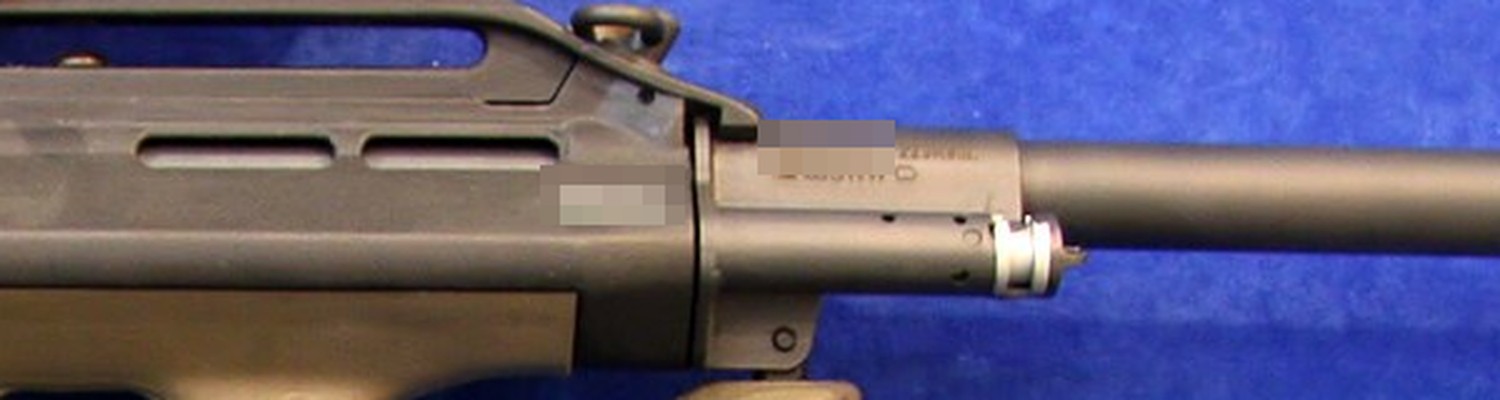
A kit builder will usually not mark anything. The normal route is a receiver bought already serialised by a licensed maker (§6.5), and a rifle assembled on it is not a “privately made firearm,” which the regulation defines as one “completed, assembled, or otherwise produced by a person other than a licensed manufacturer, and without a serial number placed by a licensed manufacturer at the time the firearm was produced.”5 The marking duties in 27 CFR 478.92 run to licensees. A non-licensee who makes a firearm for his own use has no federal duty to mark it, though the regulation contemplates that he may, and a licensee who later takes a privately made firearm into inventory must mark it within seven days.4 Michigan law on this point is in §6.10.
Michigan also makes it a felony to “wilfully alter, remove, or obliterate the name of the maker, model, manufacturer’s number, or other mark of identity” of any firearm (MCL 750.230).6 A builder who is dressing a used receiver, or refinishing one, leaves its marks alone.
6.4 What an Import Kit Is, and What the Kits on Sale Contain
Surplus military rifles cannot be imported for sale as machine guns. ATF’s import guidance, as it stood in 2014, put it this way: “it is generally unlawful to import a machinegun into the United States for unrestricted sale. However, machineguns that are properly destroyed may be imported.” Its illustrated method for other rifles was to cut the receiver into pieces with a torch removing at least a quarter inch of material at each cut, and it warned that “Cutting by means of a bandsaw or cut-off wheel does not ensure destruction.”7 What arrives is a rifle less its receiver, sold as parts.
Three US vendors had AUG kits listed on 19 September 2026. Their own descriptions, quoted:
Table 1 — Three US vendors had AUG kits listed on 19 September 2026. Their own descriptions, quoted
| Vendor | Kit | Origin | What the vendor says is in it | Price shown, 2026-09-19 |
|---|---|---|---|---|
| Apex Gun Parts, Colorado Springs | ”Steyr AUG Parts Kit, w/ Sling & Cleaning Kit, Austrian, 5.56x45 NATO” | Steyr, Austria | ”complete, Less the receiver and barrel assembly … Selectfire trigger pack can be switched between full auto and 3 round burst.” “These parts have been taken from fully automatic weapons, and no modifications have been made for semi-automatic." | "As low as $399.95”; out of stock |
| Apex Gun Parts | ”SME AUG Parts Kit w/Accessories, Malaysia, Green Polymer” | SME Ordnance, Malaysia, under Steyr licence | same wording | not captured |
| Max Arms | ”AUG A1 Key Parts Kit – 5.56x45mm NATO" | "SME and Steyr Manufactured" | "Stock, Bolt, Trigger Pack, Butt Plate, Flash hider, Bayonet lug, Sling swivel, Charging handle”; “NOT Included: Barrel, receiver, or receiver parts; Magazine(s)“ | $299.92 / $382.92 (two options) |
| Atlantic Firearms, Salisbury MD | ”Imported Surplus Steyr AUG Rifle Parts Kits 5.56x45mm” | not stated | ”from Military Surplus rifles and were demilled and disassembled from Select fire rifles.” “No FFL Required, this is not a complete firearm.” | not established |
Sources for each are in the footnotes.8910 Three things follow from the vendors’ own words.
- The kits omit the receiver and, in the two that say so, the barrel. A builder must find both. Both are on the §922(r) list.
- The kits include the military stock and a select-fire trigger pack — “can be switched between full auto and 3 round burst,” in Apex’s words. That is the subject of §6.6.
- Two origins appear: Steyr’s Austrian production and SME Ordnance’s Malaysian licence production. Malaysia built AUGs under licence from 1991, and 106,000 had been made by 2001 according to Daniel Watters’s 5.56 mm chronology (Vol 2). No Australian, Irish or other-origin kit was found on a vendor page.
6.5 Where a Receiver Comes From
This is the gap that decides the project, and the research for this dive did not close it.
- Steyr Arms USA (Bessemer, Alabama) builds the AUG A3 M1 and M2 in the United States. Its press release of 20 October 2014 announced that the A3 M1 “is built by Steyr Mannlicher-trained gunsmiths in Steyr Arms’ new Bessemer headquarters and manufacturing facility.”11 Its online parts store, read on 19 September 2026, sells barrels, bolts, stocks, trigger packs and magazines, and no receiver and no bolt carrier.12
- PJ’s Steyr AUG parts (pjs-steyraug.com), a specialist dealer, listed on its page (last updated 8 December 2025) an “AUG A1/A2/A3/M1/USR RECEIVER GROUP $1250 Shipped — Steyr AUG A3/M1 Receiver long rail — 2 In Stock.” The page does not say who made it or how it is transferred. A receiver is a firearm and has to be transferred through a licensed dealer; the vendor has to be asked.13 The same page offers “Complete Rifle Parts Kits Minus Receiver” in new A3 M1 parts and US-made barrels.
- MSAR (Microtech Small Arms Research, Bradford, Pennsylvania) made AUG-pattern rifles from 2007 (the STG-556) and 2012 (the STG-E4). It is defunct and its web domain is now unrelated content. Its own parts page said older and newer MSAR receivers differed at the barrel-locking notch, and nothing it published claims interchange with Steyr parts.14
- Historically, the receiver of the 2009 AUG A3 SA USA was an American casting. American Rifleman reported in 2010 that “the new gun’s investment cast aluminum receiver and steel barrel are made in the United States by Steyr partner Sabre Defence Industries of Nashville, Tenn.”15 Later sources name other makers; none was confirmed from a primary document.
So the realistic sources are a receiver group bought from a dealer who has one, a receiver bought from Steyr Arms USA if it will sell one to an individual through a dealer (its store does not offer it), or a receiver made by the builder. The last is taken up in Vol 7 §7.4; it is lawful for personal use under federal law, it makes the rifle a privately made firearm, and it has one serious trap, which is that a receiver copied from military geometry might accept a select-fire trigger mechanism.
A fourth route should be stated because the numbers point to it. A new Steyr Arms USA AUG A3 M2 was listed at about $1,880–1,900 by two retailers on 19 September 2026 (Vol 8). If a kit needs a receiver, a barrel, a semi-automatic trigger pack and a semi-automatic stock, the parts alone approach the price of a factory rifle before the builder’s time is counted. Vol 8 sets out the arithmetic.
6.6 The Select-Fire Parts in the Box
The federal definition of a machine gun reaches parts. 26 U.S.C. § 5845(b), after defining the weapon, continues: “The term shall also include the frame or receiver of any such weapon, any part designed and intended solely and exclusively, or combination of parts designed and intended, for use in converting a weapon into a machinegun, and any combination of parts from which a machinegun can be assembled if such parts are in the possession or under the control of a person.”16
Three facts establish that the AUG’s select-fire parts are distinct parts, not settings:
- The military trigger mechanism contains a part the semi-automatic one does not. The Steyr Mannlicher maintenance manual lists a “lever, automatic firing” in the trigger mechanism group; Steyr Arms USA’s parts list for the semi-automatic A3 has no such part, and its hammer, hammer springs and disconnector are distinct “SA” parts (Vol 5 §5.9).1718
- Steyr designates five US assemblies “SA”. The receiver (“RECEIVER A3 SA”), the bolt carrier (“BOLT CARRIER SA”), the receiver lock (“RECEIVER LOCK SA”), the stock (“STOCK USA SA”) and the trigger mechanism body.18
- The trade keeps them apart. PJ’s lists semi-automatic and full-automatic bolt carrier groups, hammer packs and stocks separately, and labels its full-automatic packs “NFA.”13 Apex sells a select-fire pack inside a kit sold as non-NFA parts.8 That divergence between two specialist vendors is itself evidence that the question is not settled in the trade.
What is not established is the part that would decide the legal question: whether a select-fire AUG trigger mechanism, stock or carrier can actually be assembled with a US semi-automatic receiver into a rifle that fires automatically. If it can, the “combination of parts” clause is engaged by possessing them together. If the “SA” parts are designed to refuse the military ones, as their naming suggests, the argument is weaker. No source read for this dive describes the interlock, and this volume does not speculate about it.
The conservative course, which this dive recommends as a matter of sequence rather than of law, is to take the select-fire trigger mechanism, the military stock and any military bolt carrier out of the build before any receiver is acquired, and either return them, dispose of them, or keep them only after a written classification from ATF’s Firearms and Ammunition Technology Division says that is lawful. The semi-automatic replacements are sold openly: Steyr Arms USA listed its semi-automatic “AUG Trigger Packs” at $136.00 and “AUG Stocks” at $360.00 on 19 September 2026.12
Michigan’s machine-gun statute, MCL 750.224(1)(a), prohibits manufacturing, selling or possessing “A machine gun or firearm that shoots or is designed to shoot automatically more than 1 shot without manual reloading, by a single function of the trigger,” as a felony carrying up to five years.19 Unlike the federal definition it has no “parts” or “combination of parts” clause, so on stray parts it is the federal text that governs. The hub’s MP 40 dive quotes the Michigan section in full and discusses its licensing exception (MP 40, Vol 6).
The kit’s bolt and carrier deserve a separate check. The kits are “taken from fully automatic weapons,” and Steyr and PJ’s both sell a distinct semi-automatic carrier. The kit’s bolt carrier should be identified before the build and treated like the trigger pack if it is the military pattern. Steyr Arms USA’s store does not sell a carrier; PJ’s lists a semi-automatic “Roller Bolt Carrier Group, Complete” at $650.13
6.7 Section 922(r): Why It Applies to an AUG
18 U.S.C. § 922(r) makes it unlawful “to assemble from imported parts any semiautomatic rifle or any shotgun which is identical to any rifle or shotgun prohibited from importation under section 925(d)(3) of this chapter as not being particularly suitable for or readily adaptable to sporting purposes.” It was added by the Crime Control Act of 1990.20 The implementing regulation, 27 CFR 478.39(a), turns it into a count: “No person shall assemble a semiautomatic rifle or any shotgun using more than 10 of the imported parts listed in paragraph (c) of this section if the assembled firearm is prohibited from importation under section 925(d)(3).”21
Whether the rule applies at all depends on whether a semi-automatic AUG is a rifle ATF will not allow to be imported. For the AUG the answer is documented in ATF’s own words. Its 1998 study of the sporting suitability of modified semi-automatic rifles narrates the AUG’s case:
“In October 1988 and February 1989, ATF had granted GSI permits to import AUG-SA rifles. As mentioned previously, in March and April of 1989, ATF imposed a temporary suspension on the importation of rifles being reviewed in the 1989 study, which included the AUG-SA rifle.”22
Gun South, Inc. sued, and the Eleventh Circuit held that ATF had authority to suspend the imports (Gun South, Inc. v. Brady, 877 F.2d 858 (11th Cir. 1989)). ATF’s working group reported on 6 July 1989, and from then on a semi-automatic rifle with any of the military features it identified other than a detachable magazine — a separate pistol grip, a flash suppressor, a bayonet mount among them — failed the sporting-purposes test.22 The AUG has a pistol grip and a flash hider. Vol 3 tells the import story in full; for this volume the point is that §922(r) applies to a semi-automatic AUG assembled in the United States from imported parts.
Two readings of the rule are worth fixing, because both are commonly mis-stated.
- The rule is a ceiling on imported parts, not a quota of US parts. It forbids more than ten imported listed parts in the assembled rifle. It does not require any particular number of US-made parts, and the ceiling does not shrink when a rifle has fewer than twenty listed parts. On a rifle with sixteen listed parts, the ceiling is still ten.
- It applies to the rifle as it stands. Snapping an imported magazine into the rifle adds three imported listed parts — body, follower and floorplate — at that moment. The AK-47 dive makes this point well (AK-47, Vol 17).
The exemptions in 478.39(b) — assembly for government sale, testing authorised by the Director, and repair or replacement of parts on a rifle imported or assembled before 30 November 1990 — do not help a new build from a kit.21
6.8 The Count on a Bullpup
The twenty listed parts were written with conventional rifles in mind, and on an AUG several of them sit in unexpected places or do not exist as separate parts. The figure applies the list to the AUG, using Steyr’s own US parts list for what exists and the vendors’ descriptions for what a kit contains.
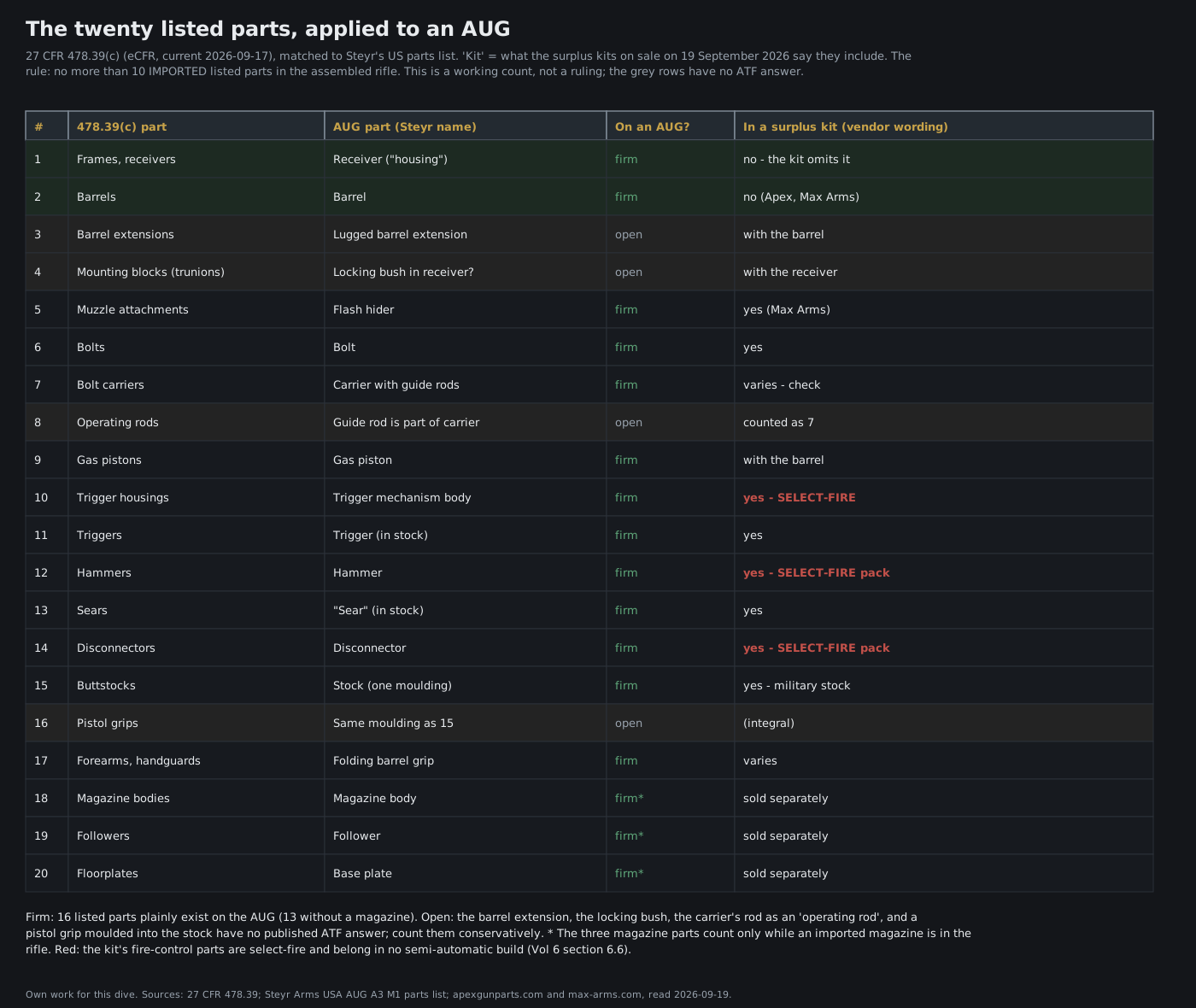
Plainly present (sixteen, thirteen without a magazine): receiver, barrel, muzzle attachment, bolt, bolt carrier, gas piston, trigger housing (the trigger mechanism body), trigger, hammer, sear (Steyr’s name for the part in the stock), disconnector, buttstock, forearm (the folding barrel grip), and the magazine body, follower and floorplate.
Arguable, with no published ATF answer:
- The pistol grip. The AUG stock is one moulding that is buttstock, pistol grip and trigger guard. Whether an imported stock counts once or twice was not found in any ATF ruling. Counting it twice is the conservative choice.
- The barrel extension and the locking bush. The lugs the bolt locks into are on the barrel group’s “barrel extension” (Vol 5 §5.6), and the receiver holds the barrel in a steel “locking bush.” Whether either is a “barrel extension” or a “mounting block (trunnion)” in the regulation’s sense is unresolved. A magazine article asserts that the insert “isn’t considered a trunnion,” without citing anything.23
- The operating rod. The piston drives the carrier through a thrust piece on one of the carrier’s own guide rods. The rod is part of the carrier assembly, so counting it again as an “operating rod” would double-count one part; the conservative position is nonetheless to note it.
The arithmetic. An all-imported AUG with an imported magazine carries roughly sixteen to nineteen listed parts, depending on how the arguable four are treated. Getting to ten or fewer imported means seven to ten of them must be US-made. The parts that do that most cheaply, on the prices found in September 2026 (Vol 8):
Table 2 — The arithmetic. An all-imported AUG with an imported magazine carries roughly sixteen to nineteen listed parts, depending on how the arguable four are treated. Getting to ten or fewer imported means seven to ten of them must be US-made. The parts that do that most cheaply, on the prices found in September 2026 (Vol 8)
| Change | Listed parts made US | Note |
|---|---|---|
| A US-made receiver | 1 | necessarily part of the build |
| A US-made magazine in the rifle | 3 | Magpul’s PMAG 30 AUS for the Steyr-pattern stock, $29.95 on Magpul’s page, 2026-09-19; origin to be confirmed on the magazine |
| A US-made semi-automatic trigger pack | 3 (housing, hammer, disconnector) | origin of Steyr Arms USA packs not stated on its store |
| A US-made stock | 1–2 | origin of Steyr Arms USA stocks not stated on its store |
| A US-made barrel | 1 (2 with its extension) | PJ’s lists “U.S. Made (Cold Hammer Forged)” AUG barrels |
| A US-made flash hider | 1 | Apex listed a “Steyr AUG Eclipse Flash Hider, .30 Cal., US Made 922(r) Compliance Part” at $49.95, 2026-09-19; the “.30 Cal.” bore should be weighed against a 5.56 barrel |
The largest single unknown is in that table’s third and fourth rows. Steyr Arms USA’s store does not say where any of its parts are made.12 A builder counting on its trigger pack or stock as US parts needs that in writing from the company. Because the kits on sale omit the receiver and barrel and the select-fire pack and stock have to be replaced anyway, a builder who buys a US receiver, a US barrel and US-made semi-automatic pack and stock is likely to be well under the ceiling, but “likely” is the word, and the count should be written down part by part and kept with the rifle’s papers.
The unit’s own count cannot be done yet: which parts it has, and where each was made, is not recorded (§6.12 and CLAUDE.md).
6.9 Barrel Length, Overall Length, and a Michigan Trap
A rifle with a barrel under 16 inches is a short-barrelled rifle under the National Firearms Act, and Steyr’s own store sells a 14.5-inch AUG barrel alongside its 16-inch ones.12 Public Law 119-21 reduced the NFA making and transfer tax on short-barrelled rifles to $0 from 1 January 2026; it did not remove registration, and it did not touch machine guns, which remain at $200 (the hub’s MP 40, Vol 6 sets this out). A 14.5-inch barrel on a kit rifle requires an approved Form 1 before it is fitted. Michigan’s own short-barrelled rifle statute, MCL 750.224b, exempts rifles “lawfully made … under federal law”; the hub’s AR Pistol .300 BLK, Vol 4 is the canonical treatment.
Barrel length on an AUG deserves care, because Steyr’s own figures have been given in different ways across generations. The current European manual says “Barrel lengths are always given without a muzzle device.”24 Legal length is measured with any permanently attached device; the fact that matters is the measured length of the barrel in hand, not the catalogue figure.
The bullpup layout creates a Michigan-specific trap. Michigan defines a “pistol” as “a loaded or unloaded firearm that is 26 inches or less in length” (MCL 750.222(f)).25 A 16-inch AUG is 28.15 inches overall, by Steyr Arms USA’s own figure.11 That is two inches clear. A shorter barrel — even a lawfully registered one — can bring an AUG under 26 inches and make it a Michigan “pistol,” with that category’s licensing consequences. On a conventional rifle a 16-inch barrel puts the overall length far above 26 inches; on a bullpup it does not.
6.10 The Michigan Position
The hub’s existing Michigan coverage is linked rather than repeated: transport and storage of rifles in AR-15 5.56, Vol 7 §7.7, buying a pistol in Remington XP-100, Vol 5 §5.8, and the machine-gun statute in MP 40, Vol 6 §6.6. Four points are specific to this build.
- Buying the receiver. 2023 PA 19, effective 13 February 2024, amended MCL 28.422 so that a person shall not “Purchase a firearm that is not a pistol in this state without first having obtained a license for the firearm as prescribed in this section.” The section carries exemptions, among them purchases through a licensed dealer with a background check; a receiver is a firearm, and the exemption that applies should be read in the statute before the purchase.26
- No state serialisation of self-made firearms was found. A search of the section titles of the Michigan Penal Code’s firearms chapter (MCL 750.222–750.239a) and of the Firearms Act (MCL 28.421–28.435), as published on 19 September 2026, found no provision requiring a privately made firearm to be serialised. Pending bills were not checked.27
- Michigan has no assault-weapons statute. Nothing in either chapter restricts the AUG’s features.27
- Marks of identity. MCL 750.230, above.
6.11 What Is Pending
On 8 May 2026 ATF proposed a rule titled “Importing Dual-Use Frames, Receivers, or Barrels” (91 FR 25192). It would allow a frame, receiver or barrel to be imported “if, at the time it is imported, there is an identified firearm sporting configuration for the frame, receiver, or barrel,” and would add a paragraph (d) to 478.39 allowing such a part to be used to assemble a non-sporting firearm “provided assembling such firearm complies with 18 U.S.C. 922(r).” Comments closed on 6 August 2026, and on 19 September 2026 it had not been made final.28 If it is, imported AUG barrels, and possibly receivers, might become available again. Each would still count as an imported part. The proposal restates that “922(r) prohibits the domestic assembly of that same non-sporting firearm from imported component parts.”
6.12 Questions Only ATF, a Lawyer or the Vendor Can Answer
These are the questions this volume could not close from published sources. Each names who can answer it.
- Is it lawful to possess a select-fire AUG trigger mechanism, stock or bolt carrier together with a semi-automatic AUG receiver? ATF’s Firearms and Ammunition Technology Division, by written request; or the classification letter under which the importer brought the kit in, if it holds one.
- How does ATF count the AUG’s integral stock, its barrel extension, its locking bush and its carrier guide rod under 478.39(c)? ATF, in writing.
- Where are Steyr Arms USA’s trigger packs, stocks, bolts, barrels and magazines made? Steyr Arms USA, in writing.
- Will Steyr Arms USA sell a receiver to an individual through a dealer? Steyr Arms USA.
- Who made PJ’s “RECEIVER GROUP,” and is it new or used, US-made or imported? The vendor. An import-marked Austrian receiver would be an imported part for the count.
- Which exemption in MCL 28.422 covers buying a long-gun receiver from a dealer, and has any Michigan bill on privately made firearms been enacted since the compiled laws were last updated? The Michigan State Police Firearms Records Unit, or a Michigan lawyer.
Sources
Footnotes
-
27 CFR 478.12, “Definition of frame or receiver,” paragraphs (a)(2), (a)(3), (a)(4)(viii), (c), (e) and (f)(1), eCFR current to 2026-09-17, https://www.ecfr.gov/current/title-27/chapter-II/subchapter-B/part-478/subpart-B/section-478.12, retrieved 2026-09-19. ↩ ↩2 ↩3 ↩4
-
ATF, “Definition of ‘Frame or Receiver’ and Identification of Firearms,” final rule, 87 FR 24652 (26 April 2022), full text https://www.federalregister.gov/documents/full_text/html/2022/04/26/2022-08026.html, retrieved and searched 2026-09-19. ↩
-
Bondi v. VanDerStok, No. 23-852, 604 U.S. ___ (26 March 2025), https://www.supremecourt.gov/opinions/24pdf/23-852_c07d.pdf. ↩
-
27 CFR 478.92, “Identification of firearms,” paragraphs (a)(1)(i), (a)(1)(v), (a)(2) and (a)(4)(iii)(D), eCFR current to 2026-09-17, retrieved 2026-09-19. ↩ ↩2
-
27 CFR 478.11, definition of “Privately made firearm (PMF),” eCFR current to 2026-09-17, retrieved 2026-09-19. ↩
-
MCL 750.230, Michigan Legislature, https://www.legislature.mi.gov/Laws/MCL?objectName=mcl-750-230, retrieved 2026-09-19. The Legislature’s annotation notes that the section’s possession presumption was held unconstitutional in People v Moore, 402 Mich 538 (1978). ↩
-
ATF, Importation Verification guide, “Machinegun destruction,” Wayback Machine capture of 15 October 2014 of https://www.atf.gov/files/firearms/guides/importation-verification/machinegun-destruction.html, retrieved 2026-09-19. The page refers to ATF Rulings 2003-1 to 2003-4 and illustrates other rifles, not the AUG. ↩
-
Apex Gun Parts, “Steyr AUG Parts Kit, w/ Sling & Cleaning Kit, Austrian, 5.56x45 NATO,” SKU STYRKT-BNDL-A, https://www.apexgunparts.com/steyr-aug-kit-vg.html (“As low as $399.95”, out of stock), and “SME AUG Parts Kit w/Accessories, Malaysia,” SKU STYRKT-BNDL-B, https://www.apexgunparts.com/sme-aug-kit-gd.html (out of stock), both read 2026-09-19. ↩ ↩2
-
Max Arms, “AUG A1 Key Parts Kit – 5.56x45mm NATO,” https://max-arms.com/product/sme-steyr-aug-key-parts/, read 2026-09-19. ↩
-
Atlantic Firearms, “Imported Surplus Steyr AUG Rifle Parts Kits 5.56x45mm,” https://atlanticfirearms.com/steyr-aug-rifle-parts, read 2026-09-19. The kit’s price could not be tied to the listing with certainty and is not given. ↩
-
Hunter Outdoor Communications for Steyr Arms, press release, “Bessemer, Ala. (Oct. 20, 2014),” Wayback Machine capture of http://www.hunteroc.com/2014/Steyr_Arms_PR4.html, retrieved 2026-09-19. Overall length 28.15 in with the 16-in barrel; the same figure is in Steyr Arms USA’s 2023 A3 M1 manual. ↩ ↩2
-
Steyr Arms, Inc., online store, https://steyr-arms.us/shop/category/tactical/aug/, product data read 2026-09-19. ↩ ↩2 ↩3 ↩4
-
PJ’s Steyr AUG parts, “Factory Steyr AUG/USR Parts,” http://www.pjs-steyraug.com/augusrparts.html, page marked “Updated: December 8, 2025,” read 2026-09-19. ↩ ↩2 ↩3
-
Microtech Small Arms Research, parts page, Wayback Machine capture of 12 December 2012; press release “MSAR Announces Release of the STG-E4,” 1 June 2012, Bradford, Pennsylvania; both retrieved from the Wayback Machine 2026-09-19. The live msarinc.com domain no longer belongs to MSAR. ↩
-
American Rifleman staff, “Steyr AUG/A3 SA USA,” americanrifleman.org, 11 May 2010, https://www.americanrifleman.org/content/steyr-aug-a3-sa-usa/, read 2026-09-19. ↩
-
26 U.S.C. § 5845(b), uscode.house.gov, retrieved 2026-09-19. ↩
-
Steyr Mannlicher AG, Maintenance Manual, Army Universal Assault Rifle, Steyr AUG, undated, Chapter V, trigger mechanism group. Internet Archive, retrieved 2026-09-19. ↩
-
Steyr Arms, Inc., Owner’s Manual STEYR AUG A3 M1, 2023, parts list pp. 32–37; and STEYR AUG/A3 SA USA manual, 2009. ↩ ↩2
-
MCL 750.224, Michigan Legislature, https://www.legislature.mi.gov/Laws/MCL?objectName=mcl-750-224, retrieved 2026-09-19. ↩
-
18 U.S.C. § 922(r), uscode.house.gov (preliminary edition), retrieved 2026-09-19; amendment note: added by Pub. L. 101–647, § 2204(b), 29 November 1990. ↩
-
27 CFR 478.39, “Assembly of semiautomatic rifles or shotguns,” eCFR current to 2026-09-17, retrieved 2026-09-19. The regulation’s own spelling is “trunions.” ↩ ↩2
-
Department of the Treasury, Study on the Sporting Suitability of Modified Semiautomatic Assault Rifles (ATF, April 1998), Background, pp. 10–13, Wayback Machine capture of http://www.atf.treas.gov/pub/assault_rifles/backgrnd.pdf, retrieved 2026-09-19. ↩ ↩2
-
RECOIL, “Steyr AUG A3: The Incomparable, Futuristic Carbine,” recoilweb.com, undated, read 2026-09-19. Cited only as the source of an uncited assertion. ↩
-
Steyr Arms GmbH, Instructions for use STEYR AUG SA, 1-BA-1726, EU-03, 2023, technical data, p. 18. ↩
-
MCL 750.222(f) and (k), Michigan Legislature, retrieved 2026-09-19. MCL 28.421 carries the same 26-inch pistol definition. ↩
-
MCL 28.422(1)(b), as amended by 2023 PA 19, Michigan Legislature, retrieved 2026-09-19. ↩
-
Michigan Legislature, section indexes of MCL chapter 750 (sections 222–239a) and Act 372 of 1927 (MCL 28.421–28.435), as published 2026-09-19. A negative finding from the indexes; pending bills were not searched. ↩ ↩2
-
ATF, “Importing Dual-Use Frames, Receivers, or Barrels,” proposed rule, 91 FR 25192 (8 May 2026), https://www.federalregister.gov/documents/2026/05/08/2026-09163/importing-dual-use-frames-receivers-or-barrels, retrieved 2026-09-19. ↩
Comments (0)